Showing posts with label Babe Ruth. Show all posts

Tuesday, March 26, 2013

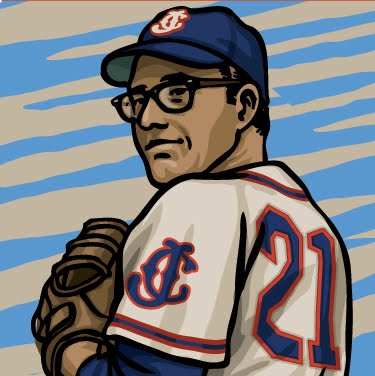
147. Ford Meadows: Better Than The Babe


I love those "what if?" questions in history. You know, those major events in history that hinged on one minor and insignificant event or individual: what if Hitler had gotten into art school or what would America be like now if Lee Oswald was a lousy shot? Baseball has plenty of those great "what if's" as well, and it was one of those minor turn of events that gave the game its greatest player.

In the spring of 1914, Baltimore Orioles owner and manager Jack Dunn looked over his roster for the coming season and knew he had a problem - left-handed pitching, or more precisely, the lack of it. Fortunately Baltimore and the surrounding countryside was an untapped gold mine of amateur talent. Though the city had a major port, world-class universities and a many top-notch semi-pro teams, Baltimore's pool of ballplayers was often overlooked due to the close proximity of Washington, Philadelphia and New York City. For years the savvy Jack Dunn had it all to himself and he was famous for his meticulous scouting of local talent. When the time came for him to fill that left-handed spot in his pitching rotation Jack Dunn knew exactly who he wanted.

For a year Dunn had been following a local 19 year-old student at an Xaverian school who was mowing down every team he pitched against. He was a big fella and like most left-handers had a bit of a reputation for being a bit eccentric. To Dunn, a veteran judge of baseball talent, this kid was one of the greatest lefties he'd ever seen. In early February of 1914 the Orioles owner took his former third baseman and now New York Yankee Fritz Maisel along to talk to the Brothers who ran the school the young phenom attended. Dunn figured that by bringing along Maisel, a local boy, would make it easier to get the Xaverians to give up their star player if they could see that being signed by the Orioles was a stepping stone to the big time.

Brother Gilbert, the schools baseball coach and athletics director, met with the two men apprehensively. While one one hand he wanted the young man to succeed, on the other he also wanted a winning ball club for the upcoming season and this kid was his ace. Brother Gilbert thought about how he could keep him for just one more season and settled on the old bait and switch tactic.

"Sure my boy is great" he told the two men, "but this other lefty we faced last season was even better". Dunn, intrigued, must have wondered who this other unknown star was. 

"Ruth from St. Mary's" was Brother Gilbert's reply.

See, the pitcher Jack Dunn had scouted and called one of the greatest left-handers he'd ever seen was not the young Babe Ruth, but a student at Mount St. Josephs College named Ford Bernard Meadows. 

At the time, Meadows was hands-down the best pitcher in Baltimore. In the 1913 season the kid had shut out Georgetown, Boston College and Holy Cross - all in one week. His games were given as much coverage in the Baltimore newspapers as the Washington Senators and Orioles. There was no doubt that Meadows was a budding superstar. As far as anyone was concerned, no one had heard of this Ruth kid over at St. Mary's that Brother Gilbert had spoke of.

And in truth, the Xaverian Brother and baseball coach was fibbing a bit: he'd never actually seen Ruth pitch before. In all the games Mount St. Josephs played against St. Mary's Ruth appeared as a left-handed catcher. The big kid impressed Brother Gilbert not with his pitching but with his bat, a skill he used to eat up any pitcher Mount St. Josephs threw at him. Because both St. Mary's and Mount St. Josephs College were run by Xaverian brothers, Gilbert was familiar with Ruth's coach, Brother Matthias, and through him had learned of Ruth's strong and accurate arm. 

It was a brilliant tactic and Jack Dunn fell for it. Within days he'd signed the young George Herman Ruth without ever seeing him play an inning of baseball, all based on the little white lie of an Xaverian Brother who was trying to keep his prized ball club intact for one more season.

But what became of Ford Meadows? 

Well, he continued to dominate the collegiate scene. He kicked off the 1914 season with a brilliantly pitched game against the Orioles. Though he lost, the newspapers reported that had he been backed by a capable catcher and right fielder, Meadows would have defeated the Birds. A few weeks later he pitched a no-hitter and at the end of the college season was in Frederick, Maryland playing semi-pro ball and making headlines with his pitching feats. So while Ruth played half a season with the Orioles and made it up to the Boston Red Sox, Meadows was still an amateur, though a well-known and highly touted one. 

After school ended in the spring of 1915, Jack Dunn swooped in and finally signed the southpaw he'd originally wanted. Dunn's Orioles has been forced to relocate to Richmond after they were beaten at the box office by the upstart Baltimore Terrapins of the Federal League. While with Richmond the former phenom was less than mediocre. He was consistently wild and in 13 games could only muster an 0-2 record. But the New York Yankees saw something in him and in late August Dunn sold Meadows to New York for a $5000 profit. 

Meadows rode the Yankees bench for the rest of the season, never getting into a game but was invited to join the team in Macon, Georgia the next year for spring training. Unfortunately for Meadows he pitched poorly and was quickly let go, rejoining the Orioles, who had again set up shop in Baltimore after the demise of the Federal League. 

Now Jack Dunn began to sour on the former college star. Throughout the spring he failed to impress. He couldn't find the plate and Dunn complained he was sorely out of shape. Exasperated with Meadow's performance and attitude, Dunn suspended him. In what was a pretty ballsy move for the time, the southpaw filed a grievance with the minor league baseball commission and Dunn was told to play him or let him go. This kind of insubordination from one of his players couldn't have sat well with the autocratic manager and owner. While Dunn was well known for treating his ballplayers with unheard of respect, the Orioles were his team, an extension of himself. That one of his boys would have the stones to file a grievance against him and challenge his authority to run the club as he saw fit must have angered him immensely.

Dunn reluctantly took him back into the fold. 

Ford Meadows, the guy who was more highly touted than Babe Ruth, would finally get his own place in the baseball history books, but not in a good way. On June 30, 1916 Dunn put him in as a relief pitcher against Richmond. Down 8-2, Meadows took the mound for the home half of the sixth and started walking everyone in sight. By the time it was over he issued free passes to 11 Richmond batters and set what was then a record. Dunn, his point made, gave Meadows his unconditional release later that day.

As far as I can tell, Meadows never appeared in another professional game. He did, however, find love and on August 4th married Miss Grace Miller. Meadows was still so well known that the Baltimore newspapers wrote about his wedding and one article reported that the couple honeymooned in Atlantic City and that since his release from the Orioles he had been playing amateur ball around Baltimore. 

With the World War raging in Europe it was just a matter of time before Meadows, 22 at the time, was caught up in it. He served with the 514th Pioneer Infantry in France where he dislocated his shoulder and had his ear shot off in the fighting. He returned home on a transport ship with thousands of other wounded doughboys almost six months after the war was over.

I couldn't find any other traces of Ford Meadows after that. Most likely he returned to his wife and made a life for himself around Baltimore. While his ball playing career might not have lived up to the promise many expected from him, he was instrumental in launching the career of the greatest baseball player of all time.

Tuesday, January 31, 2012

103. A Tale of 4 Ruths


While working on the previous Babe Ruth post, after I drew the '34 All-Americans uniform on him, I wanted to see what that drawing would look like in the colors of other teams The Babe played with. Clockwise from the top left is: 1938 Brooklyn Dodgers from his time as a Dodger coach, 1927-30 New York Yankees, 1935 Boston Braves and 1923 Barnstorming uniform.


Thursday, January 26, 2012

102. Beibu Rusu: The Babe In Japan


When my buddy Charlie Vascellaro and I were taking the Babe Ruth Museum Traveling Exhibit around the country back in '02, one of the best things about the job was the personal stories people were constantly telling us about their own, or someone they knew, had with The Babe. Most of the stories culminated in getting the cherished autograph of the big man. I don't think anyone else in the history of the world signed their own name as much as The Babe. In a day and age where guys like Barry Bond will deliberately ignore young children politely asking for a signature (I witnessed it myself, it was an episode that still turns my stomach), the stories of The Babe delaying the departure of the Yankees' team bus on a humid summer afternoon because he couldn't bring himself to leave until every scrap of paper handed to him by little children and blushing adults had his signature on it. I often wondered what went through The Babe's mind as he signed ball after ball, had his meals interrupted by a request to sign a cocktail napkin or confronted a typical day's mail delivery that held countless requests for that most famous of autographs.

I think The Babe looked on it as his obligation to the people who made him famous, a small price to pay for the love, money and adulation he now received and that his childhood so tragically lacked. We've all seen the newsreel footage of him standing on a ledge in New York, tossing brand-new baseballs with his signature to hundreds of screaming fans in the street. He's laughing so hard at the joy his autograph gave the people below. After re-watching this footage once, I realized how many hours he must have sat in a room and signed ball after ball.

Earlier this week, as I was devouring Rob Fitts' new book "Banzai Babe Ruth: Baseball Espionage & Assassination During the 1934 Tour of Japan", I read a great passage about how The Babe was relaxing one night in his suite at the Imperial Hotel in Tokyo when there was a knock at the door. An old Japanese man in a kimono bowed and handed a ball to The Babe: "sign please". The old man didn't have a pen so The Babe went back into his suite and got his own which he used to sign the ball and returned it to the old man. The old man bowed in thanks and out from his kimono sleeve rolled another ball. "Sign please" said the old man and The Babe signed the second ball. The old man bowed again and out rolled a third ball: "sign please" and The Babe did again. As Ruth's wife and daughter watched laughing, The Babe and the old man repeated the same drill more than a dozen times until there were no more balls to sign and the old man bowed and left. As Fitts writes "the amused Ruth took it in stride."

So this week I just wanted to pay tribute to Babe Ruth and how something so simple and free as his signature could bring so much happiness to so many people, as well as introduce you to a really spectacular book, the aforementioned "Banzai Babe Ruth." I've written about the 1934 Tour of Japan in my stories on Moe Berg, Eiji Sawamura and Victor Starffin and Fitt's book brings them all together in a great tale of baseball, spying and murder. I haven't read a baseball book this good in a very long time I can't recommend it enough. Here is what Rob has to say about his new book:

Nearly 500,000 screaming fans lined the streets of Tokyo on November 2, 1934, to welcome Babe Ruth and his team of American all stars to Japan. The line of open limousines held one of the greatest baseball teams ever assembled. Joining the Bambino were future Hall of Famer members Lou Gehrig, Jimmie Foxx, Earl Averill, Charlie Gehringer, Lefty Gomez, and Connie Mack as well as stars Lefty O’Doul, Bing Miller, and Earl Whitehill. Only one player didn’t seem to belong—a journeyman catcher with a .238 career batting average named Moe Berg. Berg would eventually become an operative for the OSS, the forerunner of the CIA, and many believe that this trip was his first mission as a spy.

As the motorcade paraded through Ginza rows of fans, often ten to twenty deep, crowded into the road to catch a glimpse of the Americans. The pressing crowd reduced the broad streets to narrow paths just wide enough for the limousines to pass. Confetti and streamers fluttered down from well-wishers leaning out of windows of the avenues’ multi-storied office buildings. Thousands waived Japanese and American flags and cheered wildly. Cries of “Banzai! Banzai, Babe Ruth!” echoed through the neighborhood. Reveling in the attention, the Bambino plucked flags from the crowd and stood in the back of the car waving a Japanese flag in his left hand and an American in his right. Finally, the crowd couldn’t contain itself and rushed into the street to be closer to the Babe. Downtown traffic stood still for hours as he shook hands with the multitude.

Ruth and his teammates stayed in Japan for a month, playing 18 exhibition games against Japanese opponents in 12 cities. But there was more at stake than sport. Japan and the United States were slipping towards war as the two nations vied for control over China and naval supremacy in the Pacific. Politicians on both sides of the Pacific hoped that the goodwill generated by the tour and the two nations’ shared love of the game could help heal their growing political differences. Many observers, therefore, considered the all stars’ joyous reception significant. The New York Times, for example, wrote: “The Babe’s big bulk today blotted out such unimportant things as international squabbles over oil and navies.” Connie Mack added that the tour was “one of the greatest peace measures in the history of nations.”
But the shared love for a sport would not be enough to overcome Japan’s growing nationalism. Just two miles to the northwest of the parade at the Imperial Japanese Army Academy in Ichigaya, a group known as the Young Officers was planning a coup d’etat against the government, an upheaval that would jeopardize the tour’s success and put the players’ lives at risk. In another section of Tokyo, the ultra-nationalist War Gods Society met at their dojo. Their actions would tarnish the tour with bloodshed.

Banzai Babe Ruth! is the story of the doomed attempt to reconcile the United States and Japan through the tour of Major League all stars in 1934. It will reveal how two groups of men from different cultures, temporarily united by their love for baseball, became tragically divided as their countries rushed towards war. It is a tale of international intrigue, espionage, attempted murder and, of course, baseball.

We shall see how Babe Ruth, the jovial demigod of baseball, brought the two nations together and forestalled talks of war, before becoming a symbol in Japan of American decadence, cursed by imperial troops charging to their certain deaths. We shall also see how a 17-year-old pitcher named Eiji Sawamura became a national hero by playing against the Americans in friendship but died in the South Pacific as their bitter enemy. We will follow Moe Berg’s forays into espionage; the Young Officers attempt to overthrow the Japanese government; the ultra-nationalist War Gods Society attempt to murder tour organizer Matsutaro Shoriki; and the birth of Japanese professional baseball. It will introduce the lesser-known tales of Victor Starffin, the Russian immigrant and player for Japan whose father was a convicted murderer; and Jimmy Horio, a Japanese-American who played for the All Nippon team in an effort to gain a Major League contract. The 1934 All American tour of Japan was more than just a series of exhibition baseball games. It was an event that changed lives and influenced Japanese-American relations, for better and worse, for decades.

Robert K. Fitts is the author of three books and a number of articles on Japanese baseball and baseball cards. A former historical archaeologist, Rob left academics to write about baseball in 2000. His articles have appeared in The National Pastime, Baseball Research Journal, Journal of American Culture, Tuff Stuff and on MLB.com. His first book, Remembering Japanese Baseball won the 2005 Society of American Baseball Research & The Sporting News Award for Best Baseball Research. His second book, Wally Yonamine: The Man who Changed Japanese Baseball tells the story of the "Jackie Robinson of Japan." Learn more about his projects at www.RobFitts.com