Monday, November 29, 2010

See You At The Movies...


As some of you might know, one of the things I do as a designer is create period-correct graphics for movies and television. I'm able to accurately reproduce posters and packaging that looks like it is from a certain time period, but is not a real product, for example when you watch a movie scene that takes place in a bar in say, 1953, chances are the beer the characters are drinking are a made-up brand that just looks like it is from the era. The reasons for this is 1) it's too hard for a production company to get permission from the manufacturer of every product in every scene in every movie or tv show, and 2) using real antiques is just too cost-prohibitive.

So anyway, lately I have been working on a line of 1920's era vintage sporting posters. They are not team specific, but only city specific, in this case all New York City oriented. I thought I'd show some here and give everyone an example of what I do when I'm not drawing baseball cards!

Check out my NEW POSTER WEBSITE at www.cieradkowskidesign.blogspot.com to see these and many other posters I have done and now sell! If you have any questions or want a special poster, please email me at info@cieradkowskidesign.com

Monday, November 22, 2010

Just In Time For The Holidays!

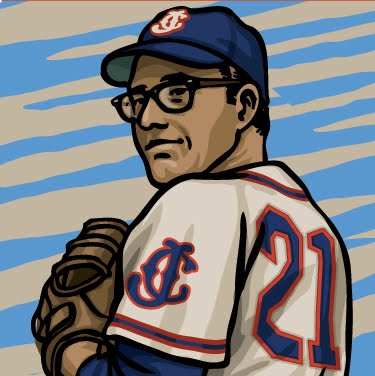
Just in time for the holidays... the first edition of a little baseball art and history journal called "Number 21". Named after the number of my Pop's favorite player, Number 21 will hopefully become a semi-regular series of themed books which will include 12 short stories and illustrations of the type of ballplayers you've come to expect from The Infinite Baseball Card Set Blog.

Due to overwhelming requests, the first book will be Jewish Baseball Pioneers and Stars. Besides including different takes on "the Big 3"- Greenberg, Koufax and Berg, I went all out to bring you 9 other guys you may or may not have heard of so it will appeal to ALL baseball history fans, whether you're Jewish or not.

Each edition will be a soft covered 20 page book printed on card stock and includes 12 different stories and artwork. Along with a short introduction about Jews and baseball these is also a 2 page section of baseball book suggestions from small-publishing companies that I think would be worthy additions to your library.

The book is being priced out now by printers and will sell for about $25 - 30.00. Stay tuned to the blog and I should have a definite publication date right after Thanksgiving!

Friday, November 12, 2010

58. Bill Byrd: Call Him "Daddy"


When I left New Jersey and arrived in Baltimore to attend art school back in 1988, I brought with me a growing passion for the negro leagues. From what books and material I was able to get a hold of in those pre-computer days, I of course knew about the mighty Kansas City Monarchs and the venerable Homestead Grays. But it was while living in Baltimore that I learned to appreciate the other teams that made up the negro leagues. The city of Baltimore had a rich black history and its baseball lineage included two great teams, the Baltimore Black Sox and the Elite Giants. Back then many former players were still alive and I tried my best to meet every one I could. My friendship with television and radio host Dr. Bob Hironemus helped me out immensely as he and his wife Zoe were big contributors to the memory and preservation of negro league history. Because of living in Baltimore, I kind of adapted the Elite Giants as "my" team and plunged myself into finding out everything I could about them. Each week as I draw and write about a different player I have to restrain myself from doing a feature on another Elite Giant player. So far I have been good and done only one other Elite, second baseman Sammy T. Hughes. Today I introduce the second Elite Giant to grace the virtual pages of The Infinite Baseball Card Set, pitcher Bill Byrd...

For every flashy Satchel Paige and Josh Gibson in the Negro Leagues, there were guys like Bill Byrd. The big right-hander was the ace of the Baltimore Elite Giants staff. Byrd had a formidable arsenal of specialty pitches; blazing fastball, slider, various speed knuckle balls, change-up and a big ol' roundhouse curve all thrown with pin-point accuracy. But what he was most known and feared for was his spitball. Byrd was the last pitcher in the negro leagues who was allowed to use the slippery pitch. Opposing players swore he used it all the time, but Byrd claimed what he did was use the threat of it more often than not and psyche-out the batter. Byrd would later say that he did not even like throwing the pitch, but that his managers would always ask for it, knowing the value of its formidable reputation. And if he really didn't want to throw it, they told him to fake it.

An opposing player once asked Byrd if he really did throw a spitter to him, to which Byrd replied "if you thought I did, I did."

To throw the pitch, Byrd would chew a tree bark called Slippery Elm which produced a real nice consistency of lubricated saliva. After loading up his thumb, index and middle fingers, Byrd would grip the ball between the seams, wind up and throw the ball not so it rolled off the finger tips, but squeezed the ball out from between the wet fingers. Robbed of its natural spin, the baseball would hurtle towards the plate and suddenly drop away from the batter, kind of like a filthy split-finger fastball. Besides being hard to hit, it was a damned scary thing to try to catch as well.

The fatherly Byrd took it upon himself to look after the younger players, who nicknamed him "Daddy", including a husky young high school kid from Philadelphia named Roy Campanella. The future Hall Of Famer was just a 16 year-old kid when he joined the Elites in 1938. The much older and responsible Byrd took Campanella under his wing and watched over the young catcher, steering him away from the temptations of the road, all the while teaching him the ropes of how to handle big league pitchers. Later while playing for the Brooklyn Dodgers, Campanella and pitcher Preacher Roe made a formidable battery because Campy knew exactly how to handle Roe's illegal spitball. Campanella later credited his years on the Elite Giants catching Bill Byrd as the key to his success in handling the unpredictable pitch. Another one of Byrd's young charges was future Dodger star Junior Gilliam. So too was a cocky young college kid named Joe Black, who joined the Elites as a shortstop in 1943, but his rifle arm made him more valuable as a pitcher. However Black was more of a "thrower" than "pitcher" and it was Byrd who quietly taught Black how to select pitches, set-up and outsmart a batter. Byrd's advice eventually turned Black into an All-Star pitcher and one of the first players to integrate the majors. Later joining the Brooklyn Dodgers, Joe Black's 1952 rookie season ranks among the most dominant season ever for a relief pitcher. Unfortunately an arm injury the next Spring curtailed Black's promising major league career.

Back in the 1930's and 40's Byrd was known as a "Money Pitcher". What this meant was that when a game meant something, this was the guy you wanted on the mound for you. When Byrd played ball, the negro leagues usually played about 3 official league games a week, the rest of the week being games against semi-pro and town teams or exhibition games that did not count in the standings. Negro league teams usually didn't play their best players in these meaningless exhibitions, saving guys like Byrd for the games that counted. More often than not, Bill Byrd came through. He was a workman-like pitcher, striking a batter out when he had to and letting him hit it to try to get a double play or pop out, what ever it took to win. Along with his suitcase of different pitches, Byrd would also use what ever was handed to him. Though he claimed to never do it himself, Byrd was also masterful at using a "cut ball". Negro league pitchers of his day were notorious for "cutting" the ball, making grooves or peeling back a part of the cover along the seams in order to make the ball do funny things. The money conscience negro leagues would use a baseball until it was either hit out of the park or fell apart so Byrd was often left with an artificially modified baseball to work with. Being the consummate professional, he made do with what he had.

Although statistics are incomplete it is fairly certain Byrd has the fourth best record for strikeouts in official negro league games. He is also credited with a lifetime league record of 114 wins and 72 losses, an approximate .615 winning percentage. The games he did lose were more often by a slim margin. For example, in box scores I collected from the 1942 season in which Byrd had 9 wins and 2 losses in league games, those 2 defeats were by the scores of 2-1 and 3-2 to the Homestead Grays who were the eventual Negro National League champs that year.

Perhaps more than his pitching skills, Byrd really was proud of his hitting prowess. As a boy he taught himself to hit by rigging up a stick on a rock and laying a smaller stick on top of that, then stepping on the first stick which popped the small stick into the air which he would then hit. The speed of which was required to hit the stick came in handy years later when he played professional ball. Byrd's bat speed was tremendous as was his power. He would often play the outfield during his days off with the Elites and he was the go-to guy when a pinch-hitter was needed. In the days when negro league teams carried only about 15-18 men on the roster, a multi-skilled player like Byrd was especially prized. As a "money pitcher" Byrd was often called upon to pitch in the Yankee Stadium four-team Sunday double-headers which attracted huge crowds, both black and white. Beside his pitching skills, it was Byrd's slugging power that really paid off in Yankee Stadium where the short right field porch was made for the switch-hitting slugger who had more power when batting from the left side. Byrd reckoned he hit 6 or 7 balls into the stands there.

The waning years of Bill Byrd's career echoed the demise of the negro leagues itself. After the Elite Giants won the Negro League World Series in 1949 when the now 42 year-old pitcher went 12-3, Byrd finally called it quits the next Spring. Attendance was rapidly declining and the Elites ceased to pay players salaries, instead dividing up a percentage of the gate receipts. The end of the league soon followed and the Elite Giants left Charm City for Nashville in 1951 and then disbanded. Byrd played semi-pro ball around Baltimore for a few years and then moved north to Philadelphia where he worked for General Electric.

Baltimore's Byrd might have retired, but his legacy lived on with three of his students moving on to the Major Leagues and stardom. Without their "Daddy", Dodger fans might never have gotten to see Roy Campanella, Junior Gilliam and Joe Black.


Thursday, November 11, 2010

Eddie Grant: A Real Hero for Veteran's Day


On a day like today, Veteran's Day, I want to feature a real hero. These days it seems anyone who does anything can be termed a hero. We are losing the real meaning of that word and that is something that really bothers me, especially when I learn about ordinary men and women who somehow rise to the top and emerge as real heroes. Miners trapped in Chile may be survivors and noteworthy, but they are not heroes. But, instead of writing a bitter, angry introduction outing the many pseudo-heroes that the media seems to create and force-feed to us non-stop, I will let the story of a real, bona-fide hero speak for itself.

They called him "Harvard Eddie." At a time when most ballplayers barely had a high school education, third baseman Eddie Grant, Harvard Class of 1909, was a member of the Massachusetts Bar, a full-fledged lawyer. He was also a darn good third baseman, batting .322 for Jersey City and leading the Eastern League during his first year in pro ball. The next season, 1907, Grant was called up to the Philadelphia Phillies. He quickly gained attention, not from his bat or fielding skills, but for what he would say on the field: when calling out his claim on a pop fly, instead of yelling the common "I GOT it!", Harvard Eddie called out the proper phrase, "I HAVE it!" much to the amusement of his more modestly educated teammates.

During off seasons Grant returned to Boston to practice law, but each spring he took up baseball again. Traded to Cincinnati in 1911, he lost something at the plate and his batting average plummeted. The death of his wife after barely 9 months of marriage might have been the reason why. In 1913 the New York Giants picked Grant up and although he rode the bench more often than not, John McGraw took a liking to the scholarly third sacker and made him the Giants' bench coach. As much as he loved the game, Grant disliked the life of a part-time coach and player and a the age of 32, retired to pursue his law career full-time.

The Great War had been raging in Europe for 3 years by now and many of Grant's Harvard classmates were active participants even before the U.S. entered the war. Whether they drove ambulances for one of the volunteer organizations operating just behind the trenches or flew airplanes for the French in the Lafayette Flying Corps, college educated men of that era felt a sense of duty and adventure that sadly seems lacking these days. Once America entered the war in April of 1917, even more of these privileged men from wealthy families left their lucrative careers and easy lives to become officers in the rapidly expanding U.S. Army. Back then the Army assumed that a college educated man made a natural leader and "Harvard Eddie" was made Captain of Company H, 307th Infantry Regiment, 77th Division of the American Expeditionary Forces. After a period of training on Long Island with his men, Grant sailed for France in the summer of 1918.

The American Army was eager to prove itself to their Allies, France and Britain and the Meuse-Argonne Offensive was its chance. Launched on October 2nd, 1918, the Battle of the Argonne was one of the fiercest fights in American military history. The 77th Division charged into the Argonne Forest and strait into the solidly entrenched veteran German Army. It was during the confusing first day of the battle that Major Whittlesey, a New York attorney, got isolated and pinned down deep within the dense forest. Although forever known as "The Lost Battalion", Whittlesey knew exactly where he and his men were, it was just that no one else in the U.S. Army did. After a few anxious days, American aviators braved the dense German anti-aircraft fire and finally located Whittlesey and his battalion. Pilot Lieutenant Harold Goettler and his observer Lieutenant Erwin Bleckley volunteered to circle the forest with the idea that the place that did not fire back at them would be the the location of the lost battalion. They were right and after taking heavy fire which mortally wounded both men, their DH-4 aircraft crashed just short of the French lines. The French soldiers rushed forward to help the downed aviators. Goettler was already dead but Bleckley, with his last dying breath pressed a bloody note into the hands of the closest French soldier. On it was a map showing the location of Whittlesey and his men! With this new information, Captain Eddie Grant and Company H was among the units rushed into the Argonne to rescue the Lost Battalion.

By the morning of October 5th, Eddie Grant and his men had been on the front line and in the thick of the fighting for 4 days. No one, most of all Captain Grant, had had any time for sleep. Being awake and constantly under enemy fire for 4 days must have been a terrible feeling. Add on top of that the responsibility for the lives of the 150 men of his company and you can imagine the stress Grant must have been under. Taken out of the line that day for rest, a fellow officer described the captain as barely able to lift his arm to bring a cup of much needed coffee to his lips. But his company's reprieve was short-lived. The Lost Battalion had been found. When orders to move-out came, Grant got to his feet and took his place at the head of his Company. He led them right back into the Argonne.

The Germans threw everything they had at the Americans rushing into the forest. If Whittlesey and his dwindling men could be captured or killed it would be a devastating blow to the upstart fresh Americans as well as their weary Allies. The story of the Lost Battalion had made newspapers all over the globe and its rescue would come as a giant shot in the arm to the young nation eager to prove itself to the world in the greatest war mankind had ever known. As the 307th Regiment marched forward the German artillery pounded the road leading into the forest. Men and horses were torn to bits by the constant exploding shells but still Captain Grant and the American Army moved forward through the hail of shrapnel.

Among the wounded being brought back past the advancing infantrymen was Major Jay, commander of Grant's battalion. Recognizing Eddie he waved him over. All the other ranking officers were either dead or wounded. Harvard Eddie was now in charge of the battalion.

Though it didn't seem possible, the shelling increased. The Germans knew they had to destroy the Americans before they reached Whittlesey. The whole road had become a deathtrap but everyone knew they had to move forward. Grant called his officers together to brief them on the situation. At that moment a shell exploded, tearing apart the two young lieutenants standing next to Eddie. Grant tried yelling over the screams and explosions for a stretcher bearer. Signaling his men to take cover and waving his arms wildly in desperation for medics that never came, the next shell exploded directly on top of Harvard Eddie. He died instantly.

New York sports writer Damon Runyon was a war correspondent in France during war and had known Eddie Grant well during his time with the Giants. He wrote a stirring eulogy for the former third baseman entitled "Eddie Grant Sleeps In The Argonne Forest". The story was reprinted widely including in the 1919 Spalding Guide and Grant, the only major leaguer killed in the war, gained posthumous fame. In 1921 the New York Giants dedicated a plaque commemorating the former infielder and bench coach in front of which a wreath was placed each Memorial Day in a solemn ceremony started by his old friend, John McGraw. That plaque was famously stolen after the last Giants game at the Polo Grounds in 1957. Historians searched in vain for the plaque or any trace of who the scumbag was who stole it but it wasn't until 1999 that a couple moving into their new Hohokus, New Jersey home discovered a plaque wrapped in a blanket hidden in the attic. Turns out the home was formerly owned by a New York City cop named
Gaetano Bucca. Officer Bucca, whose police beat in 1957 included the neighborhood surrounding the Polo Grounds, had apparently stolen the memorial. But baseball historians aren't positive the plaque is the real one stolen from the Polo Grounds. The San Francisco Giants for their part didn't seem to care as they try to distance themselves from their former life in Manhattan. First World War historians did however finally get the team to install a replacement in the new ballpark a few years ago. You can see it near the Lefty O'Doul entrance, but in this day and age of so many "heroes", this modest memorial to a fallen soldier who gave his life for his country just doesn't seem to be enough.

Dedicated to Captain Eddie Grant and every other serviceman and servicewoman who gave their life so I may live free in this great country of ours. Thank You.


Saturday, November 6, 2010

Lefty Grove Art on ebay, too!


And a Lefty Grove is also on ebay this week...
http://cgi.ebay.com/ws/eBayISAPI.dll?ViewItem&item=150516447555

Monday, October 18, 2010

55. Basilio Cueria and the Abraham Lincoln Brigade


This is the second installment of the "Guest Author" series. This week the story is by Gary Ashwill, famed baseball researcher and co-proprietor of
The Outsider Baseball Bulletin. Gary is one of the foremost experts on black baseball and when he agreed to do a story for the site I was keenly interested to see who the ballplayer would be. To my surprise he hit the proverbial home run, at least for me. See, as well as being interested in pre-war baseball history, one of my other passions is the Spanish Civil War, especially the international volunteers who fought on both sides. Until Gary emailed me his story, never in a million years would I have guessed those two interests could be combined...

Basilio Cueria was big and powerful, an ex-soldier who had been a baseball prodigy from the time of his childhood in Marianao, a suburb of Havana. He was an all-around player, a catcher who could also play the outfield and first base, and even filled in at second and third occasionally. The owner of one of his teams, the promoter Syd Pollock, even hyped him as “Babe Ruth Cueria”—but despite his potential, he never hit enough to make him more than a benchwarmer with several Cuban traveling clubs in the United States during the 1920s, when he wasn’t working in a Long Island factory.

So how did this Afro-Cuban immigrant, journeyman ballplayer, and blue collar worker become the subject of admiring profiles by two of the twentieth century’s greatest poets?

Cueria may not have been not a great ballplayer, but he was an ardent opponent of dictators and would-be dictators. He came to the United States in 1921 to play baseball with Abel Linares’s All-Cubans team, then became involved with Cuban émigrés who opposed the authoritarian governments of Gerardo Machado and Fulgencio Batista. Cueria wound up more or less exiled from Cuba for the better part of two decades. After retiring from pro baseball, he organized an amateur team in Harlem called the Julio Antonio Mella Baseball Club, named after the founder of the Cuban Communist party, who had been assassinated in Mexico.

At two in the morning on January 20, 1937, Cueria arrived in France aboard the S.S. Berengaria, then secretly made his way overland to Spain, where he joined the Abraham Lincoln Brigade—American volunteers fighting on behalf of the Spanish Republic against the fascist rebels led by Francisco Franco. During his first year in Spain Cueria survived trench warfare at the Battle of Jarama and artillery and air bombardments at Brunete. He transferred to the regular People’s Army, and rose to the position of artillery captain under the famous peasant general Valentín González, known as “El Campesino.”

That fall Nicolás Guillén, the greatest Cuban poet of the twentieth century, traveled to Spain as a magazine correspondent. Looking to interview Cubans in the Republican forces, he quickly found his way to Cueria, whom he remembered as catcher for the Marianao club in the Cuban League. Now, Guillén wrote in the the leftist journal Mediodía, Cueria had “exchanged the diamond for the trenches,” and “the ephemeral glories of baseball championships” for “the higher glories of fighting fascism.”

Guillén also introduced Cueria to the American poet Langston Hughes, who was reporting on the Spanish war for the Baltimore Afro-American. Hughes described the former Cuban Star as a “tall fine looking captain who was immensely popular with the officers and men under his command.” Cueria, Hughes claimed, was trying to teach baseball to Spanish soldiers, and was looking forward to returning home to New York, where his family still lived. “Our side is sure to win,” he said. “We can’t let the Fascists put it over on us. They’d put all the worst old prejudices back into force and probably even introduce new ones, like Hitler and his Aryanism in Germany. No, we’re not going to let them win!” He asked Hughes to “tell the Mella Club to keep up that team in Harlem, so I can play with them when I get back. Tell all those Harlem baseball players hello!”

Guillén’s interview shows a more pensive side of the soldier/ballplayer. He asked Cueria about his plans for the future, and whether he intended to come home to Cuba. “Look, I can’t say anything about the future,” Cueria replied. “I’m no fortune-teller. But my thinking now is to return to Cuba when this is done, when we’ve won, and it’s safe. And nothing gives me greater hope than the possibility of seeing people who are dear to me, people I haven’t seen for a long time. My friends, my teammates, like Oms, Fabré, José María Fernández…” He fell silent. Then, as if talking to himself, Cueria murmured: “If they don’t kill me, I’ll come back.”

Come back he did. Nothing seems to have been written about the rest of Cueria’s experience in Spain. Franco had won by April, 1939; records show that Cueria re-entered the United States from Havana in April, 1940, so he may have spent a year or more looking up those old friends and teammates. But the Spanish Civil War was, of course, only the beginning. On October 26, 1942, Basilio Cueria, former captain in the Spanish Republican Army, enlisted in the United States Army—as a 43-year-old private. He wasn’t going to let them win.

On July 22, 1943, based at Camp Rucker in Alabama, Private Cueria, “Negro,” submitted a petition for naturalization as a United States citizen to authorities in Montgomery, Alabama—where, soldier or not, anti-fascist or not, he would have had to go to the back of the bus. Nor could he have voted, or exercised very many of the other rights he would supposedly gain as a citizen. Had he objected, he could have found himself beaten, arrested, even killed. All the “worst old prejudices,” you might say.

I don’t know where he served in the war, but Basilio Cueria, veteran of three armies, two wars, and ten years of professional baseball, died on May 8, 1959, aged 60, and was buried in Long Island National Cemetery.

------------------------------------------------------------------------------------

Gary Ashwill writes the baseball history blog Agate Type (www.agatetype.typepad.com) and co-writes The Outsider Baseball Bulletin, an email newsletter about ongoing research into obscure corners of diamond history (www.outsiderbaseball.com). He has been compiling Negro league and Cuban League statistics for more than a decade. Along with work in journalism and freelance editing, Gary has written on American history and culture for such publications as the African American Review and the Oxford Companion to United States History.


Tuesday, October 12, 2010

Ted Williams Artwork on ebay


If anyone is interested, I put this Ted Williams drawing up on Ebay. (Frame not included). I have a few drawings like this that I had displayed in a show for fun and have no desire to keep them anymore, so if you want to see it or bid on it, go to: http://cgi.ebay.com/ws/eBayISAPI.dll?ViewItem&item=150506075900

Sunday, October 10, 2010

53. Jimmy Horio & the 1935 Japanese All-Stars


While learning about the negro leagues years ago, I became interested in the various teams they competed against when not playing against other black teams. Back before the Second World War there was a whole parallel universe of baseball operating just out of bounds of the recognized leagues affiliated with major league baseball. Researchers Scott Simkus and Gary Ashwill seem to have coined the perfect phrase for these teams and the games they played: "Outsider Baseball". As a young amateur historian I found out about the bearded House Of David religious colony from Michigan which sent out as many as 3 different traveling teams a season to play all over the country. I heard about the Nebraska Indians, made up of, you guessed it, Native Americans. I read about barnstorming teams made up of major league stars angling to make a buck. All-Girl teams. Teams of washed up players sponsored by a shoe company. Prison teams. The F.B.I. had a team which J. Edgar Hoover never failed to come out and support. And I also came across the Japanese All-Stars which toured North America in 1935.

The team that toured North America in 1935 was an off-shoot of the Japanese "All-Nippon" Team that was assembled in the fall of 1934 to challenge the American All-Star Team that visited the island nation that year. I briefly talked about this tour in my Moe Berg post back in July. Although stocked with the best college ballplayers on the island, the Japanese lost all 17 games against the Americans. While it was looked upon as a national embarrassment, it inspired the formation of a regular professional team sponsored by the Yomiuri Shimbun Newspaper. In the Spring of 1935 the team, now called "The Dai Nippon Tokyo Yakyu Kurabu" (Great Japan Tokyo Baseball Club), embarked on a tour of the United States and Canada. Among it's players was a 28 year-old Hawaiian named Jimmy Horio.

Jimmy Horio was born in Maui, Hawaii in 1907. Like most Americans, he learned baseball at an early age and was fortunate in growing up in Hawaii as the island was a hotbed of very talented teams made up of Japanese-Americans. He lived in Japan for a few years with his grandparents and later returned to Maui. He dropped out of high school with the ambition to become the first Japanese-American to play in the Major Leagues. The speedy Horio was signed by the Sioux Falls Canaries of the Class D Nebraska State League in the Spring of 1934. Jimmy batted .264 in 110 games. After the season ended he learned of the up-coming tour of Japan by the Major League All-Stars and wrote to the Japanese National Team's manager sending his semi-pro and minor league records and asked to be a part of the team.

Horio became the team's centerfielder but against the Big Leaguers didn't do too well, batting a lowly .196. But hey, he was batting against Lefty Gomez and Earl Whitehall, winners of 26 and 14 games that season. Jimmy's biggest contribution to the team however was not his bat, but the practical experience he brought with him as a bona-fide American Minor League player, which he readily shared with his teammates.

When the Dia Nippon team was formed, Jimmy Horio was again selected as it's centerfielder. In February of 1935, Japan's first all-professional baseball team sailed out of Yokohama Harbor, destination North America to try their lot against a full schedule real baseball competition. The Dia Nippon's toured extensively playing all-levels of ballclubs from small town factory teams to AAA level minor league teams. Gauging their success and talent is not an easy thing to do as they did extremely well against amateur teams and very good against minor league opposition, however the games against minor league teams were during spring training and many of the teams did not field their best players. None-the-less, the tour was very successful and huge crowds packed the ballpark when the Japanese came to town. American audiences were fascinated by their cultural differences such as tipping their caps and bowing deeply to the umpire when coming to bat or being thrown out steeling. Particularly noted during the tour was Jimmy Horio's excellent fielding and newspaper accounts are filled with mentions of the Japanese-American's exploits in the centerfield. His fluency in Japanese and English made it much easier for the tour to navigate it's way through the back roads of North America. It is reported that the Dia Nippon team's record for the 1935 tour stands at 74 wins and 34 losses.

After the Japanese players went home, Horio stayed in the United States where he was signed by the Sacramento Senators of the Pacific Coast League. The opportunity to play in the PCL might have come from a recommendation from Frank "Lefty" O'Doul who was part of the U.S. team in 1934 and now playing manager of the San Francisco Seals. Jimmy hit .250 in 20 games for Sacramento which at that time was part of the Brooklyn Dodgers farm system. The following year the Japanese team was back in the States, this time as the Tokyo Giants, now part of the first Japanese Baseball League. And this wasn't an exhibition tour, it was a serious spring training to get the team ready for the inaugural 1936 Nippon Professional Baseball League season.

Horio returned to Japan and joined the Hankyu Ball Club where he batted .233 for the first half of the slit season and .217 for the second. Again, although his averages were low, his influence on the game in Japan well out-weighed his offensive output. Horio steadily increased his batting average, batting over or close to .300 for the 1937-41 seasons. Horio starred for the Hanshin Tigers from 1939 to 1941 when he and Tadashi Kameda, the other American player in Japan, left the island due to the deteriorating political situation between the two countries. Jimmy continued to play semi-pro ball in Hawaii during the war, playing until he was 39 years-old. Jimmy Horio died from bone cancer in 1949 and although he never reached his goal of becoming the first Japanese-American in the majors, his influence on the game in Japan is still felt, forever known as "The Ty Cobb of Japan".

I'd like to thank two historians whose grateful sharing of their research made this post possible. Scott Simkus, co-proprietor of The Outsider Baseball Bulletin (www.outsiderbaseball.com) lent me his newspaper files on the 1935 tour as well as his painstakingly compiled statistics culled from available box scores. Robert Fitts, Japanese baseball card expert and author of two major books on Japanese baseball history: "Wally Yonamine: The Man Who Changed Japanese Baseball" and "Remembering Japanese Baseball: An Oral History Of The Game", helped me out with identifying and translating Japanese photo captions and generally sharing his knowledge of early professional baseball in Japan. I am also anxiously awaiting his book on the 1935 U.S. Tour of Japan, "Banzai Babe Ruth!" which is due to be released next year. (www.robfitts.com)


Wednesday, September 29, 2010

New Victor Starffin Card For Sale!


As a teaser for a new feature I have coming up, I thought I'd offer a limited edition Victor Starffin card. If you ordered on the the Series 1 set, you have a card of Japan's greatest pitcher, but this is a whole new drawing, featuring the big Russian in his 1934 All-Japan team uniform. Although he didn't get more than 2 innings of playing time against the Major League All-Star Team that visited Japan that year, it was none-the-less Starffin's profession debut. Within two years he and Eiji Sawamura would be the mainstay of the Tokyo Giants pitching staff. To order a card, click on the aptly named button above "Victor Starffin Card".

Tuesday, September 21, 2010

51. "Pete" Petrzilka by guest author Scott Simkus


This is the first of what I hope becomes a semi-regular "Guest Author" series of cards. I enjoy finding and researching my own ideas, but I thought it might be really interesting to collaborate on stories with authors and researchers who have a particular interest in a player or time period and would like to share it with a wider audience and give it a card of its own. I have already asked a few people to participate but if anyone else has an interest in writing a story, feel free to email me and maybe we can work it out...


This week's piece is by Scott Simkus, who along with Gary Ashwill is the proprietor of the outstanding "Outsider Baseball Bulletin" a weekly, subscription e-zine devoted to baseball history. Each issue features original research, statistics, personal essays, and humor. There are also be stories about baseball-related car crashes, sex scandals, home decorating and... murrrrder!! I highly recommend it if you enjoy the characters who I feature on my site. Scott and Gary have graciously offered a special free trial subscription to the readers of this site, information located at the bottom of Scott's story...

-----------------------------------------

Hey! I know you're busy, but you gotta take a quick look at his. Here!


I had three grandfathers.

The gentleman featured on this baseball card is my mother's father. He'd be grandfather number *two,* if you're keeping score at home, and it's worth mentioning that I never knew him. In fact, my mother never knew him.

His name was Joseph Petrzilka, he was the son of Czech immigrants who lived on Chicago's south side, and although his name was Joseph, he was known by friends and family simply as "Pete." Pete was, by all accounts, a devoted husband, a good man. He aspired to be a great father. When my mother was born, Pete was attending night classes, working towards attaining his degree in accounting. He was, as far as I know, the first person in our family to attend college. This is back in the late 1930s.

He was also, by all accounts, an outstanding athlete. He ran track, excelled in gymnastics, won medals in A.A.U. competitions. We have an old photograph of him performing a perfect handstand, muscles tense as he balances atop a wooden ladder, in the back yard of some forgotten three-flat in a working-class neighborhood which no longer exists. We have fading pictures of him at the beach in Michigan, smiling in the sun, flexing his muscles, mugging for the camera. My grandmother, young- much younger than I am now- is present in many of these black and whites, smiling in the background, laughing at her future husband. Fawning over the future grandfather number two.

And we have pictures of him in baseball garb. Baseball! There he is, in the baggy woolen uniform, black leather shoes, tiny fielder's glove. He apparently batted right, threw right, played for a high school team or semi-pro outfit, or both. I have no idea what position he played, or whether or not he was any good at the game, or if he struggled with the curve ball or had trouble with pop ups, but I can tell by the smile on his face that he loved it in some way, that it meant something to him. But it was baseball for goodness sakes, and baseball means something to all of us, right?

As my grandmother neared the end of her pregnancy, Pete didn't feel right. He was run down, tired. He was working full-time as a bookkeeper during the day, taking advanced classes at night. Perhaps the pressure of burning the candles at both ends, a baby on way, supporting his wife: perhaps this stuff was getting to him. I'm guessing he might have thought this, and soldiered on through each week, until he couldn't take the pain any longer. He was young- twenty-six- and still in athletic condition, still in great shape.

About twenty-five years ago, a strange man showed up at my parent's front door, said he'd been a classmate of Pete's. He didn't give his name, but instead he handed over a crumpled, brown paper bag filled with text books and papers, said he wanted us to have them. They were science and math books, Pete's signature on the front, his hand-written notes and doodles covered the pages inside. Everything dated from 1930 or 1931. The strange man was in his car, driving away, before anybody thought to ask any questions.

Other pieces have Pete have drifted into our lives over the years. The baseball pictures were buried in an old box, and discovered later on. A journal with his meticulous, hand-written notes (detailed income calculations, shopping lists, goals, memories from his honeymoon trip to Kentucky with my grandmother) was discovered in my grandmother's basement, when she was being moved to assisted living fifteen years ago. Courtesy of the internet, I've discovered that Pete's younger brother (the uncle my mother never knew), had been a college quarterback and team captain, back during the early 1940s. I also learned, in the Chicago Tribune archives, that his other younger brother, Fred, died tragically at the age of 8, after falling into the Chicago River. Turns out, Pete was there, maybe ten years old at the time, playing with his little brother when the kid slipped in. They tried to save him, Pete and some friends from the neighborhood, but it was too deep, they were too late.

My mother was born in early October, the day after Gabby Hartnett hit his famous 'Homer in the Gloamin,' and six weeks later my grandfather Pete simply hit the wall. He couldn't take it anymore. The excitement of becoming a father couldn't temper the pressure of working everyday, studying every evening, and getting very little sleep at night and on the weekends. Around Thanksgiving time, he finally went to see the doctor about the pain and fatigue. They took some blood, did some tests, told him to enjoy his holiday and they'd get back to him the next week if anything was wrong.

There's a haunting photograph in the Chicago Tribune. My great-grandmother standing on a bridge under an umbrella, as she watches the police drag the water below, looking for Fred's body as the rain comes down. Little pieces of Pete's life, both happy and sad and indifferent, continue to find me. Although my attention is almost completely monopolized by my own family and my baseball writing career, little glimpses into Pete's vacations and athletics and academics keep poking me in the side, demanding my attention.

Hey! I know you're busy, but you gotta take a quick look at this. Here!

The first week of December, the doctor sits Pete down in his office and tells him he wishes he had better news. You're sick, he told him. I don't know of any better way to tell you this, to convey the gravity of the situation, other than you are very, very sick.

Doctor said he had something called leukemia, and although they didn't have a set course of action, they had some experimental things they could try. By this time, it was January of '39, and hospitals back then tried a lot of things which didn't work. After a couple weeks of medicines which had no positive effect, they finally tried a blood transfusion.

It was devastating to the family, but just six short weeks after the diagnosis, the young man who once performed handstands on a ladder in the backyard, the guy who won A.A.U. track medals and played baseball in the neighborhood, the father of a newborn daughter, passed away. He was in his mid-twenties.

My grandmother was twenty-two, a widow, and single mother of an infant daughter. My grandmother's name was Libbie.

Libbie and Pete were childhood sweethearts. They lived on the same street, next door, in fact, to one another. Pete was a couple years older, used to walk my grandmother to school, carry her books. My grandmother told me these things before she passed.

Their houses were small ("cottages" was the way my grandmother used to describe them), and situated so close to one another, Libbie and Pete could pass notes through their bedroom windows. That's how they got to know each other. That's how they fell in love.

Everybody who knows me realizes I lean toward the agnostic side of the fence. Sometimes, I'm in full-blown atheist mode. Other times: Catholic-agnostic. Most times: Not worrying about it one way or the other. Once we're gone, we're gone, and I'm perfectly okay with that. Makes me want to get up every morning and enjoy as much of this fleeting existence as humanly possible.

Of course, I don't believe those who've gone before us can communicate from the great, unknown beyond. I don't believe it for a second. But I have changed my position in at least one respect: with the advances in technology, the digitization of papers and shipping manifests and other documents; with the photographs and old home movies, with out expanded understanding of DNA, and with the treasure-laden fragments of stories which have been passed down…we're getting better.

Those who have gone before us can't speak to us, but we're getting better at reaching out to them.

Hey! I know you're busy, but you gotta take a quick look at this. Here!

------------------------------------------------------------------------------------
Scott Simkus is the publisher of the Outsider Baseball Bulletin (www.outsiderbaseball.com), a weekly ezine devoted to baseball history. In 2009, he helped the Strat-O-Matic Game Company create their first Negro League set. His work as a baseball researcher has been been profiled in Sports Illustrated, The New York Times and the USA Today, among others.

Get a FREE 4 week trial subscription to the Outsider Baseball Bulletin (where they can see more of my illustration work). No obligation to subscribe, all you have to do is email Scott at outsiderbb@gmail.com and put GARY in the subject line and PRESTO you'll get four weeks of free issues to check out.