Friday, May 20, 2011

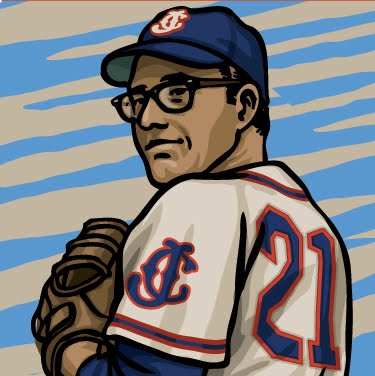
76. Cool Papa Bell: Mythbusting


This week I wanted to feature a ballplayer that is in the next issue of 21 which will focus on the 1933 Pittsburgh Crawfords. The Craws were such a great team with no shortage of superstar players - Oscar Charleston, Satchel Paige, Judy Johnson, Ted Page... it was a veritable All-Star team (in fact 7 of the Crawfords were picked to play in the first Negro League East-West All-Star Game that year). The choice was difficult, but I decided to go with the man who seems to be at the center of some of the greatest myths and stories in baseball history.

Back before hard-core baseball researchers like Scott Simkus and Gary Ashwill started really getting the actual statistics on the Negro Leagues, the field of blackball was filled with wondrous stories of the mysterious players who played before Jackie Robinson. Robert Peterson's seminal book on the subject "Only The Ball Was White" started the whole modern era of Negro League research, followed up quickly by John Holway's still enjoyable and valuable books relating his interviews with early black players. This was the "dark ages" of Negro League research, way before computers and micro-film of defunct newspapers made research easier. The subject was wrapped in oral histories, passed down by players and fans from one generation to the next, like the Greek tales of the Gods were centuries before. There were no record books like the big leagues had and no coffee table picture books were available documenting these black players. As John Holway writes in the introduction to his book "Blackball Tales," in 1969 his research into the Negro Leagues took him naturally to the Baseball hall of Fame in Cooperstown. Asking to see the Hall's files on the Negro Leagues, be was disappointed to find its collection comprised of only a scorecard of the buffoonish Indianapolis Clowns and a Washington Post article on Josh Gibson written by... John Holway! The study of Negro League ball and other outsider teams and players have come a long way since then, but along with all the knowledge gained, we also lose much of the tall-taled fun that once encased blackball and separated itself from the cold, hard facts of organized baseball.

It was the Paul Bunyan-esque figures that originally attracted me to the Negro Leagues... there was the fella who was said to have hit 70 home runs in a season, a pitcher who during a Negro League World Series game had the bases loaded and called in his outfielders and struck out the side, and of course the guy who was said to be so fast he could turn the light switch off and be under the covers before the room went black.

These stories were so fascinating to me as a young teen that it made me search for more and more and that quest eventually turned into 25 plus years of researching the old Negro Leagues. The one dangerous part of learning more is sometimes the truth behind a story is not what you want to hear. The fella who supposedly hit 70 home runs in a season was Josh Gibson in 1931. No one denies Gibson was a superstar and he'd be worth his weight in gold had he been white, but the story of those 70 home runs was just that - a story. Phil Dixon wrote The Book on the famed '31 Grays and figured out he hit 40 round-trippers, but these were against ALL levels of competition from chintzy-little town teams to top-notch black clubs and white minor league ballclubs. The pitcher who called in his outfield and struck out the side with the bases loaded in a Negro World Series game? Of course that had to be Satchel Paige. The story was colorfully related many times by his teammate Buck O'Neil, later known as the elder statesman of blackball due to his longevity and featured place in Ken Burns' "Baseball" documentary. Unfortunately, it just didn't happen. Besides being untrue, the story in my opinion makes Satchel Paige, who may have been one the greatest pitchers of all-time, look like a careless fool. While Paige undoubtedly had fun on the mound and could showboat and trash-talk better than anyone else, he was also a true professional and in games that counted he would never have done such a risky thing as call in his outfielders.

So that brings us to the third story, the one about the guy who was so fast he could turn the light switch off and get under the covers before the room went black. That was none other than James "Cool Papa" Bell.

He was born down south in Starkesville, Mississippi, his father a black farmer and his mother an Oklahoma Indian. Bell learned baseball like most young boys, did but did not consider it as a career until he left home in 1920 to join his older brothers in St. Louis so he could go to high school - Starkesville didn't have any schools above 8th grade for Negros back then.

Once in St. Louis, Bell began pitching for the local Compton Hills Cubs where the professional St. Louis Stars noticed him. For $90 a month, Bell dropped out of high school and became their new left-handed pitcher. Armed with a repertoire of screwball, knuckler and curve, Bell gained his priceless nickname "Cool Papa" when with a game on the line, he struck out the great and fearsome Oscar Charleston. After the game Bell's manager Bill Gatewood called him "one cool papa" for not being rattled when facing one of the greatest clutch hitters of all time. Like all great nicknames, "Cool Papa" stuck to Bell like it was dipped in Super Glue.

A sore arm ended Bell's promising career on the mound, but he quickly adapted by teaching himself to hit from both sides of the plate and utilising his greatest asset - his speed.

See, Cool Papa was fast! The game as it was played back in the 1920's was much different than today. There was much more aggressive base running and stealing and the blackball version of the game was even faster paced that the white one. The St. Louis Stars developed into a dynasty in the late 1920's and Cool Papa was their lead-off hitter. He didn't have much power, but when he made contact with the ball he was off like a bullet. This quickness pushed his batting average above the .300 mark in most years, higher in many others. It's hard to say for sure, the research isn't complete yet, however Scott Simkus' work on the 1933 Crawfords attributes a .307 average in 63 league games against the best black players. In exhibitions against white major leaguers Bell is verified to have batted .391 - his speed working to his benefit when playing against guys who were not used to the aggressive base running the Negro League teams displayed.

His speed out of the box surprised even veteran players and it is no exaggeration that Bell could beat out a ball hit in the infield for a single. One proven story about Bell's base running skills and speed took place during an exhibition game against Bob Lemon's white all-star team in 1948. The Cardinal's Murray Dickson was on the mound and Bell singled. The next batter, Satchel Paige, bunted in a bunt-and-run play. Bell, who was running as the ball left Dickson's hand, watched as the catcher , pitcher and third baseman all left their positions to field the ball. As Bell reached second he saw that no one was covering third so he kept going. The ball, now fielded, was sent to first base and Bell, watching all this unfold, reached third. Seeing the catcher making his way to cover third leaving home plate uncovered, flew right by him and crossed the plate before anyone else knew what was happening.

What that story proves, besides giving proof to Cool Papa's speed on the base path, is that he not only was quick, but more importantly, he was smart. It takes a very observant man to assess the situation and not only adapt to it but think one or two steps in advance. In that game in 1948, Bell wasn't playing against a rinky-dink town team but against major league players. He also 43 years-old at the time!

As an outfielder, once again Bell used his great ability to adapt to master his position. His sore arm never healed and in order to play his centerfield position he again utilized his speed to his own advantage. Bell was able to race to and catch fly balls where average players would not be able to make the play. He got around his weakened arm by developing a quick release once in possession of the ball, getting the it back to the infield faster as fast as most players who could rely on their powerful arms to get the ball there.

In our upcoming edition of 21 featuring the 1933 Pittsburgh Crawfords, Scott Simkus attributes Bell with only 2 errors during the '33 season, a cool .980 fielding percentage. In 63 verified Negro National League games that season, Simkus also recorded 12 stolen bases for Bell. 12 is a long way from the 175 he claimed to have stolen in 1933, but again these 12 were in league games against top black teams and at the same token, steals were not recorded very diligently at the time. So while it is highly unlikely Bell stole 175 bases in 1933, he probably stole more than 12 in the 63 league games and it is a given that he swiped plenty more while playing against town teams and amateur clubs that summer.

So how fast was Bell? Supposedly he was once clocked at running the bases in 11 seconds. The Baseball Hall Of Fame reportedly has some kind of documentation on this provided by Cool Papa's daughter, but I have been unable to find substantial proof of this. The official record, set in 1932 by Evar Swanson of the Columbus Red Birds, is 13.2 seconds. Official record or not, Bell was fast. While I was unable to find that all-important truth, there is something that may help validate his reputation as the fastest man in baseball. Olympian Jesse Owens was acknowledged to be the fastest man alive in the years leading up to World War II. Although he was the star of the 1936 Berlin Olympics, the 4 gold medals he won didn't put food on the table so he often toured with Negro League teams, running pre-game exhibitions against local runners and sometimes even horses. On several occasions Bell's team played against a team Owens was with and each time the Olympian declined to race against Bell - as far as I can tell the only person he refused the opportunity to race. This speaks loudly of Bell's speed at the time. Owens, who was racing against horses for God's sake, was worried about losing a race to Bell!

So anyway, some tales about Bell were unfortunately not true (like the one where he hit a single, only to be called out when the ball he hit struck him in the keister as he slid into second), or there just isn't any documented proof (running the bases in 11 seconds). But wait, what about being so fast he could turn the light switch off and be under the covers before the room went black?
That one was one of Satchel Paige's favorite stories to tell and was one of the cornerstones of the mythology that encased blackball in the "dark ages." The way Paige told it, Bell showed how fast he was by the seemingly impossible act of being quicker than light-speed. Now that is a story that has to be false, right? Wrong. Back during their days with the Crawfords, Cool Papa and Satch were roommates on the road. Bell, who wasn't anywhere near the night owl Paige was, was in his hotel room one night when he noticed that the light switch on the wall had a short. It took a few seconds between the switch being flipped and the light actually going off. Sensing a great opportunity to mess with Satchel, Bell waited up for his roommate to return from a night on the town. When he came back, Cool Papa asked Satch if he thought he was fast. Satch of course said yes. Was he so fast he could get into bed before the room went black? Satch was sceptical, and Bell got up out of bed to prove it. Hitting the switch, Bell jumped into bed and under the covers as the room went dark, leaving Satchel standing in the dark, for once, speechless...

See Cool Papa and the rest of his teammates on the 1933 Crawfords in the next issue of 21: The Illustrated Journal of Outsider Baseball coming soon...


Friday, May 13, 2011

75. Guy Zinn: Going Rogue


There was some problems with Blogger yesterday and my last post on Guy Zinn was wiped off the face of the earth, so here it is again...

After finally completing the design of the next issue of 21: The Illustrated Journal of Outsider Baseball in a coffee-fueled Jack Kerouac-like marathon work session, I was in the process of saving the file to my online back up when my screen went blue. Now I'm computer literate enough to know that blue is bad and that field diagnosis was confirmed when I took the machine to a tech guy. I spent a few agonizing days waiting to hear if the file that held the new 21 issue could be salvaged and was relieved to hear that it was. So after buying a whole new machine and all the accompanying software, I am back up and running. So why do I share my problems with you? Well, I was unable to write a good story this week for this site. Following up Bill Staples' great Kenichi Zenimura story would have been hard enough, but I thought I'd throw out the story of a fella I found while researching the first issue of 21, Guy Zinn...

Prior to 1914, when a major league team sent a player down to the minor leagues there was nothing the player could do about it unless he wanted to be blacklisted from organized baseball forever. But in the winter of 1914 when Guy Zinn found out the Boston Braves had sold him to Louisville, he never showed up. He went rogue.

Founded in 1913 as an unaffiliated minor league, the Federal League emerged the next year as an aspiring third major league. The 8 team league strategically placed their clubs all around the eastern half of the country, selecting major league cities like Chicago, Brooklyn, St. Louis and Pittsburgh as well as the big minor league markets of Baltimore, Indianapolis, Kansas City and Buffalo. The league then commenced a raiding spree on the major leagues. Aging and underpaid stars like Three-Finger Brown, Germany Schaefer and Eddie Plank joined viable young talent like Benny Kaugh and Ed Rouch. Many other stars of both major leagues used the threat of signing with the Federals as leverage to get better pay. For a veteran like Guy Zinn, the Federal League was a way to hold on to the dream.

Born in Holbrook, West Virginia, Zinn started out in the local Pennsylvania-West Virginia League in 1909 and quickly worked his way up through Macon, Memphis, Toledo and Altoona before he was signed by the New York Highlanders, now known as the Yankees. The young outfielder batted only .148 in 9 games during the 1911 season but he made the starting lineup the following year. Batting leadoff on Opening Day in Boston, Zinn became the first batter ever to step up to the plate in Fenway Park. After drawing a walk he later scored a run, also becoming the first player to score a run at Fenway. On August 15, 1912 the speedy Zinn made a name for himself again by stealing home twice in one game, a record that has been equalled 10 times but never surpassed. He also pounded a team record 6 home runs earning himself the formidable nickname “The Gunner”. Despite his memorable season, New York sold him to the Rochester Hustlers of the International League. Although the International League was the highest minor league at the time, it was still the minors. A disappointed Zinn batted .287 and hit 4 home runs. The Boston Braves noticed and purchased his contract at the tail end of the 1913 season. Guy batted .297 in 36 games including 8 doubles 2 triples and a home run but during the winter break he found out he had been sent down to the minors again, this time to Louisville.

Baltimore of the Federal League eagerly signed the proven Zinn. The Terrapins were heavily favored to win the pennant and they started out strong, outdrawing the established Baltimore Orioles so much that they were forced to sell their biggest star, 19 year-old pitcher Babe Ruth, and relocate to another city. The Gunner started great as well but then after batting .280 with 10 doubles, 6 triples and 4 homers as well as 6 steals, he broke his ankle running the bases. The team tanked during the second half and finished a disappointing third. Zinn recovered and the next year hit .269 and had 18 doubles, 3 triples and 5 homers despite the Terrapins finishing dead last in the league. But the league’s days were numbered.

Baltimore as well as the rest of the club’s attendance had dropped substantially and the Federal League finished the season in the red. The Major Leagues recognized victory over the upstart league but made a few concessions to some of the Federal League club owners: St. Louis Terriers owner Phil Ball purchased the St. Louis Browns while Chicago Whales owner Charles Weeghman was allowed to buy the Chicago Cubs. Weeghman moved the Cubs into the more modern stadium he had built for the Whales which years later would be known as Wrigley Field. The American and National Leagues skimmed off the best of the Federal League’s talent and cast adrift the remaining players.

With the demise of the Federal League, the aging Zinn bumped around the minors again, stopping off at Wilkes-Barre, Scranton, New Orleans, Louisville, Bridgeport, Newark, Jersey City and finally Hamilton, Ontario. He retired in 1922 and returned to his family in West Virginia.

Now go back up your files!

Friday, April 29, 2011

74. Kenichi Zenimura: U.S.-Japanese Baseball Ambassador


In honor of Asian American and Pacific Islander Heritage Month (May) our current feature is on Japanese American Baseball Pioneer, Kenichi Zenimura (1900-1968). While Jackie Robinson and the Negro Leagues have been well documented, few baseball fans know about the Japanese American Nisei Leagues, or of Zenimura, their most influential figure. A phenomenal player who excelled at all nine positions, Zenimura possessed a gift for using the game to transcend the ignorance and intolerance of his era. As a player, captain, and manager, he worked tirelessly to promote Japanese American baseball, leading goodwill trips to Asia, helping to negotiate tours of Japan by Negro League all-stars and Babe Ruth, and establishing a 32-team league behind the barbed wire of Arizona’s Gila River Internment Camp during World War II.

“Kenichi Zenimura, Japanese American Baseball Pioneer” (McFarland 2011) is a new book by SABR member Bill Staples, Jr. With a foreword by Don Wakamatsu, the first Asian-American manager in MLB history, this biography of the "Father of Japanese-American Baseball" delivers a thorough and fascinating account of Zenimura’s life. In anticipation of the book’s release in June, Staples shares a summary of one of the most under-appreciated aspect of Zenimura’s career, and that of Japanese American baseball in general – the important role played in pre-war U.S.-Japanese baseball relations.

The 1922 MLB Tour to Japan: A Blow to American Sportsmanship
In the fall of 1922 Major League Baseball announced that it was sending a team of all-stars to tour Japan. Among the stars selected were Luke Sewell (Indians, c), Waite Hoyt (Yankees, p), Irish Meusel (Giants, of), George “High-Pockets” Kelley (Giants, 1b) and Casey Stengel (Giants, of).[1] The tour was led by Herb Hunter and was the brainchild of American League Commissioner Ban Johnson, who said, “Perhaps someday we will have the Champions of America meeting the winners of the Japanese series in a real world’s series. This may be my dream, but it is a dream I shall cherish until it materializes.”[2]

On October 14, 1922, Herb Hunter’s all-star club and a young Kenichi Zenimura were literally two ships passing in the night. At that same time that the all-stars were heading West across the Pacific, young Zenimura was returning from Japan where he spent several months coaching baseball at Koryo High School. The Koryo team roster included his cousin Tatsumi Zenimura, outfielder and future Meiji University team captain, and Kisaku Kato, future player and manager for Nankai of the Nippon Professional Baseball league.[3]

Zenimura was born in Hiroshima in 1900, moved to Honolulu in 1907, and as a young man moved to the U.S. mainland after visiting relatives in Fresno. He arrived in 1920 and immediately assumed a leadership role with the nascent Fresno Athletic Club. While he was away coaching at Koryo, the Seattle Asahi won the 1922 West Coast Japanese baseball championship and the rights to represent the U.S. during a tour of Japan in 1923. Zeni had devised a plan to bolster the talent of his club to claim the West Coast Japanese Baseball championship from Seattle. The plan required another trip back to Japan and then on to Hawaii to recruit his former Island teammates to join him on the mainland in California.

Back in Japan, the 1922 MLB All-Stars took on and defeated every college, industrial and amateur team the country had to offer – except one. On November 23, Herb Hunter’s men lost 9 to 3 to the amateur Mita Club, led by pitcher Michimaro Ono.[4] On the surface, one would think that the Mita Club and fans would be happy with the victory over the Americans, but they were not. Reports out of Japan explained why:

America's reputation for sportsmanship suffered a severe blow when the American baseballers threw away Sunday's came to the Mita local nine, which is strong nationally, but obviously no match for the American professionals … The general opinion was frankly expressed that the Americans dropped the frame for advertising purposes, anticipating increased gate receipts later at Osaka and other parts … The Tokio Asahi expressed the disappointment, “We welcomed the American team because we thought they were gentlemanly and sportsmanlike. They have now shown themselves to be full of the mean professional spirit. Japanese baseball followers are not foolish enough to believe they tried to beat Mita … they disappointed our hopes and left an unpleasant impression upon us.”[5]

Losing pitcher Waite Hoyt would later explain that he and his teammates were just “foolin’ around” on the field and meant no disrespect to their Japanese hosts. Nonetheless, the damage was done. As a result of the All-Stars thrown-game fiasco – and perhaps other factors such as the 1923 Great Kanto earthquake in Japan, and restrictive post-season play policies established by Commissioner Landis – no major league team would tour Japan for another eight years. (Note: Ty Cobb did tour Japan in 1928, however it was as an individual and not as a member of an MLB team tour.)

Filling the MLB Void: The Nisei and Negro Leagues Step Up to the Plate
This eight-year (1923-1931) major league void was proudly filled by Zenimura and his West Coast Nisei League peers. Ironically though, just as Zenimura and his teammates were about to enter the role of goodwill baseball ambassadors to Japan, on November 13, 1922 the U.S. Supreme Court ruled in Ozawa v. U.S. to reaffirm the ban on Japanese immigrants becoming naturalized U.S. citizens.[6] First-generation Japanese Americans, or Isseis like Zenimura, would have to wait another 30 years for the opportunity to call the United States of America their true home. Despite the ruling, Issei proudly represented their adopted country during several tours back to Japan. Specifically, during the eight year MLB-team void, Japanese American teams barnstormed the land of their ancestors approximately ten times, with Zenimura involved in four of the tours (1924, 1927, 1931 and 1937). The following is a comparison of pre-WWII tours to Japan by major leaguers and that of Nisei and Negro Leaguers:

MLB Tours to Japan, Pre-WWII
1908 Reach All-Americans
1913 MLB Giants-White Sox
1920 MLB All-Stars
1922 MLB All-Stars
1928 Ty Cobb (MLB exhibition)
1931 MLB All-Stars (Gehrig, O'Doul)
1934 MLB All-Stars (Ruth, Gehrig)


Nisei-Negro Leagues Baseball Tours to Japan, Pre-WWII
1907 St. Louis-Hawaii
1914 Seattle Asahi
1915 Honolulu Asahi
1915 Seattle Asahi
1918 Seattle Asahi
1920 Honolulu Asahi
1920 Seattle Asahi
1921 Hawaii All-Stars
1921 Seattle Asahi
1921 Vancouver Asahi
1923 Seattle Asahi
1924 Fresno Athletic Club*
1925 San Jose Asahi
1925 Sacramento Nippons
1926 Honolulu Asahi
1927 Aratani Guadalupe Packers
1927 Fresno Athletic Club*
1927 Philadelphia Royal Giants (Negro Leagues)
1928 Stockton Yamato
1931 Kono Alameda All-Stars*
1931 Los Angeles Nippon
1931-32 Philadelphia Royal Giants (Negro Leagues)
1933 Seattle Taiyos
1935 Nipponese All-Stars
1937 Kono Alameda All-Stars*
1940 Honolulu Asahi

*Note: Zenimura participated in the 1924, 1927 and 1937 tours, and coached the 1931 Kono Alameda All-Star players prior to their tour.

Debating the Birth of Pro Ball in Japan
The Nippon Professional Baseball league was established in 1936. Many baseball historians credit the famous 1934 MLB tour with Babe Ruth and Lou Gehrig as the primary inspiration for the start of the first professional league in Japan. However, knowing what we know now about the role of Nisei and Negro Leagues ball clubs and their tireless efforts to export the American style of play before WWII, we now see that the 1934 MLB tour was simply the capstone for building professional baseball in Japan, and not the foundation.

In fact, in the book Gentle Black Giants, Japanese author and historian Kazuo Sayama credits the 1927 tour, especially Mackey and his Philadelphia Royal Giants teammates, as the inspiration for the start of professional baseball in Japan in 1936.[7] Sayama states that Japanese players and spectators knew about the racial segregation in professional sports in America and understood that, although they could not play in the Major League, they were as good as, or even better than, the major league players. Sabur Yokozawa, a Japanese player, later said how the Royal Giants played each game gentlemanly, with warm pedagogical thoughtfulness to the inexperienced Japanese players, while the All-American teams (of 1931 and 1934) sometimes treated the Japanese players with entertaining contempt during the actual games.[8]

Not all researchers agree with Sayama's strong sentiment, but the consensus is this – the 1927 Goodwill Tours of the Philadelphia Royal Giants and Fresno Athletic Club are much more significant than the footnote status they receive in baseball history books. During the 80th anniversary of the 1927 tours, the Nisei Baseball Research Project (niseibaseball.com) told MLB.com that the intent in showcasing the role of Japanese Americans and the Negro League all-stars was not to take credit away from the major league tours but instead to “broaden the understanding that there are more ambassadors who built that (U.S.-Japan baseball) bridge.”[9]

After the end of WWII, Zenimura offered advice to his players that reflects a key lesson he learned during his goodwill tours to Japan during the 1920s and 30s. “Try to speed up the mutual feeling between the Americans and Japanese,” Zenimura said. “It is much easier to make efforts of starting a better understanding between us in the field of sports than trying to talk your way through the rough spots." Spoken like a true diplomat.

To learn more about Zenimura’s role as a global baseball pioneer and passionate U.S.-Japan ambassador, visit www.zenimura.com.

Praise for the book:

Kenichi Zenimura, Japanese American Baseball Pioneer by Bill Staples, Jr. Foreword by Don Wakamatsu

Bill Staples, Jr. is a dedicated baseball historian, author and a meticulous researcher who utilizes twenty-first century technology to root out the most obscure facts about his subjects. His work on Kenichi Zenimura is a groundbreaking effort. –William F. McNeil, baseball historian, author, Sporting News-SABR Research Award Winner (2007), Five-time recipient of the Robert Peterson Award

Staples’ tireless research and love for the game has resulted in "Kenichi Zenimura, Japanese American Baseball Pioneer,” one of the great untold stories of our American pastime and an essential for any baseball faithful. –Kerry Yo Nakagawa, historian, author, filmmaker, founder/director of the Nisei Baseball Research Project

Hopefully (this book) helps transform a long-neglected chapter of baseball history – Nisei baseball history – into a well-chronicled saga for all fans of all races, creeds and colors to appreciate. –Don Wakamatsu, First Asian-American Manager in MLB History

Bill Staples, Jr., is a member of the Society for American Baseball Research (SABR), a board member of the Nisei Baseball Research Project, and a past speaker at the Cooperstown Symposium on Baseball and American Culture at the National Baseball Hall of Fame. He lives in Chandler, Arizona. Learn more online at www.zenimura.com.

[1] Baseball Tourists start trip today, New York Times, October 14, 1922, pg. 16
[2] Majors’ club picked to tour Japan, The Ogden Standard-Examiner, June 22, 1922, pg. 8
[3] Gila Parade of Baseball Stars, Gila News-Courier, October 7, 1943, pg. 6
[4] SABR Asian Baseball Committee Japanese Baseball Page, http://asianbb.sabr.org
[5] BIG LEAGUERS BOOT ONE IN JAPAN, Herbert Hunter takes MLB all-stars to Japan, The Fresno Bee, December 14, 1922, pg. 9
[6] Timeline, Densho.org
[7] David King, “Finally Getting His Due,” San Antonio Express-News, July 30, 2006, Pg. 01C
[8] Sayama Kazuo, “Black Baseball Heroes: The Rise and Fall of The ‘Negro League’,” (Shinsho, 1994) 11-12
[9] Black Giants were treated like royalty, By Stephen Ellsesser, MLB.com, February 23, 2007

Thursday, April 14, 2011

73. Mose Solomon: The Rabbi Of Swat


When I first started this blog a little over a year ago, I started receiving many requests for players to be profiled on here and given The Infinite Baseball Card Set "treatment." Out of all the emails I began to notice that it was not one particular player that was asked for the most, but rather a whole ethnic group: Jewish ballplayers. I did cards and stories on here of Sandy Koufax and Moe Berg, but I began slowly researching different players of the Jewish faith, trying to find characters who would fit in with the kind of stories I like to write. Guys with interesting stories who may not be known to the casual fan of baseball history. Mose Solomon was one of those guys, and in fact he appears on page 7 of the Premier Issue of "21: The Illustrated Journal of Outsider Baseball."

By the early 1920’s the owners of all three of New York’s ballclubs recognized the prospective value in finding a viable Jewish star to play for their team. Jews made up a large part of New York’s population and they embraced the National Pastime with a passion. Their loyalty was spread evenly among the three teams and each owner salivated at the thought of discovering a Babe Ruth of the Jewish persuasion which would undoubtedly attract the bulk of the city’s Jewish fans. So imagine the excitement caused when news spread of a Jew from the Lower East Side playing in the minors in Kansas hitting an unheard of 49 home runs in the summer of 1923. Manager John McGraw of the New York Giants, watching his attendance get siphoned away by the Yankees and Babe Ruth, nearly tripped over himself trying to purchase the contract of this gold mine in the making. Before he even made it to the Polo Grounds he was dubbed “The Rabbi Of Swat” by the press. As the train carrying Mose Solomon from Kansas neared New York City, the expectation of a million fans had reached a crescendo.

Born on Hester Street on the Lower East Side, Mose Solomon’s immigrant parents moved the family west to Ohio when he was a kid. Mose and his brothers grew up big and athletic, one brother becoming the boxing champ of Ohio and Mose taking up both football and baseball. He played on the Carlisle Indian School football team that featured Jim Thorpe until he was unmasked as being a Caucasian by a sportswriter. Mose started his professional baseball career in 1921 with the Vancouver Beavers and in the rough and tumble world of the low minors he made a name for himself as a man who would not put up with any anti-Semitism. Unlike many other Jews at the time including his brother Henry, the champion boxer who called himself “Henry Sully”, Mose refused to change his name to a less-ethnic one. It became evident in any place he played that he had no reservations about using his fists to fight back. Mose Solomon was one tough Jew.

It was while playing for the Hutchinson Wheat Shockers in the Southwestern League in 1923 that Mose became a legend. Out of nowhere he pounded 49 home runs, breaking the old record set way back in 1895. By September he was batting .421 and leading the league in doubles, hits and runs scored. News of his feat made newspapers all over the country and that is how John McGraw became aware of what he thought would become the Giants key to financial success. However prodigious his offensive skills were, his defensive abilities left much to be desired. In just 108 games he committed 31 errors covering first base. Even Hutchinson’s management, who would benefit greatly from selling Solomon’s contract warned the Giants about his liability in the field. None-the-less, Giant’s scout Dick Kinsella purchased his contract from the Wheat Shockers and put Mose on the next train east.

The much-heralded “Jewish Babe Ruth” rode the Giants’ bench while McGraw decided what to do. Finally on the last home game of the season, with the crowd yelling for Mose Solomon to take the field, McGraw put him in as a replacement for outfielder Ross Youngs. In the 10th inning with the score tied 3-3 and a runner on second, Solomon slammed a double to drive home the winning run. He played one more game for the Giants that year and all told went 3 for 8, a batting average of .375. Although he was ineligible to play and would not be paid, McGraw wanted Solomon to stay with the team while they played the Yankees in the World Series. Mose knew his family needed money however and declined to stay in New York, choosing to play pro football instead. An insulted John McGraw sold Solomon to Toledo, letting him find out about his demotion by reading it in the newspaper.

Mose drifted around the low minors until 1929, ending his career with a .313 average but his offensive production never again approached his 1923 numbers. Always a liability in the field, Mose Solomon was a designated hitter born way too soon. After baseball he moved to Florida and began a long and successful career as a building contractor.

The Premier Issue of "21: The Illustrated Journal of Outsider Baseball" is finally released and can be purchased by clicking on the tab right below the arrow on the main header of this blog.


Friday, April 1, 2011

THE PREMIER ISSUE OF 21: THE ILLUSTRATED JOURNAL OF OUTSIDER BASEBALL

HERE IT IS! Hot off the presses - the test copies of the Premier Edition of 21: The Illustrated Journal of Outsider Baseball. Each new issue will be a 20 page themed journal featuring 14 or more original illustrations and stories like you've gotten used to seeing here on the Infinite Baseball Card Set blog. The premier issue's theme is "Jewish Baseball Pioneers & Stars" and features 14 original drawings and stories exploring the contribution Jewish players have made to the history of the game. Sure there's Moe Berg, Hank Greenberg and Sandy Koufax in this issue, but I also tried to bring you players you might not be that familiar with, after all, isn't that what you've come to expect from the Infinite Baseball Card Set blog?


The players featured and illustrated are as follows:


Lipman Pike - 1866 Philadelphia Athletics 
Jake Atz - 1902 New Orleans Pelicans 
Abel Kiviat - 1912 Olymics 
Guy Zinn - 1914 Baltimore Terrapins 
Al Schacht - 1919 Jersey City Skeeters 
Mose Solomon - 1923 Hutchinson Wheat Shockers 
Jimmie Reese - 1927 Oakland Oaks 
Hank Greenberg - 1929 Brooklyn Bay Parkways 
Coon Rosen - 1934 Friedman Boosters 
Moe Berg - 1934 Major League All-Stars 
Moe Franklin - 1946 Tampico Alijadores 
Sam Nahem - 1946 Brooklyn Bushwicks 
Mickey Rutner - 1950 Toronto Maple Leafs 
Sandy Koufax - 1953 Coney Island Parkviews


The journal is printed on glossy card stock and the illustrations are printed front and back, in eye-catching full color. This little book actually exceeds all my expectations and I'm very proud to unveil it today. Although this issue was written and illustrated solely by me, the future editions will be in conjunction with Scott Simkus, a fellow writer and researcher who shares my interest in the forgotten nooks and crannies of baseball history. Together we are finishing up the second issue of 21 which will be an in-depth look at the 1933 Pittsburgh Crawfords and will feature never-before seen statistics and 17 original illustrations.


21: The Illustrated Journal of Outsider Baseball is $25 (shipping and handling included) and can be purchased by following the PayPal link below... (Books will be shipped starting on Saturday April 9th)


Wednesday, March 30, 2011

UPDATE -

I'm sorry the posts have been a bit slow lately, the reason being that I have been working overtime trying to put the finishing touches on the 1st issue of "21-The Illustrated Journal of Outsider Baseball" As of today it's finished and the printer is making a few test copies so I can review the color and quality before I run the full job. I will be posting photos of the book once it comes back from the printer and if it meets my standards I'll let everyone know when it'll be available...

Also in the works is issue number 2: an in-depth look at the 1933 Pittsburgh Crawfords. From this issue on I'm joining forces with re-known baseball researcher Scott Simkus. Featuring groundbreaking statistics and 17 original illustrations, this will be the most complete study of one of the greatest baseball teams of all time...

Sunday, March 20, 2011

71. Billy O'Hara: Knowing how to apply skills


Sometimes you just stumble on interesting things when you least expect it. Besides baseball history, I'm also interested in military history, particularly World War I and earlier and it was while researching something on the Canadian Expeditionary Force that I stumbled on a newspaper article mentioning a former New York Giant outfielder earning a medal for hurling grenades like baseballs at the Germans. Now that was something worth looking into!

Toronto native Billy O'Hara started out in professional baseball with the Syracuse Stars in 1902, batting a nice .342 before moving on to Montreal later that year. He spent the next couple of years bouncing around the United States, moving up the food chain of minor leagues and by 1905 O'Hara was the star leftfielder of the Baltimore Orioles. He hit in the .300 range but he was more known for his defensive abilities and his rifle arm. Runners soon learned not to test the Canadian's arm - he was as accurate as a hunting rifle. John McGraw bought him from the Orioles and he was the Giants starting leftfielder during the 1909 campaign. Besides cracking the team's starting lineup he also earned cardboard immortality by being included in the famous T-206 set of baseball cards. O'Hara's average of .236 was the lowest of all the Giants starters that year, but he made only 5 errors in 226 chances. Unfortunately for O'Hara, McGraw had slugger Fred Snodgrass in the wings and traded O'Hara to the Cardinals. In 1910 he played only 9 games and was released to Toronto of the International League, right back where he started. O'Hara rebounded from his disappointing big league experience and gave his hometown Maple Leafs 4 great seasons that saw him become not only the team's star leftfielder, but also one of the most popular players with the Toronto fans. He was described as "an Irishman of the true-blue type, a scrapper and also a born gentleman." A natural comedian, he mixed easily with the Broadway crowd and counted George M. Cohan as one of his many friends. In the summer of 1915 his average tapered off, finishing with a disappointing .170, but he had other things on his mind besides throwing runner out at the plate.

Canada had joined with Great Britain and declared war on Imperial Germany. Like many men of that age, O'Hara felt the pull to become a part of the greatest adventure of his time. Right beyond his position in leftfield was the Curtiss Aviation School where their instructors worked round the clock to train new military aviators. An envious O'Hara watched them fly overhead and finally took private flying lessons. When the season ended the team threw him a gala dinner party for the leftfielder had joined the Royal Flying Corp. By Christmas, 1915 he was commissioned a Flight Lieutenant and was on his way to war.

Stationed on the English Channel, O'Hara flew defensive patrols until he crashed his plane in a non-combat accident. As punishment for destroying The King's Property he was transferred to the balloon corp, but O'Hara had signed up for action. He requested the infantry and was promptly sent to the trenches. Serving with the 24th Canadian Battalion he got his first taste of battle at the Battle of Ypres, somehow emerging unscathed. During the summer of 1916 the exhausted French Army pressed the British to launch an offensive to take the pressure off their own armies at Verdun. The resulting offensive, known as The Battle of the Somme, turned into the worst blood bath the British had ever suffered. On July 1st, following a massive bombardment, the Allied troops left their trenches and charged the German lines - in 10 minutes the British lost 60,000 men. O'Hara's battalion went over the top not once, but twice to try to dislodge the Germans. Turned back the first time, the Canadians were successful the second time but in the process of gaining the first line enemy trench lost 950 out of 1,200 men. While clearing the trench O'Hara came face to face with a German officer and took the top of his head off with a well-placed shot from his .45 automatic.

After weeks of futile attacks failed and both sides had reverted to trench warfare again, O'Hara and his men were sent into the front lines. It was here on The Somme in October of 1916 that Billy O'Hara put his baseball skills to another use. Canadian troops were renown for their particular zeal in night-time trench raids. These typically entailed small squads of about 10-20 men led by a lieutenant crawling through the barbed wire of no-mans-land and slithering undetected into the German lines unleashing a barrage of grenades and mayhem, hopefully culminating in the capture of a few of the enemy and returning back to their own lines unharmed.
Billy O'Hara, the leftfielder remembered for his accurate and powerful throwing arm, had found another use for the skills once used while manning his position in the Polo Grounds. The standard British No. 5 Mills Bomb was the standard issue grenade used during O'Hara's time in the trenches. The No. 5 weighed about 3 times more than an Official National League baseball but it's size and shape, unlike the cumbersome German stick grenade, enabled Canadian troops, like O'Hara who had grown up playing baseball, to throw it accurately as opposed to lobbing it like European troops who were not accustomed to throwing anything overhand. This simple skill that North American boys take for granted earned Billy O'Hara one of the most coveted decorations the British government could bestow on one of her soldiers.

While leading a bombing party on a trench raid, Lieutenant William A. O'Hara, 24th Battalion, Canadian Expeditionary Forces, was recommended for the Military Cross "...in recognition of his bravery and skill in hurling bombs..."
The Military Cross was awarded only to officers and is roughly equivalent to the Silver Star in the U.S. Army.

After the Somme, O'Hara and the rest of the Canadians scored a spectacular victory at the Battle of Vimy Ridge. Vimy Ridge is to Canadians what Iwo Jima or Guadalcanal is to Americans. During the battle a shell landed next to Lieutenant O'Hara and buried him under a mound of French soil. He woke up later in a hospital behind the lines. It appears that physically O'Hara was unhurt but he was put out of action by the effects of rheumatism, brought on by too many nights in the wet trenches. Reading between the lines it can also be assumed that besides rheumatism he was suffering from severe shell shock - getting exploded and buried would do that to even the hardiest warriors. He was eventually sent back to Canada to recuperate in the Spring of 1918 and he lectured extensively about the horrors as well as the lighter side of life in the trenches.

After the war, instead of returning to baseball, Billy O'Hara decided to pursue the life of a trapper in the Echo Lake region of Northern Ontario, near the town of Kapuskasing - in other words, smack-dab in the middle of nowhere. His reasons for doing so are unknown - one would suspect it was his way of seeking solitude and dealing with the wholesale slaughter he had witnessed in the trenches during the preceding 3 years. While guys like Hemingway, Fitzgerald and Dos Passos retreated to the bright lights of Paris, others like O'Hara retreated to the peace of nature. Unfortunately his attempt to make a living as a conventional trapper came to nothing when his trap lines failed to produce much prey, but as always, Billy O'Hara was resourceful.

With a nod to the knowledge learned elsewhere, O'Hara decided to apply the deadly skills he had learned in the war to help him earn a living in the wild. In 1920 he petitioned the Canadian government to use surplus observation balloons to track the animals that eluded his traps and once found, use a machine gun mow down the unsuspecting herds of moose and deer, the same way his comrades had been mowed down on the Somme in 1916. His revolutionary ideas had made the papers at the time and although there was no follow up, I think it is safe to say that his proposal was denied.

Whatever the outcome, Billy O'Hara eventually emerged from the frozen North and in 1927 took the reigns of this hometown Maple Leafs. He managed the team through 1928 when he switched over to become their business manager. He was traveling with the team on one of their road trips in June of 1931 when he suffered a fainting spell in Newark, N.J. After being examined by doctors he was told he had a serious heart ailment and would not last the year. O'Hara continued to function as the team's business manager and it was while performing his duties that he started to feel ill while accompanying the team in Buffalo. He stayed with his team but by the time they arrived in Jersey City for a series against the Skeeters, he was unable to leave his bed at the Plaza Hotel. Billy O'Hara was surrounded by friends when he suffered a convulsion and died before doctors could arrive.

So now when someone tries telling you that baseball is just a sport and has no application to the real world, tell 'em about Billy O'Hara, the grenade-throwing leftfielder...

Thursday, February 24, 2011

69. Satchel Paige: Hitting Rock-Bottom


I was searching the internet for something or other when I came across a website dedicated to baseball in Western Canada and found an unpublished photograph of Satchel Paige. Taken in Butte, Montana in 1939 or 1940, Paige looked weary and distracted, posing with a baseball fan. I'd seen hundreds of pictures of Satchel before but this one was different. Besides the distractingly sad look on his face, it was the jersey he wore that captured my attention - it simply said "PAIGE" - that was all. I've seen Paige in the uniform of the Monarchs, Baltimore Black Sox, Birmingham Black Barons, St. Louis Browns, Cleveland Indians, Homestead Grays, Pittsburgh Crawfords, New York Black Yankees... etc, etc... but never "PAIGE." Intrigued, I decided to do a drawing of this unique jersey and write about what the Great One was doing in 1939 and 1940...

Recognized as the best pitcher in baseball, Satchel Paige took his golden arm wherever the money and swag was good. 1938 found the great Paige in Mexico City being paid $2000 a month to hurl for Club Agrario. The fledgling Mexican League desperately wanted to bring an element of legitimacy to their league and a handful of American Negro League stars provided that while the great Satchel Paige was looked upon to provide the flash and headlines.

By the age of 33 Satchel had probably thrown more innings of ball than anyone ever had before and while much younger and stronger pitchers flamed out with arm injuries, Paige and his rubber arm never dimmed. But one afternoon warming up in the rarefied air of Mexico City, Paige threw a curveball and felt a snap in his shoulder. He retreated to his hotel room and treated the injury with a liberal dose of tequila and went to sleep. The next morning the arm was worse. The pain was incredible and quickly doubled when he tried to pitch. He managed to appear in a few games for Mexico City but with the league promoters angered and Mexican fans disappointed he finally gave up and fled across the border back into the United states.

Satch traveled around the country seeking specialists who could find out what was wrong with the greatest arm in baseball, but the only advice he got was "you'll never pitch again." Paige soon found himself running out of cash and had to start pawning his belongings in order to survive. He sank into a deep depression, realizing that he had nothing to show for all his success and absolutely no options left outside of baseball. His years of ignoring contracts and leaving teams whenever he was offered better money somewhere else had made him few friends. Only 1 man was willing to take a chance with Satchel, Kansas City Monarchs owner J.L. Wilkinson. Wilkinson put Satchel on the payroll and had him front the Monarchs second-rate traveling team. Now billed as the "Satchel Paige All-Stars" the team barnstormed all over the western part of North America, often teaming up with one of the bearded House of David teams and brought their game to the most rural of towns.

Wilkinson played up Satchels reputation for all it's worth, giving him top billing on all advertisements and guaranteeing him to pitch a few innings of each game. Paige endured the terrible pain game after game trying to alternately rest and pitch his arm back into shape. Wilkinson had the Monarchs' trainer, Frank "Jew Baby" Floyd travel with Satch and see if he could do anything to help him along. "Jew Baby" (don't even ask where his name came from, better men than I have failed to find out) rubbed Satchel down relentlessly before and after each appearance with a mysterious home-made potion, then alternated between steaming hot towel treatments and freezing cold water and ice.

Through it all Satchel Paige thrilled thousands of baseball fans who had never seen real ballplayers. The publicity surrounding Paige made him a mythical figure and the arrival of the All-Stars to a small town sometimes was the highlight of the whole year. Since the regular press didn't really write about Paige or other black players and teams, many had only heard of the great pitcher through word of mouth, pushing his already monumental reputation to biblical proportions. When the All-Stars weren't touring with the House of David they played against town teams and amateur clubs where players of all levels got the chance to try their best against the greatest pitcher in the world. Dizzy Dean or Carl Hubble would never visit the places the Paige All-Stars did and to get a chance like this was something that participants never tired of retelling throughout the years. Even in constant pain Paige gave the audience what they expected from him. His double and triple windmill wind-up, hesitation pitch and trash-talk was well worth the price of admission. That his famed fastball was now nothing more than a change-up didn't really seem to matter all that much. He relied on junk pitches and street psychology to get over on opposing batters that simply added to his mystique. However some came away disappointed by seeing Paige as a mere mortal and it was humbling for the proud Paige as well. Batters that would have hesitated to even step into the box and face him a few years earlier now hit line drives off of him and the second-rate traveling team who backed him up didn't always win.

Then on a warm Sunday in Oklahoma City, the arm came back. There are a few stories that supposedly tell the true circumstances surrounding his comeback: one relates how he was punched in the arm by a teammate resulting in the arm suddenly becoming painless, another had him making a pick-off throw to first, the ball unexpectedly rocketing to the first baseman with such velocity that the whole ballpark paused in a collective hush, and still another simply has him telling his catcher that he was feeling good that day and that was that. What all the stories have in common is that they all feature the arm suddenly, not gradually, regaining its power again. What that means and what was really wrong, we'll never know.

But one thing was for sure: Satchel Paige was back.

If you're interested in this phase of Paige's career or just want a great book about an average negro league ballplayer during the 1930's and 40's, you have to get a copy of "Catching Dreams by Frazier "Slow" Robinson. He was Satchel's catcher on the 1939 and 1940 All-Stars and his book relates what it was like playing along side Paige as his career hit rock-bottom. Robinson wasn't a star, after the Paige All-Stars broke up he bumped from team to team as a second-string backstop but his stories are top notch - not as interesting as Paige's nor as embellished as Buck O'Neil's, Robinson's book is indispensable for anyone interested in what life was really like for a typical journeyman during the golden years of the negro league baseball.

The website where I found the photograph of Paige that started this story: Baseball In Western Canada


Tuesday, February 15, 2011

68. Mickey Mantle: Spring, 1949


So I heard on the radio this morning that pitchers and catchers are starting to arrive in Arizona. It's that time of year again that I look forward to so much, as do millions of others around the country: spring training. As a fan I always follow my teams as they unlimber from the long winter, slowly working themselves into a working machine again. And as a nod of all the new players reporting for their first spring training as a professional ballplayer, I thought I'd write about (and draw) Mickey Mantle's first year in pro ball. Every player, even gigantically famous hall of fame players like The Mick had to start somewhere, fresh-faced, full of self-doubt and cockiness, excitement at finally getting a start and a sense of wonder at where it all could lead...

Out in rural Oklahoma the Yankee scout Tom Greenwade had been keeping an eye on this kid for a while, tracking his development through his teenage years. He made sure he kept his distance as it was against the rules for a major league team to sign let alone approach a player while still in high school. He watched as the kid got bigger and stronger every year and boy, was he fast! Some say he got that fast from running down deserted country roads on his way home afraid of the wild animals that lurked in the dark Oklahoma night. Whatever the cause, the end result was they called this sandy-haired kid from Commerce, Oklahoma "The Comet."

His real name was Mickey Charles Mantle and his dad tutored the boy from an early age to be a ballplayer. Even his name was chosen specifically for that reason - catcher "Mickey" Cochrane was Mr. Mantle's favorite player and he named his boy after his idol. (Luckily for his son and millions of others his Dad didn't know Cochrane's real first name was in fact "Gordon." Gordon Mantle just doesn't have that certain "something" to it, does it?) A former semi-pro ballplayer who never had a chance at the big time, Mr. Mantle wanted one thing for his son - a life outside of the lead mines that he wound up in and from which he had no hope of escape.

Mickey excelled at baseball for no other reason than that he simply loved to play it. After graduating high school he played shortstop with a local semi-pro team called the Baxter Springs Whiz Kids and that Yankee scout was there watching. He was sloppy at his position but he hit for power from both sides of the plate as well. In the first game Greenwade saw him play for the Whiz Kids, Mantle went 4 for 5 with two singles, a double and a home run. Later Greenwade told reporters that watching the young Mantle play he knew the feeling that fellow Yankee scout Paul Krichell felt when he first spotted Lou Gehrig. Seeing the kid play one more game the following Sunday, the scout made his move.

Huddled in Greenwade's Cadillac in the pouring rain after the game, Mickey Mantle and his Dad listened as the scout drew up a contract to play professional baseball. Greenwade used all the slick salesman's tricks he could muster, going through his analysis of the youngsters abilities, making sure that he particularly played up his less than stellar abilities at shortstop, followed up by letting it slip that he was actually on his way to sign a much better shortstop from another team the following day. The Mantle's haggled a little over the money the contract held arguing that Mickey could make a better salary working beside his Dad in the mines. Numbers were scribbled out on scraps of paper and adjustments were made as lightening from the storm knocked out the lights in the stadium parking lot. This was the moment all three men had been waiting for - Greenwade because this Mantle kid was the best natural ballplayer he'd ever seen, Mr. Mantle because he'd never made the big time and Mickey because he was one signature away from making a living at playing the game he loved. For $1,500 Mickey and his Dad signed the papers that made him property of the New York Yankees. $1,100 was the signing bonus and the remaining $400 was for reporting to and playing the rest of the season with the Class D Independence Yankees of the KOM (Kansas-Oklahoma-Missouri) League.

With the words "This is your chance, son. Take care of yourself and give 'em hell." Mr. Mantle dropped his boy off at Riverside Stadium in Independence, Kansas. Wearing number 16, Mickey soon discovered that the level of talent was much stiffer than what he was facing in the semi-pro leagues. Easily discouraged, it took a long time for Mickey had to learn that it was only natural that he would fail 6 or 7 times out of 10 turns at bat. Early in the season and batting under .250, he confided to his Dad that maybe he wasn't good enough to play pro ball. Mr. Mantle, who'd tried his damnest to escape the debilitating life of a miner, pushed his son to continue. It wouldn't be the last time he'd have to push and cajole his boy into believing he can succeed in making it to the big leagues.

His teammates found Mickey to be a kind and innocent boy. He loved going frog hunting with pitcher and friend Red Crowder and it was at this time that he apparently began the semi-creepy hobby revealed in Jim Bouton's groundbreaking book "Ball Four" - Mantle was a peeping tom. He and roommate Bob Mallon would huddle in their closet and listen through the wall as Crowder and his wife made love in the apartment next door. The kid played boyish pranks on his teammates and thought it especially funny flicking boogers at the roof of his teammate's car interior. At the conclusion of the last road trip with the team, Mickey wept because the boys wouldn't all be together again the next year.

Overall, Mantle was sloppy at shortstop but his hitting steadily improved and he finished his first season batting .313 with 7 homers in 89 games - good enough to merit advancement to the next level in the Yankee organization. It was the beginning of a long and brilliant career, one that would eventually make him a hero to millions of young boys and become the face of the next Yankee dynasty, like Ruth and DiMaggio before him.

This story is dedicated to my Uncle Eddie, a great Mickey Mantle fan and the guy who came to my little league games when my father could not.

Monday, February 7, 2011

67. Johnny Mohardt: He Batted 1.000 - You Can Look It Up!


This post is by guest author Dan Cichalski, whose research interest lies in fellow Notre Dame alumni who made it from that prestigious Midwestern university to the major leagues. One of the reasons (besides giving me a little break) I try to encourage "guest authors" on my site is because it helps broaden the subject matter covered here. See, my main interests rest mostly with players from the 1930's and 40's - I have a pretty good working knowledge of players, both black and white, as far back as the turn of the century, but it is always a great benefit when someone else with different interests can step in and introduce us to a new time period and genre of story. The history of this great game of ours is so long and varied that sometimes I fear I can get too myopic in the subject matter I write about. Thanks to Dan and all the other writers who graciously donated their personal research efforts to make this site as varied and interesting as possible...

John Henry Mohardt was born in Pittsburgh on Jan. 21, 1898, but grew up in Gary, Indiana - from one steel town to the next. His high school education stopped after the 10th grade, when he dropped out to work in the steel mills to help support his family. This was in Gary's infancy - the settlement first took root in 1906 and became a city - with 16,000 inhabitants - only in 1909. By 1920, 55,000 people lived in Northwest Indiana's largest city.

After two years in the mills, Mohardt applied to Notre Dame and, as written in Cappy Gagnon's Notre Dame Baseball Greats, was given two tests (according to Mohardt's son): running and throwing. The right-hander passed these "tests" - presumably with flying colors - and enrolled at Notre Dame in the fall of 1918, when he was 20.

Mohardt saw athletic action right away - as the third-string right halfback on the Fighting Irish football team, playing under their first-year head coach, Knute Rockne, and assistant Walter Halas, whose brother would soon found the Chicago Bears. A year later, Mohardt had moved over to left half as the third-stringer behind starter George Gipp, whom he backed up the following fall. In 1921, after Gipp's untimely death, Mohardt became the starter and led the Irish with his feet and his arms - 781 rushing yards, 10 touchdowns, 995 passing yards (completing 53 of 98 attempts) and nine touchdowns - in an All-American campaign. His passing numbers wouldn't be surpassed until Angelo Bertelli threw for 1,027 yards in '41 and 10 TDs a year later. Mohardt's rushing records were not bettered until Creighton Miller rushed for 911 in '43 and Neil Worden scored 11 times in 1953.

From 1919-21, with Mohardt on the team, the Irish were 28-1, winning a national championship in 1920. Besides the legendary Gipp, his teammates included Paul Castner, who also had a brief Major League career, and Curly Lambeau, who went on to found the Green Bay Packers. When he wasn't playing football, Mohardt was a part of Notre Dame's baseball and track teams, serving as captain of the Notre Dame nine in '21. In his three years on the squad - from 1919-21 - Mohardt played center field and third base and compiled a 6-1 record on the mound.

In the summer of 1920, he was one of several Irish players who suited up for a semi-pro ballclub in Iowa - a common practice at the time. Though it was against the rules, it was a regulation that was not strictly enforced. Still, Mohardt and his teammates took some precaution, using aliases during their summer employment. As Jake Kline, then a teammate and later the coach of Notre Dame's baseball team for four decades, recalled, he hit .394 that summer to Mohardt's .309. But Mohardt - who used as his alias the name John Cavanaugh - scored off the field, falling in love with a local Iowa girl. She wrote to him when he returned to campus, but because Mohardt never revealed his actual name, her letter addressed to John Cavanaugh at Notre Dame went to the priest of that name - who happened to be the university president. Though Cavanaugh was not pleased with this development, Mohardt went unpunished.

No discipline resulted from Mohardt's summer ballgames in Iowa, but in January 1922, he found himself caught up in a major football scandal after it was discovered that several Irish players had suited up for a match in what was described as the "bitter rivalry" between the Illinois towns of Taylorville and Carlinville on Nov. 27, 1921. An Associated Press story that appeared in The New York Times on Jan. 30, 1922, reported that "Carlinville people bet approximately $50,000 on the game, it is said, after hiring ten college players for their eleven, only to find that Taylorville had learned of the plan and procured nine Illinois athletes for its team, which won, 16 to 0." Taylorsville was said to have played its regular "townies" for the first half, taking a 7-0 lead into halftime, then bringing out the Illini ringers to close out the game.

The nine Illinois players were disqualified from further college competition, but the investigation revealed that only eight Domers showed up to play for Carlinville for an alleged $200 apiece. While Mohardt was originally one of the 10 Irish suspected of playing in the game, the eight who actually did play - and were thereafter suspended from college competition - exonerated Mohardt and Gus Desch, a bronze medalist in the 400-meter hurdles at the Antwerp Olympics. The 17 college players who were disqualified all claimed that they took no money for playing in the game.

Though Mohardt was cleared in that scandal, he later admitted to playing for Racine in an exhibition game against Lambeau's Packers on Dec. 4, 1921, in Milwaukee. Though the investigation didn't lead to Mohardt's admission until February 1922, local papers in Wisconsin reported openly on his performance in the days after the game: "Johnny Mohardt, late of Notre Dame, made his first professional appearance." As a senior, Mohardt's football career had ended by that point, but the university suspended him from playing baseball the following spring. A science major, he went on to graduate on schedule and enroll in medical school. But in order to pay for it, he needed to earn some money first, so he turned pro in both baseball and football. His football career lasted from 1921-26, during which time he suited up for the NFL's Chicago Cardinals, Racine Legion and Chicago Bears, as well as the Dayton Triangles of the American Professional Football Association and the Chicago Bulls of the American Football League. Alongside the 27-year-old Mohardt in that 1925 Bears backfield was a 22-year-old Red Grange, both of them playing under the papa Bear, George Halas.

Mohardt's baseball career, however, lasted just five games. Courted by the Pirates, Indians, Reds, Cubs and Cardinals, he signed with the Tigers on Feb. 6, 1922, after player/manager Ty Cobb assured Mohardt that he'd be able to leave the team in the fall in time to begin medical school. A feature with the headline "Mohart student as well as athlete" in the Sporting News on March 16, 1922, described "the flash of Notre Dame" as having "all the prospects in the world, and that he is likely to add professional baseball honors to the list of his achievements." Record-keeping back then wasn't nearly the science it is today, so the article lists Mohardt's accomplishments in general terms:

"Johnny sports baseball, football and track insignia, earned while a student in South Bend. He has registered fast time in the sprints; he has won fame in the gridiron and he has batted for something like .330 for his years in college. But it is also said that when Mohardt entered Notre Dame he assumed one of the stiffest academic courses available and he leaves the institution with a ranking of something above 90 per cent."

Mohardt made Cobb's squad out of spring training and made his Major League debut in the Tigers' third game, on April 15 at Cleveland, drawing a walk in a pinch-hitting appearance for center fielder Ira Flagstead. After scoring a run, Mohardt finished the game in center. The next day, at Chicago's Comiskey Park (where the Bulls played their home games four years later), Mohardt was sent into the game as a defensive replacement for first baseman Lu Blue, but never came to the plate.

Back in Detroit on April 20, Mohardt got into his third game, finishing out the first game of a doubleheader in left field in place of Bobby Veach, but again not getting a turn at bat. That at-bat would come the next day, when he again replaced Veach in left. Mohardt singled, setting his batting average at 1.000 and upping his on-base percentage to 2.000, but was caught stealing on the basepaths. Finally, on April 22, Cobb sent himself in to pinch-hit for pitcher Ole Olsen in the seventh, then asked Mohardt to run for him. Mohardt came around to score his second career run.

With the Tigers' outfield packed with Cobb, Veach and Harry Heilmann, Mohardt was sent to Syracuse of the Class AA International League. He hit .185 in 21 games before finishing the season in the Class A Western League with the Denver Bears, for whom he hit .188 in 10 games. The next summer, he signed on with the Greenville Spinners in the Class B South Atlantic League, but called it a career after playing just 15 games and batting .280.

Medical school and his desire to become a surgeon were too hard to resist. After earning his degree and beginning his career, part of which was spent on staff at the Mayo Clinic in Minnesota, Mohardt used his talents and steady hands to serve his country. When World War II broke out, he enlisted in the Army, eventually serving with the 12th General Hospital Unit in North Africa and Italy and earning his discharge as a Lieutenant Colonel. Later, he went back into government service as the chief surgeon at a veterans hospital and the assistant director of the V.A. Surgical Service. Sadly, on Nov. 24, 1961, Mohardt took his own life at age 63, bleeding to death at his home in La Jolla, Calif., after cutting the femoral artery in his groin. He is buried in Fort Rosecrans National Cemetery in San Diego.

Mohardt's legacy covers two sports, four major leagues and the deadliest war of the 20th Century. He played under the legendary Knute Rockne, Ty Cobb and George Halas and counted among his teammates George Gipp, Curly Lambeau, Red Grange, Harry Heilmann and the same Cobb. He served his country under FDR. And he remains one of just 66 no longer active players to have a career batting line that reads 1-for-1, 1.000.

Dan Cichalski is a writer and editor who ruminates on the national pastime at www.njbaseball.net His latest obsession is collecting cards, autographs or photos of the 77 players who went on to the Major Leagues from Notre Dame, hence this post. Other profiles in the ND to MLB series can be found at http://njbaseball.blogspot.com/search/label/ND%20to%20MLB