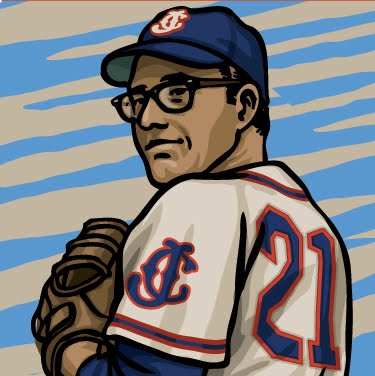
Since I was graciously asked to give a little talk and sign copies of my book at the Barnes and Noble in Knoxville, Tennessee on June 13th, I thought it the perfect time to feature one of the more unique players in Knoxville baseball history - and all of baseball history for that matter.
As anyone knows who've stood at the plate and faced down a fastball or had a screaming line drive come straight at their noggin, baseball can be a tough sport even for the most hardy of players. Yet the game's history is peppered with players who carved out a niche despite their various physical handicaps. Some, like Eddie Gaedel, were a marketing ploy and others like Eddie Bennett were beloved team mascots. But there were the rare few who defied all odds and actually joined the ranks of professional baseball. One-armed pitcher Jim Abbott comes to mind and Pete Gray's inspiring story was the subject of a made-for-TV movie. Bert Shepard lost a leg but came back to pitch briefly in the majors and Monty Stratton overcame the loss of a leg and pitched a no-no in the minors. And don't forget Humpty Badel - despite a humped back he came close to making it to the Cincinnati Reds. Now the one thing all those guys have in common, despite overcoming a handicap, is that they're all white.
As you all know, prior to 1946 when Jackie Robinson and Johnny Wright re-integrated organized baseball, there was a vibrant alternative universe of baseball catering to those who were omitted from playing in the white leagues. It's only natural that along with the hundreds of guys like Biz Mackey, Pete Hill and Bill Byrd who had the chops to make it to the majors that there would also be Blackball equivalents of Pete Gray and Jim Abbott. And that's what brings us to this week's ballplayer...
Forrest Maddox didn't let the loss of a limb get in the way of playing baseball. His left arm had been amputated all the way to his shoulder when Maddox was about 10 years old, but the young kid worked hard to carve out a reputation on the sandlots of Fulton County, Georgia. To compensate for
his disability, Maddox developed a unique system of fielding a ball
with his gloved hand, then tossing the ball in the air as he discarded his
glove, then catching the ball again and throw it to complete the play. All that was accomplished at a well-practiced lightening speed. Years later Pete Gray would demonstrate a similar fielding style, though Gray had a bit more of an advantage than Maddox in that he still had a slight stump with which to hold his glove instead of jettisoning it on the ground. At the plate Maddox learned to
hit with a one-handed bunt-style swing. His drive and determination made it almost irrelevant that he was missing an arm - only his nickname of "One-Wing", later shortened to just "Wing", remained a reminder of his disability.
While a white boy with a similar disability displaying the kind of talent Maddox did would have made great feel-good newspaper copy from coast-to-coast, this was 1910's Georgia and Forrest Maddox was black. Though he honed his playing skills off the radar of white baseball coverage, the local blackball fans took notice and by the time he was in his teens Maddox was playing for the Atlanta Cubs. The Cubs were among the better pre-World War I all-black teams below the Mason-Dixon line and about as pro as you could get in the days before the Negro Leagues were founded. This was quite an accomplishment for a one-armed pitcher and outfielder, but Forrest Maddox wasn't satisfied. He had much more he wanted to accomplish.
In the fall of 1914 Maddox matriculated to Atlanta's Morehouse College. Though he should have been precluded from collegiate athletics because he had played ball for money with the Atlanta Cubs, Maddox did indeed pitch for Morehouse. In the years before World War II many colleges turned a blind eye to such violations and Maddox continued to play for the Cubs between semesters. The following year the team was re-named the Atlanta Black Crackers and Maddox continued to impress with his stellar fielding and batting.
In 1920 the Negro Southern League was founded and Maddox was signed by the Knoxville Giants for the league's inaugural season. Knoxville had a major league-quality ace in left-hander Steel Arm Dickey and Maddox became the team's number three starter and spot-reliever. His fielding skills and bat were thought too valuable to go to waste on the bench, so when he wasn't on the mound he was in right field and batting in the bottom half of the order.
Behind Steel Arm Dickey's golden left arm, Knoxville tore through the Southern League competition and won the loop's first pennant by 17 games. Steel Arm finished the 1920 season by winning 25 straight games. Though I've yet to uncover his actual stats from the season, it was reported in the newspapers that One Wing Maddox finished up as the Negro Southern League's first batting champion.
Though the Negro Southern League was of lesser quality in both organization and talent than the northern, urban-based Negro National League, the Knoxville Giants challenged the NNL's pennant winners to a championship series. Originally planned as a massive 13 game series to be played in four different cities, the 1920 "World Series" wound up being a more compact three game affair played at Birmingham's renowned Rickwood Field, still used today. On September 21st more than 10,000 fans showed up for Game One. Steel Arm Dickey held Chicago to three runs until the 7th when the American Giants pushed 6 across for a 9-0 win. The loss ended Dickey's remarkable 25 game winning streak. Another 10,000 packed Rickwood the following afternoon. Game Two was much closer but the Chicagoans again edged out Knoxville 5-3.
Like his teammates, Maddox's bat fell silent before the American Giants formidable pitching staff, going hitless in seven trips to the plate. Chicago put the nail in Knoxville's coffin by winning Game Three by a 7 to 3 margin. However, the 1920 Negro Southern League batting champ came alive in the final game and went 2 for 4 including a tremendous triple to deep right field and scoring on an error. Newspaper accounts of the game singled out Maddox for both his bat and "two pretty catches in center.” As a silent nod to his talent, it was only mentioned as an after thought that Nashville's star had but one arm.
The next season Maddox moved to the Washington Braves and then the Birmingham Black Barons in 1923. This final season is the only one that we have hard statistics so far. According to Seamhead's Negro League Database Maddox played in 7 league games and went 3 for 16 with 2 sacrifices for a .188 average. He pitched 1.3 innings and gave up two hits and no earned runs. He retired from pro ball after that season and accepted a professor position at Morehouse College. The former ballplayer taught at his alma mater up until his death at age 31 in 1929.
For many decades blackball historians were baffled by Maddox's nickname of "One Wing" until the new breed of researchers uncovered contemporary newspaper articles that verified the pitcher-outfielder's lack of a left arm. This revelation came as a surprise to many, more so when it was found that the one-armed ballplayer was the 1920 Negro Southern League batting champ!
This illustration and story has been a fun way to say thanks to all the people in Knoxville who have invited me to their great town. In doing the research for this story I met Mark, Eastern Tennessee baseball history expert who runs the excellent Old Knoxville Base Ball website. When I expressed an interest in Wing Maddox, Mark graciously went out of his way to provide me with some great Knoxville Giants material to work with. Then there's Mike, the manager of Barnes and Noble who invited me to town in the first place. He just sent me a nice photo of the event poster on display in the store and informed me that the minor league Tennessee Smokies team mascots, Slugger and Diamond, will also be on hand for the signing! I tell you, if the rest of the people in Knoxville are half as generous as Mike and Mark, Saturday June 13th is going to be a blast! I really hope anyone in the Knoxville area comes out, it will be great to talk some good old baseball in person!
Since my book launched May 5th I've been fortunate to have participated in a few book signings and will do more throughout the summer. However, not everyone can make a signing and a few people have asked how to get a signed copy by mail. Luckily my studio is right down the street from one of the best independent book stores in the country, THE BLUE MARBLE. They're best known for being the best children's book store in the land but their store offers books for all ages, including a really choice baseball section. The owner Peter has graciously offered to handle all signed book requests, so if you'd like a signed or signed and personalized copy please order it from The Blue Marble's website. As you check out you will see a comments box where you can write in what you'd like me to inscribe. Since I'm right down the street I'll walk over and sign it, Peter will box it up and in a few days you'll have your own signed first edition of The League of Outsider Baseball!
I
originally posted the story of Captain Eddie Grant, former New York
Giants 3rd baseman, 3 years ago in honor of Veterans Day. To show my
respect and gratitude to all the men and women who interrupted their
lives in order to serve and protect this country, I'd like to post it
again, my small way to say thank you.
They
called him "Harvard Eddie." At a time when most ballplayers barely had
a high school education, third baseman Eddie Grant, Harvard Class of
1909, was a member of the Massachusetts Bar, a full-fledged lawyer. He
was also a darn good third baseman, batting .322 for Jersey City and
leading the Eastern League during his first year in pro ball. The next
season, 1907, Grant was called up to the Philadelphia Phillies. He
quickly gained attention, not from his bat or fielding skills, but for
what he would say on the field: when calling out his claim on a pop fly, instead of yelling the common "I GOT it!", Harvard Eddie called out the proper phrase, "I HAVE it!" much to the amusement of his more modestly educated teammates.
During
off seasons Grant returned to Boston to practice law, but each spring
he took up baseball again. Traded to Cincinnati in 1911, he lost
something at the plate and his batting average plummeted. The death of
his wife after barely 9 months of marriage might have been the reason
why. In 1913 the New York Giants picked Grant up and although he rode
the bench more often than not, John McGraw took a liking to the
scholarly third sacker and made him the Giants' bench coach. As much as
he loved the game, Grant disliked the life of a part-time coach and
player and a the age of 32, retired to pursue his law career full-time.
The
Great War had been raging in Europe for 3 years by now and many of
Grant's Harvard classmates were active participants even before the U.S.
entered the war. Whether they drove ambulances for one of the
volunteer organizations operating just behind the trenches or flew
airplanes for the French in the Lafayette Flying Corps, college
educated men of that era felt a sense of duty and adventure that sadly
seems lacking these days. Once America entered the war in April of
1917, even more of these privileged men from wealthy families left
their lucrative careers and easy lives to become officers in the
rapidly expanding U.S. Army. Back then the Army assumed that a college
educated man made a natural leader and "Harvard Eddie" was made Captain
of Company H, 307th Infantry Regiment, 77th Division of the American
Expeditionary Forces. After a period of training on Long Island with
his men, Grant sailed for France in the summer of 1918.
The
American Army was eager to prove itself to their Allies, France and
Britain and the Meuse-Argonne Offensive was its chance. Launched on
October 2nd, 1918, the Battle of the Argonne was one of the fiercest
fights in American military history. The 77th Division charged into the
Argonne Forest and strait into the solidly entrenched veteran German
Army. It was during the confusing first day of the battle that Major
Whittlesey, a New York attorney, got isolated and pinned down deep
within the dense forest. Although forever known as "The Lost
Battalion", Whittlesey knew exactly where he and his men were, it was
just that no one else in the U.S. Army did. After a few anxious days,
American aviators braved the dense German anti-aircraft fire and
finally located Whittlesey and his battalion. Pilot Lieutenant Harold
Goettler and his observer Lieutenant Erwin Bleckley volunteered to
circle the forest with the idea that the place that did not fire back
at them would be the the location of the lost battalion. They were
right and after taking heavy fire which mortally wounded both men,
their DH-4 aircraft crashed just short of the French lines. The French
soldiers rushed forward to help the downed aviators. Goettler was
already dead but Bleckley, with his last dying breath pressed a bloody
note into the hands of the closest French soldier. On it was a map
showing the location of Whittlesey and his men! With this new
information, Captain Eddie Grant and Company H was among the units
rushed into the Argonne to rescue the Lost Battalion.
By
the morning of October 5th, Eddie Grant and his men had been on the
front line and in the thick of the fighting for 4 days. No one, most of
all Captain Grant, had had any time for sleep. Being awake and
constantly under enemy fire for 4 days must have been a terrible
feeling. Add on top of that the responsibility for the lives of the 150
men of his company and you can imagine the stress Grant must have been
under. Taken out of the line that day for rest, a fellow officer
described the captain as barely able to lift his arm to bring a cup of
much needed coffee to his lips. But his company's reprieve was
short-lived. The Lost Battalion had been found. When orders to move-out
came, Grant got to his feet and took his place at the head of his
Company. He led them right back into the Argonne.
The
Germans threw everything they had at the Americans rushing into the
forest. If Whittlesey and his dwindling men could be captured or killed
it would be a devastating blow to the upstart fresh Americans as well
as their weary Allies. The story of the Lost Battalion had made
newspapers all over the globe and its rescue would come as a giant shot
in the arm to the young nation eager to prove itself to the world in
the greatest war mankind had ever known. As the 307th Regiment marched
forward the German artillery pounded the road leading into the forest.
Men and horses were torn to bits by the constant exploding shells but
still Captain Grant and the American Army moved forward through the
hail of shrapnel.
Among the wounded
being brought back past the advancing infantrymen was Major Jay,
commander of Grant's battalion. Recognizing Eddie he waved him over.
All the other ranking officers were either dead or wounded. Harvard
Eddie was now in charge of the battalion.
Though
it didn't seem possible, the shelling increased. The Germans knew they
had to destroy the Americans before they reached Whittlesey. The whole
road had become a deathtrap but everyone knew they had to move
forward. Grant called his officers together to brief them on the
situation. At that moment a shell exploded, tearing apart the two young
lieutenants standing next to Eddie. Grant tried yelling over the
screams and explosions for a stretcher bearer. Signaling his men to
take cover and waving his arms wildly in desperation for medics that
never came, the next shell exploded directly on top of Harvard Eddie.
He died instantly.
New York sports
writer Damon Runyon was a war correspondent in France during war and
had known Eddie Grant well during his time with the Giants. He wrote a
stirring eulogy for the former third baseman entitled "Eddie Grant
Sleeps In The Argonne Forest". The story was reprinted widely including
in the 1919 Spalding Guide and Grant, the only major leaguer killed in
the war, gained posthumous fame. In 1921 the New York Giants dedicated
a plaque commemorating the former infielder and bench coach in front
of which a wreath was placed each Memorial Day in a solemn ceremony
started by his old friend, John McGraw. That plaque was famously stolen
after the last Giants game at the Polo Grounds in 1957. Historians
searched in vain for the plaque or any trace of who the scumbag was who
stole it but it wasn't until 1999 that a couple moving into their new
Hohokus, New Jersey home discovered a plaque wrapped in a blanket
hidden in the attic. Turns out the home was formerly owned by a New
York City cop named Gaetano
Bucca. Officer Bucca, whose police beat in 1957 included the
neighborhood surrounding the Polo Grounds, had apparently stolen the
memorial. But baseball historians aren't positive the plaque is the real
one stolen from the Polo Grounds. The San Francisco Giants for their
part didn't seem to care as they try to distance themselves from their
former life in Manhattan. First World War historians did however finally
get the team to install a replacement in the new ballpark a few years
ago. You can see it near the Lefty O'Doul entrance, but in this day and
age of so many "heroes", this modest memorial to a fallen soldier who
gave his life for his country just doesn't seem to be enough.
Dedicated
to every serviceman and servicewoman who interrupted their lives, and
in some cases such as Captain Grant, gave their life, so I may live free
in this great country of ours.
Thank You.
WDNC Radio Broadcast of the June 4, 1943 game between the Durham Bulls and Norfolk Tars:
...now on the mound for the Bulls making his professional debut this afternoon is Rex Barney. Just weeks ago the 18 year-old was in his senior year in high school back in Omaha, Nebraska. As soon as he had that diploma in his paws he was signed by the Brooklyn Dodgers organization who sent him here to our Durham Bulls. Barney fires a few warm ups in to catcher Jack Phillips. The Dodgers scouts all praise his blazing fastball and the velocity at which this kid can throw. Before the game this afternoon Bulls manager Bruno Betzel was already comparing Rex Barney's speed to the great Bob Feller. Now folks, that's some good company to be in! Ok, Barney is finished with his warm ups and Grady Dunlap steps into the box to lead it off the 7th inning for Norfolk. Barney looks in for the sign from Phillips. Big sweeping windup and high leg kick - here's the pitch...
(Sound of a thump followed by paper shuffling and muffled yell)
Sorry about that folks - Barney's pitch sailed 5 feet over Jack Phillip's head and came right through the chicken wire of our radio and press booth. Right through it! The ball hit old Bill Parker of the Herald-Sun square in the noggin', but the rest of us are all ok, shaken but ok. Bill, are you - ok, he's ok. The umpire puts a new Spalding in play and Barney again looks in for the sign. Look out folks, this kid's pitching style is of the compass variety - he throws in the general direction of the plate...
That was Rex Barney's first pitch in organized baseball.
Throughout the course of the summer of 1943, Barney went from the Durham Bulls to the Montreal Royals and finally on August 18th he made his big league debut at Ebbets Field. With the exception of precious few moments, Rex Barney' major league career echoed that first pitch in Durham. Try as he might, he never could get that heater of his over the plate.
I had heard about Rex Barney many times as a kid from my Grandfather. As most of you already know, Grandpa Joe was a Brooklyn Dodgers man going back to the 1920's. When ever there was talk of a young pitcher with tremendous speed my grandfather would bring up Rex Barney. The old man loved to mention how Barney no-hit the hated New York Giants in '48. Grandpa never tired or retelling that one. But, like Karl Spooner and Pete Reiser, Rex Barney embodied the notion of unfulfilled expectation - the big "what if?"
As an 18 year-old in 1943 Barney went 2 and 2 before he was drafted into the service. He drove a tank across Belgium and into Germany and then returned to the Dodgers in 1946. Barney was wild as hell, but his speed captivated the Brooklyn management - besides he was only 21, there was plenty of time for him to learn control. Barney went 3-5 for 1946 then 5-3 in '47. Still the wildness remained. One minute he'd be burning them in over the plate and the next he'd throw a ball 20 feet over the catcher's head and into the box seats. The first thought was he simply wasn't concentrating or bearing down. It was true, Barney was a husky good-looking guy who loved the broads. He was a clothes horse and as the most heavily-touted pitcher in the Dodgers organization he held virtual movie star status throughout the borough of Brooklyn.
Nineteen forty-eight looked like the year he figured it all out. The big Nebraskan won 15 games including a no-hitter against the Dodgers hated rivals, the New York Giants. The home plate umpire for that No-no said later that Bob Feller, at the time recognized as the fasted man to ever pitch, had nothing on Barney's fastball. The season's totals showed his ERA was the fifth best in the National League and he'd finally recorded more strike outs than walks.
The Dodgers organization was pleased with his progress - there was only one problem. In the last week of the '48 season Barney slid hard into second base breaking his ankle. It wasn't thought to be especially worrisome - he had the entire winter to take his time and recover. 1949 was going to be Rex Barney's breakout year.
Only it wasn't.
No one, not even Rex himself could pinpoint why he lost his control again. Barney often said that his pitching motion was altered after the broken ankle. The Dodgers brought teams of specialists, both of the physical and psychological variety, in a search for answers. What ever it was, Barney began a quick and merciless decent out of the majors. 1949 ended in a 9-8 record followed by 2-3 in 1950. The minor leagues followed and then a rung lower into the semi-pros. All the while Barney sought help from any source trying to regain his control. There was a heartbreaking article in the April 1954 edition of Collier's Magazine entitled "Can't Anybody Help Me?"
Unfortunately no one could.
Years later Barney told author Peter Golenbock that after he found himself without a job or career he contemplated suicide. Rex Barney had never thought of a life without baseball. After bouncing around for a decade Barney broke into radio. By 1965 he was in Baltimore hosting his own sports talk show. It was there in Charm City that Rex Barney made the majors again, this time at the Orioles PA announcer. For over three decades Rex called out the pitching changes and public announcements. The Baltimore fans fell in love with his rich voice intoning "Thankyoooooooou!" after every announcement. His his catch phrase of "give that fan a contract!" after a spectator made a great catch of a foul or home run ball made him a local legend as big as Brooks Robinson and Earl Weaver.
It was in this later capacity that I got to meet Rex Barney. I was 21 and had been one of the designers of the graphics at the new Oriole Park at Camden Yards. I was having a lunch meeting with the Orioles VP who drove the whole Camden Yards project, Janet Marie Smith, when in walks Rex Barney. Now I have been fortunate in my life to have met many big name ball players and entertainment personalities. Names that would make your head spin and a paparazzi cameraman get the shakes with expectation. But very few could compare to the glee I had in meeting old Rex Barney. When Janet Marie Smith realized that I knew who the old man limping into the restaurant was, she happily introduced me to the ballplayer. Rex gave me a warm handshake and listened politely as I mumbled something about my grandfather telling me about his no-hitter against the Giants. In a game full of so many lousy characters, Rex was a class-act and I couldn't wait to call my grandfather and tell him that.
Dogged by declining health, Rex Barney passed about four years later. The city of Baltimore, which gave Rex Barney a second chance at the big leagues, mourned the passing of its adapted son. As a tribute to his tremendous speed, to this day coaches in the Dodgers organization describe a pitcher with blinding speed but no control as possessing a "Rex Barney Fastball".
With The League of Outsider Baseball hitting the shelves on Tuesday, I was fortunate enough to be interviewed by Scott Simon on National Public Radio's Weekend Edition this morning. Here's a link to the segment.
On other media fronts, the book has been getiing really great reviews from all parts of the country from Charlotte and Chicago to Dallas and Los Angeles!
Remember the 5-card series I did on the Brooklyn Bushwicks? Well, my pal Will Arlt of the Ideal Cap Co. took a shine one of the caps I had illustrated. The Bushwicks were the class-act of all semi-pro ball clubs back before World War II and as such they wore the sharpest duds around. For most of their heyday the Bushwicks' team colors were navy blue and orange - a loud combo for the time and a color scheme that earned them the nickname "The Kandy Kids". The cap Will liked was the one worn by catcher Walt VanGrofski - the 1940 Brooklyn Bushwicks cap.
As far as caps go, it's a pretty smart looking one, navy blue crown with an orange bill and orange felt "B".
Like me, Will loves baseball obscura and the Bushwicks are right in his strike zone. Thus, it was only natural that he would be compelled to take one of the caps I illustrated and make it a reality. Now the '40 Bushwicks cap is the "Cap of the Month" for April and you can see it (and own one!) HERE.
Now,
over the past 4 years I've gotten quite a few lucrative offers to
advertise on my site, all of which I turned down; I wanted the Infinite
Baseball Card Set to be pure and good, clean fun. So I want to make it
clear that this isn't some shill ad disguised as a blog post - I
get nothing from Ideal Cap and simply wanted to share what I believe is
the most unique and beautiful baseball caps in the world. I highly
recommend picking one out (and that's a hard thing to do!) and wearing
it proudly - you'll never wear one of those modern hard-hats again!
Click the logo to see Will's caps (and tell him what a great logo design it is - I designed it!)
This past summer I wrote about my friendship with Will which started as a business relationship 25 years ago. For those who haven't read it, I'll post it below...
In
what seems like a thousand years ago, during the summer of 1989 I was
working in a garment factory in Passaic, N.J. On a lunch break I was
reading Sports Illustrated and happened on an article about a company in
upstate New York called Cooperstown Ballcap Company who was recreating
classic baseball caps, just like the ones made from the 1860's through
World War II. I was smitten with the beautiful wool caps with felt
logos, with the soft crown and leather sweatbands. I WANTED one of those
caps, but they were about twice the amount one of those adjustable mesh
caps cost, and being in art school, I couldn't justify spending that
much bread on a cap. But I WANTED one of those caps!
In a rare moment
of business acumen, I wrote a letter to the owner, Will Arlt up in
Cooperstown and offered to do illustrations for his catalogue in
exchange for ballcaps. Much to my surprise Will accepted and I've been
proud to call him a friend ever since. I'll never forget opening the box
that held my first Cooperstown Ballcap - it was a 1944 St. Louis Browns
cap and I loved it. The crown molded to the shape of my head and after a
few months the brim became soft and pliable. It looked just like the
caps depicted in my baseball history books. It was perfect. Today I have
dozens of Will's ballcaps and I never wore a modern cap again. Over the
years Cooperstown Ballcap developed a following of ballcap purists and
aficionados - one guy even came up with a website devoted to fans showing off their favorite Cooperstown Ballcap!
Will
closed Cooperstown Ballcap Company about 7 years ago and knew the world
had lost the greatest cap manufacturer of all-time. I was distraught at
the horror of resigning myself to having to wear those cheap and boxy
modern jobs or substandard "retro" caps that jersey companies put out.
Then one night over drinks at the Formosa Cafe in Hollywood, Will
disclosed he was starting a new company: IDEAL CAP COMPANY.
Not only would he produce those beautiful ballcaps again, but other
interesting styles as well. I immediately signed on to design the logo
and illustrate the caps on the website, and after a few years of
preparation and inventory building, Will launched Ideal.
I highly
recommend picking one out (and that's a hard thing to do!) and wearing
it proudly - you'll never wear one of those modern hard-hats again!
When it came down to delivering the manuscript for my book, The League of Outsider Baseball, I found I had run way past my intended target of 240 pages and had about 100 extra pages. Then began the excruciating process of having to edit out dozens and dozens of great stories and illustrations. In the end I admit the final product is much leaner and taut - it's Major League quality. Still, the cuts left a slew of ballplayers who wont get their due in this book. Today's story and illustration is from a two-page spread I had done depicting the 1912 Replacement Tigers. I decided to go with one character today to represent the group of nine guys who went from the street corner to the majors in the span of one day in 1912. If my book does well then perhaps the other eight will make it into a second volume next year!
Earlier that morning Bill Leinhauser was hanging out on his street corner in Philly with a handful of his pals. Now it was two in the afternoon and he was waiting to take the field in Shibe Park as a member of the Detroit Tigers.
How did Bill Leinhauser go from a Philadelphia street corner to replacing Ty Cobb in the Tigers outfield?
Most casual baseball fans know about Ty Cobb's horrifying temper. The one story usually told to illustrate the point is how he once leaped into the stands and beat an armless man who dared heckle him to a bloody pulp. When someone cried "That man has no hands!" Cobb defiantly yelled between kicks of his cleats "I don't care if he has no legs!" and continued pummelling the man until cops and teammates dragged him away. The story, though told over and over so many times, is essentially true.
The incident took place at New York's Hilltop Park on May 15, 1912. Cobb, the best ballplayer in the American League, was a natural target for hecklers. One guy sitting in the third base stands was especially vocal. Claude Lucker was a former printer who lost eight of his ten fingers in a press accident. Now he pushed Ty Cobb into the red zone when he called the Georgia Peach one too many racial slurs. Cobb did indeed vault into the stands and kick and beat the defenceless Lucker, uttering the infamous line "I don't care if he has no legs!"
As would be expected, the American League suspended the slugger, but what was unexpected was that his teammates - who cared for Cobb about as much as he cared for them - fully supported him and voted to go on strike unless he was reinstated. When the Tigers rolled into Philadelphia to begin their series against the World Champion Athletics, neither the League nor the striking players were willing to budge. Tigers manager Hughie Jennings had a big problem: if Detroit didn't field a team that afternoon at Shibe Park, the American League would forfeit the game to the A's and bring forth all kinds of costly fines.
Jennings met with A's manager and owner Connie Mack. It became obvious Jennings had only one choice - find a team. Since time was tight he couldn't bring up any Tigers prospects or players under contract with Detroit. He had to find local amateurs. Both Jennings and Mack knew any pick-up team would get murdered going up against the A's juggernaut. Mack's men were the defending World Champs, some say the greatest team ever assembled. The kindly Connie Mack told the Tigers manager that he would hold back his regulars and field his scrubs that day. Reassured, Jennings only had one more thing to do - find a team!
Since he was unfamiliar with the local baseball scene, the Tigers skipper turned to a local sportswriter named Joe Nolan. He in turn tapped Allan Travers, the assistant coach of the St. Joseph's College baseball team to find the players. The 20 year-old went to his neighborhood and scooped up eight "ballplayers" and herded them to Shibe Park. Each man was instructed to sign an official American League Player's Contract for a salary of $25 and told to suit up in the unused Tigers road uniforms. Travers received a $50 contract because he claimed he could pitch.
The real Tigers wore their street clothes and sat in the stands. If Jennings felt relieved that he had a team, it was short-lived. When the line up cards were exchanged he discovered that Connie Mack had duped him - every position was manned by one of his regulars including three future Hall of Famers.
The game was a slaughter. The A's pounded Allan Travers for 24 runs. At one point many of the 16,000 fans demanded their money back but were refused. A riot was close to breaking out but was somehow avoided. After the game Cobb begged his teammates to end the strike, which they did. Each of the striking Tigers were fined $100 - $50 more than Cobb's original fine for beating Claude Lucker back in New York! In their next game Detroit fielded their normal lineup sans Cobb who would return from his suspension on May 25th.
The guy who
took Ty Cobb's place in center field and even wore his uniform was
William Charles Leinhauser. He was a local sandlot player and accomplished welterweight boxer, but he wasn't Ty Cobb. Leinhauser went 0 for 4 with 3 strike outs against the World Champs. Besides his failure at the plate Leinhauser also managed to get hit on the head by a fly ball. Perhaps he could be forgiven since Travers was serving up gopher balls all afternoon and the replacement Tigers were run ragged chasing flies. Cobb's replacement never appeared in another professional ballgame, but he did go on to to become a highly decorated Philadelphia Police Captain and retired as head of the city’s narcotics squad.
The Replacement Tigers became a footnote to baseball history, significant in that it added eight players to the Baseball Encyclopedia whose entire career lasted only a single game. Only one of those nine would ever effect baseball history a second time, and not for his play on the field but off it. The starting third baseman that day was Billy Maharg, a scrappy neighborhood corner boy. He went hitless in his only plate appearance and left the game early when a line drive slammed into his mouth, knocking out a handful of teeth. He continued to hang around the fringes of professional baseball and by 1916 was a trainer and chauffeur with the Phillies. In 1916 Maharg got one more chance to appear in a big league game. He did as well in his second major league game as he did in his first: 0 for 1. He did however play a few innings in the outfield, this time without any damage to his choppers. The next time he appeared in conjunction with the national pastime was when he and pal Sleepy Bill Burns helped cobble together the fix of the 1919 World Series.
69 years ago
today, Jackie Robinson sat in the visitor's locker room of Jersey City's
Roosevelt Stadium. Suiting up with his Montréal Royals teammates,
Robinson was about to do what no black man had done since 1899 - play in an organized baseball game. Johnny Wright, another black
ballplayer was on the roster that day, too, but Wright was a pitcher and
was not going to play. Once the bands stopped and Mayor Hague threw out
the first ball, Robinson
was on his own. Opening Day in Jersey City was a big deal back then, a
city-wide holiday. The Hague Democratic political machine that ran the city since
1917 expected every single municipal employee to purchase a ticket in
order to give Jersey City the largest opening day crowd every year.
Although 25,000 fans streamed through the turnstiles that afternoon,
twice than number was sold. Still, with 25,000, Jersey City easily led
the International League in attendance that day, and they witnessed
history being made.
Robinson’s fame as a college athlete, his university education, and
experience as an army officer made him the perfect man for a very
difficult job. Many Negro League ballplayers expressed disappointment
that he was to be the first to integrate the game. His manager with
Montréal silently questioned whether or not a black man was even human.
Bob Feller, who pitched against Robinson in 1945, thought so little of
his talent said “If he were a white man, I doubt if they would even
consider him big league material, except perhaps as a bat boy.” Robinson
faced it all with quiet dignity and strength. In that first game in
Jersey City he went 4 for 5, including a three-run homer, scored 4 runs,
drove in 3 and stole 2 bases. Overcoming immense racial pressure,
Jackie won over his teammates and fans with his natural physical ability
and intense drive to win. Sparked by his play, Montréal won the Little
World Series of 1946 and the next year he was playing for Brooklyn.
Through his sheer determination Jackie Robinson not only paved the way
for the desegregation of the major leagues but also the modern civil
rights movement.
Here's to you Jackie!
Don't forget the card I posted of Happy Chandler, the Commissioner of Baseball who backed up Branch Rickey when he wanted to bring Jackie Robinson to the Dodgers.
I finally received a few advance copies of The Book. Now, I'm usually my own worse critic, but I have to say, it looks better than I ever imagined. Besides that, I can honestly say I have never seen a baseball book like this one. When I started out 5 years ago with this blog, I went about it with the idea of creating the baseball card set I always wanted. I had the same thing in mind when I began the book - to create the book I always wanted to find in the bookstore.
I can honestly say I did.
The 240-page hardback book hits the stores May 5th and you can pre-order one at a whole variety of outlets HERE. If anyone is in the Cincinnati area, please know that I will be having my book launch party at Joseph Beth Booksellers in Crestview Hills, Kentucky on May 8th. I would absolutely love to meet anyone who can attend and share the greatest achievement of my artistic career with you in person!
* As a demonstration of pro-photography vs. amateur, the first three photos in this post were taken by my pal Todd Robinson, a true artist with the lens from still product shots like these to event photography. You can see more of his amazing work HERE. The last three shots are by yours truly, a testament to why I stick to ink and paper instead of a camera...

I'm usually
not one to blame a manager on the overall performance of his team.
There's usually a combination of circumstances that lead to a stink-o
season and the manager is simply a cog in the whole broken machine.
There are exceptions however. Take Dusty Baker. He had no less than
three great ball clubs under his care: the '02 Giants, '04 Cubs and the
'12 Reds. Let's give Baker the benefit of the doubt and take the '02
Giants out of the equation because I think the it can be argued the
Angels and Giants were equally matched that year. In the case of the
Cubs and Reds, Baker was completely out-managered by the skippers of
teams fielding less talented ballplayers. Then there is Bobby Valentine of the
turn-of-the-century Mets. Bobby V had a virtual National League
All-Star team right there in his club house, yet he couldn't crack down and whip those idiots into the dynasty
they should have been. While those two examples are relatively recent,
we can go back to the 1920's where we find the hapless Wilbert Robinson
of the Brooklyn Robins.
Brooklyn had gone
to the World Series in 1916 and again in 1920, and although both trips
ended in defeat, fans still had vivid memories and the faint taste of
past glory. However, by the late 1920's that memory and taste of glory
became bitter, a feeling of insurmountable failure setting in. A
combination of infighting between the owners, failure to develop young
talent and a dwindling bank account led to the ball club's quick slide
into the second division.
On top of all
this, the team's manager Wilbert Robinson seemed utterly defeated and
out of his element by the mid 1920's. Robinson had once been a superstar
catcher with the fabled Baltimore Orioles of the 1890's. He followed
his pal John McGraw to the Giants and worked as his coach until a
terrific rift between the two sent Robinson over the East River to
manage Brooklyn in 1914. At first Robinson was successful, leading the
team to the 1916 and 1920 pennant and the franchise was even renamed
"The Robins" after the popular manager. But after a few losing seasons
Robinson just gave up. The once formidable baseball sage was now known
as "Uncle Robbie", a lovable, comical and overweight loser. The only
reason he kept his job was that the majority owner felt a loyalty to the
washed up manager, much to the chagrin of the other owners and fans.
Though the team was stocked with has-beens, never-were's, and out-right
novelty acts like Pea Ridge Day,
Brooklyn actually had some solid ballplayers. Babe Herman was a real
bonafide slugger whose fielding ineptitude had been much exaggerated by
the press to sell papers. First baseman Del Bissonette always finished
in the league's top home run leaders and third baseman Harvey Hendrick
was a feared batsmen. Dazzy Vance
was as solid a starting pitcher as you could get and despite a career
spent with Robinson's losers he still managed to make it to Cooperstown.
Because of no run support Watty Clark had a losing record but
consistently finished the season with one of the lowest ERA's in the
National League. So the Robins had the makings of a good team but
unfortunately Uncle Robbie did nothing to turn around the culture of
complacency and depression in the club house.
Into this
cesspool of failure fell a few very talented ballplayers whose careers
were completely wasted because they wound up wearing a Brooklyn uniform.
Perhaps the most talented was a slight outfielder from out West named
John Henry Frederick.
By the time he
made it to Brooklyn, Johnny Frederick was 27 and had toiled away in the
minor leagues for seven years. He was tall and wiry and possessed such
speed that when he played center field he made the left and right
fielders obsolete. Twice he came excruciatingly close to making the big
leagues. The first was in 1923 when the Washington Senators tried to buy
Frederick from the Salt Lake City Bees. The Bees' owner, Bill Lane,
held out for $50,000 and the Senators folded, picking out a more modestly
priced outfielder instead. The next season the Cardinals showed
interest. Everyone from Frederick's manager on the Bees to opposing PCL
players told St. Louis GM Branch Rickey that Frederick was a big league
material. However, one person planted a bug in the GM's ear that
Frederick had an inaccurate arm so Rickey hopped a train to Utah to see
for himself. Always the savvy flesh trader, Rickey used the rumor of a bad arm to try to muscle Lane into reducing Frederick's sale price. To complicate the matter, Frederick's manager made the mistake of informing the kid
that the Cardinals GM was in the stands, specifically to see how he handled
throws from center field. Knowing this was his chance to make The Show,
he chomped at the bit to show off his rifle-accurate arm. Neither
Rickey or Frederick had long to wait. Branch Rickey sat in the press box
and watched as Salt Lake's pitcher gave up a triple in the first
inning. Then came Frederick's chance. With a man on third, the next batter sent a line drive rocketing towards left
field. Frederick charged over from center and cut off the left fielder,
making a beautiful one-handed shoe string catch. He then quickly
wheeled around and threw to home plate to catch the runner from scoring.
Frederick was off balance and the ball sailed completely off course -
right at the press box. Sports writers said that if there hadn't been a
screen Rickey would have caught the ball right between his eyes. Rickey caught the next train back to St. Louis and Frederick stayed in Utah.
Though a solid
.340 hitter in the Pacific Coast League, no other big league club wanted
to take a chance on him. See, Frederick was a throwback to the dead
ball era, a contact hitter who turned his singles into doubles and
triples with his speed. But this was the mid 1920's and every team
wanted their own Babe Ruth,
a guy who could wallop the horsehide, score a run with a single stroke.
So even though he was hitting the ball at a .340 clip, all the big
league clubs passed - all except Brooklyn.
Even before
spring training started in March of 1929, the Brooklyn newspapers were
heralding Frederick's arrival as a change in the team's fortunes. After a slow start he began to tear the cover off the ball and easily made the
big club as their starting center fielder. Playing between Rube
Bressler who hit .318 and Babe Herman who hit .389, the Robins had one
of the hardest hitting outfields in the league.
For Frederick,
1929 was a rookie year for the ages. In 628 at bats he struck out just
34 times. Because of his tremendous speed, 52 of his 206 hits went for
doubles, a big league record at the time and still the most in the history of the Dodgers franchise. His .328 batting
average and 75 RBI made him the National League's best lead-off hitter.
If there had been a Rookie of the Year Award back in '29, there's no
question Frederick would have taken that home with him in the fall. The
next year he was even better, batting .334 and again striking out a mere
34 times. With Frederick's bat added to the the club, Brooklyn managed
to stay in the pennant race all summer, just falling short the last week
of the season. But as Brooklyn's pennant hopes began to fade in
September, so to did Frederick's career. First he suffered an severe
bone bruise in the joint between the thumb and forefinger of his left
hand. The joint never healed properly and gave him trouble the rest of
his career. Then, with two weeks left in the season, Frederick dove for a
sinking liner and landed hard on his right ankle. Though he limped off
the field under his own steam, x-rays showed he'd broken it, ending his
1930 season early.
For 1931 the
Robins added Lefty O'Doul, making the Brooklyn outfield on paper look
like the second coming of Murder's Row. But paper's paper and baseball's
baseball. Though his team looked good on the line up card, old Uncle
Robbie could do nothing right. Every time he was handed a new way to
successfully manage his club, he went right back down his well traveled freeway to failure. For instance, his coaches realized every team in the
National League knew and were stealing the Robins' signals. There were a
few reasons for this: 1. Robbie hadn't changed them in decades. 2)
Every time a player was traded from Brooklyn he informed the his new team
of Robinson's signal system and 3) he made no effort to hide his
signals, lazily flashing them in full view of the opposing team's
dugout. After a losing streak, a coach delicately suggested they try
playing a few games without using hand signals. Robinson, at wits end,
agreed. Without telegraphing the opposition what was coming, Brooklyn
promptly won the next two games, yet just a quickly Uncle Robbie went
back to the old hand signals. The losing continued.
Frederick muscled
through 1931, hitting a respectable .270 average with 17 homers, but by
the time 1932 dawned, Frederick was fading fast. His legs never
regained their pre-1931 speed and the multiple injuries he'd suffered
necessitated a long pre-game ritual of adhesive taping and bandaging. It was a shame because the team's owners had finally dumped Uncle Robbie and replaced him with Max Carey. The team, now re-named the Dodgers, responded by finishing in third place.
Although
Frederick's speed was gone, he still had his batting eye and became the
best pinch hitter in Dodgers history. In the 62 times he was sent in to
pinch hit, Frederick connected for 19 hits, a remarkable .309 average.
1932 was his best year hitting in the pinch, going 9 for 29. What's most
remarkable is that of those nine hits, all but one was for extra bases
and of those 8 extra base hits, SIX were home runs! This was a major
league record that stood until Dave Hanson and Craig Wilson hit seven
apiece in 2000 and 2001 respectively (all be it in a 162 game season
against the 154 game season of Frederick's time).
Relegated to
part-time, Frederick posted .308 and .296 for 1933 and 1934 with a
marked reduction in his power at the plate. The Dodgers replaced Max Carey with Casey Stengel for 1934 and the team quickly took on the same air of failure that existed earlier under Robinson. Stengel covered up his managerial ineptitude by cracking jokes at his players expense and pandering to beat writers so he looked like a genius surrounded by fools. As would happen later when he managed the Boston Braves and New York Mets, his players became discouraged and the ball club sank into the depths of the standings. Amid all this wreckage, Frederick failed to run out a single and was subjected to Stengel's wrath. At the end of the season he told Frederick that he "didn't fit into his plans for 1935". Apparently Stengel's plans for the season included a fifth place finish, 29 1/2 game back.
When no other team picked up his contract, he expressed a desire to be signed by a west coast minor league team so he could be close to home. Sacramento in the Pacific Coast League gladly snatched up the former Dodger where he became a star attraction. Back where he started,
Frederick hit .363 and in 1936 he moved over to the Portland Beavers where his .352 average led the team to the Coast League championship. He played through 1940,
retiring at age 38 and never hitting below .300. Frederick put his glove on the shelf and began a second career running a combination ranch/tourist camp outside Portland. The best pinch hitter in Dodgers history passed away in 1977 at the age of 75.
Besides his
Dodgers franchise record for doubles and the MLB record for pinch
hitting home runs, the rangy outfielder can also claim another spot
in the record books for his part in developing a piece of equipment
used today by every baseball player. Remember that thumb injury at the
end of the 1930 season? Since the bone never healed properly, any
contact with the ball became excruciatingly uncomfortable. Frederick
remedied the situation by taping up his thumb with football padding to
put a layer of cushion between the bat and bone, something he did for
the remained of his career. While it might not seem that extraordinary,
no one had done that before on a permanent basis. At the same time teammate Lefty O'Doul remedied a
temporary hand injury by wearing an ordinary leather glove to add some cushion while he batted. The combination of the two Brooklyn outfielder's
home-made remedies gave birth to what we now know as the batting glove...