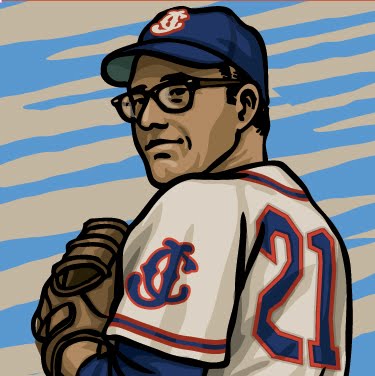
Showing posts with label Baltimore Orioles. Show all posts

Friday, November 3, 2017

234. Joe Hauser: Leave him alone, he's Our Joe!


For my next several posts, I thought I'd try something different. Ever since I began this blog back in 2010, I consciously made an effort to not have any rhyme or reason to the order in which I presented my stories. One week would bring the story of Negro League legend Leon Day and the next could be turn of the century Federal League player Guy Zinn or a 1930's Japanese baseball player. I like the freedom to present whomever I am interested in at the time, and I think those of you who keep checking back here, or have purchased my books, do as well.

However, while working on this most recent story, I thought it would be interesting to do a series of three (or, to draw on my fancy art school background: a "triptych"), focusing on the trio who held the professional baseball single-season record for most home runs before it was broken by the steroid-addled Barry Bonds in 2001. I wanted to go back to a time when home runs and their records actually meant something. When the numbers 60, 61, 714 and 755 evoked a sort of hushed reverence, a marker that was seemingly unattainable. In the years before the Major Leagues expanded exponentially, dozens of star-quality ballplayers were stranded in the high minors, trapped in second and third rate cities where they tallied seemingly impossible records for most wins, hits or home runs. Because they were achieved in the minor leagues, their names are mostly a footnote today, but if one looks under the blankets and in the deep recesses of baseball history, you'll find guys like Joe Hauser waiting to tell their story.

In the five and a half decades after he retired in 1942, Joe Hauser was the go-to man for "what if", "hard-luck" and "where is he now" baseball stories. Hauser's career stretched from the Deadball Era of Ty Cobb through the Roarin' Twenties of Babe Ruth and on into the hardscrabble Depression Era 1930's. That he lived to be 98 years old made him one of the most interviewed ballplayers and a direct and priceless link back to the game’s Golden Age.

Joe Hauser was born on January 12, 1899 to blacksmith Andreas Hauser and his wife Mary, also called “Mamie.” The couple had emigrated from Austria to Milwaukee’s German-speaking 19th Ward in the 1880’s, and Joe was the fourth of an eventual six children that made up the Hauser family. With a large amount of mouths to feed, Joe quit school at the age of 14 and began working in a mill that built cement mixers. Hauling the heavy machine parts strengthened his wrists and forearms, inadvertently giving Hauser the attributes that would later make him a power hitter. Like all kids in his Milwaukee neighborhood, Hauser grew up playing baseball on any available vacant lot. He eventually graduated from the sandlots to a semi-pro team in one of the city’s saloon leagues where he became a pitcher with a blazing fastball. Known for high strikeout games, Hauser became known as “Zep” or “Zip” for the velocity of his fastball. 


When he reached the age of 18, Hauser was recruited for a town team in Waupun, Wisconsin, where he played with and against men much older than him, many of which had previous minor league experience. When he began regularly striking out more than a dozen batters each game, he attracted the attention of Philadelphia Athletics owner and manager Connie Mack. Mack invited Hauser to the Athletics spring training in 1918, but the teenager proved to be too wild and raw to be any use for the Athletics. The kindly Mack paid for Hauser’s train ticket back to Milwaukee and $100 for his time, something that was rarely, if ever, done for failed prospects at the time.

When Joe got back to Milwaukee, his hometown Brewers signed him up. The Brewers played in the American Association, rated by organized baseball as an AA league, one level below the majors. Hauser was still too inexperienced for the AA level and he was optioned to the Providence Grays of the Eastern League. When he was unimpressive in his only outing on the mound, the Grays switched him to the outfield where he began hitting. After spending 1918 and 1919 in Providence where he batted .271 and .273 respectively, Hauser was recalled back to Milwaukee by the Brewers. While his average stayed well over .300, his fielding left much to be desired. At this time, Hauser acquired the curious nickname he’d have for the rest of his long life: “Unser Choe.” When fans at Milwaukee’s Borchert Field heckled or ridiculed Hauser’s play, the local German-American’s in the grandstand would yell back “leave him alone, das ist unser Choe!” “Unser Choe” was German for “Our Joe,” pronounced in the dialect particular to Milwaukee. 


Though his batting average was going up each season, his lackluster fielding threatened to keep him a bush league ballplayer for all eternity. Fortunately, Brewer’s manager Jack Egan came up with the brilliant idea to move the budding slugger to first base, and just like that, everything came together for Joe Hauser. When the Athletics came to Chicago to play the White Sox, Connie Mack traveled to Milwaukee to see Hauser play. Tipped off that the great man was in the stands, Unser Choe banged out four hits including a home run. The notoriously budget-conscious Mack shelled out a reported $50,000 and four players to obtain Hauser’s services for 1922. When his contract came in the mail early in 1922, Hauser sent it back to Mack, telling the Athletics owner he would have to boost the pay. It seems that the Brewers had promised a bonus to any player who hit a home run in Milwaukee, and Hauser wanted his money. Mack tried playing hardball with the brash rookie, telling him that his beef was with the Brewers and not the Athletics, but Unser Choe wouldn’t budge. Finally, with the Athletics headed to Fort Myers for spring training, Mack appealed to Henry Killilea, Brewers owner, to convince Hauser to sign. After fruitlessly chasing Hauser’s shadow all over Milwaukee, Killilea finally got the kid’s signature on a Philadelphia contract when he told him to either sign or be out of organized baseball. It worked, and Killilea bundled Hauser onto that evening’s train south to Florida.

Though he was untried at the big league level and lacked the polish of a veteran, Hauser had confidence in his talent. When he made mistakes, he listened intently to the advise of his teammates and Connie Mack, firm in his belief that he would never make the same mistake again. Won over by his positive attitude, the veterans on the Athletics took to the friendly Midwesterner, dubbing him “Dutch” for his German accented phrases.

Unser Choe played 111 games for the 1922 Athletics and hit big league pitching at a .323 clip. He recorded only 15 extra base hits, but 9 of them were home runs. When the Athletics came to Milwaukee to play an exhibition game, it was “Joe Hauser Day” at the Borchert Field, and the hometown hero was showered with gifts including a bowling ball and shoes to go with it. The next season his average dipped a bit, but he almost doubled his home run production, thus solidifying his place as the Athletics starting first baseman for the foreseeable future.

With baseball as his only profession, Hauser was careful to ensure that he was in top condition to practice his trade. He ate heartily - but in moderation, and kept himself to only a single beer when out with teammates - two when he really wanted to cut loose. He had also gotten married to Irene Kaye, lovingly called “Mama” by her husband. The couple set up house in Philadelphia where they lived in serene domesticity during the regular season. Mama would be by his side for the next 62 years as he traveled the country playing baseball. Back in Wisconsin during the off-season, Hauser played indoor baseball with Athletics teammate and fellow Milwaukeean Al Simmons to keep in shape. This strict regimen, plus his natural talent, combined to make 1924 Unser Choe’s breakout season.

Today, when one looks at the list of home run totals for 1924, Babe Ruth’s name appears at the number one spot, and just below him at number two is Joe Hauser. His 27 home runs that year was something of a feat, especially since the next highest total was 19. In fact, Unser Choe hit more home runs by himself that year than the entire Boston Braves (25) and Washington Senators (22) did collectively as a team. All those teenage years spent working in the cement mixer factory had made Hauser’s wrists into home run hitting machines. At just 25, Unser Choe looked like he had a long, successful big league career ahead of him, following in the wake of Babe Ruth as one of the game’s first power hitters.

Just before the 1925 season, the Athletics played their traditional “City Series” against the Phillies for the championship of Philadelphia. With no one on the bases, a Phillies batter hit a ground ball to the shortstop. As the fielder retrieved the ball, Hauser ran towards first to receive the throw and touch the base for the out. A simple, textbook play, one Hauser had executed hundreds of times – only this time something unexpected happened. For no apparent reason, Hauser’s right kneecap snapped in two pieces. Surgeons operated and managed to secure the two broken pieces with gold wire, then covered the whole leg with a cast to begin the long recovery process. With a long recuperation on the horizon and no guarantee he’d ever play ball again, Hauser was voluntarily retired from professional baseball and he and Irene returned to Milwaukee. When the cast was removed, Hauser tried to stay active, even appearing in exhibition games with the Athletics when they played close to Milwaukee. Mack sent him to farm team in Federalsburg, Maryland for a short time to work with young players. Hauser would draw on this brief experience many years later when he would become a minor league manager.
 

After sitting out the entire 1925 season, Hauser was pleased to report that by Christmas he was able to walk and move the knee with no perceivable side effects. That spring Hauser worked with Kid Gleason, former manager of the 1919 White Sox, now Connie Mack’s right hand man on the Athletics. Gleason had Hauser walk backwards, to strengthen the muscles. The walking evolved to running, and soon Gleason deemed Hauser ready for The Show again.

Unfortunately, the year off had played havoc with his batting eye, and Hauser was mentally not ready to subject his broken knee to rigors required of a big league first baseman. With his knee still stiff and bothered by the discomfort caused by the wires holding it together, Hauser batted a disappointing .192 after 91 games. For 1927, Mack sent him to the Kansas City Blues in exchange for their first baseman, Dud Branom. While in K.C., Unser Choe regained his home run swing and cemented his reputation as a long-ball prodigy. Kansas City’s Muehlebach Field was a home run hitter’s worst nightmare, with a right field wall some 400 feet from home plate, surmounted with a 30-foot fence. No one hit home runs out there – until Unser Choe came to play. When his blast cleared the wall, fans collected over $250 dollars to give to Hauser in recognition of his achievement. The next afternoon, Hauser repeated the feat, again raking in a couple hundred dollars from grateful fans.

That summer, Hauser really murdered the ball, bashing 49 doubles and 22 triples to go with his 20 home runs and gaudy .353 batting average.

https://infinitecardset.blogspot.com/2017/02/21-journal-mark-iii.htmlAfter Dud Branom proved worthy of his nickname, Mack brought Hauser back to Philly in 1928, but by this time the Athletics were a much different ball club. With Mickey Cochrane, Jimmie Foxx, Joe Boley, Al Simmons, Lefty Grove and George Earnshaw, Mack had assembled what may have been the greatest dynasty in baseball history, winning three pennants and two World Championships from 1929 to 1931. The 1928 team featured the great Ty Cobb, now wrapping up his Hall of Fame career with Mack’s club. Hauser started the first month of the season hitting .375 with 7 homers, then he began to slump. Hauser later blamed his plummeting average on none other than Ty Cobb, who he claimed sabotaged his batting style with bad advice because he was jealous of being out-hit by Unser Choe. Cobb reportedly advised Hauser to crowd the plate, which just resulted in him fighting off pitches and robbing him of his greatest asset, those strong wrists and forearms. Why did Hauser listen to Cobb? Maybe because he was the greatest hitter ever to play the game and even at the age of 41 he would hit .323 that season.

With Hauser’s average sliding backwards and Jimmie Foxx moving from catcher to first baseman, Mack sold Unser Choe to the Cleveland Indians. Unfortunately, with future batting crown winner Lew Fonseca already ensconced at first base, Cleveland had no use for Hauser besides as an occasional pinch hitter. When all he could manage was .250 off the bench, Cleveland sold the now 30 year-old to the Baltimore Orioles.

Baltimore played in the International League, one of the three AA leagues that, like the American Association, were right below the majors. While many ballplayers would have been discouraged by the demotion, Unser Choe resigned himself to a minor league career. Part of his contentedness might have been that because of his major league contract, he was still drawing his big league paycheck. As the country slipped deeper into the Great Depression, the $6,500 salary took the sting out of being back in the minors. When he arrived in Charm City, Hauser took the advice of the team’s shortstop, Heine Sand, and switched to a slightly lighter bat. The lightened stick enabled Hauser to get around quicker on the ball, bringing to bear all the power of his wrists. That summer Unser Choe pounded home run after home run as he chased the professional baseball single-season home run record. While Babe Ruth set the major league record with 60 in 1927, several minor leaguers surpassed that total, the most recent being 62, set in 1926 by Moose Clabaugh. Aided a little by some of the league’s short fences, Hauser closed in on the magic number and bested it by a single round tripper, setting the bar at 63.

The next year when the Orioles were in New Orleans for a spring training exhibition game, a local radio station invited the new home run king to come into the studio and give a little talk over the airwaves. Since Joe was a school dropout at 14, he felt more comfortable having his wife Irene write a 16 sentence speech for him to read. More concerned with baseball than broadcasting, Unser Choe read the entire 16 sentences without pausing for any comma or period, finishing the speech in one mad dash. When asked about his breakneck reading after it aired, Unser Choe simply replied that it “wasn’t any use to stop and tag all the bases during the exhibition season.” It’s peculiar eccentricities like this that makes it a shame that Unser Choe wasn’t more of a success in the big leagues. With a vocabulary punctuated with phases like “gin!” and “yaaaaah!” when excited and “grab me?” to ask if one understood what he was trying to say, Hauser really was a sports writer’s dream come true.

Hauser finished the 1931 season again at the top of the home run leader’s list, though this time with a more human 31 homers. Troubled by a nagging groin injury, his average also buckled to a low .259. With his age now at the elderly 32 mark, Baltimore figured Unser Choe was on the downside of his career and put him up for sale. The Minneapolis Millers of the American Association snapped him up, a move that quickly paid off when he hit 49 home runs and brought his average back up to .303. His bat helped win the Millers win the 1932 pennant, where they faced the Newark Bears in the Junior World Series. In the 6-game loss to Newark, Hauser managed only 5 hits, but three of those were home runs.

1933 began with a crushing disappointment when Hauser received his new contract. Instead of the $6,500 salary his former big league contract ensured him, Unser Choe was now required to accept a standard minor league contract. The $2,400 number was quite a comedown, but with the country engulfed by unemployment, Hauser had no choice but to sign.

Perhaps smarting from the pay cut, Hauser began 1933 in a tough slump. No home run came off his bat in the team’s first nine games, all played on the road. In the Millers’ home opener, Unser Choe finally connected for a long-awaited home run, a three-run shot over the left field wall. The next afternoon Hauser pounded out three homers, including a grand slam, and never looked back. In June he had more than 30 to his credit; in July he homered in seven straight games and in early August broke the old American Association home run record of 54 - and the home runs kept coming. On August 20 he hit number 60, becoming the only man in the history of the game to record two seasons of sixty or more home runs. He ended the season with 69, the new single-season record for home runs. He also set the league record for total bases with 439 and led the league with 182 RBIs.

Now the Home Run King of the Minor Leagues, great things were expected from Joe Hauser in 1934, and from the start, he delivered. He hammered 17 home runs in the month of April, then injured his left knee - his good one, and sat out three weeks. Still, Hauser came roaring back and with 33 homers going into the last week of July, looked to be on a pace to eclipse his own record. Then, havoc struck. Rounding third and headed for home trying to score, Hauser collapsed in a heap, his left kneecap shattered into three pieces.

Unser Choe’s baseball career was effectively over.

When the knee healed enough to think about resuming some kind of baseball career, Unser Choe was in his late 30’s, ancient by baseball standards. His name and reputation was still potent enough that several low-level minor league teams offered him contracts, but the money was a far cry from his Minneapolis salary and not enough to support he and Irene. Then, the semi-pro Sheboygan Chairmakers offered Hauser a $300 a month contract to be their player/manager in 1938. The team soon joined the Wisconsin State League, and Hauser piloted the team to back-to-back pennants in 1940 and 1941. The war shut down the league and Hauser went to work outside baseball for the first time since he was a teen. After the war, Sheboygan became part of the Dodgers organization and Unser Choe managed his team to pennants in 1947, 48 and 51. By this time, another player had matched Unser Choe’s magic number of 69, and in 1954 his hallowed record would be broken. After a short stint with another Brooklyn farm club, Unser Choe and Irene returned to Sheboygan and opened up the Joe Hauser Sports Shop.

The Home Run King retired in 1984, and his beloved Irene passed away in 1986. The couple had made the decision early on not to have children because they did not want to subject them to the transient life of a ballplayer, so Hauser spent his twilight years more or less alone, with baseball fans and historians as his only company. And that seemed to be alright with Unser Choe, spending the last decade of his long life as one of the most entertaining bards of the old game, never tiring of telling the story of his unique place in baseball history to anyone who sought him out. 


Like most old time ballplayers, Unser Choe was both bemused and disgusted by the modern player. He never understood how players from opposing teams engaged in friendly interaction during games. In his time, when one had the other uniform on, you were the enemy. He found it silly when young fans asked him about Babe Ruth, implying that he must have been on great terms with the Yankees slugger. Hauser always insisted that that wasn’t the case. Sure, he said hello to the Bambino when he ended up at first base, but that was the extent of it. The Babe played for the Yankees and Unser Choe was an Athletic. It was as simple as that. Watching the prolonged curtain calls, fist-pumps and backslapping that now went on after every single major league home run, Hauser reflected on how in his time, there was none of that. One just ran around the bases and returned to the dugout, waiting and hoping to do it again.

This story was partially built from several very good interviews Unser Choe gave during the last few decades of his life, in particular the one included in Tony Salin’s terrific book Baseball’s Forgotten Heroes: One Fan’s Search for the Game’s Most Interesting Overlooked Players. Also, Norman Macht’s Connie Mack: The Turbulent and Triumphant Years, 1915-1931 contains some great material on Joe Hauser and how well respected he was by the Athletics’ manager. Both those books are must have’s for any baseball library. Of course, the life’s blood of any great baseball history story are the original newspaper articles written during the time the events took place. Since Joe Hauser and his minor league home runs were such great news back in the 1930’s there are many detail-packed feature stories on the ball player to be found in Milwaukee, Baltimore and Minneapolis papers.

Stop back late next week when I bring you the second of this three part feature on the single-season home run kings of yesteryear…

Wednesday, July 6, 2016

219. Jack Bentley: The "Second Coming of Babe Ruth"


Finding a ball player like Babe Ruth would seem like a once in a lifetime chance, but for Jack Dunn, it happened twice. 

Back in 1914, Jack Dunn, Baltimore Orioles owner and manager, had discovered a 19 year-old man-boy by the name of George Ruth. By the time spring training had ended the kid, nicknamed "Dunn's Baby" which was then shortened to just "Babe", became the core of what Dunn hoped would be a baseball dynasty. But it was not to be.

That year the Federal League came to Baltimore and set up a team right across the street from the Orioles ballpark. Since the Federal League was billed as the "Third Major League" Baltimore fans abandoned the minor league Orioles. Jack Dunn had to sell off all his stars just to stay afloat. Even after jettisoning Ruth, Ernie Shore and Ben Egan, the Orioles still had to leave town. After a season in Richmond, the Federal League collapsed and Dunn moved his team back to Baltimore and began rebuilding. One of his many trades yielded a mediocre pitcher named Jack Bentley.

Raised in an affluent Quaker farming family, Bentley went against his parent’s wishes and signed with the Washington Senators. Four years and an unremarkable 6-9 record later, Bentley was part of a three player package deal that sent him to Baltimore. No sooner had he arrived then Jack Bentley was off to France with the U.S. Army.

The former Major Leaguer spent 1918 fighting on the Western Front where his coolness under fire earned him two citations for bravery and a battlefield commission. By the time it was over he found that after the horrors of the Argonne Forrest, nothing on a baseball field could ever be as serious as combat. His new perspective paid dividends when he got back home in 1919.

Jack Dunn was putting the finishing touches on a team that would win an astounding seven consecutive pennants. With a solid pitching staff in place, something made Dunn stick Bentley at first base. It was the right move, because out of nowhere Bentley turned into a hitting machine.

From 1920 to 1922 his batting statistics were staggering. In 1921 Bentley put on the most impressive offensive performance in the history of the International League. His .412 average and his 246 hits are both still the single season league record, and his 24 home runs earned him the Triple Crown. But what is most remarkable about Jack Bentley’s Baltimore sojourn is that at the same time he was the International League’s leading hitter, he was also the league’s best pitcher!

That’s right, when Bentley wasn’t playing first he was the team’s spot starter and most effective reliever. During those same three summers he was tearing up the International League pitching, his own mound record was an unbelievable 41-6 - a winning percentage of .872! By the time he wrapped up the 1922 season Bentley was hailed as the “Second Coming of Babe Ruth” and it was obvious he belonged back in the majors. But Jack Dunn never got over having to let the first Babe Ruth go for a song back in 1914 and there was no way in hell he was going to let that happen again. He hung a price tag of $75,000 on his star and waited. Meanwhile, Bentley was stuck watching his window of opportunity get smaller as his 27th birthday came and went. Everything came to a head in the 1922 Little World Series. When was knocked out of the box in the third game Bentley turned prima donna and refused to stay in the game as first baseman. The next day the loyal O’s fans booed their star and Jack Dunn knew the time had come to let him go.

The New York Giants paid $72,500 for the “Second Babe Ruth”, then turned around and used him as a starting pitcher. Bentley was the first to admit he was more useful as an everyday bat, but John McGraw was convinced his left arm was the key to the pennant. Indeed Bentley went 29-13  as the Giants went to the World Series in ‘23 and ‘24. The high point of his big league career was his epic Game 7 battle with Walter Johnson in the 1924 Series. After 12 innings tied at 3-3, Bentley lost the game and Series on a misplayed grounder to the third baseman.

Unfortunately, within two years age caught up with “The Second Babe Ruth” and he retired to a life of a “gentleman farmer” on his family’s Maryland farm.

Friday, November 1, 2013

163. Joe Boley: The Cost of Being Too Good


Even though I left Baltimore over 17 years ago, I still have a soft spot for its ball clubs, the 1920's International League Orioles being a particular favorite. From 1919 to 1925 they won a record seven straight pennants and many baseball historians call them the best minor league team of all time. Problem is, except for brief mentions in Lefty Grove biographies no one has really written about them. The talent stacked up on this club was unbelievable and no less than four would go on to be key members of Connie Mack's 1929-31 A's juggernaut, often called the best major league team of all time. Among the stars of the team was Joe Boley, hailed by contemporary sports writers as the best shortstop in baseball, at any level. All but forgotten today, Boley had the makings of a superstar and indeed was, just on a minor league level. It wasn't a lack of talent that stood in the way of his making the big leagues, it was that Joe Boley was too good...

The newspapers called him "Silent Joe" because of, well, he didn't talk all that much. In fact, Joe didn't do much of anything except play shortstop better than anyone else and hit like the bat was an extension of his forearm. He came from the coal mines of Pennsylvania, the son of Polish immigrants whose real name was Bolinsky. Working underground since the age of 10, Boley began playing ball in his spare time using one of his heavy work gloves as a makeshift mitt. Being from a large family, such niceties as a baseball glove were not something the Bolinsky's meager household income would allow. Eventually, when his love of the game and talent became evident, his parents finally bought him the coveted piece of equipment. With foul balls swiped at local semi-pro games, Joe sharpened the fielding that would make him famous by throwing them against a barn door and chasing them down. By 1914 at the age of 17 he was being paid $2 a game and two years later he was playing for Chambersburg in the Blue Ridge League. Somewhere he shortened his name to Boley, making it a little easier on sportswriters and having a more "American" feel to it. Catching on as a pro seemed to elude him as he bounced around the lower rungs of the minor leagues throughout the northeast. Somewhere in the Pennsylvania semi-pro circles he became friends with Max Bishop, a Baltimorean and aspiring second baseman. When Bishop was signed by the Baltimore Orioles in 1917, the first thing he did was tell owner Jack Dunn about this crackerjack shortstop named Boley.

The Baltimore Orioles back then were an unaffiliated team, meaning they grew their own players and Dunn was under no obligation to pass along his good ones to the majors, unless of course, they met his asking price. Back in 1914 Dunn had sold his greatest find, Babe Ruth, to the Red Sox in order to keep his team afloat. Though the Ruth sale gave him a much needed influx of capital to run his club, Dunn was always bitter about having to sell the kid, which derailed any plans he had of building a dynasty based around The Babe. Now back in business in Baltimore, Jack Dunn was slowly accumulating the ball players who he would lead to an unimaginable seven straight International League pennants.

Boley joined Baltimore after a stint in the army at the tail end of the war. He'd had interest from a few other clubs, but it was his friendship with Max Bishop that led Boley to becoming an Oriole. The Orioles of 1919 went down as one of the best minor league teams of all time (as would their 1920, 1921, 1922, 1923, 1924 and 1925 editions; this team was that good). First base had Jack Bentley, a slugger who doubled as the team's ace on the mound. Second was Max Bishop, Boley's pal from the Pennsylvania semi-pro days. Veteran Yankee speed merchant Fritz Maisel held down third. Outfielders included Merwin Jacobson and Otis Lawry, both big leaguers and The Babe's old catcher, Ben Egan captained a platoon of three receivers. But it was the pitching staff that really made the Orioles stand out. Besides the before mentioned Jack Bentley, Rube Parnham won 28 games and Harry Frank added 24. In a year Lefty Grove and Jack Ogden would add their arms to a squad that simply dominated the International League.

Boley became the team's starting shortstop from the start and hit .301 as the Orioles won the pennant. After just one year in the game's top minor league circuit, the writers were saying Boley was ready for the big show. 40 miles away in Washington, the Senators sure thought so and tried to buy the young shortstop after the 1919 season, but Dunn's price was too steep. There was no way in hell the O's owner and manager was going to let another dynasty slip away like he did in '14. 

When the 1920 season started the shortstop was 23, still plenty of time to make the big leagues. Boley pounded out a .308 average and continued to turn heads at his fielding. By the time the Orioles wrapped up the '20 pennant, the New York Giants, Chicago White Sox and Pittsburgh Pirates were negotiating with Dunn. Again, the price was just too high. 

Boley wasn't the only Oriole the majors tried to pry loose from Dunn. First baseman Jack Bentley was considered a second Babe Ruth due to his hitting and pitching and was tagged as the next big star of the game. But Dunn was reluctant to let his finds slip away easily. He set his prices just out of reach of what a major league owner would pay, so it looked as if the players were available, but they weren't. As a club owner, Dunn first and foremost wanted to make money and put fans in the stands; if he dumped all his good players Baltimoreans would loose interest in the team. With a good team year after year, the city would embrace his team and that was his aim.

While it might seem unfair that Dunn kept all these talented players in the minors for so long, he did treat his boys extremely well. The Orioles owner ran his club like a big league outfit: first-class travel and lodging everywhere they went and the best equipment. Dunn had a relaxed managerial style and left his charges on a loose reign. He wasn't stingy with his pocketbook either, his players were paid extremely well, many were on par with what they would make in the majors. In the spring of 1922 he even broke with tradition and gave his star shortstop a two-year contract, unheard of at the time.

When the Orioles won the 1922 pennant (their 4th in a row), the other International League owners cried foul. While Baltimore's dominance was great for Charm City, the other cities in the league saw their attendance dwindle. Fans were reluctant to follow teams that were left so far behind by the Orioles year after year. By the winter of 1922 the other owners tried to force Dunn to sell Bentley and Boley to even the playing field. The New York Giants plucked down $72,500 for Bentley but Boley stayed put in Baltimore. 

While there's no sure statistic that can adequately measure fielding, by all accounts Boley was among the best shortstops at the time. Contemporary sports writers who saw him play lavished praise on his work in the infield. There was no doubt in the minds of those in the know that Boley was of major league star quality. It was just a matter of when he'd get to prove it.

For a while Boley didn't seem to mind he was stuck just short of the majors. When he sat down to negotiate that 2 year contract in 1922, Dunn asked if he was happy to stay in Baltimore of if he wanted to go to the National or American Leagues. Boley replied that as long as he was paid well he didn't mind staying with the Orioles.

By 1923 he was the highest paid player in the minor leagues, making in the range of $10,000 a season, almost twice the salary of a typical major leaguer of the time. He hit .343 in 1922 and then .306 in next season. Brooklyn offered Dunn $100,000 for him, but no dice. Then the White Sox threw around the figure of $125,000, but no sale. It seems that by the end of the year Silent Joe was getting restless. Countless articles in the sporting press were proclaiming him a big league star and it probably started to wear on him that though he was treated well in Baltimore, it was still the minor leagues. After the Orioles swept to yet another pennant, Boley's stellar play trailed off and there were rumors he purposely slacked off during the Little World Series against Kansas City. In fact he even left the series early, supposedly due to a family issue, but it would be a good guess that either he was so disillusioned that he bailed or that Dunn, angered over his lackluster performance, sent him home.

During the winter of 1923-24, it was announced that a blockbuster deal sending Boley to the Yankees was all but done. The Yankees were on their way to becoming baseball's greatest dynasty and what better way to cinch it than installing the game's best shortstop between Lou Gehrig and Joe Dugan. By Christmas the deal fell apart due to financial reasons and Joe Boley remained property of the Baltimore Orioles. Dunn's asking price cost Silent Joe his place on one of the most famous teams in the history of the game.

Boley returned in 1924 but hit .291, his only time as an Oriole that he failed to reach the .300 mark. He was now 27 and his price was dropping accordingly. Time was running out for Boley and he knew it. After the 1925 season he refused to resign with the Orioles and Jack Dunn reluctantly agreed to set him free. All through the 1926 season he shopped Boley around, finally agreeing to deal him to the Athletics for what was variously reported as $50,000 to $65,000. 

So, at the age of 30, Joe Boley finally made the major leagues. Joining the A's, Silent Joe found himself in company with former Orioles Lefty Grove and Max Bishop. George Earnshaw would join the club the following year and by 1929 the A's would be the World Champions. Boley for his part had a phenomenal rookie year, hitting AL pitching at a .311 clip and turning plays in the infield that made even the most jaded sports writer take note. Along with Jimmie Foxx, Mickey Cochrane and Al Simmons, Boley sparked the A's to winning 3 straight pennants and two world championships. The 29-31 A's teams are often considered the best team ever assembled and Joe Boley was the center of it's defense.

With each passing summer, Silent Joe's talent decreased rapidly as injuries took their toll. By 1931 he was a well-used 34, and Joe Boley was at the end. He hung on in the minors through 1936 and then returned to the coal region he originally sprang from. He worked various jobs before rejoining the A's organization in the late 40's as a scout. 

Boley was elected to the International League Hall of Fame in 1954, but one wonders if he would have his own plaque in Cooperstown had he reached the big leagues long before the age of 30. Instead of being a footnote in baseball history, perhaps the name Joe Boley would be mentioned along side Honus Wagner, Ozzie Smith, Pee Wee Reese  and Barry Larkin...

SOURCES
  • Hanson, Darrell, Joe Boley (SABR Online Biography)
  • Bready, James H., Baseball in Baltimore  (Johns Hopkins Press, 1998)
  • Bready, James H, The Home Team (Self-Published, 1959)
  • The Sporting News, 1919-1927


Tuesday, March 26, 2013

147. Ford Meadows: Better Than The Babe


I love those "what if?" questions in history. You know, those major events in history that hinged on one minor and insignificant event or individual: what if Hitler had gotten into art school or what would America be like now if Lee Oswald was a lousy shot? Baseball has plenty of those great "what if's" as well, and it was one of those minor turn of events that gave the game its greatest player.

In the spring of 1914, Baltimore Orioles owner and manager Jack Dunn looked over his roster for the coming season and knew he had a problem - left-handed pitching, or more precisely, the lack of it. Fortunately Baltimore and the surrounding countryside was an untapped gold mine of amateur talent. Though the city had a major port, world-class universities and a many top-notch semi-pro teams, Baltimore's pool of ballplayers was often overlooked due to the close proximity of Washington, Philadelphia and New York City. For years the savvy Jack Dunn had it all to himself and he was famous for his meticulous scouting of local talent. When the time came for him to fill that left-handed spot in his pitching rotation Jack Dunn knew exactly who he wanted.

For a year Dunn had been following a local 19 year-old student at an Xaverian school who was mowing down every team he pitched against. He was a big fella and like most left-handers had a bit of a reputation for being a bit eccentric. To Dunn, a veteran judge of baseball talent, this kid was one of the greatest lefties he'd ever seen. In early February of 1914 the Orioles owner took his former third baseman and now New York Yankee Fritz Maisel along to talk to the Brothers who ran the school the young phenom attended. Dunn figured that by bringing along Maisel, a local boy, would make it easier to get the Xaverians to give up their star player if they could see that being signed by the Orioles was a stepping stone to the big time.

Brother Gilbert, the schools baseball coach and athletics director, met with the two men apprehensively. While one one hand he wanted the young man to succeed, on the other he also wanted a winning ball club for the upcoming season and this kid was his ace. Brother Gilbert thought about how he could keep him for just one more season and settled on the old bait and switch tactic.

"Sure my boy is great" he told the two men, "but this other lefty we faced last season was even better". Dunn, intrigued, must have wondered who this other unknown star was. 

"Ruth from St. Mary's" was Brother Gilbert's reply.

See, the pitcher Jack Dunn had scouted and called one of the greatest left-handers he'd ever seen was not the young Babe Ruth, but a student at Mount St. Josephs College named Ford Bernard Meadows. 

At the time, Meadows was hands-down the best pitcher in Baltimore. In the 1913 season the kid had shut out Georgetown, Boston College and Holy Cross - all in one week. His games were given as much coverage in the Baltimore newspapers as the Washington Senators and Orioles. There was no doubt that Meadows was a budding superstar. As far as anyone was concerned, no one had heard of this Ruth kid over at St. Mary's that Brother Gilbert had spoke of.

And in truth, the Xaverian Brother and baseball coach was fibbing a bit: he'd never actually seen Ruth pitch before. In all the games Mount St. Josephs played against St. Mary's Ruth appeared as a left-handed catcher. The big kid impressed Brother Gilbert not with his pitching but with his bat, a skill he used to eat up any pitcher Mount St. Josephs threw at him. Because both St. Mary's and Mount St. Josephs College were run by Xaverian brothers, Gilbert was familiar with Ruth's coach, Brother Matthias, and through him had learned of Ruth's strong and accurate arm. 

It was a brilliant tactic and Jack Dunn fell for it. Within days he'd signed the young George Herman Ruth without ever seeing him play an inning of baseball, all based on the little white lie of an Xaverian Brother who was trying to keep his prized ball club intact for one more season.

But what became of Ford Meadows? 

Well, he continued to dominate the collegiate scene. He kicked off the 1914 season with a brilliantly pitched game against the Orioles. Though he lost, the newspapers reported that had he been backed by a capable catcher and right fielder, Meadows would have defeated the Birds. A few weeks later he pitched a no-hitter and at the end of the college season was in Frederick, Maryland playing semi-pro ball and making headlines with his pitching feats. So while Ruth played half a season with the Orioles and made it up to the Boston Red Sox, Meadows was still an amateur, though a well-known and highly touted one. 

After school ended in the spring of 1915, Jack Dunn swooped in and finally signed the southpaw he'd originally wanted. Dunn's Orioles has been forced to relocate to Richmond after they were beaten at the box office by the upstart Baltimore Terrapins of the Federal League. While with Richmond the former phenom was less than mediocre. He was consistently wild and in 13 games could only muster an 0-2 record. But the New York Yankees saw something in him and in late August Dunn sold Meadows to New York for a $5000 profit. 

Meadows rode the Yankees bench for the rest of the season, never getting into a game but was invited to join the team in Macon, Georgia the next year for spring training. Unfortunately for Meadows he pitched poorly and was quickly let go, rejoining the Orioles, who had again set up shop in Baltimore after the demise of the Federal League. 

Now Jack Dunn began to sour on the former college star. Throughout the spring he failed to impress. He couldn't find the plate and Dunn complained he was sorely out of shape. Exasperated with Meadow's performance and attitude, Dunn suspended him. In what was a pretty ballsy move for the time, the southpaw filed a grievance with the minor league baseball commission and Dunn was told to play him or let him go. This kind of insubordination from one of his players couldn't have sat well with the autocratic manager and owner. While Dunn was well known for treating his ballplayers with unheard of respect, the Orioles were his team, an extension of himself. That one of his boys would have the stones to file a grievance against him and challenge his authority to run the club as he saw fit must have angered him immensely.

Dunn reluctantly took him back into the fold. 

Ford Meadows, the guy who was more highly touted than Babe Ruth, would finally get his own place in the baseball history books, but not in a good way. On June 30, 1916 Dunn put him in as a relief pitcher against Richmond. Down 8-2, Meadows took the mound for the home half of the sixth and started walking everyone in sight. By the time it was over he issued free passes to 11 Richmond batters and set what was then a record. Dunn, his point made, gave Meadows his unconditional release later that day.

As far as I can tell, Meadows never appeared in another professional game. He did, however, find love and on August 4th married Miss Grace Miller. Meadows was still so well known that the Baltimore newspapers wrote about his wedding and one article reported that the couple honeymooned in Atlantic City and that since his release from the Orioles he had been playing amateur ball around Baltimore. 

With the World War raging in Europe it was just a matter of time before Meadows, 22 at the time, was caught up in it. He served with the 514th Pioneer Infantry in France where he dislocated his shoulder and had his ear shot off in the fighting. He returned home on a transport ship with thousands of other wounded doughboys almost six months after the war was over.

I couldn't find any other traces of Ford Meadows after that. Most likely he returned to his wife and made a life for himself around Baltimore. While his ball playing career might not have lived up to the promise many expected from him, he was instrumental in launching the career of the greatest baseball player of all time.

Tuesday, December 11, 2012

139. Jimmy Lyston: One of the Big Birds


In the Fall of 1988 I turned up in the city of Baltimore, Maryland for my freshman year of art school. I'd never been to the city before, in fact I never left a 40 or 50 mile radius of Manhattan until I was dropped off on Mt. Royal Avenue that Sunday in August. Growing up within subway distance of the Big Apple, I was sorely disappointed when I first arrived in Charm City - It was small. The people had weird accents. Their subway really didn't go anywhere. They only had big league baseball for less that 35 years (and American League no less!)... there was more, but they all soon became moot points, just the typical reaction of a lonely kid thrust into very different world from what he was used to. In time I grew to love Baltimore - 
the quaintness of the different neighborhoods, its people with their Cockney-Appalachian hybrid accent, the unique quirky qualities many cities sorely lack - but most of all I fell for it's rich baseball culture. The great blackball teams of the 20's, 30's and 40's were a favorite of mine to research, and later the deep major and minor league heritage of the first Orioles caught my attention. This was especially driven home in 1991 when I was doing my research for the graphics I was designing for the new Oriole Park at Camden Yards. I wanted the graphics for the new ballpark not to merely pay homage to those great teams and ballplayers, I wanted it to look like a place they would be proud to take the field, look around, and call home. The Baltimore fans, who I'd come to respect more than anything from the countless afternoons and nights spent in the bleachers of the old Memorial Stadium, deserved a worthy place to house their century of unwavering baseball support.

Even though I left the city over 17 years ago, I still have a soft spot for its ball clubs, the 1920's International League Orioles being a particular favorite. Many baseball historian's call them the best minor league team of all time. Problem is, except for brief mentions in Lefty Grove biographies 
no one has really written about them. It's a part of baseball history that is sorely overlooked and that's why I became very excited when my pal Dr. Bob Hieronymus called and told me he was having an author on his syndicated radio show who'd written a book about his grandfather, Jimmy Lyston, who played on the 1921 Baltimore Orioles. In fact, Dr. Bob said, the book wasn't just about his grandfather, but about a succession of generations of the Lyston's playing pro and semi ball in Baltimore. When the book arrived it exceeded all expectations - this was one of the best books on minor league baseball's glory years that I'd ever read. The author, Jimmy Keenan, traces his relatives as they navigated through the bush leagues from the 19th century to the 1930's. As an outsider baseball historian, a book like this means so much more to me - for every Mickey Mantle and Hank Greenberg, there were thousands of Jimmy Lyston's whose story will never be told. Fortunately for us, Jimmy Keenan was a good enough writer, loving grandson and baseball historian, to pay the ultimate homage to his family's personal connection to the national pastime. 

So it gives me great pleasure to finally have Jimmy Keenan tell you a little about his Grandfather, Jimmy Lyston...


Jimmy Lyston was born on January 18,1903 in the Waverly section of North Baltimore, just a stones throw away from the sites of many of Charm City’s most famous ballparks. He was the fourth child of Katherine and John M. Lyston, a major league pitcher in the late 19th century and the nephew of former professional baseball players, Bill and Marty Lyston. Jimmy’s brother John C. Lyston was a standout pitcher in the Baltimore amateur and semi pro ranks. He signed with Frederick of the Blue Ridge League in 1922.

As a youth, Jimmy worked at Oriole Park at 29th Street and Greenmount Avenue in a variety of capacities, including peanut vendor, batboy and groundskeeper. In the winter of 1921, team president/manager Jack Dunn signed seventeen-year-old Jimmy to a professional baseball contract with the International League Baltimore Orioles. Seven years earlier, Dunn, a cultivator of home grown talent, signed another Baltimore boy by the name of George Herman Ruth to an Oriole contract. Jimmy, who was an excellent student at Loyola High School and a standout quarterback on the local gridiron, turned down a football scholarship to the University of Maryland in favor of pursuing a career in professional baseball.

Dunn’s Orioles were coming off two straight International League championships and they would go on to win five more championships in a row. The 1921 Baltimore Orioles compiled 119 victories against 47 losses, the second highest win total in the history of professional baseball.

Jimmy traveled south with the Orioles to their training site in Goldsboro, North Carolina in the spring of 1921. He performed well and his steal of home off future Hall of Fame pitcher “Lefty” Grove in an inter-squad game was one of the highlights of the camp.

Jack Dunn decided in advance that Jimmy, who had now turned eighteen, would be sent to the Waynesboro Villagers of the Blue Ridge League to gain experience.

A broken finger suffered in practice shortly after his arrival in Waynesboro precipitated a trip back to Baltimore for medical treatment. While recuperating, Lyston worked out regularly with Dunn’s Birds who were in the midst of an amazing 27 game winning streak. In late June, a number of Dunn’s front line players came down with injuries and Jimmy was placed on the Oriole’s active roster.

For the next few weeks, Jimmy, a natural second baseman, saw duty at every outfield and infield position, except first base. The Baltimore newspapers regularly highlighted the great defensive plays that the youngster was making during this time. One of these excerpts from the Baltimore Sun of July 11, 1921, read, “ Lyston Makes Good – Jimmy Lyston played left field and drew the applause of the Buffalo fans by the manner in which he was pulling down flies. He also doubled with two on base, his hit giving the Birds a comfortable lead.”

All of Baltimore’s baseball fans were rooting for the Waverly lad to succeed. There was even a song written about young Lyston by a local musician who penned the verse, “Dunnie made a star out of the Babe and he’ll make a star out of you.”

In early August, on an overcast and rainy day, Jimmy was hit in the right elbow by a mudball thrown by Newark pitcher Joe “Happy” Finneran. The crafty Finnerran, a former major league hurler, knew that rubbing mud on the ball created considerable movement on his pitches and he used this trickery to great effect.
Lyston, unaware that Finneran’s pitch had broken his arm, kept playing for three more weeks until Dunn, noticing that the youngster was unable to throw, sent him to the team physician for an examination. The prognosis was not good as the doctor discovered that Jimmy’s arm had been broken just below the elbow. The Oriole’s doctor said that the break and nerve damage was so severe, there was a good chance that Jimmy would never be able to throw a baseball again.

Proving the doctor wrong, Lyston reported to the Orioles training camp at Winston Salem, North Carolina in the spring of 1922. After another good showing , he was farmed out to Waynesboro of the Blue Ridge League. Jimmy played well at Waynesboro, leading the league in double plays turned by a second baseman (53) while finishing fifth in the loop in stolen bases (23). His contract was sold to Charleston Palmettos of the South Atlantic League in 1923.

The “Class League Rule” was instituted in professional baseball in 1922 and it would have a great impact on Lyston’s career. A “class” man was generally defined as a player or manager that had participated in at least 25 games and 15 games for a pitcher in a league of higher than D classification. Some leagues differed in the variation of the rule but nonetheless, it was incorporated to keep the big name players out of the lower minors. There were also monthly team salary caps put in place for the same reason. Most leagues allowed three class men including the manager, who was usually an active player, on a team roster at any one time.

Jimmy played 33 games at the highest level of the minor leagues as a rookie in 1921 and was now considered a class man. The “Class League Rule” would follow him throughout his professional baseball career. The Baltimore native enjoyed brief yet successful stints with Wilkes-Barre (.333) in 1925, Spartanburg (.412) in 1928, and Hagerstown (.333) in 1931 but he enjoyed his best full seasons as a pro in the Eastern Shore League. Lyston posted career highs in batting average (.304) with the Laurel Blue Hens in 1923 and stolen bases (27) with the Salisbury Indians in 1924.

From 1921 through 1931 Lyston was a player on a number of semi-pro, professional and barnstorming baseball teams. During this time, he played with and against some of the true immortals of our national pastime. Hall of Famers Lefty Grove, Hack Wilson, Jimmy Foxx, Mickey Cochrane, Home Run Baker, Red Ruffing, Frank Frisch plus Negro League icons Oscar Charleston, Satchel Paige, Pete Hill, Jud Wilson and Biz Mackey were just some of the great stars that he crossed paths with on the diamond.

During the thirties, Jimmy played for the great Baltimore Police baseball teams that won numerous championships in the local amateur and semi-pro leagues. In 1964, Lyston retired from the Baltimore City Police Department with the rank of Captain. Jimmy married the former Edith Wade on December 26,1929. The couple had two daughters, Peggy and Nancy along with six grandchildren and ten great-grandchildren.

Lyston was a founding member of the Oldtimers Baseball Association of Maryland and the Maryland Professional Baseball Players Association. He was elected into the Oldtimers Hall of Fame in 1960. Jimmy Lyston died on March 21,1983 and is buried at New Cathedral cemetery in West Baltimore.

I highly recommend you pick up a copy of The Lystons by Jimmy Keenan. I don't think I've ever come across a book that better documents the life of a typical 1920's minor league ballplayer than Keenan has done. Besides being a valuable look at the life and times of roarin' 20's baseball, Keenan's book is a heart-felt tribute to the man who raised him and played such an important part in his early life. There are only so many times you can re-read the same retread bio's of Satchel Paige and Cal Ripken - "The Lyston" shines a bright light on a part of baseball history that is rarely told and that is unceasingly interesting.

Wednesday, January 18, 2012

Frankie Zak: The Reason I Love This Game


Recently, I was reminded of the ballplayer whose story, more than anyone else, got me into researching obscure players and teams from baseball’s past and tell their stories.


Way back when I was a kid, I remember asking my grandfather if he ever knew anyone who made it to the major leagues. My grandfather said yes, as a matter of fact he did know a major leaguer, and his name was Frankie Zak. Frankie was a buddy of my grandfather from the old neighborhood in Passaic, New Jersey, an industrial city a few miles west of Manhattan. Frankie, like everyone else on Fourth Street, was the son of Polish immigrants. Thomas and Victoria, his parents, had immigrated from the Galicia region of Eastern Poland. Born in 1922, Frankie was the youngest of the four Zak kids. 


Just like my grandfather and the rest of the gang on Fourth Street, Frankie played baseball, but the game didn’t really interest Frankie. Sure, he tagged along when my grandfather and his cronies were devising schemes to sneak into Newark’s Ruppert Stadium to see the Yankees top farm club play, but baseball wasn’t Frankie’s thing. Just under 5’-10” and with a lean, athletic build, Frankie excelled at football, tennis, and especially track, where his fast speed earned him medals in the 60-yard dash.


When he graduated Passaic High in 1940, Frankie went to work in a wire cable factory. The stable life of a blue collar factory worker seemed to be his future, but that’s when fate stepped in.


In the summer of 1941, Frankie and a couple neighborhood pals decided to bum around the country in an old jalopy. With $30 bucks between them, they ventured south to visit another neighborhood pal (and an uncle of mine) Eddie Sudol. Back in the neighborhood, Eddie was the guy everyone thought would go all the way to the major leagues one day, and sure enough he was now playing his second year of organized ball with the Tarboro Orioles in the Coastal Plain League. This was Class D ball, the bottom rung of the minors at the time. While most teams at this level were not owned by a big league club like they are today, the Tarboro team had recently signed a working agreement with the Baltimore Orioles, an independent minor league team at the time.


So anyway, Frankie Zak and his two pals turn up in Tarboro one hot and humid June day. As Eddie told the Pittsburgh Post-Gazette, “That night I went to the park, not because I liked baseball, but just to see my friend play. I wasn’t very much impressed, and the next day was making ready with my two pals to shove off, when my ball-playing friend rushed into the room and said: “Come on to the park. You’re goin’ to play for us tonight.”


In another interview with the Paterson Morning Call, Frankie recalled that Eddie, “came up and told me their shortstop quit and I was going to play that night. I’d played a little amateur and sandlot ball, but didn’t care much about the game. But the manager, Poke Whalen, said he would pay me for it–and I needed the money. So I played. I hit one for three and didn’t make any errors. He signed me to a contract after the game, and I stayed.” But it was only temporary, you know, ‘cause Frankie didn't really care for baseball.

Though he had been a second baseman back in Passaic, Frankie eased right into his new job. And the sportswriters who covered the Coastal Plain League were delighted with the newcomer because they no longer had to write out the name of the shortstop Frankie replaced: Olesciewicz!


So Zak finishes the season with the 6th place Orioles, bats a lean .255, and fields his position with a .905 percentage, right about in the middle of the league. Not bad for a rookie who never played the position before. In normal times, it would be a tough call to say whether his first season at Tarboro was good enough to keep him in professional baseball, but these were not normal times. During the off season the Japanese attacked Pearl Harbor and the country was thrust into a two-front war. Any able-bodied men who didn't rush to volunteer were being scooped up by the draft, and baseball at all levels was being affected. It was a time when men like Frankie Zak got their chance at baseball immortality.

With the war picking up steam, Frankie's rookie season was deemed good enough to be picked up by the Pittsburgh Pirates organization. The Bucs sent the 20-year-old shortstop to the Class D Hornell Maples in the Pennsylvania-Ohio-New York League (mercifully known as the PONY League). While he didn't exactly tear up the circuit, he did boost his average to .271 in 129 games as the Maples’ starting shortstop. He had 39 RBI's and belted 2 home runs, the only ones he ever hit in his career. The baseball odyssey of Frankie Zak was fully underway.

Spring training for the Pittsburgh Pirates in 1943 was held in Muncie, Indiana due to wartime restrictions, and Frankie worked out under the tutelage of the greatest shortstop who ever played, Hall of Famer Honus Wagner. Though he didn’t seem ready for the majors quite yet, Frankie always managed to endear himself to those around him. This included the legendary managers he played for, such as Casey Stengel, Frankie Frisch, and Burleigh Grimes – all gruff veterans and Hall of Famers who did not normally take to young ballplayers. Yet something about the kid from Passaic made these normally taciturn skippers take on an almost big brother role when it came to Frankie.


Throughout his career, the slight but enthusiastic ballplayer who was descried in an Associated Press wire story as “dynamic, effervescent,” never failed to make a positive impression on those around him. He was ever eager to hone his craft, showed unselfishness at the plate, willing to take a walk and get on base instead of swinging for the fences, and was a non-stop chatterbox of whistles and encouragement to his teammates when he was manning shortstop. The other ballplayers began calling Frankie, “The Voice.”


While Frankie didn’t impress Pirates skipper Frankie Frisch enough to make the big club, he was promoted to Pittsburgh’s highest minor league team, the Toronto Maple Leafs of the International League. The 1943 Leafs were managed by Burleigh Grimes, the cantankerous former Brooklyn Dodgers spitball pitcher and later manager. Grimes quickly became a Frankie Zak fan, singing his praises to both the young ballplayer and the press. The Leafs skipper told one sportswriter that his shortstop, “is better than Pee Wee Reese was when he came to the Dodgers” and Frankie later told the Pittsburgh Post-Gazette that Grimes “told me I would be a star in the majors, but I thought it was just encouragement, that’s all.”


Besides being the Leaf's starting shortstop, Frankie became noted for his speed on the bases. He batted .246 with 9 doubles and a triple in all 150 games played that year, the only player on the team to do that. He swiped 22 bases, led the league with 104 runs scored, and was second in the league with 104 walks as Toronto won the pennant. He did, however, commit 50 errors at his position – but then again, who can find fault with that, ‘cause Frankie didn’t care for baseball very much...

In 1944, the major league talent pool had been decimated by the war. By then pretty much every player who could pull a trigger was in the service. Those still playing were high school aged kids, geezers too old for the service, guys who were just plain lucky their draft number hadn’t come up yet, and those given a 4-F deferment by the draft board. 4-F was given out for a wide variety of reasons why a person was not acceptable for military service, in most cases a physical ailment. Afflicted with what was described in newspapers as a “kidney ailment,” Frankie was one of the 4-F’s.


It was under these circumstances that Frankie Zak put on a Pirates uniform with the number 14 on the back and stepped out onto the field as a real major leaguer.


Frankie’s big league debut came on April 21, 1944, in Forbes Field against the Cincinnati Reds. With the Pirates losing 4-2 in the bottom of the ninth, with 11,377 fans in the stands, Frankie Zak was put in to pinch hit for veteran catcher Al Lopez. He wound up being stranded on first when the next batter hit into a forced third out – but still, Frankie Zak, the guy from the old neighborhood who didn't care for baseball, was now a major league baseball player!


Pirates manager Frankie Frisch continued to use Frankie exclusively as a pinch hitter through the first two months of the season until his regular shortstop, Frankie Gustine, went into a batting slump. Frankie made his batting debut on June 1 in Ebbets Field against the Brooklyn Dodgers. In his first major league at bat, Frankie hit a single off Curt Davis in the top of the third. With Rip Sewell at the plate, the over enthusiastic Frankie danced too far off the bag and was picked off by Davis. However, Davis’s throw was off target and Frankie scampered into second on the error. Frankie clipped Davis for another hit in the fifth before he was taken out for a pinch hitter in the eighth inning.


Throughout the summer the young shortstop played backup to Frank Gustine and got into 87 games, frequently used as a pinch runner. Zak batted a hearty .300 with 3 doubles, a triple and 6 stolen bases thrown in there for good measure. But breaking the .300 mark was not the highlight of Zak's 1944 season – getting named to the 1944 All-Star Game was! Yes, Frankie Zak, rookie back-up shortstop and occasional pinch-runner was named to represent the National League at the 1944 All-Star Game.

How the heck did that happen? Well, it's like this: The 1944 All-Star Game was to be played on July 11 at Pittsburgh’s Forbes Field. Marty Marion of the Cardinals and Eddie Miller of the Reds were picked as the National League shortstops for the game. However, on the eve of the game, Miller was injured and could not play. National League manager Billy Southworth needed a backup to Marion ASAP, but because of wartime travel restrictions it would be impossible to import a player from out of town. He needed to grab someone present in Pittsburgh.


Southworth’s first choice was the Pirates second baseman, Pete Coscarart. Unfortunately, Pete was using the All-Star break to go on a fishing trip out of town. Fortunately, Frankie Zak had decided to stay in town. And just like that, Frankie Zak, the guy who didn’t care for baseball all that much, became an All-Star.


Although he didn't get into the game (Marty Marion played all 9 innings), Frankie had the best seat in the house as the National League won, 7-1. He did, however, manage to get into the official team portrait, mixed right in there with the best National Leaguer players of 1944.

Frankie, who was batting .330 at the All-Star break, cooled down slightly to an even .300 at the end of the season. Though he more than held his own in his rookie season, Frankie’s major league career would last only 36 more games spread over the next two years. But Frankie Zak made up for lack of playing time with a couple of legendary baseball stories that are still told by old timers.


The first one takes place sometime in the 1944 season. The Pirates were playing Chicago at Wrigley Field and Frankie was trying to score on a double by outfielder Jim Russell. As he rounded third, the Cubs nasty little third baseman, Eddie Stanky, gave him a hard shove. Thrown off balance and now out of control, Frankie careened out of the basepath and tumbled all the way to the dugout. The ump waved in the run but neglected to discipline Stanky. Pirates manager Frankie Frisch vowed to even the score for Frankie, and sure enough on the next play Jim Russell comes sliding into third, spikes high, as does manager Frankie Frisch, sliding in spikes high from the coach’s box! The ump, Hall of Famer Jocko Conlan, calls Russell safe and Frisch out of the game.

Another great Frankie yarn took place on Opening Day, 1945. Pittsburgh is leading the Reds 1-0 in the fifth at Crosley Field and Frankie Zak beats out a bunt. Now there's two men on base. Reds pitcher Bucky Walters looks in to pitch to Jim Russell and Zak, noticing his shoe is untied, calls time. The first base umpire throws his hand up calling time out, but Walters and the home plate ump didn't hear it in time. Walters throws and Russell belts the ball into the right field bleachers for a home run. Only it wasn't. The run wasn't allowed and after much argument, Russell returned to the batter’s box while Frankie hung his head in shame, tying his cleats. The best the Pirates could do was score one run that inning and as luck would have it, they lost the game 7-6. The next day Frankie Frisch got a telegram from Casey Stengel “Am rushing a pair of button shoes for Zak.”


Then there’s the time in spring training when the Pirates were playing an exhibition game against the Cleveland Indians. Frankie was the leadoff batter in the Pirates half of the first inning. The pitcher was a giant Native American from Oklahoma named Allie Reynolds. Eager to show his stuff, Reynolds wound up and threw his hard one. Frankie swung and connected solidly – everybody heard it – but nothing happened. There Frankie was, standing at home plate, his hands empty and his bat laying on the ground – Reynolds threw so hard it literally knocked the bat out of Frankie’s hands! Pirates manager Frankie Frisch fell off the bench laughing so hard. Allie Reynolds would go on to be known for his overpowering fastball and pitch the New York Yankees to a couple World Championships.


The last Frankie Zak story comes from the old catcher, Al Lopez. When he was the manager of the Cleveland Indians he used to tell this story:


“I never like to see women in the dugout. In the first place they don't get a very good view. In the second place, they don't know how to duck. I even knew a fellow whose romance was broken up by a foul ball in the stands. His name was Frankie Zak – a shortstop when I was catching for Pittsburgh – and he fell in love with a Chicago girl. There was only one hitch. The girl's mother didn't want her daughter to have anything to do with a professional ballplayer. Frankie thought he knew how to break down a mother’s prejudice. He arranged for the girl to bring her mother to a game. We were in Wrigley Field and it was Ladies' Day – 20,000 women in the park. And of all those people, who do you suppose got the foul ball in the face? That's right. The girl's mother. She was really hurt, too. And that was the end of the romance.”

So what became of Frankie Zak? As the war wound down in the summer of 1945, former big leaguers began rejoining their old clubs. Frankie bounced back and forth between the Pirates and their farm team in Kansas City. He made the most of his demotion, leaving anyone who saw his work at shortstop come away impressed. The Kansas City Star went so far as call him, “one of the more talented tenders of that position in Kansas City’s baseball history.”


The start of the 1946 season marked the return of real baseball and replacement players like Frankie Zak became redundant. To allow both the returning vets and the replacements to have a fair shot at staying in the majors, the usual 40-man roster was enlarged to 48 players for the season. Frankie opened the season with Pittsburgh, but after batting a flat .200 in 20 at bats he was given his release by Pittsburgh. Fortunately, Frankie’s time in KC the previous summer had impressed his manager, Casey Stengel. Even though he was now managing the Oakland Oaks, when Casey heard the Pirates had cut Frankie loose, he contacted his former bosses in Kansas City and told them to sign Frankie ASAP. As Kansas City was now a Yankees farm club, Frankie was now part of their vast organization.


Again, Frankie’s fielding and speed made him stand out, with the Kansas City Star musing, “the fact remains he is considerably above the average shortstop in fielding and is a definite threat on the cushions. His inability to drive in many runs is all that prevents his becoming outstanding as a major leaguer.”


After the ’46 season, Frankie became eligible for the Rule 5 Draft. This was MLB’s way of preventing teams such as the Yankees from keeping too many talented players down in the minors when they could be used by another major league club. The St. Louis Browns snatched Frankie up, but before he could report he was thrown in to sweeten the pot of a Browns-Yankees trade and he again found himself part of the Pinstripe Empire.


The Yanks sent him to their top farm club, the Newark Bears, the same team Frankie and my grandfather’s gang would try to sneak into watch years before. He batted a weak .206 for 1947 and then spent the next three seasons with Portland, San Diego, Oklahoma City, and finally Tacoma.


His nine-year baseball odyssey at an end, Frankie returned to Pittsburgh. He had married a Smoke City gal named Helen in 1945 and had two daughters. Sometime in the late 1950s Frankie made his way back to Passaic and took a job at United Wool. He stayed active in the area’s semipro baseball scene and in 1967 was inducted into Passaic High’s Athletic Hall of Fame along with his old pal Eddie Sudol, the same guy who started Frankie on his unlikely baseball career. The National League All-Star passed away of a heart attack just a few days before his 50th birthday in February 1972.

Well, that's a lot to write about a guy who played only 123 major league games, right? Wrong. It's players like Frankie Zak who make this great game so interesting. For every Mickey Mantle and A-Rod, there are thousands of Frankie Zak’s out there, every one of them with their own bunch of stories just waiting to be told. It just takes a little digging, and you'll find them. I did.


Look up Frankie Zak today and you’ll find a bunch of mediocre articles churned out by lazy sportswriters that label Frankie “The Worst All-Star of All-Time” or some similar click-bait title. They rehash the ’44 All-Star Game replacement story and how Frankie hit just .269 in his three year MLB career and essentially was a nobody that went nowhere. The one thing all those articles have in common is that the writers didn’t look any father into Frankie’s story than his entry in Wikipedia or maybe his stat line on Baseball-Reference.com. They don’t go into how and why Frankie got to the time and place that made him an accidental All-Star. Their curiosity ceases after the 36 games Frankie played after his All-Star Game season.


Do a bit of research and you find that far from being a joke at the time, contemporary sportswriters found Frankie Zak’s story inspiring. He was given the title of “Baseball’s Cinderella Man.” Like the original “Cinderella Man,” James J Braddock who in 1935 went from being a washed up thirty-year-old New Jersey fighter to the heavyweight boxing champion of the world, the sportswriters appreciated how Frankie made the most of his unlikely career and turned into a real major leaguer. In 1944, Frankie’s story was an inspiration, something people could hold onto when their options looked bleak. Frankie proved that any man could become a “Cinderella Man.”


And that label of “worst All-Star?” Frankie was batting .330 at the All-Star break. If we use the same level of research those writers put towards their stories, one can make a case that the mantle of “worst All-Star” could be given to Willie Mays who played in the 1972 game despite hitting a sad .211 on the year – or Hank Aaron who was an All-Star in 1975 despite batting a sub-Mendoza .234. But do Mays and Aaron deserve title of “worst All-Star?” No, of course not once you look past the numbers. And neither does Frankie.


Frankie Zak was the beginning of my interest in baseball research. Where else would I have heard of the Tarboro Orioles? Or learned that before the Orioles fielded a major league team in 1954, there was a team by the same name with a proud heritage and enough success that it could support a farm system of its own, independent of the major leagues? I learned every box score and faded photograph holds the potential to launch a great yarn. That's why Frankie Zak, the guy from the neighborhood who never cared much for baseball, is the Patron Saint of The Infinite Baseball Card Set.