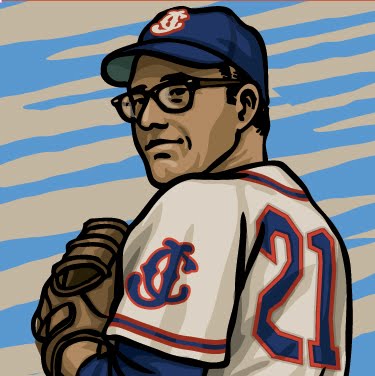
For my next several posts, I thought I'd try something different. Ever since I began this blog back in 2010, I consciously made an effort to not have any rhyme or reason to the order in which I presented my stories. One week would bring the story of Negro League legend Leon Day and the next could be turn of the century Federal League player Guy Zinn or a 1930's Japanese baseball player. I like the freedom to present whomever I am interested in at the time, and I think those of you who keep checking back here, or have purchased my books, do as well.
However, while working on this most recent story, I thought it would be interesting to do a series of three (or, to draw on my fancy art school background: a "triptych"), focusing on the trio who held the professional baseball single-season record for most home runs before it was broken by the steroid-addled Barry Bonds in 2001. I wanted to go back to a time when home runs and their records actually meant something. When the numbers 60, 61, 714 and 755 evoked a sort of hushed reverence, a marker that was seemingly unattainable. In the years before the Major Leagues expanded exponentially, dozens of star-quality ballplayers were stranded in the high minors, trapped in second and third rate cities where they tallied seemingly impossible records for most wins, hits or home runs. Because they were achieved in the minor leagues, their names are mostly a footnote today, but if one looks under the blankets and in the deep recesses of baseball history, you'll find guys like Joe Hauser waiting to tell their story.
In the five and a half decades after he retired in 1942, Joe Hauser was the go-to man for "what if", "hard-luck" and "where is he now" baseball stories. Hauser's career stretched from the Deadball Era of Ty Cobb through the Roarin' Twenties of Babe Ruth and on into the hardscrabble Depression Era 1930's. That he lived to be 98 years old made him one of the most interviewed ballplayers and a direct and priceless link back to the game’s Golden Age.
Joe Hauser was born on January 12, 1899 to blacksmith Andreas Hauser and his wife Mary, also called “Mamie.” The couple had emigrated from Austria to Milwaukee’s German-speaking 19th Ward in the 1880’s, and Joe was the fourth of an eventual six children that made up the Hauser family. With a large amount of mouths to feed, Joe quit school at the age of 14 and began working in a mill that built cement mixers. Hauling the heavy machine parts strengthened his wrists and forearms, inadvertently giving Hauser the attributes that would later make him a power hitter. Like all kids in his Milwaukee neighborhood, Hauser grew up playing baseball on any available vacant lot. He eventually graduated from the sandlots to a semi-pro team in one of the city’s saloon leagues where he became a pitcher with a blazing fastball. Known for high strikeout games, Hauser became known as “Zep” or “Zip” for the velocity of his fastball.
When he reached the age of 18, Hauser was recruited for a town team in Waupun, Wisconsin, where he played with and against men much older than him, many of which had previous minor league experience. When he began regularly striking out more than a dozen batters each game, he attracted the attention of Philadelphia Athletics owner and manager Connie Mack. Mack invited Hauser to the Athletics spring training in 1918, but the teenager proved to be too wild and raw to be any use for the Athletics. The kindly Mack paid for Hauser’s train ticket back to Milwaukee and $100 for his time, something that was rarely, if ever, done for failed prospects at the time.
When Joe got back to Milwaukee, his hometown Brewers signed him up. The Brewers played in the American Association, rated by organized baseball as an AA league, one level below the majors. Hauser was still too inexperienced for the AA level and he was optioned to the Providence Grays of the Eastern League. When he was unimpressive in his only outing on the mound, the Grays switched him to the outfield where he began hitting. After spending 1918 and 1919 in Providence where he batted .271 and .273 respectively, Hauser was recalled back to Milwaukee by the Brewers. While his average stayed well over .300, his fielding left much to be desired. At this time, Hauser acquired the curious nickname he’d have for the rest of his long life: “Unser Choe.” When fans at Milwaukee’s Borchert Field heckled or ridiculed Hauser’s play, the local German-American’s in the grandstand would yell back “leave him alone, das ist unser Choe!” “Unser Choe” was German for “Our Joe,” pronounced in the dialect particular to Milwaukee.
Though his batting average was going up each season, his lackluster fielding threatened to keep him a bush league ballplayer for all eternity. Fortunately, Brewer’s manager Jack Egan came up with the brilliant idea to move the budding slugger to first base, and just like that, everything came together for Joe Hauser. When the Athletics came to Chicago to play the White Sox, Connie Mack traveled to Milwaukee to see Hauser play. Tipped off that the great man was in the stands, Unser Choe banged out four hits including a home run. The notoriously budget-conscious Mack shelled out a reported $50,000 and four players to obtain Hauser’s services for 1922. When his contract came in the mail early in 1922, Hauser sent it back to Mack, telling the Athletics owner he would have to boost the pay. It seems that the Brewers had promised a bonus to any player who hit a home run in Milwaukee, and Hauser wanted his money. Mack tried playing hardball with the brash rookie, telling him that his beef was with the Brewers and not the Athletics, but Unser Choe wouldn’t budge. Finally, with the Athletics headed to Fort Myers for spring training, Mack appealed to Henry Killilea, Brewers owner, to convince Hauser to sign. After fruitlessly chasing Hauser’s shadow all over Milwaukee, Killilea finally got the kid’s signature on a Philadelphia contract when he told him to either sign or be out of organized baseball. It worked, and Killilea bundled Hauser onto that evening’s train south to Florida.
Though he was untried at the big league level and lacked the polish of a veteran, Hauser had confidence in his talent. When he made mistakes, he listened intently to the advise of his teammates and Connie Mack, firm in his belief that he would never make the same mistake again. Won over by his positive attitude, the veterans on the Athletics took to the friendly Midwesterner, dubbing him “Dutch” for his German accented phrases.
Unser Choe played 111 games for the 1922 Athletics and hit big league pitching at a .323 clip. He recorded only 15 extra base hits, but 9 of them were home runs. When the Athletics came to Milwaukee to play an exhibition game, it was “Joe Hauser Day” at the Borchert Field, and the hometown hero was showered with gifts including a bowling ball and shoes to go with it. The next season his average dipped a bit, but he almost doubled his home run production, thus solidifying his place as the Athletics starting first baseman for the foreseeable future.
With baseball as his only profession, Hauser was careful to ensure that he was in top condition to practice his trade. He ate heartily - but in moderation, and kept himself to only a single beer when out with teammates - two when he really wanted to cut loose. He had also gotten married to Irene Kaye, lovingly called “Mama” by her husband. The couple set up house in Philadelphia where they lived in serene domesticity during the regular season. Mama would be by his side for the next 62 years as he traveled the country playing baseball. Back in Wisconsin during the off-season, Hauser played indoor baseball with Athletics teammate and fellow Milwaukeean Al Simmons to keep in shape. This strict regimen, plus his natural talent, combined to make 1924 Unser Choe’s breakout season.
Today, when one looks at the list of home run totals for 1924, Babe Ruth’s name appears at the number one spot, and just below him at number two is Joe Hauser. His 27 home runs that year was something of a feat, especially since the next highest total was 19. In fact, Unser Choe hit more home runs by himself that year than the entire Boston Braves (25) and Washington Senators (22) did collectively as a team. All those teenage years spent working in the cement mixer factory had made Hauser’s wrists into home run hitting machines. At just 25, Unser Choe looked like he had a long, successful big league career ahead of him, following in the wake of Babe Ruth as one of the game’s first power hitters.
Just before the 1925 season, the Athletics played their traditional “City Series” against the Phillies for the championship of Philadelphia. With no one on the bases, a Phillies batter hit a ground ball to the shortstop. As the fielder retrieved the ball, Hauser ran towards first to receive the throw and touch the base for the out. A simple, textbook play, one Hauser had executed hundreds of times – only this time something unexpected happened. For no apparent reason, Hauser’s right kneecap snapped in two pieces. Surgeons operated and managed to secure the two broken pieces with gold wire, then covered the whole leg with a cast to begin the long recovery process. With a long recuperation on the horizon and no guarantee he’d ever play ball again, Hauser was voluntarily retired from professional baseball and he and Irene returned to Milwaukee. When the cast was removed, Hauser tried to stay active, even appearing in exhibition games with the Athletics when they played close to Milwaukee. Mack sent him to farm team in Federalsburg, Maryland for a short time to work with young players. Hauser would draw on this brief experience many years later when he would become a minor league manager.
After sitting out the entire 1925 season, Hauser was pleased to report that by Christmas he was able to walk and move the knee with no perceivable side effects. That spring Hauser worked with Kid Gleason, former manager of the 1919 White Sox, now Connie Mack’s right hand man on the Athletics. Gleason had Hauser walk backwards, to strengthen the muscles. The walking evolved to running, and soon Gleason deemed Hauser ready for The Show again.
Unfortunately, the year off had played havoc with his batting eye, and Hauser was mentally not ready to subject his broken knee to rigors required of a big league first baseman. With his knee still stiff and bothered by the discomfort caused by the wires holding it together, Hauser batted a disappointing .192 after 91 games. For 1927, Mack sent him to the Kansas City Blues in exchange for their first baseman, Dud Branom. While in K.C., Unser Choe regained his home run swing and cemented his reputation as a long-ball prodigy. Kansas City’s Muehlebach Field was a home run hitter’s worst nightmare, with a right field wall some 400 feet from home plate, surmounted with a 30-foot fence. No one hit home runs out there – until Unser Choe came to play. When his blast cleared the wall, fans collected over $250 dollars to give to Hauser in recognition of his achievement. The next afternoon, Hauser repeated the feat, again raking in a couple hundred dollars from grateful fans.
That summer, Hauser really murdered the ball, bashing 49 doubles and 22 triples to go with his 20 home runs and gaudy .353 batting average.
 After Dud Branom proved worthy of his nickname, Mack brought Hauser back to Philly in 1928, but by this time the Athletics were a much different ball club. With Mickey Cochrane, Jimmie Foxx, Joe Boley, Al Simmons, Lefty Grove and George Earnshaw, Mack had assembled what may have been the greatest dynasty in baseball history, winning three pennants and two World Championships from 1929 to 1931. The 1928 team featured the great Ty Cobb, now wrapping up his Hall of Fame career with Mack’s club. Hauser started the first month of the season hitting .375 with 7 homers, then he began to slump. Hauser later blamed his plummeting average on none other than Ty Cobb, who he claimed sabotaged his batting style with bad advice because he was jealous of being out-hit by Unser Choe. Cobb reportedly advised Hauser to crowd the plate, which just resulted in him fighting off pitches and robbing him of his greatest asset, those strong wrists and forearms. Why did Hauser listen to Cobb? Maybe because he was the greatest hitter ever to play the game and even at the age of 41 he would hit .323 that season.
With Hauser’s average sliding backwards and Jimmie Foxx moving from catcher to first baseman, Mack sold Unser Choe to the Cleveland Indians. Unfortunately, with future batting crown winner Lew Fonseca already ensconced at first base, Cleveland had no use for Hauser besides as an occasional pinch hitter. When all he could manage was .250 off the bench, Cleveland sold the now 30 year-old to the Baltimore Orioles.
Baltimore played in the International League, one of the three AA leagues that, like the American Association, were right below the majors. While many ballplayers would have been discouraged by the demotion, Unser Choe resigned himself to a minor league career. Part of his contentedness might have been that because of his major league contract, he was still drawing his big league paycheck. As the country slipped deeper into the Great Depression, the $6,500 salary took the sting out of being back in the minors. When he arrived in Charm City, Hauser took the advice of the team’s shortstop, Heine Sand, and switched to a slightly lighter bat. The lightened stick enabled Hauser to get around quicker on the ball, bringing to bear all the power of his wrists. That summer Unser Choe pounded home run after home run as he chased the professional baseball single-season home run record. While Babe Ruth set the major league record with 60 in 1927, several minor leaguers surpassed that total, the most recent being 62, set in 1926 by Moose Clabaugh. Aided a little by some of the league’s short fences, Hauser closed in on the magic number and bested it by a single round tripper, setting the bar at 63.
The next year when the Orioles were in New Orleans for a spring training exhibition game, a local radio station invited the new home run king to come into the studio and give a little talk over the airwaves. Since Joe was a school dropout at 14, he felt more comfortable having his wife Irene write a 16 sentence speech for him to read. More concerned with baseball than broadcasting, Unser Choe read the entire 16 sentences without pausing for any comma or period, finishing the speech in one mad dash. When asked about his breakneck reading after it aired, Unser Choe simply replied that it “wasn’t any use to stop and tag all the bases during the exhibition season.” It’s peculiar eccentricities like this that makes it a shame that Unser Choe wasn’t more of a success in the big leagues. With a vocabulary punctuated with phases like “gin!” and “yaaaaah!” when excited and “grab me?” to ask if one understood what he was trying to say, Hauser really was a sports writer’s dream come true.
Hauser finished the 1931 season again at the top of the home run leader’s list, though this time with a more human 31 homers. Troubled by a nagging groin injury, his average also buckled to a low .259. With his age now at the elderly 32 mark, Baltimore figured Unser Choe was on the downside of his career and put him up for sale. The Minneapolis Millers of the American Association snapped him up, a move that quickly paid off when he hit 49 home runs and brought his average back up to .303. His bat helped win the Millers win the 1932 pennant, where they faced the Newark Bears in the Junior World Series. In the 6-game loss to Newark, Hauser managed only 5 hits, but three of those were home runs.
1933 began with a crushing disappointment when Hauser received his new contract. Instead of the $6,500 salary his former big league contract ensured him, Unser Choe was now required to accept a standard minor league contract. The $2,400 number was quite a comedown, but with the country engulfed by unemployment, Hauser had no choice but to sign.
Perhaps smarting from the pay cut, Hauser began 1933 in a tough slump. No home run came off his bat in the team’s first nine games, all played on the road. In the Millers’ home opener, Unser Choe finally connected for a long-awaited home run, a three-run shot over the left field wall. The next afternoon Hauser pounded out three homers, including a grand slam, and never looked back. In June he had more than 30 to his credit; in July he homered in seven straight games and in early August broke the old American Association home run record of 54 - and the home runs kept coming. On August 20 he hit number 60, becoming the only man in the history of the game to record two seasons of sixty or more home runs. He ended the season with 69, the new single-season record for home runs. He also set the league record for total bases with 439 and led the league with 182 RBIs.
Now the Home Run King of the Minor Leagues, great things were expected from Joe Hauser in 1934, and from the start, he delivered. He hammered 17 home runs in the month of April, then injured his left knee - his good one, and sat out three weeks. Still, Hauser came roaring back and with 33 homers going into the last week of July, looked to be on a pace to eclipse his own record. Then, havoc struck. Rounding third and headed for home trying to score, Hauser collapsed in a heap, his left kneecap shattered into three pieces.
Unser Choe’s baseball career was effectively over.
When the knee healed enough to think about resuming some kind of baseball career, Unser Choe was in his late 30’s, ancient by baseball standards. His name and reputation was still potent enough that several low-level minor league teams offered him contracts, but the money was a far cry from his Minneapolis salary and not enough to support he and Irene. Then, the semi-pro Sheboygan Chairmakers offered Hauser a $300 a month contract to be their player/manager in 1938. The team soon joined the Wisconsin State League, and Hauser piloted the team to back-to-back pennants in 1940 and 1941. The war shut down the league and Hauser went to work outside baseball for the first time since he was a teen. After the war, Sheboygan became part of the Dodgers organization and Unser Choe managed his team to pennants in 1947, 48 and 51. By this time, another player had matched Unser Choe’s magic number of 69, and in 1954 his hallowed record would be broken. After a short stint with another Brooklyn farm club, Unser Choe and Irene returned to Sheboygan and opened up the Joe Hauser Sports Shop.
The Home Run King retired in 1984, and his beloved Irene passed away in 1986. The couple had made the decision early on not to have children because they did not want to subject them to the transient life of a ballplayer, so Hauser spent his twilight years more or less alone, with baseball fans and historians as his only company. And that seemed to be alright with Unser Choe, spending the last decade of his long life as one of the most entertaining bards of the old game, never tiring of telling the story of his unique place in baseball history to anyone who sought him out.
Like most old time ballplayers, Unser Choe was both bemused and disgusted by the modern player. He never understood how players from opposing teams engaged in friendly interaction during games. In his time, when one had the other uniform on, you were the enemy. He found it silly when young fans asked him about Babe Ruth, implying that he must have been on great terms with the Yankees slugger. Hauser always insisted that that wasn’t the case. Sure, he said hello to the Bambino when he ended up at first base, but that was the extent of it. The Babe played for the Yankees and Unser Choe was an Athletic. It was as simple as that. Watching the prolonged curtain calls, fist-pumps and backslapping that now went on after every single major league home run, Hauser reflected on how in his time, there was none of that. One just ran around the bases and returned to the dugout, waiting and hoping to do it again.
This story was partially built from several very good interviews Unser Choe gave during the last few decades of his life, in particular the one included in Tony Salin’s terrific book Baseball’s Forgotten Heroes: One Fan’s Search for the Game’s Most Interesting Overlooked Players. Also, Norman Macht’s Connie Mack: The Turbulent and Triumphant Years, 1915-1931 contains some great material on Joe Hauser and how well respected he was by the Athletics’ manager. Both those books are must have’s for any baseball library. Of course, the life’s blood of any great baseball history story are the original newspaper articles written during the time the events took place. Since Joe Hauser and his minor league home runs were such great news back in the 1930’s there are many detail-packed feature stories on the ball player to be found in Milwaukee, Baltimore and Minneapolis papers.
Stop back late next week when I bring you the second of this three part feature on the single-season home run kings of yesteryear…

When
I first started this blog back in 2010, I started
receiving many requests for players to be profiled and given The
Infinite Baseball Card Set "treatment." Out of all the emails, I began
to notice that it was not one particular player that was asked for the
most, but rather an ethnic group: Jewish ballplayers. Early on I had illustrated cards
and written stories on the site of Sandy Koufax and Moe Berg, but I began slowly researching different players who shared the Jewish faith,
trying to find characters who would fit in with the kind of stories I
like to write - players with interesting stories who may not be known to
the casual fan of baseball history. The modest research I did culminated in the Test Issue of "21: The Illustrated Journal of Outsider Baseball" which featured 12 profiles of Jewish ballplayers. This prototype became the model in which I based the current incarnation of "21".
I was never happy with that original product, and eventually I plan to do a more elaborate "21" dedicated to Jewish ballplayers. In the years since the original, I have been steadily adding to my Jewish ballplayers file, one the characters in there being Cy Malis.
Cy's single game for the 1934 Phillies earned him place in all the books on Jewish ballplayers, but it is the rest of his story that makes him so much more interesting. Plus, digging into Cy's career was for me a researchers delight, as I found that the extent of his pro career that can be found in record books and online is quite incomplete. Old box scores and creative searching enabled me to fill out Cy's minor league career quite a bit more than any other source that I've been able to find. And then, from an artistic point of view, the uniforms worn by one of Cy's semi-pro teams were so visually stunning that I couldn't wait to depict Cy in full color.
So, with that teaser, I'll get right into Cy's story...
Cy Malis was born in Philadelphia, the second son of Frank and Anna (called "Ray") Malis. Both Frank's parents were from Russia while Ray's father immigrated from Jerusalem and her mother from Russia. Frank worked an an inspector for the Philadelphia Rapid Transit Company and Ray kept house in the family's apartment on 10th Street. Ray and Frank were married around 1905 and their son Charles was born shortly afterward. The Malis' second son, Cyrus came along on February 26, 1907. Both boys played baseball, working their way up the sandlot ranks. Charles was an infielder while Cyrus - who was now going by "Cy" - was, appropriately enough, a pitcher. While Charles played for Central High, Cy starred for Brown Prep School, lettering in basketball and football as well as baseball. In his sophomore season with Brown, Cy posted a 15-4 record and struck out 22 in a game against Villanova Prep. It appears that Cy left school after his second year, joining the vibrant semi-pro baseball circuit around Philadelphia.
Like other large eastern cities, Philly boasted many top-rank semi-pro clubs. Youngsters began playing for their local neighborhood athletic clubs, then, if they were good enough, were either hired by a large company who sponsored a team or was invited to join one of the semi-pro traveling clubs who were just a step below the minor leagues.
Cy Malis' first stop was with the Waco Athletic Club. His brother Charles may have preceded him on the team, for both their names frequently appear in box scores at this time. Waco played other medium-level teams in Philadelphia and South Jersey. Then, in mid-August, Cy began pitching for the formidable Hebrews club.
The Hebrews, also known as the Sphas (South Philadelphia Hebrew Association), were one of the better semi-pro clubs in the Philly-Trenton area. The South Philadelphia Hebrew Association began sponsoring athletic teams around World War I, and by the early 1920's had become known not only for baseball, but for their basketball team as well. In fact, the basketball team actually turned pro, first joining the Eastern League in 1929, then the American Basketball League in 1933. When the NBA was formed after World War II, the Sphas best players splintered off to form the nucleus of the Philadelphia Warriors.
With the baseball Sphas, Cy not only had a first rate ball club backing him up, but he also had good press coverage with would help further his career. His competition was also of a higher class, playing against the various traveling teams that criss-crossed the country before World War II, such as Jim Thorpe's Indians and various Negro League clubs.
Cy's half season with the Sphas earned him an invitation to spring training with the minor league Wilkes-Barre Barons in 1925. The April 24 edition of the Scranton Republican said the Malis "has shown plenty of form in the preliminary workouts", but just two days later he was back in Philly pitching for the Waco A..A. and later the Sphas again. Still only a teenager, Cy had plenty of time to develop into professional material.
Malis' second chance at organized ball came along the following spring when he was signed by Petersburg Broncos of the Virginia League. In his professional debut on April 14, 1927, Malis was sent in to relieve Petersburg starter Lefty Fowlkes, pitching an inning and third, allowing a hit and two walks plus a balk. Richmond scored a run, but it was charged as an error since the outfielder dropped the ball. Soon both Cy and Lefty Fowlkes were shipped to the Northampton Red Sox of the Eastern Shore League. Malis started off the season well, winning five consecutive games, but overuse took a toll on his arm. When Cy asked management for some time off to rest his tired flinger, the Red Sox handed their ace pitcher his release. 1920's baseball was a cruel and impersonal sport, and back then a pitcher, especially a young one, was expected to pitch a complete game every time he took the mound. With minor league rosters consisting of only 15-18 players, clubs couldn't afford to carry too many pitchers, so the ones they had were used as often as possible. When Cy raised an issue about over use, it was only natural that the club would choose to jettison their ace instead of working with him, the reason probably being that if his arm is feeling fatigue now at this low level, how could he make it all the way to the majors? Minor league teams back then made their payroll by selling off their good players to higher level clubs - thus, a sore arm pitcher was of no monetary value to them. Sound front office reasoning in 1927. Fortunately for Cy, one other team in the league, the Cambridge Canners, were willing to take a chance with him. Working out of the bullpen, he finished out 1927 with a 5-6 record.
Despite a mediocre record, a team quite a bit higher up the food chain than the Cambridge Canners became interested in Cy - his hometown Philadelphia Phillies.
Like
most big league teams, the Phillies were always on the look out for
home grown talent, a native son that could blossom into a star that
would in turn put more fans in the stands. As the Phils were perennially mired in last place, it would take something or someone interesting to get fans to shell out the money to watch a lousy team. With his well publicized
mound exploits with Brown Prep and the Sphas, Cy Malis was a perfect candidate to be that someone interesting. The
Phils signed him for 1928 and shipped him off to their Lynn Papooses farm team in the New England League. From the skeleton of statistics it looks like control was Cy's biggest obstacle - for instance in the June 1, 1928 game against Salem, Cy pitched the first 3 2/3 innings, giving up 4 bases on balls and a hit batter, taking the loss. On June 12 Cy lasted 5 1/3 inning against Brockton, issuing five free passes and 12 hits for another loss. By mid-June his record was no wins and four losses in 12 innings pitched. The Papooses released him, and Cy went back to the Philly semi-pro circuit.
Every source I found on Cy Malis has no professional record for him in 1929, but I dug up some newspaper articles that say otherwise. A small article written about Cy a year after his death in 1971 states that he had played in the Philadelphia A's farm system. I thought that perhaps this was a misprint, mistaking the Philadelphia Phillies for the Philadelphia A's. Or, I thought it might have been Cy or a relative of his doing a little creative remembering, switching out the last place Phillies for the 1929 World Champion A's. Much to my relief (I don't relish debunking little white myths held dearly by old ball players and their descendents), the article actually held up to my research.
Seems that Cy had attracted the eye of his hometown's other big league team, Connie Mack's Philadelphia Athletics. The A's were right at the beginning of what would be an incredible three pennants and two World Championships, a team thought to be the greatest ever assembled in Major League history. The A's signed Cy to a minor league contract, sending him to their Martinsville White Elephants team in the Blue Ridge League. I found several box scores that record his record with Martinsville. On April 25, 1929, Cy pitched 4 innings, giving up 6 hits, 2 walks and striking out 2 against Hagerstown. On May 11 he gave up 5 hits in 5 1/3 innings of relief, walking no one and picking up the win over Chambersburg. Cy pitched one more game before he was released, his final 1929 record set at 13 hits, 6 runs, 13 walks, 3 strike outs and a wild pitch in 16 innings.
Once again Cy returned to the Philadelphia scene where he was now a much sought after arm for hire. Besides his regular gig with the mighty Sphas, box scores show Cy appearing for several other teams in the area. The Jersey Shore was a particularly lucrative spot for semi-pro ball, as all the beach communities competed against one another to field the best ball team. Not content to hire just a few ringers to supplement their team, some town hired complete semi-pro outfits to represent them. Cy was with the Trenton Club when they were rented out to represent the town of Bradley Beach.
In 1933 Cy was hired by the Berlin, Maryland team to help them beat rival Dagsboro in the five-game Eastern Shore Championship Series. Malis pitched Game 2, shutting out Dagsboro on six hits. The "Quaker City speedball artist" was tabbed to pitch the deciding Game 5, but served up three home runs early on which gave Dagsboro the game and championship.
In 1934 he was back with the Sphas. On July 29, Malis pitched and won a 14 inning marathon at Paterson, N.J., then came back to Philly where the next night he pitched a one-hitter for the Bartram club. Cy's continued good press inevitably was noticed by the moribund Phillies. For the second time, Philadelphia signed Cy Malis to a contract, but where as back in 1927 he was farmed out to the sticks, this time he was issued a uniform with number 49 on the back and sent to join the big club.
On Friday, August 17, 1934 Cy Malis made his major league debut against the Cardinals at Sportsman's Park in St. Louis. The Gas House Gang Cardinals were on their way to a World Championship with a line up that featured future Hall of Famers Joe Medwick, Frankie Frisch, Pepper Martin and sluggers Ernie Orsatti and Ripper Collins. Their mound corps was led by the Dean Brothers, Dizzy and Paul, who would collectively win 49 games that summer. In the bottom of the 5th, the Cards were up 7-2 with Phillies reliever Reggie Grabowski on the mound. Burgess Whitehead led off with a single and with one out, advanced to second when Frankie Frisch got a base on balls. Joe Medwick smashed a long single to center, scoring Whitehead and moving Frisch to third. Medwick then stole second, sending Grabowski to the showers.
Phillies manager Jimmy Wilson waved Cy Malis in from the bullpen. With men on second and third, Malis faced Ripper Collins who quickly hit a double to riht field, scoring Frisch and Medwick. Cy got Bill Delancey to fly out to center field but then lost Chick Fullis to a base on balls. Now with two on and two away, Leo Durocher stepped in and hit a flyball to right which was caught to end the inning. Wilson left Malis in to pitch the 6th, during which he gave up a single to lead off hitter Paul Dean, then got two quick pop outs. Frankie Frisch reached base on an error but Malis got Medwick to fly out to left, ending the 6th. Cy Malis' spot was first up in the top of the 7th and he reached base when he was drilled by a Paul Dean pitch. Malis watched Dean expertly dispose of the next three Phillie batters and was left standing on second base when the inning ended. In the bottom of the 7th Malis gave a lead off walk to Ripper Collins who was then caught stealing second. A fly ball out and a strike out ended the seventh. The Phils failed to score in the top of the 8th and the score remained 10-2. In the Cards half, Mailis gave up a single to Durocher, followed by a Paul Dean fly out. Burgess Whitehead ripped a triple to left-center, scoring Durocher. Whitehead scored on a long fly out to right field but an infield pop fly by Pat Crawford ended the inning. All the Phillies could manage in their last frame was a harmless single as St. Louis clobbered Philadelphia 12-2. Paul Dean picked up his 13th win of the year and Phillies starter Cy Moore took the loss.
All told, Cy's big league debut wasn't a disaster, but it wasn't lights out either: 3 2/3 innings, 4 hits, 2 runs, 2 walks and a strikeout. Remember, he was facing the eventual World Champions with a lineup overflowing with powerful bats. Still, that single game was to be the extent of Cy Malis' major league career. The Phillies released him shortly afterward.
Now a free agent, Malis was invited to spring training with the Los Angeles Angels of the Pacific Coast League. Despite reporting to camp overweight, Malis worked hard and lost twenty pounds in three weeks. Sportswriters were impressed with the hard work he put in, as were the Angels, especially after he held the team's veterans to a measly three hits in an intramural game. At this time the Angels were the top farm club of the Chicago Cubs and usually finished at, or near the top of the PCL each season. The Angels pitching staff boasted future Brooklyn Dodgers ace Hugh Casey, 28 game winner Fay Thomas, 20 game winner Mike Meola and future journeyman major leaguer Newt Kimball, but Cy's hard work gained him a spot as a reliever when the 1935 season started.
On March 28, Malis relieved Hugh Casey in the sixth inning when the Padres jumped on him for 6 runs. and pitched three innings, giving up three runs on three hits. In the April 3 game against Oakland, Malis was thrown in to stop an Oaks rally, but quickly got knocked off the mound himself as Oakland bulldozed two other Angels pitchers on the way to a 12-3 win. Malis then came down with the flu, which sidelined him for a few games. He pitched 1 1/3 inning of relief on April 12, giving up a hit and two walks. Two days later threw three innings against Portland, relinquishing 5 hits and 2 runs in the 10-4 loss. On April 16, the Angels handed Malis his walking papers. As he had back in Philly, Malis fell back on the semi-pro scene to make a living. In Los Angeles, Cy was eagerly picked up by Twentieth Century-Fox, which played in a league made up of all the major Hollywood movie studios.
Being recruited by a film studio not only let Cy keep a foot in baseball, but also opened up the door to his second career - acting. Malis made his celluloid debut in the MGM boxing picture "The Crowd Roars", as an uncredited extra. At this time dozens of studios were filming in the Los Angeles area and Cy found plenty of work. By 1940, he was married to an Alabama native named Jane, and the couple were living in a residential enclave of movie people on North Argyle Street in LA. Cy listed his occupation as "actor" and was recorded in the 1940 census and pulling in the nice yearly salary of $1500, a nice bump above the average worker at that time.
In 1942, a 35 year-old Cy enlisted in the Navy. It was during his short stint in the service that his life took an unexpected, and what could have been a tragic, turn. While undergoing gunnery training, one of the massive gun turrets swung around and slammed into Cy, breaking his neck and back. The accident landed him in the hospital for what would be a long, painful recovery period. From the start, the pain was so intense that Cy was unable to help loudly thrashing around in his bed and gnashing his teeth. To save both Cy's teeth and let the other patients get an undisturbed night's sleep, doctors prescribed morphine, the highly addictive opiate commonly used at the time for pain management. In small doses, under strict observance and over a short period of time, morphine was perfect for the job. However, in a crowded Naval hospital in wartime, Cy's use of morphine went unchecked.
Months later, when he finally was able to get his broken body out of bed, Cy came to the realization he could not function without morphine. He was hooked. Like shell shock (now called PTSD), morphine addiction was one of those little-talked about side effects of war. Thousands of wounded soldiers were treated and released back to their civilian lives with a dependence on the morphine that was supposed to heal them. Addiction to drugs and alcohol was something not fully understood during this time, yet Cy somehow recognized that his dependence was something he needed to get control of. With no program or treatment readily available to him, Cy began the difficult process of weening himself off the drug. However, behind Cy's morphine dependence was the still crushing pain of his injured neck and back. To make this constant pain manageable, the old ballplayer turned to alcohol. Looking back from the 21st century, we know that this was just substituting one evil for another, but in 1943 being alcohol dependent was much more acceptable than being a junkie. In the spring of 1943 the Navy gave Cy his discharge and he returned to civilian life. While his back and neck gradually healed, Cy went to work ratcheting down his intake of alcohol as a pain killer. It must have been unbelievably hard work, taking almost superhuman inner strength, but somehow he managed to do it.
With his part in the war through and his addiction under control, Cy threw himself back into Hollywood. He quickly became an often used extra, working with famed directors John Ford, William Wellman and Robert Wise. The list of actors he shared the screen with reads like a who's who of Hollywood's Golden Age: Gregory Peck and Lauren Bacall (Designing Woman), Lucille Ball (The Fuller Brush Girl), Cary Grant and John Garfield (Destination Tokyo), John Wayne and Richard Widmark (The Alamo), even Shirley Temple (The Story of Seabiscuit). Malis is even credited with being a stand in in for two different Stooges, Larry and Shemp. Besides his work in front of the camera, Cy was able to leverage his pro baseball experience into a couple technical advisor rolls on the baseball pictures "It Happened in Flatbush" and "Flashing Spikes".
Through all this Hollywood work, Cy still had to deal with his morphine and alcohol withdrawal. In 1953, a forward thinking LA Sheriff's narcotics detective approached an Alcoholic Anonymous member with the idea that a similar organization focusing on drugs might help the growing number of heroin and speed addicts in his city. In mid-July, the very first meeting of what would become Narcotics Anonymous was held in a church in the Moore Park neighborhood of Los Angeles. Among the handful of people present was Cy Malis and Jimmy Kinnon. The small group hashed out the pillars of the budding organization and in a few weeks Kinnon would be elected Narcotics Annonymous' first leader and accepted "founder".
Despite being present at the very beginning and taking part in its initial program, Cy charted his own course separate from NA. In his spare time he appeared before groups telling the story of his own addiction and the long, painful route he traveled in order to kick it. In the 1950's this was a very brave thing to do as drug addicts were considered the lowest of the low, and to admit to being one took an awful lot of guts. By the late 1950's Cy realized that while groups such as Narcotics Anonymous helped people out on the streets, nothing was being done for addicts behind bars. It was in the prison system that Cy Malis found his calling.
Cy Malis now became the main driving force behind helping convicts overcome their addiction and subsequent withdrawal. So successful was Cy that when the assistant warden of San Quentin was being interviewed about drug addiction problems in his prison, the jailer responded "they have improved vastly since Mr. Malis started his program. But perhaps the greatest compliment came from a former inmate and admitted addict who, when introduced to Cy called him "the best friend we dope fiends have". This wasn't a hollow compliment - back in the 1960's when this took place, dope addicts were an ignored and disparaged part of society, one for which good people did not consort with, let alone try to help. In this hostile atmosphere, Cy Malis bravely stepped forward to offer a hand to those who needed it, and he in turn was revered for it.
In between acting and technical advising in Hollywood and offering a lifeline to thousands of addicts behind bars, Cy also found time to coach Little League. The old ballplayer even managed his club to the league championship in his first summer as skipper. A kick by a horse on the set of a movie injured Cy to the point that it effectively ended his movie career and his health deteriorated. Cy's brother told a sports writer that shortly before Cy's death in 1971, the two brothers were visiting New York when a friend showed Cy a copy of the 1970 Philadelphia Phillies yearbook. Inside was a list of all the players who appeared in a Phillies uniform over the course of the team's history. There, under M's was Cy Malis. Charles told the sports writer that his brother was quite pleased at the remembrance of his one day as big leaguer.
Cy passed away on January 12, 1971, just 63 years old.
Cy Malis' big league career might have lasted but a single afternoon and takes up no more than a single line of statistics, yet his life can not be measured in stats or amount of space in a record book. Cy's personal experience of taking a tragic turn of events and making it mean something helped thousands of people. With them, Cy Malis' winning percentage was 1.000, no matter what the record book shows.
A few weeks ago, a 97 year-old ball player passed away. This just wasn't any ball player, but a guy whose 1943 debut marked him as only the second Puerto Rican to play in the major leagues. While that's something, Luis Olmo's story encompasses so much more than race, or an ethnic first (or, in his case, a "second"). It's the age-old story of a kid, born in a far away place, who had a dream of making the major leagues. It's a story of big shot baseball executives pulling out all the stops in order to get their hands on the talented and unsuspecting young man. And it's a story of how a former big leaguer lived out the final chapters of his life graciously sharing the story of his modest part in the history of the game he loved so much. Because much has already been written about his major league career, I'll recount the early part of Luis Olmo's journey, which, if you ask me, is much more fascinating than coughing up a list of firsts, dates and hard statistics.
Luis Francisco Rodriguez Olmo was born in Arecibo, Puerto Rico in 1919, the third of four sons born to carpenter Jose Francisco and his wife Ana Olmo. Of the four boys, Luis was the only athlete, encouraged by his oldest brother, Jose. Luis would later relate that he had been playing baseball since he was born, but he also excelled in several other sports such as basketball, soccer and track. At first, Olmo aspired to become a major league pitcher, but an injury suffered throwing a javelin ended his mound hopes at age 15. Luis' older brother Jose was a subscriber to The Sporting News, and through its pages the younger Olmo idolized Cubs second baseman Billy Herman, so he made the switch to the keystone sack. Continuing his schooling, Olmo moved to the city of Caguas to attend high school. Because the school offered no other sport except baseball, Olmo perfected his game without distraction. Playing second base, outfield and occasionally catching, Olmo evolved into a promising ballplayer, but Caguas was a long way away from the big leagues.
With the Great Depression in full swing, the road to the minor leagues in America was choked with thousands of American-born hopefuls trying to gain a foothold in organized baseball. Besides being born far away from the nearest minor league team, Olmo's dream of becoming a big leaguer was further hindered by the language barrier. A Spanish-speaking prospect had to show promise above and beyond an ordinary English-speaking player in order for a team to take a chance on him. And before that, he had to first catch the eye of a scout. Fortunately, Luis Olmo came of age at the perfect time in Puerto Rican baseball history.
Though Puerto Rico had a rich amateur baseball circuit, the island did not have the professional league that neighboring Cuba did. That changed in 1938 when the Puerto Rican Winter League was formed. For the first time, Puerto Rican players could showcase their talent at home as a group instead of scattering to other countries around the Caribbean and North America. The undisputed attraction that initial season was Millito Navarro, the first Puerto Rican to play in the Negro Leagues and a bonafide star. But that inaugural year also introduced the baseball world to a few young up and comers, among them pitcher Hi Bithorn of the San Juan Senators and Luis Olmo of the Caguas Creoles.
The teenage Olmo was recruited by his hometown team for the princely sum of $7 a week. Although he was young, the Creoles player-manager, Pito Álvarez de la Vega, knew in Olmo he had something special. The older man carefully mentored Olmo throughout the season, correctly assessing that this kid had what it took to make the major leagues one day. Olmo responded by hitting .335 his rookie season, generating much praise as the guy to watch in the near future.
Among those impressed with Olmo that first season was Jose Seda, a Puerto Rican baseball lifer who also scouted on the side for the Brooklyn Dodgers. The Dodgers had just begun a resurgence under the leadership of new general manager Larry McPhail. Flush with money and grandiose plans, McPhail hired Cardinals GM Branch Rickey's son, Branch Jr., to create and oversee a Dodgers farm system modeled on what his father had built for St. Louis. Seda had kept an eye on Olmo throughout the season, evaluating him as a prospective Dodger. However, Seda wasn't the only one with connections who was taking an interest in Olmo. A traveling salesman named Miguel Lloreda contacted Eddie Mooers, owner of the minor league Richmond Colts. The Colts were the only unaffiliated club in the Class B Piedmont League, and while the other teams relied on their parent club to provide players, independent owners relied on freelance tips such as Lloreda's to score talent. Whatever Lloreda wrote, it was impressive enough that Mooers decided to take a chance on the 19 year-old. At the conclusion of the 1938-39 season, the Colts wired Olmo money to take the steamship Barranquilla to New York where a team representative would meet him and accompany him to Richmond where he would sign a contract.
Now things began to get a little cloak and dagger. Just as Luis was getting on the ship to America, Jose Seda wired Branch Rickey, Jr.:
"Good ballplayer named Luis Olmo arriving on Barranquilla. Stop. Get him. Stop. -Jose."
Branch Jr. rushed down to the docks and waded through the disembarking passengers until he identified a guy who looked like a ballplayer. Using high school Spanish, Branch, Jr. was able to convince Olmo to accompany him back to the Dodgers offices in Brooklyn. Unfortunately, Rickey's Spanish wasn't good enough to convince the young Puerto Rican to put his name on a Dodgers contract. Rickey then bundled Olmo into his car and drove over to the home of Alberto Flores, a Puerto Rican third baseman that Rickey was on the verge of signing to a Brooklyn contract. Olmo was familiar with Flores, but when he and Rickey arrived, the third baseman was gone - he'd just signed a contract with the Richmond Colts.
Temporarily foiled, Branch, Jr. stalled for time while he decided how to proceed, stashing Olmo at a Dodgers safe house up in Harlem with another Puerto Rican prospect. In the meantime, the Richmond representative was desperately trying to track down the star import. With some pro sleuthing, Richmond's man was able to deduce that Olmo was Shanghaied by Branch, Jr., and then correctly figured he'd hide him with the Dodgers only remaining Spanish speaking prospect. Before morning, Olmo was located, his signature inked on a Richmond Colts contract, and on his way south to Virginia. Luis Olmo had slipped through the Dodgers fingers - for now...
Richmond placed their young import with the Tarboro Goobers of the lower level Coastal Plain League. The Goobers had no place for him so he was released and then optioned to the Wilson Tobs of the same league. Olmo got into 56 games and batted a credible .329. He returned to Caguas after the season fully expecting a contract for the next year - only it never arrived.
The reason he did not hear from the Colts was that the contract was sent to the wrong name and address: Roberto Olmo of Cuba. How the Richmond front office made that mistake is unknown, but by the time the 1939-40 Puerto Rican Winter Season began, Luis Olmo figured he was now a free agent.
Olmo once again manned the outfield for the Creoles. Word of the league's successful inaugural 1938-39 season had spread, and its sophomore year saw an influx of first-rate Negro League talent including Satchel Paige, Josh Gibson, Leon Day and Bill Byrd. Even when thrown into the mix with seasoned outsider baseball giants, Olmo continued to impress. Another Dodgers scout, Ted McGrew, approached the budding star about signing with Brooklyn, and, with no word from Richmond by March, Olmo signed a Dodgers minor league contract. Branch, Jr.'s reaction is unrecorded, but one can imagine the younger Rickey sinking into his leather chair behind his desk and lighting a celebratory cigar, just like his old man.
Olmo traveled to Macon, Georgia for spring training with the Elmira Pioneers. In one of his first exhibition games, Olmo's career almost ended when he tried breaking up a double play by coming into second base standing. He broke up the play, but at the expense of being beaned in the right ear by the throw. After being out for a half hour, Olmo recovered his senses, vowing to slide in the future. Meanwhile, Richmond noticed that their foreign import not only was absent from spring training, but his contract and all correspondence gone unanswered. Somehow word got back to Eddie Mooers in Richmond that Olmo was camped out in Macon with Elmira, the Dodgers newest acquisition. Now confronted with a second attempt by Brooklyn to poach his property, Mooers filed a protest with Minor League Baseball president William G. Bramham.
The Colts owner was able to convince Bramham that he did tender a contract in good faith before the contract deadline, even though it was mis-addressed. Olmo was awarded to Richmond for the 1940 season and the Dodgers contract voided. The Puerto Rican outfielder has slipped through Brooklyn's fingers - for the second time.
The name and nationality confusion prompted Luis' older brother Jose to write to The Sporting News correcting the misinformation printed about his kid brother. In a small piece printed in the April 18th edition, Jose penned: "His correct name is Luis Rodríguez Olmo, but he is known as Luis Olmo,
and he is a Puerto Rican, a proud American citizen. No doubt the
contract was not received by my brother because it was incorrectly
addressed. So far his name has been given out correctly only once, when
you published the reserve lists. Later he was called Lewis Elmo and now
as Roberto Olmo. Some confusion with Spanish names.”
Richmond sent Olmo back to the Wilson Tobs. At once it was clear he was well beyond the Class D level. By July he was batting just below the .350 mark with 18 homers. His superior play and potent bat had pushed the Tobs to a comfortable 18 game lead and locked in for the Coastal Plains pennant. He was called up to Richmond where he hit .271 to help the Colts take the Piedmont League pennant. Olmo returned to Caguas were he continued hitting, leading the Creoles to the Puerto Rican Winter League Championship. Olmo had turned a hat trick of pennant winners. 1940 was capped off with his marriage to Emma Paradis, a union that was still going strong when the old outfielder passed away seven decades later.
By now, Olmo was exclusively playing the outfield where his speed helped him make tremendous running catches. One of his trademarks was the basket catch. This later became a Willie Mays and Roberto Clemente staple, but Olmo had adapted this a decade before. There was a difference in styles, however: Mays caught his at waist level while Olmo positioned his glove chest-high. Clemente later credited his fellow countryman with teaching him the basket catch when he was in the minor leagues. Olmo was also blessed with a strong, accurate arm that made many runners think twice about taking an extra base.
1941 saw Olmo return to Richmond. Despite interest from major league organizations, Eddie Mooer held onto his prized foreigner, figuring another season or two of good stats would drive up his selling price. Olmo benefited from the extra seasons in Richmond, mostly due to his manager, Ben Chapman. Today, Chapman is known solely for his warped racism and the sick invectives hurled against Jackie Robinson when he was the Phillies manager in 1947. But before all that, Chapman was a truly outstanding ballplayer with several major league clubs. He was the Yankees lead off hitter in the early 1930's, and his bat and base running skills earned him a spot in the very first All-Star Game in 1933. He also had a fiery temper that got him into numerous on-field fights and led to his numerous uniform changes while in the majors. By the early 1940's, Chapman's career as a big leaguer was through, but he still had enough talent to become a respected player-manager in the minors. Whatever Chapman's feelings were towards Latinos, he became a huge influence on Luis Olmo, and the ball player later credited his Richmond skipper with teaching him more about the game than any other manager, coach or scout. The two men apparently were friendly away from the field as well. Olmo was a very talented pool player and he played his manager almost every day before lunch, loser buying the other man's meal.
I'll pause here to address the ever-present issue of race. Although Latinos had played in the majors since the early 1900's, they were still few and far between. Part of the reason was the language barrier, which could only be overcome by a player learning English. No team was going to spring for a translator when you could just reach into the minors and get a comparable English speaking replacement. Therefore, a Latino trying to make it to the majors had to be extraordinary. This was still a time of accepted ethnic stereotypes - heck, even Life Magazine ran a feature on Joe DiMaggio in 1939 that read: "Although he learned Italian first, Joe, now 24, speaks English without an
accent and is otherwise well adapted to most U.S. mores. Instead of olive oil or smelly bear grease, he keeps his
hair slicked with water. He never reeks of garlic and prefers chicken
chow mein to spaghetti."
Imagine what the perception of Puerto Ricans were to a public unfamiliar with the people or the culture of the island. Indeed, several of the profiles written about Olmo before or just after he made the majors made sure to remark how his mild manner was quite different from the stereotypical perception of the fiery Latin. This line from the April 8, 1943 edition of The Sporting News serves as an example: "Although of Latin lineage, Olmo is not hot-tempered".
Besides the perceived temper issues Latinos had to contend with, there was also the added problem of color. A whole rigid system of skin colors dictated what was and what was not acceptable in order to be labeled "white". Fortunately for Luis Olmo, his skin tone fell within the acceptable range. He was further fortunate in that his face was said to resemble Tony Lazzeri, the Yankees star second baseman of acceptable Italian heritage.
Despite a mug that resembled a Yankees All-Star, Olmo still had to deal with the occasional racial taunt and bean ball at the plate. These, he took in stride - he had to. The game was a whole lot rougher in the days before million dollar salaries and union reps. Gaining an edge in a game often came down to getting into the opposing player's heads - name calling and bean balls were two ways to achieve that. In order to make the majors, Olmo knew he had to accept and deal with these obstacles, and this he did, telling The Sporting News "But that is baseball. So I get up and hit again."
Olmo finished the 1941 season first in home runs and triples, second in hits and slugging percentage and fifth in batting average. In September he was given additional reason to celebrate when he and Emma welcomed their first child, a daughter they named Ana Lucy. In the winter he returned to the Winter League where he augmented Chapman's teachings by playing with and against Negro League superstars such as Josh Gibson, Lenny Pearson, Roy Campanella and Bill Byrd, the later pair his teammates on the Caguas Creoles.
Olmo had developed a batting stance that he later said was based on Joe DiMaggio's. He stood back in the box, feet spread and firmly planted, the bat gripped at the end and cocked way back. Olmo favored a Louisville Slugger of the Joe Medwick or Babe Ruth model, 35 inches in length and weighting 32 ounces.
The next year, Olmo again dominated the Piedmont League, this time leading in home runs, hits, triples and slugging, coming in second in batting average and doubles. He voted the most popular player in the league, but was edged out of the MVP Award by his manager Ben Chapman. Olmo's stock could get no higher in Richmond and Eddie Mooers knew this. The Luis Olmo bidding began, and in the thick of it was Branch Rickey, Jr.
Rickey had never forgotten the Puerto Rican outfielder that twice slipped from his grasp. Now that he was available, Branch Jr. made sure the Dodgers were in there with an offer. There was one big problem - his father, Branch Rickey, Sr. The elder Rickey had by now heard of Luis Olmo. The elder recognized the hustle and spark shown by Olmo, just the kind of player he favored for his Cardinals. Branch, Jr. knew this, and began maneuvering to keep his father out of the negotiations with Mooer. This covert operation was hampered by the fact that both men were staying under the same roof at the Rickey estate outside St. Louis. Branch, Sr. had an idea of what was transpiring, but his son successfully kept the old man out of the estate's telephone room while he hammered out a deal with Richmond. Branch, Jr's. evasive action worked, and Luis Olmo finally became property of the Brooklyn Dodgers.
While the phone lies were burning up between Richmond and St. Louis, Luis Olmo was traveling the long route back home for the winter. The war had made long distance travel a nightmare, and it took more than a week of waiting in Mami for Olmo to get a seat on a flight to Puerto Rico.
Waiting for him when he landed was his older brother Jose, bursting with news that he would be joining his childhood idol Billy Herman as teammates on the Brooklyn Dodgers.
This is story is just the very beginning of Luis Olmo's baseball odyssey. When he took the field as a Dodger rookie on July 18, 1943*, he was only the second Puerto Rican-born player in the majors (Hi Bithorn was the first, debuting with the Cubs in 1942). Olmo would later join the outlaw Mexican League in 1946, and then return to the Dodgers in 1949 where he became the first Puerto Rican to play and homer in a World Series. Before he ended his career in the mid-1950's, Olmo had playedball in not only the United States and his native Puerto Rico, but also Canada, Mexico, Dominican Republic, Cuba, and Venezuela, earning the nickname "America’s Baseball Player." In retirement he became the elder statesman of Puerto Rican baseball, active in his local SABR chapter and a living link to the island's first season of professional winter baseball that endures to this very day. Luis Olmo passed away on April 28, 2017.
*Olmo's debut game on July 18, 1943 was the second game of a doubleheader against Boston. The game was halted in the 6th inning locked a 4-4. The game was continued September 13, 1943, resulting in a 7-6 Boston victory. Purists may therefore say that Olmo's true debut was on July 23 against the Reds...
Special thanks to my friend Angel Colon, Puerto Rican Winter League historian who introduced me to Luis Olmo's story.