Showing posts with label Baltimore Elite Giants. Show all posts

Sunday, September 25, 2016

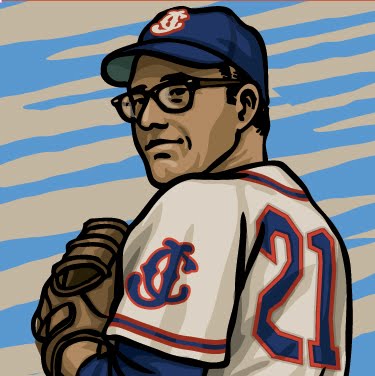
221. Wild Bill Wright: The Neglected Negro League Star


It's been a busy summer. Even though I tried to deny it, I wound up taking the summer off from writing this blog. It's not like I've been idle - on the contrary I've been both writing and drawing up a storm. It's just that every time I finish a story, I decide to include it in the issue of "21" that I'm preparing. I wish I could just go ahead and run some of the articles I've been cooking up - Lou Gehrig's Columbia days, Steve Bilko and the Summer of '56, Al Gizelbach (who? - you'll see!), spitballer and civil rights pioneer Doc Sykes - and the illustrations? Man, they're some of my finest yet. So anyway, I know this blog has been neglected too long. Summer Break is over and it's time to get back to basics. 

It's time to resume "The Infinite Baseball Card Set!

 Ever since I was a kid researching the Negro Leagues on microfilm and ancient bound newspaper volumes, I always wondered how certain players would have done had there not been a color barrier. I'm not talking about guys like Josh Gibson, Satchel Paige, Leon Day or Martin Dihigo - those guys were sure-fire big league stars. I'm talking about those second-tier stars, you know, the Dale Murphy's to the Wade Boggs'.

One of those players I often wondered about was a fella named Wild Bill Wright. I had first discovered Wright through old box scores, but it wasn't until I met a few oldsters in Baltimore who saw him play firsthand that I really came to appreciate him. For a time Wright was one of the premier stars of the Negro National League, and looking at his numbers and testimony from his peers, the name "Wild Bill Wright" should be well-known today. Yet for a few reasons it isn't.

Burnis Wright was born in Milan, Tennessee in 1914. By the time he reached his teens he grew to the then enormous height of 6'-4". Because of his imposing stature, Wright was put to work as a pitcher where he earned the moniker "Wild Bill" from his inability to find the strike zone. In spite of being built like a football player he possessed lightening speed and graceful agility, making him perfect for covering outfield pastures.

Somewhere along the way he taught himself to hit from both sides of the plate, and word got around that Wright was something special. Being from Tennessee, it was only natural that the big kid signed with Tom Wilson's Nashville Elite Giants in 1932. Wilson was a typical 1930's Negro League owner - he made his money through a combination of legit businesses and illegal enterprises like the illegal lottery, called "the numbers" back then. Although Wilson kept his base of operations firmly rooted in Nashville, he was forced to move his Elite Giants through a succession of different cities in search of the most lucrative market. The teenager they called "Wild Bill" began working out with the Elite Giants, then eased into exhibition games, all the while learning about professional Negro League ball by watching the veterans.  Finally, in 1933, he began playing against other top-shelf Blackball clubs. The 19 year-old hit .328 - today a respectable average - but in 1933 Negro League offensive numbers were sky-high, so Wright was considered still a novice. This changed when he went West during the winter and played in the California Winter League. This loose semi-pro circuit was made up of a few all-white teams that featured major and minor league stars who lived on the coast and one all-black club filled with the best talent Blackball had to offer. This time Wright held his own not just against the white professionals but also the Negro League stars - his .351 average was bested only by Cool Papa Bell and Willie Wells, two future Hall of Famers.

In 1935 Tom Wilson moved his Elites to Columbus, Ohio trying to find a larger black audience for his team. Wright was batting close to .300 when he was voted to his first East-West Game, the Negro League's All-Star classic held in Chicago's Comiskey Park. Representing the East, Wright struck out as a pinch hitter. 1936 saw the Elites relocate again, this time to Washington, D.C. and again Wright was voted to the East-West Game. As a nod to his burgeoning talent, the 22 year-old was asked to join a Blackball all-star team that competed at the 1936 Denver Post Tournament, the World Series of semi-pro baseball. Five of the players on the champion Negro League team - Josh Gibson, Satchel Paige, Cool Papa Bell, Ray Brown and Buck Leonard, are now enshrined in Cooperstown. 1937 was probably Wright's best year, at least in the Negro Leagues. Besides hitting .387 and being among the leaders in all offensive categories, Wright had two singles and a double in the East-West Game and his running catch of Newt Allan's line drive saved the game for his team.

In 1938 the Elite Giants finally found a permanent home in Baltimore, Maryland. Wright had an off year, hitting under .300 and going hitless in four at bats in the East-West Game, but rebounded in 1939. Finishing second in batting with a .398 average, Wright and the Elites won their first and only Negro National League pennant. It was Wright's double in the final game that sparked an Elite Giants' rally that won them the Championship. Facing white big leaguers in a post-season exhibition game, Wright went 3 for 8 including a double off Bob Feller of the Cleveland Indians. At this point Bill Wright was just reaching his prime as a ballplayer. Due to his gracefulness in the outfield, Sportswriters referred to him as the "Black DiMaggio" and his speed on the base paths saw him finish at or near the top in steals each season. While he didn't possess the slugging power one might expect from a 6'-4" giant, Wright was always among the leaders in extra base hits. He mastered the art of the drag bunt, using his speed to beat out any throw to first. Although it can't be definitively documented, legend has it Wright was clocked circling the bases in 13.2 seconds - the world record is 13.3 set by minor leaguer Evar Swanson in 1932. With a combined average of .371 against white big leaguers in post-season exhibition games, Wright undeniably demonstrated that he could not only hold his own against the best Blackball had to offer, but white professionals as well. Had he played out his entire career in the Negro Leagues it would be much easier for us to gauge the level of his talent and put it in easy to understand and translate figures. However, beginning in 1940, Wright left the Negro Leagues and went to Mexico to play ball.

Playing against the Negro League, Cuban and Puerto Rican stars who were lured south by lucrative contracts, Wright hit .360 and led the league with 30 doubles, finished second to Cool Papa Bell in hits and second to Sam Bankhead in steals. The following season his .390 average beat out Hall of Famers Josh Gibson, Martin Dihigo, Cool Papa Bell, Willie Wells and Ray Dandridge for the batting crown. That winter Wright played for San Juan in the Puerto Rican Winter League. Again, playing against the best players outside the major Leagues, Wright was a standout, being named to the All-Star Team and hitting the home run that put his team ahead in game one of the two-game series.

Due to the war and draft regulations, Wright returned to the United States for the 1942 season. Having an off-year, he barely managed .300 as the Elites lost the second-half pennant in the last weekend of the season. Wright was off to Mexico again in 1943 where he won the Triple Crown and stayed the following season as well. He was back in Baltimore for the 1945 season where he finished second in the batting championship. This would be Wright's last season in America.

In interviews he gave after his retirement, Wright stated that he preferred the absence of racial animosity in Mexico. South of the border he was an acknowledged star, while in his own country, no matter how good he was, he was only a marginal figure, known only by those who followed segregated baseball. Besides, life was easy for a ballplayer in Mexico. Unlike the Negro Leagues where playing two games in different towns on the same day was not unheard of, the Liga Mexicana played only on Friday, Saturday and Sundays. The travel was by train or airplane, a world apart from the bone-rattling bus rides that were the normal mode of transport in the Negro Leagues. Age also has something to do with Wright's decision to stay in Mexico. When Jackie Robinson integrated organized baseball in 1946, Wright was 32, too old to be seriously considered for a shot at the majors. This, combined with the quick collapse of the Negro Leagues after 1946, kept Wild Bill Wright in Mexico. The Mexican League had one last great season, 1946, when not only Negro League players, but also white big leaguers, ventured south. In what can be called his last hurrah, Wild Bill outhit all the white major league imports. He played through 1951, then opened a restaurant with his Hawaiian-born wife in Aguascalientes. Called "Bill Wright's Dugout," the restaurant capitalized on the familiarity of his name to Mexican sports fans. Wright raised his family in Aguascalientes, venturing back to the States only later in life to attend Negro League reunions. For his contribution to Mexican baseball, Wright was elected to the Mexico's Salon de la Fama in 1982.

So that's the story of Wild Bill. It's always bothered me that not only was this fine athlete denied the big league career his skills surely merited, but he's not even widely known today because the same mindless racism that kept him from the majors also forced him to move to another country where he played out his career in relative obscurity. While his contemporaries who played the bulk of their career in the U.S. have belatedly received the recognition they deserved, Wright, despite his statistics, remains a largely forgotten figure. I think it's fair to say that it is his time spent alternating between the Negro and Mexican Leagues that hindered any late recognition of his career and rendered analysis of his talent difficult. I'd always wanted to do a story and illustration of Bill Wright, but it wasn't until I was at a book signing in Tennessee last summer that I put Wild Bill on the front burner. Among the people who turned out for the event was a nice group of Knoxville SABR members. One of the fellas struck up a conversation about Wild Bill Wright which, of course, peaked my interest. Turns out he was part of movement to get Wright elected to the Tennessee Sports Hall of Fame. Unfortunately, as of this writing, Bill Wright has not been elected to this organization. No doubt his career spent in the shadows of baseball history has everything to do with this oversight.


Those who have met me in person know I'm not the kind of guy to toot my own horn. In fact, much to my detriment, I'm lousy about promoting myself. That's why it's hard for me to ask this, but this is something that needs to be done: if you bought a copy of The League of Outsider Baseball, can you please take the time to write a review of it on Amazon, Barnes and Noble or Good Reads? It would mean a lot to me and most importantly give future publishers an idea of what the book reading public thinks of my work. Almost all of the existing reader's reviews have been flattering, but every once in a while some crackpot writes a clunker and it throws off the real ratings. I for one often look at the reviews on those sites before I spend my money on a book. Reviews aren't the only thing I rely on in my purchasing process but it's certainly a factor, and that's why I'm asking you to please take the time to write your thoughts about my work.

Thursday, August 27, 2015

203. Sammy T. Hughes: A Second Look at Blackball's Greatest Second Baseman


Now that my book is wrapped up and on the book shelves, I returned to a series I've been working on for a few years: Bluegrass Baseball. Kentucky is my adapted home and I wanted to do a baseball tribute to the wonderful place that has welcomed this journeyman artist with open arms. While there aren't dozens of Hall of Famers that hailed from Kentucky, there are quite a few interesting characters that played a significant part in the history of our National Pastime. Over the past couple of years I've featured a few of them: Happy Chandler, Fred Toney, Casey Stengel, Mickey Stubblefield, Pee Wee Reese, Humpty Badel and Bob Bowman. As anyone who's followed my blog over the years knows, I'm particularly drawn to the history of the Negro Leagues in Baltimore, especially the Elite Giants. One of the early stories and illustrations I posted was of the Elites' second baseman Sammy T. Hughes. All but forgotten today, Hughes was considered by most Negro League players and writers as the best second baseman blackball produced. When I lived in Charm City back in the late 80's and 90's, every old fan I interviewed spoke of the Elites' "Sammy T". Hughes was also a native of Kentucky so when I began planning my Bluegrass Baseball book I knew Sammy T. needed a full page illustration.

The only problem with the Baseball Hall of Fame is that Sammy T. Hughes ain’t in it. 

During the 1930’s and 40’s Hughes was the best second baseman in blackball. According to Cum Posey, owner of the Homestead Grays, Sammy T. was the best second sacker he'd ever seen. This from a guy whose involvement with Negro League baseball stretched back to the 1910's.

Born in Louisville, Kentucky in 1910, Hughes started out as a first baseman with his hometown semi-pro Louisville White Sox in 1929 and two years later the team turned pro and joined the Negro National League. 1932 saw Hughes join the Washington Pilots where he switched to second base. When that franchise folded later that year he joined the Nashville Elite Giants.

Owned by black businessman Tom Wilson, the Elite Giants started out in Nashville but were destined to keep changing home base as they searched for a city with an appreciative fan base. Hughes was a true rarity for the time, a franchise player back when contracts meant nothing and jumping from one club to another was just another part of the game. Hughes was the Elites’ man at second through their moves from Nashville to Columbus to Washington, D.C. and finally in 1938, Baltimore, Maryland.

In Charm City the Elite Giants found a town with thousands of fans hungry for a black team. The great black newspaper, The Afro-American, was based in Baltimore and provided good coverage of the Elites during their tenure in the city. The team thrived in the environment and the fans were rewarded in 1939 when they won the Negro National League Championship in a 4-team playoff between the Homestead Grays, Philadelphia Stars, Newark Eagles and Elite Giants.

Over 6'-3" and close to 200lbs, Sammy T. Hughes was described by his contemporaries as a superior base runner, line drive hitter and artful bunter. At second he possessed the dexterity of a ballerina equipped with a rifle for an arm. On top of all that, Sammy T. played the game smart and he was a leader on the field. Fans acknowledged his skill and Hughes was voted to the annual East-West All-Star game five times in his career, more than any other second baseman. Usually batting second in the lineup, he consistently batted over .300 and executed the hit-and-run play like he invented it. From 1935 to 1942 Sammy T. was like an automatic double machine, either leading the league or finishing in the top five for two base hits each year. In exhibition games against Major Leaguers Hughes hit the white pitching at a .350 clip.

An event that never actually happened provides the best proof that Sammy T. was one of the best ball players produced by the Negro Leagues: In 1942 the Communist newspaper “The Peoples Voice” arranged a tryout with the Pittsburgh Pirates for three Negro Leaguers. Of all the untapped blackball talent it was Hughes along with Roy Campanella and pitcher Dave Barnhill who were chosen for the historic tryout. All three men showed up in Pittsburgh but Pirates owner William Benswanger backed out at the last minute. The aborted tryout received much press coverage at the time and sports writers both black and white figured Hughes to be a can’t-miss candidate to break the color line. This high appraisal of Sammy T. wasn't just due to his statistics: like Jackie Robinson, Hughes was evaluated for the way he conducted himself off the field. Sammy T.'s decade of loyalty to the Elite Giants spoke to his dedication towards his team and his clean-living made him stand out from many ball players regardless of color. New York Black Yankees player Dick Seay had this to say of Hughes: “a nice fellow. He wasn’t one of those guys that was drinking and all. He’d stay in the hotel and go get his girl and visit her.”

Unfortunately we never got to see what Sammy T. could do in the major leagues. World War II interrupted Hughes' career and he served three years in the Pacific. After his discharge from the Army he returned to Baltimore, but only after holding out for a bigger pay check. Although he hit only .277, Sammy T. rendered an even greater service by acting as mentor the Elites’ young second baseman Junior Gilliam. The veteran's unselfish tutoring made Gilliam into an All-Star second baseman for the Brooklyn and Los Angeles Dodgers. With Gilliam firmly in place as his replacement, Hughes settled down in Los Angeles and worked for Hughes Aircraft and Pillsbury, passing away in 1981. 

Every time the Hall of Fame convenes one of their Negro League committees, Sammy T. Hughes' name makes the conversation but he's always pushed aside by players of lesser talent who played for more well-known teams or had more friends among the powers-that-be. Someday the Elites' second baseman may get the recognition he deserves, but until then Cooperstown will not complete until Sammy T. gets in there.


Those who have met me in person know I'm not the kind of guy to toot my own horn. In fact, much to my detriment, I'm lousy about promoting myself. That's why it's hard for me to ask this, but this is something that needs to be done: if you bought a copy of The League of Outsider Baseball, can you please take the time to write a review of it on Amazon, Barnes and Noble or Good Reads? It would mean a lot to me and most importantly give future publishers an idea of what the book reading public thinks of my work. Almost all of the existing reader's reviews have been flattering, but every once in a while some crackpot writes a clunker - like the creep on Good Reads that said I should have had someone who knows English write the copy (that was a surprise as Simon & Schuster's editing process is quite impressive and very rigorous). I for one often look at the reviews on those sites before I spend my money on a book. Reviews aren't the only thing I rely on in my purchasing process but it's certainly a factor, and that's why I'm asking you to please take the time to write your thoughts about my work.

Tuesday, September 23, 2014

178. Charles "Square Deal" Cromwell: Blackball Umpire


I've said it before many times, but I'll say it again: one of the best benefits about writing/illustrating The Infinite Baseball Card Set is all the baseball historians, writers and artists I've met. I've asked a few to be a "Guest Author" on here and this week I'm pleased to have Bernard McKenna grace this site with a story. I became acquainted with Bernard due to our mutual interest in Baltimore Negro League history. I've always felt that with all the rich history in that city it has been sorely overlooked when it came to good solid books on the subject. The Black Sox and Elite Giants have been mentioned many times in chapters in books on general Baltimore baseball history, and the Black Sox in particular would make a great book subject. Cue Bernard McKenna. You may have already heard of him as he made some noise a few years ago when he discovered the only aerial photograph of Maryland Baseball Park where the Black Sox played. Up until McKenna's discovery, very few knew what the park looked like or was even located for that matter. Now baseball historians can gauge the dimensions and layout of the part which in turn helps put the feats of the Negro League greats in perspective. 
So, when I asked McKenna if he'd like to contribute to The Infinite Baseball Card Set he readily agreed, contributing yet another gem of Blackball research: a short history of a Negro League umpire! I hope you enjoy this extremely rare look into a little-known aspect of pre-war black baseball...

Charles Cromwell had a decision to make, and it wasn’t an easy one.  Rube Foster wanted him to come to Chicago and umpire games for the Negro National League (NNL).1  It was a tempting offer.  Foster had founded the NNL in 1920 and, in part, through sheer force of will, had carved out a successful black-baseball organization, which included the major cities in the Mid-West: Chicago, Detroit, and St. Louis among others.  By 1923, at the time of Foster’s offer, there was talk of cooperation between the NNL and the newly formed Eastern Colored League (ECL), which included teams from Baltimore, Washington, DC, Philadelphia, and New York.

Foster wanted to hire, in the language of the day, “race men,” African American professionals, to serve as umpires but insisted on excellence.  He regretted that there were not more qualified African Americans who could serve as umpires and canvassed the country to find those who were.2  Foster only wanted the best for the league.  He had already lured Billy Donaldson from the Pacific Coast League, where he had established a reputation as one of the best umpires in California, gaining the respect of ballplayers both white and black.
3  If Cromwell went to NNL, he would be at the top of the profession.

On the other hand, he had been with the Baltimore Black Sox since 1917, around the time that Charlie Spedden brought the club and moved them into the Westport Baseball Grounds.
4  Spedden offered to match Foster’s offer,5 so money wasn’t a factor.  If he had given thought to job security, the choice was harder than it might seem today, in hindsight.  At the time, Baltimore was a model franchise, with an ownership fully committed not only to its on-field success but also to improving playing conditions for its players and working conditions for its employees.6  Charles Spedden had just left his job with the Baltimore and Ohio Railroad, so he too was invested in the team’s long-term well-being.  The Black Sox had also recently (1921) built a new home, the Maryland Baseball Park, and had made major upgrades for the past two seasons, making it the “most complete colored baseball park in the country”7    He had other ties to the community as well.  He was a champion bowler, and the Afro American had asked him to write a regular column on the game.8
 
Add to this, Spedden had hired another “race man” to umpire, luring Henry “Spike” Spencer north from Washington, DC.
9  If Cromwell stayed in Baltimore, he too would be part of an elite umpiring crew.  Such a pairing would place him and Baltimore at the top of the profession.  Further, he wouldn’t have to uproot his family, and it could not have escaped his attention that he would then become a role model for and leading member of Baltimore’s African American community.  He chose to stay with the Black Sox.

There must have been times over the next few years that he regretted his decision.  In 1925 the ECL took the job of hiring umpires away from the teams, putting Cromwell out of work for that season.  A white sportswriter from Philadelphia made the assignments and did not favor “colored” umpires.
10  The league suspended that practice the following year, and Spedden brought Cromwell back in 1926.11  However, Spedden was forced to resign from the Black Sox in 1927, and George Rossiter, who had been Spedden’s partner, took control of the team’s business operations.  Rossiter chose not to employ African Americans as umpires, firing both Spencer and Cromwell shortly after Spedden left the team.  Rossiter  “insist[ed] on the use of white umpires” until “Negro umpires . . . prove competent.”12   He would eventually hire Cromwell back, but conditions had changed.  The ballpark, which had been an impressive facility, was allowed to deteriorate,13 even as the Black Sox became one of the best teams in the nation, winning the 1929 championship.  The Depression further exposed the club’s weakened financial position, and the Black Sox would cease to exist as a franchise in the early 1930s.  By that time, Cromwell had moved on.

In 1932, he would be named Lead Umpire in the Southern Colored Athletic Association.
14   Later that decade, he would return to the majors, umpiring games for the Baltimore Elite Giants.  His name appears in box scores and, occasionally, surfaces because of a controversial call.15  However, those times are rare, which bodes well for an umpire.  He did not infuse his personality into the game, preferring instead a quiet yet rigorous professionalism.  In 1941, his doctors strongly advised that he take a break from the game, but he returned a year later.16 His name last appears in a box score in 1947.17  His career spanned four decades and at least thirty-one years.  He was reported to be “one of the ‘finest’ umpires in the East.”18 He also gave back to the community, enlisting in the army during the First World War.  He also rushed into a burning building to save a woman’s life.19

If he had taken Foster up on his offer, Charles Cromwell would have likely served with distinction, ranking with Billy Donaldson and Bert Gholston as the best umpires in the NNL.  Instead, he chose to stay in Baltimore.  As a consequence, his career was twice interrupted because of racism.   He persisted, carving a place for himself in the community and in local baseball.  His years of service, his distinctions, and his work in the community rival those Major League umpires in the Hall of Fame.  Moreover, he worked in a time where a “colored umpire” was often the punch-line of a joke.
20  In this context, it is remarkable we know as much as we do about Cromwell.  For many of the “race men” hired by Rube Foster or who labored in black baseball we will never know their names.  For others, there are a few pictures or the name or partial name in a box score or a rare news story.  It’s worth remembering those we know:  Leon Augustine, Lucian Spaer, Caesar Jamison, William Embry,21 Frank Forbes, Judy Gans, Cooper, Greenwald, Ben Taylor, Peirce, Brown, Craig, and Moe Harris.22  In 1932, Bert Ghoston wrote a column, calling them “The Forgotten Men.”  Indeed, they were and are. 

NOTES
1 “Black Sox Want Cromwell Here,” Afro American, March 30, 1923, 14.
2 “We Need and can use Colored Umpires,” Afro American, January 13, 1922, A8.
3 Foster gets Umpires,” Afro American, April 13, 1923, 1. 
4 “Bowlers get Ready,” Afro American, September 8, 1922, 8. 
5 “Black Sox Want Cromwell Here,” Ibid. 
6 “Black Sox Club to be Real Ball Team,” Afro American, March 10, 1922, 9
7 “Sox sign Catcher and new Pitchers,” Afro American, February 9, 1923, 11.
8 “Charles Cromwell as a Bowler,” Afro American, February 14, 1925, 6.
9  “Best in the League,” Afro American, September 11, 1926, 9.
10 “Cromwell to Call ‘em at Sox Park,” Afro American, April3, 1926, 8.
11 Ibid.
12 “Can’t Secure Good Umpires,” Afro American, Aug 10, 1929, 15.
13 Bill Gibson, “The Passing Review,” Afro American, May 4, 1929, 15.
14 “Eagles Still Hold Ace Spot,” Afro American, June 23, 1934, 21.
15 “Player Ejected as Elites Split with Cubans,” Afro American, July 22, 1929, 23.
16 “Charlie Cromwell Quits as Umpire,” Afro American, August 30, 1941, 23.
17 “Elite Giants Lose Game,” Baltimore Sun, June 4, 1947, 15.
18 “Cromwell to Call ‘em at Sox Park,” 8.
19 “Both Heroes,” Afro American, April 30, 1927, 20.
20 “A New baseball Ruling,” Baltimore Sun, August 8, 1911, 6.
21 “Rube Foster Signs 7 Colored ‘Umps,’” Afro American, April 27, 1923, 14.
22 “Ghoston calls them the Forgotten Men,” Pittsburgh Courier, December 17, 1932, 14.

Bernard McKenna was born and raised in Baltimore City, near Memorial Stadium.  He currently works as an English professor at the University of Delaware.  Much to the delight of his wife and children, he's starting to look for the old Baltimore Black Sox, recently discovering images of their ballparks.

Sunday, January 30, 2011

66. Roy Campanella: The Goat Of The '42 Pennant Race?


Back when I lived in Northern Kentucky, I would spend one Sunday a month camped out in the University of Kentucky library microfilm room poring over the back issues of the Baltimore Afro-American. This was before computers made baseball research infinitely easier and discovering new facts and statistics pertaining to negro league history made me feel like a lower-case indiana jones. Each Sunday I would concentrate on gathering all the relevant articles and box scores I could on a specific year that the negro league Baltimore Elite Giants played in Charm City. Fortunately for my purposes the Afro-American was based in Baltimore and devoted extensive coverage to their hometown Elites after they moved to the city in 1938 after previous stops in Nashville, Columbus and Washington - the Elite Giants were the negro league version of the Atlanta Braves. Through the magic of microfilm I was able to read along as the seasons played themselves out before my eyes.

The Elite Giants were not as "sexy" a team as the Homestead Grays or Kansas City Monarchs and not much had been written about them other than it was the team that gave Roy Campanella his start. Diving into the 1938 box scores I found the very first mention of Campanella as a 16 year-old ballplayer, although his name was misspelled as "Campanello" - it actually took the beat writers from the Afro-American a year or two to finally get the kid catcher's name write in the box scores and post-game summaries.

The Elite Giants were blessed in that they had veteran catcher Biz Mackey on the squad during Campanella's first few years. Mackey was at one time the best catcher in black baseball and although he had slowed considerably by 1938 when Campanella joined the team, his natural leadership and mentor abilities made all the difference to the young catcher. Indeed, years later during a ceremony to honor Roy Campanella at Dodger Stadium, Roy called out his former mentor Biz Mackey, who was in the stands, and gave him the credit for making his career what it was.

By 1940 Roy had grown into the role of Elites starting catcher and Mackey was traded to the Newark Eagles. Baltimore had Bill Perkins and later Eggie Clark as adequate defensive back-ups to Campanella and the team embarked on a 3 year stretch where they battled the Homestead Grays for the Negro National League Championship every summer. Their rivalry became something like that between the Brooklyn Dodgers and New York Giants and the games played between the two were usually hard-fought, heavily attended affairs. The Negro National League played a split season with the winners of the first half of the season playing the winners of the second half in a play-off for the pennant.

Baltimore led for most of the first half of the 1940 season but stumbled at the end, winding up a half game behind the Grays. In the last weekend of the second half the Elites split a crucial double-header to the Newark Eagles, allowing the Grays, who won their games against the Philly Stars, to overtake Baltimore and snatch the pennant at the last moment. The following year the Elites lost 4 of their better players who jumped the team and went to Mexico along with other negro league stars who had been lured south of the border by offers of big money. Despite the loss of talent the team went on a tear but the Grays were always a game or two ahead and they won the first half of the season. In the second half the New York Cubans beat out the Elites and went on to play the Grays in the play-offs.

These close-but-no-cigar finishes were heartbreaking to the Baltimore fans who by this time really embraced the team. Baltimore had a vibrant black community at this time, mostly due to the strict segregation that was enforced in this southern city. In Baltimore, this exclusion bred a whole black society which operated parallel to the white one - blacks had their own doctors, lawyers, grocery stores, factories, gas stations, theaters and high society - everything the whites had, just owned and operated exclusively by blacks.

1942 was shaping up to be a big year for the Elite Giants. Their biggest slugger, Wild Bill Wright, returned to the team from Mexico along with second baseman Sammy Hughes and starting pitchers Lefty Glover and Pullman Porter. It was hoped that the now mature Campanella along with the extra fire-power provided by Wright would be the key to finally beating the Homestead Grays and bringing the pennant to Baltimore. The additional players indeed made all the difference and the Elites cruised to a comfortable first half victory in July. Campanella proved that he had arrived by not only handling the pitchers like a veteran but he was batting for average and came through in the clutch when most needed. The rest of the league took notice and he was elected for the second time to represent Baltimore in the East-West All-Star Game. But before he made it to the game, something happened.

Since the beginning of America's entry in World War II, various factions, both black and white, had been clamouring for the majors to integrate. While most owners were vehemently against it, a few made hesitant overtures that they might be interested. The miserable Pittsburgh Pirates were one team that led some of the black sports writers on, seeming to agree to give a few black players a tryout. Campanella was one of those players chosen and although the Pirates backed out at the last minute, Campy began to understand his worth not only to a black baseball team, but to a white one as well. On the eve of the East-West Game the Cleveland Buckeyes were scheduled to play against a team made up of white all-stars who were serving in the Army and Navy. This was a great opportunity to show the country what kind of talent existed in the negro leagues and prove once and for all that blacks could play ball just as good as white professionals. The Cleveland management invited two Baltimore players, Roy Campanella and Sammy Hughes to join their team for the special game. Unfortunately the Elites owner and also National League president Tom Wilson refused to grant them permission to go. Baltimore was locked in a drive to claim the first half pennant and losing the services of two of their key players could tip the balance to the Grays.

None-the-less, Campanella and Hughes jumped the team and went to Cleeveland. Wilson fined both players $200 and suspended them for a month. Campanella was forced to sit out the East-West Game as well. The suspension looks like it was never enforced because both players continued to appear in the lineup through August as the Elites battled neck and neck with the Grays. But Campanella was disgruntled by the way Wilson handled the affair and finally deserting the team around the 23rd of August. Jorge Pasquel, the shipping magnate and playboy who ran the Mexican Baseball League offered Roy a huge contract to finish out the season with the Monterrey Sultanes. When Campanella left he was batting .297 and was one of the team's premier players as well as a steadying influence on the pitching staff. Eggie Clark, the teams back-up catcher was a veteran who, while solid defensively, was no Campanella at the plate. In the standings Baltimore was 2 games behind the Grays going into the last 2 weeks of the season. On Friday August 28th they beat the last place New York Black Yankees 16-3 and then took the Sunday double-header by scores of 6-3 and 3-1. Now Baltimore was a half game behind the dreaded Grays.

It all came down to the final Labor day series. The Elites faced the 4th place Philadelphia Stars and needed to take 4 out of 5 games from them. The Grays faced the considerably stronger Newark Eagles and needed to take at least 2 to stay on top.

Saturday was a night game played at Parkside Park in Philadelphia. Baltimore won 8-3 and Campanella's replacement Eggie Clark went 1 for 4. The series moved south to Baltimore and a Sunday double-header at Bugle Field. In the first game it took 12 innings but Baltimore prevailed, Clark going 1 for 4 again. In the nightcap Clark went hitless in 3 at bats as Baltimore was defeated in a come-from-behind victory by the Stars. As long as Newark beat the Grays in their Monday game and Baltimore won both ends of the season finale double-header on Sunday, the pennant was theirs.

Both teams were back at Parkside Park for the holiday double-header. Baltimore's Bill Harvey tossed a terrific 1 hit shut-out and beat the Stars 6-0. Clark went hitless in 4 turns at bat. Up in Newark, N.J. the Grays and Eagles were slugging it out at Ruppert Stadium, the high scoring game still undecided as Baltimore and Philly squared off again for the last game of the season.

Baltimore lost 4-3, Eggie Clark going hitless again in 3 tries. Meanwhile the Grays out-scored Newark 14-12 and clinched the second-half pennant. What happened next is something that was unfortunately fairly common in the negro leagues. The play-off that was supposed to happen between the Elite Giants, winners of the first half and the Homestead Grays, winners of the second-half, never took place.

I've never found out any reason why, the Afro-American didn't report on it. Their focus quickly switched from the lost pennant to a series of 6 games against the all-white Baltimore Orioles of the International League. Playing against the white pros was more important it seems than playing the Kansas City Monarchs in the Negro World Series. Which brings me back to Roy Campanella.

While reading about the 1942 season in the Afro-American I was gripped by the tightness of the race and the disappointment when I read of Campanella and Hughes deserting the team for an exhibition game. I was even more upset when I discovered how Roy abandoned the team for Mexico during the last stretch. Seeing his replacement Eggie Clark go 2 for 18 and the Elites lose 2 crucial games by 1 run made me wonder how the team would have done with Campanella playing in those contests. Would they have won the pennant? The fortunes of the Elite Giants dwindled after that season. Failure to beat the Grays 3 years in a row may have hurt their fan base and the disappearance of Roy Campanella, a favorite with the fans, didn't help either. He played the entire 1943 season in Mexico while Baltimore sank into the second division.

Does Campanella deserve to be labeled as selfish and the goat of the 1942 season? Initially I thought so. Learning of Campanella's actions at the end of the '42 season went against everything I had ever read about the affable catcher. What kind of player deserts his team during a pennant drive? Then again, I go back to the Afro-American's reporting at the end of the season. Nowhere was there outrage over the lack of a play-off to decide the Negro National League Championship, nor was Campanella's desertion criticised. The Afro's writers were more focused on the Elite Giants showcasing their talent against the all-white Orioles. That made me think: by 1942 did most players and reporters think of the negro leagues as basically just a stepping stone to the eventual integration of baseball. Was a series of exhibition games played between a black team and a second-rate white minor league team really more important than the Negro World Series? For many generations we were told that the negro leagues were an entity all their own and made to exist parallel to the white leagues. Watching the 1942 season unfold made me think that by this time most players and fans were probably aware that integration was not that far off and that matters of a player jumping a team in order to better himself was not look upon as a bad quality, but simply what it was, a black man showing the world that his talents were as equal or better than others who happened to be white.

So in my book, Campanella gets a pass but, as a former Baltimore resident, I am rather chagrined to think about how the fortunes of the Elite Giants would have turned out if they had beat the Grays that year and faced the Monarchs and Satchel Paige in the 1942 World Series...

Friday, November 12, 2010

58. Bill Byrd: Call Him "Daddy"


When I left New Jersey and arrived in Baltimore to attend art school back in 1988, I brought with me a growing passion for the negro leagues. From what books and material I was able to get a hold of in those pre-computer days, I of course knew about the mighty Kansas City Monarchs and the venerable Homestead Grays. But it was while living in Baltimore that I learned to appreciate the other teams that made up the negro leagues. The city of Baltimore had a rich black history and its baseball lineage included two great teams, the Baltimore Black Sox and the Elite Giants. Back then many former players were still alive and I tried my best to meet every one I could. My friendship with television and radio host Dr. Bob Hironemus helped me out immensely as he and his wife Zoe were big contributors to the memory and preservation of negro league history. Because of living in Baltimore, I kind of adapted the Elite Giants as "my" team and plunged myself into finding out everything I could about them. Each week as I draw and write about a different player I have to restrain myself from doing a feature on another Elite Giant player. So far I have been good and done only one other Elite, second baseman Sammy T. Hughes. Today I introduce the second Elite Giant to grace the virtual pages of The Infinite Baseball Card Set, pitcher Bill Byrd...

For every flashy Satchel Paige and Josh Gibson in the Negro Leagues, there were guys like Bill Byrd. The big right-hander was the ace of the Baltimore Elite Giants staff. Byrd had a formidable arsenal of specialty pitches; blazing fastball, slider, various speed knuckle balls, change-up and a big ol' roundhouse curve all thrown with pin-point accuracy. But what he was most known and feared for was his spitball. Byrd was the last pitcher in the negro leagues who was allowed to use the slippery pitch. Opposing players swore he used it all the time, but Byrd claimed what he did was use the threat of it more often than not and psyche-out the batter. Byrd would later say that he did not even like throwing the pitch, but that his managers would always ask for it, knowing the value of its formidable reputation. And if he really didn't want to throw it, they told him to fake it.

An opposing player once asked Byrd if he really did throw a spitter to him, to which Byrd replied "if you thought I did, I did."

To throw the pitch, Byrd would chew a tree bark called Slippery Elm which produced a real nice consistency of lubricated saliva. After loading up his thumb, index and middle fingers, Byrd would grip the ball between the seams, wind up and throw the ball not so it rolled off the finger tips, but squeezed the ball out from between the wet fingers. Robbed of its natural spin, the baseball would hurtle towards the plate and suddenly drop away from the batter, kind of like a filthy split-finger fastball. Besides being hard to hit, it was a damned scary thing to try to catch as well.

The fatherly Byrd took it upon himself to look after the younger players, who nicknamed him "Daddy", including a husky young high school kid from Philadelphia named Roy Campanella. The future Hall Of Famer was just a 16 year-old kid when he joined the Elites in 1938. The much older and responsible Byrd took Campanella under his wing and watched over the young catcher, steering him away from the temptations of the road, all the while teaching him the ropes of how to handle big league pitchers. Later while playing for the Brooklyn Dodgers, Campanella and pitcher Preacher Roe made a formidable battery because Campy knew exactly how to handle Roe's illegal spitball. Campanella later credited his years on the Elite Giants catching Bill Byrd as the key to his success in handling the unpredictable pitch. Another one of Byrd's young charges was future Dodger star Junior Gilliam. So too was a cocky young college kid named Joe Black, who joined the Elites as a shortstop in 1943, but his rifle arm made him more valuable as a pitcher. However Black was more of a "thrower" than "pitcher" and it was Byrd who quietly taught Black how to select pitches, set-up and outsmart a batter. Byrd's advice eventually turned Black into an All-Star pitcher and one of the first players to integrate the majors. Later joining the Brooklyn Dodgers, Joe Black's 1952 rookie season ranks among the most dominant season ever for a relief pitcher. Unfortunately an arm injury the next Spring curtailed Black's promising major league career.

Back in the 1930's and 40's Byrd was known as a "Money Pitcher". What this meant was that when a game meant something, this was the guy you wanted on the mound for you. When Byrd played ball, the negro leagues usually played about 3 official league games a week, the rest of the week being games against semi-pro and town teams or exhibition games that did not count in the standings. Negro league teams usually didn't play their best players in these meaningless exhibitions, saving guys like Byrd for the games that counted. More often than not, Bill Byrd came through. He was a workman-like pitcher, striking a batter out when he had to and letting him hit it to try to get a double play or pop out, what ever it took to win. Along with his suitcase of different pitches, Byrd would also use what ever was handed to him. Though he claimed to never do it himself, Byrd was also masterful at using a "cut ball". Negro league pitchers of his day were notorious for "cutting" the ball, making grooves or peeling back a part of the cover along the seams in order to make the ball do funny things. The money conscience negro leagues would use a baseball until it was either hit out of the park or fell apart so Byrd was often left with an artificially modified baseball to work with. Being the consummate professional, he made do with what he had.

Although statistics are incomplete it is fairly certain Byrd has the fourth best record for strikeouts in official negro league games. He is also credited with a lifetime league record of 114 wins and 72 losses, an approximate .615 winning percentage. The games he did lose were more often by a slim margin. For example, in box scores I collected from the 1942 season in which Byrd had 9 wins and 2 losses in league games, those 2 defeats were by the scores of 2-1 and 3-2 to the Homestead Grays who were the eventual Negro National League champs that year.

Perhaps more than his pitching skills, Byrd really was proud of his hitting prowess. As a boy he taught himself to hit by rigging up a stick on a rock and laying a smaller stick on top of that, then stepping on the first stick which popped the small stick into the air which he would then hit. The speed of which was required to hit the stick came in handy years later when he played professional ball. Byrd's bat speed was tremendous as was his power. He would often play the outfield during his days off with the Elites and he was the go-to guy when a pinch-hitter was needed. In the days when negro league teams carried only about 15-18 men on the roster, a multi-skilled player like Byrd was especially prized. As a "money pitcher" Byrd was often called upon to pitch in the Yankee Stadium four-team Sunday double-headers which attracted huge crowds, both black and white. Beside his pitching skills, it was Byrd's slugging power that really paid off in Yankee Stadium where the short right field porch was made for the switch-hitting slugger who had more power when batting from the left side. Byrd reckoned he hit 6 or 7 balls into the stands there.

The waning years of Bill Byrd's career echoed the demise of the negro leagues itself. After the Elite Giants won the Negro League World Series in 1949 when the now 42 year-old pitcher went 12-3, Byrd finally called it quits the next Spring. Attendance was rapidly declining and the Elites ceased to pay players salaries, instead dividing up a percentage of the gate receipts. The end of the league soon followed and the Elite Giants left Charm City for Nashville in 1951 and then disbanded. Byrd played semi-pro ball around Baltimore for a few years and then moved north to Philadelphia where he worked for General Electric.

Baltimore's Byrd might have retired, but his legacy lived on with three of his students moving on to the Major Leagues and stardom. Without their "Daddy", Dodger fans might never have gotten to see Roy Campanella, Junior Gilliam and Joe Black.


Monday, July 5, 2010

35. Sammy T. Hughes

The only problem with the Baseball Hall of Fame is that Sammy T. Hughes ain’t in it yet. During the 1930’s and 40’s Hughes was the best second baseman in black baseball and perhaps all baseball.

Hughes was a true rarity for the time, a franchise player back when contracts meant nothing and jumping from one club to another was just another part of the game. Born in Louisville, Kentucky in 1910, Hughes started out as a first baseman with his hometown semi-pro Louisville White Sox in 1929 and two years later the team turned pro and joined the Negro National League. 1932 saw Hughes join the Washington Pilots where he switched to second base and when that franchise folded later that year he joined the Columbus Elite Giants. Owned by black businessman Tom Wilson, the Elite Giants started out in Nashville but were destined to keep changing home base as they searched for a good city with an appreciative fan base. Hughes was the Elites’ man at second through their moves from Nashville to Columbus to Washington, D.C. and finally in 1938, Baltimore, Maryland.

In Charm City the Elite Giants found a city with black fans hungry for a team. The great black newspaper, The Afro-American, was based in there and provided good coverage of the Elites during their tenure in Baltimore. The team thrived in the environment and the fans were rewarded in 1939 when they won the Negro National League Championship in a 4-team playoff between the Homestead Grays, Philadelphia Stars, Newark Eagles and Elite Giants.

Sammy T. Hughes was described by his contemporaries as the complete ballplayer, he was a superior baserunner, solid hitter, rifle for an arm, artful bunter and he played the game smart. Fans acknowledged his skill and he was voted to the annual east-West All-Star game 5 times in his career, more than any other second baseman. He consistently batted over .300, and usually batting second in the lineup, he was considered a great hit-and-run man.

In 1942 the Communist newspaper “The Peoples Voice” arranged a tryout with the Pittsburgh Pirates for Hughes, fellow Elite Giant Roy Campanella and New York Cubans pitcher Dave Barnhill. Hughes and the other players jumped their teams and travelled to Pittsburgh but the tryout was never held when the Pittsburgh owner got cold feet. However, writers both black and white figured Hughes to be a can’t miss candidate to break the color line.

Black Yankees player Dick Seay had this to say of Hughes: “a nice fellow. He wasn’t one of those guys that was drinking and all. He’d stay in the hotel and go get his girl and visit her.”

After serving with the army in the Pacific he returned for one last year with Baltimore and although he hit only .277 he rendered an even greater service by acting as mentor the Elites’ young second baseman Junior Gilliam, later a star for the Brooklyn and Los Angeles Dodgers. Hughes settled down in Los Angeles and worked Hughes Aircraft Company, passing away in 1981. Cooperstown is not complete until Sammy T gets in there.