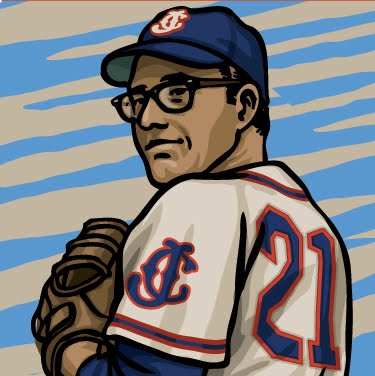
I'm not a big "records" type of baseball fan. Barry Bonds, Sammy Sosa and Mark McGwire took all the fun out of records for me as did the manufactured hype over Cal Ripken's meaningless consecutive game thing. On the other hand, DiMaggio's hitting safely in 56 consecutive games and Vander Meer's back-to-back no-hitters are still impressive and awe-inspiring. It's probably safe to say neither will be broken or even equaled anytime soon. Which brings me to Fred Toney. This relatively forgotten pitcher from the first 2 decades of the last century has no less than three unbelievable pitching performances that I'd bet will never be equaled, if only for the reason there is no way a pitcher would ever be allowed to even be in a position to try to match any of Toney's feats...
According to baseball lore, sometime in 1908 a minor league scout found himself lost on a mountain road in the back woods of Tennessee. In need of direction, he came upon a brawny teenager with with three dead squirrels in tow. The scout had engaged the barefoot hunter in conversation when he suddenly realized the boy had no rifle, pistol or even a bow and arrow. "How did you kill the squirrels?" he asked, to which the boy matter-of-factly replied "I killed them by throwing rocks at 'em". The story ends with the scout returning to civilization with young Fred Toney's signature on a pro contract.
But that's all there is to it, just a story.
Fred Toney was born and raised just outside Nashville, Tennessee. He was big and strong for his time, just over six foot and 200 pounds of farm boy muscle. A right hander, Toney got his start as a teenager with the local Nashville Free Silver Sluggers where he won 26 out of 32 games. In 1908 the nineteen year old ventured north to Kentucky to play for a semi-pro team in Bowling Green. How he came to play for Bowling Green is not known, but he was probably lured North by the prospect of a steady factory job with extra pay for playing on the ball club. When the team folded midway through the summer Toney headed back home to Tennessee, but a professional scout was hot on his heals. When the representative from the Winchester Hustlers finally caught up with Toney he was taken aback when the pitcher rebuffed all offers of a professional contract. Money wasn't the object: it seems that young Fred Toney didn't want all the pressure that being a pro ballplayer brought on. Toney's friend, "Greasy" Hanly eventually convinced Toney to sign on with Winchester and as a contract stipulation the Hustlers agreed to take along Hanly as well.
Toney finished out the '08 season in the Blue Grass League, his fastball garnering comparisons to a young Walter Johnson. The following season, 1909, is where Fred Toney enters the history books.
On Monday May 10, 1909, three hundred fans sat in the stands at Garner's Park to watch the Hustlers take on the visiting Lexington Colts. The game started in the late afternoon and the light crowd was what could be expected on a rainy, miserable spring afternoon. As the innings ticked by, neither team was able to score. Toney was magnificent, striking out batters with ease and refusing to give up a single hit. After nine frames neither team had scored and Toney had a no-hitter, but the game wasn't over. As more innings passed without a hit, word spread around Winchester of what was transpiring in their little ballpark. A boy on a bicycle raced back and forth from the ballpark to the business district with updates as the historic game went on. Crowds began to gather outside the park as Toney steadfastly remained on the mound holding the Colts hitless. By the time the game entered the 12th inning, darkness was beginning to fall over the Kentucky town. Now not only was there a race to score the first run but to do it soon as the game and no-hitter would be struck from the record if it were to be called because of darkness. The Colts' pitcher, Baker, was still on the mound as well, allowing just 6 hits through 17 innings. Finally in the bottom of the 17th Winchester's right fielder Ellis singled to right center. Left fielder Schmidt sacrificed Ellis over to second but Baker made a throwing error to first as the runner was safe and Ellis took third. Eddie Goosetree fouled off one of Baker's pitches which was caught for the first out. With runners on the corners Hustler's manager Newt Horn called for a squeeze play. Shortstop Ellis layed down a bunt and Ellis raced across the plate with the winning run.
As word of the victory spread from the ballpark, the town's factories let loose their steam whistles, church bells pealed and cars honked their horns. Toney, who just one year earlier had refused to play pro ball because of the pressure, had pitched a beautiful 17 inning no-hitter complete with 19 strike outs and giving up but two stingy bases on balls. The 17 inning game was completed in just over 2 hours, 45 minutes.
For those who haven't done the math, Toney's gem was an inning shy of two complete no-htters and remains today as the longest professional no-hitter on record. I can't find any "unprofessional" no-hitter 17 innings or more so I'm going to assume Toney's feat is unmatched. Like-wise, it's probably safe to say it would never be matched as there is no way a pitcher would be allowed to throw 17 innings in one outing today.
The feat made all the sports pages from coast to coast and Toney was soon courted by the big leagues. In July the Phillies were reported to have acquired the right hander but apparently the deal fell through. A few months after his record making game Toney again went the extra mile when he pitched all 16 innings of a game against Shelbyville, this time relinquishing six hits. In 191o the Chicago Cubs sent a man south to take the measure of Winchester's rubber armed ace. Knowing the Chicago scout was in the stands, Toney did everything he could to make himself look inept. Despite maintaining his cool and poise through two years of pro ball and tossing some of the most nerve racking games in modern memory, Fred Toney was afraid to move up to the big leagues.
He made his debut in 1911 and in 18 games he was a marginal 1-1. The Cubs sent him back and forth between the minors and Chicago before releasing him. After some fine work with Louisville Brooklyn signed him in 1914 but Toney played hardball in contract negotiations and the Reds managed to pick him up.
Now in his mid-20's and a bit more sure of himself, Toney became one of the National Leagues best right handers. He ticked off seasons of 17, 14 and 24 wins for a young Cincinnati team. On May 2, 1917 the Reds were in Chicago to play the Cubs. Toney took the mound for Cincinnati and faced the Cubs ace Hippo Vaughn. The two men had faced off before back in the minor leagues where Toney found he could get the edge on Vaughn by letting him hit a long single, the base running tiring him out.
While their bouts in the minors may have been memorable, nothing could compete with what would happen that afternoon in May. Not only did Toney not allow Vaughn a base hit, but he silenced all the other bats in the Cubs lineup as well. Vaughn did the same to the Reds and after nine complete innings both men were throwing no-hitters. Finally in the top of the 10th Vaughn gave up a single to Larry Kopf who went to third on an error and came home on a Jim Thorpe single. Toney finished off the Cubs in the bottom of the inning and won the the only double no-hit game in baseball history.
As if Fred Toney needed to prove his iron man standing, later that season he did another feat that would be impossible n today's game - pitched and won both games of a double header. Facing Pittsburgh on July 1st, Toney gave up just three hits and a single run in each game - 18 innings, 6 hits, 2 runs. Incredible. Unfortunately for Toney it was a quick decent from being the most revered pitcher on the Reds to their most reviled.
In April of 1917 America declared war and all able bodied men were expected to serve the war effort in some capacity. Toney was married with a child and as such was given a deferment in the draft. Somehow it was leaked that not only was Toney three years separated from his wife and kid, but was currently involved with a young lady other than Mrs. Toney. Federal Marshall's arrested the Reds ace and he went to trial for draft dodging. When the trial ended in an unsatisfying hung jury he was slapped with violating the Mann Act - bringing a minor across state lines for immoral purposes. The Cincinnati fans ripped him apart and the Reds unloaded him and his legal problems on the New York Giants. Between pitching for New York Toney pleaded guilty to violating the Mann Act and served out a short prison term. Through it all he pitched good ball posting 13, 21 and 18 win seasons for the Giants.
In the spring of 1924 Toney busted a finger while executing a bunt. The injury ruined his grip on the ball and he slipped back into the minor leagues. The 36 year-old hung up his spikes for good in 1925 and headed back home to Tennessee. In the town he was born and raised in he opened up a soda fountain, the walls adorned with mementos from a 17 year career highlighted by some of the most heroic pitching performances in the history of the game.
Thanks to everyone who sent good wishes on my marriage, it means a lot to Andrea and I. After a beautiful wedding (Andrea looked amazing) and a relaxing honeymoon on Coronado Island (where the new Mr. and Mrs. Cieradkowski took in a Padres-Mets game at Petco Field), I'm back in my studio in Kentucky. As such, I'd like to introduce you to a little-known part of Hall of Famer Casey Stengel's baseball career. Of course known by all as the long-time manager of the 1950's Yankees, Stengel had a long career before that as a manager of last place ball clubs, and before that as a decent major league journeyman outfielder with Brooklyn, Pittsburgh, Philadelphia, New York and Boston. But before even that, Stengel got his start in professional baseball right here in Kentucky playing in the aptly named Blue Grass League.
Before he was Casey, he was known as Dutch. At the turn of the century all peoples of Germanic stock were called "Dutchmen" or "Dutch" (case-in-point, the "Pennsylvania Dutch" actually hail from Germany and Honus Wagner, of German decent, was called "The Flying Dutchman"). The nickname came from the German word "Deutsch" meaning "German people", but disinterested Anglo ears simply heard "Dutch" instead. So all Germans became Dutchmen. Enjoying a comfortable middle-class upbringing, Stengel's old man was an insurance salesman and while he tolerated his son's interest in sports, he pushed the boy to aspire to higher goals in life.
At Kansas City's Central High, Charley was an outstanding athlete, playing football, basketball and baseball with equal ease. In the summer of 1908 at age 16, Stengel joined the semi-pro Kansas City Benton's. The Benton's barnstormed as far west as Utah and Wyoming playing army and factory teams every day to turn a profit. While it was a great learning experience for the teen and a step towards becoming a pro-ballplayer, a career in baseball wasn't Stengel's ultimate goal: Dental college was his aim and baseball was a great way to save up for the tuition.
In his junior year, the 18 year-old's pitching garnered a bit of regional notoriety when the
Central High baseball team became the Missouri State champions. In the deciding game Stengel, the team's left-handed ace, injured his pitching arm. When summer came, Stengel rejoined the Benton's, now re-named the Red Sox and embarked on another season barnstorming around the west. To rest his arm he took to playing the infield and outfield to stay in the lineup.
Dutch returned to Central High for his senior year but dropped out in February when he was offered a tryout by the local Kansas City minor league team. The Kansas City Blues played in the Class AA (equivalent to today's AAA) American Association, one of the country's three
top minor leagues. When the team sent Dutch a contract calling for a $135 a month salary, the teen was so overtaken with nerves that he turned pale. Being under age, his father reluctantly signed it for him. It was after all temporary, his boy was going to become a dentist.
Joining the Blues, Stengel soon found the competition to be way over his head. Seeing that the 19 year-old's pitching wasn't close to Class AA league standards, Danny Shay, the team's manager, put Stengel in the outfield to see what he could do. Though still not up to American Association quality, he showed significant promise and Kansas City sent kid to Illinois to play for the Class D (equivalent to today's A) Kankakee Kays. Stengel got into 59 games and was batting .251 when the league disbanded in July.
With the summer half over, Stengel was assigned to the Class D Blue Grass League in Kentucky. By the end of July he was roaming the outfield for the last place Shelbyville Blues. The low minors being a precarious business back then, the Shelbyville team couldn't turn a profit and was soon bought by a group of businessmen from nearby Maysville for $500.
It was with the Maysville Colts that Stengel began to learn the trade of a professional ballplayer. Though mired in last place, the citizens of Maysville showered their new team with enthusiasm usually saved for a pennant winner. Stengel even had his first fan, a young Maysville boy named Robert Willocks who would carry his spikes and glove to the ballpark where his idol would in-turn get him into the game for free. Though he was barely hitting .220, Stengel earned himself a few prizes with his bat: in September he hit the team's first home run and received a box of candy and safety razor shaving kit. A second round-tripper the next week added a $3 hat to his prize winnings. Late in the summer the Old Mill Tobacco Company included the rookie outfielder in the set of trading cards they inserted in their cigarette packs. The grim faced boy who stares back at you from the orange-boardered 1910 card is a far cry from the grizzled and wrinkled old man who appears 54 years later on his last baseball card as manager of the New York Mets.
It was also in Maysville that Stengel began showing his gift for colorful shenanigans which he later became famous for in the majors. The Colts' home field, League Park, had an insane asylum just beyond its outfield wall. Running to the dugout from his center field position after each inning, Stengel, who was told that he needed to work on his sliding technique, would make a practice slide into third base. The inmates of the asylum watched from their windows and cheered him on with enthusiasm - they thought he was one of their own. On another occasion Stengel drew attention to himself when he pursued a fly ball past the boundaries of an un-walled in ballpark and caught the ball standing ankle-deep in a moving stream.
When the Bluegrass League season ended, the Kansas City Blues called him up for the rest of their season. Stengel got into 4 games and hit .273 with a double. The 19 year-old ended his first season in professional baseball with a combined .237 with 18 doubles, 6 triples and 3 homers spread out over 4 teams and 3 leagues and was retained by Kansas City for the next season. But more than that, Stengel had made enough money playing ball during the 1910 season that he was able to enroll in Kansas City's Western Dental College, his ultimate goal.
And so, that might have been the last we ever heard of Charley Stengel had it not been for his being left-handed: most dental tools were manufactured for righties and Stengel had a terrible time trying to use the equipment. After 2 winters studying at Western, Stengel gave up and decided to become a professional ballplayer. And the rest, as they say, is history - but wait - where did he get the name "Casey" from? Well, as a rookie with Brooklyn in 1912, his teammates took to calling him "Kansas City" after his hometown, later shortened to "K.C." and still later to "Casey".
With all the hoopla these past few weeks about Jackie Robinson and the integration of baseball, I thought before I wheel out my new Robinson card and story this week, I'd feature one man who was directly responsible for the destruction of the color line. He's a guy that I will include in the next edition of 21, which will have a "Baseball in Kentucky" theme in tribute to my adopted state. While Brooklyn Dodgers general manager Branch Rickey gets the well-deserved lions share of ink for his part in integrating the modern game, Happy Chandler played an instrumental, though not well-recognized part.
He was one of those old-time baby-kissing, glad-handing southern politicians with a billion-watt smile, the kind you see in cartoons. He was elected governor of the Commonwealth of Kentucky two separate times, represented the state in the United States Senate and was the second Commissioner of Baseball. But before all of that, Happy Chandler was a shortstop.
In the long line of Commissioners of Baseball, Happy Chandler is the only one to have played the game professionally. He was a star athlete in high school and played ball for Transylvania College. He reportedly tossed a no-hitter playing for Grafton in North Dakota's Red River Valley League in 1920 (the town even named the local baseball field after him) and was invited to a tryout with the Saskatoon Quakers but returned to college instead.
During the summers of 1922 and 1923 he played for the Lexington Reos of the Blue Grass League. The Blue Grass League was a Class D circuit, the lowest classification at the time, but it was professional baseball and one of his teammates was future Hall of Famer and member of the famed 1927 Yankees, Earle Combs. Chandler played in less than 20 games but for a time considered pursuing baseball as a career. He also served as a league umpire during the two seasons he spent with the Reos before deciding to attend Harvard Law School.
Chandler worked his way up the ladder of Kentucky politics, first in Woodford County then on to the state level. He was a fiscally conservative Democrat and by 1935 was elected governor. He switched over to the United States Senate in 1939 and it was there that he was approached to become the second Commissioner of Baseball.
Kennesaw Mountain Landis had held the post since 1920 and upon his death the team owners elected Chandler to succeed him. In the period between Landis' death and Chandlers appointment, Brooklyn Dodgers general manager Branch Rickey signed Jackie Robinson and Johnny Wright to Montreal Royals contracts making them the first blacks to play professional ball since Hippo Galloway in 1899.
After the 1946 season, Rickey wanted to transfer Robinson's contract to the Dodgers, something that the Commissioner's office had to approve. Rickey went to personally see Chandler who gave his complete support. The Dodgers' general manager later said that without Chandlers full support he would not have been able to bring Robinson to Brooklyn.
Why did Chandler give his support to something his predecessor had vehemently opposed? There are two quotes attributed to him in regards to his approval of the smashing of the color line. The first was given right after he was named Commissioner. Ric Roberts of the Pittsburgh Courier asked Chandler about blacks playing pro ball to which he responded: "If they can fight and die in Okinawa, Guadalcanal, in the South Pacific, they can play baseball in America." Coming after more than 25 years of double-talk and out right lies by the former Commissioner, Chandler's statement came as a bombshell, not just for it's strait-forwardness but because of where he was from. Kentucky in 1946 was still a Jim Crow state and Chandler's words were sure to upset more than a few of his constituents.
The second quote shows the way he was thinking not just about baseball but the whole idea of institutionalized racism. From his autobiography Chandler had this to say to Branch Rickey at their meeting in 1946:
"I've already done a lot of thinking about this whole racial
situation in our country. As a member of the Senate Military Affairs
Committee, I got to know a lot about our casualties during the war.
Plenty of Negro boys were willing to go out and fight and die for this
country. Is it right when they came back to tell them they can't play
the national pastime? You know, Branch, I'm going to have to meet my
Maker some day. And if He asks me why I didn't let this boy play, and I
say it's because he's black, that might not be a satisfactory answer. If the Lord made some people black, and some white, and some red or
yellow, he must have had a pretty good reason. It isn't my job to decide
which colors can play big league baseball. It is my job to see that the
game is fairly played and that everybody has an equal chance. I think
if I do that, I can face my Maker with a clear conscience."
As Commissioner Chandler did as much as he could to limit the on-field racism Robinson and the other black players faced. When the St. Louis Cardinals threatened to strike if they had to face Robinson he pledged that any player who failed to take the field would be immediately suspended. After Phillies manager Ben Chapman disgraced himself and the game with sickening racial taunts when his team faced the Dodgers, Chandler made it clear that any more of that would earn him and the team severe disciplinary measures.
Besides his part in integrating the game, Chandler was known as the “Players Commissioner." After the Pittsburgh Pirates almost went on strike for more players rights, Chandler established the first pension fund using the proceeds from selling the radio broadcast rights to the World Series. He also tried to keep the game free of the threat posed by gamblers and gangsters when he suspended Brooklyn manager Leo Durocher before the 1947 season. While popular culture has often portrayed Durocher's suspension being brought on by his affair with the married actress Lorraine Day, in actuality he earned it by palling around with Bugsy Siegal and other seedy underworld figures.
For all he did for the game, Chandler's reign as Commissioner came to an abrupt end in 1951 when he resigned after the team owners twice refused to extend his contract. It was a loss for the game as Chandler was its most forward-thinking leader for many decades. He went back to politics and in 1955 was re-elected governor during which he over-saw the integration of the states' public school system. He was inducted to the Kentucky Sports Hall of Fame in 1957 and in 1982 he took his place in the National Baseball Hall of Fame. Still smiling, he lived until the age of 92, dying of a heart attack in 1991.
Though he isn't remembered today as reverently as Branch Rickey or Jackie Robinson, Happy Chandler was indeed instrumental in the games' integration.