
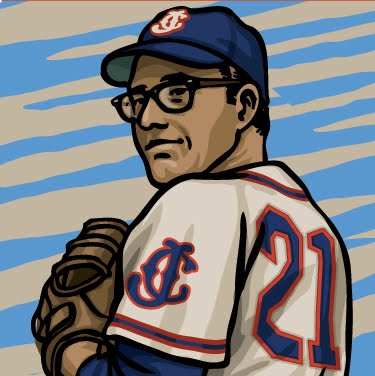


A few weeks ago, a 97 year-old ball player passed away. This just wasn't any ball player, but a guy whose 1943 debut marked him as only the second Puerto Rican to play in the major leagues. While that's something, Luis Olmo's story encompasses so much more than race, or an ethnic first (or, in his case, a "second"). It's the age-old story of a kid, born in a far away place, who had a dream of making the major leagues. It's a story of big shot baseball executives pulling out all the stops in order to get their hands on the talented and unsuspecting young man. And it's a story of how a former big leaguer lived out the final chapters of his life graciously sharing the story of his modest part in the history of the game he loved so much. Because much has already been written about his major league career, I'll recount the early part of Luis Olmo's journey, which, if you ask me, is much more fascinating than coughing up a list of firsts, dates and hard statistics.
Luis Francisco Rodriguez Olmo was born in Arecibo, Puerto Rico in 1919, the third of four sons born to carpenter Jose Francisco and his wife Ana Olmo. Of the four boys, Luis was the only athlete, encouraged by his oldest brother, Jose. Luis would later relate that he had been playing baseball since he was born, but he also excelled in several other sports such as basketball, soccer and track. At first, Olmo aspired to become a major league pitcher, but an injury suffered throwing a javelin ended his mound hopes at age 15. Luis' older brother Jose was a subscriber to The Sporting News, and through its pages the younger Olmo idolized Cubs second baseman Billy Herman, so he made the switch to the keystone sack. Continuing his schooling, Olmo moved to the city of Caguas to attend high school. Because the school offered no other sport except baseball, Olmo perfected his game without distraction. Playing second base, outfield and occasionally catching, Olmo evolved into a promising ballplayer, but Caguas was a long way away from the big leagues.
With the Great Depression in full swing, the road to the minor leagues in America was choked with thousands of American-born hopefuls trying to gain a foothold in organized baseball. Besides being born far away from the nearest minor league team, Olmo's dream of becoming a big leaguer was further hindered by the language barrier. A Spanish-speaking prospect had to show promise above and beyond an ordinary English-speaking player in order for a team to take a chance on him. And before that, he had to first catch the eye of a scout. Fortunately, Luis Olmo came of age at the perfect time in Puerto Rican baseball history.
Though Puerto Rico had a rich amateur baseball circuit, the island did not have the professional league that neighboring Cuba did. That changed in 1938 when the Puerto Rican Winter League was formed. For the first time, Puerto Rican players could showcase their talent at home as a group instead of scattering to other countries around the Caribbean and North America. The undisputed attraction that initial season was Millito Navarro, the first Puerto Rican to play in the Negro Leagues and a bonafide star. But that inaugural year also introduced the baseball world to a few young up and comers, among them pitcher Hi Bithorn of the San Juan Senators and Luis Olmo of the Caguas Creoles.
The teenage Olmo was recruited by his hometown team for the princely sum of $7 a week. Although he was young, the Creoles player-manager, Pito Álvarez de la Vega, knew in Olmo he had something special. The older man carefully mentored Olmo throughout the season, correctly assessing that this kid had what it took to make the major leagues one day. Olmo responded by hitting .335 his rookie season, generating much praise as the guy to watch in the near future.
Among those impressed with Olmo that first season was Jose Seda, a Puerto Rican baseball lifer who also scouted on the side for the Brooklyn Dodgers. The Dodgers had just begun a resurgence under the leadership of new general manager Larry McPhail. Flush with money and grandiose plans, McPhail hired Cardinals GM Branch Rickey's son, Branch Jr., to create and oversee a Dodgers farm system modeled on what his father had built for St. Louis. Seda had kept an eye on Olmo throughout the season, evaluating him as a prospective Dodger. However, Seda wasn't the only one with connections who was taking an interest in Olmo. A traveling salesman named Miguel Lloreda contacted Eddie Mooers, owner of the minor league Richmond Colts. The Colts were the only unaffiliated club in the Class B Piedmont League, and while the other teams relied on their parent club to provide players, independent owners relied on freelance tips such as Lloreda's to score talent. Whatever Lloreda wrote, it was impressive enough that Mooers decided to take a chance on the 19 year-old. At the conclusion of the 1938-39 season, the Colts wired Olmo money to take the steamship Barranquilla to New York where a team representative would meet him and accompany him to Richmond where he would sign a contract.
Now things began to get a little cloak and dagger. Just as Luis was getting on the ship to America, Jose Seda wired Branch Rickey, Jr.:
"Good ballplayer named Luis Olmo arriving on Barranquilla. Stop. Get him. Stop. -Jose."
Branch Jr. rushed down to the docks and waded through the disembarking passengers until he identified a guy who looked like a ballplayer. Using high school Spanish, Branch, Jr. was able to convince Olmo to accompany him back to the Dodgers offices in Brooklyn. Unfortunately, Rickey's Spanish wasn't good enough to convince the young Puerto Rican to put his name on a Dodgers contract. Rickey then bundled Olmo into his car and drove over to the home of Alberto Flores, a Puerto Rican third baseman that Rickey was on the verge of signing to a Brooklyn contract. Olmo was familiar with Flores, but when he and Rickey arrived, the third baseman was gone - he'd just signed a contract with the Richmond Colts.
Temporarily foiled, Branch, Jr. stalled for time while he decided how to proceed, stashing Olmo at a Dodgers safe house up in Harlem with another Puerto Rican prospect. In the meantime, the Richmond representative was desperately trying to track down the star import. With some pro sleuthing, Richmond's man was able to deduce that Olmo was Shanghaied by Branch, Jr., and then correctly figured he'd hide him with the Dodgers only remaining Spanish speaking prospect. Before morning, Olmo was located, his signature inked on a Richmond Colts contract, and on his way south to Virginia. Luis Olmo had slipped through the Dodgers fingers - for now...
Richmond placed their young import with the Tarboro Goobers of the lower level Coastal Plain League. The Goobers had no place for him so he was released and then optioned to the Wilson Tobs of the same league. Olmo got into 56 games and batted a credible .329. He returned to Caguas after the season fully expecting a contract for the next year - only it never arrived.
The reason he did not hear from the Colts was that the contract was sent to the wrong name and address: Roberto Olmo of Cuba. How the Richmond front office made that mistake is unknown, but by the time the 1939-40 Puerto Rican Winter Season began, Luis Olmo figured he was now a free agent.
Olmo once again manned the outfield for the Creoles. Word of the league's successful inaugural 1938-39 season had spread, and its sophomore year saw an influx of first-rate Negro League talent including Satchel Paige, Josh Gibson, Leon Day and Bill Byrd. Even when thrown into the mix with seasoned outsider baseball giants, Olmo continued to impress. Another Dodgers scout, Ted McGrew, approached the budding star about signing with Brooklyn, and, with no word from Richmond by March, Olmo signed a Dodgers minor league contract. Branch, Jr.'s reaction is unrecorded, but one can imagine the younger Rickey sinking into his leather chair behind his desk and lighting a celebratory cigar, just like his old man.
Olmo traveled to Macon, Georgia for spring training with the Elmira Pioneers. In one of his first exhibition games, Olmo's career almost ended when he tried breaking up a double play by coming into second base standing. He broke up the play, but at the expense of being beaned in the right ear by the throw. After being out for a half hour, Olmo recovered his senses, vowing to slide in the future. Meanwhile, Richmond noticed that their foreign import not only was absent from spring training, but his contract and all correspondence gone unanswered. Somehow word got back to Eddie Mooers in Richmond that Olmo was camped out in Macon with Elmira, the Dodgers newest acquisition. Now confronted with a second attempt by Brooklyn to poach his property, Mooers filed a protest with Minor League Baseball president William G. Bramham.
The Colts owner was able to convince Bramham that he did tender a contract in good faith before the contract deadline, even though it was mis-addressed. Olmo was awarded to Richmond for the 1940 season and the Dodgers contract voided. The Puerto Rican outfielder has slipped through Brooklyn's fingers - for the second time.
The name and nationality confusion prompted Luis' older brother Jose to write to The Sporting News correcting the misinformation printed about his kid brother. In a small piece printed in the April 18th edition, Jose penned: "His correct name is Luis Rodríguez Olmo, but he is known as Luis Olmo, and he is a Puerto Rican, a proud American citizen. No doubt the contract was not received by my brother because it was incorrectly addressed. So far his name has been given out correctly only once, when you published the reserve lists. Later he was called Lewis Elmo and now as Roberto Olmo. Some confusion with Spanish names.”
Richmond sent Olmo back to the Wilson Tobs. At once it was clear he was well beyond the Class D level. By July he was batting just below the .350 mark with 18 homers. His superior play and potent bat had pushed the Tobs to a comfortable 18 game lead and locked in for the Coastal Plains pennant. He was called up to Richmond where he hit .271 to help the Colts take the Piedmont League pennant. Olmo returned to Caguas were he continued hitting, leading the Creoles to the Puerto Rican Winter League Championship. Olmo had turned a hat trick of pennant winners. 1940 was capped off with his marriage to Emma Paradis, a union that was still going strong when the old outfielder passed away seven decades later.
By now, Olmo was exclusively playing the outfield where his speed helped him make tremendous running catches. One of his trademarks was the basket catch. This later became a Willie Mays and Roberto Clemente staple, but Olmo had adapted this a decade before. There was a difference in styles, however: Mays caught his at waist level while Olmo positioned his glove chest-high. Clemente later credited his fellow countryman with teaching him the basket catch when he was in the minor leagues. Olmo was also blessed with a strong, accurate arm that made many runners think twice about taking an extra base.
1941 saw Olmo return to Richmond. Despite interest from major league organizations, Eddie Mooer held onto his prized foreigner, figuring another season or two of good stats would drive up his selling price. Olmo benefited from the extra seasons in Richmond, mostly due to his manager, Ben Chapman. Today, Chapman is known solely for his warped racism and the sick invectives hurled against Jackie Robinson when he was the Phillies manager in 1947. But before all that, Chapman was a truly outstanding ballplayer with several major league clubs. He was the Yankees lead off hitter in the early 1930's, and his bat and base running skills earned him a spot in the very first All-Star Game in 1933. He also had a fiery temper that got him into numerous on-field fights and led to his numerous uniform changes while in the majors. By the early 1940's, Chapman's career as a big leaguer was through, but he still had enough talent to become a respected player-manager in the minors. Whatever Chapman's feelings were towards Latinos, he became a huge influence on Luis Olmo, and the ball player later credited his Richmond skipper with teaching him more about the game than any other manager, coach or scout. The two men apparently were friendly away from the field as well. Olmo was a very talented pool player and he played his manager almost every day before lunch, loser buying the other man's meal.
I'll pause here to address the ever-present issue of race. Although Latinos had played in the majors since the early 1900's, they were still few and far between. Part of the reason was the language barrier, which could only be overcome by a player learning English. No team was going to spring for a translator when you could just reach into the minors and get a comparable English speaking replacement. Therefore, a Latino trying to make it to the majors had to be extraordinary. This was still a time of accepted ethnic stereotypes - heck, even Life Magazine ran a feature on Joe DiMaggio in 1939 that read: "Although he learned Italian first, Joe, now 24, speaks English without an accent and is otherwise well adapted to most U.S. mores. Instead of olive oil or smelly bear grease, he keeps his hair slicked with water. He never reeks of garlic and prefers chicken chow mein to spaghetti."
Imagine what the perception of Puerto Ricans were to a public unfamiliar with the people or the culture of the island. Indeed, several of the profiles written about Olmo before or just after he made the majors made sure to remark how his mild manner was quite different from the stereotypical perception of the fiery Latin. This line from the April 8, 1943 edition of The Sporting News serves as an example: "Although of Latin lineage, Olmo is not hot-tempered".
Besides the perceived temper issues Latinos had to contend with, there was also the added problem of color. A whole rigid system of skin colors dictated what was and what was not acceptable in order to be labeled "white". Fortunately for Luis Olmo, his skin tone fell within the acceptable range. He was further fortunate in that his face was said to resemble Tony Lazzeri, the Yankees star second baseman of acceptable Italian heritage.
Despite a mug that resembled a Yankees All-Star, Olmo still had to deal with the occasional racial taunt and bean ball at the plate. These, he took in stride - he had to. The game was a whole lot rougher in the days before million dollar salaries and union reps. Gaining an edge in a game often came down to getting into the opposing player's heads - name calling and bean balls were two ways to achieve that. In order to make the majors, Olmo knew he had to accept and deal with these obstacles, and this he did, telling The Sporting News "But that is baseball. So I get up and hit again."
Olmo finished the 1941 season first in home runs and triples, second in hits and slugging percentage and fifth in batting average. In September he was given additional reason to celebrate when he and Emma welcomed their first child, a daughter they named Ana Lucy. In the winter he returned to the Winter League where he augmented Chapman's teachings by playing with and against Negro League superstars such as Josh Gibson, Lenny Pearson, Roy Campanella and Bill Byrd, the later pair his teammates on the Caguas Creoles.
Olmo had developed a batting stance that he later said was based on Joe DiMaggio's. He stood back in the box, feet spread and firmly planted, the bat gripped at the end and cocked way back. Olmo favored a Louisville Slugger of the Joe Medwick or Babe Ruth model, 35 inches in length and weighting 32 ounces.
The next year, Olmo again dominated the Piedmont League, this time leading in home runs, hits, triples and slugging, coming in second in batting average and doubles. He voted the most popular player in the league, but was edged out of the MVP Award by his manager Ben Chapman. Olmo's stock could get no higher in Richmond and Eddie Mooers knew this. The Luis Olmo bidding began, and in the thick of it was Branch Rickey, Jr.
Rickey had never forgotten the Puerto Rican outfielder that twice slipped from his grasp. Now that he was available, Branch Jr. made sure the Dodgers were in there with an offer. There was one big problem - his father, Branch Rickey, Sr. The elder Rickey had by now heard of Luis Olmo. The elder recognized the hustle and spark shown by Olmo, just the kind of player he favored for his Cardinals. Branch, Jr. knew this, and began maneuvering to keep his father out of the negotiations with Mooer. This covert operation was hampered by the fact that both men were staying under the same roof at the Rickey estate outside St. Louis. Branch, Sr. had an idea of what was transpiring, but his son successfully kept the old man out of the estate's telephone room while he hammered out a deal with Richmond. Branch, Jr's. evasive action worked, and Luis Olmo finally became property of the Brooklyn Dodgers.
While the phone lies were burning up between Richmond and St. Louis, Luis Olmo was traveling the long route back home for the winter. The war had made long distance travel a nightmare, and it took more than a week of waiting in Mami for Olmo to get a seat on a flight to Puerto Rico.
Waiting for him when he landed was his older brother Jose, bursting with news that he would be joining his childhood idol Billy Herman as teammates on the Brooklyn Dodgers.
This is story is just the very beginning of Luis Olmo's baseball odyssey. When he took the field as a Dodger rookie on July 18, 1943*, he was only the second Puerto Rican-born player in the majors (Hi Bithorn was the first, debuting with the Cubs in 1942). Olmo would later join the outlaw Mexican League in 1946, and then return to the Dodgers in 1949 where he became the first Puerto Rican to play and homer in a World Series. Before he ended his career in the mid-1950's, Olmo had playedball in not only the United States and his native Puerto Rico, but also Canada, Mexico, Dominican Republic, Cuba, and Venezuela, earning the nickname "America’s Baseball Player." In retirement he became the elder statesman of Puerto Rican baseball, active in his local SABR chapter and a living link to the island's first season of professional winter baseball that endures to this very day. Luis Olmo passed away on April 28, 2017.
*Olmo's debut game on July 18, 1943 was the second game of a doubleheader against Boston. The game was halted in the 6th inning locked a 4-4. The game was continued September 13, 1943, resulting in a 7-6 Boston victory. Purists may therefore say that Olmo's true debut was on July 23 against the Reds...
Special thanks to my friend Angel Colon, Puerto Rican Winter League historian who introduced me to Luis Olmo's story.

