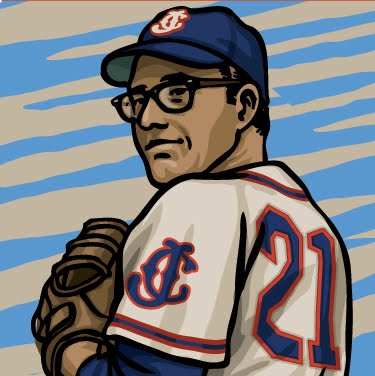
Showing posts with label Hilldale Daisies. Show all posts

Monday, December 15, 2014

183. Clint Thomas: The Hawk


I wish everyone a great Christmas, Hanukkah or whatever you may celebrate this time of year. I for one am looking forward to Christmas with my wife and her family in Southern California. This month between Thanksgiving and Christmas was a busy one. The biggest news is that I am down to the final edits on my book, The League of Outsider Baseball". It's slated to be in bookstores May 8th of next year, just in time for Father's Day. The whole process has been both unbelievably fun and nerve-racking for me. Fun because I have been able to finally present what I have been doing on the website for almost four years to a larger audience and in a format you can hold in your hands. Websites are fine for some, but I'm an old-school type of guy and love the feeling of something substantial in my fingers. That this will be a 240 page hard cover tome really gets me excited! The nerve-racking part comes when I realize that 240 pages isn't nearly enough to showcase all the great stories and drawings I want to! Each time Simon & Schuster sends me a new draft to edit I get pangs of regret about the players I had to leave out, but that's just my self-depreciating personality - when I look at the book objectively even I have to admit that this is going to be an unbelievably great book. I made the book I always hoped to find in a bookstore ever since I was a kid. With a bit of luck, the book will be a big enough success that I get the opportunity to do a volume 2. I thought you might be interested to see what one of these massive drafts looks like, so I took a quick picture:


Well, let's get on to the main reason this site exists - baseball stories and drawings! Today's story is one I have had on the back burner ever since I devoured Neal Lanctot's masterpiece "Fair Dealing and Clean Playing: The Hilldale Club and the Development of Black Professional Baseball, 1910-1932". Among the great players that once graced the Hilldale Club's lineup was a guy they called "The Hawk". While he isn't normally mentioned in the same breathe as Josh Gibson or Satchel Paige, Clint Thomas was among the best all-around ballplayers of the 1920's and 30's. Recognized by his peers as one of those rare "complete ballplayers", The Hawk not only hit for average and power, but his skill in the outfield, accurate arm and base running ability made one of the most dangerous players to take the field.


Clint Thomas was born in Greenup, Kentucky, a town along the banks of the Ohio River in 1896. According to Thomas, he didn't play much baseball as a kid because there wasn't any ball fields for he and his friends to play on. It wasn't until his family moved to the more urban surroundings of Columbus, Ohio where the teenager began his baseball career. He played a little ball when he wasn't working in a grocery store, but then World War I began. Thomas served a year in the Army and was a Sergeant by the time his year hitch ended. He returned to Columbus and began playing ball more serious. Within a year he'd migrated to New York after he heard the Brooklyn Royal Giants were looking for a third baseman. That after only a single summer of semi-pro ball Thomas felt he was ready for the big time speaks highly of his confidence. The Royal Giants were on the down-side of being one of the premier blackball outfits and still boasted legend John Henry Lloyd at short and Jesse Hubbard on the mound. While Thomas' confidence was at a pro level his skills weren't and after batting under .200 returned to Columbus. 

Fortunately for Thomas the newly formed Negro National League put a franchise in Columbus called the Buckeyes. His teammate from the Royal Giants, John Henry Lloyd, was the new team's manager and Thomas played the 1921 season hitting just shy of .300. Still, all the pieces weren't right for Thomas. Because of his speed he was always shifted between second and third base but never felt comfortable at either position. Then the Buckeye's folded and Thomas was cut loose. 

His contract was acquired by the Detroit Stars 1922. He was still floundering at second base when fate stepped in. Regular center fielder Jessie Barber got injured and when the right fielder was switched to center, Thomas took his place in right. It was a stroke of genius. The fleet footed Kentuckian snatched up anything that can near him including balls meant for the center fielder. The next game he was switched to center and a Negro League legend was born. More comfortable in his new position, Thomas loosened up and finished 1922 as the Star's best hitter. The following year Hilldale, an eastern powerhouse club located just outside Philadelphia, poached Thomas away.

With Hilldale he became known as "The Hawk" for his fielding skills, gliding all over the outfield making plays with a skill so graceful that old-timers could clearly remember one Hawk play or another through the fog of decades gone by. Ted Page, a Negro League star from the mid 1920's to the mid-1930's recalled that Thomas "attacked the ball the way a dog attacked raw meat." Hall of Famer Monte Irvin grew up in Paterson, New Jersey watching the best black and white teams of the 1930's and, starting in 1937, played in both the Negro and Major Leagues. His opinion should be taken very seriously when out of all the black players he witnessed, it was Clint Thomas who Irvin called “the black Joe DiMaggio". To draw a more contemporary comparison the Hall of Famer said "Clint was a Pete Rose type of player, he always went all out".
 

That aggressive attitude didn't just apply to batting and fielding - Thomas quickly established himself as one of blackball's best base runners as well. Buck Leonard, Hall of Famer and contemporary of Thomas remembered "when he got on base we all knew what was on his mind. He had stealing on his mind." Judy Johnson, another Hall of Famer and contemporary called him one of the best he ever saw play and said "I called him "Racehorse" because he ran to first so fast that he almost had to turn around backwards to stop".

The Hawk was Hilldale's clean-up hitter throughout the 1920's. Thomas, along with Judy Johnson, Frank Warfield, Biz Mackey and Louis Santop, Thomas powered Hilldale to three consecutive Eastern Colored League pennants from 1923-25. This may have been one of the greatest blackball teams of all-time and no less than four players: Judy Johnson, Biz Mackey, Louis Santop and John Henry Lloyd have plaques hanging in Cooperstown. 

After dominating the east coast baseball scene for almost a decade, Hilldale began to hemerage players to other teams with bigger pocket books. At this time finances for black baseball teams were precarious at best and Thomas spent the next couple years surfing the dollar sign around from team to team. As the best clean-up man in the game, The Hawk was a much sought after item and after periods with the Atlantic City Bacharachs and Homestead Grays, Thomas returned to New York City where his pro career began. He hooked up with the old Lincoln Giants, a once proud powerhouse now winding down as an independent team playing in the lucrative Metropolitan semi-pro scene. Even though New York had a huge black population with disposable income to burn, Negro League teams found it hard to build a strong team in the city. Shady gangster "Soldier Boy" Semler took over the remains of the Lincoln Giants and formed the New York Black Yankees in 1931. Semler hired Clint Thomas and John Henry Lloyd to add some credibility to a team of underpaid kids and washed up vets. Despite their grandiose name, the Black Yankees were the whipping boys of the Negro Leagues. Still the team was monetarily successful due to their monopoly on the New York City market. Unfortunately Semler used the team primarily to launder his underworld profits and did nothing to improve the Black Yankees talent pool. Still, Thomas continued to shine. It was during this period that he was able to demonstrate his considerable talent to the largest audience. Unlike Hilldale which primarily stayed close to Philadelphia, the Black Yankees not only played in Yankee Stadium but also toured extensively.

During one such road trip Clint Thomas made what has gone down to be the greatest catch in blackball history. Gus Greenlee, owner of the Pittsburgh Crawfords, built a grand stadium to house the virtual All-Star team he was assembling. For the very first game in Greenlee Field, the Crawfords hosted the Black Yankees. With Satchel Paige on the mound the Craws expected opening day at the only black-owned sports complex to be an easy win for the home team. Unfortunately Clint Thomas had other ideas. With the Black Yanks up 1-0 and a few Crawfords on base slugger Josh Gibson pounded a long fly ball to deep left center. The Hawk turned on his heels and peeled off for the fence, his back to the plate. The left fielder ran along side yelling "got it Hawk, got it?" Thomas just ran as fast as he could and when he reached the wall, stretched his arm out high and snagged the ball right at the top of the wall. The air went out of the Crawfords after that and the Black Yankees beat Paige. Ted Page, a member of the Crawfords that day remarked "Clint could chase that ball into another world".

The Hawk wrapped up his career in 1938. He drove a delivery truck for the Ballantine Scotch Company then segued into a small real estate business. Finally The Hawk settled in West Virginia where he became a staff supervisor for the state's Department of Mines and then a messenger for the State Senate, a post he held well into his 80's. Thomas was one of the most likable players of his time and when The Hawk turned the big eight-oh in 1976, his old home town of Greenup, Kentucky honored him with a birthday party that became the very first Negro League reunion. Long before the big collector-fueled heyday of Negro League collecting of the 1990's, the annual Greenup reunion was an intimate affair where the old superstars of segregated baseball congregated to relive their past glory. At the center of it all was The Hawk.

Tuesday, October 1, 2013

160. Biz Mackey: International Man of Clout


Here's a ball player I've been wanting to do a card of for a long time. Actually, I illustrated the thing long ago, I just hadn't felt I completed enough research on the guy to tell the story the way I wanted to. Back when I was in college in Baltimore, I got to asking many of the old timers about the Negro League stars, and when catcher came up, most of the oldsters said Biz Mackey was The Man. I asked about Josh Gibson, the great Homestead Grays slugger and sure enough most said that yeah, that Josh could hit the ball a mile, but Biz was the better all-around ball player. 

Strong words, and contradictory to most blackball history you read, but me, I'll side with people who were there every time. So, who was Biz Mackey?

Heard of Roy Campanella? The Tokyo Giants? Well, without Biz Mackey both might not have existed...

He grew up playing town ball with his brothers Ray and Ernest before going pro with the San Antonio Black Aces in 1918. When the team folded C.I. Taylor's Indianapolis ABC's bought his contract. The ABC's were among the elite black teams at the time and for a young kid like Mackey to be picked up by them was saying a lot about his raw talent. Serving his big league internship on a team filled with stars such as Oscar Charleston, Dizzy Dismukes, Crush Holloway and Ben Taylor benefited the burly young catcher and he batted .312, 329 and .365. 

In 1923 he moved to the Hilldale Club out of Darby, Pennsylvania. Hilldale was the classiest of the eastern blackball outfits and were about to embark on a tear of three pennants once the Eastern Colored League was founded the year Mackey joined them.Because Hilldale already had slugger Louis Santop behind he plate, Mackey often played in the infield so both his and Santop's bats could be in the lineup. It says a lot that a man of Mackey's size, about 6' and over 200 pounds, could play shortstop and third base with the same ease as he could catcher. When he did displace Santop behind the plate, Mackey's mastery of the position became legendary. His arm was so strong and accurate that he didn't have to stand up to throw a base runner out at second. No one had seen that before and soon Mackey was getting compared to Major League baseball's best catcher, Mickey Cochrane, who played across town with the Philadelphia Athletics. Oldtimers who saw both men play usually give Cochrane the slight edge with a bat, but overwhelmingly give Mackey the nod when it came to defence and calling a game.

Mackey was gregarious and jolly; his nickname "Biz" actually derives from his propensity to give batters "the business" as they tried to concentrate at the plate. Mackey would ask them questions, try to get the ump to examine their bat, anything to distract them. He loved the nightlife, too. Blackball players were royalty in the still segregated cities and Mackey took full advantage of all it had to offer. Extremely fond of the sauce, the big catcher was known for his epic nights on the town, but while other ball players eventually succumbed to its debilitating effects, Mackey avoided the slippery slope to alcoholism. While known to show up at a ball game still showing the effects of the night before, once he put on that uniform and crouched behind the plate he was all business.

Because Mackey was renown as one of the best players outside the majors he was much in demand to play during the winter months. Besides the Caribbean, which was a popular destination for black ball players since the early 1900's, by the 20's Southern California had a burgeoning winter baseball season as well. The California Winter League usually featured a few white teams made up of major leaguers and Pacific Coast League stars and a single black ball club stocked with the best the Negro Leagues had to offer. In the winter of 1926-1927, promoter Lonnie Goodwin assembled the Philadelphia Royal Giants, what may have been the greatest single-season team of black players ever to take the field. Joining Mackey was the Kansas City Monarchs' ace Bullet Rogan, Turkey Stearnes, Willie Wells, Andy Cooper and Bill Foster, all Hall of Famers. The Royal Giants buzz-sawed their way through the winter league and took the pennant with a 26-11-1 record against the white teams. In a few more seasons Commissioner Landis would put a stop to the major leaguers playing in the Winter League, but for a few years it was possible to see how black ball players could do against their white counterparts. 

After the Winter League season ended, the Royal Giants split up. Bullet Rogan and the other Kansas City Monarchs headed back east to start the 1927 Negro National League season, but Biz Mackey, Frank Duncan, Rap Dixon, Andy Cooper and a handful of others boarded a ship to Japan. Touring baseball teams were not all that uncommon in Japan; American college, Japanese-American semi-pro and white professional teams had been doing it since the turn of the century, but this was the first major tour of black ball players.

Like every other American ball club that toured Japan, The Royal Giants won nearly every game; 47 out of 48 games. Their single loss to the Daimai Club serves as an example of what made the Japanese appreciate the black players so much. In a close game against the
Daimai Club, a bad call by the local umpire gave the game to the Japanese: with one out and two on base, a Royal Giant hit a long fly ball to sacrifice score a run, but the second runner was doubled off first and tagged out. The umpire refused to allow the run to count and Daimai won. The Royal Giants took the loss in stride, something the Japanese deeply appreciated.

While other visiting teams came to the island and beat the hell out of the inexperienced Japanese, the Royal Giants subtly kept their scores low to not insult the locals. The blackball players knew how to play "the game", they'd done it countless times back in the states against white semi-pro and town teams where to run up the score and embarrass the locals could cost them their part of the gate receipts, or worse, a beating. The black ballplayers also knew that by keeping the score close, the possibility to see a win would keep fans interested and coming to the park. The 1922 Major League tour realized this too late and gate receipts greatly diminished by the time their tour ended. When the big leaguers did let the Japanese win a game, it was such a farce that it only embarrassed the locals even more.

The Royal Giants also brought some good old barnstorming entertainment to the island, driving the fans nuts with their shadow ball routines. The Japanese watched in amazement as the Royal Giants whipped the invisible ball around the field. The team also shared their knowledge of the game with the Japanese, Mackey's exhibition on how to throw to second base from a crouch especially drew eager students.

When the Royal Giants played in Tokyo's brand new Meiji Shrine Stadium, Mackey became the first man to hit a ball out of its massive environs. The blast was estimated at 427 feet and before the tour ended he'd hit two more out of the ball park, each to a different field.

The Japanese deeply appreciated the kindness of the Royal Giants and the tour did much to spread the game's popularity. Many of the college players who faced the Royal Giants in 1927 went on to have roles in the founding of the Japanese Baseball League in 1936. By keeping the scores low and not embarrassing the locals, the Americans played to the Japanese sense of honor and dignity, something no other team of Americans had in the past. The gesture helped bolster the Japanese player's confidence, which when dealing with a game as complex as baseball, becomes very important.


Mackey returned to Hilldale half-way through the 1927 season. In his absence, the team had finished dead-last in the league's first half, but climbed back to 3rd place in the second half with him behind the plate. If the catcher had been a major leaguer who abandoned his team to barnstorm for half a season, he'd have been banned from the game. But, Mackey was in the Negro Leagues, and it speaks volumes of the precarious nature of the league that his only punishment amounted to little more than a scolding. Biz Mackey was a superstar of black baseball and the Negro Leagues need him.

For the rest of his long career, Mackey continued to be among the best ball players in outsider ball. When the Negro Leagues had their first East-West All-Star Game in 1933, it was Mackey, not Josh Gibson, who received the most fan votes and was the game's starting catcher. When Mackey was playing for the Philadelphia Stars in 1935, there was a chubby local kid who kept hanging around the star catcher. Through persistence, a little raw talent and Mackey's mentoring, the kid showed promise. By 1938 Mackey was in Baltimore with the Elite Giants and had the kid take the train down to Charm City on weekends to play in exhibition games under his watchful eye. Over the course of a summer the boy transformed into Mackey's "mini me". Veterans said that unless the kid took the mask off, you swore it was the ol' Biz himself behind the plate. When Mackey went to the Newark Eagles in 1939, the Elite Giants' catching was left in the able hands of that kid: Roy Campanella.
In Newark Mackey found a whole new crew of youngsters to mentor and over the next decade brought Larry Doby, Monte Irvin and Don Newcombe's skills up to major league standards. With collapse of the black teams in the early 1950's, Mackey drove a forklift but was brought into the national spotlight when on May 7, 1959, Roy Campanella introduced his old mentor before a crowd of over 90,000 Dodgers fans as the man who made him who he was. It was a tremendous compliment to a man whose generosity and kindness helped influence ballplayers of many colors and nationalities.

And that's who Biz Mackey was.

SOURCES
  • Holway, John B., Blackball Stars (Meckler Books, 1988)
  • Fitts, Robert K., Banzai Babe Ruth (University of Nebraska, 2012)
  • Lanctot, Neil, Fair Dealing and Clean Play (Syracuse University, 2007)
  • Gary Ashwill, Agate Type Website


Thursday, November 8, 2012

135. Rap Dixon: The Negro Leagues' Best Left Fielder

Every so often I get requests for ballplayers to feature on the site. This week's player was suggested by a reader over a year ago and not only did he ask me to feature this particular player, but he also took the time to write out a nice outline of his career to get me started. It took me quite a long time to assemble everything, research, drawing and actually writing it all down, but finally, here it is...

Now the first thing you think about when you here that a ballplayer's nickname is "Rap" is a massive slugger, right? Rap has got to be derived from the sound the ball makes when it "raps" into the outfield wall. Well, in Herbert Albert Dixon's case, "Rap" was short for the Rappahannock River. Why was he named after a river in Virginia? I have no idea. He was born in Kingston, Georgia and grew up in Steelton, Pennsylvania. I'll make an educated guess and throw it out there that perhaps Dixon's family, after leaving Georgia, briefly settled in Virginia, somewhere along the banks of that river. Moving to urban Pennsylvania it was probably just natural his nickname reflected the place he'd come from. But, like I said, it's all just a guess. What is known for sure is that by his teens Dixon was living in Steelton where his Pop was a steelworker.

Colonel Strothers, the owner and manager of the semi-pro Harrisburg Giants, spied the 20 year-old "Rap" Dixon playing sandlot ball in Steelton, Pennsylvania and snatched him up for his own ball club. Strothers was in the process of turning his semi-pro Giants into a big league quality team and the was Dixon played the outfield Strothers knew this kid would be an integral part of what he envisioned for his club. 

By 1924 the Harrisburg Giants had become that pro club the Colonel envisioned. To compliment his young left fielder, Struthers signed Oscar Charleston to play center and brought in Fats Jenkins to anchor right field. The Dixon-Charleston-Jenkins combo became what may have been the greatest outfield of all-time. 

The Giants joined the Eastern Colored League in 1924 and Dixon began what should be a hall of fame career. In 47 games he hit a .265 but did slug 4 homers and demonstrated solid skills on the base paths. His fielding out in left field was so impressive that there was no question he would be in that same place the next season. Playing full time in 1925 Dixon responded by knocking the ball around for a  .344 average. After the regular season, Dixon was invited to go to the West Coast and play in the winter league around Los Angeles. Off-season baseball work was scarce and only the best ballplayers were offered slots in the winter league so it speaks highly of Dixon's talent at the age of 23 that he was granted a berth on one of those all-star teams. 

Back east with Harrisburg again in 1926 he's credited with a .310 average and many Negro teams tried to get Dixon to jump the Giants and join their clubs, to no avail. The left fielder was tall and bony, just over 6 feet tall. His legs were stripped down and built for speed and his arms were the only thing on him that could be called muscular, which was the source of his cannon arm and the reason he could scatter booming line drives all over a ball field. By 1927 no one remembered that "Rap" had anything to do with a river. To blackball fans, "Rap" was what he did to a baseball, and that was that.

Instead of heading out west in the winter of 1927 and stopping at Los Angeles, Dixon was recruited by famed catcher Biz Mackey to join his team which was headed to the Orient to play ball. The team, dubbed the Philadelphia Royal Giants, stopped off in many exotic locations including the Philippines and Japan, spreading the brand of ball playing they played in the Negro leagues. Japan particularly embraced the American visitors and Dixon in particular. The fans were captivated by his "shadowball" pantomime routine before games and one of his home runs was so impressive that a plaque was erected to commemorate it. His batting performance in Japan was so impressive that it earned him a special trophy from the Emperor Hirohito. 

When the tour ended Dixon took his brand of ball playing to the Baltimore Black Sox. Baltimore had consistently fielded a competitive team but always seemed to fall short at the end of the season. The addition of Rap Dixon to the lineup was that missing part of the machine. After batting .382 in 1928, the Black Sox finally put it all together the next season and they won the league championship, Dixon's .369 tally adding considerably to a well-balanced ball club. Unfortunately the league disbanded after that and while the 1930 Black Sox were considered even better than the previous edition, they were an independent club and it's not easy to gauge in retrospect how good they were. 

One thing is for certain however, and that is that Rap Dixon was a superstar. In July of 1930 Yankee Stadium was officially opened up to black teams and the Black Sox were there to play the hometown Lincoln Giants in the House that Ruth Built. By the time the game ended that afternoon Dixon had gone down in the history books as not only the first black ball player to hit a home run in Yankee Stadium, but he hit three of them that day. It was a monstrous demonstration of power in front of a huge crowd in the largest city in the nation. If anyone didn't know about Rap Dixon by the morning before that game, they sure did afterwards. 

Unfortunately along with fame comes a whole cart full of unwanted baggage and Dixon fell victim to two of the most common ones - booze and ego. That drinking went along with the transient lifestyle of a ballplayer is not sup prizing. Black or white, many great careers were damaged by the sauce and Dixon was no different. Alcohol combined with a swollen head made for an unpleasant teammate. But, just like his white counterparts, as long as you performed on the field such unpleasantness's were overlooked.

Like many stars of blackball, Dixon now began the life of ball player for hire, frequently switching teams and showing up bat in hand to whichever team offered him the most money. One thing everyone who followed Negro baseball was that when Rap Dixon came to join your team, he was bringing speed, power and the the best fielding skills around. Dixon's appearance in the lineup was like money in the bank. In 1931 he was roaming left field in a Hilldale uniform. 1932 found him on the Pittsburgh Crawfords, one of the best ball clubs ever assembled, black, white, brown or any other color. The next season he was recruited by the Philadelphia Stars and creamed the ball for a .370 average. When the voting for the very first All-Star Game was tallied in July of that year, Rap Dixon was the East's starting left fielder of course. He promptly stole the first base in All-Star history.

When he went south to Puerto Rico in the winter of 1933-34, Dixon was at the top of his game. Then it all ended. Sliding into second base, Dixon severely injured his spine. The all-star spent almost half a season in the hospital and when he finally returned to the game he wasn't even half the player he was before. Philadelphia cut Dixon loose but Baltimore took a chance on their old star and hired him as manager of the Black Sox. While he was one of the best ballplayers to ever step on a ball field, he wasn't a skilled enough manager to make a difference with the lack-luster club Baltimore saddled him with and the club folded. The Brooklyn Eagles picked up his contract the next season bu he didn't stick and he bumped around a series of teams in quick succession before hanging up his spikes after the 1937 season. He stayed in the game as a manager of a few low-level teams including a reconstituted Harrisburg Giants in the 1940's. Though Harrisburg's level of play wasn't one the same level as a Negro National League team, it was notable for another reason - it was an integrated ball club - a rarity back then and perhaps one of the many reasons which proved why Jackie Robinson should be given a shot at professional ball in 1946.

After a good 15 years of heavy drinking, Rap Dixon succumbed to tuberculosis in July of 1944. His heath had been declining steadily since his hospitalization ten years earlier and his death wasn't much of a surprise to those who knew him. When Oscar Charleston was creating his all-time dream lineup of Negro league players in 1949 he chose his old Harrisburg teammate to be the starting left fielder. Quite a compliment considering the source and the vast pool of talent he had to choose from. The Hall of Fame had Dixon on their ballot in 2006 but he failed to garner enough votes. Perhaps one day when guys like Gil Hodges and Sammy T. Hughes get their just rewards, the name Herbert Albert "Rap" Dixon will be right along with them.

Saturday, July 10, 2010

37. Judy Johnson

Teammates, opponents, sportswriters and fans all agreed on one thing, Judy Johnson was the smartest third baseman ever to grace a diamond. Johnson instinctively knew where a ball was going and how to get at it and put it where it needs to be. His baserunning gave the Hilldale Daisies an edge many other teams couldn’t compete with and his clutch hitting was legendary.

Born on Maryland’s Eastern Shore and raised in Delaware, Johnson’s father wanted his son to become a boxer and physical training was a part of his life from an early age. As a boy he was batboy for his father’s semi-pro baseball team and decided on making it a career. After working on the New Jersey docks during the first world war, Johnson played for a succession of semi-pro teams and was eventually signed by the mighty Hilldale Daisies from the outskirts of Philadelphia. Hilldale was just at the beginning of its period of dominance over black and white ballclubs and the team was stocked with old professionals and up and coming stars, of which Johnson was one.

The great John Henry Lloyd took Johnson under his wing and taught the promising young ballplayer the ropes. Lloyd’s tutelage paid off in dividends as he turned out to be the preeminent third baseman of the 1920’s and 30’s.Johnson swung a heavy 40 ounce bat and while he did not hit with tremendous power, he smacked out timely base hits that seemed to evade the opposing fielders. Time and time again his clutch hitting saved the day as Hilldale marched to top of the Eastern Colored League in 1923, 1924 and 1925. In 1925 Johnson and the Hilldale Daisies defeated the Kansas City Monarchs of the Negro National League 5 games to 1 in the second Colored World Series.
Throughout his career Judy Johnson consistently batted just under .400 but it was his ability to drive in runs during a clutch and his levelheadedness in any situation that made him such a well respected player. He was known throughout the league for his fair play and good sportsmanship in an era where violence and cheating was just another part of the National Pastime. Johnson studied the game from a scientific point of view and became a world-class sign stealer, knowing exactly what the opposing team was going to do at any time. He became the rock on any team he played for, the steady, quiet influence that players like Lou Gehrig and Gil Hodges were later known for.

When Hilldale folded in 1932 he signed with the Pittsburgh Crawfords and became the cornerstone of what is now seen as the best negro league team of all time. After his playing days were over Johnson became the first black coach in the majors when he joined the staff of the Philadelphia Athletics. Later he scouted for the Phillies organization, signing future stars Bill Bruton and Dick Allen. In 1975 he was elected to the Baseball Hall Of Fame, the sixth negro league player to be enshrined in Cooperstown.

Judy Johnson’s great attitude and cheerful disposition was always remembered by those who played with him. I’ll leave the last words to his teammate “Cool Papa” Bell: “He would never let you down. he was always up and optimistic. He brought sunshine into your life. When things got rough for us, Judy would always say, somewhere the sun is always shining.”