Showing posts with label New Jersey. Show all posts
Wednesday, May 22, 2013
151. Al Schacht: Fun & Games
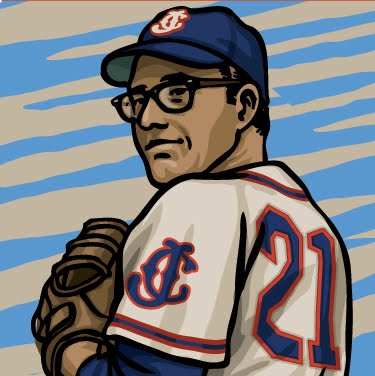
When I first started this blog a little over 3 years ago, I started receiving many requests for players to be profiled on here and given The Infinite Baseball Card Set "treatment." Out of all the emails I began to notice that it was not one particular player that was asked for the most, but rather a whole ethnic group: Jewish ballplayers. I did cards and stories on here of Sandy Koufax and Moe Berg, but I began slowly researching different players of the Jewish faith, trying to find characters who would fit in with the kind of stories I like to write - guys with interesting stories who may not be known to the casual fan of baseball history. Al Schacht was one of those guys, and in fact he appears on page 7 of the Premier Issue of "21: The Illustrated Journal of Outsider Baseball." While many baseball fans may know of him from the comedy routines he did with Nick Altrock, Al Schacht was actually a real pro ballplayer and had a nice career before he started his second career as a comedian. His story of doing everything possible to attain his goal of playing in the major leagues was both funny and inspiring to me, as I hope it is to you...
Al Schacht was a product of the teaming slums of the Lower East Side. The son of Russian immigrants, Al defied his parents wishes by embracing the American pastime of baseball. His mother, daughter of the village Rabbi back in Russia, was especially against the game, fearing he’ll turn out to be a bum or a loafer if he continued. Despite the warning, Schacht poured his heart and soul into the game. After the family moved to the more rural Bronx, Schacht would walk all the way to the Polo Grounds in Harlem to see his beloved New York Giants play. He went beyond being a casual fan however and soon made himself useful to the team by running errands for the players. Christy Mathewson especially became a favorite of Schacht and the two struck up a friendship of sorts. Mathewson even taught the young kid how to throw his famed “fadeaway” pitch.
Because of being 5’-11” and only 125 pounds, Schacht was overlooked for his high school team so he put his talents to use on the sandlot and with semi-pro teams. Although he eventually made his high school team, he was later found illegible because of his having played semi-pro ball for pay. So Schacht dropped out of school all together and pursued a career in professional baseball.
Catching on with a team in Walton, N.Y. he promptly won 16 consecutive games. Before one game he learned that a scout from the Cincinnati Reds was in the stands to watch him. Fearing his diminutive size would work against him before he even had a chance, Schacht pulled on double pairs of socks and a couple of sweatshirts along with sliding pads to make himself seem bigger. The afternoon was hot and the struggling Schacht lost 2-0, but he was called to Cincinnati and put in front of owner Clark Griffith. Seeing that he was much smaller than described, Griffith offered him a minor league contract. Schacht declined, knowing he could make more playing semi-pro ball than in the low minors.
Schacht played around the Northeast for various clubs and after a stint in the army during the First World War, where he did little more than play baseball, Al signed with the Jersey City Skeeters in 1919. The Skeeters were a miserable team, winning only 45 games during the whole season. However, Schacht was the winner of 20 of those contests. After each win Schacht would anonymously send a newspaper clipping of the game to Clark Griffith. Now owner of The Washington Senators, Griffith himself travelled to Jersey City to look Schacht over. After his 10th shutout of the year, Griffith signed Al to play for the Senators. He was a good pitcher for a few seasons but it was his second talent on the diamond that he became known for.
Al Schacht was a natural clown. Teaming up with former player Nick Altrock, the two made the stands howl with laughter as they went through silent vaudeville routines between innings. Besides being clowns, the two men served as 1st and 3rd base coaches. By all reports Schacht was a well respected coach while with the team. By 1921 Altrock and Schacht were performing all over the league as well as at the World Series. Somewhere along the way however, Altrock and Schacht had a falling out. No one really knows the reason why, some say it was an anti-Semitic remark Altrock made while drunk, others say it was jealousy over Schacht's younger age. Whatever the reason the two silently feuded for years before breaking up the act in 1936.
Clad in his trademark top hat and tails over a baseball uniform and known as the “Clown Prince of Baseball” Schacht was famous all over the country, even appearing on stage with such celebrities as Bing Crosby. During the Second World War Al volunteered to entertain the troops. Appearing in such remote places as North Africa and the South Pacific, Schacht helped bring a smile to homesick servicemen. After the war he opened up a restaurant in Manhattan which became a hang out for ballplayers and celebrities. The affable Schacht worked the room entertaining his customers.
Throughout his long career Al Schacht never hid that he was a Jew, famously remarking: "There is talk that I am Jewish-just because my father was Jewish, my mother was Jewish, I speak Yiddish and once studied to be a rabbi and a cantor. Well, that's how rumors get started."
Tuesday, October 23, 2012
134. Charlie Sweasy: Cincinnati's first second baseman
I'm angry. And disappointed, too. Once again my ball club has let me down. I wrote a long and recklessly eloquent intro piece on how the Reds blew the playoffs this year and my explanation of why they did. Oh, it was magnificent in its unrelenting venom and just looking at the card of Charlie Sweasy of the 1869 Red Stockings I had designed specifically for the day when the Reds clinched the 2012 National League pennant made me angry all over again. Then all at once I stopped. It wasn't worth it. Anyone who comes here can simply read the same thing at countless other blogs all over the internet - disappointed Angels fans, angry Cardinals nuts and perennially pissed-off White Sox aficionados probably wrote more or less the same stuff I had.
So I pressed delete.
Who the heck needs another rant? Let's get to some good old-time base ball...
It was the end of August, 1870. For the past 2 years the Cincinnati Red Stockings criss-crossed the nation destroying all who were foolish enough to engage them on the field of battle. They were the first all-professional baseball team assembled and they lived up to all the expectations anyone ever had of them, but by the time the team disembarked from a river steamer at Portsmouth, Ohio their success was such that it was starting to work against them.
The novelty of seeing a Red Stockings game no longer had that certain shine any longer - they were going to win and that was that. Attendance suffered. Once you saw them there wasn't any reason to go again such was the usual lopsidedness of the exhibitions. The team also became a victim of their success on the field. The ballplayers who were once held to vows of abstinence from alcohol was now starting to cut loose. Where once the Red Stockings were the only professional team in the nation, two years after their founding many of the players were being courted to jump the Red Stockings and join newly formed pro teams for more money. With the threat of being tossed off the only paying ball club now irrelevant, the ballplayers became lax on and off the field and it was starting to show.
On the ball field at Portsmouth, the once invincible Red Stockings were losing to the half-rate local Riverside Base Ball Club. When the 9th inning rolled around Portsmouth was ahead 27-23. After Cal McVey and Charlie Gould made 2 quick outs, it looked like the Red Stockings were about to lose their 3rd game of the year. With one out needed to secure a Portsmouth win, Fred Waterman chiseled out a base hit when the shortstop dropped an easy play. Doug Allison and Harry Wright singled to keep the inning alive and suddenly the bases were full of Red Stockings. Andy Leonard then launched an easy fly ball to left field and as the Portsmouth outfielder settled under it for the final out, Leonard slammed down his bat and swore. But the left fielder lost track of the ball, then found it again and made a jumping catch for what appeared to be the final out. Waterman and Allison had crossed the plate but it was in vain as the umpire ruled it an out, game over.
Cincinnati manager Harry Wright ran over to the umpire and claimed it wasn't a catch, that he saw the left fielder drop the ball. Wright and the umpire went out to the left fielder who was picking himself up off the grass. Astonishingly, he willingly admitted he did in fact drop the ball. The umpire ruled a hit and Waterman and Allison runs counted bring the score to 27-25 Portsmouth.
Asa Brainard came up next and his single loaded the bases once again. That brought up Cincinnati's second baseman Charlie Sweasy. He was the team's leading slugger that season, and that afternoon in Portsmouth, Ohio, he certainly didn't disappoint. With a mighty wallop, Sweasy drilled the ball to deep center. Watching the ball carry, Wright, Leonard and Brainard roared around the bases followed closely by Sweasy. Since there was no outfield fence, the center fielder eventually came up with the ball and threw towards the infield - but it was too late. Charlie Sweasy's inside the ballpark home run put Cincinnati ahead 29-27.
It was a close one - too close. To all present it was obvious the quality of the Cincinnati Red Stockings ball playing had seriously deteriorated. While the Portsmouth win was certainly exciting, there was no reason it should have even been close. Nightlife and offers of more cash had taken its toll on the greatest best ball team in history.
As the sun set, the Red Stockings boarded the river steamer Fleetwood for the overnight trip back to Cincinnati. Because of the mixed emotions of that day's game, the team settled into the steamers restaurant and drank freely. The teams once stringent alcohol policy was all but forgotten by now, and most of the men drank continuously through the night. The tanked-up ballplayers became more and more agitated and the air was right for something to happen. When breakfast was being served, Charlie Sweasy, the hero of the previous day's win, began fighting his teammates. Reporters accompanying the team didn't say what the argument was all about, but it's easy to assume it was over his teammates' lousy play of late. Sweasy was in the process of taking on 2 or 3 other Red Stockings when the Fleetwood's captain threatened to run the ship aground if the fighting didn't stop.
The thought of being marooned somewhere along the rural Ohio River wisely put an end the brawl. When the team returned to Cincinnati, its executives decided to suspend Sweasy from the team. Discipline had been breaking down for some time and it was obvious Harry Wright was losing control of his men.
So now Charlie Sweasy, Cincinnati's first second baseman was now professional baseball's first suspended ballplayer.
Charlie Sweasy was a product of Newark, New Jersey's bleak and seamy slums. The city made the young man strong and tough, and it was inevitable that this athletic scrapper would become roped in by the area's burgeoning baseball scene. The game had been popular since before the Civil War, and by the time Sweasy picked up a bat North Jersey boasted some of the most competitive baseball in the country. After cutting his teeth with a few of the many sandlot teams in Newark, Sweasy was recruited by the New Jersey Irvingtons. This was the ball club that launched Sweasy as well as his teammate Andy Leonard to stardom. Their play with the popular Irvingtons got them both a lucrative offer from the Cincinnati Buckeyes from whom they were in turn snatched away from when the Red Stockings formed in 1869.
With Cincinnati, Sweasy became their solid and dependable second baseman. While not their best hitter, he was 2nd on the team with 30 home runs in 1869 and first the next year with 18, securing his reputation as the Red Stockings' premier slugger. When he felt his $800 salary for 1869 was not enough for the following season, Sweasy held out for a couple hundred more and became baseball's first hold-out.
But the man the Red Stockings swiped from the Buckeyes was to prove a complicated fellow. At times belting out popular songs and appearing gregarious and witty, he was also cranky and irritable. By the time the Red Stockings swiped him off the Buckeyes' bench, Sweasy was known as a troublesome character. Booze was mostly to blame, and the Red Stockings' enforced abstinence kept Sweasy from becoming his own worst enemy for most of 1869 and 1870. When fame started destroying the team in the late summer of 1870, Sweasy was its first casualty.
The suspension of the team's best slugger was unpopular with the press and fans, resulting in a quick reinstatement. The decision further brought out the Red Stockings' problems: when the team completed its schedule it was announced that Harry Wright was taking the Red Legs name and most of the marquee players and heading for Boston. Sweasy, though he led the team in home runs, wasn't one of the players invited to join. More than anyone else, Harry Wright knew that left to his own devices, Charlie Sweasy was a shipwreck waiting to happen. Though he didn't take his old second baseman to Boston he did vouch for him to other clubs, being careful to tell them that he performs best when held under strict guidelines to ensure sobriety. Along with old pal Andy Leonard he went to Washington but his play never came close to what he'd become known for with Cincinnati and he left after a season. From then on his career was like a pinball machine - Cleveland, Boston, Brooklyn, Baltimore, St. Louis, Cincinnati, Providence and finally back in Newark. Somewhere he picked up rheumatism to add to his alcoholism and he dropped out of the game, spending the rest of his life peddling oysters on the dank streets of Newark.
SOURCES
- Rhodes, Greg and Erardi, John, The First Boys of Summer: The 1869-1870 Cincinnati Red Stockings (Road West Publishing, 1994)
- Guschov, Stephen D., The Red Stockings of Cincinnati (McFarland & Company, 1998)
- Wheeler, Lonnie and Baskin, John, The Cincinnati Game (Orange Frazer Press, 1988)
- This Game of Games (thisgameofgames.blogspot.com)
Tuesday, December 13, 2011
98. Russ Van Atta: The Babe, Oil and One Dead Finger

Well, it's Christmas time again and I'm preparing for my trip back to New Jersey to visit my Brother and Mom. Although I left that place when I was 17 and never really looked back, Christmastime always makes me a bit nostalgic about growing up there and I get a little homesick for my home state. So, like last year at this time when I did a feature on New Jersey native Johnny Vander Meer, I'd like to introduce you to another son of The Garden State, former Yankee pitcher Russ Van Atta.
Back when I was growing up in New Jersey, my Grandparents would take my brother and I out into the country of the northwest part of the state to pick apples. Sussex County was as far away from the belching smokestacks, endless overpasses and teaming city streets of the eastern part you think of when the word "New Jersey" is invoked. No, Sussex County was and still is a dazzling wilderness of rolling green foothills, black and white milk cows, race horses and tidy red barns. It was the reason New Jersey's often-derided nickname is "The Garden State."
Now back then, in the late 1970's, chances were if you stopped in any diner or tavern in the county there would be one thing that they all had in common besides offering cold Ballantine Beer in bottles - an autographed picture of Babe Ruth. Every single establishment had one, even hotels, golf courses, hardware stores... they were as common as a calendar. Who was behind this county-wide plethora of Bambino ephemera? The Sheriff, that's who.
Long before he was known as "The Sheriff", Russ Van Atta was just another poor kid trying everything he could to escape the zinc mines that dotted the foothills of Northwestern New Jersey. Understandably, working underground all day for 53 cents an hour wasn't how he wanted to spend the rest of his life. Like many other young kids in the United States before and since, Russ figured baseball was his way out. A southpaw pitcher, Van Atta was good enough to have been offered a partial scholarship to Penn State in 1924. Unlike most of his well-to-do classmates, Van Atta took on any odd job he could find in order cover school costs - making the beds in fraternity houses and keeping the furnaces lit during the bitter winter months. By the time graduation rolled around Van Atta had firmly established himself as the Nittany Lion's ace pitcher, losing only 1 game in 4 seasons.
For a $250 bonus, super-scout Paul Kritchell got Van Atta's signature on a New York Yankees contract and by June the kid from the mines was dressed in pinstripes, sitting on the Yankees bench wondering when he was going to pitch. Manager Miller Huggins quickly waved away any delusions the kid had about cracking the Yank's rotation when he sat him down and told him he didn't even trust him to pitch batting practice, let a lone a real game. No, the newly-minted college grad was going to Hartford in the Eastern League for seasoning.
He was 8-4 in 24 games for the Hartford Senators with a 2.37 ERA. In August he went the full 9 innings against the Boston Braves, shutting the National Leaguers out on 4 hits. The word was he was wild but talented and the next year the Yankees moved him up to their St. Paul team.
Van Atta now suffered through two seasons of bad luck and even worse pitching. The control problems became a real issue and by the time spring 1931 rolled around all Van Atta had to show for two seasons was a lousy 7-14 record. During the off-season he contemplated giving up game but eventually decided to give it the old college try. It was a good choice.
New to the Saints in 1931 was veteran Cardinals and Giants catcher Frank Snyder. Working closely with Van Atta, Snyder used his 16 years of major league experience to mold the discouraged southpaw into a first-class pitcher. By August he was considered the best pitcher in the American Association and finished 13-5 for the '31 pennant winning Saints.
The following year was Van Atta's break-out season as a pitcher. He tied for league-leader in wins with 22 and on May 19th, 1932 Van Atta barely missed making a baseball history by following up teammate Slim Harriss' no-hitter of the previous afternoon with one of his own against the Kansas City Blues. Van Atta's no-hit bid was busted up in the 8th when Pat Collins doubled and he had to settle for a one-hitter. Together the two St. Paul pitchers tossed 17 2/3 consecutive scoreless innings. By now Van Atta was considered as a no-questions asked sure thing and after the Yankees struck their spring training camp and headed north to start the 1933 season, Russ Van Atta was wearing his own set of pinstripes with the number 14 on the back, his signature freshly inked on a $3,500 Yankee contract for the season.
On April 25th the Yankees were in Griffith Stadium to play the Washington Senators. Once the butt of many a joke, the Senators now possessed a talented team that would eventually derail the mighty Yankees' annual pennant. Russ Van Atta took the ball and began one of the most memorable and infamous debut performances in baseball.
Van Atta had the Senators handcuffed and scoreless for the first 3 innings. In the top half of the 4th, Yankee outfielder Ben Chapman came to bat. Chapman was a mediocre ballplayer who more than made up for his inadequacies with ruthless determination and a mean streak 16 miles long. On the professional, sterile New York Yankees, Chapman stuck out like a sore thumb, provoking fights and cultivating his reputation as a rabid anti-Semite, to the point of taunting Jewish fans in Yankee Stadium with the Hitler salute. So Chapman hits a double off Monte Weaver and after rounding first sees Washington's star second baseman Buddy Myer blocking the base. Chapman bears down and slides into the base spiking the hell out of Myer in the process. Buddy Myer, a tough ballplayer himself, jumped to his feet and kicked Chapman in the head. Being Jewish he undoubtedly figured Chapman's aversion towards his religion had something to do with the intentional spiking. The two went at it and slugged it out. Both benches emptied as the players ran onto the field to fight.
Van Atta was among them but was quickly grabbed by manager McCarthy and pushed back towards the bench - he was their pitcher and the Yanks couldn't afford to have him be thrown out of the game, or even worse, hurt. When he reached the Yankee dugout he discovered there were only two men still sitting there, Babe Ruth and Lou Gehrig. From the dugout Van Atta marveled at the orgy of violence that unfolded before him. Finally the umpires managed to separate the players and promptly ejected both Chapman and Myer. As Chapman walked past the Senators bench on his way to the clubhouse, Washington pitcher Earl Whitehill shouted something at him and Chapman belted the pitcher in the mouth.
Now all hell broke loose.
An estimated 300 fans rushed onto the field to attack Chapman. Yankee outfielder Dixie Walker did his best to defend his teammate but was soon overwhelmed. The rest of the Yankees charged through the crowd to rescue the 2 men as the police beat back the enraged spectators trying to restore order. 20 minutes later it was over. In addition to Chapman and Myer, Dixie Walker was ejected and a handful of Washington fans were taken away in handcuffs. It was probably one of the worst riots in Major League history, but the day wasn't over yet.
Van Atta, much to his credit, resumed his mastery on the mound, unwilling to become rattled by the battle that took place. At bat he registered hit after hit, going 4 for 4, all singles, knocking in a run and scoring three. He kept the Senators to five hits and shut them out 16-0. It was one of the best debut performances for a pitcher to date but it was totally overshadowed by the riot in the 4th inning.
To Van Atta it didn't really matter because everything he did that season went his way. With an already overpowering fastball, the rookie worked with veteran pitcher Herb Pennock and developed a nasty little curve, the key being the pressure he put on the ball with the middle finger. As the season wore on number 14 registered win after win and closed out the season 12-4, his .750 win-loss percentage leading the quartet of Yankee starters. Besides his dominance on the mound Van Atta batted a nice .283 to boot. New York finished 7 games behind Washington who absolutely crushed the competition that year - all except the rookie Van Atta who was the winning pitcher 5 of the 6 times the Yanks managed to defeat the pennant-bound Senators.
Van Atta went home to the Jersey foothills a conquering hero. The Sporting News, back then the New York Times of the baseball world, picked him, along with Hank Greenberg and Joe Medwick, for their 1933 freshman all-star team. Besides the accolades in the sporting press, Van Atta had also made some influential friends, namely his teammate and the most famous athlete in the world, Babe Ruth.
The big slugger was winding down his career in New York and befriended a the young ballplayer from North Jersey. Both the Babe and Van Atta had a passion for the outdoors - hunting, fishing and golf, and Van Atta proudly took the big slugger home with him on off days to sample what his corner of The Garden State had to offer. The Babe fell in love with Van Atta's hometown and continued to visit there every year up into the 1940's. The locals who were already proud of their hometown hero now really had something to crow about, Van Atta brought The Babe home with him. Local roadhouses, well-stocked with liquor since the recent appeal of prohibition, all boasted Bambino visits and every golf course in that part of the state proudly displayed a personally autographed picture of the big guy.
Anyone in the know predicted great things for this lefty and when the Yankees sent him his 1934 contract filled out with the same $3,500 he made in '33, Van Atta wasn't shy about sending it back with a counter offer of $7,500. Both parties settled for $6,000 and Van Atta was so well touted for a great future even that made the papers nationwide. Then a week later, this tiny article appeared:
HOUSE BURNS.
Russell Van Atta, New York Yankee pitcher, his mother, wife and child were left homeless when fire destroyed the family residence at Lake Mohawk, near Sparta, N.J. on December 13. Firemen from Sparta tried to save the house but the flames had gained such head-way that their efforts were unavailing.
Losing your house was a lousy way to cap off a great year, but so long as no one was injured, Van Atta had the world at this feet. Baseball season, and what was supposed to be another great year, was right around the corner.
But right from the start something was wrong. His fastball lost it's sting and the new-found curve left town. By May Van Atta had been knocked out of the box 4 times and quickly slipped from New York's starting rotation. The former phenom soon found himself in the bullpen, back then a shameful demotion for such a young player. 1934 ended with a disappointing 3-5 record with an unacceptable 6.34 E.R.A. Newspapers debated Van Atta's season - was it the dreaded sophomore jinx, did he strain his arm in spring training, maybe the other batters around the league simply "figured" the southpaw out. No one knew for sure until the real reason finally leaked out.
Remember that December fire? Well, there was an injury that fateful night. As the fire engulfed the family home, Van Atta took stock of his family members - mother, wife, child, dog... wait, where was the dog? Realizing his cocker spaniel was missing Van Atta dashed back into the burning house to find his dog. In the rescue attempt somehow the pitcher sustained a terrible cut on the index finger of his left hand, severing the nerves. Van Atta staggered back outside clutching his pitching hand only to discover his dog waiting for him.
As the winter turned to spring, Van Atta's finger healed in appearance but the nerves had been destroyed. He could no longer get a good grip on the ball which pretty much threw his newly-found curve ball out the window and robbed his fastball of its velocity. He told no one about the injury, not the Yankees, not even his wife. In spring training he muddled through, trying to get by on his fastball as best he could but the finger was so badly damaged he could run a lighted match along it with out feeling a thing - not a bad cocktail party trick but meaningless for a big league pitcher trying to stay in the game.
After his wipe out in 1934, Van Atta stumbled through spring training in '35 before being sold for the waiver price to the St. Louis Browns. Van Atta's career was effectively over. He went 18-32 with the miserable Brownies, all the while feuding with their despot of a manager, Rogers Hornsby. He held on in the Browns' bullpen until the spring of 1940 and then returned home to the foothills of New Jersey. Still a popular fella, Van Atta ran for Sheriff of Sussex County and with the help of his old pal Babe Ruth, easily won. The Babe's campaign pitch was simple: with a wink of the eye he told the locals if you don't elect Russ, I'm not coming back to this part of the state anymore. And that's how Russ Van Atta became known as "Sheriff" Van Atta. A few years later as The Babe lay dying from cancer, Van Atta made the trek to his hospital bedside to bid his old pal goodbye. He died 2 days later.
After a term as sheriff he moved on to the post of County Freeholder and then on to a highly successful career as a representative of the Gulf Oil Company. Shrewd land deals made him a wealthy man. Renown throughout Sussex County as an all-around good guy, "Sheriff" Van Atta spent his retirement traveling around the country visiting his old teammates, reliving his once promising career and reveling in all the friendships he made. Alzheimers finally claimed the old southpaw and Sheriff Van Atta died at the age of 80 on October 6, 1986.
Subscribe to:
Posts (Atom)