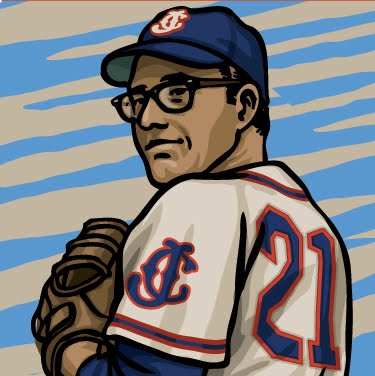
Recently,
I was reminded of the
ballplayer whose story, more than anyone else, got me into researching obscure
players and teams from baseball’s past and tell their stories.
Way
back when I was a kid, I remember asking my grandfather if he ever knew anyone
who made it to the major leagues. My grandfather said yes, as a matter of fact
he did know a major leaguer, and his name was Frankie Zak. Frankie was a buddy
of my grandfather from the old neighborhood in Passaic, New Jersey, an
industrial city a few miles west of Manhattan. Frankie, like everyone else on Fourth
Street, was the son of Polish immigrants. Thomas and Victoria, his parents, had
immigrated from the Galicia region of Eastern Poland. Born in 1922, Frankie was
the youngest of the four Zak kids.
Just
like my grandfather and the rest of the gang on Fourth Street, Frankie played baseball,
but the game didn’t really interest Frankie. Sure, he tagged along when my
grandfather and his cronies were devising schemes to sneak into Newark’s
Ruppert Stadium to see the Yankees top farm club play, but baseball wasn’t
Frankie’s thing. Just under 5’-10” and with a lean, athletic build, Frankie
excelled at football, tennis, and especially track, where his fast speed earned
him medals in the 60-yard dash.
When
he graduated Passaic High in 1940, Frankie went to work in a wire cable
factory. The stable life of a blue collar factory worker seemed to be his
future, but that’s when fate stepped in.
In
the summer of 1941, Frankie and a couple neighborhood pals decided to bum
around the country in an old jalopy. With $30 bucks between them, they ventured
south to visit another neighborhood pal (and an uncle of mine) Eddie Sudol.
Back in the neighborhood, Eddie was the guy everyone thought would go all the
way to the major leagues one day, and sure enough he was now playing his second
year of organized ball with the Tarboro Orioles in the Coastal Plain League.
This was Class D ball, the bottom rung of the minors at the time. While most
teams at this level were not owned by a big league club like they are today,
the Tarboro team had recently signed a working agreement with the Baltimore
Orioles, an independent minor league team at the time.
So
anyway, Frankie Zak and his two pals turn up in Tarboro one hot and humid June day.
As Eddie told the Pittsburgh Post-Gazette, “That night I went to the
park, not because I liked baseball, but just to see my friend play. I wasn’t
very much impressed, and the next day was making ready with my two pals to
shove off, when my ball-playing friend rushed into the room and said: “Come on
to the park. You’re goin’ to play for us tonight.”
In
another interview with the Paterson Morning Call, Frankie recalled that
Eddie, “came up and told me their shortstop quit and I was going to play that
night. I’d played a little amateur and sandlot ball, but didn’t care much about
the game. But the manager, Poke Whalen, said he would pay me for it–and I
needed the money. So I played. I hit one for three and didn’t make any errors.
He signed me to a contract after the game, and I stayed.” But it was only
temporary, you know, ‘cause Frankie didn't really care for baseball.
Though he had been a second baseman back in Passaic, Frankie eased right into
his new job. And the sportswriters who covered the Coastal Plain League were
delighted with the newcomer because they no longer had to write out the name of
the shortstop Frankie replaced: Olesciewicz!
So
Zak finishes the season with the 6th place Orioles, bats a lean .255, and
fields his position with a .905 percentage, right about in the middle of the
league. Not bad for a rookie who never played the position before. In normal
times, it would be a tough call to say whether his first season at Tarboro was
good enough to keep him in professional baseball, but these were not normal
times. During the off season the Japanese attacked Pearl Harbor and the country
was thrust into a two-front war. Any able-bodied men who didn't rush to
volunteer were being scooped up by the draft, and baseball at all levels was
being affected. It was a time when men like Frankie Zak got their chance at
baseball immortality.
With the war picking up steam, Frankie's rookie season was deemed good enough
to be picked up by the Pittsburgh Pirates organization. The Bucs sent the 20-year-old
shortstop to the Class D Hornell Maples in the Pennsylvania-Ohio-New York
League (mercifully known as the PONY League). While he didn't exactly tear up the
circuit, he did boost his average to .271 in 129 games as the Maples’ starting
shortstop. He had 39 RBI's and belted 2 home runs, the only ones he ever hit in
his career. The baseball odyssey of Frankie Zak was fully underway.
Spring training for the Pittsburgh Pirates in 1943 was held in Muncie, Indiana
due to wartime restrictions, and Frankie worked out under the tutelage of the
greatest shortstop who ever played, Hall of Famer Honus Wagner. Though he
didn’t seem ready for the majors quite yet, Frankie always managed to endear
himself to those around him. This included the legendary managers he played
for, such as Casey Stengel, Frankie Frisch, and Burleigh Grimes – all gruff
veterans and Hall of Famers who did not normally take to young ballplayers. Yet
something about the kid from Passaic made these normally taciturn skippers take
on an almost big brother role when it came to Frankie.
Throughout
his career, the slight but enthusiastic ballplayer who was descried in an
Associated Press wire story as “dynamic, effervescent,” never failed to make a
positive impression on those around him. He was ever eager to hone his craft,
showed unselfishness at the plate, willing to take a walk and get on base
instead of swinging for the fences, and was a non-stop chatterbox of whistles
and encouragement to his teammates when he was manning shortstop. The other
ballplayers began calling Frankie, “The Voice.”
While
Frankie didn’t impress Pirates skipper Frankie Frisch enough to make the big
club, he was promoted to Pittsburgh’s highest minor league team, the Toronto
Maple Leafs of the International League. The 1943 Leafs were managed by
Burleigh Grimes, the cantankerous former Brooklyn Dodgers spitball pitcher and later
manager. Grimes quickly became a Frankie Zak fan, singing his praises to both the
young ballplayer and the press. The Leafs skipper told one sportswriter that his
shortstop, “is better than Pee Wee Reese was when he came to the
Dodgers” and Frankie later told
the Pittsburgh Post-Gazette that Grimes “told me I would be a star in
the majors, but I thought it was just encouragement, that’s all.”
Besides
being the Leaf's starting shortstop, Frankie became noted for his speed on the
bases. He batted .246 with 9 doubles and a triple in all 150 games played that
year, the only player on the team to do that. He swiped 22 bases, led the
league with 104 runs scored, and was second in the league with 104 walks as Toronto
won the pennant. He did, however, commit 50 errors at his position – but then
again, who can find fault with that, ‘cause Frankie didn’t care for baseball
very much...
In 1944, the major league talent pool had been decimated by the war. By then
pretty much every player who could pull a trigger was in the service. Those
still playing were high school aged kids, geezers too old for the service, guys
who were just plain lucky their draft number hadn’t come up yet, and those
given a 4-F deferment by the draft board. 4-F was given out for a wide variety
of reasons why a person was not acceptable for military service, in most cases
a physical ailment. Afflicted with what was described in newspapers as a
“kidney ailment,” Frankie was one of the 4-F’s.
It
was under these circumstances that Frankie Zak put on a Pirates uniform with
the number 14 on the back and stepped out onto the field as a real major
leaguer.
Frankie’s
big league debut came on April 21, 1944, in Forbes Field against the Cincinnati
Reds. With the Pirates losing 4-2 in the bottom of the ninth, with 11,377 fans
in the stands, Frankie Zak was put in to pinch hit for veteran catcher Al
Lopez. He wound up being stranded on first when the next batter hit into a
forced third out – but still, Frankie Zak, the guy from the old neighborhood
who didn't care for baseball, was now a major league baseball player!
Pirates
manager Frankie Frisch continued to use Frankie exclusively as a pinch hitter
through the first two months of the season until his regular shortstop, Frankie
Gustine, went into a batting slump. Frankie made his batting debut on June 1 in
Ebbets Field against the Brooklyn Dodgers. In his first major league at bat,
Frankie hit a single off Curt Davis in the top of the third. With Rip Sewell at
the plate, the over enthusiastic Frankie danced too far off the bag and was
picked off by Davis. However, Davis’s throw was off target and Frankie
scampered into second on the error. Frankie clipped Davis for another hit in
the fifth before he was taken out for a pinch hitter in the eighth inning.
Throughout
the summer the young shortstop played backup to Frank Gustine and got into 87
games, frequently used as a pinch runner. Zak batted a hearty .300 with 3
doubles, a triple and 6 stolen bases thrown in there for good measure. But
breaking the .300 mark was not the highlight of Zak's 1944 season – getting
named to the 1944 All-Star Game was! Yes, Frankie Zak, rookie back-up shortstop
and occasional pinch-runner was named to represent the National League at the
1944 All-Star Game.
How the heck did that happen? Well, it's like this: The 1944 All-Star Game was
to be played on July 11 at Pittsburgh’s Forbes Field. Marty Marion of the
Cardinals and Eddie Miller of the Reds were picked as the National League
shortstops for the game. However, on the eve of the game, Miller was injured
and could not play. National League manager Billy Southworth needed a backup to
Marion ASAP, but because of wartime travel restrictions it would be impossible
to import a player from out of town. He needed to grab someone present in
Pittsburgh.
Southworth’s
first choice was the Pirates second baseman, Pete Coscarart. Unfortunately,
Pete was using the All-Star break to go on a fishing trip out of town.
Fortunately, Frankie Zak had decided to stay in town. And just like that,
Frankie Zak, the guy who didn’t care for baseball all that much, became an
All-Star.
Although
he didn't get into the game (Marty Marion played all 9 innings), Frankie had
the best seat in the house as the National League won, 7-1. He did, however,
manage to get into the official team portrait, mixed right in there with the
best National Leaguer players of 1944.
Frankie, who was batting .330 at the All-Star break, cooled down slightly to an
even .300 at the end of the season. Though he more than held his own in his
rookie season, Frankie’s major league career would last only 36 more games
spread over the next two years. But Frankie Zak made up for lack of playing
time with a couple of legendary baseball stories that are still told by old
timers.
The
first one takes place sometime in the 1944 season. The Pirates were playing
Chicago at Wrigley Field and Frankie was trying to score on a double by
outfielder Jim Russell. As he rounded third, the Cubs nasty little third
baseman, Eddie Stanky, gave him a hard shove. Thrown off balance and now out of
control, Frankie careened out of the basepath and tumbled all the way to the
dugout. The ump waved in the run but neglected to discipline Stanky. Pirates
manager Frankie Frisch vowed to even the score for Frankie, and sure enough on
the next play Jim Russell comes sliding into third, spikes high, as does
manager Frankie Frisch, sliding in spikes high from the coach’s box! The ump,
Hall of Famer Jocko Conlan, calls Russell safe and Frisch out of the game.
Another great Frankie yarn took place on Opening Day, 1945. Pittsburgh is
leading the Reds 1-0 in the fifth at Crosley Field and Frankie Zak beats out a
bunt. Now there's two men on base. Reds pitcher Bucky Walters looks in to pitch
to Jim Russell and Zak, noticing his shoe is untied, calls time. The first base
umpire throws his hand up calling time out, but Walters and the home plate ump
didn't hear it in time. Walters throws and Russell belts the ball into the
right field bleachers for a home run. Only it wasn't. The run wasn't allowed
and after much argument, Russell returned to the batter’s box while Frankie
hung his head in shame, tying his cleats. The best the Pirates could do was
score one run that inning and as luck would have it, they lost the game 7-6.
The next day Frankie Frisch got a telegram from Casey Stengel “Am rushing a
pair of button shoes for Zak.”
Then
there’s the time in spring training when the Pirates were playing an exhibition
game against the Cleveland Indians. Frankie was the leadoff batter in the
Pirates half of the first inning. The pitcher was a giant Native American from
Oklahoma named Allie Reynolds. Eager to show his stuff, Reynolds wound up and
threw his hard one. Frankie swung and connected solidly – everybody heard it –
but nothing happened. There Frankie was, standing at home plate, his hands
empty and his bat laying on the ground – Reynolds threw so hard it literally
knocked the bat out of Frankie’s hands! Pirates manager Frankie Frisch fell off
the bench laughing so hard. Allie Reynolds would go on to be known for his
overpowering fastball and pitch the New York Yankees to a couple World
Championships.
The last Frankie Zak story comes from the old catcher, Al Lopez. When he was
the manager of the Cleveland Indians he used to tell this story:
“I
never like to see women in the dugout. In the first place they don't get a very
good view. In the second place, they don't know how to duck. I even knew a
fellow whose romance was broken up by a foul ball in the stands. His name was
Frankie Zak – a shortstop when I was catching for Pittsburgh – and he fell in
love with a Chicago girl. There was only one hitch. The girl's mother didn't
want her daughter to have anything to do with a professional ballplayer.
Frankie thought he knew how to break down a mother’s prejudice. He arranged for
the girl to bring her mother to a game. We were in Wrigley Field and it was
Ladies' Day – 20,000 women in the park. And of all those people, who do you
suppose got the foul ball in the face? That's right. The girl's mother. She was
really hurt, too. And that was the end of the romance.”
So what became of Frankie Zak? As the war wound down in the summer of 1945,
former big leaguers began rejoining their old clubs. Frankie bounced back and
forth between the Pirates and their farm team in Kansas City. He made the most
of his demotion, leaving anyone who saw his work at shortstop come away
impressed. The Kansas City Star went so far as call him, “one of the
more talented tenders of that position in Kansas City’s baseball history.”
The
start of the 1946 season marked the return of real baseball and replacement
players like Frankie Zak became redundant. To allow both the returning vets and
the replacements to have a fair shot at staying in the majors, the usual 40-man
roster was enlarged to 48 players for the season. Frankie opened the season
with Pittsburgh, but after batting a flat .200 in 20 at bats he was given his
release by Pittsburgh. Fortunately, Frankie’s time in KC the previous summer
had impressed his manager, Casey Stengel. Even though he was now managing the
Oakland Oaks, when Casey heard the Pirates had cut Frankie loose, he contacted
his former bosses in Kansas City and told them to sign Frankie ASAP. As Kansas
City was now a Yankees farm club, Frankie was now part of their vast
organization.
Again,
Frankie’s fielding and speed made him stand out, with the Kansas City Star
musing, “the fact remains he is considerably above the average shortstop in
fielding and is a definite threat on the cushions. His inability to drive in many
runs is all that prevents his becoming outstanding as a major leaguer.”
After
the ’46 season, Frankie became eligible for the Rule 5 Draft. This was MLB’s
way of preventing teams such as the Yankees from keeping too many talented players
down in the minors when they could be used by another major league club. The
St. Louis Browns snatched Frankie up, but before he could report he was thrown
in to sweeten the pot of a Browns-Yankees trade and he again found himself part
of the Pinstripe Empire.
The
Yanks sent him to their top farm club, the Newark Bears, the same team Frankie
and my grandfather’s gang would try to sneak into watch years before. He batted
a weak .206 for 1947 and then spent the next three seasons with Portland, San
Diego, Oklahoma City, and finally Tacoma.
His
nine-year baseball odyssey at an end, Frankie returned to Pittsburgh. He had
married a Smoke City gal named Helen in 1945 and had two daughters. Sometime in
the late 1950s Frankie made his way back to Passaic and took a job at United
Wool. He stayed active in the area’s semipro baseball scene and in 1967 was
inducted into Passaic High’s Athletic Hall of Fame along with his old pal Eddie
Sudol, the same guy who started Frankie on his unlikely baseball career. The
National League All-Star passed away of a heart attack just a few days before
his 50th birthday in February 1972.
Well, that's a lot to write about a guy who played only 123 major league games,
right? Wrong. It's players like Frankie Zak who make this great game so
interesting. For every Mickey Mantle and A-Rod, there are thousands of Frankie
Zak’s out there, every one of them with their own bunch of stories just waiting
to be told. It just takes a little digging, and you'll find them. I did.
Look up Frankie Zak today and you’ll
find a bunch of mediocre articles churned out by lazy sportswriters that label
Frankie “The Worst All-Star of All-Time” or some similar click-bait title. They
rehash the ’44 All-Star Game replacement story and how Frankie hit just .269 in
his three year MLB career and essentially was a nobody that went nowhere. The
one thing all those articles have in common is that the writers didn’t look any
father into Frankie’s story than his entry in Wikipedia or maybe his stat line on
Baseball-Reference.com. They don’t go into how and why Frankie got to the time
and place that made him an accidental All-Star. Their curiosity ceases after
the 36 games Frankie played after his All-Star Game season.
Do a bit of research and you find
that far from being a joke at the time, contemporary sportswriters found
Frankie Zak’s story inspiring. He was given the title of “Baseball’s Cinderella
Man.” Like the original “Cinderella Man,” James J
Braddock who in 1935 went from being a washed up thirty-year-old New Jersey
fighter to the heavyweight boxing champion of the world, the sportswriters
appreciated how Frankie made the most of his
unlikely career and turned into a real major leaguer. In 1944, Frankie’s story was
an inspiration, something people could hold onto when their options looked
bleak. Frankie proved that any man could become a “Cinderella Man.”
And that label of “worst All-Star?”
Frankie was batting .330 at the All-Star break. If we use the same level of
research those writers put towards their stories, one can make a case that the mantle
of “worst All-Star” could be given to Willie Mays who played in the 1972 game
despite hitting a sad .211 on the year – or Hank Aaron who was an All-Star in 1975
despite batting a sub-Mendoza .234. But do Mays and Aaron deserve title of
“worst All-Star?” No, of course not once you look past the numbers. And neither
does Frankie.
Frankie
Zak was the beginning of my interest in baseball research. Where else would I
have heard of the Tarboro Orioles? Or learned that before the Orioles fielded a
major league team in 1954, there was a team by the same name with a proud
heritage and enough success that it could support a farm system of its own,
independent of the major leagues? I learned every box score and faded
photograph holds the potential to launch a great yarn. That's why Frankie Zak,
the guy from the neighborhood who never cared much for baseball, is the Patron
Saint of The Infinite Baseball Card Set.