


This is the fifth and last of 5 Bushwicks Stories in 5 days. For the introduction to the Bushwicks and this series please go HERE first.
So far we've seen three of the four types of players that made up the Brooklyn Bushwicks:
1) The guy who had all the talent in the world, but never wanted to turn pro.
2) Aging big leaguer on his way back down into the civilian world.
3) The career minor leaguer who just didn't have that certain "something" to make the majors.
Today we have Marius Russo, a guy who perfectly personifies the fourth and last type of Bushwick:
4) The young guy from the area who wanted to make a name for himself.
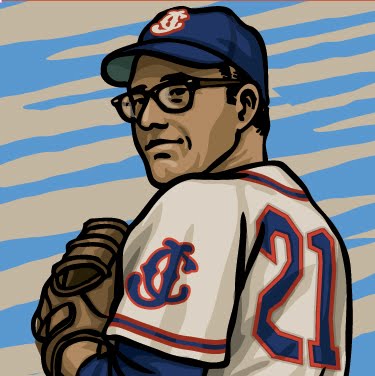
With pin-point control and a nice side-arm fastball, Marius Russo cut through collegiate competition like a knife. The Long Island University student's 8-2 record and headline-grabbing win at the Greater New York College All-Star Game grabbed the attention of the Yankees super-scout Paul Krichell. When Russo's college athletic eligibility was used up in the spring of 1936, the lefty found his services were in much demand in New York City's semi-pro circuit. The college kid hired his arm out to various teams including the Glendale Farmers and Brooklyn Bay Parkways. Krichell sat in the stands and watched closely but before he got the kid's signature on a Yankee contract he wanted to see more. He wanted to see how the lefty did against the best players outside the major leagues. Krichell wanted to see how Russo did against Negro League teams.
After ascertaining the kid wanted was game to pursuing a career in pro ball, Krichell made a phone call to Max Rosner and within days Russo was in a Brooklyn Bushwick's uniform.
Krichell knew, and Russo soon discovered, that whiffing a bunch of college kids was a lot different than facing the Negro League teams. A great many of the blackball players he would face in the summer of 1936 were of obvious major league caliber but for their skin color.
His first brush with blackball came against the New York Black Yankees. Formed from the ashes of the old Lincoln Giants, the Black Yankees were the perennial losers of the Negro National League but still had some solid ballplayers like Tubby Scales and Fats Jenkins - not Hall of Famers but had they been the right hue they'd be on a big league roster somewhere. The Black Yanks slapped Russo around for 7 runs on 15 hits. Next he faced the Philadelphia Stars, Negro National League champs two years earlier. The Stars had future Hall of Famers Jud Wilson and Turkey Stearnes in their line up and knocked the kid out of the box by the 5th inning. Russo went on to lose his next four starts against the black teams. None of his losses came close to being as dramatic as the game he pitched against the Pittsburgh Crawfords in June.
The Crawfords were the New York Yankees of blackball. Ruthlessly assembled by racketeer Gus Greenlee, the Craws had by 1936 assembled the greatest team in Negro League history. No less than five Hall of Famers - Satchel Paige, Josh Gibson, Oscar Charleston, Cool Papa Bell and Judy Johnson - came to face Russo and the Bushwicks that day. By now the college kid had faced blackball teams a few times and knew they played fast and hard. His teammates on the Bushwicks were much more experienced - the median age was about 31 - and their advice on how to pitch to those guys was starting to pay off. In that June game against the Craws Russo was holding onto a 4-3 lead going into the 9th inning. It had been a see-saw game but three more outs and Russo would have his first victory over a black team.
Second baseman Dickie Seay was up first. He was playing on a swollen ankle and had gone hitless all afternoon. Now he led off the ninth with a cheap single that found a hole in the Bushwicks infield. Manager Oscar Charleston put in a pinch runner and the pitcher Leroy Matlock sacrificed him over to second. With one away Cool Papa Bell came up to the plate. Cool already tapped Russo for three hits that day but he popped a ball up to the infield that is caught for out number two. Russo is one out from beating the best team in blackball history.
Speedy outfielder Jimmie Crutchfield is due up but the Craws manager Oscar Charleston takes the bat from his hands and pencils himself in as a pinch hitter. Charleston, who many say was the absolutely best black (heck, some say of any color) ballplayer of all time, was now into his fourth decade and beginning to pack on the chub. Regardless, when Russo hung his fastball over the inside of the plate Charleston sent it 410 feet over the right field wall for a two run homer and the 5-4 edge. Russo recovered enough to snag Sam Bankhead's liner back to the box for out number three. The Bushwicks still had one more inning to retaliate and the odds weren't bad until Satchel Paige emerged from the bullpen to pitch the ninth. Satch was in the prime of his career and his blazing fastball sent the three Bushwicks he faced back in order for the win.
While many young ballplayers would have been discouraged by continued failure, Russo did not. He'd lose seven times before he could claim a win over the black teams and he used this crash course in blackball to become a smarter pitcher. Over all his stats weren't horrible. Scott Simkus meticulously reassembled Russo's 1936 Bushwicks season and found the kid had a respectable 3.82 ERA in 12 games against Negro League clubs. By the end of the summer Russo was a seasoned veteran, a graduate of the Dexter Park Academy of hardball. On September 2nd he got the chance to face the Crawfords again, and this time it was he who was the victor. As opposed to the 12,000 who watch their first tryst, just 4,400 braved the threatening weather for the night game. In what may have been Marius Russo's greatest pitching performance of his entire career, the lefty shut out the Crawfords on two hits and struck out nine.
Krichell has seen enough. Before the summer was through Russo was part of the Yankees organization.
The Yankees sent him to their top farm team which happened to be just across the Hudson River in Newark, New Jersey. The team Russo joined has gone down in history as possibly the best minor league team of all time. Of the 32 men who suited up for the Newark Bears that year, no fewer than 27 would go on to play in the majors, either with the Yankees or other big league teams. The kid from Queens won 8 games for the pennant-bound Bears, and the Yankees ear-marked him to be the heir-apparent to the great Lefty Grove. To give him a touch more seasoning he spent 1938 in Newark where he posted a record of 17 wins and then was called up to the big club for 1939.
Now Marius Russo became an integral part of what historians believe was the greatest team in major league history, the 1939 Yankees. As part of this juggernaut the lefty won 8 games with a 2.41 ERA, not bad at all for a rookie. He followed that up with 14 wins in 1940 and then another 14 in 1941. By now he was the best pitcher on the Yankees and manager Joe McCarthy had him pitch Game 3 of the World Series against the Dodgers. With the series tied at a game apiece he faced off against veteran Fat Freddie Fitzsimmons. Both men pitched magnificently, neither giving up a run through six innings. Then in the bottom of the seventh, Russo hit a line drive that smashed into Fitzsimmons' kneecap. Brooklyn rushed reliever Hugh Casey into the game who promptly gave up 2 runs while Russo cruised to a 4-hit complete game victory to give the Yankees the edge in the series. The hometown kid was an instant hero and the Yanks went on to beat the Dodgers in seven games.
His fame was short-lived. Sometime early in the '42 season he hurt his arm. He managed a 4-1 record but to relieve the pain in his arm he began noodling with his delivery and soon the velocity was gone from his fastball. 1943 was a disappointing 5-10, but with a still respectable 3.72 ERA. With a good part of his pitching staff evaporating into the service, McCarthy tapped Russo to pitch Game 4 of the 1943 World Series against St. Louis. The Cards had been fortunate in regards to the draft and still had all of their starters in uniform. Russo came through with one last glorious game. Holding Hall of Famers Stan Musial and Marty Marion and the rest of the Cards to seven hits, the sore armed lefty hit two doubles and scored the go ahead run in the eighth. The win put the Yanks up 3 games to 1 in their eventual win over St. Louis.
Russo joined the Army after the series and briefly came back to the Yanks in 1946 but the arm was through. He put away his spikes and worked in the aircraft industry on Long Island, eventually retiring to a life of travel with his wife. The old lefty was a popular character at old-timers games and became a font of first hand knowledge for historians interested in the great Yankees teams of the 1930's. He passed away at the age of 90 in 2005.
Baseball archaeologist Scott Simkus wrote a wonderful piece on Russo and his 1936 season with the Bushwicks in the much-missed Outsider Baseball Bulletin. Simkus meticulously reconstructed the lefty's record against the Negro Leaguers and uses these and other Bushwicks stats in a brilliant formula to accurately gauge the level of talent found in the black leagues. I can't stress how important his book "Outsider Baseball" is to modern researchers and can't recommend it enough.
This concludes the "5 Bushwicks in 5 Days" series. It's been fun concentrating on one little-known aspect of baseball history in one break-neck marathon session. I'm not quite sure where next week's story will take us, but you can be assured it sure as heck will be interesting!

