Sunday, March 28, 2010

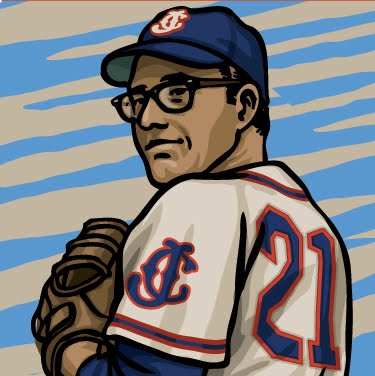
22. Bullet Joe Rogan

The legend goes like this: A low-level barnstorming team of white minor league ballplayers wearily traveling through the American south-west pull up at a desolate, hot and dusty army post somewhere on the Arizona-Mexico border. The baseball team on this forgotten outpost turns out to be one of the greatest teams the young outfielder of the traveling white team has ever seen, especially a pitcher and catcher named Rogan. He mentally notes the names of the players and when he finally arrives back in his home town of Kansas City all he can do is talk about the great ballplayers he has seen. Unfortunately the great players he has witnessed were all black and the year is 1919. The only man in Kansas City who will listen to young Casey Stengel is J.L. Wilkinson, owner of the all-black Kansas City Monarchs. On his word Wilkinson hires 5 players Casey saw after they are discharged from the Army. These players go on to form the core of the great Monarch teams of the 1920's and 30's.

Makes a great story, but is it true? Not really. Stengel may have played against Rogan and his 25th Infantry Regiment team in Arizona but details are sketchy. Did he recommend the army ballplayers to Wilkinson? Maybe, but Joe Rogan, the pitcher and catcher that Stengel was especially amazed with was actually from Kansas City and had already played for a team owned by Wilkinson back in 1917 while on leave from the service. Chances are Rogan contacted Wilkinson or the other way around and Rogan brought along his other teammates to Kansas City. Black newspapers occasionally ran stories about the black Army baseball teams and Rogan and the 25th Infantry team was fairly well known by 1919. Whatever the truth behind the legend may be, Bullet Joe Rogan became one of the greatest players in history. He was an overpowering and smart pitcher who also hit for power. When ranking ballplayers, I always throw the great Babe Ruth out there to end the discussion for the simple fact that besides being the spectacular hitter he was, the first 5 years of his career was spent as a pitcher and not only did he pitch but he was the best left-hander in baseball. To me that versatility trumps anything any other player can boast and there is only one other player who had that kind of sheer talent, Joe Rogan. Unfortunately his color kept him from competing in the major leagues but we can piece together from the records available that he was every bit as talented as Ruth when it comes to pitching and his hitting became legendary all across the country wherever the Monarchs played ball.

In 1910 Joe Rogan joined the all-black 24th Infantry Regiment and served in the Philippine Islands where he became legendary for his catching and pitching for the regimental team. Discharged in 1914 he soon re-enlisted again, this time with the 25th Infantry at Schofield Barracks in Hawaii which had a powerful ballclub known as the Wreckers. While there he shut out the Portland Beavers of the Pacific Coast League on 3 hits, struck out 13 and hit a double. In 1918 the regiment moved to Camp Little on the Arizona-Mexico border and the team continued its winning record with Sergeant Rogan of the machine gun company credited with an incredible 52 wins in one season. In 1920 Rogan, along with teammates Dobie Moore, Bob Fagan, Oscar Johnson, Hurly McNair and Lem Hawkins went onto form the nucleus of the Kansas City Monarchs, one of the most powerful negro league teams.


Wednesday, March 24, 2010

Requests?

I really appreciate all the emails from you guys who enjoy what I am doing here and from time to time I'm asked if I take requests. Sure, why not? So, if you have a player you really want to see, drop me a line at info@cieradkowskidesign.com and tell me who you think should be part of The Infinite Baseball Card Set. I can't promise I will draw it up any time soon, but I'd like to see who YOU want! Keep checking in, I may have an announcement in the next couple of weeks regarding real limited edition sets of cards available...

Monday, March 22, 2010

20. Lefty Grove

Back when there were only 16 major league teams and all were located east of the Mississippi River, the minor leagues were often a baseball fan's only option to see professional baseball. During the 1910's and 20's most minor league teams were unaffiliated with major league teams and because of this autonomy were able to keep players longer than just a year or two like today. The Baltimore Orioles were in the International League, arguably the highest and most professional of the minor leagues. Owned by Jack Dunn the Orioles created a powerful dynasty starting in 1919 that saw the O's win 7 straight league championships. It got to the point where in 1923 the other International League team owners forced Dunn to start selling off some of his players to the majors or else they would all sign a contract with major league baseball giving them the right to purchase any player at a flat fee. They were willing to sell short their profits rather than continue to keep losing to Baltimore! How good was the Orioles of the early twenties? Maybe not as great as the Yankees or the Giants, but they were certainly able to compete with the lower ranked major league teams at the time. Baltimore would often play exhibition games against major league all-star teams and win, so they were definitely up there in the talent department. Those Oriole teams had some great players back then, most of whom were eventually sold off to the Philadelphia Athletics, forming the nucleus of their dynasty of the late twenties and early thirties. George Earnshaw, Joe Boley, Max Bishop, Jack Bentley, Tommy Thomas, and others all went to the majors. The pitching on those teams were amazing, John Ogden going 31-8 in 1921, Jim Parnham winning 33 games in 1923, Tommy Thomas winning 32 in 1925 and of course the unrivaled Lefty Grove who lead the league in strike outs for 4 years in a row.

Signed by the independent Baltimore Orioles in 1920, Lefty Groves became a starter the next season and led the International League in strikeouts for the next four years. He quickly became an integral part of the great Baltimore Oriole dynasty and the team finished in first place every year he played with them. Oriole owner Jack Dunn refused to sell Grove to a major league team until after the 1924 season when he made the Philadelphia Athletics pay a record $100,500 for his services. It was around this time Lefty dropped the “s” at the end of his last name because newspaper sportswriters continually used “Grove” instead of “Groves”.

Anyone wanting to learn more about the Baltimore Orioles from 1903 to 1953 should pick up a copy of Jimmy Keenan's book called "The Lystons" about his grandfather who played on the 1921 Orioles and is a great narrative of the minor leagues and semi-pro circuit during the 1920's. Available at www.keenanbaseball.com

Friday, March 19, 2010

18. Overton Tremper

Overton who? Overton Tremper, that's who. Never heard of him? Well, don't feel so bad, unless you lived in Brooklyn in the 1930's chances are you would have never heard of him or his team, the Bushwicks of Brooklyn. Back during the 1920's up until the advent of televised games in the 1950's semi-pro baseball was a big thing for many parts of the country where there was no chance of seeing a real major league game in person. Thousands of real talented teams sprung up all over the land and most major league players began their careers playing for teams like the Bushwicks. Semi-pro teams were also a place where over-the-hill major leaguers could wring a few extra dollars more out of their career before retiring from the game. Grover Cleveland Alexander, Rogers Hornsby and Dazzy Vance are 3 Hall of Famers who did just that. But the Brooklyn Bushwicks were a little bit better than most semi-pro outfits. Owner Max Rosner put lots of money into his team and even had their own stadium, Dexter Park. Teams travelled far and wide to challenge the Bushwicks, more often than not returning in defeat but slightly richer as Dexter Park regularly drew crowds of 12,000 during its heyday. The Bushwicks battles with the best negro league teams were legendary and real big league stars often stopped by to play a game or two with the "Kandy Kids" as they were known for their blue and orange uniforms. Dazzy Vance, Babe Ruth, Joe Dimaggio all played games for the Bushwicks and a young college kid, Lou Gehrig tried out but failed to make the team. But the regular roster players, such as Overton Tremper, were as equally well known and idolized.

After graduating from the University of Pennsylvania with a degree in economics, Tremper played parts of 2 seasons with the Brooklyn Dodgers before being sent down to the minors. Deciding that it wasn’t the lifestyle he wanted he returned to Brooklyn where he became a high school teacher. On weekends and nights from 1931 to 1934, Tremper was the star outfielder for the semi-pro powerhouse Brooklyn Bushwicks who played major league caliber baseball against all levels of teams. Many ballplayers were actually able to earn more money playing for the Bushwicks than they could playing in the majors as well as having a regular paycheck from their day job. Many major league stars played for or against the Bushwicks and their games against the best negro league teams were legendary. Tremper later earned a master's in education from N.Y.U. in 1938 and coached various semi-pro teams on Long Island. He died in 1996.


Wednesday, March 17, 2010

17. Jackie Robinson

It often happens that an historical figure gets so obscured by their own fame that we fail to truly see and appreciate the things that made them so famous in the first place. Jackie Robinson falls into that category. Sure, his famous number 42 is officially retired on all major league teams and everyone celebrates him every season. But man, if you really look closely at Jackie Robinson, you get acquainted with a talented, brave, complicated man the likes of which no other country than America can produce. This was a guy who put human nature aside and kept his mouth shut when confronted with the worst slights and actions ignorant racist fans and players could throw at him. It was his sheer will that enabled blacks to get back into organized baseball and it was on Jackie's broad shoulders that the cause for civil rights was brought forward by leaps and bounds. I can't think of anyone that had more of a direct impact on civil rights than this man. In the course of maybe 3 years he brought blacks into American homes that were once kept negligent of them. In a precious few short years it became alright for a white boy to have as his sports idol a black man and for once a black boy growing up in America could look upon Jackie Robinson and know that with the right amount of talent and drive he too could become a major league ballplayer. Or anything else for that matter. America was taught that people of all color could sit together in one place without rioting and a person of color is just as talented as a white man. In today's day and age it is hard to relate to the way people thought back then. Jackie had to overcome things like his manager in Montreal saying that he wasn't even sure a negro was a human being or opposing players in Baltimore releasing a black cat onto the field to taunt him. In those few years Jackie bore all that weight and pressure and in turn changed the mindset and outlook of both his fellow players and fans. Clay Hopper, his Montreal manager later became instrumental in bringing up and tutoring black ballplayers in the Dodger organization. Southerners like Pee Wee Reese had their eyes opened to the racism Robinson had to endure and came to his side as a friend. I don't know, I could go on forever singing the praises of this man and what he did for this country of ours and how sometime everyone should sit back and thank God we have men like Jackie Robinson. As my tribute to this giant of a man, I give you Jackie Robinson in his first season of organized baseball playing for the Montreal Royals of the International League.

Signed by Brooklyn, Jackie Robinson spent 1946 with the Dodgers’ AAA minor league team, the Montreal Royals and on April 18, 1946 in Jersey City, N.J. Jackie Robinson became the first black ballplayer in the 20th century to play in organized baseball. He promptly went 4 for 5, including a three-run home run, scored four runs, drove in three, and stole two bases. Overcoming immense racial pressure, Jackie won over his teammates and fans with his natural physical ability and immense drive to win. Sparked by his play the Montreal Royals won the International League Championship and then went on to beat Louisville in the Little World Series of 1946. Through his sheer determination Jackie Robinson paved the way for the desegregation of the Major Leagues.

Tuesday, February 23, 2010

7. Bill Sayles


In tribute to the spirit of the Olympics going on now in Canada we have Bill Sayles, member of the 1936 U.S. Olympic Baseball Team. Although baseball was first showcased at the 1912 Games, 1936 was the first organized team specifically made up of real ballplayers. Tryouts were held in Baltimore and 12 amateur ballplayers were selected. They were later augmented by a few more ex-collegiate players and the team sailed to Berlin in August 1936. Originally the idea was for the U.S. team to play a team from Japan but the latter pulled out before the games started. The U.S. team was split into 2 teams, the home team called the "Weltmeisters" or "World Champions" and the visiting team called the "U.S.A. Olympics". In the week leading up to the exhibition game newspaper articles were printed and clinics were held demonstrating the finer points of the National Pastime. On the evening of August 12, 1936 the 2 teams took the field before over 100,000 spectators. After 7 innings of play, Weltmeister player Les McNeece hit a home run breaking the 5-5 tie to win the game. The crowd which had steadily dwindled over the course of the game politely applauded and the first Olympic baseball game ended. The International Olympic Committee agreed to feature Baseball in the 1940 Tokyo Games and 16 nations were slated to compete but the second world war put a stop to that. The sport was not to make another Olympic appearance until 1984.

Bill Sayles. This University of Oregon graduate travelled to Baltimore for the Olympic Team tryouts and was picked to represent the U.S.A. at the 1936 Berlin Olympics. A fireballing right-hander with a reputation for wildness, Sayles was the pitcher for the Weltmeister (German for “World Champions”) team. He faced off against another team made of fellow Americans called “Olympics.” In front of over 100,000 spectators Sayles gave up 11 hits and 5 runs but held for 7 innings to be the winning pitcher after Les McNeece hit the game winning home run. Despite being a popular exhibition, baseball failed to catch on as an Olympic sport. Bill Sayles returned to the United Stated and was signed by the Boston Red Sox. He went on to play for Red Sox, Giants and Dodgers. He later became a scout for the Cardinals and died in Lincoln City, Oregon in 1996.

Monday, February 22, 2010

5. Pete Hill

One of the reasons I started this project is that I always thought it unfair that so many great players never got their own baseball card during their careers. The negro league players are the perfect example of this. Take Pete Hill. Probably one of the greatest outfielders of the dead ball era before the first world war and he has no American cards showing him in his prime.

Pete Hill was the complete ballplayer, an excellent fielder and a hard hitter who rarely struck out. He was most compared to Ty Cobb for his natural ability and fiery play. Hill played for some of the greatest early negro teams including the Philadelphia Giants from 1904 to 1907 and the Leland Giants from 1907 to 1910. He also played six winters in Cuba. With Rube Foster’s American Giants in 1911 Pete hit safely in 115 of 116 games and he won the Cuban batting title that same year with a .365 batting average. Hill was named captain of the American Giants and Rube Foster considered him his "field general" and a second manager. He left Chicago in 1919 and took over as manager of the Detroit Stars, where he was credited with a .391 average in 1921. He finished up his career in 1925 as the player-manager of the powerful Baltimore Black Sox. Pete Hill died in Buffalo in 1953.


Sunday, February 21, 2010

3. Dave "Lefty" Brown


When I first read Robert Peterson's ground breaking book on the negro leagues "Only The Ball Was White" I was fascinated by the story and grainy photograph of Dave "Lefty" Brown. Imagine a star with the fame and talent like Randy Johnson who also happened to be a convicted highway robber and who disappears at the peak of his career because he shot a guy in a drug deal and you have Dave Brown. I know I shouldn't celebrate such an unsavory character, but who can resist a story like that!

According to legend, manager Rube Foster secured Brown’s release from a Texas chain gang in order to sign him for his Chicago American Giants. Once free he became the ace of the pitching staff for Foster‘s powerful teams of the early 1920’s. His league records of 10-2, 11-3 and 8-3 for the years 1920-1922 show his dominance at this time. He had great speed and a good curve served up with superb control. Lefty is often named as the best left hander in Negro League history. Unfortunately trouble seemed to follow him around and in April 1925 he was accused of murdering a man on a New York City street during an argument. Brown disappeared the next day and rumors have him playing ball in small towns under assumed names with the F.B.I. hot on his trail. He may have been arrested in Greensboro, N.C. in 1938, or he may have died under shady circumstances in Denver.


1. Leon Day


For my first card, I thought I'd start off with Leon Day. Back when I was a kid, my Grandfather would tell me stories about back in the late 30's seeing the Newark Bears and the Jersey City Giants, farm teams of the Yankees and Giants. He also told me about the Newark Eagles which was a negro team. A negro team? What the heck was that? He explained that before Jackie Robinson joined Brooklyn in 1947 blacks had their own leagues, the Newark Eagles being one of them. This piqued my interest and I searched in vain for any other mention of these mysterious black leagues, but this was back in the early 80's and information was scarce to say the least. Finally I stumbled across Robert Peterson's "Only The Ball Was White" and I got the story at last and a life-long interest in the Negro Leagues began. Fast forward to 1991 and I'm designing the graphics for Oriole Park at Camden yards in Baltimore. I get interviewed on local tv and I meet presenter Dr. Bob Hieronymus. Somehow or other we start talking about the Negro Leagues and find out we are both deeply interested in the subject. Dr. Bob introduced me to Leon Day, the great pitcher for the Eagles who lived in my neighborhood. I was fortunate enough to start up a friendship with Leon and I spent quite a few hours in his baseball room talking about his career and his contemporaries. Leon was a terribly modest man, never really bragging about how great a pitcher he had been back in the day. Getting him to talk about his career was tough, but he was quick to point out all the great players he shared the field with. Because of he and Dr. Bob I got to meet many of the living negro league players when they would get together for reunions. Leon would tell the other guys I was ok and not one of the scumbag baseball memorabilia dealers that would try to scam them out of their souvenirs. The stories I was privy to during these dinners were amazing! Thanks to Dr. Bob's efforts, Leon was finally given the honor he so deserved when the Baseball Hall of Fame opened it's doors to him in 1995. He learned about his enshrinement while lying in the hospital and died a day or so later. So it's only natural that card number 1 in the Infinite Baseball card Set belongs to my friend, the great Leon Day.

Leon Day had a screaming fastball and a sharp curve that made him one of the negro leagues most successful pitchers. He was a dangerous hitter as well as a fast base runner. Day was as complete a ballplayer as you’d want. He pitched from the stretch without winding up and he held the record for strikeouts in the Negro National League, Puerto Rican Winter League and the East-West All-Star Game. Day was the ace of the Newark Eagles staff from 1936 to 1943 and he went 13-0 in 1937, 16-7 in 1939, 6-0 in 1940, 3-0 in 1941 and 7-1 in 1942. He served in Europe with the Army and was an integeral part of the team that won the European championship in 1945. On opening day 1946 he pitched a no-hitter against the Philadelphia Stars and went 13-4 leading Newark to the World Series beating the Kansas City Monarchs. He played minor league ball in Canada until retiring in 1955 and he died in Baltimore in 1995.