Thursday, June 10, 2010

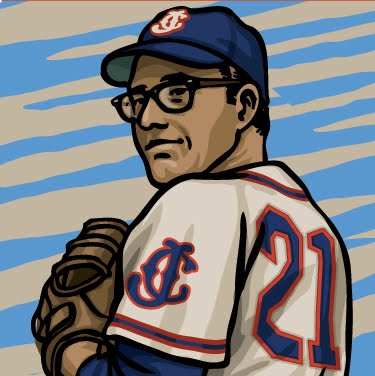
32. Bump Baily

Like many baseball fans, I was fascinated by the 1984 movie "The Natural" when it came out. The story was pretty mediocre and in fact it took me a few watches to realize that Glen Close's son was actually Roy Hobbs' son also. Maybe I was too busy paying attention to Kim Basinger at the time to fully comprehend such a slow curve of a plot twist. But anyway, the one thing that truly stands out is the great portrayal of baseball in 1939. I mean everything looked good, the uniforms, the outfield wall advertising, the stadiums, the way the ball players looked and talked, even the newspaper articles they showed close-ups of. It all looked absolutely fantastic. As a designer, I have to tip my hat to the artist that developed the uniforms for the fictional New York Knights because they looked like they would have been around in 1939. As someone who does graphic props for Hollywood, one of the hardest things for a movie designer to do is to get the right feel and look for a particular time period. So many details can throw the piece off like typeface, color, phrasing or style. So many movie sets fail to get the details right and it ruins the whole movie for nit-wits like me who spent way too many hours studying such minutia as typography and design history and wonder why the stupid artist couldn't do the same. But that's enough about films that didn't do it right because "The Natural" did.

I mentioned earlier about the mediocre plot. When I found out the movie was based on a book by Bernard Malamud I dug up a copy and read it expecting to read the same story as the movie. What a big shock, but it wasn't the same story. Not even close. The beginning was basically the same, young phenomenon on his way to a sure-thing tryout with the Chicago Cubs gets shot by a deranged psychopathic nymphomaniac. But now Malamud's Roy Hobbs becomes a dark, mean spirited jerk. He had a dishonest streak perhaps driven into him by the hard road he travelled after being shot and now that he has crawled his way back to the majors after 16 years he will let no one stop him in his quest to become the best there ever was. Robert Redford's Hobbs seemed like a nice guy, humbled by his experiences. Malamud's Hobbs is the opposite. He is just out for himself. Guy doesn't even like kids who ask him for his autograph. I won't spoil the rest of the book, because it will make a good, fast summer read for anyone who hasn't read it, but I will say the ending sure ain't like the movie!

Now back to the cards. I have been wanting to do a card of a New York Knights player and settled on one of Bump Baily. He was the Knights' star outfielder who died when he crashed through the outfield wall, paving the way for Roy Hobbs to get into the lineup. Bump was also a thug, womanizer and crooked. He was being bribed by the Knights owner to throw games so the team did not win the pennant. In the movie tough guy Michael Madsen portrayed Bump rather well. He had a rough voice and the proper thuggish attitude that the book described. When I decided to do a Bump Baily card, I made my depiction a hybrid of Madsen and another great slugger of the late 1930's - Joe Medwick. I leaned heavily on Medwick because he was exactly as I would picture Baily - a rough, mean and a powerful slugger. He was cocky because he was that good, he even won the Triple Crown in 1937. He was quick with is fists to the point of KOing his own pitcher during a game when he dared to criticize Medwick's error in fielding a ball. Teammate Dizzy Dean said of Medwick "Dawgonnit. That Medwick don't fight fair at all. You argue with him for a bit and then he beats you before you've even had a chance to speak your piece." (To set the record strait, Medwick was all these things BUT not a dishonest ballplayer.) For the fictional 1939 statistics on the card I went through some old newspapers and figured out what Medwick was batting in mid-May of '39, the time when Bump Baily met his demise in the outfield of Knights Field. The drawing leans heavily on the facial features of Michael Madsen combined with the scowl and slouching, cock-sure body language of Joe Medwick. The last thing was how to spell his name. In the book Malamud spells it "Baily" and in the movie it is spelled "Bailey". I like the story in the book better so I stuck with the original. Malamud must have had his reasons and who the heck am I to change it. So here you have it, Batholomew "Bump" Baily on his first and only baseball card.


Tuesday, June 1, 2010

Anatomy of a card


From time to time I have had people commission me to make cards for their relatives who played ball but never had a baseball card of their own or from people who thought it would be really neat to have a card with themselves on it picturing them playing for the Homestead Grays, New York Knights or some other old-time team. Here is one such request I recently did and got permission to show the process...

Gary,
I love your cards, the stories and drawings are great. I was wondering if you do custom cards, because I would really like to have one made of my grandfather Eddie. He played for a few Navy teams during the war and I'd really like a card of him back in his playing days. Would you be able to create a card of him, in the style of your card set and have some printed? We don't have any pictures of him playing baseball, but do have a few pictures of him when he was in the Navy.
Thanks and keep up the great work,
-Jay

Jay,
Yes, I can do custom cards. If you send me one or more photographs of your grandfather when he was young I can find a suitable ball playing pose that would work. I will send you a sketch of the card and when you approve it I will color it and add a background. Let me know if you would like a stadium, fence with trees, buildings, etc. I'd probably suggest a fence with trees because it would be more appropriate for a military base back during the war. Let me know what teams he played for and I will try to find out what the uniforms looked like. Once you ok the finished card, I can get 500 of them printed just like my cards and will also give you an 4" x 6" print of the card you can frame for a price of $200. Let me know if this is what you'd like to do.
-Gary C.

Gary,
Yes that would be great! I am attaching a scan of my grandfather taken during the war as well as a file with the story I'd like on the back of the card. Can you have him play for the Sampson Naval Training Station? I don't know what the uniforms looked like. He threw and batted right and played 2nd base.
Let me know if you need any more to work with,
-Jay

Jay,
Here is the sketch of your grandfather. I posed him with his hand in his glove. I could not locate a photograph showing the Sampson baseball team but I found a good uniform type that will be visually interesting and I attached it to this email. I will place an "S" on it for "Sampson". It is the second one from the left with the star on the sleeve. I think the story you wrote will work fine for the card. Please let me know if the drawing looks good to you and I will color and detail it out for you.
Thanks,
-Gary C.

Gary,
The drawing looks really nice, I can't wait to see how it looks in color! I think the uniform you picked looks the best out of all of them...
-Jay

Jay,
Here is the finished card, front and back in color. What do you think? Please re-check the story on the back and make sure everything is spelled correctly. I'd hate to print your grandfathers' first and only baseball card with his name misspelled! If it meets with your approval, I'll send it to the printer and you should have everything in a week.
Thanks,
-Gary C.

Gary,
I just received the cards today... THANK YOU SO MUCH! They look fantastic and I can't wait to give these to my relatives! THANK YOU, THANK YOU, THANK YOU!
-Jay

Wednesday, May 19, 2010

29. Eddie Cicotte

This card is the first in a series I will be doing on the Eight Men Out, the players who were banned from organized baseball after being accused of throwing the 1919 World Series. I originally had the idea of depicting the players while on the 1919 Sox, complete with their season stats and series record. In fact I actually posted the Lefty Williams and Buck Weaver cards in this format. The more I thought about it though, I decided that I wanted to focus more on an aspect that always intrigued me, what did those players do AFTER they were banned. I had heard stories back where I grew up in Northern New Jersey of Shoeless Joe Jackson playing under fake names for little Jersey town teams back in the '20's, but found no proof. At the end of Eliot Asinof's great book "Eight Men Out" he leaves us with tantalizing mention of a Black Sox barnstorming tour. Was this team real? What did these guys do after the ban? Could they have just gave up playing the game they must have loved? Through my research and with the help of many historians who generously shared their material I will attempt to create an 8 card set of these guys and the outlaw teams they played on after Judge Landis threw them out of organised baseball in the Fall of 1920.

After being banned from organized baseball, the eight Chicago players implicated in fixing the 1919 World Series spent the 1921 season playing pick-up games in and around the Chicago area waiting in vain for an appeal of Commissioner Landis' decision. The players were not actually convicted of any wrong doing in any court and the office of Commissioner of Baseball was a new institution at the time. Like many people they underestimated the absolute power the commissioner now had. By the spring of 1922 they now understood the dire situation they were in and were not likely to be let back in the major leagues for the foreseeable future. Faced with the need to make a living the players decided to capitalize on their infamous notoriety. Eddie Cicotte joined Lefty Williams, Swede Risberg, Joe Jackson, Hap Felsch and Buck Weaver to form a barnstorming team called the “Ex-Major League Stars”. Lord knows how this name must have angered the new Commissioner of Baseball. The team played a few games around the mid-west but many fans ridiculed the dirty players and most teams refused to play the them due to warnings about doing so by Commissioner Landis. Young players did not want to be tainted by the association with the banned players and to do so could have a negative effect on their eligibility to move up to organised ball. Older players understood what a terrible mark the whole affair of 1919 cast over their beloved game and local newspapers who were usually more than enthusiastic about a barnstorming team of major league players coming to town now railed against the shunned players. All was not well in the Ex-Major League Stars camp, however and the team apparently broke up when Cicotte got into a fight with The Swede over money. The rough and tumble Risberg got the best of the match and reportedly knocked two of Eddie’s teeth out. This was the last time that many of the players were together on a team. Cicotte eventually drifted back to his farm and family in Michigan where he anonymously worked on the assembly line for Ford Motor Company.

Special thanks to the people over at the great site "The Shoeless Joe Jackson Virtual Hall of Fame Web Site" http://www.blackbetsy.com/ They were very helpful answering questions and sending me newspaper articles regarding the Black Sox after 1920.

Tuesday, May 11, 2010

28. Willard Brown

Back in 1947 as Jackie Robinson was breaking the color line in the National League, Willard Brown and Hank Thompson, two heavy weight negro league sluggers joined the American Leagues' St. Louis Browns. While Robinson was given a year of minor league seasoning to get acclimated to white organized ball, Brown and Thompson were sent directly to the big club. This move by the Browns ultimately hurt both the players and the team as they were not able to adapt to the huge cultural difference and senseless racism they encountered. They were unable to sleep in the same hotel as their teammates who were pretty much indifferent to their presence on the club. On August 13, 1947 Brown belted a Hal Newhouser pitch into the far reaches of Sportsmans Park and quickly rounded the bases for an inside the park home run, the first by a black player in the American League. Instead of celebrating the feat, teammate Jeff Heath, whose bat Brown used, broke it in half rather than have him use it again. After 21 games and a low batting average both Brown and Thompson were released. Thompson had a second chance with the Giants a few years later and made good but Willard Brown never made it back to the majors, spending the next 10 years in the negro and minor leagues where he continued his legendary status as one of the games best sluggers.

As the mighty Kansas City Monarchs' batboy, Willard Brown dreamed of playing for the Monarchs. In 1935 he realised that dream when he became the team's starting shortstop. Soon moved to the outfield to take advantage of his speed, Brown became black baseball's most prolific hitter. He hit for a high average and was also one of the fastest ballplayers of the late 1930’s. Brown was sometimes accused of being lazy in the field, saving his strength for larger crowds and more important games but at the same time he was considered to be a superior outfielder and was voted to the All-Star Game 8 times. He hit well above .300 for his whole negro league career and led the league in doubles, triple, home runs and stolen bases many times. The Monarchs of the late '30's and '40's were a powerhouse and Brown was instrumental in their winning the pennant 5 times during his time with the team. During the war Brown played on the champion ballclub that won the European Theater World Series and he hit the winning home run of the deciding game giving Leon Day the victory over Ewell Blackwell and Patton's 4th Army team made up of major league players. He then played ball in the negro and minor leagues until 1957. Popular with players and fans, Brown was elected to the Hall of Fame in 2006.

Monday, April 26, 2010

26. "Turkey" Stearnes

Unlike today, baseball didn't stop after the World Series. As soon as the season ended, the most talented professional ballplayers followed the warm weather south to Cuba and Puerto Rico or west to California. Starting at the beginning of the twentieth century Southern California had a thriving integrated league featuring pros from the white and black major leagues. Bonafide stars like Babe Herman, Walter Johnson, Kiki Cuyler, Ted Williams, Jimmy Foxx, Bob Meusel played against the great black stars Bullet Joe Rogan, Biz Mackey, Satchel Paige, Chet Brewer and Turkey Stearnes. During the league's heyday of the late 1920's the all-black Los Angeles Royal Giants dominated the league. The Giants hitters pounded the white pitching and the Giants hurlers smoked the white batters. Blacks were barred from playing in most of the ballparks around Los Angeles so White Sox Park was built specifically for them. Located near Fourth and Anderson Streets fans of all colors showed up to see the best baseball available west of the Mississippi. Although the league was integrated at a time when blacks were being lynched in the south and non-whites were barred from many beaches along the California coast, surprisingly few incidents of racism occurred on the field or in the stands. The spectacle of darn good baseball transcended any sense of racial superiority or inequality.

One of the greatest players of any hue to play in Southern California was Norman "Turkey" Stearnes. In nine years of coming west surviving box scores show he hit for a .373 average and hit 44 homers in 754 at bats.

Stearnes got his unique nickname from the awkward, flailing way he ran the bases, described by fans as looking like a “hunted turkey”. Six foot tall with powerful shoulders, Stearnes was a star centerfielder during the 1920’s and 30’s. He was also a fast runner and led the Negro National League in both triples and stolen bases on a few occasions. Like many other players of his time, he was not shy about sliding into a base with spikes high and his aggressive play became his trademark. He often batted leadoff because of his speed and he was the consummate team player. Talking about his home runs he said "If it didn't win a game, it didn't matter." He was elected to four all-star games, batted over .400 three times and led his league in home runs seven times. Although Stearnes was a quiet and modest man his fans and players understood his value as a player and he was elected to the Hall of Fame in 2000.


Sunday, April 11, 2010

24. Billy Martin

Anyone who knows me will tell you that I hate the Yankees. In fact I am a third generation Yankee hater. That out of the way, you might be wondering why the heck I would produce a card of the ultimate Yankee, Billy Martin. Respect, that's why. As much as I can't stand the team that he has come to represent, I have to admire his grit and determination as a player. There are some players who just have that natural talent for the game like Ken Griffey, Jr, Mickey Mantle and Babe Ruth. And then there are those other players that seem to get by on sheer will, pouring everything they have into the way they play the game making it seem like they are playing for their life and will do anything to win. Pete Rose comes to mind as does Eddie Stanky and Ryan Freel. These were guys who may not have been the best fielder or the best hitter. They may not have been the fastest or the biggest. They did however always seem to find a way to beat you. Billy Martin is one of these guys and love him or hate him, it is for that reason he belongs in The Infinite Baseball Card Set.

Billy Martin was brought up in the slums of Berkley, California during the depression made all that more grim when his father, always referred to as "The Jackass" by his mother, abandoned the family. An ugly and awkward kid Martin had to grow up tough in his rough neighborhood and he was reputed to be the leader of a local gang. Sports became his way out of the hood and he excelled at both baseball and basketball at Berkley High School. Oakland of the Pacific Coast League signed him upon graduation and after 2 years on their farm teams he made the Oaks at the end of the 1947 Season.

When Billy Martin joined the team it was primarily made up of older veteran players. They took a liking to the feisty young player and dubbed him “The Kid”. Casey Stengel was the manager at the time and while today he is thought of as a kindly, grandfatherly figure he was actually a rough player and a proponent of the old school way of playing the game and winning by any means necessary. He was able to channel all of Martin's inner rage towards the Oaks' opponents and Stengel encouraged his young protege to needle the other team's players. Martin ably replaced the Oaks veteran second baseman Dario Lodigiani when he was injured early in the 1948 season and later also filled in at shortstop and third base providing a valuable utility role during the Oaks championship season. When Stengel became Yankee manager in 1949 he made sure “The Kid” followed. As the manager of The New York Yankees he was expected to win and what better insurance is there than having Billy Martin on your team.

Sunday, April 4, 2010

23. Alexander Cartwright

Today is Opening Day. Unlike New Years Day or my birthday, I always look upon the first day of the baseball season as my mark of another year gone by and the hopeful beginning of another. This past year, or season, had been a tough one, the big crushing blow being the sudden death of my Father in September. Today is a day that had a special meaning for my father and I, the beginning of months of friendly banter about how our favorite teams are doing, how much we both hated the Yankees and who we thought would go all the way. But this year I am left alone on this day, and I face a long season without my best friend. What I wouldn't give for one more catch with my Pop or one more minor league New Jersey Cardinals afternoon game or just one more quick phone call to talk about last night's game. But today is Opening Day, the beginning of a new year, one that always brings the possibility of great things, where it matters only what you do this season, where past failures and disappointments are forgotten and the future is up to you.

So today, Opening day, I bring you the man who probably did more than anyone else in making baseball the great game it is today. Although most think of baseball as a sport played out in the country in idyllic settings, the game as we know it actually came from the crowded streets of Lower Manhattan. Back in the 1830's and 40's successful businessmen who had always lived above or behind their businesses began to move away from their shops into the less crowded suburbs and the young men who worked for them as apprentices and clerks now had many free and unsupervised hours of leisure time at their disposal. Many joined volunteer fire companies that served the dual purpose of serving the community and providing a fashionable club environment. It was while a member of The Knickerbocker Fire Company that Alexander Cartwright learned the game of base-ball.

When he could no longer find enough open space for his team to play in Manhattan, bank clerk and volunteer fireman Alexander Cartwright formed The New York Knickerbocker Base-Ball Club. The exclusive club charged a $5 initiation fee with annual dues of $2, the proceeds going towards the rental of Elysian Fields, a grassy tree-lined park across the Hudson River in Hoboken, N.J. Cartwright had a keen interest in writing down a set of universally accepted rules for a game that had many different incarnations depending on where it was played. The distance between bases, number of fielders and most importantly batters need to be tagged out and not simply hit with the ball. The first real game of baseball was played at Elysian Fields in 1846 and Cartwright left New York in 1849 to seek his fortune in California and spread the game where ever he stopped including his final home, Hawaii.

Happy Opening Day to everyone, and I wish you all the best of seasons!


Sunday, March 28, 2010

22. Bullet Joe Rogan

The legend goes like this: A low-level barnstorming team of white minor league ballplayers wearily traveling through the American south-west pull up at a desolate, hot and dusty army post somewhere on the Arizona-Mexico border. The baseball team on this forgotten outpost turns out to be one of the greatest teams the young outfielder of the traveling white team has ever seen, especially a pitcher and catcher named Rogan. He mentally notes the names of the players and when he finally arrives back in his home town of Kansas City all he can do is talk about the great ballplayers he has seen. Unfortunately the great players he has witnessed were all black and the year is 1919. The only man in Kansas City who will listen to young Casey Stengel is J.L. Wilkinson, owner of the all-black Kansas City Monarchs. On his word Wilkinson hires 5 players Casey saw after they are discharged from the Army. These players go on to form the core of the great Monarch teams of the 1920's and 30's.

Makes a great story, but is it true? Not really. Stengel may have played against Rogan and his 25th Infantry Regiment team in Arizona but details are sketchy. Did he recommend the army ballplayers to Wilkinson? Maybe, but Joe Rogan, the pitcher and catcher that Stengel was especially amazed with was actually from Kansas City and had already played for a team owned by Wilkinson back in 1917 while on leave from the service. Chances are Rogan contacted Wilkinson or the other way around and Rogan brought along his other teammates to Kansas City. Black newspapers occasionally ran stories about the black Army baseball teams and Rogan and the 25th Infantry team was fairly well known by 1919. Whatever the truth behind the legend may be, Bullet Joe Rogan became one of the greatest players in history. He was an overpowering and smart pitcher who also hit for power. When ranking ballplayers, I always throw the great Babe Ruth out there to end the discussion for the simple fact that besides being the spectacular hitter he was, the first 5 years of his career was spent as a pitcher and not only did he pitch but he was the best left-hander in baseball. To me that versatility trumps anything any other player can boast and there is only one other player who had that kind of sheer talent, Joe Rogan. Unfortunately his color kept him from competing in the major leagues but we can piece together from the records available that he was every bit as talented as Ruth when it comes to pitching and his hitting became legendary all across the country wherever the Monarchs played ball.

In 1910 Joe Rogan joined the all-black 24th Infantry Regiment and served in the Philippine Islands where he became legendary for his catching and pitching for the regimental team. Discharged in 1914 he soon re-enlisted again, this time with the 25th Infantry at Schofield Barracks in Hawaii which had a powerful ballclub known as the Wreckers. While there he shut out the Portland Beavers of the Pacific Coast League on 3 hits, struck out 13 and hit a double. In 1918 the regiment moved to Camp Little on the Arizona-Mexico border and the team continued its winning record with Sergeant Rogan of the machine gun company credited with an incredible 52 wins in one season. In 1920 Rogan, along with teammates Dobie Moore, Bob Fagan, Oscar Johnson, Hurly McNair and Lem Hawkins went onto form the nucleus of the Kansas City Monarchs, one of the most powerful negro league teams.


Wednesday, March 24, 2010

Requests?

I really appreciate all the emails from you guys who enjoy what I am doing here and from time to time I'm asked if I take requests. Sure, why not? So, if you have a player you really want to see, drop me a line at info@cieradkowskidesign.com and tell me who you think should be part of The Infinite Baseball Card Set. I can't promise I will draw it up any time soon, but I'd like to see who YOU want! Keep checking in, I may have an announcement in the next couple of weeks regarding real limited edition sets of cards available...

Monday, March 22, 2010

20. Lefty Grove

Back when there were only 16 major league teams and all were located east of the Mississippi River, the minor leagues were often a baseball fan's only option to see professional baseball. During the 1910's and 20's most minor league teams were unaffiliated with major league teams and because of this autonomy were able to keep players longer than just a year or two like today. The Baltimore Orioles were in the International League, arguably the highest and most professional of the minor leagues. Owned by Jack Dunn the Orioles created a powerful dynasty starting in 1919 that saw the O's win 7 straight league championships. It got to the point where in 1923 the other International League team owners forced Dunn to start selling off some of his players to the majors or else they would all sign a contract with major league baseball giving them the right to purchase any player at a flat fee. They were willing to sell short their profits rather than continue to keep losing to Baltimore! How good was the Orioles of the early twenties? Maybe not as great as the Yankees or the Giants, but they were certainly able to compete with the lower ranked major league teams at the time. Baltimore would often play exhibition games against major league all-star teams and win, so they were definitely up there in the talent department. Those Oriole teams had some great players back then, most of whom were eventually sold off to the Philadelphia Athletics, forming the nucleus of their dynasty of the late twenties and early thirties. George Earnshaw, Joe Boley, Max Bishop, Jack Bentley, Tommy Thomas, and others all went to the majors. The pitching on those teams were amazing, John Ogden going 31-8 in 1921, Jim Parnham winning 33 games in 1923, Tommy Thomas winning 32 in 1925 and of course the unrivaled Lefty Grove who lead the league in strike outs for 4 years in a row.

Signed by the independent Baltimore Orioles in 1920, Lefty Groves became a starter the next season and led the International League in strikeouts for the next four years. He quickly became an integral part of the great Baltimore Oriole dynasty and the team finished in first place every year he played with them. Oriole owner Jack Dunn refused to sell Grove to a major league team until after the 1924 season when he made the Philadelphia Athletics pay a record $100,500 for his services. It was around this time Lefty dropped the “s” at the end of his last name because newspaper sportswriters continually used “Grove” instead of “Groves”.

Anyone wanting to learn more about the Baltimore Orioles from 1903 to 1953 should pick up a copy of Jimmy Keenan's book called "The Lystons" about his grandfather who played on the 1921 Orioles and is a great narrative of the minor leagues and semi-pro circuit during the 1920's. Available at www.keenanbaseball.com