Monday, October 18, 2010

55. Basilio Cueria and the Abraham Lincoln Brigade


This is the second installment of the "Guest Author" series. This week the story is by Gary Ashwill, famed baseball researcher and co-proprietor of
The Outsider Baseball Bulletin. Gary is one of the foremost experts on black baseball and when he agreed to do a story for the site I was keenly interested to see who the ballplayer would be. To my surprise he hit the proverbial home run, at least for me. See, as well as being interested in pre-war baseball history, one of my other passions is the Spanish Civil War, especially the international volunteers who fought on both sides. Until Gary emailed me his story, never in a million years would I have guessed those two interests could be combined...

Basilio Cueria was big and powerful, an ex-soldier who had been a baseball prodigy from the time of his childhood in Marianao, a suburb of Havana. He was an all-around player, a catcher who could also play the outfield and first base, and even filled in at second and third occasionally. The owner of one of his teams, the promoter Syd Pollock, even hyped him as “Babe Ruth Cueria”—but despite his potential, he never hit enough to make him more than a benchwarmer with several Cuban traveling clubs in the United States during the 1920s, when he wasn’t working in a Long Island factory.

So how did this Afro-Cuban immigrant, journeyman ballplayer, and blue collar worker become the subject of admiring profiles by two of the twentieth century’s greatest poets?

Cueria may not have been not a great ballplayer, but he was an ardent opponent of dictators and would-be dictators. He came to the United States in 1921 to play baseball with Abel Linares’s All-Cubans team, then became involved with Cuban émigrés who opposed the authoritarian governments of Gerardo Machado and Fulgencio Batista. Cueria wound up more or less exiled from Cuba for the better part of two decades. After retiring from pro baseball, he organized an amateur team in Harlem called the Julio Antonio Mella Baseball Club, named after the founder of the Cuban Communist party, who had been assassinated in Mexico.

At two in the morning on January 20, 1937, Cueria arrived in France aboard the S.S. Berengaria, then secretly made his way overland to Spain, where he joined the Abraham Lincoln Brigade—American volunteers fighting on behalf of the Spanish Republic against the fascist rebels led by Francisco Franco. During his first year in Spain Cueria survived trench warfare at the Battle of Jarama and artillery and air bombardments at Brunete. He transferred to the regular People’s Army, and rose to the position of artillery captain under the famous peasant general Valentín González, known as “El Campesino.”

That fall Nicolás Guillén, the greatest Cuban poet of the twentieth century, traveled to Spain as a magazine correspondent. Looking to interview Cubans in the Republican forces, he quickly found his way to Cueria, whom he remembered as catcher for the Marianao club in the Cuban League. Now, Guillén wrote in the the leftist journal Mediodía, Cueria had “exchanged the diamond for the trenches,” and “the ephemeral glories of baseball championships” for “the higher glories of fighting fascism.”

Guillén also introduced Cueria to the American poet Langston Hughes, who was reporting on the Spanish war for the Baltimore Afro-American. Hughes described the former Cuban Star as a “tall fine looking captain who was immensely popular with the officers and men under his command.” Cueria, Hughes claimed, was trying to teach baseball to Spanish soldiers, and was looking forward to returning home to New York, where his family still lived. “Our side is sure to win,” he said. “We can’t let the Fascists put it over on us. They’d put all the worst old prejudices back into force and probably even introduce new ones, like Hitler and his Aryanism in Germany. No, we’re not going to let them win!” He asked Hughes to “tell the Mella Club to keep up that team in Harlem, so I can play with them when I get back. Tell all those Harlem baseball players hello!”

Guillén’s interview shows a more pensive side of the soldier/ballplayer. He asked Cueria about his plans for the future, and whether he intended to come home to Cuba. “Look, I can’t say anything about the future,” Cueria replied. “I’m no fortune-teller. But my thinking now is to return to Cuba when this is done, when we’ve won, and it’s safe. And nothing gives me greater hope than the possibility of seeing people who are dear to me, people I haven’t seen for a long time. My friends, my teammates, like Oms, Fabré, José María Fernández…” He fell silent. Then, as if talking to himself, Cueria murmured: “If they don’t kill me, I’ll come back.”

Come back he did. Nothing seems to have been written about the rest of Cueria’s experience in Spain. Franco had won by April, 1939; records show that Cueria re-entered the United States from Havana in April, 1940, so he may have spent a year or more looking up those old friends and teammates. But the Spanish Civil War was, of course, only the beginning. On October 26, 1942, Basilio Cueria, former captain in the Spanish Republican Army, enlisted in the United States Army—as a 43-year-old private. He wasn’t going to let them win.

On July 22, 1943, based at Camp Rucker in Alabama, Private Cueria, “Negro,” submitted a petition for naturalization as a United States citizen to authorities in Montgomery, Alabama—where, soldier or not, anti-fascist or not, he would have had to go to the back of the bus. Nor could he have voted, or exercised very many of the other rights he would supposedly gain as a citizen. Had he objected, he could have found himself beaten, arrested, even killed. All the “worst old prejudices,” you might say.

I don’t know where he served in the war, but Basilio Cueria, veteran of three armies, two wars, and ten years of professional baseball, died on May 8, 1959, aged 60, and was buried in Long Island National Cemetery.

------------------------------------------------------------------------------------

Gary Ashwill writes the baseball history blog Agate Type (www.agatetype.typepad.com) and co-writes The Outsider Baseball Bulletin, an email newsletter about ongoing research into obscure corners of diamond history (www.outsiderbaseball.com). He has been compiling Negro league and Cuban League statistics for more than a decade. Along with work in journalism and freelance editing, Gary has written on American history and culture for such publications as the African American Review and the Oxford Companion to United States History.


Tuesday, October 12, 2010

Ted Williams Artwork on ebay


If anyone is interested, I put this Ted Williams drawing up on Ebay. (Frame not included). I have a few drawings like this that I had displayed in a show for fun and have no desire to keep them anymore, so if you want to see it or bid on it, go to: http://cgi.ebay.com/ws/eBayISAPI.dll?ViewItem&item=150506075900

Sunday, October 10, 2010

53. Jimmy Horio & the 1935 Japanese All-Stars


While learning about the negro leagues years ago, I became interested in the various teams they competed against when not playing against other black teams. Back before the Second World War there was a whole parallel universe of baseball operating just out of bounds of the recognized leagues affiliated with major league baseball. Researchers Scott Simkus and Gary Ashwill seem to have coined the perfect phrase for these teams and the games they played: "Outsider Baseball". As a young amateur historian I found out about the bearded House Of David religious colony from Michigan which sent out as many as 3 different traveling teams a season to play all over the country. I heard about the Nebraska Indians, made up of, you guessed it, Native Americans. I read about barnstorming teams made up of major league stars angling to make a buck. All-Girl teams. Teams of washed up players sponsored by a shoe company. Prison teams. The F.B.I. had a team which J. Edgar Hoover never failed to come out and support. And I also came across the Japanese All-Stars which toured North America in 1935.

The team that toured North America in 1935 was an off-shoot of the Japanese "All-Nippon" Team that was assembled in the fall of 1934 to challenge the American All-Star Team that visited the island nation that year. I briefly talked about this tour in my Moe Berg post back in July. Although stocked with the best college ballplayers on the island, the Japanese lost all 17 games against the Americans. While it was looked upon as a national embarrassment, it inspired the formation of a regular professional team sponsored by the Yomiuri Shimbun Newspaper. In the Spring of 1935 the team, now called "The Dai Nippon Tokyo Yakyu Kurabu" (Great Japan Tokyo Baseball Club), embarked on a tour of the United States and Canada. Among it's players was a 28 year-old Hawaiian named Jimmy Horio.

Jimmy Horio was born in Maui, Hawaii in 1907. Like most Americans, he learned baseball at an early age and was fortunate in growing up in Hawaii as the island was a hotbed of very talented teams made up of Japanese-Americans. He lived in Japan for a few years with his grandparents and later returned to Maui. He dropped out of high school with the ambition to become the first Japanese-American to play in the Major Leagues. The speedy Horio was signed by the Sioux Falls Canaries of the Class D Nebraska State League in the Spring of 1934. Jimmy batted .264 in 110 games. After the season ended he learned of the up-coming tour of Japan by the Major League All-Stars and wrote to the Japanese National Team's manager sending his semi-pro and minor league records and asked to be a part of the team.

Horio became the team's centerfielder but against the Big Leaguers didn't do too well, batting a lowly .196. But hey, he was batting against Lefty Gomez and Earl Whitehall, winners of 26 and 14 games that season. Jimmy's biggest contribution to the team however was not his bat, but the practical experience he brought with him as a bona-fide American Minor League player, which he readily shared with his teammates.

When the Dia Nippon team was formed, Jimmy Horio was again selected as it's centerfielder. In February of 1935, Japan's first all-professional baseball team sailed out of Yokohama Harbor, destination North America to try their lot against a full schedule real baseball competition. The Dia Nippon's toured extensively playing all-levels of ballclubs from small town factory teams to AAA level minor league teams. Gauging their success and talent is not an easy thing to do as they did extremely well against amateur teams and very good against minor league opposition, however the games against minor league teams were during spring training and many of the teams did not field their best players. None-the-less, the tour was very successful and huge crowds packed the ballpark when the Japanese came to town. American audiences were fascinated by their cultural differences such as tipping their caps and bowing deeply to the umpire when coming to bat or being thrown out steeling. Particularly noted during the tour was Jimmy Horio's excellent fielding and newspaper accounts are filled with mentions of the Japanese-American's exploits in the centerfield. His fluency in Japanese and English made it much easier for the tour to navigate it's way through the back roads of North America. It is reported that the Dia Nippon team's record for the 1935 tour stands at 74 wins and 34 losses.

After the Japanese players went home, Horio stayed in the United States where he was signed by the Sacramento Senators of the Pacific Coast League. The opportunity to play in the PCL might have come from a recommendation from Frank "Lefty" O'Doul who was part of the U.S. team in 1934 and now playing manager of the San Francisco Seals. Jimmy hit .250 in 20 games for Sacramento which at that time was part of the Brooklyn Dodgers farm system. The following year the Japanese team was back in the States, this time as the Tokyo Giants, now part of the first Japanese Baseball League. And this wasn't an exhibition tour, it was a serious spring training to get the team ready for the inaugural 1936 Nippon Professional Baseball League season.

Horio returned to Japan and joined the Hankyu Ball Club where he batted .233 for the first half of the slit season and .217 for the second. Again, although his averages were low, his influence on the game in Japan well out-weighed his offensive output. Horio steadily increased his batting average, batting over or close to .300 for the 1937-41 seasons. Horio starred for the Hanshin Tigers from 1939 to 1941 when he and Tadashi Kameda, the other American player in Japan, left the island due to the deteriorating political situation between the two countries. Jimmy continued to play semi-pro ball in Hawaii during the war, playing until he was 39 years-old. Jimmy Horio died from bone cancer in 1949 and although he never reached his goal of becoming the first Japanese-American in the majors, his influence on the game in Japan is still felt, forever known as "The Ty Cobb of Japan".

I'd like to thank two historians whose grateful sharing of their research made this post possible. Scott Simkus, co-proprietor of The Outsider Baseball Bulletin (www.outsiderbaseball.com) lent me his newspaper files on the 1935 tour as well as his painstakingly compiled statistics culled from available box scores. Robert Fitts, Japanese baseball card expert and author of two major books on Japanese baseball history: "Wally Yonamine: The Man Who Changed Japanese Baseball" and "Remembering Japanese Baseball: An Oral History Of The Game", helped me out with identifying and translating Japanese photo captions and generally sharing his knowledge of early professional baseball in Japan. I am also anxiously awaiting his book on the 1935 U.S. Tour of Japan, "Banzai Babe Ruth!" which is due to be released next year. (www.robfitts.com)


Wednesday, September 29, 2010

New Victor Starffin Card For Sale!


As a teaser for a new feature I have coming up, I thought I'd offer a limited edition Victor Starffin card. If you ordered on the the Series 1 set, you have a card of Japan's greatest pitcher, but this is a whole new drawing, featuring the big Russian in his 1934 All-Japan team uniform. Although he didn't get more than 2 innings of playing time against the Major League All-Star Team that visited Japan that year, it was none-the-less Starffin's profession debut. Within two years he and Eiji Sawamura would be the mainstay of the Tokyo Giants pitching staff. To order a card, click on the aptly named button above "Victor Starffin Card".

Tuesday, September 21, 2010

51. "Pete" Petrzilka by guest author Scott Simkus


This is the first of what I hope becomes a semi-regular "Guest Author" series of cards. I enjoy finding and researching my own ideas, but I thought it might be really interesting to collaborate on stories with authors and researchers who have a particular interest in a player or time period and would like to share it with a wider audience and give it a card of its own. I have already asked a few people to participate but if anyone else has an interest in writing a story, feel free to email me and maybe we can work it out...


This week's piece is by Scott Simkus, who along with Gary Ashwill is the proprietor of the outstanding "Outsider Baseball Bulletin" a weekly, subscription e-zine devoted to baseball history. Each issue features original research, statistics, personal essays, and humor. There are also be stories about baseball-related car crashes, sex scandals, home decorating and... murrrrder!! I highly recommend it if you enjoy the characters who I feature on my site. Scott and Gary have graciously offered a special free trial subscription to the readers of this site, information located at the bottom of Scott's story...

-----------------------------------------

Hey! I know you're busy, but you gotta take a quick look at his. Here!


I had three grandfathers.

The gentleman featured on this baseball card is my mother's father. He'd be grandfather number *two,* if you're keeping score at home, and it's worth mentioning that I never knew him. In fact, my mother never knew him.

His name was Joseph Petrzilka, he was the son of Czech immigrants who lived on Chicago's south side, and although his name was Joseph, he was known by friends and family simply as "Pete." Pete was, by all accounts, a devoted husband, a good man. He aspired to be a great father. When my mother was born, Pete was attending night classes, working towards attaining his degree in accounting. He was, as far as I know, the first person in our family to attend college. This is back in the late 1930s.

He was also, by all accounts, an outstanding athlete. He ran track, excelled in gymnastics, won medals in A.A.U. competitions. We have an old photograph of him performing a perfect handstand, muscles tense as he balances atop a wooden ladder, in the back yard of some forgotten three-flat in a working-class neighborhood which no longer exists. We have fading pictures of him at the beach in Michigan, smiling in the sun, flexing his muscles, mugging for the camera. My grandmother, young- much younger than I am now- is present in many of these black and whites, smiling in the background, laughing at her future husband. Fawning over the future grandfather number two.

And we have pictures of him in baseball garb. Baseball! There he is, in the baggy woolen uniform, black leather shoes, tiny fielder's glove. He apparently batted right, threw right, played for a high school team or semi-pro outfit, or both. I have no idea what position he played, or whether or not he was any good at the game, or if he struggled with the curve ball or had trouble with pop ups, but I can tell by the smile on his face that he loved it in some way, that it meant something to him. But it was baseball for goodness sakes, and baseball means something to all of us, right?

As my grandmother neared the end of her pregnancy, Pete didn't feel right. He was run down, tired. He was working full-time as a bookkeeper during the day, taking advanced classes at night. Perhaps the pressure of burning the candles at both ends, a baby on way, supporting his wife: perhaps this stuff was getting to him. I'm guessing he might have thought this, and soldiered on through each week, until he couldn't take the pain any longer. He was young- twenty-six- and still in athletic condition, still in great shape.

About twenty-five years ago, a strange man showed up at my parent's front door, said he'd been a classmate of Pete's. He didn't give his name, but instead he handed over a crumpled, brown paper bag filled with text books and papers, said he wanted us to have them. They were science and math books, Pete's signature on the front, his hand-written notes and doodles covered the pages inside. Everything dated from 1930 or 1931. The strange man was in his car, driving away, before anybody thought to ask any questions.

Other pieces have Pete have drifted into our lives over the years. The baseball pictures were buried in an old box, and discovered later on. A journal with his meticulous, hand-written notes (detailed income calculations, shopping lists, goals, memories from his honeymoon trip to Kentucky with my grandmother) was discovered in my grandmother's basement, when she was being moved to assisted living fifteen years ago. Courtesy of the internet, I've discovered that Pete's younger brother (the uncle my mother never knew), had been a college quarterback and team captain, back during the early 1940s. I also learned, in the Chicago Tribune archives, that his other younger brother, Fred, died tragically at the age of 8, after falling into the Chicago River. Turns out, Pete was there, maybe ten years old at the time, playing with his little brother when the kid slipped in. They tried to save him, Pete and some friends from the neighborhood, but it was too deep, they were too late.

My mother was born in early October, the day after Gabby Hartnett hit his famous 'Homer in the Gloamin,' and six weeks later my grandfather Pete simply hit the wall. He couldn't take it anymore. The excitement of becoming a father couldn't temper the pressure of working everyday, studying every evening, and getting very little sleep at night and on the weekends. Around Thanksgiving time, he finally went to see the doctor about the pain and fatigue. They took some blood, did some tests, told him to enjoy his holiday and they'd get back to him the next week if anything was wrong.

There's a haunting photograph in the Chicago Tribune. My great-grandmother standing on a bridge under an umbrella, as she watches the police drag the water below, looking for Fred's body as the rain comes down. Little pieces of Pete's life, both happy and sad and indifferent, continue to find me. Although my attention is almost completely monopolized by my own family and my baseball writing career, little glimpses into Pete's vacations and athletics and academics keep poking me in the side, demanding my attention.

Hey! I know you're busy, but you gotta take a quick look at this. Here!

The first week of December, the doctor sits Pete down in his office and tells him he wishes he had better news. You're sick, he told him. I don't know of any better way to tell you this, to convey the gravity of the situation, other than you are very, very sick.

Doctor said he had something called leukemia, and although they didn't have a set course of action, they had some experimental things they could try. By this time, it was January of '39, and hospitals back then tried a lot of things which didn't work. After a couple weeks of medicines which had no positive effect, they finally tried a blood transfusion.

It was devastating to the family, but just six short weeks after the diagnosis, the young man who once performed handstands on a ladder in the backyard, the guy who won A.A.U. track medals and played baseball in the neighborhood, the father of a newborn daughter, passed away. He was in his mid-twenties.

My grandmother was twenty-two, a widow, and single mother of an infant daughter. My grandmother's name was Libbie.

Libbie and Pete were childhood sweethearts. They lived on the same street, next door, in fact, to one another. Pete was a couple years older, used to walk my grandmother to school, carry her books. My grandmother told me these things before she passed.

Their houses were small ("cottages" was the way my grandmother used to describe them), and situated so close to one another, Libbie and Pete could pass notes through their bedroom windows. That's how they got to know each other. That's how they fell in love.

Everybody who knows me realizes I lean toward the agnostic side of the fence. Sometimes, I'm in full-blown atheist mode. Other times: Catholic-agnostic. Most times: Not worrying about it one way or the other. Once we're gone, we're gone, and I'm perfectly okay with that. Makes me want to get up every morning and enjoy as much of this fleeting existence as humanly possible.

Of course, I don't believe those who've gone before us can communicate from the great, unknown beyond. I don't believe it for a second. But I have changed my position in at least one respect: with the advances in technology, the digitization of papers and shipping manifests and other documents; with the photographs and old home movies, with out expanded understanding of DNA, and with the treasure-laden fragments of stories which have been passed down…we're getting better.

Those who have gone before us can't speak to us, but we're getting better at reaching out to them.

Hey! I know you're busy, but you gotta take a quick look at this. Here!

------------------------------------------------------------------------------------
Scott Simkus is the publisher of the Outsider Baseball Bulletin (www.outsiderbaseball.com), a weekly ezine devoted to baseball history. In 2009, he helped the Strat-O-Matic Game Company create their first Negro League set. His work as a baseball researcher has been been profiled in Sports Illustrated, The New York Times and the USA Today, among others.

Get a FREE 4 week trial subscription to the Outsider Baseball Bulletin (where they can see more of my illustration work). No obligation to subscribe, all you have to do is email Scott at outsiderbb@gmail.com and put GARY in the subject line and PRESTO you'll get four weeks of free issues to check out.

Thursday, September 9, 2010

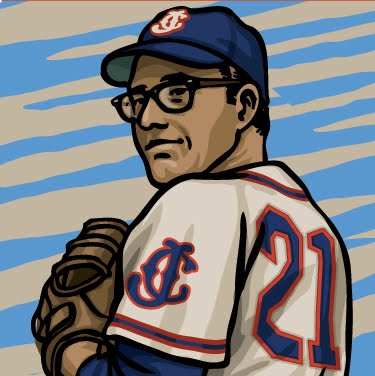
49. Warren Spahn: My Father's Favorite


My Father died one year ago this week. In some ways it seems like a million years since he passed and yet at the same time I still reach for the phone to call him several times a week as if it never happened. I'm not going to go on about The Old Man dying, but in honor of his passing, I give you a card of his all-time favorite player, Warren Spahn.

When I was a kid, I was a Mets fan. I suppose I still follow them. It was pre-destined that I wind up that way. See, my Father's Father was a die-hard Brooklyn fan and having a Cieradkowski being a fan of the Yankees was just not going to happen. So all I had was the Mets. This was the 1970's- Not the giddy, pennant winning Mets of the early 1970's, but the stinky, bottom-of-the-barrel Metropolitans of the late 1970's. Because the Mets stunk so bad, talking about them just wound up turning into angry complaining sessions, so out of a lack of quality Mets topics to discuss, baseball talks with my Dad often turned into question and answer sessions with me asking The Old Man about baseball when he was my age, kindling my interest in baseball history.

The best baseball talk I remember having with my Pop happened one muggy Saturday afternoon. The two of us had just got home after working a half-day in the factory. My Dad was a garment cutter and on Saturdays I swept floors, made boxes and did other menial and filthy things to have spending money and to teach me the meaning of a good day's worth of work. Plus I was convinced Pop lived to bust my balls and what better way than to make your kid work in a garment industry sweat shop. Anyway, I was about 12 and we're sitting in the kitchen and The Old Man was working on his first beer of the afternoon. Growing up in Passaic, N.J. and being the son of the biggest Brooklyn fan in the tri-state area, I always figured Pop would have been a Dodger fan, but I was wrong. Pop was a Braves fan! "How the hell did that happen?" I asked incredulously. Ignoring the swear word (a luxury he allowed me and my brother when Mom wasn't around) he uttered one phrase: "1957. Grab me another beer".

I was intrigued. I never met anyone who liked a team other than the Mets or Yankees, or if they were older, maybe the Giants or Dodgers. But the Braves? My Father told me that back in 1957, everyone knew the Dodgers were skipping town. He was 8 that year and was fishing around for a new team. Remember, the Yanks didn't factor into this choice and the Mets were just a nightmare in Casey Stengel's dreams. So the World Series rolls around and in '57 it was a fairly tight race. Both Brooklyn and St. Louis made a good run for the pennant but it was Milwaukee behind the pitching of Warren Spahn and Lew Burdette that carried the Braves to the finish line. They'd been pretty competitive in the years prior with guys like Adcock, Aaron and Mathews but Brooklyn and New York always seemed to have the edge over them. On the other side that year waiting to take them on lie the New York Yankees. They won the World Series 5 times already that decade and they were heavily favored to win again. But it wasn't meant to be. Lew Burdette beat the Yanks 3 times and Warren Spahn won another to give them the Series win and a young Polish kid in Passaic, N.J. had a new favorite team.

Yeah, I know it might seem strange that a boy would choose his favorite ballclub based on the fact they defeated another team. But hell, this was the Cieradkowski's and we just didn't do things the right way. See, my family's hatred of the Yankees was an artform all its own. It was a seething, horrible hate that was carefully passed down from generation to generation, the seed of which festered and grew in each of us as we aged, manifesting itself in different and terrible ways. I'll pass on telling about how I deal with my distaste for the other New York team, but I'll tell you this about my Dad: he would watch every Yankee game year after year just on the off-chance they would lose. Yeah, that's right. Instead of having a beer, enjoying a Braves game and watching a team and players he liked, the Old Man would sit and simmer in front the tv watching the Yankees play their sterile, winning games, all the while listening to whatever annoying announcer they had at the time blather on about Yankee Glory. That was my Dad. Hell, ask him who his favorite football team was and he'd say the Philadelphia Eagles. I don't think he ever even stepped foot in Philly his whole life, but he loved those Eagles. Why? Well, in 1960 the Eagles defeated the dreaded New York Football Giants in the season championship. Yeah, in my family the Football Giants warrented the same hatred as the Yankees. (My Grandfather's favorite team was the old Cleveland Browns. Why? He saw them defeat the Giants sometime long ago and he never forgot that).

So anyway, back to the Milwaukee Braves and Warren Spahn. As the sun set that day and The Old Man worked through a double sixer of cheap beer, the baseball stories poured forth. Up to that point, my father and I were never particularly close. I was a loner then and like him not very talkative. But that humid day we found a connection for the first time. He told me about how he and his cousin Glen would write away to all the Major League teams asking for free stuff and how Milwaukee sent them the biggest package with all kinds of stickers and pennants. Told me about how all he wanted for his birthday one year was a baseball mitt and when he opened his present that year, there was a mitt, but it was a second hand split finger model, not the modern pocket ones everybody else in the neighborhood had. But mostly he talked about Warren Spahn. I had never heard of him before. Pop reeled off numbers that seem astronomical to a Mets fan like myself. 21 wins and 11 losses in 1957. 22-11 in '58. 21-15 in '59. The stats went on. I got dizzy, I was lucky if one of my guys on the Mets could put up a winning record let alone win 20 or more games 13 times in a career. Told me how he was a bona-fide war hero, getting a battlefield commission and Silver Star during the Battle Of The Bulge. Pop talked about listening to Spahn pitch on the radio and then finally seeing him pitch against the Mets in '62 and '63 at the old Polo Grounds. How he threw a no-hitter against the Phillies at age 39 and then another against the Giants at age 40. He told me how Spahn wore number 21 and that it became his number whenever the need for one arose. Told me about the stately indian brave's head that the team wore on their sleeves and how they changed it later to a cool screaming brave. He went on about how stunning the dark blue and bright red uniforms looked on television and in real life when you watched them from the bleachers. That how as an artist I of all people could appreciate that. How the tomahawk was such a cool logo when he was kid and how he'd try to draw it over and over again. He told me how Spahn would throw his arms back behind him and swing them forward like some graceful machine to begin his delivery. How he would kick his leg high into the air, higher than anyone could think was possible. "Spahn finished all his games, too" he said and a quick check with the record book shows this to be true, he led the National League in complete games 9 times in his career. And he told me how he watched first hand as his hero Warren Spahn finished up his career playing for the '65 Mets, going 4-12 with them, only the second time in 21 years that he recorded more losses than wins in a season.

So, as the sun set that day in New Jersey, I had found a common ground with my Dad that lasted the rest of his life, growing more and more as we both aged. Through each season, every time we talked or got together in person, there was always baseball. And through it all, I secretly adapted Warren Spahn as my good luck charm. Whenever I played ball, I wore the cherished number 21 on my back. A colored pencil drawing I did in high school of Warren Spahn going through his wind up won a major award, was featured in a calendar and started me on my way to a career in art. Years later we both liked to team up and play roulette in Atlantic City and ol' 21 red became the lucky bet for us. And in 1998 when I got to meet Spahn over a few drinks in a hotel bar, I couldn't wait to tell The Old Man about it, how his old idol was really a pretty damn good guy in person. I could hear the relief in his voice all the way on my end of the country.

So anyway, this entry is dedicated to my Father, Gary Joseph Cieradkowski and his boyhood hero, Warren Edward Spahn.


Tuesday, September 7, 2010

48. The Weasel vs. The Ghost


I 'm doing something a little different for this post. Instead of focusing on one player I decided to feature 2 players and the story that binds the two of them together.

When I was first researching negro league baseball back in the early 1980's, the first great solid piece of work I stumbled upon was Robert Peterson's "Only The Ball Was White". Published in the early 1970's it was the groundbreaking work that laid the foundation for all the subsequent books and research on black baseball. Although riddled with inaccuracies (through no fault of his own, he was the first for God's sake!) Peterson's book shines a light on the dark and hidden world of early black ball. The stories in it ware fascinating to me, almost like ancient legends from another time and place. These were men who were playing the most popular sport in the country in front of millions of fans, yet no one ever heard of them. They were existing in a parallel universe and Peterson's book still gives me that feeling of mystery and danger when I think back on reading it so long ago. It was through his book that many of us were first introduced to two of the greatest infielders of the 20th century, Frank "The Weasel" Warfield and Oliver "The Ghost" Marcelle and the story that links them together forever in baseball lore.

By 1929 Frank Warfield and Oliver Marcelle were both stars and veteran infielders for the champion Baltimore Black Sox. So talented were they that along with teammates Jud Wilson at first base and Dick Lundy at shortstop they were called the "Million Dollar Infield". Warfield and Marcelle had been teammates before, playing together on the Detroit Stars. The Black Sox, always a strong team but never able to pull it together and win the championship, did just that in 1929, winning the Negro American League Pennant under Warfield's management. Warfield hit a mediocre .221 but it was his managerial experience and superb fielding that made the difference for Baltimore. His style of leadership has been described as rough and abrasive and he was often engaged in arguing and baiting umpires and berating his own players right on the field in front of everyone watching. He was quiet and brooding, flashed big wads of cash and was quick with a knife. Unpopular and sarcastic, his fellow teammates dubbed him "The Weasel".

Oliver Marcelle was the best third baseman of the 1920's. His ability to play deep and seemingly to appear at the right spot out of nowhere earned him the nickname "The Ghost". Marcelle was a good looking Creole from Louisiana and the vainest man in the league. He also had one of the nastiest dispositions in the negro leagues and the chronicle of black baseball is littered with stories of his battles. He was a stone-cold street fighter and would use anything to gain the upper hand in a fight. Already nasty, he was only worse when under the influence of alcohol. Once while fighting Oscar Charleston (himself a legendary brawler who had once ripped the hood from a Klansman who was threatening him) he hit the much larger Charleston over the head with a bat. He fought with opposing players, umpires and his own teammates.

After the successful 1929 season, Marcelle and Warfield headed south to Cuba for winter baseball. Back before the Second World War, Cuba's winter league attracted the best players of all colors who were eager to supplement their regular salary with some post-season employment. Only the best players were asked to play and being part of the "Million Dollar Infield" guaranteed an invitation for Warfield and Marcelle. The Weasel went with the Santa Clara Club and The Ghost to Almendares. It was playing in Cuba during that winter of 1929-30 that the incident occurred that bound those two volatile players together forever in baseball history.

It started with a dice game. Warfield and Marcelle were in a group shooting craps at a hotel in Santa Clara and Warfield was riding a winning streak. For every winning throw of the dice The Weasel threw, The Ghost crapped out finally coming up broke. Marcelle asked Warfield for five bucks to continue to play. The Ghost said it was owed to him by the Black Sox from the previous season in Baltimore. The Weasel refused. Things started getting nasty. Both men were not adverse to violence. It got out of hand quickly. Marcelle challenged Warfield to fight and slugged him in the mouth. It was on. The fight was so brutal that it was only ended after Warfield had managed to bite off a piece of Marcelle's nose. That's right, he bit off the part that covered the nostril on one side of Marcelle's nose.

Marcelle was taken to the hospital were he pressed charges against his former manager. Warfield cooled his heals in a Cuban jail for a few days while a minor international incident swirled around the fight. Eventually charges were dismissed and he was quietly released because both men were American citizens and Cuban officials probably just wanted to rid themselves of two nasty and violent men.

Now remember, Marcelle was one the vainest men to step on a ballfield. Losing a big ol' chunk of his proboscis in the days before plastic surgery must have been a crushing blow. He took to wearing a black eye patch over his nose to cover the hole. The once sarcastic and cruel player was now on the receiving end of what must have been an endless cycle of jokes from his opponents on the ballfield and the fans in the bleachers. It got to be so bad that Marcelle left organized ball and drifted out west where he was not known, playing semi-pro ball in dusty frontier towns along the way. He settled in Denver as a house painter and was instrumental in getting the Kansas City Monarchs an invitation to play in the Denver Post Tournament in 1934. The Monarchs promptly won the tourney and the white sports world was introduced to their pitching star, Satchel Paige. But The Ghost continued to drink, his addiction getting so out of hand that his family left him and he died alone and broke at age 51. No one in his neighborhood knew he was once a great ballplayer. they just remembered the guy with the nose patch.

Warfield, the victor in the fight, went back to Baltimore and resumed managing the Black Sox. His playing days were drawing to a close but he was coming into his own as a successful manager. In 1932 he took up the reigns of the Washington Pilots and while in Pittsburgh that July he died under shady circumstances. Warfield, always the ladies man, was with a woman that July night when he was rushed to the hospital bleeding. Internal hemorrhaging led to a heart attack and death. He was 37.


Sunday, August 29, 2010

47. "Happy" Felsch: Life After The Black Sox


As a White Sox fan (and I mean a REAL ONE, not a politically-motivated one like the president who, when pressed, could not name a single friggin' player on the team he supposedly was a die-hard fan of), I don't glamorize the infamous 1919 team. They were what they were, damn good ballplayers who succumbed to temptation and betrayed the game they loved and violated the simple understood trust between players and fans that when they pay to see a game, each team tries their best to win. In my view, betraying this basic pillar of sportsmanship is a forfeiture of the right to continue playing that game. I don't care that Joe Jackson was underpaid. I don't give a damn Eddie Cicotte was cheated out of his 1919 bonus money. It is not an excuse that Chick Gandil felt he deserved more money from the White Sox. What those 7 men (I leave Weaver out of this as he was probably clean) did was wrong. Plain and simple. All that said, I was always fascinated by what happened to those players post-1920. Where did they go, what did they do? Did baseball still play a part in their lives? The answer as we have seen in my Eddie Cicotte post a few months ago is yes. Each player, in their own way kept baseball in their lives even though they had to do it secretly or in an un-organized way. This post is about the White Sox's centerfielder, "Happy" Felsch.

Oscar Felsh was born and raised in Milwaukee and he earned his nickname honestly, he really was a happy-go-lucky fella. "Hap" was the quintessential American success story. The son of German immigrants, he rose from his humble origins and with the support of his baseball-playing father, Charles, Oscar soon attracted the attention of scouts and after playing on a succession of semi-pro teams he was signed by the hometown Milwaukee Brewers. Quick with a smile and joke, popular with his teammates, Felsch was also blossoming into a superior outfielder. It was only a matter of time before he caught the attention of the majors and after a bidding war between Cincinnati, Washington, New York and both Chicago teams he was sold to the White Sox for the 1915 season. It is at this point in his career that sympathetic fans try to make a point for Felsch being just a victim of circumstances that eventually lead to the Black Sox scandal of 1919. Felsch had but a sixth grade education and as such it has been argued that he was at the mercy of smarter, more cunning team owners when it came to contract negotiations. That may be true but thousands of other players came from comparable or even more disadvantaged backgrounds and did not succumb to the temptation to throw a game for money.

After a pretty good rookie season marred by leg injuries, Felsch developed into a first-class centerfielder, recognized as among the best in the American League. In the White Sox's magnificent 1917 season Felsch really came into his own batting .308, being first among outfielders in put-outs, second in RBI's and fourth in home runs. The Sox went on to win the series that year and many rank that team among the best in history. It was also during this season that Happy came upon a hunch-back kid in New York hanging around the Polo Grounds and adopted him as the White Sox mascot that year. That hunch-back was Eddie Bennett who later went on to be batboy for Brooklyn in 1920 and then the Yankees from 1921-32.

The White Sox of this period was a club divided by class-consciousness. One part of the club was dominated by Eddie Collins, a college educated ballplayer who knew what he was worth and how to extract it from the crafty club owners. The other half of the team was run by Swede Risberg and Chick Gandil, uneducated, street-smart ballplayers who were close with the shady gamblers who were an all-too frequent part of the sporting scene back then. Felsch, with his limited education and zest for fun naturally found himself with the later group.

The full story Black Sox scandal is a tale that need no elaboration in this entry, but suffice it to say it was partly Felsch's uncharacteristically shoddy fielding that gave the first inclination that something was just not right with the series. The collaborators stories quickly fell apart and after the 1920 season Joe Jackson, Chick Gandil, Swede Risberg, Buck Weaver, Lefty Williams, Eddie Cicotte, Fred McMullin and Happy Felsch were banished from organised baseball. All the 8 players with the exception of Williams and Felsch were probably past their prime. Fesch was just reaching his peak as a ballplayer and with that, he was out of a livelihood.

Fortunately for the 8 men, baseball was the most popular sport in the land and every small town and decent sized company had a team of their own. It was a matter of pride to have a good team and some towns and companies stopped at nothing to field an unbeatable team. Former players who found themselves out of the big leagues but still a few more years of game left in them found employment with such teams looking for an edge over the competition. In addition to the town and company ballclubs, hundreds of travelling teams crossed the county playing against anyone who would take up the challenge and provide a decent day of ticket sales. It was in this atmosphere that the former White Sox players formed a team of their own called the "Ex-Major League Stars". The short, bitter history of this team was covered in my entry on Eddie Cicotte (http://infinitecardset.blogspot.com/2010/05/29-eddie-cicotte.html)

After the breakup of the team, the Sox went their separate ways. Felsch went back to Milwaukee where he remained a hometown favorite. He opened up a grocery store and engaged in numerous legal battles related to the fix of the world series and his attempts to get back pay from the Sox after being banned from baseball. Felsch was batted around mercilessly by smarter attorneys and he returned home to Milwaukee time after time defeated and humiliated. Now married with 2 children and realising his career as a major leaguer was over, Felsch migrated west and found a home with the Scobey, Montana baseball team. Swede Risberg was already a star player on the Scobey team and was the obvious reason Felsch found a home there. This was a low point of Felsch's life and in this rough and tumble world of outlaw baseball played out west, Felsch and Risberg made a reputation for themselves as two tough customers who should never be crossed when drinking, a tall compliment in the still wild west of 1925 Montana. The two banned players earned a nice $600 a month plus expenses and attracted huge crowds eager to see how real professional ballplayers played the game. Hap entertained the crowds by smacking tremendous homeruns all the while enduring taunts by opposing players and fans about being a crook. Arguments were often settled after the game with fists instead of words. He spent the following season in Montana and then turned north to Regina, Saskatchewan where he played on and managed the Balmorals. The following seasons were spent with a succession of lower quality semi-pro teams culminating in the 1930 season playing with the travelling American-Canadian Clown Team. The 39 year-old Felsch was at the end of his career as a ballplayer.

Returning home to Milwaukee as he always seemed to do, Felsch began a long career as a saloon keeper on the Northside where each bar he operated became a hangout for the local sandlot and semipro players who came to partake of Hap's jovial company. Not many brought themselves to ask the friendly barkeep of the famous scandal and he never brought it up. After his saloon owning days ended, Felsch became a crane operator and died at age 73, still an avid fan of the game he and his teammates betrayed.


Saturday, August 21, 2010

46. Lipman Pike: Somebody's Gotta Be First


Somebody has always got to be the first to do something, but not many people get that distinction multiple times. Lipman Pike is one of those people.

First of all, "Lipman" is his real name. I have no idea where that name derives from, but when Pike was born in New York City in 1845, his parents were Dutch Jews who owned a haberdashery so perhaps one of those things had something to do with the name. Whatever the origins, "Lip" as he was inevitably nicknamed, became a graceful athlete by his teens and he and his brothers took up the new sport of base-ball then popular with the young middle-class merchants in the city. As Pike's talents on the diamond became known, he switched from team to team continuously upgrading to better clubs. By the time he reached age 21 Lipman had travelled to Philadelphia where he joined the baseball team called the "Athletics". Pike was the prototype of a powerhitter and his early accomplishments at the plate includes a 6 home run game. The final score ended up being 67-25 so it remains a mystery how anyone noticed but 6 homers in 1 game is impressive none-the-less.

It was during this 1866 season that a horrific scandal enveloped the Philadelphia ballclub. Pike and two other teammates were discovered to be paid $20 a week to play ball for the Athletics. The sport was at that time a wholly gentlemanly amateur affair and to play for more than just glory, comradeship and exercise was just unthinkable. A hearing was set up by the National Association of Base Ball Players, the committee that oversaw the sport at the time. Apparently the controversy quickly subsided because no one showed up on the date the hearing was to be held and the whole matter dropped. Everyone knew some of the better players had been accepting cash secretly for years, it was just that Pike and his 2 teammates did it in the open. So with Pike accepting the money he became the first paid professional baseball player. With this distinction comes another first for Lipman Pike. Not only was he the first pro ballplayer, he was also the first Jewish ballplayer as well. This was not just an idle distinction, Pike was a true superstar of his time, almost 70 years before Hank Greenberg became the first modern Jewish baseball hero.

Philadelphia released Pike a year later because he was from New York and considered an outsider or foreigner by the Athletics, who I guess had conveniently forgotten this information the whole year he was on their payroll. Didn't matter much to Lip as he was a star and he played for the powerful Irvington, New Jersey team before being lured to the New York Mutuals. The next year, 1870, he crossed the East River and played for the Brooklyn Atlantics, the club that has the distinction of ending the Cincinnati Reds 89-game winning streak. Pike batted a tremendous .610.

In 1871 the National Association was formed, becoming the first professional baseball league. Pike of course became a player in this league and he signed with the Troy Haymakers. He batted a nice .377, good for 6th best in the league. It was with Troy that Pike grabbed another first when he led the National Association with 4 homers. Pike was now the first ever home run champion in baseball history. Pike continued to move around from team to team, Baltimore Canaries, Hartford Dark Blues, St. Louis Browns, Cincinnati Reds... his talents were always welcome at any location. He continued to hit for high averages including .574 with Hartford in 1874. But besides his hitting prowess, Pike was also a fast runner and often was a leader in steals at the season's end. So fast was Pike that he would challenge anyone to beat him for a cash prize. Seldom did he lose. In a famous 1873 incident he even raced a horse in a 100 yard dash, actually beating the challenger who happened to be a professional trotter.

By 1881 Pike was playing in the minors, having played the game for almost 20 years. Halfway through the 1881 season he was brought back to the big leagues when the National League Worchester Ruby Legs (I ain't making that up) needed a centerfielder. He played terribly and after a series of questionable lapse in the field, Pike was accused of throwing games. Unfortunately at the time this was a common occurrence and at the seasons end Pike and 8 other players were banned for life, effectively ending his career.

So Lipman Pike, first professional baseball player, first Jewish ballplayer, first home run champ, returned to New York City and opened up a haberdashery, dying at the age of 48 from heart disease. His funeral was a big event for the time, well attended by the baseball community who came to honor one of the first superstars of the game.

Friday, August 13, 2010

44. Slim Jones - The Greatest Pitcher of 1934


One of my favorite things about baseball, and history in general for that matter, is the big "what if..." question. You know, what if the South won the Civil War, what if Babe Ruth stayed a left- handed pitcher, questions that would have changed everything in a radically different way than events turned out. And then there are the little what if questions. Stuart "Slim" Jones is one of those nagging little questions and for a long time a player I have been fascinated with...

Jones was was a tall thin lefty from Baltimore and although he grew up playing softball, hardball was where the money was if you wanted to escape the grim depression then gripping the country back in the early 30's. Like Leon Day shortly after him, Jones tried joining the hometown Baltimore Black Sox. The once proud powerhouse had fallen on hard times and all its stars had fled to better paying teams, but the club still attracted the best black local talent and gave many players their start in professional baseball. So Stuart, now nicknamed "Slim" for obvious reasons, brought his 6'-6" frame to a tryout with the Sox but just didn't have enough to stick with the team. The next year he had developed a nice curve to compliment his blazing fastball and under manager Dick Lundy's watchful eye Jones stuck with the club and registered a 4-2 record for 1933.

Back before the 1960's most ballplayers, no matter how good they were, black or white, had to have a job during the winter to support themselves and family. Some of the most talented were able to get a berth on a team in the Cuban, Puerto Rican, California, Mexican or South American winter leagues. Because spaces on the teams were limited and players of all colors and nationalities were trying out, only the best were eligible to play down in paradise. In the winter of 1933, Slim Jones, with barely 1 year of professional experience with a marginal ballclub, made the Puerto Rican Winter League. It was down there that Jones really had his breakthrough. The reason for his dramatic rise is lost to history, maybe it was the experience of being around great veteran players in the islands or perhaps the 21 year-old just matured, but Jones struck out a resounding 210 men down there and the Philadelphia Stars of the Negro National League came looking for that tall lefty as soon as he and his luggage arrived back in the States.

1934 was all about Slim Jones. Right from the start of the season everyone that followed negro league baseball knew that someone special was in their midst. Jones simply dominated not only the various semi-pro and town teams the Stars played against, but the professional teams in the Negro National League as well. By mid-season Jones garnered enough fan votes for the annual East-West All-Star Game to eclipse the reining giant of negro league ball, Satchel Paige. Slim started the game instead of Satchel, a clear indication of his popularity with the fans and a nod to his talent on the mound. Pitching against the best players the West had to throw at him, Jones kept them hitless in the first inning but in the second he gave up a walk and a hit and now had runners on second and third with no outs. Slim bore down and struck out the powerful Sam Bankhead for the first out. Larry Brown of the Chicago American Giants was up next and hit a scorcher to third baseman Jud Wilson who knocked it down and threw out Mule Suttles at the plate as he tried to score. Two out, two men on base. Nashville's Sammy T. Hughes was up next. Hughes was one of the best clutch hitters who ever wore spikes but he too hit the ball to Wilson who made the long throw to first, inning over. Jones pitched the third inning as well and all told against the best negro league players of 1934 he pitched 3 innings, gave up 1 hit, walked 1 and fanned 4. Not bad for a 20 year-old in his first year in professional ball.

Negro League baseball has always been known for its showmanship as well as talent and in 1934 fans had the perfect storm. Everyone wanted a duel between the one and only Satchel Paige and the young upstart Slim Jones. On September 9th, the stars aligned at Yankee Stadium in New York City as the Paige's Pittsburgh Crawfords met Jone's Philadelphia Stars. Paige drove all night from a freelance pitching assignment and slept in his car outside the stadium. Jones told his teammates before the game "get me 2 runs and I'll win."

From the start everyone knew they were watching something special. Paige and Jones fanned batter after batter, double plays were turned as if it were a life or death battle and through 6 innings both men were pitching 1 hit shutouts. Then in the top of the 7th Dewey Creacy got a hit off Paige and scored on a double by Slim's catcher Biz Mackey. With 2 outs Jake Dunn hit a long fly to right fielder Ted Trent to made a spectacular shoe-string catch. The base umpire called it a trapped ball however and Mackey scored from second but then the home plate umpire ruled it a legit catch. No run scored, inning over and the score remained 1-0 Philadelphia.

For Slim's half of the 7th an error by second baseman Dick Seay and 2 singles tied the ballgame before he could extradite himself out of the inning. The next inning both pitchers ran into trouble but each time they pitched themselves out of it. Night was starting to descend on Yankee Stadium and going into the 9th each pitcher bore down harder. Fans were already calling it the greatest game ever played and Slim Jones retired the Crawfords in the top of the inning. Satch took the mound in the bottom of the ninth and set the Stars down one after another to end the inning. By now it was too dark to continue and fans ran on the field. Slim Jones had struck out 9 and gave up 3 hits, Paige wiffed 12 and relinquished 6 hits. The greatest game ever played was frozen for all eternity in a 1-1 tie.

Press coverage was incredible and the fans clamored for more. This is America after all, there has to be a winner and a loser. There must be a re-match! One week later, the two teams met again at Yankee Stadium in front of 30,000 fans. Dancer and honorary Mayor of Harlem Bill "Bojangles" Robinson presented both pitchers with a set of leather luggage - a very thoughtful gift seeing how much traveling the negro league teams did at the time. Jones struck out 6 and spread 5 hits over 9 innings, but Paige and the Crawfords bested the Stars, winning by a score of 3-1. Paige struck out 18 that day, gave up but 2 hits and forever sealed his reputation as the best clutch pitcher in the negro leagues.

So by the end of the 1934 season Jones had racked up the wins going 22-3 in league games and winning an additional 10 more games against semi-pros and lesser competition. In the hot pennant race of 1934 the Stars won the second half of the split season and now faced the first half winners, the venerable Chicago American Giants. In game one Jones came on in the ninth inning of a tie 1-1 game. Dewey Creacy made a bad throw on an easy out and Mule Suttles got a cheap hit through the infield scoring the winning run. Jones started game two but lost to Chicago's Ted Trent 3-0. Philly then evened the series forcing an eighth game after the 7th game ended in a tie due to darkness. Jones was at his best spreading 5 hits over the course of 9 innings and even smashed a double in the seventh scoring a run as the Stars cruised to a 2-0 shutout championship.

What else could top off such a spectacular year for a 20 year-old? How about pitching against the best pitcher in the white major leagues? The great Dizzy Dean, fresh off his 30 win season and marvelous world series performance against Detroit was barnstorming around the country with his brother Paul, also a star pitcher (19 wins) and a pick-up team of semi-pro players. Although the quality of Deans backing players may be suspect, Slim Jones still beat the Dizzy Dean All-Stars at Shibe Park capping off what may be the single greatest season ever recorded by a pitcher in baseball history.

So where do you go from here? Unfortunately for Slim, it was all down hill, and fast. Feted as the greatest pitcher in generations, Jones made the rounds of the bars and taverns in the off-season basking in the attention and indulging way too much. When he reported to the Stars at the start of the 1935 season he was out of shape and his ego inflated to a monstrous porportion. He fought with the management demanding a higher salery and at one point left the team in protest. His skills had eroded over the winter and by the middle of the season had still not registered a win. The fans still loved Slim and he received the second highest amount of votes for a pitcher that year for the East-West Game. Slim performed magnificently throwing 3 shut-out innings and had 2 hits including a two-run homer. But while that one day in Chicago may have reminded everyone of Jone's great promise, he finished 1935 with a 5-10 record. Winter of 1935-6 was spent back in Baltimore making the rounds of the clubs and bars cashing in on his reputation and when he returned to Philadelphia in 1936 his drinking had spiraled out of control. He finished the year 1-2, was 1-1 in 1937 and then 2-1 in 1938.

By the winter of 1938 Slim Jones, now a hopeless alcoholic barely holding on to a career as a ballplayer was out of cash and desperate. That winter was one of the worst in Baltimore history and Jones wired the Philadelphia Stars owner Ed Bolden for an advance on his next years salary. Bolden refused, partly because of Jone's declining performance and partly because of the precarious financial position his club was in. Like all negro league clubs the Stars barely turned a profit year after year and money, especially in the off-season, was tight. So now Jones, formerly the greatest pitcher in the world was desperate and thirsty wandering the streets of Baltimore searching for a drink. He sold his only overcoat to buy a bottle of whiskey and caught pneumonia. He died just before New Years, aged just 25.

Baseball is littered with stories like Slim, players who for a little while seemed to be the greatest in the game, only to have it all go away in a flash. Dizzy Dean, who Slim bested in 1934 had his brilliant career curtailed in 1936 due to an arm injury as did his equally talented brother Paul. Countless players drank themselves out of the game or were used up too fast because the fans wanted to see their hero pitch every time they went to the ballpark. But not many players had such a remarkable single season as Jones did in 1934 and he remains, at least for me, one of the biggest "what if" questions in baseball history.