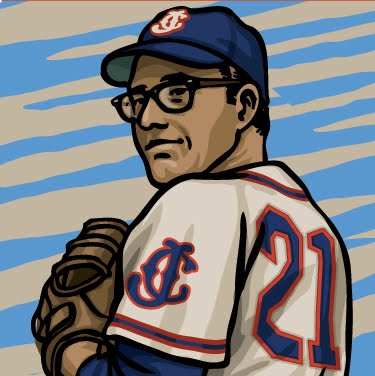
There's no doubt that baseball's full of stories about guys who got the short end of the stick. When you're talking about the Negro leagues, the list gets even longer. Even after the majors were integrated there were precious few slots open to the black players and many men of doubtless talent were left languishing in the minors or never received the call they hoped for. Max Manning is one who received that longed-for call. When I learned about the life and career of Manning, known by the frightful nickname of Dr. Cyclopse, from his former teammate Leon Day, I figured if anyone had the right to be bitter, it was this guy. When I was fortunate to sit down with Dr. Cyclopse himself in the summer of 1992, I was pleased to see that he wasn't in the least bit bitter about the way things shook down for him. On the contrary, I found the former All-Star to be a gracious, friendly man who readily shared his observations of over 10 years in the Negro Leagues with me.
In the spring of 1948, honor and integrity was the only thing that stood between Max Manning and his shot at the big leagues. Manning was relaxing at his New Jersey home, fresh from another successful winter season in Cuba where he went 10-8 for Cienfiegos. That he had that many losses stemmed from his trying out new pitches, namely a straight change-up taught to him by Carl Erskine of the Brooklyn Dodgers. In a few weeks Negro Leagues spring training would start and he and those new pitches were ready to go. Two years earlier Manning got out of the service and had roared back into action with the Newark Eagles, posting a 9-1 record in '46 and following that up with 15-6 in '47. 1948 promised to be even better.
Then one chilly spring afternoon the telephone rings. On the other end is Alex Pompez, former owner of the New York Cubans of the Negro National League, now a scout for the New York Giants. Jackie Robinson, Don Newcombe, Dan Bankhead and almost two dozen other black ballplayers have already been signed to play professional ball. Three of his teammates with the Newark Eagles, Larry Doby, Monte Irvin and Ray Dandridge, have been signed to play in the white leagues and now, according to Pompez, it was Manning's turn.
All the tall, lanky pitcher had to do was go up to the Polo Grounds, add his signature on a contract Pompez had on hand and he was property of the New York Giants. Sounded great, but there was a problem: Manning had already signed a contract to play for the Newark Eagles in 1948. To most black ball players and the white teams that signed them, that little technicality was conveniently overlooked, which was exactly what Alex Pompez and the New York Giants expected Manning to do.
Suddenly the black Bakelite telephone receiver weighted 100 pounds in Manning's hand. Sorry, he couldn't break his word: the Giants would have to negotiate with Newark owners Abe and Effa Manley. No doubt Pompez brought up all the other ball players who jumped their Negro League contracts: Roy Campanella, Larry Doby, Monte Irvin, Willard Brown, Hank Thompson... but those guys weren't Max Manning. Taken aback, the scout asked again if he wanted to pitch in the major leagues, to which Manning replied "more than you could ever know, but if you don't have honor, what do you have?"
It wasn't the first time Max Manning had a cruel brush with the Majors. Back at Pleasentville High, Manning had tossed a couple no-hitters and a 23 strike-out game, he made the papers quite a few times. One day in 1937 a letter arrived from former Athletics star Max Bishop, now a scout for the Detroit Tigers. The letter, accompanied by a questionnaire, told young Max Manning that the Tigers were looking forward to seeing him in the spring for a tryout with the team. Obviously super-scout Max Bishop had just read the sports pages and not looked any further than Manning's stats. The letter was a mistake. A cruel mistake, but a mistake all the same.
Manning pitched on weekends with a semi-pro outfit out of Atlantic City called the Johnson Stars. His teammates were Pop Lloyd, Rats Henderson and a bunch of other ancient blackball stars. These oldsters taught the teenager how to pitch like a pro. At 18, Manning was a slim 6 foot 4. He possessed a side-arm fastball that would eventually register in the 90's and he had a streak of wildness. That speed coupled with his thick glasses made his wildness all the more scary to opposing batters. Leary batsmen soon called the skinny kid "Dr. Cyclopse".
Since a Major League career with the Tigers was not an option, Manning entered his father's alma matta, Lincoln University. His teammate on the baseball team was Monte Irvin and soon the two had attracted the attention of the Newark Eagles of the Negro National League. With his father's permission, Max Manning embarked on a career in baseball.
The Newark Eagles team Manning and Irvin joined seemed to always be a bridesmaid and never the bride. The powerful Homestead Grays with Josh Gibson and Buck Leonard never failed to swoop in and take the pennant every year, but the Eagles had some good talent. Pitcher Leon Day was the equal of Satchel Paige and also happened to be one of the teams best sluggers as well. Shortstop Willie Wells and third baseman Ray Dandridge anchored what was dubbed the "Million Dollar Infield", Mule Suttles' bat added the power hitting pop to the line up and catcher Biz Mackey was a 20-year vet who most consider the best receiver in blackball history. All those men would eventually end up in Cooperstown.
By 1939 Manning was the team's number-two started after Leon Day. Though young and as thin as a reed, Dr. Cyclopes earned the respect of opposing batters with a dose of 90 MPH medicine thrown with a side of wild. He broke even his first full season with a 4-4 record. In '40 he busted out a 14-7 slate and became the Eagles ace after Leon Day jumped ship for Mexico. That he resisted the temptation of the big money Mexico waved in front of black ballplayers should have made Manning popular with the Eagles' husband-wife owners, Abe and Effa Manley, but it didn't. Manning, who was a bit more educated than the average ballplayer of the time, knew how much his arm was worth and his annual salary disputes with the Manley's kept him from being a front office favorite. While Effa's affections were slathered all over fellow pitcher Terris McDuffie, Manning, who had a better record, was held in contempt by Effa and their relationship never improved.
At the height of his career, Manning was drafted into the Army. With his couple years of college, Manning would have been ushered into officer training had he been white, but as it were, he became a truck driver. As part of the famed "Red Ball Express", Manning drove ammo round the clock to Patton's Third Army during the Battle of the Bulge. Manning's reaction to Army racism earned him a stint in the brig and his time in the service left him with a bad taste in mouth. Honorably discharged in January of 1946, Manning was ready to re-start his baseball career.
After dropping his first decision, Manning went on a tear that had him winning every other game he pitched that year. He and Leon Day led the Eagles to the Negro National League pennant and he took home the Champion Pitcher Award, the blackball version of the Cy Young. Facing the fabled Kansas City Monarchs in the World Series, Manning beat Satchel Paige in Game 2 to even the series at a game a piece. Starting Game 5, Manning lost to Hilton Smith and the series was again even up at two games each. Newark eventually won in seven games and the 1946 edition of the Eagles have gone down as one of the best teams before integration. Two of his teammates, Monte Irvin and Larry Doby would make it to the majors and the Hall of Fame, and Johnny Davis, Pat Patterson, Rufus Lewis and Jimmy Wilkes would play in the minors. Leon Day and Biz Mackey would also eventually have a plaque in Cooperstown. It was a heck of a team and for that very reason it was quickly destroyed. Among the thousands of fans in the stands at the 1946 World Series was a whole corps of major league scouts. With Jackie Robinson, Johnny Wright and Roy Partlow already in the minor leagues, the big leagues were scouring the Negro Leagues trying to figure out the best talent they could grab. Not only were the two teams that played in the series that year stocked with great talent, as far as the majors were concerned, it was free for the taking.
Since black ballplayers for generations had taken the contracts they signed each spring with a grain of salt, "jumping" became common in the Negro leagues. Ball players were used to looking out for themselves and following the money and the owners very rarely had to money or legal staff to fight contract disputes. Since many of the owners, including Newark's Abe Manley, were gangsters who did not want to attract the kind of attention a court battle would bring, they grudgingly let the players jump from team to team with little retribution other than a small fine at best.
So, as the white teams came calling, black ball players didn't hesitate to jump. When Branch Rickey signed Robinson, Wright and Partlow, the Kansas City Monarchs, Newark Eagles and Homestead Grays, their respective ball clubs, were not compensated a single cent. While the Monarchs and Grays let the matter drop, the Manley's were angered. Effa in particular was incensed. With Rickey being given God-like status for his racial sensitivity, Manley made as much of a stink as she could protesting what she considered stealing from the Negro Leagues. No one cared; white newspapers loved the controversy black ballplayers would unleash and the black press were ecstatic about the doors being opened for the first time in almost 50 years. When the Bill Veeck plucked Larry Doby for his Indians and then Horace Stoneham pulled Monte Irvin for the Giants, Effa swore to fight any other white owner who took any of her boys. Didn't really matter: there was only so many slots available for the influx of black talent and there were plenty of other teams to raid. That was why when Alex Pompez hung up the phone after Max Manning told him to negotiate his contract with the Manley's, the smart scout knew to look elsewhere. No one who knew Effa Manley wanted to negotiate with her.
For Max Manning, in the spring of 1948 he was in great shape, a young 29 and at the prime of his game. Sure he'd stood on his moral ground and it would keep him from going to spring training with the Giants, but his word was his word and that had to mean something. Of all the Newark players, Manning could especially make a case of jumping the club. Unlike Irvin and Doby, who were Effa's personal favorites, Dr. Cyclopse wasn't shown any particular love from the Manley's, but at least he could look himself in the eye every time he shaved. He was confident another team would come knocking. That winter in Cuba, many of the white major leaguers he played with and against told him he was of big league caliber, but he already knew that - white, black or brown skin, his fastball set 'em on their asses. He'd post another good season, augmented by that Erskine change-up, and then see what kind of offers came in.
But things don't always work out the way they should. It was a few weeks into the 1948 season that Manning separated his shoulder, and just like that, his baseball career was over. Manning consulted doctors and tried to hang on, pitching in Venezuela and Canada as the Negro leagues collapsed, but the fastball left and the pain was too intense. Now married, his wife talked him into going back to college. With help from the G.I. Bill, he graduated from Glassboro State and began a teaching career that would last for 28 years, retiring as Pleasentville's most beloved 6th grade teacher.
Perhaps it's this second career that kept Manning from being bitter. Or, more likely it's the fact that until the day he died in 2003 at the age of 84 that every time he ran a razor across his chin, he could look himself straight in the eyes, knowing his honor was intact.
SOURCES
- Author's meeting with Max Manning, Baltimore circa 1992
- 1946 Negro Baseball Yearbook (Sepia Publications, 1946)
- Holway, John B., Black Diamonds (Stadium Books, 1991)
- Holway, John B., Complete Book of Baseball's Negro Leagues (Hastings House, 2001)
- Martin, Alfred M. & Martin, Alfred T., The Negro Leagues in New Jersey (McFarland, 2009)
- The Press of Atlantic City (June 25, 2003)
If you look closely, he's there, standing on the top right, between the bear-like outfielder Ben Paschal and the diminutive trainer Doc Woods. It's the official team portrait of the legendary 1927 New York Yankees, commonly referred to as "The Greatest Team of All-Time". As the subject of countless books and thousands of articles, they're undoubtedly the most documented lineup in baseball history, so why has this one tall young man who stares straight at the camera remained anonymous and mislabeled until recently?
First of all, the young man's name is not "unknown" or "Walter Beall" or "John Stiborski". His name is Joseph Styborski.
He was born in Sharpsburg, Pennsylvania, the eldest son of Antoni and Helen Styborski, immigrants from Russian Poland. The family would have 4 more children before moving to the rural Cambridge Springs, tucked away in the upper western corner of Pennsylvania. Antoni rented a dairy farm on which he and his family worked. Joe developed into a husky teen, just shy of six feet tall. Somewhere, like almost every other American boy, he learned baseball. For Joe it wasn't so much a game; it was his ticket to a better life.
After high school Joe matriculated to Penn State. By his sophomore year the big righty was the mainstay of Penn's pitching staff. Like many young pitchers, Styborski got by on just his speed ball, which by all newspaper accounts, was something to behold. Along with his tremendous velocity came the inherent wildness and Penn's coach Hugo Bezdeck worked with him to achieve greater accuracy. The extra work paid off and he was the undisputed ace of the university's 1926 staff. In a May 20th game against Princeton, Styborski gave up a pair of walks in the first inning and then a run scored on two errors, but he held the Tigers to a just two hits, striking out 4 through nine innings, only to lose the game 1-0. It was a rare loss for Styborski, who soon got the nickname "Cy", a comparison to the great Cy Young. (Plus, "Cy Styborski" is just fun to say - try it).
Coach Bezdeck must have known his ace had the stuff for a career in professional baseball and he began to help Styborski prepare for the 1927 season. In the off season, Bezdeck helped his ace develop a change up and it paid dividends when his senior year came around. In his first start, Styborski beat North Carolina 8-2, scattering 6 hits, striking out 11 and smashing a two-run homer. Against Syracuse he hit a double while giving up 4 hits and whiffing 6 Orangemen. A week later he went the distance against Princeton, striking out 5, scattering 8 hits and again getting a double, winning 8-2. And so it went for the 1927 season, Styborski finishing with a 6-1 record. His solitary loss was from a May 22nd game against NYU when he came in to relieve Russ Van Atta, a lefty from New Jersey who would also eventually wind up in the Yankees farm system.
With the heavy press coverage Penn State ball games received and his great record over three collegiate seasons, Styborski was courted by major league scouts. While the offers were welcomed, Styborski wanted one thing more than a contract: his diploma. The young ace rebuffed all offers until the sheepskin was firmly in his grasp. On June 13th, 1927 he graduated from Penn State with a degree in Arts and Letters, and signed a contract with the best team in baseball, the New York Yankees. Two days later young Joe Styborski was on a train to New York to join the team.
It was a great time to be a Yankee, the team blew into the '27 season as defending American League champs. Ruth was in the midst of his greatest season and Lou Gehrig had finally come into his own as one of the games best young stars. The team's starting rotation of Waite Hoyt and Herb Pennock, both future Hall of Famers, and ace reliever Wilcy Moore were the perfect counterpoint to the teams offensive punch.
Due to a rain delayed series with Boston during which the beat writers had nothing much to report, Styborski's signing made the major papers. Much was made out of his college education, which was indeed a rarity amongst major league players of the time. The sportswriters played up his hitting, quoting the Yankee scouts report to manager Miller Huggins "Joe is quite a ball player, hitting about as well as he pitches." The scribes also warned future scorekeepers of the tongue-twisting, pencil-breaking Styborski-Grabowski pitcher-catcher battery. (Johnny Grabowski was the Yankee's back-up catcher).
So by mid-July, Penn State's Cy Young was fitted out for a set of pinstripes and took his place in the Yankees dugout. If Styborski thought he'd soon get a chance on the mound backed by Murderer's Row, he was wrong. During
the his tenure as skipper of the Yanks, Miller Huggins habitually
brought up newly signed youngsters and had them practice with the team
and ride the pines during league games. That was Huggin's way of
deciding what minor league level the team should farm the ball player
out to. It was tantalizingly close to the big show, riding the pines in a
new set of pinstripes, and many young kids foolishly thought they were
going to actually get into a game. He did, however get to work out with the team and throw batting practice, all under Huggin's watchful eye.
In
the years before corporations and unions took the fun out of the game,
it was common for major league teams to spend an off day playing a minor
league or semi-pro team for extra money. It was a quaint way for fans
in pre-radio days to get to see a big league team play. It was also a
time that managers like Miller Huggins used to see what his new or
little-used players could do in game situations. So, on Friday June 24th, the Yankees swung into Springfield, Massachusetts on their way home from Boston. Not wanting to waste any of his starters, Huggins penciled in Roy Chesterfield to start the game against the Ponies.
Over 7,000 fans turned out to see the mighty Yankees and they weren't disappointed: Babe Ruth socked two trademark home runs plus a double and Lou Gehrig hit a 2-run blast. Chesterfield gave up 3 runs in three innings before Huggins handed Styborski the ball. Taking the mound in the bottom of the fourth, the pre-rookie blanked the Ponies for a few innings before giving up 4 big runs in the 6th which tied it up. A Ruth homer the following inning put the Yankees ahead by a run.
Joe Giard took the mound in the eighth, which happened to be the last completed frame since the game ended prematurely when 500 boys burst from the overcrowded stands and mobbed Babe Ruth. With a smile on his broad face, Ruth obligingly signed for his young fans. The kindness wasn't reciprocated because in the confusion someone walked out of the ballpark with nine of The Babe's bats, including his favorite. Ruth promptly offered a no-questions-asked $25 reward along with a duplicate bat if the thief would return his lumber.
After the game the Yankees took the train back to New York to get ready for the Philadelphia Athletics. It is probably during this July home stand that the famous photograph was taken. With the Yanks running away with another pennant and Ruth and Gehrig on path to shatter all previous home run records, someone recognized the need to photographically capture this great ball club.
The Yankees were all dressed and on the field taking batting practice. Unlike today, the 1927 Yankees wore what they would wear for that afternoon's game - no special BP jersey or cap. Someone, probably from the front office, gathered the men together in front of Section 10, just to the left of home plate. The dirt before them is churned by spike marks, meaning batting practice had just ended and the grounds crew were about to dismantle the batting cage visible in the far right edge of the photo. The seats behind the players are peppered with men in suits and hats, relaxing in the warm, early afternoon sun. Those were the expensive seats, reserved for the swells that could afford them. The Yankees are posed formally in the time-honored tradition of baseball team photos, front row sitting "Indian-style", second row seated and the back row standing. Front and center is the team's bat boy since 1921, Eddie Bennett. Directly behind him, seated, is manager Huggins, arms folded tightly and cap brim tilted forward to shield his eyes from the sun. The mighty Babe Ruth is standing in the back row, towards the left side, his belly starting to show the effects of too much road cuisine. Lou Gehrig stands off to the extreme left, hands behind his back, his powerful legs apart. There's a playful tilt to his head, like he is amused by something. It isn't a stretch to imagine that Herb Pennock, standing beside Lou, said something funny to mess up the photograph, another timeless component to baseball team pictures. And all the way to the opposite side of the back row, second man in, is the face that was mis-identified or left unknown for many years. Joe Styborski. He stares straight at the camera, hand resting jauntily on his left hip. Then the photographer snapped the shutter and Joe Styborski was forever immortalized beside the Gods of baseball history.
On that home stand the Yanks won 10 out of 14 and then packed up for a series against Detroit. Along the way the team stopped off in Toronto to play the Maple Leafs. This was another chance for Huggins to test the new guys and gauge their level of talent. The Leafs played in the International League, today's AAA level. While not stocked with Hall of Famers, almost every man on the Toronto roster had played in or were future major leaguers. For the Thursday day game, Huggins gave the ball to Styborski.
The Yankees team that took the field that afternoon were a mixture of starters and subs. Tony Lazzeri, Earle Combs, Babe Ruth and Lou Gehrig bolstered little used Julie Wera at third, Cedric Durst in left, Ray Morehart at second and a catcher named Pickens. To shake things up, Ruth and Gehrig swapped positions for the game.
Perhaps unnerved by the large crowd and knowing his future was riding on his performance that afternoon, the young pitcher ran into trouble, yielding a single to the first batter. The next Leaf forced the runner out and two walks loaded up the bases. Former St. Louis Brown Bobby Lamotte hit a hot liner right at Ruth who made the play and doubled the runner off first to end the inning. The Babe, who always took his pre-game warm-up at first base, knew his way around the bag.
In the second, Styborski got the first man on a ground out then gave up a single and walk. He bore down and struck out the next batter then lost all composure by walking the next batter, loading the bases again. Styborski still couldn't locate the plate and he gave a free pass to veteran Bill Webb to force a run home. Former Yankee Merwin Jacobson dropped a single in short left scoring another run but Cedric Durst fired the ball to the catcher who tagged out another potential Toronto run to end the inning.
Styborski led off the third and got a hold of an Augie Prudhomme pitch but Merwin Jacobson shagged it for an out. By the time Styborski picked up his glove and took the mound, he'd calmed down a bit and got the side out fast with two ground balls to Lazzeri and an outfield fly out.
The Yankees came alive in the forth, kick started by Gehrig's lead-off single. With one out Lazzeri smashed a double to left, moving Lou over to third. Third baseman Julie Wera knocked in both runners with a long single and suddenly it's 2-0 New York. The catcher Pickens hit into a double play to end the frame.
On the mound again, Styborski gave up a quick single to the right fielder. With one on and no outs and the game on the line again, Styborski reached deep down and fired a pitch to Fred Bratschi. The left fielder swung and hit it deep to left field but Durst made the play, halting the runners. The pitcher Prudhomme hit the ball back to Styborski who fielded it and threw his counterpart out at first. Now with the runner on second and two away, former Detroit Tiger and lead-off batter Les Burke stepped to the plate. Styborski fired the ball in and Burke hit it back to Wera at third. End of inning.
The pitcher paused in the dugout just long enough to grab his bat before stepping up to the plate. Prudhomme was a bit wild and he walked Styborski. Earle Combs flied out to center field, freezing Styborski at first. Ray Morehart smashed a ball to Burke at second and beat the throw, moving the runner over to second as well. And that brought up Babe Ruth. While the crowd must have been thinking home run, Ruth hit a cheap fly behind first base and by the time the right fielder caught up with it, everyone was safe and the bases were filled for Gehrig. Lou banged a liner to center and Styborski ran home followed by Morehart. Ruth advanced to third. Pruhomme was rattled by this time and walked Durst to load the bases again, and it was only a well executed double play off a Lazzeri hit that ended the inning.
Since it was an exhibition game and Huggins wanted to see what his other youngsters could do, the fifth inning was to be Styborski's last of the day. He got Webb to hit an infield out to short, then got Jacobson to hit a foul ball down the third base side that Wera raced over to snag. He put Tony Rensa on with a walk, who promptly stole second off the youngster. Lamotte then hit the ball right at Morehart at second who threw to Ruth at first to end the inning. Styborski walked off the mound, took his glove off and left his final game as a New York Yankee.
A few days later, Miller Huggins finished the evaluation of his collegiate pitcher and sent him back to New York to gather his things: he was headed to the Easton Farmers of the Class D Eastern Shore League. Facing somewhat easier opposition, Styborski got into 12 games and finished with a 4-3 record. After the season ended he entered dental school in St. Louis. While professional baseball was a dream come true for most American boys, Joe Styborski desired to become the first doctor in his family. He returned to baseball every summer after school ended, steadily climbing his way up the minor league ladder. Moved up to Hartford in 1928, the year started off terribly when manager Paddy O'Connor took a dislike to the budding dentist and did a number on his confidence by yanking him every time he walked a batter. Styborski said he became scared to cut loose, lest he miss with a fastball and be pulled from the mound. Mercifully he was traded to Albany. Senators skipper Bill McCorry took the pitcher aside before his first game and told him he was the starting pitcher and was sticking with him for nine innings, no matter what. The show of confidence worked and Styborski began to win. He salvaged his season with a 13-9 record including 4 shutouts. In 1929 he turned in a stellar 19-5 season to become the ace of the Albany staff. Then, as before, he returned to dental school.
Styborski played one more season of pro ball, going 11-10 with three different teams. There his baseball record ends and his dental career began.
After he graduated dental school, the former pitcher relocated to Woonsocket, Rhode Island and opened his own practice. He and his wife Helen had 2 daughters. It was his grandson who was watching CNN in 1993 and heard that Mark Koenig, the last member of the 1927 Yankees had passed away. That was incorrect he knew, because his grandfather Joe Styborski was alive and well. Thus, a former ball player emerged from the shadows of baseball history, correcting over half a decade's worth of mis-identified photograph captions. Not unknown, not Walter Beall or even John Stiborski.
It was Joe Styborski.
There's a companion piece to this story, which traces my creative process when researching, writing and drawing. It can be seen here.
Last week I spent a pleasant morning with Mike Shannon, editor of Spitball Magazine. He was interviewing me about my art for a baseball card and memorabilia magazine (when it gets printed I'll post a link) and one of the things we covered was my creative process. I had handy a file of research for an illustration I was currently working on and shared it with him. A few days later, with the drawing and story completed, I was about to throw it all out when I thought it might make an interesting side topic before I post the card and story that came from it all.
I get my ideas from many places, conversations I had with my Pop years ago, books I read, tangents I come across while researching other stories and from just general screwing around on the internet. That's how I came across Joe Styborski.
One of my favorite websites I visit is Net54, the venerable pre-war baseball card site. Outside SABR, Net54 must have the highest concentration of baseball history experts in the world. While I usually just stop by to look at the cool looking old cards and memorabilia, sometimes a thread contains the kernel of an story idea. In a topic about collecting the autographs of the 1927 Yankees, someone mentioned that not only would a "true completist" have to collect all the guys who appeared in a regular 1927 season game, but signatures of the trainer, bat boy, batting practice pitchers, bullpen catcher, scouts, executives... and so on. Then someone mentioned Don Miller. He appeared in a few photos of the '27 team but never played a game. He's sometimes called the "mystery man" of the greatest team of all time. But then someone upped the ante with an even more mysterious and unknown guy, a man who until recently wasn't even identified (or mis-identified) on the official team picture, Joe Styborski.

Of course I knew he had to be part of the Infinite Baseball Card Set and promptly made a note of him in my sketchbook. Over the course of a few months I added onto the original note when I found out more about Styborski until I felt it was time to turn on the research.
Off to the library I went, grabbing all the books I could on the 1920's Yankees. Luckily I live right across the river from downtown Cincinnati which boast the best library system in the country. I've always found that if the downtown library doesn't have something (and that's a rare occasion), the Northern Kentucky University, Xavier University, Kenton or Campbell County Libraries do.

After tearing through all the Murderer's Row books in the Ohio River Valley, I moved onto the internet to do contemporary newspaper research. Box scores and game-day news articles popped up, filling out the life of a long forgotten ballplayer. The next stop was Baseball-Reference.com. While I miss my old 1982 edition of "The Baseball Encyclopedia", Baseball-Reference made stats so much easier to access. Plus, their minor league statistical database it indispensable for the kind of players I like to write about. One of the things I pride myself on is the accuracy of the uniforms and equipment I illustrate. In Styborski's instance the Yankees uniforn he will be depicted in is easy. The biggest thing to find out about is what length he liked his sleeves on his jersey - some liked them long, others shortened. I also looked into what kind of glove Styborski would have been using in '27. Old Spalding catalogsues are a great source for them as well as the collectors who share their prized items on Net54. Over the course of a few weeks I made copies of everything I could find and tossed them into my trusty "STYBORSKI" folder.
Now, to find out what Joe Styborski looked like.
I was able to locate two photographs of Styborski; one was the famous 1927 Official team photo that started the whole thing, and the other was a 1927 spring training shot taken in St. Petersburg. While the team photo gives a mugshot-like idea of what our man looked like, the spring training photograph gives me a better clue what his body language was, how he stood, wore his uniform and even what his glove looked like. All these I use when I do my illustration because unlike most baseball artists, I don't like to just reproduce photos you've seen before - I like to create a whole new image of a ballplayer that doesn't exist anywhere else.
For the drawing itself, I knew I wanted to depict Joe Styborski on the mound at Yankee Stadium. Though he never pitched a game there, I felt that after 86 years Joe deserved a shot on the mound in the Bronx. A quick pencil sketch executed while waiting for my pal Todd at the coffee shop one morning became the framework of the illustration I developed. While many times the original sketch varied wildly from what the final card looks like, with Styborski I had a clear idea of what it would be.

Satisfied with the sketch, I then do a few larger ink sketches, about 10" tall. Once I'm happy with the results I work up a hard black ink outline drawing which will then be scanned into the computer to have color added. Sometimes I like to see other variations of the illustration, and in Styborski's case I tried out the idea of depicting him in a Yankees road jersey since his only appearances with the team was during exhibition games on the road. It was an alright drawing, but I decided to go with my original idea and show him in the Stadium. It just seemed right to me.
Now with the illustration completed, I write up the short biographical story for the back of the card. While space is limited on the backs, the small story gives me a basic outline from which I write the longer stories you see on the website.
Which reminds me, now I have to put the finishing touches on my Styborski story - check back in a day or so for Joe Styborski: The Mystery 1927 Yankee.
Here's a ball player I've been wanting to do a card of for a long time. Actually, I illustrated the thing long ago, I just hadn't felt I completed enough research on the guy to tell the story the way I wanted to. Back when I was in college in Baltimore, I got to asking many of the old timers about the Negro League stars, and when catcher came up, most of the oldsters said Biz Mackey was The Man. I asked about Josh Gibson, the great Homestead Grays slugger and sure enough most said that yeah, that Josh could hit the ball a mile, but Biz was the better all-around ball player.
Strong words, and contradictory to most blackball history you read, but me, I'll side with people who were there every time. So, who was Biz Mackey?
Heard of Roy Campanella? The Tokyo Giants? Well, without Biz Mackey both might not have existed...
He grew up playing town ball with his brothers Ray and Ernest before going pro with the San Antonio Black Aces in 1918. When the team folded C.I. Taylor's Indianapolis ABC's bought his contract. The ABC's were among the elite black teams at the time and for a young kid like Mackey to be picked up by them was saying a lot about his raw talent. Serving his big league internship on a team filled with stars such as Oscar Charleston, Dizzy Dismukes, Crush Holloway and Ben Taylor benefited the burly young catcher and he batted .312, 329 and .365.
In 1923 he moved to the Hilldale Club out of Darby, Pennsylvania. Hilldale was the classiest of the eastern blackball outfits and were about to embark on a tear of three pennants once the Eastern Colored League was founded the year Mackey joined them.Because Hilldale already had slugger Louis Santop behind he plate, Mackey often played in the infield so both his and Santop's bats could be in the lineup. It says a lot that a man of Mackey's size, about 6' and over 200 pounds, could play shortstop and third base with the same ease as he could catcher. When he did displace Santop behind the plate, Mackey's mastery of the position became legendary. His arm was so strong and accurate that he didn't have to stand up to throw a base runner out at second. No one had seen that before and soon Mackey was getting compared to Major League baseball's best catcher, Mickey Cochrane, who played across town with the Philadelphia Athletics. Oldtimers who saw both men play usually give Cochrane the slight edge with a bat, but overwhelmingly give Mackey the nod when it came to defence and calling a game.
Mackey was gregarious and jolly; his nickname "Biz" actually derives from his propensity to give batters "the business" as they tried to concentrate at the plate. Mackey would ask them questions, try to get the ump to examine their bat, anything to distract them. He loved the nightlife, too. Blackball players were royalty in the still segregated cities and Mackey took full advantage of all it had to offer. Extremely fond of the sauce, the big catcher was known for his epic nights on the town, but while other ball players eventually succumbed to its debilitating effects, Mackey avoided the slippery slope to alcoholism. While known to show up at a ball game still showing the effects of the night before, once he put on that uniform and crouched behind the plate he was all business.
Because Mackey was renown as one of the best players outside the majors he was much in demand to play during the winter months. Besides the Caribbean, which was a popular destination for black ball players since the early 1900's, by the 20's Southern California had a burgeoning winter baseball season as well. The California Winter League usually featured a few white teams made up of major leaguers and Pacific Coast League stars and a single black ball club stocked with the best the Negro Leagues had to offer. In the winter of 1926-1927, promoter Lonnie Goodwin assembled the Philadelphia Royal Giants, what may have been the greatest single-season team of black players ever to take the field. Joining Mackey was the Kansas City Monarchs' ace Bullet Rogan, Turkey Stearnes, Willie Wells, Andy Cooper and Bill Foster, all Hall of Famers. The Royal Giants buzz-sawed their way through the winter league and took the pennant with a 26-11-1 record against the white teams. In a few more seasons Commissioner Landis would put a stop to the major leaguers playing in the Winter League, but for a few years it was possible to see how black ball players could do against their white counterparts.
After the Winter League season ended, the Royal Giants split up. Bullet Rogan and the other Kansas City Monarchs headed back east to start the 1927 Negro National League season, but Biz Mackey, Frank Duncan, Rap Dixon, Andy Cooper and a handful of others boarded a ship to Japan. Touring baseball teams were not all that uncommon in Japan; American college, Japanese-American semi-pro and white professional teams had been doing it since the turn of the century, but this was the first major tour of black ball players.
Like every other American ball club that toured Japan, The Royal Giants won nearly every game; 47 out of 48 games. Their single loss to the Daimai Club serves as an example of what made the Japanese appreciate the black players so much. In a close game against the
Daimai Club, a bad call by the local umpire gave the game to the Japanese: with one out and two on base, a Royal Giant hit a long fly ball to sacrifice score a run, but the second runner was doubled off first and tagged out. The umpire refused to allow the run to count and Daimai won. The Royal Giants took the loss in stride, something the Japanese deeply appreciated.
While other visiting teams came to the island and beat the hell out of the inexperienced Japanese, the Royal Giants subtly kept their scores low to not insult the locals. The blackball players knew how to play "the game", they'd done it countless times back in the states against white semi-pro and town teams where to run up the score and embarrass the locals could cost them their part of the gate receipts, or worse, a beating. The black ballplayers also knew that by keeping the score close, the possibility to see a win would keep fans interested and coming to the park. The 1922 Major League tour realized this too late and gate receipts greatly diminished by the time their tour ended. When the big leaguers did let the Japanese win a game, it was such a farce that it only embarrassed the locals even more.
The Royal Giants also brought some good old barnstorming entertainment to the island,
driving the fans nuts with their shadow ball routines. The Japanese watched in amazement as the Royal Giants whipped the invisible ball around the field. The team also
shared their knowledge of the game with the Japanese, Mackey's exhibition on how
to throw to second base from a crouch especially drew eager students.
When the Royal Giants played in Tokyo's brand new Meiji Shrine Stadium, Mackey became the first man to hit a ball out of its massive environs. The blast was estimated at 427 feet and before the tour ended he'd hit two more out of the ball park, each to a different field.
The Japanese deeply appreciated the kindness of the Royal Giants and the tour did much to spread the game's popularity. Many of the college players who faced the Royal Giants in 1927 went on to have roles in the founding of the Japanese Baseball League in 1936. By keeping the scores low and not embarrassing the locals, the Americans played to the Japanese sense of honor and dignity, something no other team of Americans had in the past. The gesture helped bolster the Japanese player's confidence, which when dealing with a game as complex as baseball, becomes very important.
Mackey returned to Hilldale half-way through the 1927 season. In his absence, the team had finished dead-last in the league's first half, but climbed back to 3rd place in the second half with him behind the plate. If the catcher had been a major leaguer who abandoned his team to barnstorm for half a season, he'd have been banned from the game. But, Mackey was in the Negro Leagues, and it speaks volumes of the precarious nature of the league that his only punishment amounted to little more than a scolding. Biz Mackey was a superstar of black baseball and the Negro Leagues need him.
For the rest of his long career, Mackey continued to be among the best ball players in outsider ball. When the Negro Leagues had their first East-West All-Star Game in 1933, it was Mackey, not Josh Gibson, who received the most fan votes and was the game's starting catcher. When Mackey was playing for the Philadelphia Stars in 1935, there was a chubby local kid who kept hanging around the star catcher. Through persistence, a little raw talent and Mackey's mentoring, the kid showed promise. By 1938 Mackey was in Baltimore with the Elite Giants and had the kid take the train down to Charm City on weekends to play in exhibition games under his watchful eye. Over the course of a summer the boy transformed into Mackey's "mini me". Veterans said that unless the kid took the mask off, you swore it was the ol' Biz himself behind the plate. When Mackey went to the Newark Eagles in 1939, the Elite Giants' catching was left in the able hands of that kid: Roy Campanella.
In Newark Mackey found a whole new crew of youngsters to mentor and over the next decade brought Larry Doby, Monte Irvin and Don Newcombe's skills up to major league standards. With collapse of the black teams in the early 1950's, Mackey drove a forklift but was brought into the national spotlight when on May 7, 1959, Roy Campanella introduced his old mentor before a crowd of over 90,000 Dodgers fans as the man who made him who he was. It was a tremendous compliment to a man whose generosity and kindness helped influence ballplayers of many colors and nationalities.
And that's who Biz Mackey was.
SOURCES
- Holway, John B., Blackball Stars (Meckler Books, 1988)
- Fitts, Robert K., Banzai Babe Ruth (University of Nebraska, 2012)
- Lanctot, Neil, Fair Dealing and Clean Play (Syracuse University, 2007)
- Gary Ashwill, Agate Type Website

I said it before, but I'll say it again: the greatest thing about writing and illustrating this blog has been all the friends I've made through it. While I started this out of my feeling of loss and loneliness after my Dad died, the many acquaintances I've made through this site have been an unexpected blessing. This week's story comes from one of those new acquaintances. Writing back and forth, he (name withheld by his request) asked me if I'd thought about doing a card of Larry MacPhail. While I never wanted to do cards of owners or executives, MacPhail would prove to be the obvious exception. I thought I'd like to concentrate on his early years in Columbus and Cincinnati, before the Dodgers and Yankees, but I didn't have any reference to start my research. A few weeks later a box arrived at my studio with a big book on MacPhail and some other photocopied material on his Columbus and Cincinnati period. It was all I needed to start writing about this underrated baseball savant - the only thing left was to figure out how to illustrate loud plaids in the Infinite Baseball Card style...
Since baseball became the National Pastime, there have been countless innovators that have moved the game forward: Branch Rickey with integration and the farm system, Dummy Hoy with universal hand signals for umpires, Roger Bresnahan's invention of catching equipment... but perhaps no man had more to do with the advancement of the game, and at the same time is more overlooked, than Larry MacPhail.
Columbus, Ohio 1931.
Larry MacPhail was busted out. After pouring his life's savings into developing a medical arts building that went under after the stock market crash, he was without a job and available. But that didn't worry Larry MacPhail: something would turn up, it always did. He lived his life on the edge, a brilliant mind coupled with a gambler's wit. He followed genius moves with stupid mistakes and each time rebounded to greater height. He was a banker's son from Michigan. Started out as a lawyer in Chicago, then the manager of a Nashville department store. Restless, he wrangled a commission in the army and went to France with an artillery regiment. Six months later he was wounded, promoted to captain and helped lead a daring and booze-fueled raid to capture the Kaiser who was hiding out in neutral Holland. Getting away with his life and one of the Kaiser's ashtrays, MacPhail returned to America and settled in Columbus, Ohio. That's where he was living when he went bust.
As smooth a networker as a Southern senator, MacPhail made friends easy and it wasn't long before some of them came through with his next opportunity. The minor league Columbus Senators were hemorrhaging money like a bottomless boat and hadn't been above 5th place in decades. Fans stayed away from their dumpy ballpark like it was festering with the plague and there was every reason to believe the team would either fold or move away. Local businessmen believed that this would be a tragedy. With the country slipping deeper and deeper into the depression, the Columbus business community believed that the population needed baseball as a diversion from the economic disaster around them and help restore their morale. But they needed a winning team. With Larry MacPhail out of a job, he was asked to see what he could do with the Senators.
Like everything in his life, MacPhail threw his entire weight behind re-forging the franchise into a success. Like a whirlwind of action, he was soon called "Hurricane Larry". Within weeks he'd convinced Branch Rickey to make the Columbus club part of the Cardinals farm system. MacPhail knew that doing so was the future of minor league baseball and the constant flow of players provided by being a part of the Cardinals organization would make his team competitive. The Senators became the Red Birds and soon a steady stream of fresh young talent were putting on Columbus uniforms.
MacPhail slapped new paint on the beat up ballpark, dressed the ushers in colorful uniforms and started fun promotions to lure the fans to the park. At the end of the season the Red Birds were perched in 4th place - the highest in the standings that anyone could easily recall.
By the time the 1932 season started, MacPhail was named to the league's governing body and led the initiative to revamp the play-off system. He instituted a player-incentive program to ensure teams stayed competitive to the end of the season. It was all new and brilliant and by the following season other minor leagues had adapted it to survive the depression.
In June of 1932 he put his team in a brand new stadium which was opened up with unprecedented fanfare and even attracted the Commissioner of Baseball Kennisaw Mountain Landis. Not content with just a merely new stadium, MacPhail insisted lights be permanently installed atop the new ballpark. He began special days where he let unemployed fans see a game for free and started Red Birds fan clubs to get the local kids involved. The Red Birds finished second and actually drew in 100,000 more fans than the parent Cardinals did! It was pure genius and he made headlines from coast-to-coast, but, like every stage in his life, it would come crashing down.
The Red Birds jumped off to a spectacular start in 1933 and were tabbed as the league's favorite. MacPhail continued to make headlines but not always in a good way. Always a first-class boozer, MacPhail sometimes lost control during a binge, such as the time he accompanied the team on a road trip. After an all-night drinking session with the hotel manager ended with an argument, MacPhail made his team pack up and move lodgings right then and there. While some laughed it off, in St. Louis someone was watching.
While Branch Rickey found much to admire about Larry MacPhail, he also had much to despise. Rickey was a teetotaler; MacPhail, of course, drank to excess. The Cardinals president was a model of modesty, the Red Birds' president dressed in flashy clothes to match his personality. And worst of all, MacPhail was quickly out-shining Rickey in the baseball world.
There were two things that ended MacPhail's reign in Columbus. The first was when Rickey saw how well-appointed MacPhail's office was in the new ballpark: walnut paneled walls and plush Oriental carpets. It was more extravagant than any of the major league owners and Rickey seethed with resentment when he thought of how much club money MacPhail had spent on his own regal comfort. When the Red Birds president tried to explain that the walnut panels were installed at a discount by a grateful contractor and that the rugs were obtained after a furniture store had a fire-sale, Rickey was too upset to listen. This brash display of immodesty coupled with the hard time MacPhail gave Rickey when he wanted to promote one of the Red Birds' players during the pennant race sealed the new president's fate. By mid-1933 MacPhail was unemployed.
And, like every other time, he bounced back higher: 100 miles south of Columbus, a ball club was in trouble; a Big League ball club.
The Cincinnati Reds were a miserable club in 1933. Ever since the early 1920's, the team had dived deeper and deeper into the second division. The owner Sidney Weil lost all he had and turned the team over to a local bank. Now in last place with no where else to go, they needed a miracle. They sent for Hurricane Larry.
As he had in Columbus, MacPhail's first months in Cincinnati was a whirlwind of re-painting and re-thinking. He dressed the ushers in fancy garb, hired pretty girls to roam the stands selling cigarettes and cigars. Promotions abounded - ladies nights, kid's days - but still he needed a winning team. MacPhail took stock of his surroundings and set his sights on the richest man in town: Powell Crosley. The local businessman owned a radio and appliance manufacturing company and a brace of radio stations. He took risks, was an innovator in his field and loved his hometown. He was the perfect match for MacPhail. After bombarding the businessman for weeks with reasons he should buy the team, Crosley finally purchased the struggling Reds from the bank. Now MacPhail now had his bankroll.
He got rid of every malcontent and slacker in a Reds uniform. Good, bad, it didn't matter, to MacPhail they were all losers. When star outfielder Babe Herman complained he didn't receive a bonus for hustling that he had in his contract, MacPhail bad mouthed him to the press and kicked him off the team. When he found manager Bob O'Farrell more infatuated with a new golf club than with his team which was on a losing streak, MacPhail fired him then and there. Trades were announced on what seemed like a daily basis. To
cut down on train travel, he occasionally put his boys on a pair of
Ford Tri-Motors and flew them to far away cities. Using St. Louis as a model, the Reds created a sprawling farm system to harvest new ballplayers at a minimum cost. The sportswriters ate
that stuff up, and to make sure they continued to do so, MacPhail built a well-stocked open bar lounge just for them.
Utilizing Crosley's pioneering radio empire, the Reds hired a Floridian announcer named Red Barber and began broadcasting every single game. Major league owners resisted broadcasting their games, fearing fans would just stay home instead of journeying to the ballpark. MacPhail knew they were wrong: the 50,000 watt station WLW could be heard from Texas to Manhattan and soon the broadcasts created a whole legions of Reds fans around the country. Then he allowed three other stations to carry the games as well - the more broadcasts the more Reds fans - and he charged each station two grand for the right to do so. MacPhail
worked with the railroad companies for special excursion trains to
bring all the new Reds fans created by the radio broadcasts to
Cincinnati at a reduced rate.
And then he brought lights to the big leagues. Backed by Crosley's cash, MacPhail installed lights on the re-named Crosley Field. First, he had to convince the other National League owners who were vehemently against the lights. Through deals, arm twisting and flattery, MacPhail managed to have 7 night games for 1935, one with each National League team. It was a smash hit. The first game was linked by a remote link to the White House where President Roosevelt threw the switch lighting up Crosley Field. Every game was a sell-out and though wary, the other team owners agreed to continue the idea.
When Puerto Rico invited the Reds to spend spring training on the island, MacPhail flew the team down there and became the first major league team to visit that Caribbean territory. And through it all, the Reds started to rise. 8th place in 1934; 6th place in 1935 and then 4th place in 1936.
But then, like every stage in his life, it would come crashing down.
Always a boozer and prone to making a scene, MacPhail was on a collision course with Cincinnati's Midwestern values. As his grandson famously said about him:
"My grandfather was bombastic, flamboyant, a genius when sober, brilliant
when he had one drink and a raving lunatic when he had too many."
For a while everyone looked the other way, but by 1936 he had reached the level of "too many. When a drunken MacPhail slugged it out with a police sergeant in the elevator of the Netherland Plaza Hotel, Powell Crosley sent him packing.
It was an inglorious way to exit the big leagues, but to Hurricane Larry, it was the only way. And,
like every other time, he bounced back higher: by 1938 he was running the Brooklyn Dodgers.
That's where I'm ending this story. Most fans of baseball history know how MacPhail assembled the great Dodgers teams of the 1940's and then the post-war Yankees dynasty of the late 40's and 50's. He was elected to the Hall of Fame in 1978. He started his own personal baseball dynasty as his kids and grand kids went on to great heights on the business end of the game. But, as far as an innovator, no one can ever match Larry MacPhail.
Thanks again to the baseball fan who sent me the book and photocopies without which this story could never have been done. It was a fun one to draw, Larry MacPhail was notorious for his loud and flashy clothes. Illustrating baseball uniforms gives me great artistic pleasure, but the chance to draw a sharp suit of clothes, well, that I really couldn't pass up!
SOURCES
- Warfield, Don, The Roaring Redhead (Diamond Communications, 1987)
- McKelvey, G. Richard, The MacPhails (McFarland & Company, 2000)
- Golenbock, Peter, Bums (Putnam, 1984)
- Grandson's quote on Larry MacPhail (Baltimore Sun, November 9, 2012)
Thanks to everyone who sent good wishes on my marriage, it means a lot to Andrea and I. After a beautiful wedding (Andrea looked amazing) and a relaxing honeymoon on Coronado Island (where the new Mr. and Mrs. Cieradkowski took in a Padres-Mets game at Petco Field), I'm back in my studio in Kentucky. As such, I'd like to introduce you to a little-known part of Hall of Famer Casey Stengel's baseball career. Of course known by all as the long-time manager of the 1950's Yankees, Stengel had a long career before that as a manager of last place ball clubs, and before that as a decent major league journeyman outfielder with Brooklyn, Pittsburgh, Philadelphia, New York and Boston. But before even that, Stengel got his start in professional baseball right here in Kentucky playing in the aptly named Blue Grass League.
Before he was Casey, he was known as Dutch. At the turn of the century all peoples of Germanic stock were called "Dutchmen" or "Dutch" (case-in-point, the "Pennsylvania Dutch" actually hail from Germany and Honus Wagner, of German decent, was called "The Flying Dutchman"). The nickname came from the German word "Deutsch" meaning "German people", but disinterested Anglo ears simply heard "Dutch" instead. So all Germans became Dutchmen. Enjoying a comfortable middle-class upbringing, Stengel's old man was an insurance salesman and while he tolerated his son's interest in sports, he pushed the boy to aspire to higher goals in life.
At Kansas City's Central High, Charley was an outstanding athlete, playing football, basketball and baseball with equal ease. In the summer of 1908 at age 16, Stengel joined the semi-pro Kansas City Benton's. The Benton's barnstormed as far west as Utah and Wyoming playing army and factory teams every day to turn a profit. While it was a great learning experience for the teen and a step towards becoming a pro-ballplayer, a career in baseball wasn't Stengel's ultimate goal: Dental college was his aim and baseball was a great way to save up for the tuition.
In his junior year, the 18 year-old's pitching garnered a bit of regional notoriety when the
Central High baseball team became the Missouri State champions. In the deciding game Stengel, the team's left-handed ace, injured his pitching arm. When summer came, Stengel rejoined the Benton's, now re-named the Red Sox and embarked on another season barnstorming around the west. To rest his arm he took to playing the infield and outfield to stay in the lineup.
Dutch returned to Central High for his senior year but dropped out in February when he was offered a tryout by the local Kansas City minor league team. The Kansas City Blues played in the Class AA (equivalent to today's AAA) American Association, one of the country's three
top minor leagues. When the team sent Dutch a contract calling for a $135 a month salary, the teen was so overtaken with nerves that he turned pale. Being under age, his father reluctantly signed it for him. It was after all temporary, his boy was going to become a dentist.
Joining the Blues, Stengel soon found the competition to be way over his head. Seeing that the 19 year-old's pitching wasn't close to Class AA league standards, Danny Shay, the team's manager, put Stengel in the outfield to see what he could do. Though still not up to American Association quality, he showed significant promise and Kansas City sent kid to Illinois to play for the Class D (equivalent to today's A) Kankakee Kays. Stengel got into 59 games and was batting .251 when the league disbanded in July.
With the summer half over, Stengel was assigned to the Class D Blue Grass League in Kentucky. By the end of July he was roaming the outfield for the last place Shelbyville Blues. The low minors being a precarious business back then, the Shelbyville team couldn't turn a profit and was soon bought by a group of businessmen from nearby Maysville for $500.
It was with the Maysville Colts that Stengel began to learn the trade of a professional ballplayer. Though mired in last place, the citizens of Maysville showered their new team with enthusiasm usually saved for a pennant winner. Stengel even had his first fan, a young Maysville boy named Robert Willocks who would carry his spikes and glove to the ballpark where his idol would in-turn get him into the game for free. Though he was barely hitting .220, Stengel earned himself a few prizes with his bat: in September he hit the team's first home run and received a box of candy and safety razor shaving kit. A second round-tripper the next week added a $3 hat to his prize winnings. Late in the summer the Old Mill Tobacco Company included the rookie outfielder in the set of trading cards they inserted in their cigarette packs. The grim faced boy who stares back at you from the orange-boardered 1910 card is a far cry from the grizzled and wrinkled old man who appears 54 years later on his last baseball card as manager of the New York Mets.
It was also in Maysville that Stengel began showing his gift for colorful shenanigans which he later became famous for in the majors. The Colts' home field, League Park, had an insane asylum just beyond its outfield wall. Running to the dugout from his center field position after each inning, Stengel, who was told that he needed to work on his sliding technique, would make a practice slide into third base. The inmates of the asylum watched from their windows and cheered him on with enthusiasm - they thought he was one of their own. On another occasion Stengel drew attention to himself when he pursued a fly ball past the boundaries of an un-walled in ballpark and caught the ball standing ankle-deep in a moving stream.
When the Bluegrass League season ended, the Kansas City Blues called him up for the rest of their season. Stengel got into 4 games and hit .273 with a double. The 19 year-old ended his first season in professional baseball with a combined .237 with 18 doubles, 6 triples and 3 homers spread out over 4 teams and 3 leagues and was retained by Kansas City for the next season. But more than that, Stengel had made enough money playing ball during the 1910 season that he was able to enroll in Kansas City's Western Dental College, his ultimate goal.
And so, that might have been the last we ever heard of Charley Stengel had it not been for his being left-handed: most dental tools were manufactured for righties and Stengel had a terrible time trying to use the equipment. After 2 winters studying at Western, Stengel gave up and decided to become a professional ballplayer. And the rest, as they say, is history - but wait - where did he get the name "Casey" from? Well, as a rookie with Brooklyn in 1912, his teammates took to calling him "Kansas City" after his hometown, later shortened to "K.C." and still later to "Casey".
As some of you may know, I got married on the 10th of August, hence the hiatus in recent posts. Once I get back to the real world next week I'll begin writing and drawing again. In the meantime, I thought I'd post a picture of the little appreciation gift I gave to my groomsmen in appreciation of their honoring me by standing up with me on the most important day of my life. Since I started the Infinite Card Set over 3 years ago, I've had many people commission me to do cards of themselves or relatives, but I'd never done one of my friends. Instead of giving the boys' a flask or pocket knife, and since they're all big baseball fans, I thought I'd say thanks by doing their portrait in the uniforms of their favorite baseball teams, wrap up the set of 5 cards in a special wrapper with a stick of gum and voilà! - a special limited edition set of The Inifinite Baseball Card Set - Groomsmen Edition!
One of my other passions in life, besides baseball, drawing and my soon to be wife, is military history. I'm especially drawn towards the United States Navy in China due to watching Steve McQueen in "The Sand Pebbles" as a kid. It's a fascinating topic, so don't get me started. Anyway, while working on a series of illustrations depicting the various uniforms worn by our Navy in China, I picked up a rare 1933-34 Navy Sports Annual. It's a nicely done hardback yearbook that depicts all the Navy's sports teams from golf and swimming to football and baseball. While flipping through it, I found a reference to a sailor named Torpedo Mills who was "going on to make good in the majors..." I was intrigued and looked him up - sure enough he did make it to the majors. So, thanks to obscure military history, a rare book and countless hours in newspaper archives, I bring you Howard "Torpedo" Mills...
The ex-sailor was big - 6-1, 190lbs - so the St. Louis sports writers gathered around him listened: you can call him "Lefty" or even "Torpedo", but you'd better not call him "Popeye The Sailor Man". Sitting in the Browns dugout at Sportsman's Park that August afternoon in 1934, Howard "Torpedo" Mills had sure come a long way...
Growing up in Dedham, Massachusetts, Howard Mills missed all the best parts of being a kid. Always on the scrounge for money, he chose odd jobs and caddying for swells at a golf course over playing baseball or football with the boys. He liked mechanics and tinkering, but regular school work just didn't interest him - years later they said someone had to burn down the schoolhouse to get Mills out of the 5th grade. When the Great Depression loomed over his corner of Massachusetts, the big 17 year-old found himself with no education or trade to speak of. With an eye to the future, the only viable option was the service. At least there he'd get a bed, three squares and learn a trade. Army, Navy or Marines? Throw in a young man's thirst to see the world and the choice was obvious: Navy.
Mills got his father's signature on the enlistment papers and set off to see the world. With his interest in mechanics, Mills gravitated towards airplanes and he was sent to training at North Island Navy Base in San Diego. Much to his chagrin, there he remained ashore for over 2 years before finally being posted to the U.S.S. Lexington, the Navy's premier aircraft carrier.
Life aboard the Lady Lex wasn't bad, especially considering that all around the country men were out of work and scrounging just to get by. The Lexington was based out of San Pedro, just south of Los Angeles, where the weather was as near perfect as could be and the Navy provided everything he needed. Still, every day while on the flight deck repairing the Boeing F4B-2's and Martin BM-1's, Mills could see a bunch of gobs who had it even easier than him - the sailors who played for the Lexington Minutemen - the carrier's baseball team.
Between the wars, the Navy as well as the other services fielded extremely competitive athletic teams. Winning trophies was a feather in any commanding officer's cap and soldiers and sailors who were especially adapt at athletics could expect fast promotions and easy duties. If you've ever read the book or seen the movie "From Here To Eternity", you can get the idea of how rampant the favoritism showered on athletes was in the interwar military. In the Navy, the ships in the different fleets competed against each other and the winners advanced to championship series. MVP's were chosen and trophies awarded, it was a big moral booster for the thousands of sailors who cheered on their ships, helping to forge a tight esprit de corps. Football, boxing, rowing, golf, swimming and baseball all had a year-end series with the winning ship awarded the title of All-Navy Champion.
So every afternoon, Aviation Machinist's Mate 2/c Mills, wiping the grease from his hands after a hard day of keeping Boeing F4B-2's running, couldn't help but envy the boys who got off duty just to throw a ball around. Win or lose, the ballplayers even got extra shore leave. One morning Mills told his Chief Petty Officer he wanted the day off to try out for the baseball team. The Chief looked him over and eventually acquiesced - if a sailor from his section panned out, it would look good on the Chief. In the Navy, the good as well as the bad, tended to trickle down like that.
Mills, who had never played baseball before, went ashore and headed towards the base ball fields.
The Lex had a pretty good baseball team. The bigger ships of the fleet - the carriers, battleships and cruisers - tended to have the best teams due to their larger compliment of sailors. Plus, the larger ships could afford to carry a few extra ringers aboard who just played ball. The smaller ships didn't have that luxury. While the Minutemen had a decent team, since 1926 the U.S.S. Wright held the All-Navy Championship title. Try as they might, for seven long years the aircraft tender beat off all challengers to their trophy. That afternoon on the ball field at San Pedro, no one on the team figured the key to the All-Navy Championship was the tall, sturdy aircraft mechanic who asked for a tryout.
By all reports, Mills was terrible at first. Remember, he'd never played the game before. Still, visions of all the extra time ashore in San Pedro danced in his head and Mills set his mind to making the club. After a few days practice, it became evident that the newcomer could throw pretty fast from the port side. The coach, an old Chief Gunner's Mate by the name of Fenton, took the eager gob aside and taught him some pitches. Chief Fenton had coached Navy ball clubs for 32 years and knew a thing or two about pitching. Mills couldn't have asked for a better teacher and the Chief couldn't have asked for a better pupil. His fastball had something natural to it - someone said it "hops like two frogs going somewhere". And once the season started, it was soon clear that Mills' fastball wasn't the only thing going somewhere...
The 1933 Pacific Fleet Baseball League was made up of the Navy's most imposing ships, the battleships Arizona, Texas, Oklahoma, Maryland, West Virginia, Tennessee, Nevada, Pennsylvania and the Lexington's sister carrier Saratoga. One by one, Mills, now nicknamed "Torpedo" by his fellow gobs on the Lexington, mowed them down.
It was obvious by the third game of the season that Mills was something special. Against the U.S.S. Maryland, the lefty beat the powerful battleship 8-1, his own throwing error being the only thing that kept him from tossing a shutout. On June 7, the Minutemen faced the California Bears, defending Pacific Fleet Champs. In front of two thousand bluejackets, Mills pitched a three hitter and struck-out 15 to beat the mighty battleship 4-2.
Meanwhile, the perk of being a ball playing bluejacket began to pay off. All that extra shore leave gave Mills the time to court Dana Rhodes, a local L.A. girl who would eventually become his wife.
Easily taking the Pacific Fleet title, the Lexington now faced the U.S.S. Wright, undefeated for seven years in the Battle Force Championship. In the whole history of the series, no Pacific Fleet ship had won. The Lexington aimed to change that. The best of three series was held at Trona Field in San Pedro. Over 8,000 sailors and civilians packed the ballpark for the first game. In every port that had a U.S. Navy ship in it, money changed hands over the big game. The odds were pretty even, the Wright was the seasoned veterans, but the Lexington had Torpedo Mills, undefeated all year. From Shanghai to Newport News, navy men crowded around their ships radio shack for the play-by-play transmitted over the wire.
From the start, Mills and the Minutemen were in control. After setting down the Wrights 1-2-3 in the top of the first, the Minutemen got a hit, followed by a sacrifice and a homer and by the time Mills took the mound to start the 2nd, he had a for run lead. The Wrights scored a run thanks to a single and two errors by the second baseman in the fifth but came back with three more runs to wrap up the game 7-1. Mills struck out 15 and went 2 for 1 at the plate, a double.
A few days later Mills took the mound again for the Lexington. As 8,000 sailors watched from the stands and countless others followed around the world, Lefty Mills no-hit the Wrights as the Minutemen scored 14 runs to sweep the Battle Force Championship.
Among the ecstatic bluejackets in the crowd was Willis Butler, west coast scout for the St. Louis Browns. Within weeks he had Mills' signature on a Browns contract. Problem was, to the Browns he may be Torpedo Mills - pitching prospect, but to the U.S. Navy he was still Aviation Machinist's Mate 2/c Mills. The Browns, perennial losers in the American League, were desperate for anyone who could put a spark in their line up. To the front office in St. Louis, Mills looked like that shining star every struggling ball club hopes for, except for one thing: his Navy contract.
Mills had reenlisted for a two-year hitch the year before he picked up a baseball and was due to be discharged in the summer of 1934. The Browns wanted him asap and went so far as to enlist the help of congressman John J. Cochran to lobby the Navy for Mills' emancipation. The Navy refused to budge. Besides the fact that trained aircraft mechanics were highly prized, there was still another series to be played.
All across the globe, Navy and Marine Corps ball clubs competed in their divisions, vying to get to the All-Navy Championship, the best of three series held in September. The U.S.S. Dobbin, a destroyer tender, emerged the winner. The San Diego-based Dobbin was a dark horse - back then the Navy's fleet was based in San Pedro and no one knew much about the Dobbin. With a dearth of Navy ships to play against, the Dobbin's men honed their skills playing against strong San Diego semi-pro teams - the same baseball hotbed that gave birth to Ted Williams. First winning the Destroyer Squadron title, then the Scouting Force Championship, the Dobbins weighted anchor and headed to San Pedro to face the Lexington.
The first game was a slug fest. Mills gave up 10 runs on 10 hits but still the Minutemen prevailed, scoring 16 runs. It wasn't pretty but it was a win. With the next game in 2 days, Mills' season was through. Anderson took the mound for the Minutemen and held fast as the Lex won 13-6. The U.S.S. Lexington were the Champions of Navy baseball.
In 14 games Mills was undefeated and with the exception of a 17-10 win over the Texas, he'd kept the opposition to under 3 runs a game and averaged 16 strike-outs every time he took the mound. At the end of the year a service-wide pole conducted by Navy Magazine voted him "The Navy's No. 1 Athlete". Better yet, a trophy and new Ford Coupe came with the title. It was a hell of a season for a guy who never played the game before and with a big league contract waiting for him when he got out of the service, the future looked bright indeed.
As most baseball fans know, the St. Louis Browns were one of the lowliest franchises in the history of the game. Once more popular than the Cardinals who shared their ballpark, the Browns began a quick decline in the 1920's that soon made then the worst team in the American League. While other teams embraced the farm system, the Browns tried to trade their way to the first division resulting in even more humiliating losing seasons. Time after time decent pitchers were sent to the Browns only to become run-down and discouraged by the lack of defense and run support. It was into this maelstrom that the newly civilianized Torpedo Mills stepped in 1934.
First he was sent to the San Antonio Missions of the Texas League. The newly civilianized Mills went 3-3 in 15 games and the Browns called him up to St. Louis in August. He got into his first game in Cleveland on August 10th when manager Rogers Hornsby threw the newcomer in to relieve Dick Coffman in the 8th inning. Down 4-1, Mills gave up 4 hits and two runs before he was able to get out of the inning. It wasn't an ideal start, but it was the major leagues.
The rest of the summer Mills pitched batting practice and rode the pines as Hornsby used the former bluejacket sparingly in 3 more games. He worked 7 .2 innings and gave up 6 hits and 2 runs, but walked an unacceptable 11 batters. The old wildness was a continual hindrance in the majors against patient and seasoned batters. The Browns sent him back down, this time to the St. Paul Saints. Used as a starter, Mills turned in a 7-8 record for a miserable team. His control seemed to improve though, and in 146 inning he gave up 84 walks.
In the off season Mills returned to Southern California and married his girlfriend Dana, a by-product of his bonus baseball shore leave from the Lexington. Making their home in Manhattan Beach, Mills used his spare time to coach his younger brother, also called "Lefty" and making a name for himself in Navy baseball as a first baseman. When spring came, Mills headed to San Antonio for the 1936 season.
Things started to come together now as he got a little more control of his fastball and finished the season 12-6, followed by 14-12 the next year. The Browns brought him up at the end of the 1937 season to give him a look. Mills started 2 games and split the decisions. In 12 innings he struck out 10 but walked the same number and relinquished 16 hits. It was a mixture of promise and catastrophe, but on the Browns, who managed to win only 46 games that year, it was a fresh arm.
When the 1938 season opened Lefty Mills was a Browns regular and the most promising thing on the team. Early on, the sports writers who covered the Browns seized on the former sailor's story. It was a feel-good tale, tailor-made for a country still stuck in the doldrums of the Great Depression. Mills was open with the writers who covered the Browns but cautioned them: calling him "Torpedo" or "Lefty" was fine, but "Popeye The Sailor Man" was out of the question. At 6-1, 190lbs, none of the writers argued the point. Once the season started, compared to anything else wearing a Browns uniform, Lefty Mills was the team's star.
In his first start Mills beat the Washington Senators 4-3 in a 13 inning stand-off, scattering 10 hits before the Brownies could eek out the winning run. He then pitched 5 innings of shut-out ball against the A's before the game was called by rain, followed by a heady 1-0 blanking of the Yankees, out-dueling their ace Lefty Gomez. Unfortunately, the Browns were still a terrible team and Mills' 10 wins were accompanied by 12 losses. He was still wild, as the August 31st game in Boston showed. Allowing only seven hits, Mills put 5 Red Sox on base, 4 of whom scored as the Browns lost 6-3. But, wild or not, he was the second best hurler the Browns had, next to Bobo Newsom who somehow managed 20 wins that year.
When spring came, Mills' refused to sign with St. Louis unless he received a raise. After he and Newsom held out, the Browns relented and bumped their ace lefty from $2400 to a staggering $6000. Not a bad increase from the $1000 a year he was banking as an Aviation Machinist's Mate 2/c.
1939 just didn't turn out the way Torpedo Mills expected. On May 18th he got pounded off the mound at Yankee Stadium, unable to get out of the third and giving up 6 runs on 4 hits, 3 walks and a wild pitch. He continued to pitch erratically throughout the summer, the wildness compounding the inept backing he received from his teammates. On July 2nd a little of the old magic came back as Mills tossed a 5 hitter against a strong Cleveland team, but lost his next 7 starts.
September 17th he pitched a complete game win over Lefty Gomez, winning 3-1. He spread 6 hits over 9 innings, the only Yankee run coming off a Babe Dahlgren solo homer in the 5th. It brought his record to 4-11 and was the last game he'd ever win in the majors. The Browns finished dead last again, managing only 43 wins, a staggering 64.5 games behind the first place Yankees.
By the beginning of the 1940 season it was obvious that Mills' career in the big leagues was nearing its end. In first game of the season Cleveland roughed him up for 5 runs in the first and sent him to the showers without retiring a batter. He was relegated to the bullpen, the lowliest spot on the lousiest ball club in the majors. In 59 innings he walked 52 and gave up 55 runs. During the winter St. Louis sold him to Brooklyn, who added the condition that the Browns would buy him back if he failed to make the Dodgers.
Spring, 1941 found the Brooklyn ball club getting into shape in hospitable Havana, Cuba. Torpedo Mills was in camp, vying with a dozen other left handers to make Leo Durocher's rotation. With a pitching staff that included Whit Wyatt, Kirbe Higbe, Kurt Davis, Freddie Fitzsimmons and Hugh Casey, Brooklyn had no use for Mills and he was returned to the Browns in April. St. Louis in turn sent him to their Toledo club, but there's no evidence that he ever pitched for the Mud Hens. In fact, there's no evidence of anything else from Torpedo Mills.
Not to leave you hanging, but as so often happens when researching obscure ballplayers, Mills just disappears from the record. He and his wife Dana are in the 1940 census, living together in Manhattan Beach, California. I tracked down his date of death as September 23, 1982 in nearby Riverside. Online, there's even a photo floating around of his headstone, but oddly enough, while there's room for a spouse, Dana's name is not on it. Perhaps she's still around or their marriage just didn't go the distance, I can't say.
Most of the big battleships whose baseball teams Mills defeated in 1933 were at Pearl Harbor when the Japanese attacked. The Arizona and Oklahoma were destroyed but the others went on to have admirable war records. The Dobbin, who the Lady Lex defeated for the All-Navy Championship, was also at Pearl Harbor that fateful morning. Her crew heroically manned their small boats and under fire rescued countless wounded sailors adrift in the harbor set aflame by burning oil. His old ship, the U.S.S. Lexington went down fighting in the Battle of Coral Sea in May, 1942.
Regardless what happened to Torpedo Mills, his was a fun story to research, illustrating a heck of an off-beat way to make it to the big leagues!