Wednesday, February 18, 2015
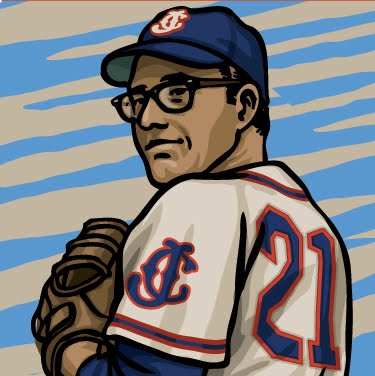
193. Cesar Fernandez: Spring, 80 Years Ago
Today the pitchers and catchers of the Cincinnati Reds organization begin spring training. Although it's 12 degrees here in Kentucky and I'm getting ready to go out and shovel snow, somewhere the sun is shining. Today is a hopeful day, the dawn of another year where anything can happen.
I love this time.
If you are a fan of a lousy team, then today is probably the brightest it will be all year, before the statistics are tallied and standings count, before playoff dreams are shattered yet again. If you are a fan of a good team, then today is the dawn of a year you will look back and remember with a certain fondness and years from now proudly tell your pals "I knew it from Spring Training we were going all the way!"
At least for a short while we can all forget about steroid scandals, sleazy player's unions and $12 beers and just focus on the game. Over the next few weeks we'll all watch the little one paragraph baseball stories in the morning newspaper grow longer and more plentiful as the rosters are pared down. In between European Premier League soccer segments and the latest football scandal, maybe ESPN will squeeze in an interview with a new can't-miss star. Some of us will quietly close the office door at work and tune in to a radio broadcast of a split-squad game from far away Florida or Arizona.
The point is, starting today with the "thwack!" of the first ball hitting a catcher's mitt, anything is possible.
And that brings me to Cesar Fernandez.
I don't know who Cesar Fernandez was. All I can find is that he was one of the many hopefuls that turned up at the Cincinnati Reds training camp in Tampa in the spring of 1935. The press photo I stumbled upon said nothing more than his name and that he was a catcher trying to land a place on the team. I don't know where he came from - Cuba or perhaps Puerto Rico? Could be Florida or NorCal. I managed to find that a guy named "Fernandez" (no first name) appeared in 17 games the previous summer with a single A Reds team in Jeannette, Pennsylvania. He hit .295 with a homer, triple and pair of doubles in 44 trips to the plate. As a catcher he made 5 errors in 14 games behind the plate. Probably was Cesar, I'd lay odds it was, but we'll probably never know. After his photo was taken he seems to have disappeared all together.
But today, it doesn't really matter who Cesar Fernandez was. Let's just look at the hope in his face and remember that on that spring day 80 years ago, he, like us, have no idea what the upcoming season holds.
Play Ball!
Tuesday, February 10, 2015
192. Shumza Sugimoto: A False Spring or Lost in Translation?
Yesterday I found a box on my porch containing five advance copies of my book "The League of Outsider Baseball". With shaking hands I cut open the box and started peeling back the cardboard packaging. Peering inside I hesitantly eyed the culmination of five years of work, the actual hard-bound realization of the most pleasurable project of my long career as an illustrator and writer. Next week I'll write a post with some nice photos (not lousy iPhone shots) of the book which I hope you find as incredibly rewarding and interesting as I do!
Shumza Sugimoto.
He's a footnote to a footnote of baseball history, a ballplayer known not for what he did on the field, but for how he was kept off that field by the white powers that be. You can find Shumza Sugimoto mentioned in books and articles on Japanese baseball, New York Giants histories and scholarly studies of racism in the game. Some writers elevate Sugimoto to a Jackie Robinson before his time, one of the game's great "what-if?" questions. Some more creative historians draw a direct line linking Sugimoto with baseball's most favored "what-if" character, Moonlight Graham.
Who was Shumza Sugimoto?
First mention of the man comes in the Spring of 1905. The mighty New York Giants were beginning their pre-spring training in Hot Springs, Arkansas. Manager John McGraw, always on the prowl for fresh talent, spotted a Japanese ballplayer who happened to be in Hot Springs. As most blackball aficionados know, at the turn-of-the-century Hot Springs was the winter base for the best black baseball talent in the country. The opulent resorts in town fielded virtual outsider baseball all-star teams made up of some of the best black ballplayers in the land who doubled as hotel employees. In the days before radio, television and movies, taking in a ballgame was first-rate daytime entertainment for their guests.
A February 10, 1905 newspaper story reported that John McGraw discovered Shumza Sugimoto in his hotel's massage parlor where he was working as a masseuse. A New York Times article lists Sugimoto as being a 23 year-old outfielder weighing in at 118 pounds. Described as a "jiu jitsu expert", Sugimoto revealed that he had played the previous season with the Cuban Giants. At the time the Cuban Giants were one of the best outfits playing outside the white major leagues. To suit up with them you had to have some serious chops. The story goes on to say that McGraw had the masseuse/ballplayer/jui jitsu expert practice with the Giants who pronounced him as having "all the goods". It was reported that Sugimoto was "as good with the willow as with the wrestling art". Articles claimed that the Japanese outfielder could field, hit and run in "first class style". John McGraw told the sports writers that when the Giants broke training camp and went south on their spring exhibition tour he was taking the Japanese ballplayer with them. Some papers chose to leave off the part where the manager stated that he didn't think Sugimoto would eventually make the team. Follow up stories became a touch more fanciful, playing up Sugimoto's Jiu Jitsu. One story even claimed that Sugimoto came close breaking Turkey Mike Donlin's neck in a club house martial arts exhibition!
Then, as soon as it began, the story ends. Before the Giants left Hot Springs, Sugimoto declared in the February 25th edition of Sporting Life Magazine that he "does not like the drawing of the color line in his case, and says he will remain a semi-professional with the Creole Stars of New Orleans if his engagement by the Giants will be resented by the players of other clubs.”
Sugimoto's semi-voluntary retirement was picked up by a few newspapers who spun it into a broader discussion on race and sports. The above quote is interesting in that it is one of the earliest use of the phrase "color line" in conjunction with baseball. Articles appeared in the sporting press questioning why Japanese were excluded when American Indians were welcomed. One article has Cincinnati Reds managers Frank Bancroft and Ned Hanlon and the team's owner Garry Herrmann going on record as having no objections to a Japanese ballplayer and notes that there appeared to be no rule or by-law prohibiting Sugimoto from joining the Giants. Interestingly, Black athletes were not mentioned in the race discussion. At any rate, the Giants headed south to play their way into shape and Shumza Sugimoto disappears.
Or did he? I think the better question is: "Did Shumza Sugimoto even exist in the first place?"
I'm really not sure.
The Sugimoto story brought together two of the finest Blackball and Japanese baseball historians you could assemble: Rob Fitts and Ryan Whirty. However, this research dream team could unearth no previous or subsequent record on Shumza Sugimoto. Fitts, probably the fore-most American expert on Japanese baseball history, could find no trace of a ball playing Sugimoto in Japanese archives. Whirty is a specialist in Louisiana blackball and he could not verify even the existence of the Creole Stars of New Orleans team Sugimoto was to play for in 1905. Over the years Negro League historians like Gary Ashwill and Phil Dixon have successfully mined newspaper archives for information and box scores for the 1905-era Cuban Giants. Although the Cuban Giants played on the fringes of organized baseball, the team was very successful and left a trail of box scores and stories from wherever their barnstorming took them. Sugimoto doe not appear in any photograph of the team nor does his name appear in any box score or game recap.
But Bill Staples, the go-to man on Japanese ball players in America and head of SABR's Asian Baseball Committee has another take on the Cuban Giants/Creole Stars link. Bill suggests we take a step back from taking team names mentioned in the newspaper articles literally - "Cuban Giants" might have referred to one of the many barnstorming teams that used the name "Cubans" back at the turn-of-the-century. In Bill's own words: "It's not out of line to think that as an Issei, Sugimoto's English was not perfect, so perhaps he tried to explain his playing experience and a reporter misinterpreted what he said? I've seen many articles where a reporter gets a fact wrong, and then it is repeated by others. If we explore this possibility then maybe this would point us to more clues about Sugimoto the real person."
Also Bill brings to our attention that the 1904 World's Fair in St. Louis brought many foreign ball players to the States. Again, I'll let Bill explain: "That year baseball was an exhibition sport there (perhaps with the Olympics too, which was held in conjunction with the fair), and teams and players came from all over to compete." Bill emailed me an example of a 1904 immigration record of a Cuban ball player arriving at the Port of New Orleans with the intention of attending the World's Fair. "With that it mind, I suspect there were other Cubans playing ball in St. Louis in 1904, and maybe this is where Sugimoto played briefly with a team that might have called themselves the Giants (Giants was a popular team name in the early 1900s). In Ancestry.com we see that on March 8, 1904. S. Sugimoto arrived in New Orleans from Cuba. Perhaps he learned about the Cuban baseball plans in St. Louis World's Fair when he was in Cuba?"
Very interesting stuff.
My own research uncovered that if you opened a newspaper in the spring of 1905 you'd find a few mentions of men and women named "Sugimoto", just none who played ball. There was a troupe of female Japanese jugglers and acrobats called the "Sugimoto's Score of Japanese" who toured the country from 1904 through 1906. These geisha-clad ladies played every vaudeville and opera house from California to Denver to Baltimore. A Mr. Sugimoto could be found touring the east coast giving intellectual talks on Buddhism to packed houses. Another man named Sugimoto was a prominent businessman in Cincinnati, Ohio and was touring the Midwest giving lectures on Japan. In the spring of 1905 it was announced that Waseda University's baseball team was scheduled to tour the eastern United States for the first ever Japanese-American Intercollegiate games.
Besides the name Sugimoto and Japanese baseball being readily found in newspapers across the United States, you have to take a broader look at the time period during which this McGraw story takes place.
During 1904 and 1905 the Japan and Russia were fighting a savage war in Manchuria. While this conflict is all but forgotten today, back in '04 and '05 this was big news. Russia was a creaky superpower on the way to revolution and Japan was a brand-new nation that fascinated the West. The war began with Japan's sneak attack on the Russian port of Port Arthur. The complete defeat of the Russian Pacific Fleet was the first time an Asian nation inflicted a military defeat on a Western power. The subsequent Russo-Japanese War was the first modern conflict to be fought on a large scale using machine guns, observation balloons and all-steel and steam warships. This clash of modern arms attracted newspaper correspondents and military observers from every nation. Since the Japanese were on the offensive, most of the newspaper correspondents were attached to the Japanese army and the majority of newspaper articles on the war were Japan-centric.
America loves an underdog and the majority of the country was pulling for little Japan. Plus the United States was in the middle of a surge of immigrants from Poland, Ukraine and other countries that were under the oppressive thumb of the Czar. All these newly minted Americans were rooting for Japan to kick the hell out of Russia.
If you were a bored and mildly playful sportswriter in the spring of 1905 with a hankering to file a phony dispatch about a foreign ballplayer, you'd most likely conjure up a Japanese one.
It's isn't like this hadn't happened before: as far back as 1887 the story of a Chinese ballplayer signed by the White Sox made the rounds. (Please the wild tale on Teang Wong Foo HERE). It is very interesting to note another, more well known incident that took place just a four years earlier featuring the exact same elements of the Sugimoto story: John McGraw, Hot Springs, Arkansas and an ethnic ball player. In the spring of '01, McGraw was the manager of the Baltimore Orioles and he tried unsuccessfully to pass off blackball star Charlie Grant as an American Indian named "Chief Tokohama". (For the whole story please see my post on Chief Tokohama HERE). The story made all the papers and the incident became an early baseball legend. It wouldn't be a stretch to imagine a bored sports writer conjuring a fake story to sell a few more newspapers.
Bill Staples enters again to offer his take on whether or not a sports writer would fake this story. The February 25th Sporting Life article in which Sugimoto reveals he will remain a semi-pro was written by William F. H. Koelsch. Back at the turn-of-the-century Koelsch was a highly respected sports writer who closely followed the New York Giants before, during and after spring training. McGraw and his club were Koelsch's beat and he was the go-to man for anything Giants. Bill raises a good point: Would a guy like Koelsch risk his reputation by spreading false information?
As another side-note to this tangled tale is a story originating from Chicago in the winter of 1911. According to Chicago Cubs president Charles Webb Murphy an infielder named Ito Sugimoto wrote asking for a tryout with the club. The article mentions that this Sugimoto played semi-pro ball in Hawaii and San Francisco where he was a resident. The letter was forwarded to manager Frank Chance and just like Shumza six years before, this Sugimoto conveniently disappears...
Well, that's my take on the whole Sugimoto - first Japanese ballplayer - Cuban Giants story. On one hand, I would like to see the whole yarn proven true. The stories it provoked sparked a dialogue on racism and baseball's color line like never before. Like I wrote in the introduction, I've even seen it writen quite matter-of-factly that when Sugimoto left the Giants his place was taken by - wait for it - Archibald "Moonlight" Graham! Now that would be one heck of a story. (As Bill Staples points out, this comes from both men being mentioned in the same half page Sporting Life article by William F. H. Koelsch). On the other hand, when put into a broader historical context, it not only reveals a long forgotten war but also demonstrates how Americans and the west in general were fascinated with the world's mysterious new superpower, Japan.
Special thanks goes out to Bill Staples who adds a great counter-point to my original story. You may remember Bill from a story and illustration we collaborated on just after the publication of his book "Kenichi Zenimura, Japanese American Baseball Pioneer”. This excellent piece of research not only recounts the life of a pioneering ball player but also tells the story of Japanese-American baseball in America, one of the great untold chapters of baseball history.
Sunday, February 1, 2015
191. Shipwreck Kelly: Football Star, Baseball Mercenary
Ah, Super Bowl Sunday. For a die-hard baseball fan like myself, no day makes baseball season seem as far away as Super Bowl Sunday. As a nod to football, yet keeping baseball in the forefront, I give you Shipwreck Kelly. Hard-core football historians (if there are any of them) know Kelly was a star running back for the University of Kentucky in the late 20's - early 30's and then was one of the first stars of the fledgling NFL. He also played baseball.This little story about Shipwreck Kelly is part of a
series I've been working on for a few years: Bluegrass Baseball. Now that my book is wrapped up and at the publisher (on track for a May 5, 2015 release), I returned to this hardball tribute to my adapted home. While there aren't dozens of Hall of Famers that hailed from Kentucky, there are quite a few interesting characters that played a significant part in the history of our National Pastime. Over the past couple of years I've featured a few of them: Happy Chandler, Fred Toney, Casey Stengel, Mickey Stubblefield, Pee Wee Reese, Humpty Badel and Bob Bowman.
Hailing from Springfeld, Kentucky, John Simms Kelly was the University of Kentucky’s first star running back. He earned the nickname “Shipwreck” because of what he did to the opposing team’s defensive line. Kelly won the All-Southern Conference honors in 1929, 1930 and 1931 and still holds the university record for most yards gained in a game (280). Before one game he called a press conference to predict a 50 yard touchdown run (he did!).
Besides a gridiron star, Kelly was one of the Wildcat’s varsity outfielders from 1929 to 1931. When UK dropped their baseball program in 1932, Kelly and many of the other Wildcats hired themselves out to the various semi-pro teams around Lexington.
After graduation Kelly played professional football in the NFL’s New York Giants and Brooklyn Dodgers. His larger than life personality and wealth made him one of the most popular sports stars of the 1930’s. After his playing days Kelly bought the Dodgers football team. During World War II he worked with the FBI as a spy tracking the movements of Nazi agents in South America and the Caribbean. A charter member of the Kentucky Athletic Hall of Fame, Kelly later became both a champion golfer and world-class big game hunter and is a relative of Giants quarterback Phil Simms.
Friday, January 30, 2015
190. Marius Russo: Battle-tested on the Fields of Bushwick
This is the fifth and last of 5 Bushwicks Stories in 5 days. For the introduction to the Bushwicks and this series please go HERE first.
So far we've seen three of the four types of players that made up the Brooklyn Bushwicks:
1) The guy who had all the talent in the world, but never wanted to turn pro.
2) Aging big leaguer on his way back down into the civilian world.
3) The career minor leaguer who just didn't have that certain "something" to make the majors.
Today we have Marius Russo, a guy who perfectly personifies the fourth and last type of Bushwick:
4) The young guy from the area who wanted to make a name for himself.
With pin-point control and a nice side-arm fastball, Marius Russo cut through collegiate competition like a knife. The Long Island University student's 8-2 record and headline-grabbing win at the Greater New York College All-Star Game grabbed the attention of the Yankees super-scout Paul Krichell. When Russo's college athletic eligibility was used up in the spring of 1936, the lefty found his services were in much demand in New York City's semi-pro circuit. The college kid hired his arm out to various teams including the Glendale Farmers and Brooklyn Bay Parkways. Krichell sat in the stands and watched closely but before he got the kid's signature on a Yankee contract he wanted to see more. He wanted to see how the lefty did against the best players outside the major leagues. Krichell wanted to see how Russo did against Negro League teams.
After ascertaining the kid wanted was game to pursuing a career in pro ball, Krichell made a phone call to Max Rosner and within days Russo was in a Brooklyn Bushwick's uniform.
Krichell knew, and Russo soon discovered, that whiffing a bunch of college kids was a lot different than facing the Negro League teams. A great many of the blackball players he would face in the summer of 1936 were of obvious major league caliber but for their skin color.
His first brush with blackball came against the New York Black Yankees. Formed from the ashes of the old Lincoln Giants, the Black Yankees were the perennial losers of the Negro National League but still had some solid ballplayers like Tubby Scales and Fats Jenkins - not Hall of Famers but had they been the right hue they'd be on a big league roster somewhere. The Black Yanks slapped Russo around for 7 runs on 15 hits. Next he faced the Philadelphia Stars, Negro National League champs two years earlier. The Stars had future Hall of Famers Jud Wilson and Turkey Stearnes in their line up and knocked the kid out of the box by the 5th inning. Russo went on to lose his next four starts against the black teams. None of his losses came close to being as dramatic as the game he pitched against the Pittsburgh Crawfords in June.
The Crawfords were the New York Yankees of blackball. Ruthlessly assembled by racketeer Gus Greenlee, the Craws had by 1936 assembled the greatest team in Negro League history. No less than five Hall of Famers - Satchel Paige, Josh Gibson, Oscar Charleston, Cool Papa Bell and Judy Johnson - came to face Russo and the Bushwicks that day. By now the college kid had faced blackball teams a few times and knew they played fast and hard. His teammates on the Bushwicks were much more experienced - the median age was about 31 - and their advice on how to pitch to those guys was starting to pay off. In that June game against the Craws Russo was holding onto a 4-3 lead going into the 9th inning. It had been a see-saw game but three more outs and Russo would have his first victory over a black team.
Second baseman Dickie Seay was up first. He was playing on a swollen ankle and had gone hitless all afternoon. Now he led off the ninth with a cheap single that found a hole in the Bushwicks infield. Manager Oscar Charleston put in a pinch runner and the pitcher Leroy Matlock sacrificed him over to second. With one away Cool Papa Bell came up to the plate. Cool already tapped Russo for three hits that day but he popped a ball up to the infield that is caught for out number two. Russo is one out from beating the best team in blackball history.
Speedy outfielder Jimmie Crutchfield is due up but the Craws manager Oscar Charleston takes the bat from his hands and pencils himself in as a pinch hitter. Charleston, who many say was the absolutely best black (heck, some say of any color) ballplayer of all time, was now into his fourth decade and beginning to pack on the chub. Regardless, when Russo hung his fastball over the inside of the plate Charleston sent it 410 feet over the right field wall for a two run homer and the 5-4 edge. Russo recovered enough to snag Sam Bankhead's liner back to the box for out number three. The Bushwicks still had one more inning to retaliate and the odds weren't bad until Satchel Paige emerged from the bullpen to pitch the ninth. Satch was in the prime of his career and his blazing fastball sent the three Bushwicks he faced back in order for the win.
While many young ballplayers would have been discouraged by continued failure, Russo did not. He'd lose seven times before he could claim a win over the black teams and he used this crash course in blackball to become a smarter pitcher. Over all his stats weren't horrible. Scott Simkus meticulously reassembled Russo's 1936 Bushwicks season and found the kid had a respectable 3.82 ERA in 12 games against Negro League clubs. By the end of the summer Russo was a seasoned veteran, a graduate of the Dexter Park Academy of hardball. On September 2nd he got the chance to face the Crawfords again, and this time it was he who was the victor. As opposed to the 12,000 who watch their first tryst, just 4,400 braved the threatening weather for the night game. In what may have been Marius Russo's greatest pitching performance of his entire career, the lefty shut out the Crawfords on two hits and struck out nine.
Krichell has seen enough. Before the summer was through Russo was part of the Yankees organization.
The Yankees sent him to their top farm team which happened to be just across the Hudson River in Newark, New Jersey. The team Russo joined has gone down in history as possibly the best minor league team of all time. Of the 32 men who suited up for the Newark Bears that year, no fewer than 27 would go on to play in the majors, either with the Yankees or other big league teams. The kid from Queens won 8 games for the pennant-bound Bears, and the Yankees ear-marked him to be the heir-apparent to the great Lefty Grove. To give him a touch more seasoning he spent 1938 in Newark where he posted a record of 17 wins and then was called up to the big club for 1939.
Now Marius Russo became an integral part of what historians believe was the greatest team in major league history, the 1939 Yankees. As part of this juggernaut the lefty won 8 games with a 2.41 ERA, not bad at all for a rookie. He followed that up with 14 wins in 1940 and then another 14 in 1941. By now he was the best pitcher on the Yankees and manager Joe McCarthy had him pitch Game 3 of the World Series against the Dodgers. With the series tied at a game apiece he faced off against veteran Fat Freddie Fitzsimmons. Both men pitched magnificently, neither giving up a run through six innings. Then in the bottom of the seventh, Russo hit a line drive that smashed into Fitzsimmons' kneecap. Brooklyn rushed reliever Hugh Casey into the game who promptly gave up 2 runs while Russo cruised to a 4-hit complete game victory to give the Yankees the edge in the series. The hometown kid was an instant hero and the Yanks went on to beat the Dodgers in seven games.
His fame was short-lived. Sometime early in the '42 season he hurt his arm. He managed a 4-1 record but to relieve the pain in his arm he began noodling with his delivery and soon the velocity was gone from his fastball. 1943 was a disappointing 5-10, but with a still respectable 3.72 ERA. With a good part of his pitching staff evaporating into the service, McCarthy tapped Russo to pitch Game 4 of the 1943 World Series against St. Louis. The Cards had been fortunate in regards to the draft and still had all of their starters in uniform. Russo came through with one last glorious game. Holding Hall of Famers Stan Musial and Marty Marion and the rest of the Cards to seven hits, the sore armed lefty hit two doubles and scored the go ahead run in the eighth. The win put the Yanks up 3 games to 1 in their eventual win over St. Louis.
Russo joined the Army after the series and briefly came back to the Yanks in 1946 but the arm was through. He put away his spikes and worked in the aircraft industry on Long Island, eventually retiring to a life of travel with his wife. The old lefty was a popular character at old-timers games and became a font of first hand knowledge for historians interested in the great Yankees teams of the 1930's. He passed away at the age of 90 in 2005.
Baseball archaeologist Scott Simkus wrote a wonderful piece on Russo and his 1936 season with the Bushwicks in the much-missed Outsider Baseball Bulletin. Simkus meticulously reconstructed the lefty's record against the Negro Leaguers and uses these and other Bushwicks stats in a brilliant formula to accurately gauge the level of talent found in the black leagues. I can't stress how important his book "Outsider Baseball" is to modern researchers and can't recommend it enough.
This concludes the "5 Bushwicks in 5 Days" series. It's been fun concentrating on one little-known aspect of baseball history in one break-neck marathon session. I'm not quite sure where next week's story will take us, but you can be assured it sure as heck will be interesting!
Thursday, January 29, 2015
189. Walt VanGrofski: Good, But Just Not Good Enough
This is the fourth of 5 Bushwicks Stories in 5 days. For the introduction to the Bushwicks and this series please go HERE first.
Some where, many years ago I came across a catcher named VanGrofski. For the life of me I can't remember where or how I first heard of him, but for the better part of a decade I've tried to piece together the career of this journeyman catcher. Maybe it was the odd Polish name with the Dutch prefix. Or perhaps it was because he came from Bloomfield, New Jersey, close to the city of Passaic where I was born. What ever it was, it certainly wasn't because he was well-known. VanGrofski never played in the majors and his last name is misspelled in records and newsprint more often than it is spelled correctly. Still, every time I came across a box score or article that mentioned him, I put it in my "VanGrofski file", just waiting for the right time to put it all together. Now, with this "5 Bushwicks in 5 Days" series I have that perfect opportunity - Walt VanGrofski is the perfect example of one of the four types of players on the Brooklyn Bushwicks...
Walt VanGrofski was good, just not good enough to make it all the way to the majors.
Walt VanGrofski came out of the same Polish neighborhood in Bloomfield, New Jersey that produced future Yankees Hank Borowy and Dan Savage. At Bloomfield High he knocked the cover off the ball and divided his time between the outfield and calling the shots from behind the plate. Even in the early 1930's Walt VanGrofski was described as a throwback - an old school backstop cast from the same mold as Ray Schalk. Just over 6' tall and 170 lbs, VanGrofski possessed a take no prisoners attitude with a gritty, excitable drive that became immediately obvious when you were on the wrong end of his dark, steely-eyed glare. His friends and local sports writers called him "Beeky", a nickname no one outside Bloomfield dared to use.
He turned pro in 1931 with the Clarksburg Generals of the the entry-level Mid Atlantic League. The next season he was picked up by the Dodgers organization and shipped to York of the New York-Penn League. VanGrofski batted around .250 through 1933 and was picked to join a tour of minor league prospects stopping at Puerto Rico and parts of South America. While in San Juan VanGrofski learned his contract was picked up by the Pirates who promoted him to the Little Rock Travelers, a team which today would be AA level ball. Now the catcher's career seemed to stall. He hit a lack-luster .214, then was demoted back to the New York-Penn League. When the Pirates decided to send him to Savannah the catcher called foul. Rather than play low-level ball in the sweltering Georgia summer, VanGrofski packed his grip and took the next train back to New Jersey. On his way out of town he told reporters he intended to stay in Bloomfield indefinitely and play semi-pro ball in the New York Metropolitan area.
A week later Pittsburgh punted him back to the Brooklyn organization who shuttled him to the Allentown Brooks. It was while playing for the Brooks in 1936 that VanGrofski made headlines for his hitting, just not the kind you did with a bat. Allentown was beating the snot out of future Phillies pitcher Hugh Mulcahy. (Mulcahy would earn the unfortunate nicknames of "Losing Pitcher Mulcahy" and "Hard Luck Mulcahy" after twice losing 20 games in a season for the Phils). VanGrofski had three hits off the future Phillie when he came up the forth time with runners in scoring position. Mulcahy lost his cool and fired a fastball at VanGrofski's head. Walt threw away his bat and charged the mound. The pitcher, who had a few inches and 20 lbs on VanGrofski, left the mound to meet him. Before Mulcahy could get a swing in, VanGrofski landed a devastating hook that opened up a large cut above the pitchers eye and another quick jab that settled the score. A fight broke out that eventually rose to riotous proportions, necessitating a platoon of police to quell the mess. VanGrofski was slapped with a $25 fine and Mulcahy charged $10 as punishment.
Whether it was frustration building up or just Walter being what the press described as "the aggressive type of player", VanGrofski rode the adrenaline and was hitting a career high .304 when an incident happened that might be the reason the catcher never made the bigs. During a close game against Elmira and the pennant on the line, second baseman Packy Rogers attempted to score on a long single. VanGrofski took the throw from the relay man and waited for Rogers who came in spike high. In the terrible collision Rogers' metal spikes tore the catcher's mitt completely off VanGrofski's hand but somehow he held onto the ball to tag the his assailant out. Newspapers at the time remarked on how nasty a play it was and there remained bad blood between the two teams for quite some time. There was no mention I could find about an injury, but one phrase began appearing after this incident to describe VanGrofski: "weak armed".
The Brooklyn organization took notice of the 25 year-old firebrand and sent him to the Winston-Salem Twins as their player-manager. He was still with Winston-Salem in '38 when he butted heads with the club's president. When the dust settled VanGrofski was fired and exiled from the Dodgers family. He went back to Jersey again and soon found a berth with the Trenton Senators, part of the Washington Senators organization. A newspaper article from the time finds a vengeful VanGrofski chomping at the bit to face the Dodgers farm team that played in the same league as Trenton. The accompanying photograph shows a man you'd not want to cross. This time the animosity didn't translate to success on the field and he finished the summer with a lousy .198 average. When he hit the same numbers in 1940 he found himself without a job in organized baseball.
Again, VanGrofski went home to New Jersey. Bloomfield is a short bus or train ride from Manhattan, the hotbed of semi-pro baseball. VanGrofski might have been out of organized baseball, but that didn't mean he was finished as a player. While many young ballplayers used the semi-pro's as a place to gain the attentions of big league scouts, experienced veterans like VanGrofski hoped that a good season on the sandlots would rejuvenate their flagging career. In the spring of 1940 Walt VanGrofski was 28 years-old and far from giving up his major league dreams.
The best semi-pro outfit in the country, the Brooklyn Bushwicks, had a bona-fide major league veteran behind the plate in Charlie Hargreaves. The 43 year-old spent 8 seasons with the Brooklyn Dodgers and Pittsburgh Pirates and now was making a comfortable living playing semi-pro ball at Dexter Park. However, since the Bushwicks played double headers on Saturday and Sundays, Hargreave's 43 year-old knees would necessitate an understudy and Walt VanGrofski was available.
The catcher's plan to stay in the minds of the baseball powers-that-be worked, but just like Allentown in 1936, it was for the wrong reason.
On Sunday July 21st, the Bushwicks were hosting the Homestead Grays of the Negro National League for a double header. As usual Hargreaves caught the first game and VanGrofski took the night cap. In the sixth inning Howard Easterling, the slugging third baseman of the Grays, hit a long fly down the right field line. The Bushwicks typically hired two umpires for a game as opposed to the majors who used three at the time. While this saved money it sometimes made for bad calls and this was one of those times. Umpire Meyers called the blast a home run which would have tied the score at 3-all. The other umpire by the name of Shannon ruled it foul and Meyers reversed his call. The 10,000 fans in the stands made their disapproval known and a deluge of seat cushions, scorecards and hats began. When those ran out they started with the soda pop and beer bottles.
Someone in the third base box seats fired a Coca Cola bottle at VanGrofski that just missed his head. If you've ever held one of those old glass Coke bottles in your hand then you can understand why the Bushwick's catcher became super-pissed. Already a high-strung and aggressive competitor, VanGrofski picked out who he believed threw the bottle, a black guy named Henry Strong, and charged into the stands to settle accounts. In seconds he was over the rail and all over Strong, but just as fast the crowd turned on VanGrofski and he had to be rescued by his teammates. Meanwhile more than one hundred angry fans swarmed onto the field. A squad of Brooklyn's Finest met them head on and brought order back to Dexter Park.
Being this was an inter-racial sporting event, the consequences could have been very dire. Fortunately this was Brooklyn, not Birmingham or Atlanta and no repercussions followed. The Bushwicks continued to play the top-level Negro League teams without incident and VanGrofski was soon back in organized ball.
The Yankees saw a promising leader in the fiery catcher and assigned him to their Wellsville team as a player/manager in 1942. The Wellsville fans embraced their scrappy manager and the team became known throughout the league as "VanGrofski's Ruffians". Then almost as soon as he returned to pro-ball he was drafted into the Army. He served a year as an athletics instructor before sent back home. The battle damage inflicted on his body during his more than ten years as a professional catcher was probably the reason for the early discharge. He was working as recreation attendant at Newark's Wilson Avenue school when the Yankees gave him a call. Their top farm team, the Newark Bears, were a team full of kids too young for the draft and aging veterans useless for combat. An experienced backstop with managerial experience like VanGrofski was just the thing the Bears needed. Now well into his thirties, VanGrofski finally made it to one step shy of the major leagues.
The catcher barely hit above .200 in 59 games in 1944, but the next year he swatted the wartime pitching at a .290 clip. The problem was that his arm was shot and runners knew it, swiping bases off him at their leisure. When the war ended, VanGrofski and most of the wartime Bears were released. The Yankees saw managerial promise in VanGrofski and sent him to their Sunbury, Pennsylvania club where they'd just built a $200,000 stadium. Described by local sports writers as "a high-strung fellow", VanGrofski led the league in being thrown out of games by umpires. He even nursed a private feud with the scribes in the press box. The fans loved it. He managed for a few more seasons, passing from the Yankees to the A's organization before calling it a career after more than twenty years. He returned to Bloomfield where he and his wife Mathilde raised an athletic son named Tom and put in 25 years as an electrician. The fiery receiver passed away at his home in Ocean City, New Jersey in 2000.
As a foot note, I wish I'd have known VanGrofski was still alive and living near my Grandma until 2000. I'd began researching his career years before that and would have loved the chance to talk to him in person, to sit face to face with the guy who I'd read so much about. While guys like Joe DiMaggio or Honus Wagner had careers that took them to Cooperstown, to me they're a bore compared to a journeyman like Walt VanGrofski.
Wednesday, January 28, 2015
188. Dazzy Vance: Dazzy's Last Dance
This is the third of 5 Bushwicks Stories in 5 days. For the introduction to the Bushwicks and this series please go HERE first.
One of the greatest attraction for Bushwicks fans was the revolving door of former big league stars who suited up at Dexter Park. George Earnshaw, Waite Hoyt, Jeff Tesareau and Dazzy Vance were among the aging marquee names that played a last season or two with the semi-pros.
Dazzy Vance was by far the Bushwick fan's favorite. For more than a dozen years Vance had toiled for the Brooklyn Dodgers. Although he'd won the MVP Award in 1924, led the National League in strike outs seven consecutive times and wins twice, Vance never seemed to get the adulation he deserved, solely because he played for a lousy ball club. Still, the cowboy from Iowa kept a cheery attitude and went out there every time determined to win. By the time he was released by the Dodgers in August of 1935, Vance had won just three game shy of 200 games all for a team that very rarely finished over .500. It was this determination in the face of overwhelming odds endeared him to the blue collar Brooklyn fans. Vance was a well-traveled 44 years of age when the Dodgers handed him his walking papers. Over the hill as he might be, Vance still felt he had life left in his arm and someone, somewhere would want him on their side. He didn't have to look far.
Max Rosner quickly put together a lucrative package to lure the pitcher to Woodhaven: $4,000 for 2 months work. This was a tidy sum back in 1935 and when adjusted for inflation would be about $69,000 today. For Rosner, the four grand was pretty much a guarantee that the Bushwicks would pull in sold out crowds for the rest of the season.
While today it might seem sad to see a former star playing for a semi-pro team, Vance for one didn't think so. He was going from the worst team in the National League to a team that not only drew more fans than the Dodgers but also could probably beat his old team in a short best of seven series. Another factor was Vance would get to pitch at least for a little while longer before a crowd that totally idolized him. What aging ballplayer wouldn't want to hear that roar a few more times before slipping away into the history books?
There was one last reason Vance was eager to take the Bushwicks offer, something he couldn't get with any major or minor league team. The pitcher told reporters "I'm having my first fling, too, at pitching against Negro teams".
Dazzy Vance's debut for the Bushwicks was on August 30th. Before a huge crowd Vance threw 2 hitless innings against the semi-pro Springfield Greys, striking out three. Two days later he faced his first Negro League opponent, the Nashville Elite Giants of the Negro National League, the big leagues of blackball. Although the pitcher was sick earlier in the day, once he saw the 15,000 who packed into Dexter Park to see him, he suited up. The old hurler was terrific, scattering three hits through seven innings and striking out five.
And so it went. On September 8 the bearded House of David came to Dexter Park. Pitching for the House was an even older ex-big leaguer than Vance - Grover Cleveland Alexander. Alex was barely holding himself together at this point in his career, his 49 year-old body ravaged by alcohol abuse and years of neglect. Still, 20,000 fans watched as the two dinosaurs faced off one last time. Alex lasted barely two innings, but Vance put on quite a show, six shutout innings and striking out eleven of the beards that day.
A week later he faced another Negro National League team, the Philadelphia Stars, going six innings and leaving the game down 4-3. Seven Stars were strike out victims. Five days later he lasted three innings against the Elmhurst Grays, a local white semi-pro team. On the 29th Vance pitched against the New York Cubans, striking out nine in six innings of work. If Vance truly wanted to test his mettle against the best Negro League clubs, the Elites, Stars and Cubans were among the best around, and for an aging 44 year-old, he did pretty good.
The crowds that turned out to watch Vance's swan song certainly made Max Rosner's $4,000 investment worth while. It was now midway through October and the weather was getting cold and wet. Baseball season would soon be over, but there was still one big game left. On October 13th the rival Brooklyn Bay Parkways came to play, this time with the great Babe Ruth on their team.
15,000 fans braved football weather to see the two oldsters face off. Vance was in top form, holding the 40 year-old Ruth hitless his first two at bats. When The Babe came to the plate the third time, the fans razzed the big man, all of which he took in stride. "Hell" he yelled to the crowd "I'm tryin' to get a hit!" Vance turned around and waved his outfielders in, the ultimate in baseball showmanship, a direct challenge to The Babe. Vance fired one straight down the middle for strike one. No one ever knew what the next pitch was because Ruth knocked it over the right field wall for a home run. Smiling broadly, The Babe circled the bases as the crowd went insane.
Dazzy Vance and The Babe faced off one last time a week later. Ruth went 1 for 3 and Vance, playing his last game, pitched five innings before calling it a career. The ancient pitcher retired to Florida, leading an active life and frequent guest at Brooklyn Dodgers reunions up until his death in 1961.
Tuesday, January 27, 2015
187. Dutch Woerner: The Definition of a "Semi-Pro"
This is the second of 5 Bushwicks Stories in 5 days. For the introduction to the Bushwicks and this series please go HERE first.
Go ahead, search all the baseball reference books and online stat sites for as long as you want, but you'll never find Dutch Woerner in any of them. Yet for almost two decades William "Dutch" Woerner was a super star to baseball fans in the New York City area. He didn't play for the New York Yankees or John McGraw's Giants, not even the lowly Brooklyn Dodgers. Nor is he one of the countless Negro League players who never got a chance to play in the majors because of their skin tone. Dutch Weorner was a Brooklyn Bushwick.
There were basically four types of player on the Bushwicks:
2) Aging big leaguer on his way back down into the civilian world.
3) The career minor leaguer who just didn't have that certain "something" to make the majors.
4) The guy who had all the talent in the world, but never wanted to turn pro.
Dutch Woerner was one of the later.
In the early 1920's the Bronx-born Bill Woerner blazed a three-sport path through Fordham's hallowed halls. You couldn't open the sports page of a New York newspaper without seeing his name mentioned in conjunction with some Fordham victory. By the time he graduated in 1924, Dutch was captain of the basketball team, All-American football hero and fleet-footed shortstop with offers sitting on the table from the St. Louis Cardinals and New York Yankees. He also had himself a business degree from a first-rate university.
For most red-blooded American kids in 1924, the career choice was obvious - pick the pro baseball career! But for Dutch Woerner and many other talented athletes, the lure of the business world was much more powerful. Countless college athletes gave up on their dreams and chose the safer, more lucrative path of a real job instead of the hard-scrabble world of pro sports. With the exception of golf or tennis at the club, their athletic career was over for good.
Fortunately for Woerner he had a third option. Because he resided in New York City - the epicenter of semi-pro baseball, a guy with his talent and name recognition could carve out a nice, well paid career for himself. Many of the other semi-pro teams in the New York/New Jersey area paid their players. The Bushwicks were not only the most successful semi-pro outfit around but they also paid the best. Depending on the level of talent, a guy signing on with Max Rosner could expect about $20 game. The average take-home salary in 1931 was about $35. Since the Bushwicks played doubleheaders on Saturday and Sunday and a weekday night game, an infielder like Woerner could go home Sunday with more than double the average man's paycheck - this on top of his regular job.
While weekdays he might be entry-level stock broker William Brendel Woerner, on weekends he emerged from the subway in Woodhaven Dutch Woerner - star second baseman of the Brooklyn Bushwicks.
Dutch anchored the Bushwick's infield from 1931 through 1936. During those years he was consistently in the top five for batting average and local newspaper coverage marveled at both his clutch hitting and his ability to cover the infield "like a circus tent". Woerner's day job sometimes clashed with his weekend athletic career and he had to miss some games over the years, temporarily retiring during the '36 season so he could dedicate seven days a week to his work. The following summer he joined the rival Springfield Greys. He was batting lead-off as usual in a July 3rd game against the New York Black Yankees when pitcher Roy Williams drilled Dutch in the head with a fastball. Woerner collapsed with a fractured skull and he was raced to South Nassau Communities Hospital where he hovered between life and death for seven days. He eventually recovered after a long hospital stay but he never played baseball again. As a side note to Woerner's beaning, the Greys experimented with wearing leather polo helmets borrowed from a local country club during a game, one of the earlier recorded attempts to develop a batting helmet.
As for Dutch Woerner, he apparently got out of the brokerage business and opened a bar and grill in Lakewood, New Jersey. In 1958 he returned to Brooklyn where he was inducted into the "Sandlot Hall of Fame". While it sure wasn't Cooperstown, Dutch could look back at a nice semi-pro career that enabled him to make almost as much as a big leaguer, while at the same time raising a family, advancing in his career and enjoy being regarded as a first-rate ballplayer - all without traveling further than a subway token away from home. The Brooklyn Eagle's reporter covering the event that day in 1958 remarked how good the former shortstop looked more than twenty years after he hung up his spikes...
Monday, January 26, 2015
186. Joe Press: A Semi-Pro Scouting for the Pros
This is the first of 5 Bushwicks Stories in 5 days. For the introduction to the Bushwicks and this series please go HERE first.
I wanted to start out this series with Joe Press, the team's manager from 1935 until they folded in 1951. Through Joe Press and the Bushwicks, the New York Yankees had a nice pipeline of young New York/New Jersey born talent that flowed into their farm system. Joe Press represents the Bushwick's unique role in developing raw semi-pro talent into big league material.
Since the Bushwicks were founded around 1917, the team's owner Max Rosner had held the managers reigns. However by the early 1930's the once local semi-pro team had become bigger and more financially profitable than many minor league franchises. When his silent partner Nat Strong passed away after the 1934 season, Rosner recognized the need to step back and hire a dedicated manager to pilot the Bushwicks. Instead of tapping a retired big leaguer, Rosner snagged local semi-pro legend Joe Press.
The Bronx-born Joe Press was in his early 30's and although he never played professional baseball, he had been managing the New York Metropolitan area's best semi-pro teams since he was a teenager. Even lacking a professional pedigree, Joe Press was a respected man. After dropping out of school at age 14, the teenage Press skippered the Bronx Orioles, then took over the Highbridge Athletics, a traveling team that featured future Hall of Famer Frankie Frisch, a Fordham University student at the time. By age 19 he was running the Bronx Giants, one of the best semi-pro outfits of the pre World War I period. During the war Press managed a team for the Seabury Shipyards which boasted several big leaguers trying to avoid the draft. After the war he moved up steadily to better clubs, first College Point, then the Springfield Greys. The veteran baseball man gained a reputation of not only assembling top-notch teams but also for his role in finding and nurturing home-grown talent for professional baseball. Among his biggest finds were Tony Cuccinello of the Dodgers and a steady stream of prospects for the Yankees. As one of the most experienced men in the Metropolitan semi-pro circuit, Press' word was good enough for Yankees super-scout Paul Kritchell to hop on the subway and take a look at whoever the manager recommended. The two men formed an unofficial working relationship that lasted into the 1950's.
By 1930 Press was leading the Brooklyn Bay Parkways, the Bushwick's biggest rival and coincidentally owned by Max Rosner's little brother Joe. When Max made the decision to give up the reigns he received permission from his brother to ask Press.
For Joe Press the decision was a no brainer - the Bushwicks paid the best salary outside professional baseball and were the New York Yankees of the semi-pros. He could hope to climb no higher than the Bushwicks. There was one thing standing in the way of his taking the helm of the mighty Bushwicks: their popular outfielder Overton Tremper. Tremper was a former Brooklyn Dodger, the best Bushwick player and a clubhouse leader. Two of those three attributes posed a problem to Joe Press - unlike Tremper, the manager-to-be had no pro experience and the ex-big leaguer's leadership on the team could pose a threat to Press' authority. To accommodate Press, Rosner released Tremper who was immediately snatched up by another Bushwick rival, the Springfield Greys.
Now with his hand at the tiller of the best semi-pro outfit in the area, Press began re-making the team. With the exception of a few core players with big league experience, Press discarded all the high-priced but otherwise washed up veterans. Instead, he focused on college students and graduates who for family or career reasons turned down professional baseball contracts in order to stay in New York. To many it was more advantageous to hold down a lucrative weekday job and play ball for the Bushwicks on the weekends. Often the combined salaries added up to more than an average player would have made in the big leagues. Joe Press was no stranger to holding down a day job - since he left school he ran a business delivering bacon and ham throughout the city.
Under Press' leadership the Bushwicks became an even stronger team. His youth movement worked well with the core veterans like former Giant Al Cuccinello and former Red Charlie Hargreaves. The revolving door of young players were complimented with appearances by former big league stars on their way down the ladder of pro baseball. Lefty Gomez, Waite Hoyt, Dazzy Vance and George Earnshaw were among the fading stars who donned the Bushwick colors. In fact, Joe Press might hold the record for managing the largest number of Hall of Famers, all be it some for only a game or two.
Like he had previously with Springfield and the Bay Parkways, Joe Press acted as an unofficial scout for the New York Yankees. Working closely with Paul Kritchell, Press supplied the Yanks with a steady stream of local prospects, all battle tested and evaluated before hand by the Bushwicks manager. The pipeline worked both ways, as in the case of Marius Russo. The former Long Island University student originally caught the attention of Kritchell while pitching for the Bay Parkways. The Yankees scout arranged for Russo to be transferred to the Bushwicks where he could play against a higher caliber of opponents, thus enabling Kritchell to better evaluate his talent. With Bushwick Russo not only faced the best white semi-pros, but also against various big league all-star teams that came into Dexter Park throughout the summer. Perhaps more importantly, Russo and the Bushwicks also got the opportunity to play against the best non-white players in the country.
The Bushwicks can claim a unique position in baseball history in that they played against the very best blackball teams on a regular basis. From the early 1920's through the team's disbandment in 1951, the Bushwicks were host to the Pittsburgh Crawfords, Homestead Grays, Baltimore Elites, Kansas City Monarchs, New York Cubans - you name the team and they came to Dexter Park. Until his death in 1935, Max Rosner's silent partner was Nat Strong, the Philadelphia-based booking agent who worked closely with most of the blackball teams on the east of Chicago. This partnership ensured that Bushwick faced the best talent excluded from organized baseball. While the Bushwicks crushed any white teams that ventured to Woodhaven, the team held their own or more often than not were bested by the top-level black teams. Because of this unique opportunity, both Bushwick players and fans were able to evaluate first hand the talent level of Negro League players. And here lies Bushwicks and Joe Press' part in one of the more frustrating stories in baseball history.
In the spring of 1949 the Birmingham Black Barons ventured north to play the New York Cubans at the Polo Grounds. They also scheduled a double header with the Bushwicks. The Barons were the defending Negro League Champions and boasted a great roster of veteran blackball players. For more than a decade Joe Press had had the unique opportunity to play against the best black players in the country. Now with Jackie Robinson and Larry Doby integrating the National and American Leagues, Press was perhaps the most knowledgeable white man on black baseball talent. His role as an unofficial Yankees scout gave the Bronx Bombers the leading edge in first hand scouting.
Only the Yankees didn't care.
When Birmingham pulled into Dexter Park, Press made a note of two players in particular - second baseman Piper Davis and outfielder Willie Mays. He notified Kritchell of the two, further singling out Mays as the can't-miss prospect. The Yankees passed. The New york Giants didn't. It's apparent from his surviving correspondence that Press was frustrated with the Yankees refusal to sign a black ball player: "Within the past two years I have given you reports on practically every player, with the exception of a very few, that have been signed to contracts by other teams. . . . You could have had practically all of them, just for the asking".
I don't know for sure if the Yankees were completely against having a black player don the saintly pinstripes for racist reasons. They may very well have been. But then again, if the Dodgers or Giants or Braves farm system was pumping out Mantles, Fords, Rizzutos, Martins and Berras by the dozens, who would needed all the headaches that came along with integration?
Anyway, for Joe Press it was probably the only disappointment of his long semi-pro career. The Bronx dropout and bacon and ham delivery man who never played a day of professional baseball in his life could say he launched the careers of dozens of big leaguers, managed countless Hall of Famers and personally held the reigns of the most successful semi-pro team in baseball history, the Bushwicks of Brooklyn.
Sunday, January 25, 2015
Bushwicks Week at the Infinite Baseball Card Set
Last week artist Monty Sheldon "challenged" me on my Facebook page to show 3 of my works in 5 days. Since it didn't have any water buckets involved and I didn't have to take a sad-faced selfie holding a sign with some hashtag slogan on it, I agreed. The week of January 26 will be "Bushwicks Week" in which I will post not 3, but 5 stories and illustrations of interesting players who took the field for the greatest semi-pro team in the world, the Bushwicks.
For those who aren't familiar with the Bushwicks, they were a semi-pro team based out of the Woodhaven neighborhood of Queens, New York. They were founded by Austrian immigrant and cigar manufacturer Max Rosner around 1917. The team quickly grew from a moral-boosting club for his employees into a talented squad that beat all their neighborhood rivals. Originally based in the Brooklyn neighborhood of Bushwick, Rosner relocated the team just over the Queens border in Woodhaven to take advantage of Dexter Park, a large entertainment complex along the lines of a miniature Coney Island. Rosner managed the team and stocked it with a nice mixture of young local tri-state talent and mercenary professionals. Many Yankees got their start with the Bushwicks including Hank Borowy, Whitey Ford and Marius Russo. At the same time many former big leaguers like Chad See, Jeff Tesareau, Waite Hoyt, Dazzy Vance and Otto Miller stretched out their career by playing with the Bushwicks. Quite a few guys who had a cup of coffee in the majors or decided the life of a traveling ballplayer wasn't for them found they could make as much or more by staying home in New York, working a job and playing with the Bushwicks on the weekend. Guys like Overton Tremper, Buck Lai and Eddie Boland, bonafide big league talents who didn't want to leave home, did just that.
Besides playing against local semi-pro squads and industrial league teams, the Bushwicks attracted the best Negro League clubs of the 1920's through the 1940's. Crowds of 8,000 or more ensured any blackball team who ventured to Dexter Park would come away with a nice paycheck. Also, one odd aspect of Dexter Park was the crowd's usual cheering for the visitors instead of the home team. On any given Sunday in Woodhaven, lucky fans could see Satchel Paige, Chino Smith, Leon Day, or Cool Papa Bell take on the best white players found outside the majors, a virtual Outsider Baseball All-Star series that lasted for decades. The New York-New Jersey area was a hotbed of semi-pro baseball from the turn of the century up until 1950 when a combination of automobiles, television and growing popularity of other sports brought an end to one of the most interesting and unique parts of baseball history.
Although it is difficult to judge how talented the Bushwicks were, baseball archaeologist and author Scott Simkus dissected the 1931 and 1935 teams, and using a genius system of talent measurement all his own, put the needle of Bushwicks level of play at just below the AA level (today known as the AAA level). Since the Bushwicks squads consisted of so many former and future major leaguers, the Bushwicks are also an import part in what Simkus brilliantly calls "the missing link" in which it theoretically becomes possible to gauge the talent of the Negro League players of the 1920's though the 1940's. If you need to know more about this, I highly recommend Simkus' book "Outsider Baseball". I don't hesitate to call it the most important piece of baseball research in the past ten years. Not only has Simkus put together some great research into the talent level of the old Negro Leagues but he's also a very witty story teller and his book is a perfect storm of hard-core original research and good old school baseball yarns. I bought a stack of these to give as presents at Christmas this year and I think I've re-read the thing seven times since it came out less than a year ago!
For a straight-up team history of the Bushwicks you couldn't ask for a better one than Thomas Barthel's "Baseball's Semipros". Published a few years back, Barthel was the first baseball historian to piece together the entire history of the Bushwick and the New York semi-pro baseball scene.
Of note will be the illustrations accompanying each story. Since some of the players are not well known, these will be the first illustrations ever done of them. Also noteworthy will be the uniforms worn by the Bushwicks. As an artist I was always drawn to the Bushwick uniforms which changed fairly often. Owner Max Rosner was proud of his team and he made sure they suited up in big league quality apparel. The team colors were an eye popping navy blue and orange, their distinctive striped socks earning them the nickname of "The Kandy Kids". As I try to do in all my illustrations, the Bushwick uniforms I depict the players in are as close to authentic as I could research. My secret hope is that Will Arlt over at Ideal Cap Company sees some of the cap styles I found and replicates them in his magical, historically accurate way!
Anyway, please check back every day this week as I introduce five characters from the Brooklyn Bushwicks, each attempting to focus on a different aspect of why the team was quite unlike any other in baseball history.
Monday, January 19, 2015
185. Hack Wilson: When 1938 was 1930 for a Day
Mills Stadium on the west side of Chicago, August 21st, 1938.
Hack Wilson's uniform was ill-fitting, snug in all the wrong places. The wool was coarse and made the 38 year-old former Cubs star scratch and pull at the collar. Even though the ball game hadn't started yet, the grey flannel suit was completely soaked through with his sweat. If any of the sports writers who sat around him got close enough to take a whiff, they could probably discern what his choice of alcohol the previous night was. Still, the former National League Home Run and RBI Champ felt good to be back in Chicago. Although it was a mere 6 years since he last roamed the outfield for the Cubs, the ensuing seasons seemed like a lifetime.
Hack Wilson had been the National League's answer to Babe Ruth - all-swagger and raw talent packaged in as ungainly a body as ever seen on a ball field. His exuberance for the nightlife completely embodied Chicago of the Roarin' Twenties. He brawled and blustered, balked and boomed. Back then everyone was Hack's pal and Chicago was his town.
His fall was tremendous and tragic. In the season following his record 56 home runs and 191 RBI in 1930, Wilson went on a season-long slump that he never recovered from. The tyrannical Rogers Hornsby became Cubs manager that year and his relentless needling of Wilson was often whispered to be the reason behind the nosedive. Everyone knew Wilson was a juicer, a lover of the nightclub scene. For years he rode a fine line between controlling his alcohol consumption and falling prey to it, and in 1931 the later happened. He was sold to a miserable Brooklyn team in '32 then to the even lousier Phillies organization in '34. By 1935 he was released to Albany in the minor leagues, a side-show attraction roaming the outfield along side Alabama Pitts, the Sing Sing convict turned ballplayer. It was damned embarrassing. When they wanted to send him to Portland he got pissy, went home to Martinsburg, West Virginia and waited for a better offer to arrive. None did.
Hack shoveled his savings into a sporting goods store that failed. Then he and a partner opened up a tavern. Hack managed to drink away any profit the joint made, which was small due to his penchant for buying the whole house round after round. His drinking alienated his wife and son. As long as Hack had money he had a steady crew of bar room pals to keep him company. When his wife finally divorced him after 15 years, she took their house and what was left of his savings. Heck, she even took his hunting shotgun. The tap room pals evaporated and Hack's drunken former-jock act wore thin. Soon his adapted hometown of Martinsburg wasn't so friendly anymore. He met and married a woman named Hazel and waited for something to happen. In late July of 1938 it did.
A guy named Al Duffy showed up in Martinsburg and tracked Hack and Hazel to the back room of a bar the newly weds called home. The stranger had a proposition for the former star. Duffy owned a bar in McKeesport, Pennsylvania, close to where Hack Wilson was born. Duffy was a former ball player who managed a semi-pro team sponsored by the Tube City Brewery. The Tube City Brewers toured around the northern Midwest states playing industrial league and town teams promoting Tube City Pilsner. It wasn't the Cubs, or even the Phillies for that matter, but it was baseball and there was a paycheck attached to it. Hack and his wife ditched Martinsburg and moved to McKeesport. As part of his contract Hack acted as a greeter in Duffy's joint, not much of a stretch as he and Hazel set up house in the apartment attached to the bar and he would have spent his nights there anyway.
His signing to play with Tube City put Hack back in the sports pages again, if only for a short "what ever happened to" paragraph. From the beginning it was obvious this wasn't going to be the start of a miraculous comeback. Hack was woefully out of shape. His hulking muscles had turned soft and his eyesight was shot. Where once his mighty swing produced tremendous home run blasts, now all it seemed to produce was an ocean of sweat and a round of wheezing. In the games he appeared in he rarely made it past the 4th or 5th inning. Still, throughout small town Pennsylvania fans turned out to see the former star. Then in August he found out that Tube City was headed to Chicago.
If Hack ever thought he was forgotten in Chi he was mistaken. In the years he left town the Cubs had a series of first-rate ball clubs that always seemed to fall short. 1932 ended in a 4 game sweep by the Yanks with the added humiliation of Babe Ruth's called shot. The Tigers mauled the 1935 squad beyond recognition. Now in the summer of '38 the Cubbies had another pennant winner. Even with new stars Gabby Hartnett, Stan Hack, Phil Cavarretta and Billy Herman, Cubs fans remembered Hack Wilson. The slugger brought to mind the care-free days before the Great Depression brought a curtain of misery down on America's Second City. When the Tube City Brewers arrived at Mills Stadium for their doubleheader on August 21st, the press was there to meet Hack.
The old slugger gave his longest press interview in more than half a decade. He dished on the animosity between he and Hornsby in the summer of 1931. The normally magnanimous Wilson laid the blame for his wipe out on Hornsby's strict rules and vindictive fines. Hack sent the pencils scribbling when he told the reporters Hornsby was insanely jealous of Wilson's $33,000 salary that year. Not one to pass along all the blame, Hack admitted he liked to drink and that he did over-do it at times. He told the sports writers that the biggest mistake of his career was turning down the Portland gig. He believed now that it was actually a chance for him to manage. Though the old slugger smiled his broad smile throughout the presser, the scribes could see a wistful look in his eyes. Today, Hack Wilson was as close to 1930 than he had ever been in the past six years.
What Hack Wilson saw when he emerged from the club house at Mills Stadium moved him beyond words. More than 8,000 screaming fans packed the wooden bleachers to see him. The adoring crowd overflowed onto the playing field and just his presence on the field provoked a roar of approval. The game was nothing special. It was a humid August afternoon and Hack was drowning in his sweat. Although he usually couldn't last longer than the sixth inning, he played the entire first game. Every time he came to the plate the stands erupted with applause. Each time his old legs carried him back to snag a pop up, the cheering increased. Riding this wave of admiration which he hadn't felt for years, Wilson managed to play up until the fifth inning of the second game before exhaustion got the better of him. He'd managed just one single the entire afternoon, yet when it was announced he was leaving the field the roar was so intense Hack stayed in to coach first base. For one day, Hack Wilson was able to make all the years between 1930 and 1938 disappear.
It was all down hill after that day in August. He quit playing ball shortly afterwards and focused on drinking. He and Hazel moved to Brooklyn where he had a short career as a night club singer and greeter in a steakhouse across the street from Ebbets Field. He then moved back to Chicago and did the same at a roadhouse re-named "Hack Wilson's House of Seven Gables" after him. The months passed by in blurr of beer and whiskey. He and Hazel made their home in a room behind a bar on Milwaukee Avenue. At one point he was paid to umpire a semi-pro game. Like the Tube City game the year before, thousands showed up just to see Hack on a baseball field again. After the promoters dragged Wilson to the ball park in a drunken haze, he passed out on the field in the third inning. Now even the Chicago fans gave up on old Hack.
Somehow he wound up in Baltimore during the war. Like thousands of other drifters he and Hazel were lured to Charm City by the lucrative defense plant factory jobs. His first wife passed away and his own boy didn't want anything to do with him. Forgotten, Wilson somehow found the strength to kick the booze habit that had been a part of him since he was a kid. He even pulled himself together enough to appear as a guest on a radio program about the evils of alcohol. Unfortunately the years of abuse had done its damage to his body - his liver was shot and he was was suffering from influenza and a bunch of other internal plumbing problems. In November of 1948 Hazel called the ambulance after he fell and didn't get up. He died the next day of the typical alcoholic death - pulmonary edema - his lungs filled with water and he drowned from the inside out.
Shortly afterwards Hazel was sent to a mental hospital. When no one claimed the body donations from bar patrons along Baltimore's North Avenue helped cover the costs. The National League was shamed into throwing in $350 so their former home run and RBI champ could avoid a pauper's grave. At Hazel's request, some of Hack's old pals from Martinsburg drove to Baltimore to take his body back to West Virginia.
In what has to be one of the more tragic sidebars to an already tragic life, Hack's old team, the Chicago Cubs, claimed they were planning on finding a place for their former star in their organization. Whether the Cubs front office made it up to look like good guys or not, it didn't really matter. This was 1948, along way away from 1930, or even 1938 for that matter.
The story of the Cubs greatest slugger, Hack Wilson, always interested me. When I started writing this blog four years ago, I always wanted to do a story on Hack, his rise and fall has got to be one of the most dramatic in all of baseball history, with the exception being maybe Slim Jones. When I started to look for details on Wilson I was shocked by the lack of modern research on him. Even the Society of American Baseball Researchers website which boasts the encyclopedic SABR Biography Project does not have an entry for Hack. Luckily I found Clifton Parker's book "Fouled Away: The Baseball Tragedy of Hack Wilson". Parker did a fantastic job of bringing Hack to life again and thoroughly recounts the years after he fell from grace. However, the idea for this story comes from a few 1938 newspaper accounts I found written when Hack returned to Chicago with the Tube City Brewers. One of them was accompanied by a photograph of a bloated Wilson wearing an ill-fitting uniform with the name of the beer he and his team were promoting. It took more than four years, but when I saw it, I knew that I had found the illustration and story I wanted for The Infinite Baseball Card Set.
Subscribe to:
Posts (Atom)


