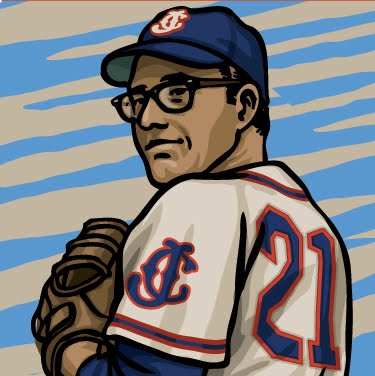
Growing up a
Mets fan in the 1970's, I had to hate Pete Rose. No one knew how to and
did beat my Mets than Number 14. I'll always remember that scowl and
look of utter confidence when he walked briskly up to the plate or the
way he was always diving and running, perpetually in motion, a blur of
grey and red as he squelched a late innings rally or hit a cheap
grounder through a hole in the infield. I hated Pete Rose.
As I got older
and read more about his outlook on the game I understood the guy more
and came to really appreciate his motivation. There's that great quote
from Pete that went something like "I'd walk through a fire wearing a
gasoline suit to play baseball".
I hated Pete Rose. I hated him because he didn't play for my team.
Whitey
Ford slumped in the shade of the dugout, fanning himself against the
humidity with a scorecard. Out in the hot Florida sun his Yankees were
playing the Cincinnati Reds in one of the last spring training games
before the 1963 season would start. With the exception of a few key
stars that the fans expected to see, both clubs allowed their regulars
to rest before the long season began. Most of the guys on the field were
Scrubini's - scrubs - guys trying to impress the scouts before they
were tossed back to minors, most never to be seen again. The only thing
that stirred the Yankee ace from his comfortable spot was when that
gap-toothed Reds rookie came to bat.
Ford
had saw the kid jawing with the Reds veterans Frank Robinson and Vida
Pinson in batting practice and didn't like the ease in which he seemed
to carry himself. No scrub should act like that and it stuck in Ford's
craw all afternoon. It made him even angrier when the kid, who wore number 27 and was playing
left field that day, chased a Mickey Mantle home run all the way to the
wall and then made a point of climbing the fence in pursuit like a lemur,
even though The Mick hit it 20 feet over his head. The kid was a
showboat.
Now
as that same kid trotted up to the plate Ford unfolded his scorecard
and looked for his name. "27 Rose, Peter". The Yankee ace thought to
himself that the name sounded like a loan shark or one half of a
third-rate nightclub act, not a ball player. When Ford looked back to
the plate he saw the kid had run up the count to three balls, one
strike. When the next pitch came in a little low and away the rookie
threw his bat towards the dugout and didn't jog but ran full on to first
base. Like he was beating out a bunt or something. Who the heck did he
think he was? Climbing a wall in vain might impress the local yokel
Florida fans, but now he's just trying to show up the Yankee pitching.
Ford tossed the scorecard down and stepped up to the top of the dugout
and hollered loud enough so his pal Mickey could hear it in center
field: "Hey!
Look at Charlie Hustle!"
Peter
Edward Rose was born on the West Side of Cincinnati in 1941. As a kid
he wasn't a natural athlete and he was a bit on the slight side, but
that didn't stop Rose. He made his freshman football team as a running
back and played baseball any chance he got. When he was denied promotion
to varsity football as a sophomore he blew off school work and failed
the year. A few months of summer school would have made up for it, but
Rose's father concluded that his boy would get more out of playing
baseball in the summer and the repeated year would make Pete physically
larger than other sophomores. To make himself more valuable on the ball
field Rose taught himself how to hit from both sides of the plate and he
learned to play second base and shortstop as well as catch. To build up
his upper body the teenager swung a weighted bat six-hundred times a
day - 300 left-handed and 300 right-handed. When his senior and fifth
year in high school came, Rose was ineligible to compete in high school
athletics. He joined an adult amateur league sponsored by the Bob's Big
Boy restaurant chain and hit over .600. But he had a long way to go if
he was going to be a pro ballplayer. When several of Rose's teammates
received offers from major league teams, Rose graduated un-signed.
Fortunately Pete
had a guardian angel - or more accurately - an Uncle Buddy. Rose's
mother's brother was an ex-minor leaguer named Buddy Bloebaum who
happened to be a part-time scout for the Cincinnati Reds. The old bird
dog was able to convince the Reds to give the hometown kid a chance and
soon his nephew had a Reds contract and $5,000 bonus. It wasn't much -
one of his high school teammates received $75,000 to sign with the
Washington Senators - but it was enough to buy a new Corvette to drive
to his first spring training in.
Pete's first stop
on the long road to the majors was in Geneva, New York in 1960. He hit
.277 in his first season of pro ball and the Reds scouting reports
made it look like he was destined to be a minor league lifer. He wasn't a
smooth fielder, but he knocked down balls and got them to the right
base any way he could. He wasn't a team leader in batting, but he did
have more fire in his belly than any five guys on the Geneva bench. This
first year he also displayed the kind of polarizing personal behavior
that would mark his long career. Rose was brash, cocky and shot his
mouth off at anyone. On the field he upset locals with the language he
used which was clearly audible in Geneva's small ball park. With a
little extra money than he was used to, Rose accumulated a garishly
flashy wardrobe and chased girls like it was an Olympic sport. Still,
something in his file made the Reds keep him on and they sent him to
Tampa for 1961.
Rose spent the winter of 1960-61 loading heavy wooden crates
of glass Coca-Cola bottles onto trucks. This labor combined with his
daily weighted bat routine continued to add strength to his body. When
spring came Rose charged right back into baseball. He was at the ball
park before dawn each day, often badgering one of his teammates into
coming with him to practice. At night Rose didn't drink or smoke but
talked constantly about baseball with anyone who would listen. Playing
in almost every game, Rose made 21 errors at second base, down from 36
his first year. At the plate he hit a nice .331 but showed no power. His
swing was described as "ugly" and out of all the skills needed by a
ball player only his speed and throwing arm were "above average". At the
end of the season his scouting report still had him pegged as a career
minor leaguer, but Rose had something that couldn't be rated on a scale -
he had heart and an endless enthusiasm to play the game.
Nearly everyone
who played with Rose in the early 1960's remarked on his relentless
drive to play and improve himself. Tampa had several can't-miss big
leaguers whose natural ability eclipsed Pete's, but the team's manager,
ex-Reds ace Johnny Vander Meer,
saw something unique in him. Pete's head-first slides and
ever-improving switch-hitting made the old lefty convince the Reds front
office to not only keep the kid from the West Side but promote him further up the farm system.
The
Reds sent Pete to the Class A (today's AA) Macon Peaches. Now playing
at a much higher level, Rose bore down even harder. Though the Peaches
had players far more talented than Pete, the kid from Cincinnati
remained as cocky as ever, never relenting in his drive to become a
better player. Still, there was only so much one can do to improve on
God-given athletic ability - but this was Pete Rose we're talking about
here.
When
his fielding skills only got him so far, Pete spent hours before home
games grooming the area around his second base position to give himself
every possible advantage. Through trial and error Rose learned he
fielded better when the dirt was thick and a little on the muddy side.
His fielding average slightly improved and his offensive numbers made
the Reds second-guess their evaluation of Rose as a career minor
leaguer. Throw in his ever present hustle and the Reds invited him to
spend spring training 1963 with big club.
But nothing was
ever easy for Pete Rose. As was the custom back then, the veterans did
everything possible to make life difficult for a cocky hopeful like
Rose. It didn't help that Pete was overflowing with swagger and
confidence, dressed flashy and chased anything in a skirt. At first the
other ball players looked at the hopeful as a show-off and a rube.
Gradually however, Rose began winning over teammates and Reds manager
Fred Hutchinson - all came to the realization that this kid wasn't
showboating - he really wanted to win ballgames at any cost.
Perhaps
no story from the spring of 1963 sums up Pete Rose better than the one
that earned him the nickname "Charlie Hustle". Whitey Ford's wise crack must have made quite a few of
the veterans laugh, but Rose never let it bother him - in fact he always
saw it as proof of his enthusiasm for the game. In the end the kid from
Cincinnati's West Side had the last laugh - he made the Reds out of
spring training and at the end of the '63 season was voted the National
League's Rookie of the Year.
I hated Pete Rose. I hated him because he didn't play for my team.
Those
who have met me in person know I'm not the kind of guy to toot my own
horn. In fact, much to my detriment, I'm lousy about promoting myself.
That's why it's hard for me to ask this, but this is something that
needs to be done: if you bought a copy of The League of Outsider
Baseball, can you please take the time to write a review of it on Amazon, Barnes and Noble or Good Reads?
It would mean a lot to me and most importantly give future publishers
an idea of what the book reading public thinks of my work. Almost all of
the existing reader's reviews have been flattering, but every once in a
while some crackpot writes a clunker out of jealousy or boredom. I for one often look at the reviews
on those sites before I spend my money on a book. Reviews aren't the
only thing I rely on in my purchasing process but it's certainly a
factor, and that's why I'm asking you to please take the time to write
your thoughts about my work.
I don't like to get too personal about my life when writing this blog. I keep politics and all that stuff out because everyone comes here to read about baseball, not get a lecture or anything. However, life does get in the way sometimes, and I have to say this has been a rough couple of months for me and my family. My brother-in-law (and one of the groomsman at my wedding) passed away after a valiant battle with the very same cancer he spent his life researching. Then one of my closest and oldest friends decided that living was too much and took his own life. That's all I'm gonna say about all that except that those were among the reasons the content has been light over the last few months. I just wasn't all that inspired to write anymore.
But the other night a good friend of mine fired up that spark again.
My wife was in Oklahoma City with her sister's family and I was home alone. I called up my friend Vic and he crossed the river to my home in Kentucky to watch one of the Mets playoff games with me. As we walked to one of the local taverns here in Fort Thomas, Vic kept remarking how nice the town I lived in was. The streets were clean and tidy, people wave to you as you walk by and kids were out playing as the sun slowly went down. I couldn't help but agree, I do live in a special place.
That walk inspired today's story. The town of Fort Thomas is named for the military installation that still stands today. Though many of the buildings are gone, a good number still remain and the property is now owned by the city. The old water tower disguised as a Medieval stone parapet still guards the entrance to the fort. The tree lined streets that once reverberated with the sound of marching boots now allows walkers and joggers a picturesque setting in which to exercise. Many of the stately old officer's houses are restored and lovingly maintained by their civilian owners. The VA operates a large outpatient facility on the grounds and the old gymnasium is now open to the public. A small museum manned by enthusiastic local historians tells of the fort's past and a large playground entertains the children who will one day be the town's future. For a history buff like me it's a great place to wander around, and being a baseball fan, I looked for something to tie my two interests together.
I didn't have to look far. As recent as the 1968 Fort Thomas had a deep connection with baseball: Pete Rose and Johnny Bench did their Army Reserve duty at the fort serving with A Company of the 418th Engineering Battalion and you can find pictures of the heart and soul of the Big Red Machine peeling potatoes and doing KP duty in their fatigues.
But I like older stories so I dug deeper. Since the Civil War the U.S. Army embraced baseball. Not only was it a healthy activity for troops but it also instilled teamwork and regimental pride in the men. The 6th Infantry Regiment stationed at Fort Thomas on the Ohio River was no exception. In the 1890’s the regiment’s commanding officer was Colonel Melville Cochran. The Civil War veteran from Maine was an early and tremendous fan of the national pastime and had formed baseball teams at every post he was stationed, from Fort Apache to his new command in Northern Kentucky.
In tribute to the team’s founding father, the 6th Infantry club was named The Cochrans and the men’s jerseys bore their patron's name in bold letters across their chests. The Colonel’s dedication to the team’s success as so complete that he was known to order key players locked up in the brig the night before a big game to ensure their sobriety. He also turned a blind eye when the fort's provost let members of the team out of the brig to participate in a big game.
A large part of the Cochran’s success was that big league ballplayers who lived in the area used the Fort Thomas’ large indoor athletic facilities to keep in shape over the winter. Connie Mack, Bill Wilson and Jesse Tannehill were among the players who used the indoor batting cages and equipment. In return, the Cochran’s benefited from being coached by real major leaguers. This impressive athletic hall still stands on the grounds of the old fort and still serves in its original capacity as a community gym.
Throughout the 1890’s the Fort Thomas Cochrans fielded the best baseball team in the U.S. Army until 1898 when the regiment left to fight in Cuba. The star of the Cochrans during their heyday was a sergeant from Baltimore named John Thomas Grimes. A veteran of the Sioux Indian War, it’s not known when Grimes began playing baseball, but by the time he was posted to Fort Thomas he was a talented twirler.
When not hurling for the Cochrans, Grimes hired his services out to teams as far away as Indiana when they needed a professional arm. He made headlines in 1894 when he whipped the Cincinnati Reds of the National League while pitching for the semi-pro Newport Reds.
In 1897 Sergeant Grimes wrangled four months of leave and began playing minor league ball in Evansville, Indiana. He was an instant success and became extremely popular with the Evansville fans - so much so that he acquired a "groupie", Rose Stewart, who cause a sensation by leaving home to follow the dashing soldier on a road trip. The scandal made all the Indiana papers and Grimes was momentarily accused of wrong-doing but quickly cleared when it became known he hadn't encouraged Rose's affections. Seems Miss Stewart was a bit of a Victorian hell-raiser and perpetual runaway.
By the end of the summer Grimes, now called “Soldier Boy”, had made it all the way to the majors with the St. Louis Browns. On July 31, 1897 Grimes made history by hitting a record six Louisville batters in one game - though to be fair it appears that he did it on purpose! Apparently there was some bad blood between the two clubs and Grimes was dishing out some retribution. In all he pitched 3 games in the majors, lost 2 and had an admirable .286 batting average. After his leave was up, Grimes returned to the army where he served in the Spanish-American War and World War I before retiring with the rank of captain.
As an interesting side note, you might have noticed that I obscured Grimes' face. See, John Grimes is one of the only men to play in the Major Leugues of whom there is no known photograph. I was rather shocked by this as not only did he play minor league ball and was quite popular but he was a wildly sought after semi-pro mercenary. On top of that he was a soldier for more than 40 years, surely there is a photo of him somewhere? Enjoying a good hunt, I scoured the local archives for hours on end. At the Fort Thomas Museum I found a team photo of the Cochrans - but Grimes was absent that day! So the search continues. Hopefully some day I can revise his portrait, dropping his hands to his side and re-introduce the face of the man who made Rose Stewart leave home back in 1897...
Those
who have met me in person know I'm not the kind of guy to toot my own
horn. In fact, much to my detriment, I'm lousy about promoting myself.
That's why it's hard for me to ask this, but this is something that
needs to be done: if you bought a copy of The League of Outsider
Baseball, can you please take the time to write a review of it on Amazon, Barnes and Noble or Good Reads?
It would mean a lot to me and most importantly give future publishers
an idea of what the book reading public thinks of my work. Almost all of
the existing reader's reviews have been flattering, but every once in a
while some crackpot writes a clunker out of jealousy or boredom. I for one often look at the reviews
on those sites before I spend my money on a book. Reviews aren't the
only thing I rely on in my purchasing process but it's certainly a
factor, and that's why I'm asking you to please take the time to write
your thoughts about my work.
Two months ago our water heater exploded, flooding my studio. Could have been a lot worse, none of my work was touched, but the damage was such that I had to abandon my studio until the repairs were finally finished yesterday. Moving back in, I came across a forgotten box containing eight copies of the prototype of what eventually became "The League of Outsider Baseball". I thought they were all sold out!
So for a limited time - meaning until they're gone - I'll be offering these little hard-cover gems for $45 at the link below. Once they're gone, they're gone!
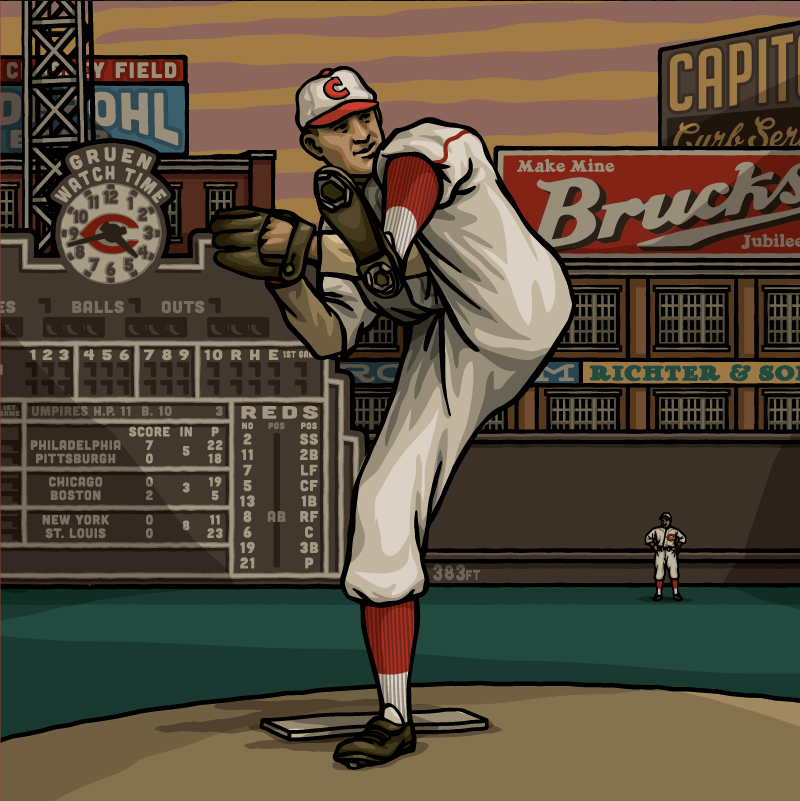
This week I wanted to showcase a large illustration I recently completed of Paul Derringer. Besides wanting to bring the old Reds ace to life in full color, I also looked forward to re-creating the scoreboard and factories that formed the outfield walls of Crosley Field. Turned out to be one of my favorite drawings...
One would think a pitcher with a record of 7-27 would find himself back in the minor leagues, right? Not Paul Derringer - he got a $2,500 raise. In 1933, the year he put up those terrible stats, Derringer had an ERA of 3.30, better than league average, and his walks and home runs allowed per inning was among the lowest in both leagues.
Paul Derringer’s career had more dramatic peaks and valleys than Kentucky's Red River Gorge. He came from Springfield, the son of a prosperous Kentucky tobacco farmer and former baseball player. Built like a line backer and over six feet tall, Derringer had a blazing fastball delivered with a dizzying leg kick and pin-point control. By 1931 he was pitching for the Cardinals where the rookie won 18 games as St. Louis went to the World Series. Then he had the misfortune of going from the best team in the National League to the worst when he was traded to the Cincinnati Reds. That’s the season he lost 27 games.
Derringer was a surly fellow and he often ended arguments with his fists. His decade-long feud with former Cardinals teammate Dizzy Dean culminated in a full-blown on-field brawl in 1939. Perhaps due to all his pent-up rage (or maybe he was just tired of losing), Derringer began winning despite a lousy Reds ball club. In ‘36 he won 22 games and by 1938 the Reds had themselves a good ball club. Derringer’s 25-7 record in 1939 was the best winning percentage in the league as the Reds won their first pennant in twenty years. In 1940 the big right hander won 20 games and then 2 more in the World Series as Cincinnati won it all.
Derringer retired after his 16 wins helped the Cubs to their last pennant in 1945. He finished with 223 career wins and is the third most winningest pitcher in Cincinnati Reds history.
Those
who have met me in person know I'm not the kind of guy to toot my own
horn. In fact, much to my detriment, I'm lousy about promoting myself.
That's why it's hard for me to ask this, but this is something that
needs to be done: if you bought a copy of The League of Outsider
Baseball, can you please take the time to write a review of it on Amazon, Barnes and Noble or Good Reads?
It would mean a lot to me and most importantly give future publishers
an idea of what the book reading public thinks of my work. Almost all of
the existing reader's reviews have been flattering, but every once in a
while some crackpot writes a clunker - like the creep on Good Reads
that said I should have had someone who knows English write the copy
(that was a surprise as Simon & Schuster's editing process is
quite impressive and very rigorous). I for one often look at the reviews
on those sites before I spend my money on a book. Reviews aren't the
only thing I rely on in my purchasing process but it's certainly a
factor, and that's why I'm asking you to please take the time to write
your thoughts about my work.
80 Years ago today Len Koenecke met his end in the skies above Canada. This re-post from a few years ago is for you Len...
On
the advice of a few colleagues, I've been actively searching around for
someone to represent my baseball illustrations. After many years in my
line of work I've built up an impressive body of work,
but through it all I know one thing - I'm a terrible business man -
most artists are. Talking about my work has always been a tough thing
for me to do, I've always been shy about tooting my own horn and as a
result I've never been able to take advantage of opportunities a more
savvy professional would have leaped at, and I'm finally come to the
point where I'm seeking someone to handle that. That said, if anyone has
any suggestions, I'd be most appreciative.
But back to baseball...
I've been working on this week's story for quite some time. The
illustration was completed 6 months ago and it's one of my favorites so
far. What artist could turn away from that striking dark blue
Indianapolis Indians flannel uniform with the white socks? The subject
of the story has a chiseled granite mug that no illustrator would pass
up the opportunity to render. But it's the story that makes this week's
chapter worth while. Len Koenecke was always fascinating to me - he's a
footnote, a trivial oddity you come across in quite a few baseball
anthologies and I've been looking forward to researching it from the
perspective of contemporary accounts. My Grandfather, who was a die-hard
Brooklyn Dodger fan at the time Koenecke was roaming center field at
Ebbets Field, would talk about him every so often and I suppose it's
through him that I heard of him first. Over the past months I've amassed
a nice-sized binder of clippings and accounts and finally gotten 'round
to putting the whole thing together this Thanksgiving weekend...
It seemed like some crazed pulp magazine story but it was really happening.
The lone passenger picked
himself up off the floor and drew his broad 6' frame up as tall as the
cramped airplane cabin would allow, which wasn't much. The cabin of the
single-engine Stinson SM-1 Detroiter wasn't much bigger than a modern
Chevy Suburban. Surprised that the man still had it in him to get up,
the exasperated co-pilot tore a portable fire extinguisher from the
cabin wall, determined to defend the cockpit from this maniac who was
equally determined to crash the plane. Behind him, the pilot struggled
to keep the Stinson SM-1 airplane steady in the early morning skies over
Toronto. The fight had pitched the plane violently and the pilot had
lost all navigational bearings just trying to keep the plane level. All
three men were yelling incoherently but with the noise from the engine
nothing could be heard, just the twisted faces of two men desperately
fighting for their lives and a third trying his best to end it for them
all.
The passenger pulled his
head down into his broad shoulders and lunged forward. Drawing the metal
fire extinguisher across his body the co-pilot hit the charging man as
hard as he could. With a noiseless scream he easily deflected the heavy
metal canister which spun through the air and hit the pilot in the
shoulder. Defenseless, the co-pilot was no match for the crazed
passenger who now hammered on his body with ham-sized fists until he
slumped to the cabin floor.
Now nothing stood between him and the pilot.
Seeing his friend and
co-pilot rendered useless, the pilot, with one hand on the controls,
reached down at his feet and grabbed hold of the fire extinguisher.
While the co-pilot was a slightly-built man, the pilot was a former
star athlete and
tonight he would need all his strength to save his life. In the dim
cockpit lighting he could see the shadow of the passenger quickly
looming behind his seat. Blindly he swung the extinguisher behind him
and hit something - it was the co-pilot's head. The pilot swung the
extinguisher again and this time hit the looming passenger in the side
of the face. With the big man momentarily stunned, the pilot drew back
and swung, again hitting the passenger in the face. Blood splashed in
all directions and the pilot swung again, another head shot, and then
another. And another. The man took a step back and crumpled
into the back seat in a pool of rapidly spreading blood. As the man
slumped forward, he brought the heavy canister down once more onto the
top of his head before the blood made the extinguisher slip from his
grasp and roll away into the dark recesses of the cabin.
This time he wasn't getting up. The lone passenger, Len Koenecke, outfielder of the Brooklyn Dodgers, was definitely dead.
Len Koenecke's career had
been about as rocky and turbulent as his last airplane ride. He was from
a Wisconsin railroad family, hard-working men who made the giant steam
engines run. Following in his Pop Herman's footsteps, young Len took a
job as a fireman, shoveling coal into the hungry fires that propelled
the Chicago & North Western locomotives across the midwest. The
work hardened the boy's 6' bony frame and he developed hulking shoulders
and powerful arms. More importantly though, young Koenecke was assigned
the Escanaba to Ispheming run where he met brakeman Murray Boyle.
Before Murray Boyle was a
brakeman he was a minor league ballplayer, but now managed the Escanaba
town team. One week Boyle knew Escanaba needed a catcher for that
weekend's game and he asked the athletically-built Koenecke if he'd care
to play. Though he never caught before he did a good enough job that he
kept playing and soon jumped to another semi-pro team where he was
spotted by a fella who told a friend who knew the manager of the Class B
Springfield Senators of the Three I League. Koenecke took a leave of
absence from the railroad and headed south to Illinois. Unfortunately
his skills behind the plate were poor for a class B team and he was
dropped in May without ever playing a game. He slipped over to Moline
which was a class D level and when the Plowboy's regular outfielder got
injured, Koenecke took his place. In 117 games he his 20 homers and
batted a nice .343. In the fall he returned to the Chicago &
Northwestern where he shoveled coal throughout the off season.
When spring came, Koenecke
rejoined the Moline Plowboys. From the hard railroad work he was a
physical specimen to behold, but found it took weeks to finally unlimber
his massive back muscles and swing a bat comfortably. He increased his
average to .389 for 1928 and was sold to the Class B Quincy Indians at
the end of the season. Quincy was in turn owned by the Indianapolis
Indians and the big club had Koenecke join them for the remainder of the
American Association season. Indianapolis was Class AA, the highest
rung of the minor leagues. Getting into 17 games Koenecke hit .394 and
clocked 4 homers. In October he went back to Wisconsin and rejoined the
railroad.
1929 was much the same as
1928 with the long spring training spent getting his body back to
baseball form. He was sent down to Quincy in the first part of the
season and when his swing came back he moved up to Indianapolis. The
books show he hit .323 for the year. Again, winter was spent with the
railroad where his leave of absences was starting to rub the other
workers the wrong way. Koenecke's Pop Herman was an engineer on the line
and no doubt his position and seniority had everything to do with his
son's excessive leaves each summer. Fact of the matter was that each
time Koenecke returned he pushed out another well-trained worker.
Baseball just didn't pay enough for Koenecke to take the winter off nor
was he sure his career would go anywhere. The constant back and forth
between the mid and high minors left him uncertain of his future so he
needed to keep his railroad job as long as he could. In February he
married Gladys Stoltenberg which made his position even more precarious.
He needed to keep both feet in, it was just the smart way to play it.
That spring he again wound
up in the lower Class B level and stayed there except for 67 games with
Indy where he his a disappointing .250. The long time it took each
spring to work back into baseball shape was taking its toll on him and
when he returned to the railroad in the fall, he was confronted with a
decision: work or play. No more leaves of absence. Koenecke chose
baseball.
In the spring he came
barreling into training camp and made the Indianapolis roster to stay.
Throughout the season he prowled the outfield like a hungry leopard and
hit everything in sight. He punished the American Association pitchers
at a .353 clip, second best on the team. He led Indianapolis in hits
(224), triples (19) and home runs (24). In one great leap Koenecke went
from human pinball machine to top-rung minor league star. And important
people were watching.
John McGraw, long-time
manager of the mighty New York Giants, was looking around for a new
outfielder. The Cardinals and Cubs had usurped the Giants as the best
teams in the National League and the hated Yankees were now THE New York
team to root for. McGraw was determined to find a ballplayer of immense
quality to plug the gaps of his sinking ship, win pennants and fill the
stands. Although he was in ill-health, McGraw boarded a train west and
personally scouted the Indianapolis Indians' phenom from the stands.
Liking what he saw, the Giants manager bought Koenecke for an
unbelievable $70,000.
When he boarded the train
to Los Angeles for spring training, Koenecke left behind a trail of
Indianapolis baseball records that still stand: 5th highest season
batting average (.353); 3rd in hits (224); 1st in runs scored (141); 4th
in triples (19) and 3rd in RBI (131).
In
sunny L.A., Koenecke was the talk of the camp. His high price tag made
him a sure topic for the newspaper boys and McGraw fed them lines
proclaiming that his new outfielder was sure to "be a bright star in the
National League". On the field he performed well, seeming to live up to
the hype that swirled around him.When the Giants suited up for Opening
Day, Len Koenecke was right along with them wearing number 31.
1932 was a dismal year for
New York. No matter what McGraw tried his boys slipped further and
further down the standings. The Old Man was not well and perhaps this
rubbed off on the team. The Giants were beginning a transition from the
old-time baseball of their manager and the modern-day tactics of the
heir-apparent, outfielder Bill Terry. The new $70,000 wonder-boy had a
hard time breaking into the veteran lineup. The outfield consisted of
future Hall of Famers Mel Ott and Freddie Lindstrom and 2 time National
League MVP and 5 time All-Star Jo-Jo Moore. None-the-less McGraw played
Koenecke off and on but after 40 games he was barely batting .250. Most
insulting to McGraw was his 5 errors in the outfield including an
unforgivable misplay on a ball that gave Cardinals pitcher Dizzy Dean an
inside-the-ballpark home run.
The New York Giants at this
time was a close-knit fraternity and difficult for any outside
ballplayer to break in. McGraw was a hard man to play for and many
players failed to make good solely because of his criticism and acidic
personality. Besides being an over-aged rookie, Koenecke reportedly was
quiet and had a fragile ego, a trait that didn't bode well for a new
ballplayer, especially one who had the press clippings and expectations
that he came with. To make an already bad situation worse, somehow he'd
gotten under the skin of Bill Terry, McGraw's right-hand man. When the
Old Man retired after the first 40 games of the season, any protection
he was getting from McGraw evaporated. New skipper Bill Terry had enough
on his plate than worry about bringing along a 28 year-old rookie he
had personal problems with. Despite what his mentor might have thought
of Koenecke's talent, Terry sent the $70,000 Man across the Hudson River
to the minor league Jersey City Skeeters.
While it must have been
frustrating for Koenecke to again be swung back and forth between teams,
he performed well with the Skeeters. The Giants might not have a place
or time for him but his .355 with 18 homers got the Brooklyn Dodgers
interested and they swapped Lefty O'Doul and Watty Clark for him and
infielder Sam Leslie. Brooklyn let Koenecke spend another season in the
minors and he batted .334 with the Buffalo Bisons for the 1934 season.
When Spring rolled around
again the 30 year-old Koenecke was now an old man in baseball years. He
had a reoccurring foot injury that made him sit out games but he was
still strong and eager to make good. The Brooklyn team that was training
in Orlando was a miserable bunch. Besides youngster Van Mungo and the
elderly Ray Benge the pitching staff was a collection of never-were's
and the majority of the bench were has-beens. It was Casey Stengel's
first season as a Major League manager and he worked hard to make
something of the rubble calling themselves Dodgers.
In what is one of the only
cases of that I've heard of Casey Stengel going out of his way to tutor a
ballplayer, Brooklyn's new manager drilled Koenecke all spring.
Newspapers gave Stengel credit for giving the former bonus baby back the
confidence he left on the Giants locker room floor back in 1932. Where
Koenecke was a good outfielder before, Stengel put Koenecke through the
paces until he caught anything that came near him. When the Dodgers
headed north to start the 1934 season, Koenecke was raring to go.
Go he did. Batting
clean-up, the re-born Koenecke batted .320 against National League
pitching, second best on the team. While not a speed-demon, he was smart
and sure-footed on the base paths but it was in the field where he
excelled. In 123 games Koenecke made but 2 errors - a .994 fielding
percentage and still a National League record. While the Dodgers
finished in 6th place, 23 1/2 games behind the Cardinals, Brooklyn
finally had something to look forward to in the coming season. With Len
Koenecke, the Dodgers had a bonafide star.
The off-season was spent making the usual rounds a newly minted star did back then
- steak and potatoes testimonial dinners and drinks on the house from
coast-to-coast. While newspapers back east speculated on the glories
Koenecke was going to lead the Dodgers to in 1935, Koenecke bulked up
back home in Wisconsin. The formerly reserved and emotionally tender
ballplayer rolled into Brooklyn's training camp in Orlando with a
swelled head and body to match.
If you look at the record
book for 1935 and isolated all other years, on the surface Leonard
George Koenecke didn't have too bad of a season: .283 average in 100
games ain't nothing to sneeze at. Under the hood however, the numbers
tell a different story: where he only struck out 38 times in 536 at bats
the previous year he now swished 45 times in only 374 chances. His
power seemed to disappear over the winter and his already bad feet now
all but hobbled him through out the summer. His record-making fielding
dissipated as well and he was charged with 8 errors. Stengel watched
with horror as his protege of the previous year crumbled before his
eyes. The team as a whole was falling apart, too. Where the year before
the rookie skipper was the darling of the sports page, he soon
discovered his corny jokes and witticisms only make you look stupid when
your team is stinking up the National League.
As the summer churned into
the humid days of September, Stengel was at the end of his rope. Losing
his cool he lashed out at his team for making him look bad. Koenecke in
particular drew his ire due to his disappointing record. As September
began the Brooklyn skipper let the press know that there was changes
a-comin' - and he was cleaning house. Word leaked that Stengel was
trying pawn Koenecke off on any team that would take him - minor league
teams. All these Stengel-fueled rumors swirled around the team as they
brought their losing show on the road. In Boston last year's hero went 5
for 8 then 2 for 18 against Pittsburgh and Cincinnati. When the Dodgers
turned up in Chicago, Koenecke sat out the first game then went 1 for 4
before being benched for the last game at Wrigley Field. In the 9th
inning Stengel tapped Koenecke to pinch hit. He grounded out. Didn't
matter anyway. He could have hit a grand slam and it wouldn't have
mattered. When the team arrived in St. Louis the following day, Stengel
had arranged for Koenecke and two other slackers, Bob Barr and Les
Munns, to go to Buffalo. Len Koenecke was sent back to the minor leagues
again.
You have to try get in the
head of Len Koenecke to fully understand what led up to the event
described in the beginning of this story. Baseball lore has twisted the
story of Len Koenecke's demise so many ways it is hard to tell what
really happened in his final hours, but let's try. Here he was, 31
years-old, been sent up and down the rungs of organized baseball so many
times he had to look in a mirror and read his jersey to see what ball
club he was with on any given day. He was a married man with a 5
year-old girl waiting for him in their apartment in Brooklyn. The Great
Depression was in full swing and the once lucrative security of his
railroad job was long gone. His feet were bad and he'd been thrown off
two major league teams in disgrace, both times after garnering high
praise and expectations. With a fragile ego that was probably coming
apart at the seams, Koenecke packed his bags once again. Before he
picked up his plane ticket back to New York he paused and wrote a
postcard to his daughter Anne: "Hurrah, I'll be with you tomorrow."
The Brooklyn Dodgers' use
of airplane travel was rare for 1935, especially since the three men the
reservations were made for were being demoted. Whatever the front
office's motives behind the swanky travel plans, Munns, Barr and
Koenecke took a cab to St. Louis' airport and boarded an American
Airlines flight to Chicago. From there they would change planes in
Detroit before arriving in Newark, New Jersey the next day. It was a
long journey but much shorter than taking the train. Somewhere on the
way to the airport the ballplayers picked up a bottle or two of whiskey.
What better way to drown your sorrows and cover up any anxieties of
flying than with booze?
The first leg of the trip
went off fine. They were late to Chicago but made the flight to Detroit.
Witnesses reported seeing Koenecke with a bottle of whiskey in his
hand. Once on board the three men were rapidly becoming intoxicated.
Koenecke, who I've read wasn't known as a big drinker, was by far the
worse of the former Dodgers that day. Juiced-up and combative, the
large-framed Koenecke started a fight with a fellow passenger. When a
stewardess tried to calm things down Koenecke knocked her down as well.
The former railroad fireman's hulking size and strength made him
extremely dangerous in the confined space of the primitive aircraft and
it took a handful of men to wrestle Koenecke to the ground and tie him
up. The plane's co-pilot came out of the cockpit in order to personally
sit on the ballplayer until they landed in Detroit.
He was carried off the
plane passed out and snoring by Munns and Barr who unceremoniously
deposited their former teammate into a waiting room chair. A
representative from American Airlines tore up his connecting ticket and
refunded the Dodgers' money - there was no way they were going to let
him on another flight. Munns and Barr left Koenecke snoozing on a bench
and boarded their own flight back to the minor leagues.
Sometime after midnight
Koenecke snapped awake. Realizing he was marooned in Detroit he
frantically looked around the deserted airport for a way home to his
wife and daughter. Suddenly the door opened and a leather jacketed man
walked in off the runway. Quickly assuming correctly he was a pilot,
Koenecke offered to charter a plane to New York and home. The pilot,
William Mulqueeney, owned a single engine Stinson Detroiter. The small
passenger plane could seat six including the pilot and despite the late
hour and the disheveled state of the man before him, he decided to
accept. The catch was he would go only as far as Buffalo. Koenecke
thought it over and decided he could catch the morning train to New York
City and be home in Brooklyn for lunch.
Mulqueeney, either thinking
he may have some trouble with the intoxicated passenger or just wanted
some company on the flight back, asked his friend Irwin Davis to join
him. Though Davis was later referred to as a co-pilot, he was in fact
just Mulqueeney's pal. He was also known as "The Human Bat" for his
dare-devil parachute stunt where he would jump out of a plane in a black
bat-wing parachute. In 1935 people ate that stuff up and he was fairly
well-known in the Midwest.
Davis later described Koenecke as being under "a great stress" as the three
men boarded the Stinson. Mulqueeney squeezed in behind the controls on
the left side of the cockpit and Koenecke sat next to him in the
co-pilot's chair. The Human Bat stretched out by himself on the plush
bench seat behind them. They were cleared to taxi and took off into the
night sky.
Both men said later that
Koenecke was quiet for the first few minutes of flight. Then he started
nudging the pilot. No one knows what the hell he was thinking. Maybe he
was just being funny. Lord knows liquor makes many a man a bad comedian.
But this just wasn't funny. In 1935 there was no auto-pilot, flying a
plane back then was a full time operation. In the confines of a
primitive airliner like the Stinson, any false move could be a pilot's
last. Mulqueeney told him to quit it. He did. Then he started up again.
He poked Mulqueeney. Then he nudged him with his shoulders - those huge
rock-solid shoulders. The plane swayed. Mulqueeney told him to knock it
off. Koenecke made a grab for the controls and at that point the pilot
had enough of the sole passenger. Reluctantly Mulqueeney and Davis
coaxed Koenecke into the back seat. But it was far from over.
Koenecke lost his mind. He
tried again to shove the pilot. Davis did his best to restrain the
hulking ballplayer but he was just too small. He knocked him back a few
times, every time thinking he would just pass out in his drunken stupor,
but then it would start over. It was getting serious now - both Davis
and Mulqueeney said later they were convinced Koenecke was trying to
crash the plane. Davis tried to fight Koenecke back but the big man
pounded on him, even bit his shoulder, then pounded him some more.
That's when the fire extinguisher came into play.
With the passenger crumpled
in a bloody mess on the floor of the cabin, Mulqueeney brought the
Stinson in for a forced landing on the first flat clear spot he could
find. Both he and Davis were dripping with blood and on top of the dead
man lying in the cabin, when the two men opened the door and spilled out
onto the grassy earth, what they thought were wild animals charged out
of the darkness at them. Fortunately they were just the guard dogs of
the caretaker of the country club they had landed on. They were in
Toronto, Canada. In their airborne do-or-die fight they had over shot
their destination of Buffalo by miles.
The next morning all the
newspapers carried the story of Koenecke's wild flight. Mulqueeney and
Davis were swiftly arrested and charged with murder. Photographers
snapped pictures of the two men with torn, bloody clothes and shocked
expressions. A reporter caught Stengel in St. Louis before that day's
game against the Cardinals and he was uncharacteristically shaken: "I
can't believe it - I won't believe it" he said. It was the manager's
demotion of Konecke that put him on that plane. His teammates were
devastated. The
Dodgers organization circled their wagons and said nothing to the press
except condolences. Team secretary John Gorman later released a
statement to eager newspapermen that Koenecke "apparently was not
depressed when he left the team."
Lawyers
were hired and the rumors began. Some carried the line the big
outfielder was trying to kill himself in one last blaze of glory. Others
said it was some kind of murder, motive unknown. Another claimed
Koenecke made unwanted sexual advances towards the two men - put into
play by the two survivor's lawyer who was probably throwing anything out
there to get his clients off the hook fast.
Researching
the story I can't honestly say what his motivations were. Some modern
accounts I've read play up that Koenecke was a brawler who got violent
when he drank, yet I can't find any contemporary accounts supporting
this and I have no clue where those writers got it from. Maybe it's just
an obvious guess - many ballplayers back then were tough boozers, God
knows I've written about quite a few on this site myself. But the things
I've read seem to indicate Koenecke wasn't a bad-tempered tough guy and
he didn't appear to drink more than anyone else. However, it is known
he was tanked up on that final day of his life. Hell, who wouldn't hit
the bottle after being canned from their job and faced with an uncertain
future? But intentionally try to kill himself and two innocent people,
too? It just doesn't seem right and I can't believe it was anything more
sinister than a man mentally at the end of his rope filled with so much
whiskey he didn't fully comprehend what he was doing. Koenecke's widow
Gladys refused to believe he would try to commit suicide and the upbeat
postcard to his daughter seemed to back it up. The Toronto authorities
fully investigated the whole incident and held Mulqueeney and Davis in
custody until a jury sifted through the evidence. When the
Canadian court ruled it self-defense the story quickly went away.
All that remained was a grieving widow, a fatherless daughter and one heck of a story that became a classic of baseball lore.
SOURCES
- The Sporting News (December 20, 1934)
- The Pittsburgh Press (May 7, 1935)
- The Telepraph Herald (August 10, 1934)
- The Milwaukee Journal (March 21, 1934)
- Ludington Daily News (August 8, 1938)
- New York Daily News (April 7, 2003)
- Toronto Sun (June 1, 2009)
- The New York Times (September 17, 1935)
In today's game it's quite common for a ball player to go from Double A ball to the majors. Most players today have at least a few seasons of college ball under their belt before they even appear in the minors. With today's structured and very regimented scouting and farm systems, major league teams know fairly quickly whether a player has what it takes to make The Show. Thirty major league teams means there are almost twice the number of positions available than there were fifty tears ago and that extra room enables clubs to take more risks than they did decades ago - like bringing up rookies after only a single season in the low minors.
That's what makes Mahlon Higbee's story quite interesting. Back in the summer of 1922 Higbee was a 20 year-old outfielder for the Hopkinsville Hoppers of the Kentucky-Indiana-Tennessee League (thankfully called the "KITTY League" for short). The KITTY was classified a Class D loop, equivalent to today's Rookie League level and pretty much the bottom rung of Organized Baseball. By late July the Louisville native was hitting .385 with 16 homers, 101 RBI and 31 stolen bases. Despite playing in a low-level league far from the big cities of the major leagues, the New York Giants got wind of Higbee's numbers.
In the early 1920's the New York Giants were the best and most feared organization in the game. Firmly managed by John McGraw, the Giants boasted no less than six future Hall of Famers in their regular line up and could boast of having beaten the upstart Yankees in the 1921 World Series. In short, back in 1922 the New York Giants were what the Yankees would become in just a few short years - the embodiment of baseball excellence.
So Mahlon Higbee must have made one heck of an impression on the Giants scouts that summer. John McGraw bought Higbee's contract from Hopkinsville for a nice $2,500. Back in the days before minor league teams had working agreements with major league teams, selling young players at the end of a season often meant the difference between finishing the year with their books in red or black ink.
By the time Mahlon Higbee packed his bag and took the train north, the Giants had clinched the National League pennant by seven games. On September 27th Higbee took his position in left field as the Giants hosted the Philadelphia Phillies at the Polo Grounds. The rookie struck out twice as Jimmy Ring pitched shut out ball. Higbee did record a sacrifice hit which must have pleased John McGraw, letting him know the young slugger could also play "small ball" which the Giants skipper much preferred to the new home run game being made popular by Babe Ruth and the Yankees. After seven innings the Phils led 2-zip but the Giants came alive in the eighth. Higbee got his only hit of the game, a two run single which tied the game and later scored the go ahead and ultimately winning run.
The next game was a double header on Saturday September 30 against the Boston Braves. Higbee sat out the first game, a 5-1 loss. Playing left field in the night cap, Higbee went 2 for 4 with an RBI as the Giants beat Garland Braxton and the Braves 5 to 3. The late editions of the New York papers showed that the Giants rookie was batting a lofty .429.
Sunday, October 1st was the last day of the season and another double header against Boston. Higbee sat on the bench as the Braves shut out New York 3 nothing. In the second and last game Higbee played right field. In his first two at bats the rookie failed to get a hit but in the sixth he came to bat again. With a man on first Higbee took an Al Yeargin pitch deep for a two run homer making it 3-0 Giants. The last two innings went fast and uneventful as New York closed out 1922 with a final win.
With the end of the regular season came the final statistics and Mahlon Higbee's 1922 line was fantastic: 10 at bats; 4 hits; 5 RBI; 1 home run and a sterling .400 average. Since he was brought up too late to qualify to play in the World Series, Higbee had to ride the bench as the Giants creamed the Yankees 4 games to 1. It was a given that the rookie would be invited to the Giants' spring training the next year and he was.
Although the Giants were overflowing with outfield talent, beat writers following the team in San Antonio that April tabbed Higbee as the forth outfielder, backing up Irish Meusel and Hall of Famers Casey Stengel and Ross Youngs. Then, right before the Giants broke camp, Higbee wrenched his left ankle. Now instead of holding a train ticket with "New York City" on it he found himself headed to Denver, Colorado.
The Denver Bears played in the Western League and had a loose working agreement with the Giants. The Western League had a classification of A, about same or a little lower than what Single A is today. Higbee played well for the Bears, hitting 2 points shy of .300 with 10 homers and 31 doubles, but it was far from the numbers he put up in 1922. At the end of the season the Giants sent Higbee to the Portsmouth Truckers in exchange for some low-level minor leaguers. The once promising Giants phenom now found himself in Class B ball, one rung backwards. He hit .279 with 12 homers but a collision with the outfield wall in Richmond effectively ended his career.
Higbee was back with Portsmouth in 1925 but he only managed to play 26 games. After batting a disappointing .188 with Evansville in 1927 he called it quits.
Today Mahlon Higbee is just a single line in the baseball record books - but oh what a line it is. Since 1900 roughly 10,000 ball players played less than 10 games in the big leagues. It's called having a "Cup of Coffee", meaning their time spent in The Big Show was barely long enough to consume a cup of joe. Most of those guys have completely uneventful numbers, not leaving much to the imagination as to why they didn't stick. Mahlon Higbee is different. He actually left a line of stats a guy could be proud of and one that makes the casual reader wonder what the heck happened... and now you do.

Now that my book
is wrapped up and on the book shelves, I returned to a series I've been working on for a few years:
Bluegrass Baseball. Kentucky is my adapted home and I wanted to do a
baseball tribute to the wonderful place that has welcomed this journeyman artist with open arms. While there aren't dozens of
Hall of Famers that hailed from Kentucky, there are quite a few
interesting characters that played a significant part in the history of
our National Pastime. Over the past couple of years I've featured a few
of them: Happy Chandler, Fred Toney, Casey Stengel, Mickey Stubblefield, Pee Wee Reese, Humpty Badel and Bob Bowman. As anyone who's followed my blog over the years knows, I'm particularly drawn to the history of the Negro Leagues in Baltimore, especially the Elite Giants. One of the early stories and illustrations I posted was of the Elites' second baseman Sammy T. Hughes. All but forgotten today, Hughes was considered by most Negro League players and writers as the best second baseman blackball produced. When I lived in Charm City back in the late 80's and 90's, every old fan I interviewed spoke of the Elites' "Sammy T". Hughes was also a native of Kentucky so when I began planning my Bluegrass Baseball book I knew Sammy T. needed a full page illustration.
The only problem with the Baseball Hall of Fame is that Sammy T.
Hughes ain’t in it.
During the 1930’s and 40’s Hughes was the best
second baseman in blackball. According to Cum Posey, owner of the Homestead Grays, Sammy T. was the best second sacker he'd ever seen. This from a guy whose involvement with Negro League baseball stretched back to the 1910's.
Born in Louisville, Kentucky in 1910, Hughes started out
as a first baseman with his hometown semi-pro Louisville White Sox in
1929 and two years later the team turned pro and joined the Negro
National League. 1932 saw Hughes join the Washington Pilots where he
switched to second base. When that franchise folded later that year
he joined the Nashville Elite Giants.
Owned by black businessman Tom
Wilson, the Elite Giants started out in Nashville but were destined to
keep changing home base as they searched for a city with an
appreciative fan base. Hughes
was a true rarity for the time, a franchise player back when contracts
meant nothing and jumping from one club to another was just another part
of the game. Hughes was the Elites’ man at second through
their moves from Nashville to Columbus to Washington, D.C. and finally
in 1938, Baltimore, Maryland.
In Charm City the Elite
Giants found a town with thousands of fans hungry for a black team. The great black
newspaper, The Afro-American, was based in Baltimore and provided good
coverage of the Elites during their tenure in the city. The team
thrived in the environment and the fans were rewarded in 1939 when they
won the Negro National League Championship in a 4-team playoff between
the Homestead Grays, Philadelphia Stars, Newark Eagles and Elite Giants.
Over 6'-3" and close to 200lbs, Sammy
T. Hughes was described by his contemporaries as a superior base runner, line drive hitter and artful bunter. At second he possessed the dexterity of a ballerina equipped with a rifle for an arm. On top of all that, Sammy T. played the game smart and he was a leader on the field. Fans acknowledged his
skill and Hughes was voted to the annual East-West All-Star game five times in
his career, more than any other second baseman. Usually batting second in the lineup, he consistently batted
over .300 and executed the hit-and-run play like he invented it. From 1935 to 1942 Sammy T. was like an automatic double machine, either leading the league or finishing in the top five for two base hits each year. In exhibition games against Major Leaguers Hughes hit the white pitching at a .350 clip.
An event that never actually happened provides the best proof that Sammy T. was one of the best ball players produced by the Negro Leagues: In 1942 the Communist newspaper
“The Peoples Voice” arranged a tryout with the Pittsburgh Pirates for three Negro Leaguers. Of all the untapped blackball talent it was Hughes along with Roy Campanella and pitcher Dave Barnhill who were chosen for the historic tryout. All three men showed up in Pittsburgh but Pirates owner William Benswanger backed out at the last minute. The aborted tryout received much press coverage at the time and sports writers both black and white
figured Hughes to be a can’t-miss candidate to break the color line. This high appraisal of Sammy T. wasn't just due to his statistics: like Jackie Robinson, Hughes was evaluated for the way he conducted himself off the field. Sammy T.'s decade of loyalty to the Elite Giants spoke to his dedication towards his team and his clean-living made him stand out from many ball players regardless of color. New York Black
Yankees player Dick Seay had this to say of Hughes: “a nice fellow. He
wasn’t one of those guys that was drinking and all. He’d stay in the
hotel and go get his girl and visit her.”
Unfortunately we never got to see what Sammy T. could do in the major leagues. World War II interrupted Hughes' career and he served three years in the Pacific. After his discharge from the Army he returned to Baltimore, but only after holding out for a bigger pay check. Although he hit only .277, Sammy T. rendered an even greater
service by acting as mentor the Elites’ young second baseman Junior
Gilliam. The veteran's unselfish tutoring made Gilliam into an All-Star second baseman for the Brooklyn and Los Angeles Dodgers. With Gilliam firmly in place as his replacement, Hughes
settled down in Los Angeles and worked for Hughes Aircraft and Pillsbury, passing
away in 1981.
Every time the Hall of Fame convenes one of their Negro League committees, Sammy T. Hughes' name makes the conversation but he's always pushed aside by players of lesser talent who played for more well-known teams or had more friends among the powers-that-be. Someday the Elites' second baseman may get the recognition he deserves, but until then Cooperstown will not complete until Sammy T. gets in there.
Those
who have met me in person know I'm not the kind of guy to toot my own
horn. In fact, much to my detriment, I'm lousy about promoting myself.
That's why it's hard for me to ask this, but this is something that
needs to be done: if you bought a copy of The League of Outsider
Baseball, can you please take the time to write a review of it on Amazon, Barnes and Noble or Good Reads?
It would mean a lot to me and most importantly give future publishers
an idea of what the book reading public thinks of my work. Almost all of
the existing reader's reviews have been flattering, but every once in a
while some crackpot writes a clunker - like the creep on Good Reads
that said I should have had someone who knows English write the copy
(that was a surprise as Simon & Schuster's editing process is
quite impressive and very rigorous). I for one often look at the reviews
on those sites before I spend my money on a book. Reviews aren't the
only thing I rely on in my purchasing process but it's certainly a
factor, and that's why I'm asking you to please take the time to write
your thoughts about my work.
Since my book came out in May I've been lucky enough to have been a guest on over 60 radio shows across the country (you can listen to a selection HERE). At first I was uncomfortable, but after I had a few under my belt I became very at ease with live radio. I even looked forward to each interview as a challenge, not knowing what questions a host would throw at me. I think I had a much easier time than the usual author because with the exception of but one interviewer, I could tell the hosts had actually read my book. Many times the host would tell me before the interview or during a commercial break that they do not always get the chance to or necessarily want to read the books they get in, but the League of Outsider Baseball was an exception. A few of the radio station engineers even told me that the guys in the office were fighting over who got to keep the book! I can't tell you how proud that made me feel inside.
Although the range of questions thrown at me were wildly different (heck, there are 240 pages of stories to choose from!) there were two that always seemed to pop up. The first, and most difficult, was "Who's your favorite player in the book?" That's a tough one as it changes all the time. One day I might like the Frankie Zak story because it was personal to me, while another day I would say the Farmer Dean story because no one ever wrote about him before me. It would have been easier for me to answer a trigonometry question instead of who's my favorite!
The other question that came up often is "How did you find the players in the book?" That one was easier to answer, though there is no single answer. If you've read this blog for some time, you already know that sometimes I find mentions of a player in a book about a better known player - like Ford Meadows. This was the guy who was deemed a better prospect than a young Babe Ruth in 1913 Baltimore. He was briefly mentioned in a Ruth biography and I wanted to know who that guy was - so I did. Or another way I find ideas is like what happened with the Lou Gehrig story in the book. I remember hearing that a young Gehrig played under an assumed name for a town team in New Jersey when he was a student at Columbia. This is briefly touched on in a few Gehrig books but with no details given. I dug and dug and found a guy in Morristown, New Jersey who was also researching this forgotten part of Gehrig's life. He was kind enough to share what he found and I built upon that to the point where I tracked down not only box scores from his time in Morristown but also a team photograph that had once hung in a tavern that had long since closed. The third way I find stories is simply by accident. Sometimes I just stumble upon an interesting newspaper article when researching something entirely separate. That's how I came upon Farmer Dean when I was researching the 1935 Tokyo Giants American Tour. When I do come across those hidden gems I print them out or make notes and put them in a bulging manila folder which I usually take with me on business trips or on airplanes to pass the time. It was on my recent trip to Los Angeles to accept the 2015 Salin Award that I re-discovered the star of today's post: Red Solomon.

In the summer of 1929 the woeful Chicago Cubs suddenly emerged as a National League contender. In the decade since their drubbing in the 1918 World Series by Babe Ruth and the Red Sox, the Cubs had foundered. Chewing gum magnate William Wrigley purchased the team in 1926 and began making positive changes to the club. Backed by Wrigley's deep pockets, Cubs president William Veeck, Sr. began to assemble a team of proven veterans and promising cast-offs. By spring training 1929, the Cubs had a solid roster and was poised to wrestle the pennant from the defending Pittsburgh Pirates. That year's edition of Northsiders fielded a squad of sluggers that rivaled the Yankees Murderer's Row: Hack Wilson, Rogers Hornsby, Kiki Kuyler... all future Hall of Famers. Their pitching staff was among the best in both leagues with Pat Malone leading the NL with 22 victories and Charlie Root and Guy Bush winning 19 and 18 games respectively. And like the Yankees' Murderer's Row, the Cubs also led the league in characters. Pat Malone and Hack Wilson were the life of a seemingly never-ending party of gin-joints, speakeasies and road houses. Their manager Joe McCarthy, a journeyman infielder who never made the big leagues, defied his many detractors and led the Cubbies to 98 wins. In that last summer before the Great Depression descended on the nation, the 1929 Cubs were the last gasp of the Roarin' 20's fun and excess.
Despite all the newspaper and press coverage lavished on the Cubbies that summer, very few moving images exist of the team. One of the rare reels that remain was shot by Movietone News at the Polo Grounds on August 18th. Among the shots of Hack Wilson and Kiki Cuyler and the fellas limbering up before the game is a segment featuring the team's wonder manager Joe McCarthy and a short freckle-faced kid. McCarthy smiles uneasily, obviously still not used to all the attention foisted upon him as leader of the best team in the National league. The freckle-faced kid on the other hand, pounds his glove and looks totally natural in his grey pinstriped uniform with "NY KAWANIS" written across the chest. Remarkably, it's a "talkie", the latest in moving picture technology at the time. After a few false starts McCarthy puts his hand on the boy's shoulder and says "Folks, I want you to meet Red Solomon, the Jewish boy with the Irish face". McCarthy goes on to say that the kid is the youngest ballplayer to sign a major league contract and he'll be 13 years-old next month.
And finally there's a great shot of little Red standing with a group of six Chicago Cubs. Each man has on a dirty road uniform and a scowl on his face - including little Red. Afterwards Red plays catch with a few of his "future teammates", the older men yelling back and forth telling the kid to take it easy as he's too young to have a sore arm. Then the film reel runs out and the Cubs and Red are gone.
Turns out Samuel Solomon - called "Red" for his flaming red hair - was well known around New York City. Red's Kiwanis Club sponsored team played in a city-wide sandlot league run by the impressively-named Captain George H. Maines, former president of the Michigan-Ontario League. The organization Maines put together wasn't just some suburban Little League - the loop boasted over 1,000 teams with more than 15,000 boys - of which Red Solomon stood out as the very best. At the age of 12 Red not only was the team's star third baseman but he also managed the team. The newspaper articles I found seem to all have a line in them about how Red Solomon's timely hitting or robust defense saved or won the game. The 1928 Bronx Kiwanis club finished with a 20-1 record and capped off the season by winning the city-wide sandlot championship.
So Red Solomon was already fairly known to New Yorkers when the announcement came that he was signed by the Chicago Cubs. Back in 1915 the New York Giants had signed 15 year-old Waite Hoyt, but the 75 pound freckle-faced redhead made Hoyt look like he was a grizzled veteran. After Solomon put his signature on a contract, Cubs manager Joe McCarthy told the assembled writers "I consider young Solomon the best natural baseball player for his size I have ever seen".
After news of the historic signing made the newspapers and newsreels, Red worked out with the Cubs whenever they played in New York, Brooklyn and Philadelphia. Wearing a pint-sized Cubs uniform, Red took batting tips from the great Rogers Hornsby and roomed on the road with outfielder Kiki Cuyler. He was quoted time and again proclaiming himself "the luckiest boy in the whole world". The Cubs put their young prospect on a strict regimen designed to turn him into a future star. Before he signed his Cubs contract, Red told sportswriters that his typical breakfast consisted of a doughnut and cup of coffee. Now the Chicago trainers had the boy eating fresh fruit each morning.
Realizing that being a big league ball player did not stop after a game, Red was paired with Miss Betty Van Alan who would teach him the proper etiquette expected of a major leaguer. A newspaper printed a list of commandments that Red was to live by under his most unique apprenticeship, of which some are quite obvious:
• Bathe after every baseball game
• Don't smoke or drink
• Brush your teeth
while some are quite quaint:
• Help another boy every day
• Don't ever be late for an appointment
• Study your baseball rules
and others are, well, sort of bizarre:
• Don't butter a whole slice of bread
• Don't drink milk with meat
• Don't cut a salad with a knife
• Don't wash your food down with water
• Don't cut more than one piece of meat at a time
While many news stories portrayed the Red Solomon signing as a feel-good human interest piece, others did not see it so positive. Cubs skipper Joe McCarthy said later that he received many angry letters from mothers berating him for allowing a 13 year-old to play on the same field as grown men. The concerned moms warned of the dangers a screaming liner would do to the 75 pound third baseman. Some sports writers warned of how difficult adult 20 year-old rookies found the pressures and expectations of trying to make good in the big leagues - how would a 13 year-old boy be able to cope with all that?
The Cubs took the National League pennant by 10 1/2 games and prepared to meet the Philadelphia Athletics in the World Series. The '29 A's were perhaps the greatest team ever assembled in the history of the Major Leagues, but Red for one was not worried. In the build up to the Series he was often quoted in the papers as predicting a quick finish to the Philadelphians. Red's optimistic outlook and earnest appeal led to him being picked up as a featured correspondent for United Press International wire service.
Unfortunately Red's optimism didn't last long. The Athletics completely dismantled the Cubs in 5 games. Red's articles are at first fun to read, written from the perspective of a 13 year-old fan and featuring peppy little "interviews" with the Cubs players. But after each heart-breaking loss Red struggles more and more to stay optimistic. Game 4 saw Chicago's 8-0 lead evaporate in an A's 10 run 7th inning and in the fifth and final game Philadelphia rallied for a 3 run ninth to bet the Cubs 3-2. The humiliating loss was a devastating surprise. Perhaps the first line of Red's final dispatch best sums up the Cubs fans' frustration and dismay:
"What's the use of writing a story now? It's all over."
The Cubs slinked back to Chicago and Red returned to school in the Bronx. Although he says in his final dispatch that he would be back with Cubs for the 1930 campaign he never did. Like most people already knew, the Cubs signing of little Red was nothing more than a publicity stunt. Capt. Maines, the guy who ran the league Red played in, had drummed up the whole scheme to publicize his organization. Most likely the Captain approached and had been turned down by the local Yankees, Giants and Dodgers before the Cubs took the bait. Bill Veeck, Sr. obviously possessed some of the huckster mentality his more well-known son turned into an art form when he ran the Browns, Indians and White Sox.
Red continued to play superb sandlot ball, first with his Kiwanis club and then with the Bronx Incas. Solomon's name could be found in the New York sports pages throughout the summer of 1932 and 33 when he starred for a team assembled by the New York Yankees. When Red tried to join another amateur league he was temporarily banned because he failed to secure a waiver from his former club - sandlot ball in 1930's New York sure wasn't like today's Little League - these guys were serious!
Finally in the summer of 1933 Red was old enough to be invited to try out for the Brooklyn Dodgers. On the very morning of the tryout Red was practicing with the Incas at Cretona Park when a runner crashed into him as he covered third base. When the dust settled Red lay in a heap, his left leg suffering a double compound break. Solomon was rushed to Morrisania Hospital where doctors told the newspapers his baseball career was through. Fortunately though, Red had friends in places a normal teen didn't. Joe McCarthy, Cubs skipper back in '29, was now managing the New York Yankees right there in the Bronx. When the Yanks heard of Red's dire prognosis the team sent their own doctors to work on the boy and by the end of September Red was expected to make a full recovery. In the meantime, to help Red's family pay for all the hospital bills a benefit baseball game was held at the Polo Grounds when the Giants were out of town. While he was laid up in the hospital Joe McCarthy came calling with a ball signed to him by Rogers Hornsby, his old teammate from 1929 and now manager of the Browns. Red's old bunk mate Kiki Cuyler dropped by when the Cubbies were playing the Giants and fellow Bronx native Hank Greenberg made an appearance. Red may not have been on a big league roster but he sure had friends of major league quality!
Despite all the rosy predictions, the injury did hamper Red's game. He went south with the Chicago White Sox for spring training in 1934 but failed to make the team. A wire story from the Jewish Telegraphy Service the following spring had Red going to spring training with the New York Giants, but again he didn't make the cut. For the rest of the decade Red Solomon played the game he loved. You can find him playing with semi-pro teams like the Murray Hills and the Paterson Silk Stockings, both of which featured former major leaguers and college stars.
I tried as best as I could to find out what became of Red. I re-read Roberts Ehrgott's great book on the 1920's and 30's Cubs "Mr. Wrigley's Ballclub" looking for Solomon but he's not mentioned. Nor was he included in SABR's comprehensive study of the '29 Cubs "Winning on the Northside". Even the handful of books about Bill Veeck, Jr. fail to bring up his dad's signing of the 13 year-old third baseman. This is perhaps the biggest oversight as I can't help but hypothesize that Veeck Sr's 1929 stunt influenced Veeck Jr's 1951 Eddie Gaedel signing and all his subsequent big league hijinx.
Regardless, after 1940 Red disappears from newspapers and into the unpublicized normal lived most of us lead. My best guess is Red's the Samuel Solomon who passed away in 1991 aged 75, but I'm not positive. If it is, I wonder how Red looked back across all those decades to the summer of 1929 when he was the luckiest boy in the world...
Those
who have met me in person know I'm not the kind of guy to toot my own
horn. In fact, much to my detriment, I'm lousy about promoting myself.
That's why it's hard for me to ask this, but this is something that
needs to be done: if you bought a copy of The League of Outsider
Baseball, can you please take the time to write a review of it on Amazon, Barnes and Noble or Good Reads?
It would mean a lot to me and most importantly give future publishers
an idea of what the book reading public thinks of my work. Almost all of
the existing reader's reviews have been flattering, but every once in a
while some crackpot writes a clunker - like the creep on Good Reads
that said I should have had someone who knows English write the copy
(that was a surprise as Simon & Schuster's editing process is
quite impressive and very rigorous). I for one often look at the reviews
on those sites before I spend my money on a book. Reviews aren't the
only thing I rely on in my purchasing process but it's certainly a
factor, and that's why I'm asking you to please take the time to write
your thoughts about my work.