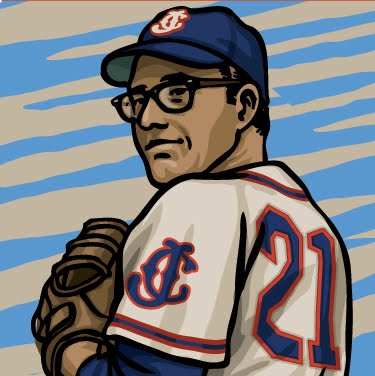
Finding a ball player like Babe Ruth would seem like a once in a lifetime chance, but for Jack Dunn, it happened twice.
Back in 1914, Jack Dunn, Baltimore Orioles owner and manager, had discovered a 19 year-old man-boy by the name of George Ruth. By the time spring training had ended the kid, nicknamed "Dunn's Baby" which was then shortened to just "Babe", became the core of what Dunn hoped would be a baseball dynasty. But it was not to be.
That year the Federal League came to Baltimore and set up a team right across the street from the Orioles ballpark. Since the Federal League was billed as the "Third Major League" Baltimore fans abandoned the minor league Orioles. Jack Dunn had to sell off all his stars just to stay afloat. Even after jettisoning Ruth, Ernie Shore and Ben Egan, the Orioles still had to leave town. After a season in Richmond, the Federal League collapsed and Dunn moved his team back to Baltimore and began rebuilding. One of his many trades yielded a mediocre pitcher named Jack Bentley.
Raised in an affluent Quaker farming family, Bentley went against his parent’s wishes and signed with the Washington Senators. Four years and an unremarkable 6-9 record later, Bentley was part of a three player package deal that sent him to Baltimore. No sooner had he arrived then Jack Bentley was off to France with the U.S. Army.
The former Major Leaguer spent 1918 fighting on the Western Front where his coolness under fire earned him two citations for bravery and a battlefield commission. By the time it was over he found that after the horrors of the Argonne Forrest, nothing on a baseball field could ever be as serious as combat. His new perspective paid dividends when he got back home in 1919.
Jack Dunn was putting the finishing touches on a team that would win an astounding seven consecutive pennants. With a solid pitching staff in place, something made Dunn stick Bentley at first base. It was the right move, because out of nowhere Bentley turned into a hitting machine.
From 1920 to 1922 his batting statistics were staggering. In 1921 Bentley put on the most impressive offensive performance in the history of the International League. His .412 average and his 246 hits are both still the single season league record, and his 24 home runs earned him the Triple Crown. But what is most remarkable about Jack Bentley’s Baltimore sojourn is that at the same time he was the International League’s leading hitter, he was also the league’s best pitcher!
That’s right, when Bentley wasn’t playing first he was the team’s spot starter and most effective reliever. During those same three summers he was tearing up the International League pitching, his own mound record was an unbelievable 41-6 - a winning percentage of .872! By the time he wrapped up the 1922 season Bentley was hailed as the “Second Coming of Babe Ruth” and it was obvious he belonged back in the majors. But Jack Dunn never got over having to let the first Babe Ruth go for a song back in 1914 and there was no way in hell he was going to let that happen again. He hung a price tag of $75,000 on his star and waited. Meanwhile, Bentley was stuck watching his window of opportunity get smaller as his 27th birthday came and went. Everything came to a head in the 1922 Little World Series. When was knocked out of the box in the third game Bentley turned prima donna and refused to stay in the game as first baseman. The next day the loyal O’s fans booed their star and Jack Dunn knew the time had come to let him go.
The New York Giants paid $72,500 for the “Second Babe Ruth”, then turned around and used him as a starting pitcher. Bentley was the first to admit he was more useful as an everyday bat, but John McGraw was convinced his left arm was the key to the pennant. Indeed Bentley went 29-13 as the Giants went to the World Series in ‘23 and ‘24. The high point of his big league career was his epic Game 7 battle with Walter Johnson in the 1924 Series. After 12 innings tied at 3-3, Bentley lost the game and Series on a misplayed grounder to the third baseman.
Unfortunately, within two years age caught up with “The Second Babe Ruth” and he retired to a life of a “gentleman farmer” on his family’s Maryland farm.
By
the morning of March 4th, 1945, the boys of G Company, 2nd Battalion,
11th Infantry Regiment, 5th Infantry Division had become hardened
veterans. Most had just arrived in Europe barely 3 months before and now
those same freshly minted young soldiers had checked the Germans at the
Battle of the Bulge, chased their asses back across the Rhine and were
now slugging their way into the Third Reich itself. The war was close to
being over with, the Allies gaining more momentum everyday and the
enemy knew it. If the Germans were only fighting the western powers they
most likely would have caved in already. However, on the other side of
Germany the Soviets were smashing towards Berlin and every day they held
out meant more Germans could make their way west to be captured or at
least get to an area occupied by the western Allies. No one wanted to be
around when the Russians came so the war ground on.
The
boys of G Company probably didn’t care much about the reason why the
Germans still fought them tooth and nail. Each man had had his life
interrupted and shipped half way around the globe to stop an evil that
was threatening to swallow the whole world. The boys of G Company had
left pretty young wives, anxious mothers, college classrooms or good
jobs and took up a Garand Rifle to do their part. Complaining about what
they were missing out on was pointless - the fella next to you had the
same story. Maybe even better than yours. Nah, complaining wouldn’t do
any good. Best thing was to keep marching forward and get this over
with. As they wearily crossed the makeshift bridge built over the Kyll
River they just cared about the fight they had ahead of them that
afternoon and the one after that and the one after that until these
Krauts threw in the towel.
If
any of the boys in G Company were still sleepy, chances are the mortar
fire that greeted them as the crossed the bridge woke them up. The enemy
they’d been chasing since Luxembourg had dug in around the town of
Erdorf. As the German lines collapsed and contracted the enemy became
more dense, more desperate. Besides regular infantry, G Company was
marching right into redeployed artillery and Panzer units. As they
pushed forward the resistance became stiffer and more determined. Each
gain was met with vicious counter-attacks and artillery barrages.
G
Company was deployed to sweep the fields around the village of Erdorf.
This was pleasant farm land of rolling little green hills and blooming
trees. To the boys of G Company, the area they were clearing of enemy
troops looked a lot like familiar places in the northeast and Midwest
United States. Perhaps more than a few were suddenly lost in thoughts of
an afternoon spent in surroundings much like this. The boys of G
Company thought back to little places they left behind called Sussex
County, Washington Courthouse, Mechanicsburg or Crescent Springs.
To the officers of G Company, this place was just called Hill 378.
The
company spread out and took a low hill like they had countless other
times in the last three months. All very textbook. Regrouping and moving
forward, they entered a wooded area where entrenched German troops and
the Panzer tanks were waiting. This obstacle, too, was eventually beaten
aside by G Company and just like every other hill and wood and field G
Company had cleared in the past three months, they left behind some of
their own. As the troops emerged on the other side of the wood and
continued eastward into Germany, one of the 32 boys they left behind
that afternoon was 22 year-old Private First Class Bill Niemeyer of
Crescent Springs, Kentucky. The life he had put on hold in order to beat
back the evil that darkened the world consisted of his young wife
Marie, infant daughters Deanna Gail and Mary Johanna and a promising
pitching career in the Chicago Cubs organization.
Even
though Bill Niemeyer never made it up to the Cubs, I wanted to depict
Bill in a Chicago uniform. Was he good enough to have eventually made it
to Wrigley Field? I don’t know. We will never know. The same as we will
never know what any of the other boys in G Company who died that
afternoon in Germany would have accomplished in their lives. The one
thing I do know is that is their sacrifices, all veteran’s sacrifices,
made it possible for me to have a good life in the greatest country in
the world. As I sit here writing this, I can see and hear my neighbors
enjoying this beautiful Memorial Day weekend. The shouts of the boys
next door, the couple across the street putting a pair of mountain bikes
in their SUV and the girl on the corner attempting to train her new
puppy on her green front lawn. In a few hours I will be going over to
see my fiancé who I love very much, and share a nice, lazy summer
evening. All that I see and hear right at this very moment was possible
because of men and women like Bill Niemeyer, a 22 year-old promising
ballplayer who once lived right down the street from where I sit right
now, the place he left to go off to war and never saw again.
Originally posted in 2012.
Many
thanks to Gary Bedingfield who is the foremost authority on baseball
and World war II. While looking around for a ballplayer to feature this
Memorial Day I of course consulted his amazing website www.baseballinwartime.com. Consulting a page he constructed showing the many professional ballplayers who died fighting for our country, Bill Niemeyer jumped
off the screen. He was born and raised right where I was sitting. I
might even pass his relatives at the market or live next door. The fact
that he came from this place made his sacrife a bit more personal for
me, especially as I sat there with a nice fresh cup of coffee by an open
window enjoying the beautiful Kentucky scenery he never saw again. The
place of his death was even more interesting as that part of Germany
looks very similar to what he had grown up in. I’m glad I found Bill’s
name on that website and I encourage every other baseball fan to take a
look at Gary Bedingfield’s monumental work. His site features in-depth
articles about hundreds (actually it might even be thousands of entries
by now!) of players who found themselves in the service during the war.
Gary is also an author of two indispensable books on the subject, "Baseball's Dead of World War II: A Roster Of Professional Players Who Died" and one of my personal favorites, "Baseball In World War II Europe (part of the Images of Sports series)."
Just as I did when I was a kid, the first thing I do upon entering a ballpark is to buy a scorecard. Not a program, nor a yearbook - a scorecard. Even if I choose not to score the game, I always write down the day's lineup, pitchers, the date, weather conditions and who went with me to the game. It's just a thing I've always done. To me, a scorecard is the one thing I can't live without when going to a ball game. Same with a hot dog. If I have enough left over after buying the scorecard, I'll slap my money down for a Cincinnati Brat, Dodger Dog, White Sox Italian Sausage, a Nathan's frank, etc., depending what ballpark I'm at. It's just what I've always done, just like my Pop and his Pop before him. Until recently it never dawned on me just how those two things became so synonimus with baseball. That's how I found out about a man whose name I've seen all my life but never gave a second thought to, Harry M. Stevens.
Never heard of him?
Well, no person in history has had a bigger impact on the way Americans experience a sporting event than Harry M. Stevens...
Columbus, Ohio Summer of 1887
Harry M. Stevens was tired. He'd spent the morning and afternoon lugging a leather suitcase door-to-door trying to get the residents of Columbus, Ohio excited about what he had to offer. No one, it seemed, was interested in a subscription set of the collected works of William Shakespeare. When the famous mid-west summer humidity got to be too much, Harry decided to take a break. Half the town, it seemed, was headed into the city's ballpark where the Columbus Senators were playing a game.
Stevens had not grown up playing baseball. He was born in England and moved his wife and son over to America when he was 27 years-old. Back in England he was something of a child-prodigy - not in music or academics - but as a street corner kid preacher. Harry was blessed with a set of booming pipes that could make the walls of Jericho crumble and he was charismatic well beyond his age. But, despite the promising beginning, so far he'd been unable to turn these abilities into a secure living. That's why he packed up his family and moved across the pond. He had family in Niles, Ohio and quickly secured himself a job in a steel mill. That gig quickly ended when the workers went on strike and owners shut the mill down. After a few dead-end jobs Harry took to the roads of the mid-west hawking volumes of The Bard. At the time subscription book series were very popular and salesmen like Harry went door-to-door offering books on every subject imaginable. Ulysses S. Grant's memoirs were a hot item as was the biography of the recently massacred General Custer. But Shakespeare, Harry realized while flipping through his empty order book, seemed to be a dud.
Now as he sat in the stands watching the Columbus Senators play ball, he found himself surrounded by opportunity.
Like everyone else entering the ballpark that afternoon, Harry had bought a scorecard. Inside the single sheet of folded card stock was a grid upon which a fan could use an intricate system of initials and symbols to record all the action that unfolded on the field. As Harry turned the simple piece of ephemera around in his hands he saw unlimited profit where no one else did. Using his people skills honed years before as the kid preacher, Harry offered the Senators owner the princely sum of $500 for the rights to supply scorecards to the ballpark. Columbus' owner figured he was not only getting an unexpected bonus check but also ridding himself of the extra job getting scorecards printed up and sold. Harry thought he'd just won the Irish Sweepstakes.
Withing days Harry had not only made back his $500 investment but turned a $200 profit without printing a single card. Harry's brilliant idea was to sell advertising space on the scorecards. It was a stroke of genius. Everyone who went to a ballgame bought a scorecard. It was a perfect captured audience and that's the way Harry sold the idea to Columbus' shop and business owners. When the scorecards were printed up and ready to sell, Harry reached back to his street corner days and pulled out all his showman talents. Dressed in a bright red suit complete with a silk top hat he held his scorecards high and called out the now famous slogan: "You can't tell they players without a scorecard!"
Withing a few years Harry expanded his scorecard operation beyond Columbus into Toledo and Wheeling, West Virginia. Then he went big league into Pittsburgh, Boston and Washington, D.C. In 1893 he became partners with Ed Barrow, a Pittsburgh hotel manager and baseball fan. The partnership did not last long as Barrow wanted to pursue a career in baseball management. The two men remained strong friends and it was Harry who supplied the financing when his friend bought the Paterson Silk Stockings team in 1894. While owner of the team Barrow discovered an awkward infielder from the coal mines of Pennsylvania named Honus Wagner. Barrow went on to run a succession of successful ballclubs and his relationship with Harry would come to full fruition when he later became general manager of the New York Yankees.
Always wanting to be part of the action, Harry was right there in the ballparks with his employees selling his ubiquious scorecards, always on the make for more opportunities. His next area of expansion was culinary. Most ballparks had independent vendors that sold items like peanuts and lemonade. There was no fixed percentage that was kicked back to the ballclub and the quality of the items sold varied. Harry changed all that. His approach was to not only handle the scorecard responsibilities but to also bring all the food concessions under one responsible and professional umbrella. Teams were paid a fixed percentage for the rights to sell in the ballpark and in turn the fans could expect reasonably priced fare of a consistent quality. Harry's vendor stands not only offered peanuts and lemonade but soda water, ice cream and chocolate. When he saw the clouds of tobacco smoke wafting above the field he saw opportunity and added cigar and cigarettes to his repertoire of tempting offerings. When the game began attracting women and young children he branched out by selling small souvenirs that these new fans could purchase as a memento of their day at the park.
By the 1893 Harry's work made a day at the ballpark quite enjoyable and people noticed. Although baseball was the game of the land, it was only played in the warm months. To fill the gaps Harry introduced his concession ideas to boxing, bicycle racing and horse tracks - anything that attracted a crowd.
For a recent immigrant, Harry was doing very well for himself and his growing family. Many men would have been quite happy to sit back and enjoy the fruits of his hard work, but not Harry. Boston, Washington and Pittsburgh were swell, but there was one place that so far eluded the Harry M. Stevens empire: New York City. That changed one day in 1894 when the New York Giants came to Pittsburgh for a series. "Scorecard Harry's" mug was by now familiar to the ballplayers and the affable Brit had befriended many of the game's top stars. The Giants manager John Montgomery Ward was one of his high profile pals and it was he who convinced Harry that his talents were sorely needed in New York.
As it is today, New York City at the time was the gleaming beacon of opportunity. With two major league and a dozen minor league teams plus countless other sporting venues all within a 60 mile radius, New York City was epicenter of American sport. Harry moved his base of operations to Manhattan and immediately secured the scorecard and food concessions for New York Giants and Brooklyn Trolley Dodgers. Then he secured the year-round contract for all the events held at Madison Square Garden and the other indoor sporting venues. Like a web, Harry's empire spread forth. Don't be mistaken, Harry wasn't getting these lucrative contracts because of a silver tongue presentation or well-placed bribes - he was offering a quality service that was greatly appreciated by the fans. The smart owners realized that a good experience at a game brought a fan back again and again. And those owners also knew that with Harry they were dealing with a man of strong character, a fair professional. For instance, in 1901 millionaire William Collins Whitney bought the Saratoga Race Course. The venue had long been neglected and Whitney wanted to remake the area into the country's premier horse racing attraction. When his horse Volodyowski won the English Derby, Whitney held court in the track's clubhouse. In celebration, the proud owner ordered champagne for everyone in the club. When it came time to present Whitney with the bill, the track's concessionaire took the opportunity to charge full market price for the expensive bubbly. A smart businessman would have given a thoughtful discount on the huge order, keeping this important client happy, thus likely to repeat the expensive gesture. But this concessionaire was not of the smart mindset. His big paycheck turned out to be his last - Whitney called in Harry M. Stevens to come take over the lucrative Saratoga concessions.
And so it went all over the country. But again, while lesser men would have rested, Harry trudged forward, searching for opportunity. One day while working an event at Madison Square Garden he realized that in order to take a swig from a bottle, a fan had to take his eyes off the action for an instant - and the modern drinking straw was born. When he witnessed one fan too many become frustrated because he missed a great play because he left his seat to buy a snack, Harry dispatched his vendors into the stands to bring the food to them. As a true sports fan, Harry was able to recognize the different needs that fans of each sport desired. Boxing meant cigars and mineral water. Baseball was peanuts. Horse racing aficionados required a menu of heavy food. And while he provided tried and true staples, Harry was able to adapt when necessity and opportunity presented itself. This led to the invention of the one thing that is now indelibly intertwined with our National Pastime.
It was a cold day at the Polo Grounds, sometime in April of 1901. The crowd was bundled up trying to concentrate on the game. For several innings Harry watched as his vendors returned with their unsold consignments of lemonade and chocolates. No one wanted something that was cool and refreshing in this weather. As a sports fan, Harry thought about what he would want to eat if it was he who was sitting in the bleachers. He turned to one group of vendors and dispatched them to buy all the sausages they could find. He deployed a second group to purchase rolls and French bread. When they returned Harry had his men boil the sausages and put them into the rolls - a perfect hot sandwich that was easy to hold and eat. With his old street preacher flair he dispatched his men back into the stands and instructed them to call out "Get your red hots! Get 'em while they're hot!" And just like that an American culinary classic was born.
Granted, some food historians disagree that Harry was the first person to put a sausage and roll together, however he is the man who found the perfect venue for its consumption. And baseball being the most popular spectator event in the nation ensured that the hotdog's fame would quickly spread by word of mouth. The naming of the snack is a whole other story. The most popular one is that Harry named it a "Dachshund Sandwich" after the dog it resembles. Somehow it was shortened to "hot dog", some say because a cartoonist couldn't spell "dachshund", though the cartoon in question has never been found as far as I know. And as popular as the treat was with cold, hungry sportsmen it took a bit of reassuring before it became a staple outside the ballpark - many people took the name literally and believed it was made from real dog meat!
Harry soon moved into opulent Manhattan hotel suites and circulated in the city's top sporting circles. As one of the most respected sportsmen in the nation, Harry became a trusted confidant to the athletes. Babe Ruth himself called Harry "his second Dad". Turns out that early in the Babe's Yankee career Harry convinced the slugger to invest a portion of his savings for the future. While many of his contemporaries found themselves struggling financially once their careers ended, the Babe led a life of luxury due to his wise investments. Sportswriters, too, flocked to the ebullient Brit who liked to quote Shakespeare at he drop of a hat. In the era before team owners got smart and provided a press club stocked with free food and booze, it was Harry's office that offered the scribes a much welcomed snack and drink after the game.
In his private time Harry was a well-read man, specializing in his beloved Shakespeare whose works he was unable to sell back in the 1880's. Contemporary newspapers remarked on being well-versed in English literature and a keen amateur historian. He was also a very generous man for whenever baseball moguls were reported to have made donations to various charities, "Harry M. Stevens" was always listed along side the more familiar names. When his children came of age he brought them into the family business, learning the ropes from the bottom up.
After a few nasty bouts of pneumonia, Harry passed away in May of 1934, aged 78. More than 500 people turned out for his funeral service including Babe Ruth, Yankee skipper Joe McCarthy, Giants owner Charles Stoneham, National League President John Heydler and many other luminaries of the sporting world. By that time his sons had taken over running his company. In his absence the family took The Harry M. Stevens Company to new heights. Besides expanding the reach of his food, souvenirs and scorecard empire, the company operated fancier dining options, pioneering what today we call Stadium Clubs. When the Giants moved west in 1958, they brought Harry M. Stevens with them to handle their concessions. No sports victory was complete without the Harry M. Stevens people setting up a spread in the locker room. When I was going to Shea Stadium in the 1970's and 80's, the Harry M. Stevens people were selling more than 40,000 hotdogs at each and every Mets game. Every scorecard, beer cup and souvenir pennant bore the name of the man who embodied The American Dream. Remember that Saratoga contract inked back in 1901? It was renewed every season until 1994 when the company was finally swallowed up by the giant international conglomerate, Aramark.

Those
who have met me in person know I'm not the kind of guy to toot my own
horn. In fact, much to my detriment, I'm lousy about promoting myself.
That's why it's hard for me to ask this, but this is something that
needs to be done: if you bought a copy of The League of Outsider
Baseball, can you please take the time to write a review of it on Amazon, Barnes and Noble or Good Reads?
It would mean a lot to me and most importantly give future publishers
an idea of what the book reading public thinks of my work. Almost all of
the existing reader's reviews have been flattering, but every once in a
while some crackpot writes a clunker out of jealousy or boredom. I for
one often look at the reviews on those sites before I spend my money on a
book. Reviews aren't the only thing I rely on in my purchasing process
but it's certainly a factor, and that's why I'm asking you to please
take the time to write your thoughts about my work.