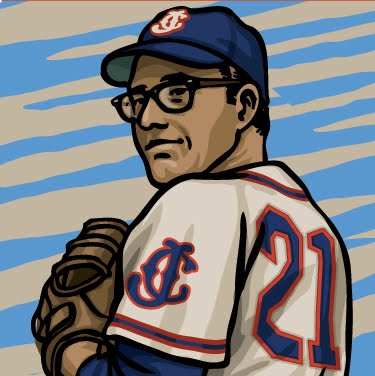
I've been on a bit of a break lately - well, not really a break. You see, I kind of got bogged down with some research-heavy stories and I keep getting sucked further and further into them. I don't want to spoil anything, but one is a big Joe DiMaggio story about a period in his career that no one has really written about in any depth before. I want to do as thorough a job as I can, and that means exhausting all possible leads, and in this case it actually involves a cross-country to the west coast to explore an untapped archive. This story is so involved, with all kinds of sidebars, so I'll probably make it the cover story of the next issue of '21' (you should SEE the illustration I did for it - it's one of my best so far!). I'm also traveling for business, and although I brought two giant folders of other research with me, I haven't finished anything yet.
Usually the hard part is finding time to do the drawings, but in this case I have at least 10 new drawings ready to go, just waiting for a story to go with it. In the meantime, I thought I'd toss out an oldie but a goodie. I'm currently writing for a major auction house and I've had some pretty major Jackie Robinson memorabilia cross my desk this week. So, in honor of the man himself, I re-give you Jackie Robinson and the very beginning of his pro baseball career...
In
the summer of 1944 2nd Lieutenant Jack Robinson found himself at Camp
Breckinridge, an infantry replacement training depot in the hills of
western Kentucky. The war had been rough for Robinson - not on the
battlefields of France or a nameless island in the Pacific, but at home
in a racial war whose injuries were not physical but mental.
Before
the war Jackie Robinson was a well-known collegiate athlete. His
exploits as a track star at UCLA set numerous records and his skills on
the gridiron made the sports page from coast to coast. If he had been
white, Jackie Robinson would have had to fight off offers from National
Football League teams upon graduation. Instead Robinson took a position
with a government-run athletic program which quickly folded. Looking for
employment, Robinson took the most lucrative sports job he could find -
semi-pro football in Hawaii. After a successful 1941 season, Robinson
booked passage on a steamship back to Los Angeles. On Sunday, December
7th, 1941 he was contemplating his next move when the Japanese decided
it for him.
The
23 year-old Robinson received his draft notice in early 1942. After
basic training with a cavalry regiment he and several other black
soldiers requested a transfer to officer's candidate school. Robinson's
natural leadership qualities and UCLA education made him ideal officer
material but his skin color worked against him. His transfer was put on
the back-burner until boxer Joe Lewis stepped in to help open the gate
allowing black soldiers to attend officer's school. By January 1943 the
former college star was 2nd Lieutenant Jack Robinson,U.S. Army.
Robinson
was assigned to the 761st Tank Battalion at Ft. Hood Texas. Known as
the "Black Panthers", the 761st would go on to earn a distinguished
combat record serving under General Patton in Europe. For two reasons
Lt. Robinson wasn't one of them.
Years
of strenuous athletic activity had left Robinson with an old ankle
injury that required testing to guarantee he was combat-ready. On
afternoon while awaiting the results of the test, Robinson boarded an
integrated Army bus and took a seat near the front. When the driver told
Robinson to sit in the back he flatly refused. The driver reported the
incident to the Military Police who took the insolent lieutenant in
custody. The commander of the 761st flatly refused to prosecute his
young officer but the matter was taken out of his hands when Robinson
was transferred to another battalion. His new commanding officer happily
signed off on court-martial proceedings before the ink was dry on his
transfer papers.
After
a humiliating trial in which he was acquitted of all charges, Robinson
found himself a soldier without an army. His unit had deployed to Europe
during his court martial and medical tests found his ankle was tender
enough to keep him out of combat. The trial had made news and his
superiors at Ft. Hood didn't want him around so he was transferred to
another black unit, the 372nd Infantry Regiment.
The
372nd had a brilliant battle record from the first world war. The units
shoulder patch was a red hand on a white disk trimmed in blue and red.
This striking insignia was bestowed on the regiment by the French Army
of Africa with which the unit had fought with in 1918. By the time Lt.
Robinson caught up with the regiment at Camp Breckinridge, Kentucky it
was being used as a feeder unit that trained replacement infantry
troops. As a distinguished college athlete, Robinson was named the
regiment's athletic director.
It
was only a temporary assignment. Robinson's fight against the bogus
court marshal gained him a reputation as a hard case, and with a bum
ankle he wasn't any good for combat. The army decided to discharge him.
In the meantime, Robinson waited for the slow moving paperwork to wind
its way through Army bureaucracy by keeping the recruits occupied with
baseball.
One
afternoon Robinson happened upon a soldier throwing big league curve
balls on the baseball field. The soldier was Ted Alexander, a former
pitcher with the Kansas City Monarchs of the Negro American League.
Robinson had had a brush with Negro League baseball back before the war
when a traveling blackball team had played a pickup team which Robinson
was a part of. When the game ended the team took off without giving
Robinson his agreed upon money for the exhibition. The whole experience
left Robinson with a bad taste in his mouth and a lingering distrust of
black baseball operations. When Robinson told Alexander
of his concerns about post-army employment, the pitcher revealed the
the Monarchs were always hiring good talent. The war had hit black
baseball as hard as the white version with many of its good players in
the service. However with many blacks now employed in high paying war
industry jobs, blackball was the most popular diversion for their
new-found disposable income. The Negro Leagues were experiencing their
most profitable period in their history.
The former Monarchs pitcher surely related all this to Robinson and before the two men parted ways Alexander
had given the Lieutenant Kansas City Monarchs' owner Tom Baird's
contact information. When he received his honorable discharge in
November of 1944, Robinson wrote to the Monarchs inquiring about a
position. In the meantime he took a job as athletic director at Sam
Huston College in Austin, Texas. When spring rolled around the Monarchs
sent Robinson a $400 a month contract and instructed him to report for
spring training.
Jackie Robinson's baseball career had begun.
If you're anything like me, you probably think that cap Jackie is wearing is pretty darn cool, right? Will Arlt at the Ideal Cap Co. thought the same thing, too, and decided to reproduce these little babies. You can check them out HERE.


Whether you think his movies are hysterical (like I do) or dopey (then I pity you), one thing's for sure: you know who Jerry Lewis was. I saw "was", because the comedian passed away this week at the age of 91. Very few performers could boast a career arc as broad as Lewis' seven decades of work. From nightclubs to radio to movies, as part of a comedy team and as a solo act, the name Jerry Lewis is synonymous with American comedy. For over 40 years his Labor Day fundraisers for the Muscular Dystrophy Association helped raise millions of dollars for a disease that was unknown and unpronounceable before he brought attention to it. Millions, maybe billions, of people found comfort in the laughter he created over the years. Even actors and comedians who take cheap shots at his being perceived by the French as a "genius" all owe at least a small amount of credit for their careers to this comedic trailblazer. One can go on for eternity cataloging Jerry Lewis' life in show business, but that's not what this story is going to be about. This post will reveal a little-known side of this giant of American comedy, for beyond the movies and fame, Jerry Lewis was a baseball fan.
Jerome (some say it was Joseph) Levitch was born in Newark, New Jersey in 1926. At a young age Lewis was exposed to the entertainment business - his father was a vaudevillian and his mother was a professional piano player. Much of Jerry's early life was spent being passed off to relatives and family friends while his parents traveled the vaudeville circuit. This transient lifestyle made the only child feel rootless and vulnerable much of the time. It's not recorded where Jerry Lewis first got his appreciation for baseball, but it is not out of line to opine that the lonely boy found solace in being able to follow one team through newspaper box scores and radio, no matter where he was temporarily living.
When they were able to, the Lewis' took their son with them when they had a lengthy engagement at a club in the Catskills or Jersey shore. As early as age 5, Lewis began appearing on stage with his parents. One of his earliest original comedy bit was to exaggerating lip-sync to a phonograph record - a routine Andy Kaufman appropriated and make his own some forty years later. Lewis knew he was destined for a life in showbiz, and dropped out of high school when he was 15 to pursue his dream. During World War II Lewis was rejected for military service due to a heart murmur, and he spent the war years honing his comedy chops working Manhattan's nightclub circuit. At the Glass Hat Club in 1945, Lewis shared the bill with a slick looking Bing Crosby sound-alike named Dean Martin. The two hit it off and quickly formed a comedy team, Martin and Lewis. With Dean as the suave straight man and Lewis as the zany sidekick, the unscripted act was unlike any other that came before. By 1947 they had reached the pinnacle of New York nightclub acts when they headlined the Copacabana. The following year the duo appeared on Ed Sullivan's "Toast of the Town" TV show. The Sullivan appearance combined with their own NBC radio show quickly made Martin and Lewis the country's most popular comedy act.
Because of their celebrity, the two comedians were soon making the acquaintance of all categories of celebrity. While Dean gravitated towards the Sinatra crowd, Jerry palled around with ballplayers. One of the first big names Lewis formed friendships with was New York Giants manager Leo Durocher. Leo was a fixture of Manhattan's swankier nightclubs and its only natural that he would have caught Martin and Lewis' act on numerous occasions. Durocher piloted the Giants to the pennant in 1951 and after the World Series returned to his home in Los Angeles. In late October the Giants manager and his opponent in the World Series, Casey Stengel, were asked to manage teams in a charity ballgame. It was only natural that Leo reached out to his pal Jerry Lewis who was in Hollywood with Dean at the time. The comedy duo appeared in the late innings of the game, sharing the field with All-Stars such Warren Spahn, Mike Garcia, Bob Lemon and Hank Sauer.
By this time, Martin and Lewis had transitioned their nightclub and radio
act into a full-blown comedy movie franchise. In the years since their
first movie in 1949, Martin and Lewis had made over 12 films before
1954.
Lewis' baseball connection to Durocher and his Giants continued through the years. Both Martin and Lewis appeared at the Giants spring training camp in Phoenix in 1954 where the two each managed their own team in an inter squad game. Martin, wearing uniform number "00" played third base while his partner donned a jersey with "?" on the back and played first base for his team. Martin managed a triple when the Lewis' outfielders unwisely played him too shallow. Lewis had a single to his credit and his Giants beat his partner 5-3 before 5,000 fans at Phoenix' Municipal Stadium.
Just after their Giants game, both men's love of the game led to the team optioning an original screenplay for a musical called "Safe at Home". The story revolved around two New York Giants players who desert the team to play ball in Mexico. The two get mixed up with a crooked bullfighter and, you guessed it, hilarity ensues. There was even talk of who would play Durocher in the picture (considering Leo's later penchant of TV and movie cameos, it's only natural go imagine the Giants manager playing himself). Unfortunately for both cinephiles and baseball fans, "Safe at Home" was never produced.
Lewis and his wife Patti lived in Pacific Palisades, a neighborhood on LA's westside. The Lewis family consisted of two boys, Gary and Ronnie, and father passed his love of baseball down to his sons. To encourage the boys, Lewis purchased the vacant lot next to the family's home and constructed their own private ball field. Lewis also added his star power and sponsorship to a local kids ball club named the "Jerry Lewis Stars".
In the spring of 1956, Martin and Lewis again combined their love of baseball with their comedy when the two appeared in a charity game at LA's Wrigley Field. The game pitted a team of major leaguers against a squad of PCL League stars. This time Lewis and Martin appeared on the same team, Lewis at first and Martin at third. The duo acquitted themselves well, with newspaper accounts complimenting their teamwork in the infield and Lewis' errorless play at first. Lewis went 0 for 4, but Martin got himself a single in four at bats.
 Exactly ten years to the day of their debut performance in 1946, Martin and Lewis split up. Dean went on to be a leading man in more serious movies like "Rio Bravo" and "Some Came Running", and teaming up with Frank Sinatra and Sammy Davis, Jr. as the core of the uber-cool "Rat Pack". Jerry forged ahead as a solo act, establishing himself as more than just a sidekick to Dean Martin. Besides his Vegas act, Lewis branched out and recorded a successful album of standards for Capitol Records that shot to number 3 on the charts. A succession of hit movies followed, making Jerry Lewis one of the most bankable performers in the country.
When the Brooklyn Dodgers relocated to Los Angeles in 1958, Jerry Lewis was reported to be one of the first season ticket holders. With a real big league team in the city, Lewis quickly befriended many of the Dodgers players, Gil Hodges in particular. Hodges was one of the teams most popular players and a perennial All-Star. Hodges was also, like Lewis, a first baseman.
Exactly ten years to the day of their debut performance in 1946, Martin and Lewis split up. Dean went on to be a leading man in more serious movies like "Rio Bravo" and "Some Came Running", and teaming up with Frank Sinatra and Sammy Davis, Jr. as the core of the uber-cool "Rat Pack". Jerry forged ahead as a solo act, establishing himself as more than just a sidekick to Dean Martin. Besides his Vegas act, Lewis branched out and recorded a successful album of standards for Capitol Records that shot to number 3 on the charts. A succession of hit movies followed, making Jerry Lewis one of the most bankable performers in the country.
When the Brooklyn Dodgers relocated to Los Angeles in 1958, Jerry Lewis was reported to be one of the first season ticket holders. With a real big league team in the city, Lewis quickly befriended many of the Dodgers players, Gil Hodges in particular. Hodges was one of the teams most popular players and a perennial All-Star. Hodges was also, like Lewis, a first baseman.
In 1959 Lewis was back again at LA's Wrigley Field for a charity game. This time Lewis was playing for the Los Angeles Dodgers as they faced a Major League All-Star team piloted by Gene Mauch. Wearing number "55", Lewis took the field alongside Dodgers stars Sandy Koufax, Don Drysdale, Johnny Roseboro and Charley Neal. Roseboro's two home runs powered the Dodgers over Mauch's All-Stars, 9-7. Lewis went 0 for 4 against the big league pitching and was credited with three errors of a comedic nature.
Ever since the movie industry moved from New York and New Jersey to Southern California in the 1920's, both studios and prominent actors formed baseball teams. Fatty Arbuckle, one of Hollywood's earliest and popular comedic actors, even owned the Vernon Tigers of the Pacific Coast League. Tom Mix had a team and Paramount hired Black Sox outcast Fred McMullin as a ringer for their team. Later in the 1940's, Frank Sinatra formed his own team called the Swooners who's rotating roster boasted everyone from Nat King Cole to Robert Wagner and Anthony Quinn. With Jerry Lewis' baseball interest it was only natural that he would do the same, and the "Jerry Lewis Clowns" were formed.
By the early 1960's these celebrity pickup teams had evolved into the Hollywood Entertainment League. Besides the Clowns there was "Garner Gems" led by James Garner, singer Bobby Darin's "Darin's Demons", and Pat Boone's "Boones". Even Lewis' old partner had his own team, "Dean Martin's Dino's". Lewis outfitted his Clowns with home white flannels supplied by Rawlings with "Clowns" in red script across the front. The left sleeve sported a large caricature portrait of Lewis which would become his trademark. Red stirrups with white stripes and a red cap with a white "JL" monogram topped off the uniform.
Besides owning his own team and appearing as a ringer at first base for the Dodgers, Lewis' baseball interest was acknowledged by the game's writers when he was tapped to be the master of ceremonies for the Baseball Writers Awards in January, 1966. The gig was especially personal to Lewis as the event would also honor his beloved Dodgers, that years' World Series champions.
With the advent of television and the popularity of football and basketball, baseball's popularity began a steady decline throughout the 1960's. The Hollywood Entertainers League folded by the end of the decade, yet the game still held some popularity among the stars. The Dodgers and Angels hosted "Hollywood Stars" benefit games fairly regularly, and Lewis would suit up with fellow baseball fans like James Garner, Mickey Rooney, Ricky Nelson and Walter Matthau.
Perhaps the pinnacle of Jerry Lewis' baseball career came on July 19, 1973. The Houston Astros were hosting a rare in-season exhibition game against the Detroit Tigers. Lewis' old pal, Leo Durocher, was now skipper of the Astros, and he had a great time writing "Jerry Lewis" batting lead off and playing first base in his line up card. Lewis wore number "9" and hit a single off Detroit's Mike Strahler. Later the Tigers sent their pitching coach, Art Fowler, to the mound, off whom Lewis drew a walk. Tigers first baseman Norm Cash acknowledged that the comedian looked pretty good in his 4 innings of work, noting that he played errorless ball and didn't drop a single throw.
Jerry Lewis' last big brush with baseball came at the tail end of his long career. Having conquered nightclubs, radio, TV, and film, only Broadway remained unchecked on his list of successes. That changed when he took over the roll of the Devil in the revival of "Damn Yankees". For those of you who don't know the play, the story is about a long-suffering Washington Senators fan who sells his soul to the Devil to become a star baseball player and finally defeat the Yankees. Lewis drew great reviews, then began a semi-retirement with select guest spots in movies and TV shows.
Jerry Lewis passed away on August 20, 2017 after a long illness. I had wanted to do a card and story on him ever since I found a photo of his Clowns baseball team several years ago. When I was writing my book, The League of Outsider Baseball, I had Jerry penciled in for the "People's Game" chapter which had stories and illustrations of people who you wouldn't think were baseball fans or players. But, unfortunately, Jerry got cut during the outline phase. His baseball interest was a little more dynamic than most, and I wanted more than a page or two in order to give his story a proper telling. Unfortunately, it wasn't until he passed away last week that I revived my story and pulled together all the newspaper clippings I had accumulated and sat down to write. For all the joy his movies gave me ever since I was a kid, and all the good he did with his Muscular Dystrophy telethons, I hope he'd get a kick out of his very own baseball card.
When
I first started this blog back in 2010, I started
receiving many requests for players to be profiled and given The
Infinite Baseball Card Set "treatment." Out of all the emails, I began
to notice that it was not one particular player that was asked for the
most, but rather an ethnic group: Jewish ballplayers. Early on I had illustrated cards
and written stories on the site of Sandy Koufax and Moe Berg, but I began slowly researching different players who shared the Jewish faith,
trying to find characters who would fit in with the kind of stories I
like to write - players with interesting stories who may not be known to
the casual fan of baseball history. The modest research I did culminated in the Test Issue of "21: The Illustrated Journal of Outsider Baseball" which featured 12 profiles of Jewish ballplayers. This prototype became the model in which I based the current incarnation of "21".
I was never happy with that original product, and eventually I plan to do a more elaborate "21" dedicated to Jewish ballplayers. In the years since the original, I have been steadily adding to my Jewish ballplayers file, one the characters in there being Cy Malis.
Cy's single game for the 1934 Phillies earned him place in all the books on Jewish ballplayers, but it is the rest of his story that makes him so much more interesting. Plus, digging into Cy's career was for me a researchers delight, as I found that the extent of his pro career that can be found in record books and online is quite incomplete. Old box scores and creative searching enabled me to fill out Cy's minor league career quite a bit more than any other source that I've been able to find. And then, from an artistic point of view, the uniforms worn by one of Cy's semi-pro teams were so visually stunning that I couldn't wait to depict Cy in full color.
So, with that teaser, I'll get right into Cy's story...
Cy Malis was born in Philadelphia, the second son of Frank and Anna (called "Ray") Malis. Both Frank's parents were from Russia while Ray's father immigrated from Jerusalem and her mother from Russia. Frank worked an an inspector for the Philadelphia Rapid Transit Company and Ray kept house in the family's apartment on 10th Street. Ray and Frank were married around 1905 and their son Charles was born shortly afterward. The Malis' second son, Cyrus came along on February 26, 1907. Both boys played baseball, working their way up the sandlot ranks. Charles was an infielder while Cyrus - who was now going by "Cy" - was, appropriately enough, a pitcher. While Charles played for Central High, Cy starred for Brown Prep School, lettering in basketball and football as well as baseball. In his sophomore season with Brown, Cy posted a 15-4 record and struck out 22 in a game against Villanova Prep. It appears that Cy left school after his second year, joining the vibrant semi-pro baseball circuit around Philadelphia.
Like other large eastern cities, Philly boasted many top-rank semi-pro clubs. Youngsters began playing for their local neighborhood athletic clubs, then, if they were good enough, were either hired by a large company who sponsored a team or was invited to join one of the semi-pro traveling clubs who were just a step below the minor leagues.
Cy Malis' first stop was with the Waco Athletic Club. His brother Charles may have preceded him on the team, for both their names frequently appear in box scores at this time. Waco played other medium-level teams in Philadelphia and South Jersey. Then, in mid-August, Cy began pitching for the formidable Hebrews club.
The Hebrews, also known as the Sphas (South Philadelphia Hebrew Association), were one of the better semi-pro clubs in the Philly-Trenton area. The South Philadelphia Hebrew Association began sponsoring athletic teams around World War I, and by the early 1920's had become known not only for baseball, but for their basketball team as well. In fact, the basketball team actually turned pro, first joining the Eastern League in 1929, then the American Basketball League in 1933. When the NBA was formed after World War II, the Sphas best players splintered off to form the nucleus of the Philadelphia Warriors.
With the baseball Sphas, Cy not only had a first rate ball club backing him up, but he also had good press coverage with would help further his career. His competition was also of a higher class, playing against the various traveling teams that criss-crossed the country before World War II, such as Jim Thorpe's Indians and various Negro League clubs.
Cy's half season with the Sphas earned him an invitation to spring training with the minor league Wilkes-Barre Barons in 1925. The April 24 edition of the Scranton Republican said the Malis "has shown plenty of form in the preliminary workouts", but just two days later he was back in Philly pitching for the Waco A..A. and later the Sphas again. Still only a teenager, Cy had plenty of time to develop into professional material.
Malis' second chance at organized ball came along the following spring when he was signed by Petersburg Broncos of the Virginia League. In his professional debut on April 14, 1927, Malis was sent in to relieve Petersburg starter Lefty Fowlkes, pitching an inning and third, allowing a hit and two walks plus a balk. Richmond scored a run, but it was charged as an error since the outfielder dropped the ball. Soon both Cy and Lefty Fowlkes were shipped to the Northampton Red Sox of the Eastern Shore League. Malis started off the season well, winning five consecutive games, but overuse took a toll on his arm. When Cy asked management for some time off to rest his tired flinger, the Red Sox handed their ace pitcher his release. 1920's baseball was a cruel and impersonal sport, and back then a pitcher, especially a young one, was expected to pitch a complete game every time he took the mound. With minor league rosters consisting of only 15-18 players, clubs couldn't afford to carry too many pitchers, so the ones they had were used as often as possible. When Cy raised an issue about over use, it was only natural that the club would choose to jettison their ace instead of working with him, the reason probably being that if his arm is feeling fatigue now at this low level, how could he make it all the way to the majors? Minor league teams back then made their payroll by selling off their good players to higher level clubs - thus, a sore arm pitcher was of no monetary value to them. Sound front office reasoning in 1927. Fortunately for Cy, one other team in the league, the Cambridge Canners, were willing to take a chance with him. Working out of the bullpen, he finished out 1927 with a 5-6 record.
Despite a mediocre record, a team quite a bit higher up the food chain than the Cambridge Canners became interested in Cy - his hometown Philadelphia Phillies.
Like
most big league teams, the Phillies were always on the look out for
home grown talent, a native son that could blossom into a star that
would in turn put more fans in the stands. As the Phils were perennially mired in last place, it would take something or someone interesting to get fans to shell out the money to watch a lousy team. With his well publicized
mound exploits with Brown Prep and the Sphas, Cy Malis was a perfect candidate to be that someone interesting. The
Phils signed him for 1928 and shipped him off to their Lynn Papooses farm team in the New England League. From the skeleton of statistics it looks like control was Cy's biggest obstacle - for instance in the June 1, 1928 game against Salem, Cy pitched the first 3 2/3 innings, giving up 4 bases on balls and a hit batter, taking the loss. On June 12 Cy lasted 5 1/3 inning against Brockton, issuing five free passes and 12 hits for another loss. By mid-June his record was no wins and four losses in 12 innings pitched. The Papooses released him, and Cy went back to the Philly semi-pro circuit.
Every source I found on Cy Malis has no professional record for him in 1929, but I dug up some newspaper articles that say otherwise. A small article written about Cy a year after his death in 1971 states that he had played in the Philadelphia A's farm system. I thought that perhaps this was a misprint, mistaking the Philadelphia Phillies for the Philadelphia A's. Or, I thought it might have been Cy or a relative of his doing a little creative remembering, switching out the last place Phillies for the 1929 World Champion A's. Much to my relief (I don't relish debunking little white myths held dearly by old ball players and their descendents), the article actually held up to my research.
Seems that Cy had attracted the eye of his hometown's other big league team, Connie Mack's Philadelphia Athletics. The A's were right at the beginning of what would be an incredible three pennants and two World Championships, a team thought to be the greatest ever assembled in Major League history. The A's signed Cy to a minor league contract, sending him to their Martinsville White Elephants team in the Blue Ridge League. I found several box scores that record his record with Martinsville. On April 25, 1929, Cy pitched 4 innings, giving up 6 hits, 2 walks and striking out 2 against Hagerstown. On May 11 he gave up 5 hits in 5 1/3 innings of relief, walking no one and picking up the win over Chambersburg. Cy pitched one more game before he was released, his final 1929 record set at 13 hits, 6 runs, 13 walks, 3 strike outs and a wild pitch in 16 innings.
Once again Cy returned to the Philadelphia scene where he was now a much sought after arm for hire. Besides his regular gig with the mighty Sphas, box scores show Cy appearing for several other teams in the area. The Jersey Shore was a particularly lucrative spot for semi-pro ball, as all the beach communities competed against one another to field the best ball team. Not content to hire just a few ringers to supplement their team, some town hired complete semi-pro outfits to represent them. Cy was with the Trenton Club when they were rented out to represent the town of Bradley Beach.
In 1933 Cy was hired by the Berlin, Maryland team to help them beat rival Dagsboro in the five-game Eastern Shore Championship Series. Malis pitched Game 2, shutting out Dagsboro on six hits. The "Quaker City speedball artist" was tabbed to pitch the deciding Game 5, but served up three home runs early on which gave Dagsboro the game and championship.
In 1934 he was back with the Sphas. On July 29, Malis pitched and won a 14 inning marathon at Paterson, N.J., then came back to Philly where the next night he pitched a one-hitter for the Bartram club. Cy's continued good press inevitably was noticed by the moribund Phillies. For the second time, Philadelphia signed Cy Malis to a contract, but where as back in 1927 he was farmed out to the sticks, this time he was issued a uniform with number 49 on the back and sent to join the big club.
On Friday, August 17, 1934 Cy Malis made his major league debut against the Cardinals at Sportsman's Park in St. Louis. The Gas House Gang Cardinals were on their way to a World Championship with a line up that featured future Hall of Famers Joe Medwick, Frankie Frisch, Pepper Martin and sluggers Ernie Orsatti and Ripper Collins. Their mound corps was led by the Dean Brothers, Dizzy and Paul, who would collectively win 49 games that summer. In the bottom of the 5th, the Cards were up 7-2 with Phillies reliever Reggie Grabowski on the mound. Burgess Whitehead led off with a single and with one out, advanced to second when Frankie Frisch got a base on balls. Joe Medwick smashed a long single to center, scoring Whitehead and moving Frisch to third. Medwick then stole second, sending Grabowski to the showers.
Phillies manager Jimmy Wilson waved Cy Malis in from the bullpen. With men on second and third, Malis faced Ripper Collins who quickly hit a double to riht field, scoring Frisch and Medwick. Cy got Bill Delancey to fly out to center field but then lost Chick Fullis to a base on balls. Now with two on and two away, Leo Durocher stepped in and hit a flyball to right which was caught to end the inning. Wilson left Malis in to pitch the 6th, during which he gave up a single to lead off hitter Paul Dean, then got two quick pop outs. Frankie Frisch reached base on an error but Malis got Medwick to fly out to left, ending the 6th. Cy Malis' spot was first up in the top of the 7th and he reached base when he was drilled by a Paul Dean pitch. Malis watched Dean expertly dispose of the next three Phillie batters and was left standing on second base when the inning ended. In the bottom of the 7th Malis gave a lead off walk to Ripper Collins who was then caught stealing second. A fly ball out and a strike out ended the seventh. The Phils failed to score in the top of the 8th and the score remained 10-2. In the Cards half, Mailis gave up a single to Durocher, followed by a Paul Dean fly out. Burgess Whitehead ripped a triple to left-center, scoring Durocher. Whitehead scored on a long fly out to right field but an infield pop fly by Pat Crawford ended the inning. All the Phillies could manage in their last frame was a harmless single as St. Louis clobbered Philadelphia 12-2. Paul Dean picked up his 13th win of the year and Phillies starter Cy Moore took the loss.
All told, Cy's big league debut wasn't a disaster, but it wasn't lights out either: 3 2/3 innings, 4 hits, 2 runs, 2 walks and a strikeout. Remember, he was facing the eventual World Champions with a lineup overflowing with powerful bats. Still, that single game was to be the extent of Cy Malis' major league career. The Phillies released him shortly afterward.
Now a free agent, Malis was invited to spring training with the Los Angeles Angels of the Pacific Coast League. Despite reporting to camp overweight, Malis worked hard and lost twenty pounds in three weeks. Sportswriters were impressed with the hard work he put in, as were the Angels, especially after he held the team's veterans to a measly three hits in an intramural game. At this time the Angels were the top farm club of the Chicago Cubs and usually finished at, or near the top of the PCL each season. The Angels pitching staff boasted future Brooklyn Dodgers ace Hugh Casey, 28 game winner Fay Thomas, 20 game winner Mike Meola and future journeyman major leaguer Newt Kimball, but Cy's hard work gained him a spot as a reliever when the 1935 season started.
On March 28, Malis relieved Hugh Casey in the sixth inning when the Padres jumped on him for 6 runs. and pitched three innings, giving up three runs on three hits. In the April 3 game against Oakland, Malis was thrown in to stop an Oaks rally, but quickly got knocked off the mound himself as Oakland bulldozed two other Angels pitchers on the way to a 12-3 win. Malis then came down with the flu, which sidelined him for a few games. He pitched 1 1/3 inning of relief on April 12, giving up a hit and two walks. Two days later threw three innings against Portland, relinquishing 5 hits and 2 runs in the 10-4 loss. On April 16, the Angels handed Malis his walking papers. As he had back in Philly, Malis fell back on the semi-pro scene to make a living. In Los Angeles, Cy was eagerly picked up by Twentieth Century-Fox, which played in a league made up of all the major Hollywood movie studios.
Being recruited by a film studio not only let Cy keep a foot in baseball, but also opened up the door to his second career - acting. Malis made his celluloid debut in the MGM boxing picture "The Crowd Roars", as an uncredited extra. At this time dozens of studios were filming in the Los Angeles area and Cy found plenty of work. By 1940, he was married to an Alabama native named Jane, and the couple were living in a residential enclave of movie people on North Argyle Street in LA. Cy listed his occupation as "actor" and was recorded in the 1940 census and pulling in the nice yearly salary of $1500, a nice bump above the average worker at that time.
In 1942, a 35 year-old Cy enlisted in the Navy. It was during his short stint in the service that his life took an unexpected, and what could have been a tragic, turn. While undergoing gunnery training, one of the massive gun turrets swung around and slammed into Cy, breaking his neck and back. The accident landed him in the hospital for what would be a long, painful recovery period. From the start, the pain was so intense that Cy was unable to help loudly thrashing around in his bed and gnashing his teeth. To save both Cy's teeth and let the other patients get an undisturbed night's sleep, doctors prescribed morphine, the highly addictive opiate commonly used at the time for pain management. In small doses, under strict observance and over a short period of time, morphine was perfect for the job. However, in a crowded Naval hospital in wartime, Cy's use of morphine went unchecked.
Months later, when he finally was able to get his broken body out of bed, Cy came to the realization he could not function without morphine. He was hooked. Like shell shock (now called PTSD), morphine addiction was one of those little-talked about side effects of war. Thousands of wounded soldiers were treated and released back to their civilian lives with a dependence on the morphine that was supposed to heal them. Addiction to drugs and alcohol was something not fully understood during this time, yet Cy somehow recognized that his dependence was something he needed to get control of. With no program or treatment readily available to him, Cy began the difficult process of weening himself off the drug. However, behind Cy's morphine dependence was the still crushing pain of his injured neck and back. To make this constant pain manageable, the old ballplayer turned to alcohol. Looking back from the 21st century, we know that this was just substituting one evil for another, but in 1943 being alcohol dependent was much more acceptable than being a junkie. In the spring of 1943 the Navy gave Cy his discharge and he returned to civilian life. While his back and neck gradually healed, Cy went to work ratcheting down his intake of alcohol as a pain killer. It must have been unbelievably hard work, taking almost superhuman inner strength, but somehow he managed to do it.
With his part in the war through and his addiction under control, Cy threw himself back into Hollywood. He quickly became an often used extra, working with famed directors John Ford, William Wellman and Robert Wise. The list of actors he shared the screen with reads like a who's who of Hollywood's Golden Age: Gregory Peck and Lauren Bacall (Designing Woman), Lucille Ball (The Fuller Brush Girl), Cary Grant and John Garfield (Destination Tokyo), John Wayne and Richard Widmark (The Alamo), even Shirley Temple (The Story of Seabiscuit). Malis is even credited with being a stand in in for two different Stooges, Larry and Shemp. Besides his work in front of the camera, Cy was able to leverage his pro baseball experience into a couple technical advisor rolls on the baseball pictures "It Happened in Flatbush" and "Flashing Spikes".
Through all this Hollywood work, Cy still had to deal with his morphine and alcohol withdrawal. In 1953, a forward thinking LA Sheriff's narcotics detective approached an Alcoholic Anonymous member with the idea that a similar organization focusing on drugs might help the growing number of heroin and speed addicts in his city. In mid-July, the very first meeting of what would become Narcotics Anonymous was held in a church in the Moore Park neighborhood of Los Angeles. Among the handful of people present was Cy Malis and Jimmy Kinnon. The small group hashed out the pillars of the budding organization and in a few weeks Kinnon would be elected Narcotics Annonymous' first leader and accepted "founder".
Despite being present at the very beginning and taking part in its initial program, Cy charted his own course separate from NA. In his spare time he appeared before groups telling the story of his own addiction and the long, painful route he traveled in order to kick it. In the 1950's this was a very brave thing to do as drug addicts were considered the lowest of the low, and to admit to being one took an awful lot of guts. By the late 1950's Cy realized that while groups such as Narcotics Anonymous helped people out on the streets, nothing was being done for addicts behind bars. It was in the prison system that Cy Malis found his calling.
Cy Malis now became the main driving force behind helping convicts overcome their addiction and subsequent withdrawal. So successful was Cy that when the assistant warden of San Quentin was being interviewed about drug addiction problems in his prison, the jailer responded "they have improved vastly since Mr. Malis started his program. But perhaps the greatest compliment came from a former inmate and admitted addict who, when introduced to Cy called him "the best friend we dope fiends have". This wasn't a hollow compliment - back in the 1960's when this took place, dope addicts were an ignored and disparaged part of society, one for which good people did not consort with, let alone try to help. In this hostile atmosphere, Cy Malis bravely stepped forward to offer a hand to those who needed it, and he in turn was revered for it.
In between acting and technical advising in Hollywood and offering a lifeline to thousands of addicts behind bars, Cy also found time to coach Little League. The old ballplayer even managed his club to the league championship in his first summer as skipper. A kick by a horse on the set of a movie injured Cy to the point that it effectively ended his movie career and his health deteriorated. Cy's brother told a sports writer that shortly before Cy's death in 1971, the two brothers were visiting New York when a friend showed Cy a copy of the 1970 Philadelphia Phillies yearbook. Inside was a list of all the players who appeared in a Phillies uniform over the course of the team's history. There, under M's was Cy Malis. Charles told the sports writer that his brother was quite pleased at the remembrance of his one day as big leaguer.
Cy passed away on January 12, 1971, just 63 years old.
Cy Malis' big league career might have lasted but a single afternoon and takes up no more than a single line of statistics, yet his life can not be measured in stats or amount of space in a record book. Cy's personal experience of taking a tragic turn of events and making it mean something helped thousands of people. With them, Cy Malis' winning percentage was 1.000, no matter what the record book shows.
The photo-hosting site I used for my website has decided to charge an insane amount of money to continue using. Without warning, all my pictures (and everyone else who uses this site) were taken down and replaced with a (poorly designed, I might add) icon. I will be slowly replacing all the illustrations, so please be patient and all the art will return...
UPDATE: So far I've replaced the illustrations for all the stories going back to number 199.

This week we have a special guest author, John Klima. John wrote the very well reviewed Willie's Boys: The 1948 Birmingham Black Barons, The Last Negro League World Series, and the Making of a Baseball Legend. If you haven't read it already, I highly recommend it. As the title suggests, Willie's Boys is the story of the 1948 Black Barons. Today, the Black Barons are overshadowed by the more well-known teams like the Monarchs and Grays, yet Birmingham can boast some really great alumni, such as Satchel Paige, Mule Suttles, Artie Wilson, Sam Bankhead, Charley Pride, Sam Streeter, Lyman Bostock, and of course, Willie Mays. Throughout the 1940's Birmingham was the strongest club in the Negro American League, winning pennants in 1943, 1944 and 1948. The '48 squad was piloted by by their 4-time All-Star second baseman, Lorenzo "Piper" Davis, and it is Piper who John Klima has so graciously written about, coinciding with the 100th anniversary of his birth. So, without further ado, here's author John Klima...
Happy 100th, Piper Davis
Piper Davis was born to play in the big leagues. Time and circumstances got in the way of his destiny but never changed the way he viewed his life. He played until his bones ached and his body became bridle, swinging the bat long enough to afford to put his children into college, and with enough years behind him to influence decades of baseball players who gravitated to his knowing pull. They followed the scent of his swirling pipe smoke and listened to him speak. His voice was booming and robust, soulful and soothing. He saw things in the game others could not readily see and he freely shared his knowledge.
There was not a touch of greed within him, and when he died there was no regret or lament. Time had taken a toll on his memories but not his spirit, and from the time he was born on July 3, 1917 to the time he died on May 21, 1997, Birmingham's favorite son was sure of one thing -- though he had never appeared in a major league game, Piper Davis knew he was a big leaguer. Never had a doubt about it. He didn't need you to tell him that. He knew it all along.
I got to know Piper, posthumously, when I wrote my book Willie's Boys, which was published in 2009. The book was about how Willie Mays, Piper's young charge on the 1948 Birmingham Black Barons, navigated the world of segregated baseball and was eventually signed by the New York Giants in 1950. I still maintain that this is the greatest single story in the history of free agent scouting, for all the moving parts and behind-the-scenes connections and contacts that made the career of Mays possible. Piper's part in all this was unreported and enormous, and the fingerprints of his character were all over Mays's career. Simply put, Piper put the youngster first.
When a talented young amateur player comes around, you will find if you stay in baseball long enough, that greedy adults will do everything in their power to manipulate the player to their advantage. They will do so for personal benefit and at the expense of the young player's development. This dynamic exists today, and it always gets dicey in June and July.
Piper was a rarity -- a man of immense character, a man of God and a man of Family, who refused to deviate from the time he knew Mays needed to become a pro. He taught him and pushed him. He preached and he punished. He left in the bus without him. He also hit him cleanup and played him in center field when he decided Mays was ready. When white scouts came to ask about Mays, it was Piper they sought. Though Piper himself wanted out of the Negro Leagues before it was too late, never once did he tie his future to Mays. He refused to compromise Mays for his own personal gain.
Willie's Boys was about Mays but the story belonged to Piper, because the reason baseball had Willie Mays is Piper Davis. When I called Willie, he very genially reflected and said, "You know this stuff better than I do." And when I asked about his fondness for Piper, he simply reflected and said, "He was a very special person to me."
Piper had that affect on players he met and people who never met him. So on the occasion of what would have been his 95th birthday, July 3, 2012, I decided to do something that hadn't been done before. I decided to try to get Piper Davis into a major league game.
Luck was on my side. The Cincinnati Reds were in Los Angeles, at Dodger Stadium. The manager of the Reds at the time, Dusty Baker, has an affinity for history and a deep awareness of those who came before him. These characteristics were handed down to him as a young man when he was placed under the wing of Henry Aaron and when Satchel Paige made the young Johnnie B. Baker tote his fishing poles. As a Dodger, Dusty admired the heritage of Jackie Robinson and Roy Campanella. Though the decades, Dusty has shown he has a lot of Piper Davis in him, too -- a guy whose instincts and feel for the game, for talking to young ballplayers and older players alike is unique. In the modern era where baseball is a game of massive information drops on a daily basis, there still comes a need for a communicator with the feel of a baseball man. And so Dusty was just the right man for this job.
I went to the visiting manager's office at Dodger Stadium and sat down inside one of the old locker stalls and asked Dusty to get Piper into a big league game. My idea was to have him write Piper's initials on his wristbands. Dusty had a better idea.
"What position would he play?" Dusty asked.
"Second base," I said. "Right-handed hitter."
So Dusty took his black pen (black for right-handers, red for left-handers) and where his second baseman for the day, Brandon Phillips was written, Dusty instead wrote in PIPER DAVIS, batting fourth, playing second base.
Cleanup hitter on a first place club. That would be just fine.
Dusty handed the new card to his bench coach, Chris Speier and asked him to print it off. A few minutes later, here comes Chris with the lineup. He hands it to Dusty, who signs it, making it (unofficially) official. Dusty handed me the lineup card. I told him it was going to Birmingham.
The Reds lost that game, 3-1, but the only run the Reds scored was an RBI double to center field in the fourth inning off the bat of the cleanup hitter, second baseman Brandon Phillips. Fitting -- it was a short, compact powerful swing from a second baseman, to straightaway center. It was as if Piper was swinging the bat himself. You can dream on that if you like.
I did.
After the game, I made a color copy to keep for myself. I sent the original to Faye Davis, Piper's daughter, who over the years has done an admirable job keeping her father's memory alive. I told her, on Piper's birthday, he finally "appeared" in a major league game. Even got himself a double, so to speak.
She was moved by the gesture. She also showed the lineup card to her mother, Piper's widow Laura, who after all those years waiting, finally saw her husband's name in a big league game. A few years later, she passed away, but not before Dusty Baker signed Piper Davis into the big leagues. As Piper always said, without reservation, he knew he was a big leaguer all along.
The
path Piper Davis took to professional baseball was as long as winding
as the dirt roads leading to the coal mines in his hometown of Piper,
Alabama. From the coal mining company teams of his boyhood, Piper
realized that baseball was his path to prosperity. He joined the
Birmingham Black Barons in 1942 and spent the next two seasons playing
baseball in the summer and basketball in the winter for the Harlem
Globetrotters. He was an All-Star in the Negro Leagues and was
frequently mentioned as an integration candidate for "White Folks Ball,"
as the black players referred to organized baseball. The St. Louis
Browns took an option on him in 1947, which proved to be a fruitless
endeavor, and in 1948 he became player-manager of his hometown Black
Barons.
From
the moment he perched his front foot onto the top step of the dugout at
Rickwood Field, Piper's personality had a pull on his players. He
understood how to be their teammate and their manager. He drew lines. He
was a married man and so he did not partake in the nightlife. He did
not drink or use profanity. The years after 1947 were a trying time for
Negro League players, who could see their once proud league dying a slow
death, and who recognized that the white majors were not in a hurry to
sign them all despite the successful arrival of Jackie Robinson.
Piper's
1948 Black Barons were special for the arrival of the young Willie
Mays, then a high school sophomore. Mays played with the Black Barons
until the time of his high school graduation in 1950. In 1948, the Black
Barons beat their rival, the Kansas City Monarchs, to win the Negro
American League. They played in the last Negro League World Series,
losing to the Homestead Grays.
When
the Boston Red Sox purchased Piper and made him the first black player
the organization purchased, he was released shortly before Mays
graduated when it became clear the Red Sox were not going to acquire
Mays. Shortly thereafter, Mays was signed by the Giants. The great
ballplayers of the '48 Black Barons scattered, including Piper.
He
settled into the Pacific Coast League in the 1950s, playing his best
years for the Oakland Oaks and winding down with the Los Angeles Angels.
While with the Angels, he often schooled a young infielder named Gene
Mauch, who loved Piper for his personality and his wisdom. Piper
finished his career with Fort Worth in the Texas League, playing until
1950.
You
can find his career path online but to feel his contributions, you had
to talk to the people who knew him. When I wrote Willie's Boys, Piper
was a constant. I would listen to those who knew him and read what he
had to say. When you write books, sometimes you feel as though you "get
to know" people who have died long ago. Piper's lessons, as it pertains
to developing ballplayers, guide me to this day. Piper once said, in all
humility, that "if he had played today, he'd have been a million dollar
ballplayer," but never once complained. So here on his 100th birthday,
we think it is fitting that we share Piper Davis' story, and how he posthumously made it to the big leagues -- a centennial for a man born to be a big leaguer.
It's the moment every ballplayer dreams of
- when the rep from Hillerich & Bradsby sits down and guides you through
the process of ordering your very own custom signature-model Louisville Slugger
bats. This rite-of-passage dated back to the early 1900's when Honus Wagner
became the first pro ballplayer to have his own Louisville Slugger with his
signature stamped into the barrel. Since then, the Kentucky bat maker had given
everyone from Hank Aaron to Frankie Zak his own custom model. It's as momentous
a moment as when a rookie gets his own big league uniform, visual and physical
proof that he had really "made it" as a ball player.
That spring day in 1944 must have been
especially sweet for Jesus "Chucho" Ramos. His Louisville Slugger
order not only marked his personal advancement to the major leagues, but also a
historic moment for his native country: Ramos would be joining the Cincinnati
Reds as the very first position player from Venezuela.
Students who studied abroad in America
imported baseball to Venezuela in the 1890’s. The Amenodoro brothers formed the
Caracas Baseball Club in 1895, and the game slowly spread from there. American
engineering and oil companies also formed their own company teams, and in 1917
the Navegantes del Magallanes were formed. This club still exists today and is
kind of the New York Yankees of Venezuela. When the country formed its first professional
league, the Federación Venezolana de Béisbol in 1927, the Navegantes were among
the first ball clubs to join. Because Venezuela was a considerable distance
from the other Caribbean baseball hot spots like Cuba, Puerto Rico and the
Dominican Republic, Venezuelans had to play on those islands in order to
advance their careers.
If a Venezuelan ball player like Jesus Ramos had dreams of playing the United
States, he had a long road ahead of him that would require not only talent, but
also other provisions before he reached his ultimate goal. First among them was
the language barrier. Common baseball terminology was universal, but simple
interaction with teammates or during travel from town to town could be daunting
and frustrating if one did not grasp basic English. Unlike today, no team would
consider hiring a translator to help out a Spanish-speaking recruit. Why would
they when there were thousands of eager English speakers to take their place?
And if a player was able to master the language barrier, there was the
ever-present issue of race. Though several Latinos had played in the majors
before World War II, they were usually singled out for heckling and derision.
Just like every other ethnicity, Latino's were known for certain crude stereotypes
that were accepted as common knowledge. A Latino had an even harder time if his
skin tone was a shade or two darker than an Italian, Native American or other
"accepted" ethnicities with a swarthy complexion.
So, these were the obstacles Jesus Ramos had to navigate before that day in
1944 when he sat down and ordered his first batch of signature model Louisville
Sluggers.
Jesús Manuel Ramos García was born on April 12, 1918 in the city of Maturín.
Capitol of the state of Monagas, Maturín was one of the hubs of Venezuela's
petroleum industry. He was an outstanding all-around athlete in high school where
he was a track star as well as ball player. Ramos picked up the nickname
"Chucho" as a boy. "Chucho" translates to "Babe"
and is a term of endearment in his native Venezuela. Though being called Babe would
later lead to his being confused with being a home run slugger, Ramos would
freely point out the more innocent origins of the name he would be known by his
entire life.
After high school, Ramos entered the prestigious Venezuelan Military Academy
where he continued to enjoy success in numerous sports. At the age of 19, Ramos
was selected to represent Venezuela at the 1937 South American Olympic Games,
where he won the gold in the 100 and 220-meter races. That same year he began
playing in the Federación Venezolana de Béisbol, initially for Nacional in
1937, then switching to Vargas for the next three seasons. At this point in his
career, Chucho was a left-handed pitcher and played the outfield. In the
meantime, Ramos graduated from the military academy as an artillery specialist.
He joined the Caracas police department, working in the headquarters of the San
Agustín district where he picked up the additional nickname "El
Comisario", or "The Captain".
During this period, Venezuelans had made a
small, but distinct, impression on the international stage. Several had played
in the Cuban and Puerto Rican winter leagues, and pitcher Alejandro Eloy
Carrasquel Aparicio (better known as Alex Carrasquel) became the first
Venezuelan to reach the major leagues when he suited up for the Senators in
1939.
In 1941, Ramos was selected to represent his country in the Amateur World
Series. The tournament had been played annually since 1938, but this was only
the second year Venezuela fielded a team. Playing against teams from Cuba,
Mexico, Panama, Dominican Republic, United States, Nicaragua, Puerto Rico and
El Salvador, Venezuela's 7-1 record tied them with Cuba, setting the stage for
a climactic playoff game. Venezuela's ace, Daniel Canónico, out-dueled future
big leaguer Connie Marrero for the gold medal. Ramos played outfield during the
series and hit a nice .389 for the team that would become known in Venezuelan
baseball history as "Un héroe del 41" (The Heroes of '41).
1941 was also the year Ramos reached the big time when he joined Navegantes del
Magallanes. The Magallanes were and still are the class of the Venezuelan
League. Ramos acquitted himself well, hitting over .400 in 1942-43 and then
.365 in 1943-44. At the plate, Ramos batted right handed, a natural line drive
hitter. The speed he exhibited as a track star translated well into base
running. His former pitching arm plus his speed made him a skilled outfielder,
and he also played first base when needed. In an odd twist, while a right-handed
batter, Ramos threw left-handed. This baseball anomaly added to his
versatility, giving him the option of playing first base when needed.
Eventually word spread of Chucho Ramos.
The Brooklyn Dodgers were reportedly interested in signing Ramos in 1942, but
he ultimately chose to stay home in Venezuela.
After a couple years of war, America's
baseball's talent pool was completely decimated. Anyone able to hold a rifle
was lost to the service, and anyone left over was siphoned off to work in the
war industry or face being drafted. To fill this void, many major league teams
looked to Latin America. The Washington Senators, Brooklyn Dodgers and
Cincinnati Reds were three teams who made extensive sweeps through the Cuban
and Puerto Rican leagues looking for players. In the spring of 1944, Hector
Gouvernier, an English teacher and State Department official in Caracas,
contacted Reds General Manager Warren C. Giles to suggest a prospective player.
The two men had previously met in New York, and Giles invited Gouvernier's
prospect to spring training on his word alone. Within days Chucho Ramos was on
his way to America. As he was in transit to America, an offer from the
Washington Senators arrived on the recommendation of Ramos' fellow countryman
Alex Carrasquel.
International and domestic travel in 1944
was extremely difficult due to the war. Civilians were regularly bumped from
planes, trains and buses to make room for servicemen, and Ramos was even more
handicapped by his lack of English. Somehow he made it from Caracas to Miami
via Pan American Clipper, then by train to Cincinnati, successfully navigating
all the connections and delays. He arrived in Cincinnati on April Fools Day and
reported to the Reds offices, all in one piece, but shivering in the late
winter freezing weather. A front office employee took pity on Ramos and helped
him purchase his very first overcoat. This protected, Chucho was sent on to the
Reds spring training camp in Bloomington, Indiana. Due to wartime travel
restrictions, all major and minor league spring training was to take place
within a close proximity to the cities they represented. Because Cincinnati
trained in Indiana, Ramos was able to experience snow for the first time.
The Reds team Ramos was joining in 1944
was a shell of its former self. Cincinnati had won back-to-back pennants in
1939-1940 and won the World Championship in 1940. However, the leaders of those
teams were either on the downside of their career or serving in the military.
Manager Bill McKechnie did his best to cobble together a competitor, but
players slipped away to the war like sand through fingers.
While on many of the other big league
clubs Ramos would have immediately ran into the language barrier, the 1944 Reds
had Cuban pitcher Tommy de la Cruz and linguist-relief pitcher Joe Beggs to
translate for him. The other Reds players found Ramos a very likeable fellow
and instead of the usual mean-spirited ethnic ribbing, seemed to enjoy having the Venezuelan
in the clubhouse. His limited English gave birth to the teams' spring training
rally cry of "Ho Kay!", one of the only phrases Ramos knew when he
arrived and with which he answered almost all questions posed to him. With
Cruz' and Beggs' help, Ramos quickly added to his vocabulary, and soon he was
able to speak enough English to talk to reporters and coaches. As was common in
those days, his English skills were a point of humor in the newspapers, though
in Chucho's case it appears more good-natured than malicious. For instance,
scribes particularly enjoyed the formality by which Ramos addressed people:
Reds coach Hans Lobert was "my dear coach", Traveling Road Secretary
Bill McCorry was "my dear secretary," and newspaper writers were
addressed as "my dear newspaper." A big gold tooth that sparkled in the sunlight added to Chucho's colorful and exotic image.
After his first day in the Reds camp,
Ramos was excited enough that he insisted on placing a person-to-person call to
his mother back in Venezuela. Tommy de la Cruz helped him navigate the
logistics of an international call and timed the conversation so it would not
run past the 3-minute limit. As it turned out, de la Cruz didn't need to keep
time as Ramos was so excited that he ended the conversation after a minute and
a half, even though he had paid the full $17 for three minutes. The beat
writers ate this stuff up.
His second day in camp was when Chucho
Ramos was asked to join the likes of Ruth, Cobb and DiMaggio by signing a
contract for his own personalized bat. Tommy de la Cruz and Joe Beggs helped
Louisville Slugger rep Junie Hillerich smooth out the details with Ramos. The
Venezuelan looked over his teammates bats and selected a Bucky Walters model
that suited his specifications. As the ever-present beat writers looked on,
Ramos signed his name with a flourish, ordering his first batch of bats that
would bear his name.
Although Ramos had been primarily and
outfielder in Venezuela, McKechnie had the rookie work out at first base where
his snappy play made a good impression on the coaches. His nickname of Chucho
(Babe) had led to Ramos being perceived as a home run hitter, but he quickly
let the writers know that Chucho was not in reference to the great Babe Ruth,
but a term of endearment given to children back home. Home run hitting aside,
Ramos made an impression with his line drive hitting ability, though one of
them he hit in batting practice severely injured Estell Crabtree when it hit
him above his eye.
Ramos' hustle and good nature made him a
pleasant addition to what would have otherwise been a very mediocre Reds spring
training. The Reds had a surplus of outfielders, but Ramos' speed and first
base option made him worth keeping. McKechnie told reporters that Ramos looked
"very promising," and it was thought that bringing him along slowly
over the course of the upcoming season would gain him the experience needed to
make good. When the team broke camp and traveled to Cincinnati for Opening Day,
Chucho Ramos was with them.
Wearing number 24, Chucho Ramos made his
major league debut on May 7, 1944 in the second game of a Sunday double header
in St. Louis. On the mound that day was Max Lanier, one of the Cardinals' best
pitchers. Batting seventh in the lineup and playing right field, Ramos had his
first at bat in the top of the 2nd. With a runner on first, he lined a single
to right, advancing the runner to third. Trying to take advantage of his speed,
McKechnie signaled Ramos to steal second, but Lanier cut him down at the base.
In his next at bat, again with a runner on first, Ramos hit a double off the
Cardinals ace, moving the runner to third, who scored on the next play. In the
6th Ramos hit an infield single to extend his perfect record. It wasn't until the
top of the 9th that Lanier was able to retire Ramos, getting him to hit into a
forced out. 3 for 4 against one of the National League's best pitchers was a
heck of a way to make a debut. When word reached Venezuela the following day,
the nation's baseball fans rejoiced at Chucho's success.
Besides being only the second Venezuelan
to make the majors, Ramos' debut marked just the third time in the history of
the game that a player made it to the majors without appearing in a minor
league game. The first was White Sox legend Ted Lyons, and the second,
coincidentally, was Ramos' fellow countryman, Alex Carrasquel.
On May 12, Ramos was sent in to pinch run
for catcher Ray Mueller, but was stranded when the inning ended with a fly out.
On May 21 against the Dodgers, McKechnie sent Ramos in to hit for Max Marshall
in the 6th inning. Chucho hit a single off Fritz Ostermueller and stayed in for
the rest of the game, though he had no other at bats. After three big league
games, Chucho Ramos' batting average was a lofty .800.
Seven days later Ramos would play what
would be his last big league game. Facing the Philadelphia Blue Jays at Shibe
Park, Ramos went 1 for 5 and scored a run in the Reds 7-4 win. That night, a
check of newspaper box scores showed that Chucho Ramos of Cincinnati was
batting .500.
With this win, the Reds were now 2 games
out of first place, but disaster was close at hand. A series of injuries
suffered by most of the pitching staff sent manager Bill McKechnie into damage
control mode. Reaching down into his limited farm system, McKechnie started
bringing up young arms. In order to make room, the Reds no longer had the
luxury of breaking in Ramos over the course of the season. On June 2nd, the
Reds skipper asked Ramos to come to his office. Waiting for him was Tommy de la
Cruz who translated the bad news that he was to be sent down to the Syracuse
Chiefs. In what probably both shocked and perplexed the veteran McKechnie,
Ramos slumped into a chair and broke out in tears. Though what was said went
unrecorded, McKechnie most likely explained through de la Cruz that Ramos would
be better off playing every day in Syracuse where his added experience would
make him more valuable when he rejoined Cincinnati. When he regained his
composure, Chucho gathered his things and bid farewell to his teammates, adding,
"I'll be back."
Ramos finished out the 1944 season in
Syracuse where he hit a disappointing .259. The Reds had him return to spring
training the following year, but he was farmed out Syracuse again for the
entire 1945 season, finishing with a .255 average.
With the war over, 1946 saw a huge influx
of returning veterans. For a wartime foreign replacement such as Chucho Ramos,
this meant some stiff competition to compete against. Unfortunately for Ramos,
he was never given the opportunity to do just that. In late January the Reds
mailed him his unconditional release. Although the doors to the big leagues
were closed, there were still plenty of venues still open for a ball player
like Ramos. He was still a star in Venezuela and he quickly rejoined the
Magallanes. For the next 11 years, Chucho Ramos established himself as the
greatest first baseman in Venezuelan baseball history, helping the Magallanes
win pennants in 1950, 1951 and 1955. After the 1955 championship season, the 38
year-old Ramos retired, credited with a .271 lifetime batting average.
Chucho remained close to the game, though
as he aged he opined that the newer players and management lacked the love and
mysticism players of his generation held for the game. Jesús Manuel Ramos
García passed away on September 2, 1977 from respiratory failure in Caracas. He
was aged 59 and was survived by his beloved wife of 21 years, Rosa Elena.
Although Chucho Ramos' career in The Show
was brief, his .500 average and acknowledgement as a trailblazer inspired more
than 200 of his fellow countrymen to reach the major league level. To mark his
importance to Venezuelan baseball history, a league in that country was named
in his honor, and in 2009 Chucho Ramos was elected to the Venezuelan Baseball
Hall of Fame.