Showing posts with label Baltimore Black Sox. Show all posts

Tuesday, September 23, 2014

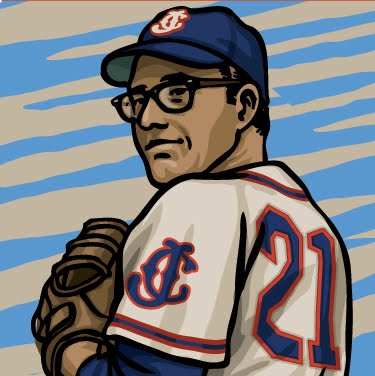
178. Charles "Square Deal" Cromwell: Blackball Umpire


I've said it before many times, but I'll say it again: one of the best benefits about writing/illustrating The Infinite Baseball Card Set is all the baseball historians, writers and artists I've met. I've asked a few to be a "Guest Author" on here and this week I'm pleased to have Bernard McKenna grace this site with a story. I became acquainted with Bernard due to our mutual interest in Baltimore Negro League history. I've always felt that with all the rich history in that city it has been sorely overlooked when it came to good solid books on the subject. The Black Sox and Elite Giants have been mentioned many times in chapters in books on general Baltimore baseball history, and the Black Sox in particular would make a great book subject. Cue Bernard McKenna. You may have already heard of him as he made some noise a few years ago when he discovered the only aerial photograph of Maryland Baseball Park where the Black Sox played. Up until McKenna's discovery, very few knew what the park looked like or was even located for that matter. Now baseball historians can gauge the dimensions and layout of the part which in turn helps put the feats of the Negro League greats in perspective. 
So, when I asked McKenna if he'd like to contribute to The Infinite Baseball Card Set he readily agreed, contributing yet another gem of Blackball research: a short history of a Negro League umpire! I hope you enjoy this extremely rare look into a little-known aspect of pre-war black baseball...

Charles Cromwell had a decision to make, and it wasn’t an easy one.  Rube Foster wanted him to come to Chicago and umpire games for the Negro National League (NNL).1  It was a tempting offer.  Foster had founded the NNL in 1920 and, in part, through sheer force of will, had carved out a successful black-baseball organization, which included the major cities in the Mid-West: Chicago, Detroit, and St. Louis among others.  By 1923, at the time of Foster’s offer, there was talk of cooperation between the NNL and the newly formed Eastern Colored League (ECL), which included teams from Baltimore, Washington, DC, Philadelphia, and New York.

Foster wanted to hire, in the language of the day, “race men,” African American professionals, to serve as umpires but insisted on excellence.  He regretted that there were not more qualified African Americans who could serve as umpires and canvassed the country to find those who were.2  Foster only wanted the best for the league.  He had already lured Billy Donaldson from the Pacific Coast League, where he had established a reputation as one of the best umpires in California, gaining the respect of ballplayers both white and black.
3  If Cromwell went to NNL, he would be at the top of the profession.

On the other hand, he had been with the Baltimore Black Sox since 1917, around the time that Charlie Spedden brought the club and moved them into the Westport Baseball Grounds.
4  Spedden offered to match Foster’s offer,5 so money wasn’t a factor.  If he had given thought to job security, the choice was harder than it might seem today, in hindsight.  At the time, Baltimore was a model franchise, with an ownership fully committed not only to its on-field success but also to improving playing conditions for its players and working conditions for its employees.6  Charles Spedden had just left his job with the Baltimore and Ohio Railroad, so he too was invested in the team’s long-term well-being.  The Black Sox had also recently (1921) built a new home, the Maryland Baseball Park, and had made major upgrades for the past two seasons, making it the “most complete colored baseball park in the country”7    He had other ties to the community as well.  He was a champion bowler, and the Afro American had asked him to write a regular column on the game.8
 
Add to this, Spedden had hired another “race man” to umpire, luring Henry “Spike” Spencer north from Washington, DC.
9  If Cromwell stayed in Baltimore, he too would be part of an elite umpiring crew.  Such a pairing would place him and Baltimore at the top of the profession.  Further, he wouldn’t have to uproot his family, and it could not have escaped his attention that he would then become a role model for and leading member of Baltimore’s African American community.  He chose to stay with the Black Sox.

There must have been times over the next few years that he regretted his decision.  In 1925 the ECL took the job of hiring umpires away from the teams, putting Cromwell out of work for that season.  A white sportswriter from Philadelphia made the assignments and did not favor “colored” umpires.
10  The league suspended that practice the following year, and Spedden brought Cromwell back in 1926.11  However, Spedden was forced to resign from the Black Sox in 1927, and George Rossiter, who had been Spedden’s partner, took control of the team’s business operations.  Rossiter chose not to employ African Americans as umpires, firing both Spencer and Cromwell shortly after Spedden left the team.  Rossiter  “insist[ed] on the use of white umpires” until “Negro umpires . . . prove competent.”12   He would eventually hire Cromwell back, but conditions had changed.  The ballpark, which had been an impressive facility, was allowed to deteriorate,13 even as the Black Sox became one of the best teams in the nation, winning the 1929 championship.  The Depression further exposed the club’s weakened financial position, and the Black Sox would cease to exist as a franchise in the early 1930s.  By that time, Cromwell had moved on.

In 1932, he would be named Lead Umpire in the Southern Colored Athletic Association.
14   Later that decade, he would return to the majors, umpiring games for the Baltimore Elite Giants.  His name appears in box scores and, occasionally, surfaces because of a controversial call.15  However, those times are rare, which bodes well for an umpire.  He did not infuse his personality into the game, preferring instead a quiet yet rigorous professionalism.  In 1941, his doctors strongly advised that he take a break from the game, but he returned a year later.16 His name last appears in a box score in 1947.17  His career spanned four decades and at least thirty-one years.  He was reported to be “one of the ‘finest’ umpires in the East.”18 He also gave back to the community, enlisting in the army during the First World War.  He also rushed into a burning building to save a woman’s life.19

If he had taken Foster up on his offer, Charles Cromwell would have likely served with distinction, ranking with Billy Donaldson and Bert Gholston as the best umpires in the NNL.  Instead, he chose to stay in Baltimore.  As a consequence, his career was twice interrupted because of racism.   He persisted, carving a place for himself in the community and in local baseball.  His years of service, his distinctions, and his work in the community rival those Major League umpires in the Hall of Fame.  Moreover, he worked in a time where a “colored umpire” was often the punch-line of a joke.
20  In this context, it is remarkable we know as much as we do about Cromwell.  For many of the “race men” hired by Rube Foster or who labored in black baseball we will never know their names.  For others, there are a few pictures or the name or partial name in a box score or a rare news story.  It’s worth remembering those we know:  Leon Augustine, Lucian Spaer, Caesar Jamison, William Embry,21 Frank Forbes, Judy Gans, Cooper, Greenwald, Ben Taylor, Peirce, Brown, Craig, and Moe Harris.22  In 1932, Bert Ghoston wrote a column, calling them “The Forgotten Men.”  Indeed, they were and are. 

NOTES
1 “Black Sox Want Cromwell Here,” Afro American, March 30, 1923, 14.
2 “We Need and can use Colored Umpires,” Afro American, January 13, 1922, A8.
3 Foster gets Umpires,” Afro American, April 13, 1923, 1. 
4 “Bowlers get Ready,” Afro American, September 8, 1922, 8. 
5 “Black Sox Want Cromwell Here,” Ibid. 
6 “Black Sox Club to be Real Ball Team,” Afro American, March 10, 1922, 9
7 “Sox sign Catcher and new Pitchers,” Afro American, February 9, 1923, 11.
8 “Charles Cromwell as a Bowler,” Afro American, February 14, 1925, 6.
“Best in the League,” Afro American, September 11, 1926, 9.
10 “Cromwell to Call ‘em at Sox Park,” Afro American, April3, 1926, 8.
11 Ibid.
12 “Can’t Secure Good Umpires,” Afro American, Aug 10, 1929, 15.
13 Bill Gibson, “The Passing Review,” Afro American, May 4, 1929, 15.
14 “Eagles Still Hold Ace Spot,” Afro American, June 23, 1934, 21.
15 “Player Ejected as Elites Split with Cubans,” Afro American, July 22, 1929, 23.
16 “Charlie Cromwell Quits as Umpire,” Afro American, August 30, 1941, 23.
17 “Elite Giants Lose Game,” Baltimore Sun, June 4, 1947, 15.
18 “Cromwell to Call ‘em at Sox Park,” 8.
19 “Both Heroes,” Afro American, April 30, 1927, 20.
20 “A New baseball Ruling,” Baltimore Sun, August 8, 1911, 6.
21 “Rube Foster Signs 7 Colored ‘Umps,’” Afro American, April 27, 1923, 14.
22 “Ghoston calls them the Forgotten Men,” Pittsburgh Courier, December 17, 1932, 14.

Bernard McKenna was born and raised in Baltimore City, near Memorial Stadium.  He currently works as an English professor at the University of Delaware.  Much to the delight of his wife and children, he's starting to look for the old Baltimore Black Sox, recently discovering images of their ballparks.

Thursday, November 8, 2012

135. Rap Dixon: The Negro Leagues' Best Left Fielder

Every so often I get requests for ballplayers to feature on the site. This week's player was suggested by a reader over a year ago and not only did he ask me to feature this particular player, but he also took the time to write out a nice outline of his career to get me started. It took me quite a long time to assemble everything, research, drawing and actually writing it all down, but finally, here it is...

Now the first thing you think about when you here that a ballplayer's nickname is "Rap" is a massive slugger, right? Rap has got to be derived from the sound the ball makes when it "raps" into the outfield wall. Well, in Herbert Albert Dixon's case, "Rap" was short for the Rappahannock River. Why was he named after a river in Virginia? I have no idea. He was born in Kingston, Georgia and grew up in Steelton, Pennsylvania. I'll make an educated guess and throw it out there that perhaps Dixon's family, after leaving Georgia, briefly settled in Virginia, somewhere along the banks of that river. Moving to urban Pennsylvania it was probably just natural his nickname reflected the place he'd come from. But, like I said, it's all just a guess. What is known for sure is that by his teens Dixon was living in Steelton where his Pop was a steelworker.

Colonel Strothers, the owner and manager of the semi-pro Harrisburg Giants, spied the 20 year-old "Rap" Dixon playing sandlot ball in Steelton, Pennsylvania and snatched him up for his own ball club. Strothers was in the process of turning his semi-pro Giants into a big league quality team and the was Dixon played the outfield Strothers knew this kid would be an integral part of what he envisioned for his club. 

By 1924 the Harrisburg Giants had become that pro club the Colonel envisioned. To compliment his young left fielder, Struthers signed Oscar Charleston to play center and brought in Fats Jenkins to anchor right field. The Dixon-Charleston-Jenkins combo became what may have been the greatest outfield of all-time. 

The Giants joined the Eastern Colored League in 1924 and Dixon began what should be a hall of fame career. In 47 games he hit a .265 but did slug 4 homers and demonstrated solid skills on the base paths. His fielding out in left field was so impressive that there was no question he would be in that same place the next season. Playing full time in 1925 Dixon responded by knocking the ball around for a  .344 average. After the regular season, Dixon was invited to go to the West Coast and play in the winter league around Los Angeles. Off-season baseball work was scarce and only the best ballplayers were offered slots in the winter league so it speaks highly of Dixon's talent at the age of 23 that he was granted a berth on one of those all-star teams. 

Back east with Harrisburg again in 1926 he's credited with a .310 average and many Negro teams tried to get Dixon to jump the Giants and join their clubs, to no avail. The left fielder was tall and bony, just over 6 feet tall. His legs were stripped down and built for speed and his arms were the only thing on him that could be called muscular, which was the source of his cannon arm and the reason he could scatter booming line drives all over a ball field. By 1927 no one remembered that "Rap" had anything to do with a river. To blackball fans, "Rap" was what he did to a baseball, and that was that.

Instead of heading out west in the winter of 1927 and stopping at Los Angeles, Dixon was recruited by famed catcher Biz Mackey to join his team which was headed to the Orient to play ball. The team, dubbed the Philadelphia Royal Giants, stopped off in many exotic locations including the Philippines and Japan, spreading the brand of ball playing they played in the Negro leagues. Japan particularly embraced the American visitors and Dixon in particular. The fans were captivated by his "shadowball" pantomime routine before games and one of his home runs was so impressive that a plaque was erected to commemorate it. His batting performance in Japan was so impressive that it earned him a special trophy from the Emperor Hirohito. 

When the tour ended Dixon took his brand of ball playing to the Baltimore Black Sox. Baltimore had consistently fielded a competitive team but always seemed to fall short at the end of the season. The addition of Rap Dixon to the lineup was that missing part of the machine. After batting .382 in 1928, the Black Sox finally put it all together the next season and they won the league championship, Dixon's .369 tally adding considerably to a well-balanced ball club. Unfortunately the league disbanded after that and while the 1930 Black Sox were considered even better than the previous edition, they were an independent club and it's not easy to gauge in retrospect how good they were. 

One thing is for certain however, and that is that Rap Dixon was a superstar. In July of 1930 Yankee Stadium was officially opened up to black teams and the Black Sox were there to play the hometown Lincoln Giants in the House that Ruth Built. By the time the game ended that afternoon Dixon had gone down in the history books as not only the first black ball player to hit a home run in Yankee Stadium, but he hit three of them that day. It was a monstrous demonstration of power in front of a huge crowd in the largest city in the nation. If anyone didn't know about Rap Dixon by the morning before that game, they sure did afterwards. 

Unfortunately along with fame comes a whole cart full of unwanted baggage and Dixon fell victim to two of the most common ones - booze and ego. That drinking went along with the transient lifestyle of a ballplayer is not sup prizing. Black or white, many great careers were damaged by the sauce and Dixon was no different. Alcohol combined with a swollen head made for an unpleasant teammate. But, just like his white counterparts, as long as you performed on the field such unpleasantness's were overlooked.

Like many stars of blackball, Dixon now began the life of ball player for hire, frequently switching teams and showing up bat in hand to whichever team offered him the most money. One thing everyone who followed Negro baseball was that when Rap Dixon came to join your team, he was bringing speed, power and the the best fielding skills around. Dixon's appearance in the lineup was like money in the bank. In 1931 he was roaming left field in a Hilldale uniform. 1932 found him on the Pittsburgh Crawfords, one of the best ball clubs ever assembled, black, white, brown or any other color. The next season he was recruited by the Philadelphia Stars and creamed the ball for a .370 average. When the voting for the very first All-Star Game was tallied in July of that year, Rap Dixon was the East's starting left fielder of course. He promptly stole the first base in All-Star history.

When he went south to Puerto Rico in the winter of 1933-34, Dixon was at the top of his game. Then it all ended. Sliding into second base, Dixon severely injured his spine. The all-star spent almost half a season in the hospital and when he finally returned to the game he wasn't even half the player he was before. Philadelphia cut Dixon loose but Baltimore took a chance on their old star and hired him as manager of the Black Sox. While he was one of the best ballplayers to ever step on a ball field, he wasn't a skilled enough manager to make a difference with the lack-luster club Baltimore saddled him with and the club folded. The Brooklyn Eagles picked up his contract the next season bu he didn't stick and he bumped around a series of teams in quick succession before hanging up his spikes after the 1937 season. He stayed in the game as a manager of a few low-level teams including a reconstituted Harrisburg Giants in the 1940's. Though Harrisburg's level of play wasn't one the same level as a Negro National League team, it was notable for another reason - it was an integrated ball club - a rarity back then and perhaps one of the many reasons which proved why Jackie Robinson should be given a shot at professional ball in 1946.

After a good 15 years of heavy drinking, Rap Dixon succumbed to tuberculosis in July of 1944. His heath had been declining steadily since his hospitalization ten years earlier and his death wasn't much of a surprise to those who knew him. When Oscar Charleston was creating his all-time dream lineup of Negro league players in 1949 he chose his old Harrisburg teammate to be the starting left fielder. Quite a compliment considering the source and the vast pool of talent he had to choose from. The Hall of Fame had Dixon on their ballot in 2006 but he failed to garner enough votes. Perhaps one day when guys like Gil Hodges and Sammy T. Hughes get their just rewards, the name Herbert Albert "Rap" Dixon will be right along with them.

Thursday, November 24, 2011

New Card Set Dedicated to the Career of Pete Hill!


Just in time for the Holidays! Joining forces with famed Negro League researcher Gary Ashwill and Pete Hill's great nephew, Major Ron Hill I am proud to bring to you a beautiful 15 card tribute to one of the greatest black ballplayers of all time - PETE HILL. Many of you are familiar with Pete's career which spanned the first quarter of the 20th century. Each of the cards picture Pete on one of the many teams he played for - The Philadelphia Giants, Havana Reds, Chicago American Giants, Leland Giants, Baltimore Black Sox, Detroit Star, Cuban X Giants - and many more - Pete Hill's baseball odyssey found him playing on some of the greatest blackball teams of the dead-ball era. The illustrations I did for this set are some of the best ones I've done and the amount of research I put in trying to make each uniform as accurate as possible is something I'm really proud of. Working on this set I was so tempted to slip one or two into the website to show them off, but I held myself back in order to make all 15 of these illustrations new to everyone. The back of each card tells the life story of this talented Hall of Famer, all written and painstakingly researched by Gary Ashwill. Besides the narrative Gary has also gone so far as to compile Pete's statistics for his career in the Negro and Cuban Leagues as well as his career totals against Major and Minor League competition.

I can't tell you how unique this card set is, as far as I know no one has ever attempted to do something like this before and speaking for myself, I'm proud to be part of it! The first run will be of 1000 numbered sets for $25 each.

Just in time for the Holidays! Joining forces with famed Negro League researcher Gary Ashwill and Pete Hill's great nephew, Major Ron Hill I am proud to bring to you a beautiful 15 card tribute to one of the greatest black ballplayers of all time - PETE HILL. Many of you are familiar with Pete's career which spanned the first quarter of the 20th century. Each of the cards picture Pete on one of the many teams he played for - The Philadelphia Giants, Havana Reds, Chicago American Giants, Leland Giants, Baltimore Black Sox, Detroit Star, Cuban X Giants - and many more - Pete Hill's baseball odyssey found him playing on some of the greatest blackball teams of the dead-ball era. The illustrations I did for this set are some of the best ones I've done and the amount of research I put in trying to make each uniform as accurate as possible is something I'm really proud of. Working on this set I was so tempted to slip one or two into the website to show them off, but I held myself back in order to make all 15 of these illustrations new to everyone. The back of each card tells the life story of this talented Hall of Famer, all written and painstakingly researched by Gary Ashwill. Besides the narrative Gary has also gone so far as to compile Pete's statistics for his career in the Negro and Cuban Leagues as well as his career totals against Major and Minor League competition.


I can't tell you how unique this card set is, as far as I know no one has ever attempted to do something like this before and speaking for myself, I'm proud to be part of it! The first run will be of 1000 numbered sets for $25 each.


Tuesday, September 7, 2010

48. The Weasel vs. The Ghost


I 'm doing something a little different for this post. Instead of focusing on one player I decided to feature 2 players and the story that binds the two of them together.

When I was first researching negro league baseball back in the early 1980's, the first great solid piece of work I stumbled upon was Robert Peterson's "Only The Ball Was White". Published in the early 1970's it was the groundbreaking work that laid the foundation for all the subsequent books and research on black baseball. Although riddled with inaccuracies (through no fault of his own, he was the first for God's sake!) Peterson's book shines a light on the dark and hidden world of early black ball. The stories in it ware fascinating to me, almost like ancient legends from another time and place. These were men who were playing the most popular sport in the country in front of millions of fans, yet no one ever heard of them. They were existing in a parallel universe and Peterson's book still gives me that feeling of mystery and danger when I think back on reading it so long ago. It was through his book that many of us were first introduced to two of the greatest infielders of the 20th century, Frank "The Weasel" Warfield and Oliver "The Ghost" Marcelle and the story that links them together forever in baseball lore.

By 1929 Frank Warfield and Oliver Marcelle were both stars and veteran infielders for the champion Baltimore Black Sox. So talented were they that along with teammates Jud Wilson at first base and Dick Lundy at shortstop they were called the "Million Dollar Infield". Warfield and Marcelle had been teammates before, playing together on the Detroit Stars. The Black Sox, always a strong team but never able to pull it together and win the championship, did just that in 1929, winning the Negro American League Pennant under Warfield's management. Warfield hit a mediocre .221 but it was his managerial experience and superb fielding that made the difference for Baltimore. His style of leadership has been described as rough and abrasive and he was often engaged in arguing and baiting umpires and berating his own players right on the field in front of everyone watching. He was quiet and brooding, flashed big wads of cash and was quick with a knife. Unpopular and sarcastic, his fellow teammates dubbed him "The Weasel".

Oliver Marcelle was the best third baseman of the 1920's. His ability to play deep and seemingly to appear at the right spot out of nowhere earned him the nickname "The Ghost". Marcelle was a good looking Creole from Louisiana and the vainest man in the league. He also had one of the nastiest dispositions in the negro leagues and the chronicle of black baseball is littered with stories of his battles. He was a stone-cold street fighter and would use anything to gain the upper hand in a fight. Already nasty, he was only worse when under the influence of alcohol. Once while fighting Oscar Charleston (himself a legendary brawler who had once ripped the hood from a Klansman who was threatening him) he hit the much larger Charleston over the head with a bat. He fought with opposing players, umpires and his own teammates.

After the successful 1929 season, Marcelle and Warfield headed south to Cuba for winter baseball. Back before the Second World War, Cuba's winter league attracted the best players of all colors who were eager to supplement their regular salary with some post-season employment. Only the best players were asked to play and being part of the "Million Dollar Infield" guaranteed an invitation for Warfield and Marcelle. The Weasel went with the Santa Clara Club and The Ghost to Almendares. It was playing in Cuba during that winter of 1929-30 that the incident occurred that bound those two volatile players together forever in baseball history.

It started with a dice game. Warfield and Marcelle were in a group shooting craps at a hotel in Santa Clara and Warfield was riding a winning streak. For every winning throw of the dice The Weasel threw, The Ghost crapped out finally coming up broke. Marcelle asked Warfield for five bucks to continue to play. The Ghost said it was owed to him by the Black Sox from the previous season in Baltimore. The Weasel refused. Things started getting nasty. Both men were not adverse to violence. It got out of hand quickly. Marcelle challenged Warfield to fight and slugged him in the mouth. It was on. The fight was so brutal that it was only ended after Warfield had managed to bite off a piece of Marcelle's nose. That's right, he bit off the part that covered the nostril on one side of Marcelle's nose.

Marcelle was taken to the hospital were he pressed charges against his former manager. Warfield cooled his heals in a Cuban jail for a few days while a minor international incident swirled around the fight. Eventually charges were dismissed and he was quietly released because both men were American citizens and Cuban officials probably just wanted to rid themselves of two nasty and violent men.

Now remember, Marcelle was one the vainest men to step on a ballfield. Losing a big ol' chunk of his proboscis in the days before plastic surgery must have been a crushing blow. He took to wearing a black eye patch over his nose to cover the hole. The once sarcastic and cruel player was now on the receiving end of what must have been an endless cycle of jokes from his opponents on the ballfield and the fans in the bleachers. It got to be so bad that Marcelle left organized ball and drifted out west where he was not known, playing semi-pro ball in dusty frontier towns along the way. He settled in Denver as a house painter and was instrumental in getting the Kansas City Monarchs an invitation to play in the Denver Post Tournament in 1934. The Monarchs promptly won the tourney and the white sports world was introduced to their pitching star, Satchel Paige. But The Ghost continued to drink, his addiction getting so out of hand that his family left him and he died alone and broke at age 51. No one in his neighborhood knew he was once a great ballplayer. they just remembered the guy with the nose patch.

Warfield, the victor in the fight, went back to Baltimore and resumed managing the Black Sox. His playing days were drawing to a close but he was coming into his own as a successful manager. In 1932 he took up the reigns of the Washington Pilots and while in Pittsburgh that July he died under shady circumstances. Warfield, always the ladies man, was with a woman that July night when he was rushed to the hospital bleeding. Internal hemorrhaging led to a heart attack and death. He was 37.