
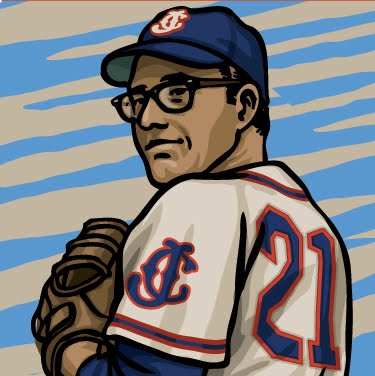


I said it before, but I'll say it again: the greatest thing about writing and illustrating this blog has been all the friends I've made through it. While I started this out of my feeling of loss and loneliness after my Dad died, the many acquaintances I've made through this site have been an unexpected blessing. This week's story comes from one of those new acquaintances. Writing back and forth, he (name withheld by his request) asked me if I'd thought about doing a card of Larry MacPhail. While I never wanted to do cards of owners or executives, MacPhail would prove to be the obvious exception. I thought I'd like to concentrate on his early years in Columbus and Cincinnati, before the Dodgers and Yankees, but I didn't have any reference to start my research. A few weeks later a box arrived at my studio with a big book on MacPhail and some other photocopied material on his Columbus and Cincinnati period. It was all I needed to start writing about this underrated baseball savant - the only thing left was to figure out how to illustrate loud plaids in the Infinite Baseball Card style...
Since baseball became the National Pastime, there have been countless innovators that have moved the game forward: Branch Rickey with integration and the farm system, Dummy Hoy with universal hand signals for umpires, Roger Bresnahan's invention of catching equipment... but perhaps no man had more to do with the advancement of the game, and at the same time is more overlooked, than Larry MacPhail.
Columbus, Ohio 1931.
Larry MacPhail was busted out. After pouring his life's savings into developing a medical arts building that went under after the stock market crash, he was without a job and available. But that didn't worry Larry MacPhail: something would turn up, it always did. He lived his life on the edge, a brilliant mind coupled with a gambler's wit. He followed genius moves with stupid mistakes and each time rebounded to greater height. He was a banker's son from Michigan. Started out as a lawyer in Chicago, then the manager of a Nashville department store. Restless, he wrangled a commission in the army and went to France with an artillery regiment. Six months later he was wounded, promoted to captain and helped lead a daring and booze-fueled raid to capture the Kaiser who was hiding out in neutral Holland. Getting away with his life and one of the Kaiser's ashtrays, MacPhail returned to America and settled in Columbus, Ohio. That's where he was living when he went bust.
As smooth a networker as a Southern senator, MacPhail made friends easy and it wasn't long before some of them came through with his next opportunity. The minor league Columbus Senators were hemorrhaging money like a bottomless boat and hadn't been above 5th place in decades. Fans stayed away from their dumpy ballpark like it was festering with the plague and there was every reason to believe the team would either fold or move away. Local businessmen believed that this would be a tragedy. With the country slipping deeper and deeper into the depression, the Columbus business community believed that the population needed baseball as a diversion from the economic disaster around them and help restore their morale. But they needed a winning team. With Larry MacPhail out of a job, he was asked to see what he could do with the Senators.
Like everything in his life, MacPhail threw his entire weight behind re-forging the franchise into a success. Like a whirlwind of action, he was soon called "Hurricane Larry". Within weeks he'd convinced Branch Rickey to make the Columbus club part of the Cardinals farm system. MacPhail knew that doing so was the future of minor league baseball and the constant flow of players provided by being a part of the Cardinals organization would make his team competitive. The Senators became the Red Birds and soon a steady stream of fresh young talent were putting on Columbus uniforms.
MacPhail slapped new paint on the beat up ballpark, dressed the ushers in colorful uniforms and started fun promotions to lure the fans to the park. At the end of the season the Red Birds were perched in 4th place - the highest in the standings that anyone could easily recall.
By the time the 1932 season started, MacPhail was named to the league's governing body and led the initiative to revamp the play-off system. He instituted a player-incentive program to ensure teams stayed competitive to the end of the season. It was all new and brilliant and by the following season other minor leagues had adapted it to survive the depression.
In June of 1932 he put his team in a brand new stadium which was opened up with unprecedented fanfare and even attracted the Commissioner of Baseball Kennisaw Mountain Landis. Not content with just a merely new stadium, MacPhail insisted lights be permanently installed atop the new ballpark. He began special days where he let unemployed fans see a game for free and started Red Birds fan clubs to get the local kids involved. The Red Birds finished second and actually drew in 100,000 more fans than the parent Cardinals did! It was pure genius and he made headlines from coast-to-coast, but, like every stage in his life, it would come crashing down.
The Red Birds jumped off to a spectacular start in 1933 and were tabbed as the league's favorite. MacPhail continued to make headlines but not always in a good way. Always a first-class boozer, MacPhail sometimes lost control during a binge, such as the time he accompanied the team on a road trip. After an all-night drinking session with the hotel manager ended with an argument, MacPhail made his team pack up and move lodgings right then and there. While some laughed it off, in St. Louis someone was watching.
While Branch Rickey found much to admire about Larry MacPhail, he also had much to despise. Rickey was a teetotaler; MacPhail, of course, drank to excess. The Cardinals president was a model of modesty, the Red Birds' president dressed in flashy clothes to match his personality. And worst of all, MacPhail was quickly out-shining Rickey in the baseball world.
There were two things that ended MacPhail's reign in Columbus. The first was when Rickey saw how well-appointed MacPhail's office was in the new ballpark: walnut paneled walls and plush Oriental carpets. It was more extravagant than any of the major league owners and Rickey seethed with resentment when he thought of how much club money MacPhail had spent on his own regal comfort. When the Red Birds president tried to explain that the walnut panels were installed at a discount by a grateful contractor and that the rugs were obtained after a furniture store had a fire-sale, Rickey was too upset to listen. This brash display of immodesty coupled with the hard time MacPhail gave Rickey when he wanted to promote one of the Red Birds' players during the pennant race sealed the new president's fate. By mid-1933 MacPhail was unemployed.
And, like every other time, he bounced back higher: 100 miles south of Columbus, a ball club was in trouble; a Big League ball club.
The Cincinnati Reds were a miserable club in 1933. Ever since the early 1920's, the team had dived deeper and deeper into the second division. The owner Sidney Weil lost all he had and turned the team over to a local bank. Now in last place with no where else to go, they needed a miracle. They sent for Hurricane Larry.
As he had in Columbus, MacPhail's first months in Cincinnati was a whirlwind of re-painting and re-thinking. He dressed the ushers in fancy garb, hired pretty girls to roam the stands selling cigarettes and cigars. Promotions abounded - ladies nights, kid's days - but still he needed a winning team. MacPhail took stock of his surroundings and set his sights on the richest man in town: Powell Crosley. The local businessman owned a radio and appliance manufacturing company and a brace of radio stations. He took risks, was an innovator in his field and loved his hometown. He was the perfect match for MacPhail. After bombarding the businessman for weeks with reasons he should buy the team, Crosley finally purchased the struggling Reds from the bank. Now MacPhail now had his bankroll.
He got rid of every malcontent and slacker in a Reds uniform. Good, bad, it didn't matter, to MacPhail they were all losers. When star outfielder Babe Herman complained he didn't receive a bonus for hustling that he had in his contract, MacPhail bad mouthed him to the press and kicked him off the team. When he found manager Bob O'Farrell more infatuated with a new golf club than with his team which was on a losing streak, MacPhail fired him then and there. Trades were announced on what seemed like a daily basis. To cut down on train travel, he occasionally put his boys on a pair of Ford Tri-Motors and flew them to far away cities. Using St. Louis as a model, the Reds created a sprawling farm system to harvest new ballplayers at a minimum cost. The sportswriters ate that stuff up, and to make sure they continued to do so, MacPhail built a well-stocked open bar lounge just for them.
Utilizing Crosley's pioneering radio empire, the Reds hired a Floridian announcer named Red Barber and began broadcasting every single game. Major league owners resisted broadcasting their games, fearing fans would just stay home instead of journeying to the ballpark. MacPhail knew they were wrong: the 50,000 watt station WLW could be heard from Texas to Manhattan and soon the broadcasts created a whole legions of Reds fans around the country. Then he allowed three other stations to carry the games as well - the more broadcasts the more Reds fans - and he charged each station two grand for the right to do so. MacPhail worked with the railroad companies for special excursion trains to bring all the new Reds fans created by the radio broadcasts to Cincinnati at a reduced rate.
And then he brought lights to the big leagues. Backed by Crosley's cash, MacPhail installed lights on the re-named Crosley Field. First, he had to convince the other National League owners who were vehemently against the lights. Through deals, arm twisting and flattery, MacPhail managed to have 7 night games for 1935, one with each National League team. It was a smash hit. The first game was linked by a remote link to the White House where President Roosevelt threw the switch lighting up Crosley Field. Every game was a sell-out and though wary, the other team owners agreed to continue the idea.
When Puerto Rico invited the Reds to spend spring training on the island, MacPhail flew the team down there and became the first major league team to visit that Caribbean territory. And through it all, the Reds started to rise. 8th place in 1934; 6th place in 1935 and then 4th place in 1936.
But then, like every stage in his life, it would come crashing down.
Always a boozer and prone to making a scene, MacPhail was on a collision course with Cincinnati's Midwestern values. As his grandson famously said about him:
"My grandfather was bombastic, flamboyant, a genius when sober, brilliant when he had one drink and a raving lunatic when he had too many."
For a while everyone looked the other way, but by 1936 he had reached the level of "too many. When a drunken MacPhail slugged it out with a police sergeant in the elevator of the Netherland Plaza Hotel, Powell Crosley sent him packing.
It was an inglorious way to exit the big leagues, but to Hurricane Larry, it was the only way. And, like every other time, he bounced back higher: by 1938 he was running the Brooklyn Dodgers.
That's where I'm ending this story. Most fans of baseball history know how MacPhail assembled the great Dodgers teams of the 1940's and then the post-war Yankees dynasty of the late 40's and 50's. He was elected to the Hall of Fame in 1978. He started his own personal baseball dynasty as his kids and grand kids went on to great heights on the business end of the game. But, as far as an innovator, no one can ever match Larry MacPhail.
Thanks again to the baseball fan who sent me the book and photocopies without which this story could never have been done. It was a fun one to draw, Larry MacPhail was notorious for his loud and flashy clothes. Illustrating baseball uniforms gives me great artistic pleasure, but the chance to draw a sharp suit of clothes, well, that I really couldn't pass up!
SOURCES
- Warfield, Don, The Roaring Redhead (Diamond Communications, 1987)
- McKelvey, G. Richard, The MacPhails (McFarland & Company, 2000)
- Golenbock, Peter, Bums (Putnam, 1984)
- Grandson's quote on Larry MacPhail (Baltimore Sun, November 9, 2012)

