Showing posts with label Olympics. Show all posts

Sunday, August 5, 2012

126 Abel Kiviat: Olympian


Like millions of people around the globe, I tuned in to watch the opening ceremonies of this year's Olympic Games in London. A few hours later I found myself trying to make sense of what the crippled kids, scarey demon monkees and high school theater club "dancing-through-time" skit had to do with the world's greatest sporting event. I longed for the time when the opening ceremony meant each team marching around the track carrying the flag of their nation, followed by some speeches by local dignitaries and then the games would begin. The newspaper reporting of the games and participants was centered not like today on an athlete's tragic family history, but on their athletic prowess, vitality and determination to win for their country. In tribute to those more sports-oriented games, I bring to you Abel Kiviat, American silver medalist and a member of the first Olympic baseball team.

Although baseball had been popular in Latin America and Japan since the 1880’s, the game just hadn’t caught on with young men in other countries. The game was seen as too complicated and unrefined especially to Europeans but because of the way immigrants from these same countries embraced and excelled at the sport once arriving in America, the game was given a chance at becoming an official Olympic event. At the 1912 Games in Stockholm a series of two exhibition games were scheduled to gauge spectator interest in the sport. The first game was against a team made up of local Swedish players, the game having become recently introduced to that country courtesy of immigrants returning home from America. The American team was selected from athletes already competing in officially sanctioned events. Due to obvious reasons, the United States Olympic Committee forbade any of their athletes from competing in the exhibition baseball games until their own events were finished. A natural selection for the team was Jim Thorpe who seemed to excel at just about any sport invented, but he had to miss the first game because he was in the process of winning a gold in the decathlon. However Thorpe’s roommate played that day.

By the age of 20 Abel Kiviat was one of the best middle-distance runners in the world. He was a star athlete at his high school on Staten Island, holding the New York City record for the half-mile and mile race as well as being recognized as an All-Star shortstop in baseball. After high school he raced competitively for the Irish-American Athletic Club, one of the best sporting clubs in the States. While representing the Club he set 3 outdoor and 6 indoor records and won an additional nine national titles. Although a Jew and not of Irish heritage he was selected to be the teams captain for five years. While qualifying for the 1912 United States Olympic Team, Kiviat set the world record for the 1500 meter race with a time of 3 minutes 55.8 seconds which remained unbroken until 1917. Although the favorite going into the 1912 Olympics, he managed to win only the silver when he inadvertently eased up towards the end of his race and lost to England’s Arnold Jackson. Kiviat was, however, the American baseball team’s biggest slugger.

In the first game against the local Swedes, Kiviat went 2 for 4 with a triple and stole two bases as the Americans won 13-3 in a game lasting 6 innings. The sparsely attended game mostly attracted Americans and Swedish-Americans who were already familiar with the sport. The game played on the following day attracted a much larger crowd, probably due to the fact that the regular events were winding down and that Jim Thorpe, the sensation of that year’s games was scheduled to play.

The teams were made up solely from American athletes with Thorpe making an appearance in right field on the same squad as his roommate, Kiviat. With the competition much stiffer and being a little rusty since his days as an All-Star high school shortstop, Abel committed 2 errors in the game but more than made up for it at the plate, going 2 for 3 with a double and stolen base. Kiviat’s team won 6-3.

Baseball didn’t make that big of an impression on the Olympic Committee and would not be tried again until 24 years later at the Berlin Games. Abel Kiviat returned to America and continued to run races but his career was cut short when he was suspended by the Amateur Athletic Union in 1915 when he was accused of asking for too much money for expenses in order to travel to a track meet in Upstate New York. Athletes were supposed to maintain their eligibility by not receiving outright payment for their talent but some got around this by accepting large payments under the category of “travel expenses.” Kiviat fought the charges and was reinstated 8 years later but by then he was a long way from his former peak. He stayed active in the sport he loved by volunteering at the big annual track meets held at Madison Square Garden where he became a gregarious fixture in the press box. In 1984, at the age of 91, Kiviat was given the honor of participating in the Olympic torch relay through Manhattan. He lived to the ripe old age of 99, for a time America’s oldest living Olympian.

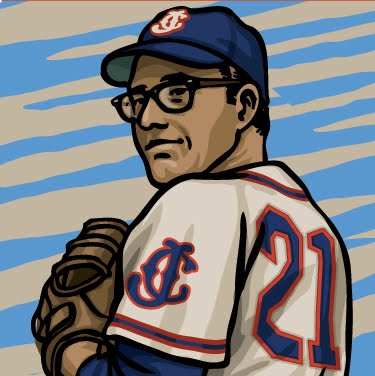
This story was included in the Premier Issue of "21: The Illustrated Journal of Outsider Baseball" which highlights the careers of 14 Jewish ballplayers and can be purchased by clicking HERE or on the tab right below the arrow on the main header of this blog.


Friday, October 14, 2011

93. Jim Thorpe: A Minor Oversight


Back in 1983 I was in my 8th grade English class when this kid named Brian sitting next to me dropped a copy of Sports Illustrated which he was secretly reading and was cleverly hidden in his textbook. The magazine hit the wooden floor, gathered air beneath its spread-out pages, accelerated and shot across the aisle, coming to a halt under my chair. The teacher was this tall, mustachioed thug who liked slapping us kids around for minor infractions, so I quickly snapped up the magazine so that Brian didn't get caught. I didn't particularly care for Brian, but that teacher was a full-blown dangerous psychotic and it was an unwritten rule that while in his class us kids all looked out for one another. I slipped the magazine in my desk and that sick teacher never noticed. Not only did I save Brian from a beating, but I discovered Jim Thorpe that day. The main article was on the International Olympic Committee giving the long-deceased Thorpe's 2 gold medals back to his children. Jim Thorpe, the greatest athlete of the 20th Century, I learned, forfeited his gold because he played two seasons of baseball in the minor leagues...

After excelling in every sport the Carlisle Indian Industrial School had to offer - football, track, baseball and even lacrosse, Jim Thorpe jumped at the chance to make a few bucks playing low-level minor league baseball in North Carolina. A few of his schoolmates had already accepted offers to play down south and in the spring of 1909 he joined his former Carlisle teammates Joe Libby and Jesse Longdeer on the Rocky Mount Railroaders of the Class-D Eastern Carolina League. Making about $15 a game, Thorpe played most positions in the infield and outfield but mostly was utilized as a pitcher. Rocky Mount was the worst team in the league that year and Thorpe registered a 9-10 record at the season's end, but upon a closer look he didn't have as mediocre a season as it appears. 6'-1" and powerful, Thorpe was raw and sometimes wild but had a few good games including 2 shutouts. In August before a home crowd "The Big Chief" as he was called, pitched both ends of a doubleheader against the Goldsboro Giants, dropping the first but winning the second game.

Rocky Mount was a town that had no love for people of color, even if they played on the towns own baseball team. "Coloreds" (which apparently included Native Americans) were expected to stay out of the downtown area and use a "colored road" outside of town to go from one part of town to the other. Thorpe and his two Carlisle teammates, Joe Libby and Jesse Longdeer, discovered this the hard way when they cut through town on their way to the ball field and were set upon by a local cop. When the officer shoved Thorpe he promptly knocked him out cold. The three ballplayers spent the night in jail and Libby and Longdeer left the team short there after.

Away from the discipline of the Carlisle Indian School, Thorpe seems to have cut loose during the season and he had a few additional scrapes with the law due to alcohol. One story has him wandering drunk downtown and smashing his head through a store window on a $5 bet. Another night he and teammate Marvin O’Gara went at each other in a drunken brawl and Thorpe had to be physically cuffed and dragged to the police station by a team of cops. O’Gara wound up being arrested as well after he was apprehended antagonizing Thorpe through the bars of his cell window.

Thorpe reported to Rocky Mount the next season and during spring training injured his arm. The Railroaders made another poor showing in 1910 but Thorpe's pitching kept the team competitors. Although he wound up with a 10-10 record, 5 of those loses were by a single run. The Rocky Mount team eventually traded Thorpe to the Fayetteville Highlanders near the end of the season. In his only game on the mound for the Highlanders Thorpe was unimpressive and got the loss. Manager Charlie Clancy decided to move the big fellow over to first base and his batting started to get a little better by the time the season ended. Unfortunately Thorpe didn't get along with Charlie Clancy, probably because of his thirst for the nightlife. His propensity towards alcohol fueled mischief followed him to Fayetteville and one time an inebriated Thorpe fought off 5 police officers before smashing his head through another window. Still refusing to submit to the law, the police called in the president of the Fayetteville team to try to calm him down, all to no avail. Finally an officer lassoed Thorpe, tied up the big man and subdued him with chloroform him until he was docile enough to be taken to a hospital.

By all reports he showed promise as a pitcher but needed a lot of coaching, both on the field and off. At the plate he hovered around .250 and had trouble with curve balls, something that would haunt him throughout his baseball career. On the base paths he was pretty fast and stole 11 bases in 1910. For unknown reasons Thorpe didn't return to Fayetteville the following season but concentrated on amateur track and field events. Technically, Thorpe forfeited his eligibility to compete because he accepted money to play baseball.

In 1912 as a member of the United States Olympic Team, Thorpe won 2 gold medals and was declared by the King of Sweden to be the world's greatest athlete. A hero upon his arrival back in the states, Thorpe's new-found fame quickly turned dark fast. Almost at once rumors started to swirl about him playing professional baseball somewhere down south - a no-no if you want to be eligible for the Olympics. While many college athletes played sports for money and kept their eligibility, Thorpe neglected to do what they all had done: use a false name. It wasn't hard to find records pertaining to Thorpe's 2 years in the Eastern Carolina League and there was one guy in particular who helped make sure the story had legs.

Fayetteville manager Charlie Clancy seems to have gone out of his way to make the story of Thorpe's baseball career known. Not only did he volunteer the story to a local reporter, he sweetened the pot with a few seamy stories about the Olympian's taste for the nightlife and even called him "yellow" on the mound because he claimed he would develop a sore arm after 7 innings and would magically be fine the next day. The story was picked up in a few newspapers and that, coupled with an anonymous teammate ratting him out to another newspaper effectively sealed Thorpe's fate. He came clean about playing in North Carolina but claimed he did not know it was against the Olympic rules. Charlie Clancy, for what it's worth, backtracked and tried to redact his story but the dam had burst. His 2 gold medals were swiftly taken away from him.

Jim Thorpe went on to become a household name during the teens and twenties as he played professional baseball with the Giants, Reds and Braves from 1913 to 1919 as well as what passed for pro-football with the Canton Bulldogs, Cleveland Indians, New York Football Giants and Chicago Cardinals. After his athletic career ebbed he struggled to hold a job, the boozing he started in his minor league days finally developing into alcoholism. He died almost penniless in 1953 at the age of 64.

In January of 1983 the International Olympic Committee officially gave Jim Thorpe's 2 children his gold medals back.

I had been wanting to do a Jim Thorpe card for quite a while but it took me a while to gather enough info on that part of his life. 2 books that were really helpful were Kate Buford's "Native American Son" and William Cook's "Jim Thorpe: A Biography." For a much more in depth look at the pre-Olympic baseball career of Jim Thorpe, please go to Brian McKenna's classy and well-researched Baseball History Blog. Don't just stop at the Thorpe article, there are a whole lot of other nice pieces by Brian on there that are very interesting.

Tuesday, February 23, 2010

7. Bill Sayles


In tribute to the spirit of the Olympics going on now in Canada we have Bill Sayles, member of the 1936 U.S. Olympic Baseball Team. Although baseball was first showcased at the 1912 Games, 1936 was the first organized team specifically made up of real ballplayers. Tryouts were held in Baltimore and 12 amateur ballplayers were selected. They were later augmented by a few more ex-collegiate players and the team sailed to Berlin in August 1936. Originally the idea was for the U.S. team to play a team from Japan but the latter pulled out before the games started. The U.S. team was split into 2 teams, the home team called the "Weltmeisters" or "World Champions" and the visiting team called the "U.S.A. Olympics". In the week leading up to the exhibition game newspaper articles were printed and clinics were held demonstrating the finer points of the National Pastime. On the evening of August 12, 1936 the 2 teams took the field before over 100,000 spectators. After 7 innings of play, Weltmeister player Les McNeece hit a home run breaking the 5-5 tie to win the game. The crowd which had steadily dwindled over the course of the game politely applauded and the first Olympic baseball game ended. The International Olympic Committee agreed to feature Baseball in the 1940 Tokyo Games and 16 nations were slated to compete but the second world war put a stop to that. The sport was not to make another Olympic appearance until 1984.

Bill Sayles. This University of Oregon graduate travelled to Baltimore for the Olympic Team tryouts and was picked to represent the U.S.A. at the 1936 Berlin Olympics. A fireballing right-hander with a reputation for wildness, Sayles was the pitcher for the Weltmeister (German for “World Champions”) team. He faced off against another team made of fellow Americans called “Olympics.” In front of over 100,000 spectators Sayles gave up 11 hits and 5 runs but held for 7 innings to be the winning pitcher after Les McNeece hit the game winning home run. Despite being a popular exhibition, baseball failed to catch on as an Olympic sport. Bill Sayles returned to the United Stated and was signed by the Boston Red Sox. He went on to play for Red Sox, Giants and Dodgers. He later became a scout for the Cardinals and died in Lincoln City, Oregon in 1996.