Showing posts with label Pittsburgh Crawfords. Show all posts

Thursday, November 8, 2012

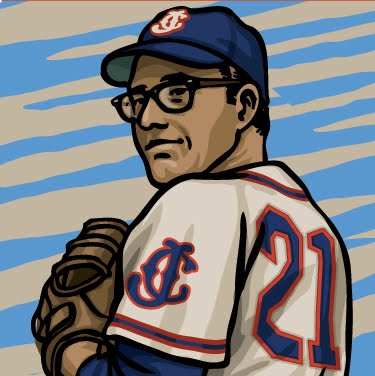
135. Rap Dixon: The Negro Leagues' Best Left Fielder

Every so often I get requests for ballplayers to feature on the site. This week's player was suggested by a reader over a year ago and not only did he ask me to feature this particular player, but he also took the time to write out a nice outline of his career to get me started. It took me quite a long time to assemble everything, research, drawing and actually writing it all down, but finally, here it is...

Now the first thing you think about when you here that a ballplayer's nickname is "Rap" is a massive slugger, right? Rap has got to be derived from the sound the ball makes when it "raps" into the outfield wall. Well, in Herbert Albert Dixon's case, "Rap" was short for the Rappahannock River. Why was he named after a river in Virginia? I have no idea. He was born in Kingston, Georgia and grew up in Steelton, Pennsylvania. I'll make an educated guess and throw it out there that perhaps Dixon's family, after leaving Georgia, briefly settled in Virginia, somewhere along the banks of that river. Moving to urban Pennsylvania it was probably just natural his nickname reflected the place he'd come from. But, like I said, it's all just a guess. What is known for sure is that by his teens Dixon was living in Steelton where his Pop was a steelworker.

Colonel Strothers, the owner and manager of the semi-pro Harrisburg Giants, spied the 20 year-old "Rap" Dixon playing sandlot ball in Steelton, Pennsylvania and snatched him up for his own ball club. Strothers was in the process of turning his semi-pro Giants into a big league quality team and the was Dixon played the outfield Strothers knew this kid would be an integral part of what he envisioned for his club. 

By 1924 the Harrisburg Giants had become that pro club the Colonel envisioned. To compliment his young left fielder, Struthers signed Oscar Charleston to play center and brought in Fats Jenkins to anchor right field. The Dixon-Charleston-Jenkins combo became what may have been the greatest outfield of all-time. 

The Giants joined the Eastern Colored League in 1924 and Dixon began what should be a hall of fame career. In 47 games he hit a .265 but did slug 4 homers and demonstrated solid skills on the base paths. His fielding out in left field was so impressive that there was no question he would be in that same place the next season. Playing full time in 1925 Dixon responded by knocking the ball around for a  .344 average. After the regular season, Dixon was invited to go to the West Coast and play in the winter league around Los Angeles. Off-season baseball work was scarce and only the best ballplayers were offered slots in the winter league so it speaks highly of Dixon's talent at the age of 23 that he was granted a berth on one of those all-star teams. 

Back east with Harrisburg again in 1926 he's credited with a .310 average and many Negro teams tried to get Dixon to jump the Giants and join their clubs, to no avail. The left fielder was tall and bony, just over 6 feet tall. His legs were stripped down and built for speed and his arms were the only thing on him that could be called muscular, which was the source of his cannon arm and the reason he could scatter booming line drives all over a ball field. By 1927 no one remembered that "Rap" had anything to do with a river. To blackball fans, "Rap" was what he did to a baseball, and that was that.

Instead of heading out west in the winter of 1927 and stopping at Los Angeles, Dixon was recruited by famed catcher Biz Mackey to join his team which was headed to the Orient to play ball. The team, dubbed the Philadelphia Royal Giants, stopped off in many exotic locations including the Philippines and Japan, spreading the brand of ball playing they played in the Negro leagues. Japan particularly embraced the American visitors and Dixon in particular. The fans were captivated by his "shadowball" pantomime routine before games and one of his home runs was so impressive that a plaque was erected to commemorate it. His batting performance in Japan was so impressive that it earned him a special trophy from the Emperor Hirohito. 

When the tour ended Dixon took his brand of ball playing to the Baltimore Black Sox. Baltimore had consistently fielded a competitive team but always seemed to fall short at the end of the season. The addition of Rap Dixon to the lineup was that missing part of the machine. After batting .382 in 1928, the Black Sox finally put it all together the next season and they won the league championship, Dixon's .369 tally adding considerably to a well-balanced ball club. Unfortunately the league disbanded after that and while the 1930 Black Sox were considered even better than the previous edition, they were an independent club and it's not easy to gauge in retrospect how good they were. 

One thing is for certain however, and that is that Rap Dixon was a superstar. In July of 1930 Yankee Stadium was officially opened up to black teams and the Black Sox were there to play the hometown Lincoln Giants in the House that Ruth Built. By the time the game ended that afternoon Dixon had gone down in the history books as not only the first black ball player to hit a home run in Yankee Stadium, but he hit three of them that day. It was a monstrous demonstration of power in front of a huge crowd in the largest city in the nation. If anyone didn't know about Rap Dixon by the morning before that game, they sure did afterwards. 

Unfortunately along with fame comes a whole cart full of unwanted baggage and Dixon fell victim to two of the most common ones - booze and ego. That drinking went along with the transient lifestyle of a ballplayer is not sup prizing. Black or white, many great careers were damaged by the sauce and Dixon was no different. Alcohol combined with a swollen head made for an unpleasant teammate. But, just like his white counterparts, as long as you performed on the field such unpleasantness's were overlooked.

Like many stars of blackball, Dixon now began the life of ball player for hire, frequently switching teams and showing up bat in hand to whichever team offered him the most money. One thing everyone who followed Negro baseball was that when Rap Dixon came to join your team, he was bringing speed, power and the the best fielding skills around. Dixon's appearance in the lineup was like money in the bank. In 1931 he was roaming left field in a Hilldale uniform. 1932 found him on the Pittsburgh Crawfords, one of the best ball clubs ever assembled, black, white, brown or any other color. The next season he was recruited by the Philadelphia Stars and creamed the ball for a .370 average. When the voting for the very first All-Star Game was tallied in July of that year, Rap Dixon was the East's starting left fielder of course. He promptly stole the first base in All-Star history.

When he went south to Puerto Rico in the winter of 1933-34, Dixon was at the top of his game. Then it all ended. Sliding into second base, Dixon severely injured his spine. The all-star spent almost half a season in the hospital and when he finally returned to the game he wasn't even half the player he was before. Philadelphia cut Dixon loose but Baltimore took a chance on their old star and hired him as manager of the Black Sox. While he was one of the best ballplayers to ever step on a ball field, he wasn't a skilled enough manager to make a difference with the lack-luster club Baltimore saddled him with and the club folded. The Brooklyn Eagles picked up his contract the next season bu he didn't stick and he bumped around a series of teams in quick succession before hanging up his spikes after the 1937 season. He stayed in the game as a manager of a few low-level teams including a reconstituted Harrisburg Giants in the 1940's. Though Harrisburg's level of play wasn't one the same level as a Negro National League team, it was notable for another reason - it was an integrated ball club - a rarity back then and perhaps one of the many reasons which proved why Jackie Robinson should be given a shot at professional ball in 1946.

After a good 15 years of heavy drinking, Rap Dixon succumbed to tuberculosis in July of 1944. His heath had been declining steadily since his hospitalization ten years earlier and his death wasn't much of a surprise to those who knew him. When Oscar Charleston was creating his all-time dream lineup of Negro league players in 1949 he chose his old Harrisburg teammate to be the starting left fielder. Quite a compliment considering the source and the vast pool of talent he had to choose from. The Hall of Fame had Dixon on their ballot in 2006 but he failed to garner enough votes. Perhaps one day when guys like Gil Hodges and Sammy T. Hughes get their just rewards, the name Herbert Albert "Rap" Dixon will be right along with them.

Friday, May 20, 2011

76. Cool Papa Bell: Mythbusting


This week I wanted to feature a ballplayer that is in the next issue of 21 which will focus on the 1933 Pittsburgh Crawfords. The Craws were such a great team with no shortage of superstar players - Oscar Charleston, Satchel Paige, Judy Johnson, Ted Page... it was a veritable All-Star team (in fact 7 of the Crawfords were picked to play in the first Negro League East-West All-Star Game that year). The choice was difficult, but I decided to go with the man who seems to be at the center of some of the greatest myths and stories in baseball history.

Back before hard-core baseball researchers like Scott Simkus and Gary Ashwill started really getting the actual statistics on the Negro Leagues, the field of blackball was filled with wondrous stories of the mysterious players who played before Jackie Robinson. Robert Peterson's seminal book on the subject "Only The Ball Was White" started the whole modern era of Negro League research, followed up quickly by John Holway's still enjoyable and valuable books relating his interviews with early black players. This was the "dark ages" of Negro League research, way before computers and micro-film of defunct newspapers made research easier. The subject was wrapped in oral histories, passed down by players and fans from one generation to the next, like the Greek tales of the Gods were centuries before. There were no record books like the big leagues had and no coffee table picture books were available documenting these black players. As John Holway writes in the introduction to his book "Blackball Tales," in 1969 his research into the Negro Leagues took him naturally to the Baseball hall of Fame in Cooperstown. Asking to see the Hall's files on the Negro Leagues, be was disappointed to find its collection comprised of only a scorecard of the buffoonish Indianapolis Clowns and a Washington Post article on Josh Gibson written by... John Holway! The study of Negro League ball and other outsider teams and players have come a long way since then, but along with all the knowledge gained, we also lose much of the tall-taled fun that once encased blackball and separated itself from the cold, hard facts of organized baseball.

It was the Paul Bunyan-esque figures that originally attracted me to the Negro Leagues... there was the fella who was said to have hit 70 home runs in a season, a pitcher who during a Negro League World Series game had the bases loaded and called in his outfielders and struck out the side, and of course the guy who was said to be so fast he could turn the light switch off and be under the covers before the room went black.

These stories were so fascinating to me as a young teen that it made me search for more and more and that quest eventually turned into 25 plus years of researching the old Negro Leagues. The one dangerous part of learning more is sometimes the truth behind a story is not what you want to hear. The fella who supposedly hit 70 home runs in a season was Josh Gibson in 1931. No one denies Gibson was a superstar and he'd be worth his weight in gold had he been white, but the story of those 70 home runs was just that - a story. Phil Dixon wrote The Book on the famed '31 Grays and figured out he hit 40 round-trippers, but these were against ALL levels of competition from chintzy-little town teams to top-notch black clubs and white minor league ballclubs. The pitcher who called in his outfield and struck out the side with the bases loaded in a Negro World Series game? Of course that had to be Satchel Paige. The story was colorfully related many times by his teammate Buck O'Neil, later known as the elder statesman of blackball due to his longevity and featured place in Ken Burns' "Baseball" documentary. Unfortunately, it just didn't happen. Besides being untrue, the story in my opinion makes Satchel Paige, who may have been one the greatest pitchers of all-time, look like a careless fool. While Paige undoubtedly had fun on the mound and could showboat and trash-talk better than anyone else, he was also a true professional and in games that counted he would never have done such a risky thing as call in his outfielders.

So that brings us to the third story, the one about the guy who was so fast he could turn the light switch off and get under the covers before the room went black. That was none other than James "Cool Papa" Bell.

He was born down south in Starkesville, Mississippi, his father a black farmer and his mother an Oklahoma Indian. Bell learned baseball like most young boys, did but did not consider it as a career until he left home in 1920 to join his older brothers in St. Louis so he could go to high school - Starkesville didn't have any schools above 8th grade for Negros back then.

Once in St. Louis, Bell began pitching for the local Compton Hills Cubs where the professional St. Louis Stars noticed him. For $90 a month, Bell dropped out of high school and became their new left-handed pitcher. Armed with a repertoire of screwball, knuckler and curve, Bell gained his priceless nickname "Cool Papa" when with a game on the line, he struck out the great and fearsome Oscar Charleston. After the game Bell's manager Bill Gatewood called him "one cool papa" for not being rattled when facing one of the greatest clutch hitters of all time. Like all great nicknames, "Cool Papa" stuck to Bell like it was dipped in Super Glue.

A sore arm ended Bell's promising career on the mound, but he quickly adapted by teaching himself to hit from both sides of the plate and utilising his greatest asset - his speed.

See, Cool Papa was fast! The game as it was played back in the 1920's was much different than today. There was much more aggressive base running and stealing and the blackball version of the game was even faster paced that the white one. The St. Louis Stars developed into a dynasty in the late 1920's and Cool Papa was their lead-off hitter. He didn't have much power, but when he made contact with the ball he was off like a bullet. This quickness pushed his batting average above the .300 mark in most years, higher in many others. It's hard to say for sure, the research isn't complete yet, however Scott Simkus' work on the 1933 Crawfords attributes a .307 average in 63 league games against the best black players. In exhibitions against white major leaguers Bell is verified to have batted .391 - his speed working to his benefit when playing against guys who were not used to the aggressive base running the Negro League teams displayed.

His speed out of the box surprised even veteran players and it is no exaggeration that Bell could beat out a ball hit in the infield for a single. One proven story about Bell's base running skills and speed took place during an exhibition game against Bob Lemon's white all-star team in 1948. The Cardinal's Murray Dickson was on the mound and Bell singled. The next batter, Satchel Paige, bunted in a bunt-and-run play. Bell, who was running as the ball left Dickson's hand, watched as the catcher , pitcher and third baseman all left their positions to field the ball. As Bell reached second he saw that no one was covering third so he kept going. The ball, now fielded, was sent to first base and Bell, watching all this unfold, reached third. Seeing the catcher making his way to cover third leaving home plate uncovered, flew right by him and crossed the plate before anyone else knew what was happening.

What that story proves, besides giving proof to Cool Papa's speed on the base path, is that he not only was quick, but more importantly, he was smart. It takes a very observant man to assess the situation and not only adapt to it but think one or two steps in advance. In that game in 1948, Bell wasn't playing against a rinky-dink town team but against major league players. He also 43 years-old at the time!

As an outfielder, once again Bell used his great ability to adapt to master his position. His sore arm never healed and in order to play his centerfield position he again utilized his speed to his own advantage. Bell was able to race to and catch fly balls where average players would not be able to make the play. He got around his weakened arm by developing a quick release once in possession of the ball, getting the it back to the infield faster as fast as most players who could rely on their powerful arms to get the ball there.

In our upcoming edition of 21 featuring the 1933 Pittsburgh Crawfords, Scott Simkus attributes Bell with only 2 errors during the '33 season, a cool .980 fielding percentage. In 63 verified Negro National League games that season, Simkus also recorded 12 stolen bases for Bell. 12 is a long way from the 175 he claimed to have stolen in 1933, but again these 12 were in league games against top black teams and at the same token, steals were not recorded very diligently at the time. So while it is highly unlikely Bell stole 175 bases in 1933, he probably stole more than 12 in the 63 league games and it is a given that he swiped plenty more while playing against town teams and amateur clubs that summer.

So how fast was Bell? Supposedly he was once clocked at running the bases in 11 seconds. The Baseball Hall Of Fame reportedly has some kind of documentation on this provided by Cool Papa's daughter, but I have been unable to find substantial proof of this. The official record, set in 1932 by Evar Swanson of the Columbus Red Birds, is 13.2 seconds. Official record or not, Bell was fast. While I was unable to find that all-important truth, there is something that may help validate his reputation as the fastest man in baseball. Olympian Jesse Owens was acknowledged to be the fastest man alive in the years leading up to World War II. Although he was the star of the 1936 Berlin Olympics, the 4 gold medals he won didn't put food on the table so he often toured with Negro League teams, running pre-game exhibitions against local runners and sometimes even horses. On several occasions Bell's team played against a team Owens was with and each time the Olympian declined to race against Bell - as far as I can tell the only person he refused the opportunity to race. This speaks loudly of Bell's speed at the time. Owens, who was racing against horses for God's sake, was worried about losing a race to Bell!

So anyway, some tales about Bell were unfortunately not true (like the one where he hit a single, only to be called out when the ball he hit struck him in the keister as he slid into second), or there just isn't any documented proof (running the bases in 11 seconds). But wait, what about being so fast he could turn the light switch off and be under the covers before the room went black?
That one was one of Satchel Paige's favorite stories to tell and was one of the cornerstones of the mythology that encased blackball in the "dark ages." The way Paige told it, Bell showed how fast he was by the seemingly impossible act of being quicker than light-speed. Now that is a story that has to be false, right? Wrong. Back during their days with the Crawfords, Cool Papa and Satch were roommates on the road. Bell, who wasn't anywhere near the night owl Paige was, was in his hotel room one night when he noticed that the light switch on the wall had a short. It took a few seconds between the switch being flipped and the light actually going off. Sensing a great opportunity to mess with Satchel, Bell waited up for his roommate to return from a night on the town. When he came back, Cool Papa asked Satch if he thought he was fast. Satch of course said yes. Was he so fast he could get into bed before the room went black? Satch was sceptical, and Bell got up out of bed to prove it. Hitting the switch, Bell jumped into bed and under the covers as the room went dark, leaving Satchel standing in the dark, for once, speechless...

See Cool Papa and the rest of his teammates on the 1933 Crawfords in the next issue of 21: The Illustrated Journal of Outsider Baseball coming soon...