


This is the long-delayed final installment of my Home Run Champion Triptych. I had wanted to do the Bauman/Crues/Hauser stories in quick succession, but as it sometimes does, life got in the way. October, November and December are my busy months, filled with long, lonely business travel and rush jobs that need to be completed by Christmas. This year I added on a trip to MLB's Winter Meetings in Orlando where I set up a booth for the first time. The weeks running up to that event was a blur of non-stop work as I not only designed and oversaw production of the graphics for my booth, but also completely re-vamped my website in anticipation of the trade show. For years I had CieradkowskiDesign.com as my company website. Besides being a mouthful in Manhattan, the site was clunky and impossible to update. I decided I needed a completely new site and domain. I settled on the much easier StudioGaryC.com. Since many can not pronounce "Cieradkowski," I have always been known as "Gary C," so it was only natural that I'd use that as my new domain. Besides completely re-designing my site, I also linked up my blog directly to my website. It will take a few more weeks until I get all the bugs worked out, but soon you can access The Infinite Baseball Card Set right from StudioGaryC.com. I will also have a store where along with my art posters you may also easily purchase copied of '21' and other baseball goodies. I'm quite sure all of you who have complained (rightfully) about the difficulties in ordering anything from my old site will be pleasantly pleased by the ease in which future purchases can be made. Also, the new blog will have an easier interface as well, along with a nice up to date design.
So, I just wanted to say that I am back in the writing and illustration game, and have a growing stack of stories on deck for 2018!
Joe put the gas cap back on the '52 Mercury Monterrey, and wiped his calloused hands on a rag he pulled from his back pocket. Two wide-eyed young boys, their opened mouth, freckled faces smashed against the back window, followed his every move from the back seat. A light, warm late-afternoon breeze made the enamel Texaco signs mounted above the gas pumps squeak rhythmically.
The driver stuck a pair of dollar bills through the open window and craned his head to look up at the tall gas jockey. "You gonna hit one out tonight, Joe?" Adding the two singles to the thick folded wad of greenbacks he pulled from his pocket, Joe replied "You know I'll do my best, Frank."
As he watched the Merc pull back onto Second Street, the bell above the office door jingled behind him. "Joe, it's 5" his wife called from the open door, "you better head to the ballpark."
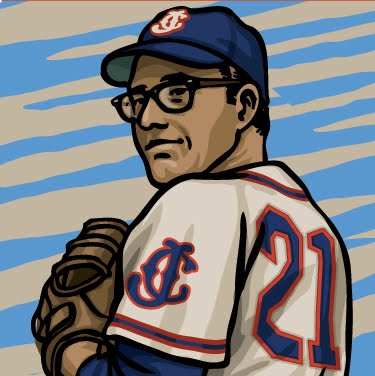
That's how it went in Roswell, New Mexico, in the summer of 1954. The Roswell Rockets star first baseman would put in a full day's work pumping gas at one of the Texaco service stations he and his wife Dorothy owned, knock off at 5 and spend the evening chasing baseball's most elusive offensive record.
Joe Bauman was a product of the Oklahoma City sandlots. Like most kids in those pre-television, pre-Play Station days, Joe grew up playing the game every chance he had. Just under six and a half feet tall and athletic, he played basketball and football at Capitol Hill High, but it was baseball that he truly loved. His pursuit of the game was encouraged by his pop, Joe Senior, who turned his naturally right handed boy into a left hander. His father also taught Joe how to wrap the palm of his right hand around the knob of the bat instead of around the handle. This helped Joe get under a ball and muscle it skyward. After he helped lead his Legion team to the state championship in 1941, Joe began getting interest from organized baseball.
It so happened that former big leaguer turned minor league skipper Bert Niehoff made his home in OKC during the winter. Although there were other offers floating out there for the big first baseman, it was that hometown connection that convinced Joe he should sign with Niehoff's team, the Little Rock Travelers. As soon as he finished his senior year, Joe got on a train to join Niehoff.
Little Rock was in the Southern Association, then classified as a Class A1 league, what today would be Double A. The Travelers were an independent club, meaning they were not affiliated with any major league team, and thus had to develop their own talent which they then sold to bigger clubs after the season ended. It was Niehoff's plan to have the 19 year-old Joe work out with his club for a few days, then farm him out to a lower level minor league for more experience. The Travelers shipped him to the Newport Dodgers in the Northeast Arkansas League. After a few weeks, Joe learned his mother died and he went home to Oklahoma for the funeral. When he returned to Newport he found that he couldn't get his head back in the game and finished 1941 with a terrible .205 average. Joe went home for the winter with the intention of getting back into the swing of things, but the Japanese had other plans which they made known on December 7, 1941.
With the United States at war in 1942, Joe put his baseball dreams on the shelf and landed a job at the Beechcraft aircraft factory in Kansas. Like every other large defense plant during the war, Beechcraft had a competitive baseball league for their workers, and Joe spent the summer of '42 playing industrial league ball. He also married his high school sweetheart, Dorothy Ramsey. As soon as he turned draft age, Joe joined the Navy, preferring to be on a ship than in a muddy trench. For the duration of the war, Joe was fortunate enough to be kept stateside, on dry land, right on the campus of the University of Oklahoma in Norman.
Besides the fact that he wasn't immediately shipped out to the South Pacific to face the Japanese, Joe was lucky because his posting gave him priceless baseball experience. Turned out that the base commander was a baseball nut and he made it a point to have a top notch baseball team. Ex-Cardinals star Charlie Gelbert was put in charge of the team which, thanks to nefarious transfers and semi-legit counter orders, was being stocked with sailors who had previous experience in the majors and minors. Soon Johnny Rizzo of the Cardinals, Al Benton of the Tigers and Bennie Warren of the Phillies were suiting up for Gelbert's team. Though he only had a lone mediocre season in the low minors, Joe got up his nerve to try out for Gelbert's team, which he made, much to his surprise. For the next three and a half years, Joe put aviation trainees through their calisthenics in the mornings and played first base in the afternoons for the base ball club, soaking up all the tips offered to him by his veteran teammates.
When he was discharged in 1946, Joe found he was still under contract to Little Rock. Now 24 years old with two years of experience playing alongside major leaguers, Joe went to spring training raring to get his baseball career back on track. Once there, he found that there were 125 former GI's vying for only a handful of spots on the Little Rock roster. Joe was sent to Amarillo in the West Texas League where he hit .301, but it was his 48 home runs that raised eyebrows. The next spring when Little Rock wanted to send him to another low-level league, Joe balked. He told the Travelers' owner point blank that for three years in the Navy he had held his own against former big leaguers - better players than were currently on the Little Rock team. He told the owner that he deserved to move up to a higher level team - or just send him back to Amarillo.
The owner of the Travelers sent him back to Amarillo.
In 1947 Joe played along side Bob Crues whose 52 homers eclipsed his own record from the previous season. With Crues stealing all the thunder with his home run onslaught, Joe concentrated on putting the ball in play more consistently. While only hitting 38 homers, the hard work improved his average to a nice .348, leading to his contract being purchased by the Boston Braves.
For 1948, the Braves placed Joe with their highest farm team, the Milwaukee Brewers of the American Association. Unfortunately, Milwaukee had a guy named Heinz Becker ensconced at first base. Besides being a former big leaguer, Becker had won the American Association batting crown in 1947 and had led the Brewers to the pennant. With this seasoned vet in place, Joe got into only a single game with Milwaukee before being shipped to Hartford.
Though Hartford was a level lower than Milwaukee, Joe got to play everyday - that is until Ray Sanders showed up. Sanders was an ex-Cardinals first baseman who was acquired by the Brewers and then shipped to Hartford because they had Becker. As good as Joe was hitting with Hartford, he was forced to play second chair to the former big leaguer Sanders. Used mostly as a pinch hitter, Joe hit .275 with 10 homers, pretty credible in that unfamiliar and difficult clutch role.
That winter Joe was back in OKC when he received his new contract from Hartford. Instead of getting a raise for 1949, the contract called for a pay cut - $400 and month instead of the $600 he made in '48. Joe returned the contract unsigned, writing "I could make more money selling twenty-seven inch shoelaces on a street corner in Oklahoma City than I can playing for you." After fruitless negotiations with Hartford's GM which ended in "take it or leave it," Joe left it and stayed home in Oklahoma.
Today it's hard to understand a guy who seemingly throws away a shot at making the majors. But when you put yourself in the cleats of a guy whose baseball clock is ticking fast and suddenly he's not only being sent back to the same level he was at last year, but at a lower salary, things get a little easier to comprehend. Add in the fact that $400 a month for just the baseball months really didn't add up to all that much. Not that Joe was a special case - minor league ball players just didn't earn all that much until unions got involved decades later. In fact, unless you were a Joe DiMaggio or Stan Musial, even the majority of big leaguers had to hold down an off-season job to make ends meet.
So, with his 27th birthday coming up, Joe said goodbye to organized baseball.
That spring Joe was contacted by the manager of a semi-pro team in Elk City, Oklahoma. Elk City was going through an oil boom and a highly competitive league of semi-pro teams had sprung up to entertain the lonely oil workers. In the time-honored tradition of the semi-pro team, Elk City was assembling a team made up of former minor leaguers and younger college players. When Elk City offered Joe the $600 Hartford wouldn't, he agreed to play. Then, just as luck would have it, the Braves organization called, offering Joe the first baseman's spot in Atlanta. He told 'em that they should have spoke up earlier and that he had given his word that he'd play the season with Elk City.
Joe played three years in the Oklahoma semi-pro oil league. Against the semi pro pitching Joe murdered the ball, earning him not just the fans roar of approval but also plenty of "screen money." A tradition of Southeast bush league baseball, "screen money" was a spontaneous monetary tribute pushed through the chicken wire screen that separated the fans from the playing field. After a particularly fine catch or hit, fans would line the fence pushing their dollar bills through the screen while the game was halted so players and umpires could collect the cash. On a good day a guy could collect a couple hundred dollars - in a boom town flush with oil cash, there was no telling how much a home run hitter like Joe could rake in.

Besides playing ball, he and a teammate bought a Texaco gas station. Joe and his teammate worked the pumps and Dorothy held down the cash register. This experience running his own business would be more beneficial to him, and shape the rest of his baseball career than anything else he learned in a ball park. By 1951, Elk City's oil boom went bust and the baseball money dried up. Over the winter a man named Earl Perry stopped by Joe's Texaco station for something more than a tank of gas. Turned out this fella was buying into a minor league team in Artesia, Texas, and wanted to know if Joe would play first base for him.
Technically, Joe was still under contract with the Boston Braves, and he told Perry that. All the fledgling team owner wanted to know was if he bought Joe's contract from the Braves, could he count on him showing up in Artesia in 1952? The answer was "yes." Several weeks later, Joe was property of the Artesia Drillers club of the Longhorn League and making more than he was in Elk City - $1000 a month and another $1000 just for signing. On top of that, the owner gave Joe the option of getting his outright release from the team after he completed his first season.
So, now after three years, Joe was back in organized baseball. But don't think he had any delusions of making it all the way to The Show - Joe was getting close to thirty and he had a wife to support. He knew he only had a handful of seasons left in him and then he was out of the game. He wisely took his experience of owning a Texaco station in Elk City and replicated it in his new home base. The knowledge that he'd have a steady income regardless of his baseball career gave him a sense of security and a maturity level most bush league ball players did not have.
Joe hit .375 with 50 homers for '52 and followed that up with .371 and 53 homers in '53. Now, in any other league, marks of 50 and 53 home runs would have been huge deal, however the Longhorn league was the backwater of organized baseball, far removed from any big cities. Plus, Longhorn league stadiums were pretty much glorified high school fields, many with odd dimensions and short fences that favored pull hitters like Joe. Hitters were also aided by the light air and hot temperatures, which added an extra pop to any ball put into the air. Still, home runs are home runs and eventually word spreads. Bob Crues made headlines coast to coast when he tied Joe Hauser's record of 69 home runs in 1948 playing in the same kind of bandbox ball parks as the Longhorn League. In '52 Bauman's 50 home runs led the league by a wide margin, the next guy hitting 27, and in '53 he hit 15 more than his closest rival. So, even with short fences and light air, Joe's home run output was far above the league average.
As popular he was with the Drillers fans, his services were no longer needed for the 1954 season. Artesia had signed a working agreement with the Dallas Steers who were sending a whole team of their own young talent to replace the Drillers current roster. Now a free agent, the slugger was quickly signed by the Roswell Rockets of the same league, where Earl Perry had turned up as the teams GM. Joe took his signing bonus and bought a brand new Texaco service station right on Roswell's Second Street, where he settled into the familiar routine of pumping gas in the day, playing ball at night. Roswell turned out to be just the place he and Dorothy were looking for to put down roots. The New Mexico town had sprung up around the Army Air Force base built during the war and which was now home to the nation's elite nuclear bomber squadrons. Besides its air force connection, Roswell had briefly made headlines in 1947 when it was reported that the army had recovered a crashed space craft. Despite its interstellar connection, the remote town had a safe, family-oriented atmosphere, and the Rockets were the go-to summer diversion for its population.
Right from the start of the 1954 season, Joe emerged as the fan's favorite Rocket. It wasn't just his home runs that made him a local hero, but also it was his modest demeanor and that his service station right in town made him something more than the usual transient ball player. The people of Roswell felt that Joe was one of them. It was true that he led a humble life, different than the typical young jocks that were spending their first year without parental superstition. Teammates later said that Joe's big night out would be a plate of chiles rellenos washed down with a Miller High Life. Although he was the Rockets veteran star, he turned down the single room option offered to him on road trips and bunked with a teammate. Likewise at home in Roswell - the Bauman's were more comfortable at a teammate's back yard barbecue than at one of Roswell's nightclubs or upscale restaurants.
The Rockets played their home games in Fair Park Field which, like most of the other ball parks in the league, had outfield dimensions that favored hitters. In 2013 baseball historian Scott Simkus wrote about Bauman and Fair Park Field in the very much missed Outsider Baseball Bulletin. Up until that time, the only reference to the park's dimensions was 329 down the right field line. No one bothered to record the other measurements until Simkus, using Google Earth, was able to calculate the dimensions of the old ball park, which still stands today, renamed Joe Bauman Field. The park's left field line was 340, center field 380 and the right field power alley was an inviting 329 feet with a 10' high fence, perfect for a left handed slugger like Joe.
Glover's Packing House offered a hog for every home run hit at Fair Park Field, and by mid-season Joe was single-handedly destroying New Mexico's pork population. He received so many courtesy hogs that he began giving them away to grateful teammates. As the home run totals grew, so did the screen money. At first he was make $40 a shot, towards the end of the season it was reported that totals of $800 had become the average compensation for a Joe Bauman blast.
Years later, Joe was asked what made him hit so many home runs in 1954. Joe attributed his success to the fact that he was healthy all season, no colds or injuries, and more importantly, the ball looked like the size of a cantaloupe all year long. Late in the season, Joe started to wear down. The summer heat and age was catching up with him so he went to a doctor in Roswell. The solution was a lighter bat - Joe switched to a 36 inch/34 ounce Vern Stephens S2 model Louisville Slugger - and a B-12 vitamin shot. Joe's home run assault continued. On August 22 he launched three home runs in a double header against San Angelo, giving him 60 for the season. The middle one gave him the organized baseball record for most home runs in a three year period, 163. The record was previously held by Babe Ruth for his 1926, 27 and 28 seasons in which he hit total of 161. Joe then hit three more in the next three games to bring him to number 63. With only seven games left to play, Joe was still six home runs away from Hauser and Crues record. Then on August 31 he unleashed a hail of hurt against the Sweetwater Spudders pitching staff, slamming four home runs and driving in 10 runs in the 15-9 victory.
The last home run he hit in front of the Roswell fans was number 69, a 375-foot shot that tied Joe Hauser and Bob Crues' record. The local paper reported that the roar let lose by the overflowing crowd as the ball cleared the right field wall could be heard two miles away. The Rockets finished their season on the road with two games each against Big Springs and Artesia. Now the pressure was really on. Life, Sports Illustrated and countless news outlets sent photographers and writers to cover Bauman's every swing. In the first two games, the Big Springs pitchers pitched around him and incessant flashes from photographers distracted the humble slugger as he went homerless. The last day of the season was a double header against the Artesia NuMexers (the Drillers had re-branded themselves after Joe left). Rockets manager Pat Stasey penciled Joe into the lead off spot so he would have more chances to bat. Twenty-six thousand fans jammed into Artesia's ball park to watch history being made. Among the crowd was Joe's mother and father who secretly slipped into town so as not to disturb their boy's concentration. The crowd didn't have long to wait for the record breaking homer. In his first at bat, Artesia's Cuban ace Jose Gallardo rang up a 2-2 count before Joe blasted a fastball 349 feet to set the new record for single season home runs. After rounding the bases Joe joined the other ballplayers in collecting the money pushed through the chicken wire fence by grateful fans. Joe pocketed a reported $800 for number 70. Since the season was effectively over and both Artesia and Roswell had made the playoffs, both teams used position players as pitchers in the second game of the double header. Against these ersatz hurlers, Joe hit homers 71 and 72, thus setting the final number that would stand until a steroid-addled Barry Bonds would hit 73 in 2001.
Joe ended 1954 with those 72 home runs, an even .400 average and 224 RBI, good enough for the Longhorn League Triple Crown. He averaged a home run every 6.9 at bats and his slugging percentage of .916 was 69 points better than Ruth's best (or 53 better than Bonds, if you count his bloated steroid stats). In the Longhorn League playoffs, Roswell lost the in the first round to Carlsbad, 4 games to two. As for Joe, at age 32, there were no big league offers on the table, though the San Francisco Seals of the Pacific Coast League did give him a call. But Joe was realistic. He could uproot he and Dorothy and go to Frisco, but what would he gain from that? One last big baseball paycheck? He knew he'd never get further than the Pacific Coast League, and after that, what, maybe two or three more seasons as he pinballed his way back down to the Longhorn League level? Nah, he and Dorothy had found a home in Roswell, so he signed on the dotted line for the same salary he got in '54 and stayed with the Rockets.
Joe again led the league in homers, 48, though his average slipped to a more human .336. Over the winter, the ball player slipped in the snow and injured his ankle. Doctors told him that he'd need surgery to play ball so he voluntarily retired. But the Roswell fans wouldn't have it. Reluctantly, he signed for 1956. By early June he had hit 17 homers in 52 games, but the pain in his ankle hurt incessantly. He told a teammate he was having trouble seeing the ball, which in a league filled with young and wild pitchers meant big trouble for a target as big as Joe. So, on June 12, 1956, baseball's leader in single season home runs retired from the game.
Joe slipped right into the role of full-time gas station owner, eventually adding a second Texaco station to his service station empire. He briefly managed the Roswell Pirates minor league team in 1959, but he begged out halfway through the season. Joe later joined his father in law in a liquor store venture and then managing a beer distributor. Through it all, he and Dorothy lived in Roswell, the New Mexico town where he made history back in the summer of 1954.
These days you hear so many stories about those old ball players who look back at the life they devoted to baseball and feel short-changed by the game they loved, but that's not what became of Joe Bauman. Ever since he broke the record in 1954 he's been the subject of countless articles trying to belittle in varying degrees his accomplishment, attributing it to bad pitching, light air, short fences, heck, even aliens. Heck, during the Barry Bonds/Sammy Sosa/Mark McGwire era some writers tried to equate Joe's B-12 vitamin boost to the steroids those juicers had pumping through their veins. Every so often a baseball writer would get a hold of the old champ in person to get his opinion on some young ball player who was challenging his record, or to be a part of one of those "where are they now" pieces papers like to run when news is slow. To the day he passed away in 2005, Joe remained modestly proud of his record, his memory untainted by any false illusions of his ability to get to the majors. Joe was a proud bush leaguer through and through, nothing more, but certainly nothing less.
This story was partially built from a very good interview Joe Bauman gave Tony Salin for his terrific book Baseball’s Forgotten Heroes: One Fan’s Search for the Game’s Most Interesting Overlooked Players. For both the Bauman story and the previous one on Bob Crues, Toby Smith's Bush League Boys: The Postwar Legends of Baseball in the American Southwest was instrumental for its small details such as the kind of beer Bauman drank (Miller High Life) as well as giving an invaluable look at life the Southwest bush leagues. It's a really well researched book and should be part of yor baseball library. Of course, the life’s blood of any great baseball history story are the original newspaper articles written during the time the events took place. Since Bauman's record was reported by all the major news outlets, there were plenty of newspaper stories from which I could build this story.


