
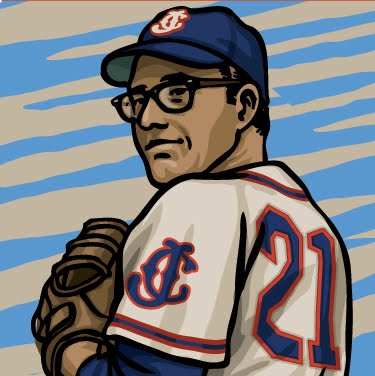


Writing up the Subway Sam Nahem story last month, I related how I learned about him from Negro League All-Star and Baseball Hall Of Fame member Leon Day, who'd played with Nahem during the war on one of the first, if not the first, integrated military baseball team. Like I related in the Nahem story, Leon told me that the game he was most proud of in his long and storied career was the one he pitched against Patton's 3rd Army team in the 1945 G.I. World Series. It's a great and little known part of baseball history and I thought it deserved a place here at the Infinite Baseball Card Set...
By 1942 Leon was one of the best pitchers in baseball. During that year's East-West All-Star Game Day entered the game in the 7th inning and beat Satchel Paige, striking out 5 of the first 7 batters. The next year Newark had a lousy team, hampered by players entering the service and Day fell to 4-5 but he pulled extra duty as an outfielder and hit a nice .304 before he too got the call from Uncle Sam.
Day shipped out to England with the 818th Amphibian Battalion and went ashore on Utah Beach on June 6th, 1944. Leon drove a DUKW, a six-wheeled amphibious vehicle, across France and Belgium throughout 1944 and '45. When the war ended, Day was recruited to pitch for the Com Z OISE All-Stars baseball team that represented the Forward Base at Reims, France. With the war over and thousands of troops anxiously waiting around to go home, baseball leagues were organized to take the men's minds away from mischief. The U.S. Army had a plethora of former big league ballplayers and each unit fielded a competitive team with the local champs going through a serious of playoffs culminating in the G.I. World Series to be held in September, 1945.
The OISE All-Stars were a scrappy hodge-podge made up of former semi-pro players and low-level minor leaguers put together by former Brooklyn Dodgers and St. Louis Cardinals pitcher Subway Sam Nahem. With the inclusion of Leon Day and former Kansas City Monarch slugger Willard Brown the All-Stars became one of the first integrated ball clubs in the military. Against all odds, the OISE team decisively beat team after team, steadily advancing through the playoffs.
Meanwhile, on the other side of Europe in occupied Germany, the 71st Infantry Division Red Circlers team pounded their way through the playoffs. Led by Cincinnati Reds pitcher Ewell Blackwell and St. Louis Cardinals star Harry Walker, the Red Circlers boasted an alarming 9 former major leaguers and 3 more who'd play in the bigs right after the war. Representing General George Patton's 3rd Army, the Red Circlers were the odd-on favorites, and just to be sure, Patton had 7 former pro ballplayers transferred to the 71st Infantry just in time for the opening game of the G.I. World Series.
On September 2nd, 1945, 50,000 GI's packed Nuremberg Stadium to see the first game of the best of 5 series. Armed forces radio was on hand to broadcast the games to the thousands of other GI's stationed throughout Europe and Africa. It wasn't the real world Series, but there was enough major league talent on hand to make it enjoyable. During the course of World War II, no less than 500 big league ballplayers and 4,000 minor leaguers were in the service, and all the best ones seemed to be on Patton's team. As expected, the Red Circlers' beat up on Bobby Keane, former Brooklyn Bushwicks semi-pro hurler, and won the first game 9-2.
The next day was Labor Day in America and in Nuremberg 45,000 soldiers filled the stands of Hitler's former stadium expecting to watch another one-sided contest. Coach Nahem gave the ball to Leon Day. Facing major league talent was nothing new to Day, heck he was a veteran of the Negro National League and had out-dueled Satchel Paige himself on numerous occasions. The Red Circlers may be more well known than the OISE All-Stars, but that didn't mean Leon Day couldn't handle them. Facing off against minor leaguer Walter "Ole" Olson, Day was simply magnificent, holding the big league sluggers to just 4 hits and not allowing a single run for the first 8 innings. However Olson also did well, keeping the game scoreless despite being hit hard by the All-Stars. OISE's first baseman Tony Jaros, a 6'-3" giant who played Big Ten basketball for Minnesota before the war, belted out 3 doubles in the game and Subway Sam Nahen added two doubles of his own to the mix. Finally in the sixth with no one out, St. Louis semi-pro Joe Herman singled followed by a walk to Roy Marion. That brought up Kansas City Monarch All-Star Willard Brown who banged out an RBI singles scoring Herman. Jaros came up next but went down swinging. Nick "Warehouse" Macone popped out and then Olson fanned Ty Richardson to get out of the inning. The next inning the All-Stars jumped on Olson again, this time Emmet Altenburg tripled to right-center field followed by Coach Nahem's double to the same place, pushing across a run.
The next inning Patton's men came to life and finally tapped Day for a run. With two outs, St. Louis Cardinals All-Star Harry "The Hat" Walker got a double off of Day and then Cincinnati Reds' second baseman Benny Zientara doubled him home. With the tying run on second and the go-ahead run at the plate in the form of Pittsburgh Pirate Johnny Wyrostek, Leon Day, proving that the previous 2 years in the service didn't hamper his pitching, struck him out to end the inning. It was a surprising upset and Day proved he could more than hold his own against white major league talent. All told, Day had struck out 10 batters and walked only 2 that day and the OISE All-Stars evened the series at 1 game a piece.
The series then shifted to Reims, France where the OISE All-Stars were based. Subway Sam penciled himself in as the starting pitcher and tossed a great game, winning 2-1. With the All-Stars now unbelievably up 2 games to 1, Leon Day was tapped to pitch game 4.
Unfortunately Leon didn't have his stuff that afternoon and by the 4th inning he's given up 4 runs on 6 hits and was taken out of the game. The Red Circlers won 5-0 and evened up the series. The fifth and deciding game was a see-saw event with the All-Stars eventually scoring the winning run in the 9th inning to take the game and the series, 2-1. Now OISE was supposed to be headed to Rome to take on the Mediterranean champs but unfortunately things got fowled up. Not content with being the losing team, many of the major league players on the Red Circlers got themselves transferred to the OISE All-Stars and many of the unknown semi-pros who were the heart and soul of the scrappy team were left behind in Reims. Leon was still bitter about that years later when retelling the story. But, in the end I guess it didn't matter all that much, Leon got his honorable discharge and in his first Negro League game threw a no-hitter against the Philly Stars on opening day, 1946. While not as flashy and well known as Satchel Paige, Leon Day was shown the ultimate tribute when a panel of his peers elected him into the Baseball Hall of Fame shortly before his death in 1995.

