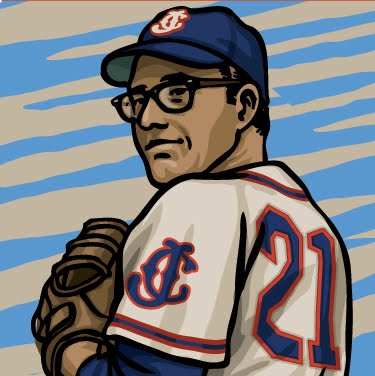
I just got back from two long business trips. Looking out the window as the place followed the Ohio River toward the airport, I got that "it's good to be back" feeling, and when my plane touched down in Kentucky, I can't tell you how glad I felt that this was my home. So, in honor of my adopted state, I thought I'd share a larger illustration I did of one of baseball's greatest players, and tell you a bit how he got his start in ol' Kentucky...
Future New York Yankees president Ed Barrow was managing the Paterson Silk Weavers in New Jersey when he discovered Honus Wagner. The big, bow-legged kid from Pennsylvania turned out to be a tremendous hitter - but a liability in the field. None the less Barrow could see Wagner’s potential and convinced Barney Dreyfuss, owner of the Louisville Colonels to sign him in 1897.
Louisville was a National League team at the time and Wagner hit big league pitching at a .330 clip. He also turned himself into a superior third baseman and by 1899 was one of the best players in the National League. Despite his ungainly physique, Wagner was one of the era’s most daring and successful base runners and in 1898 he was the first player to steal second, third and home in succession.
Wagner was a big hit with the Louisville fans. He won a throwing contest by hurling a ball 403 feet. To make the most of his popularity his likeness was used to sell locally made cigars - a practise he famously discontinued a decade later when he forced the removal of his baseball card from cigarette packs. The few copies that survive are the most sought after and valuable piece of sports memorabilia in existence.
The National League contracted from twelve to eight teams after the 1899 season and the Louisville franchise was eliminated. Barney Dreyfuss bought into the Pittsburgh club and took Wagner with him. In his first season in Pittsburgh Wagner won the first of eight batting crowns he would win during his Hall of Fame career. And even though Honus Wagner left Kentucky after 1899, he returned in 1905 to sign a contract with Hillerich & Bradsby becoming the first ball player to have his own signature model Louisville Slugger bat.
Last year I began to write a story about the early career of Hack Wilson. I was always fascinated by the guy, ever since I saw a photo of him standing with Lou Gehrig and Babe Ruth in a book I had as a kid. His odd physique (5'-6" with a Ruthian barrel chest wearing a size 5 1/2 shoe) made me do a double-take, and when I learned of his amazing 191 RBI season in 1930 it made me want to learn more about this odd guy. Wilson and the other 1920's Cubs really came alive for me in "Mr. Wrigley's Ballclub" by Roberts Ehrgott (a must-read for any pre-war baseball fan, I can't recommend this book enough!) and I drew up a few versions of a Hack Wilson minor league card. However, to use a real flaky artist term, none of them "felt" right to me and I never got around to finishing the story. Instead, I stumbled upon a newspaper story from the opposite end of his career and got gleefully side tracked. You can read that story HERE, it's become one of my favorites. So, the pre-big league Hack Wilson story got put on the shelf - that is until now. This weekend I put the finishing touches on an illustration of Hack that I felt fit him perfectly and dug up my stack of 1921-1922 newspaper clippings and notes and got to work...
It was Opening Day in the Blue Ridge League, 1921.
The Martinsburg Blue Sox, a league powerhouse since the loop was founded, looked like they had another pennant winner. But besides the hold overs from last season like Reggie Rawlings and Johnny Neun, there was a new kid in town, about as odd a looking ballplayer to ever step foot on a diamond.
The kid (and I'm using that term loosely now) sprang forth from the rough factory towns of Western Pennsylvania. The illegitimate son of part-time laborer and full-time drunk and a wandering prostitute, Lewis Wilson grew up more or less on his own. His mother died of appendicitis when he was seven and his father entrusted the boy to the care of the woman who ran the boarding house they lived in. Fortunately the proprietor and her son were a huge baseball fans and both tutored the young boy in the finer points of the game.
Like I mentioned earlier, Lew was an odd looking fella - he was short, had a big, flat, moon face, a stocky torso perched on dainty ankles that terminated at even daintier feet. He also perspired - a lot. Modern scholars of the game have speculated that Lew's appearance and later actions as an adult had the hallmarks of Fetal Alcohol Syndrome, a birth defect brought on by excessive drinking during pregnancy. With his parents track record, it could very well be the case. Being such an ungainly looking figure made him the object of every bully in town, so Lew grew up knowing how to use his fists. With no good male role models except his booze-hound of a father, he also took to drinking at a young age, a habit that would have serious consequences to both his career and personal life (see my earlier story HERE). At 16 he quit school and worked first in a locomotive factory, then a shipyard. The intense physical labor not only hardened his rough physique, but it also gave him the chance to showcase his baseball skills in the highly competitive industrial leagues in operation at that time.
Now at his full adult height of 5'-6", 190 pounds with a size 5 1/2 foot, Lew billed himself as a catcher and his prowess with a bat earned him a $175 a month contract to play ball for the Martisburg Blue Sox. Martinsburg was a mid-sized mill and railroad town in the eastern panhandle of West Virginia. It was an unpolished, homey kind of place and Lew took to it like it was the home he never had. Indeed, Martinsburg would be his primary residence for most of his life and the town still proudly claims him as one of their own.
The Blue Sox had a pretty good veteran core in 1921. The team already had a starting backstop, but by the time spring training ended Lew had edged his way into the starting lineup. So, that Opening Day in 1921, Martinsburg fans were expecting great things from Lewis Wilson.
They'd have to wait.
Sliding into home plate that Opening Day, Wilson suffered a compound fracture of his right tibia. Back in 1921 this was a very serious injury that often left a man with a limp for the rest of his life. A gimp leg would mean no professional baseball career. Somehow Wilson kept himself positive during the long hospital stay. This was no doubt helped when he made the acquaintance of the friend of one of his nurses. Wilson and Virginia Riddleburger hit it off and soon the pair were seriously dating. Virginia was a good dozen years older than the 21 year-old ballplayer, and it would not be out of line to suspect that Wilson saw her as part mother-figure. Virginia had been married before, and at age 34 might have felt that this colorful young ballplayer was her chance to shake off grim prospect of living the rest of her days as a small town spinster divorcee. Whatever the reason, the two were devoted to one another and soon Virginia was a baseball fan.
After two months out of the action, Wilson played the last 30 games of the season, his new girl in the stands cheering him on. Now hobbled with a slight limp he'd have the rest of his life, Wilson pounded out 36 hits in 101 at bats for a nice .356 average. His total of five home runs were but a tiny taste of what was to come. When the season ended Wilson stayed in Martinsburg to work in the mills and court Virginia. Wilson was a jovial, good natured fella who soon became a favorite character around town. His odd barrel chested frame earned him the nickname "Stouts" and every Blue Sox fan looked forward to the 1922 season.
From the start Wilson pounded the ball. By July he broke the Blue Ridge League record for single season home runs and had doubled it by the end of the summer. He hit the ball at a .366 clip and eventually adjusted to his new position of outfielder. The Blue Sox won the pennant and then league Championship. Home run champ of the Blue Ridge League was swell, but Wilson wanted to be a big leaguer. The only way to reach that goal was to keep posting good numbers until someone from a higher up league took notice. Lucky for him, someone did.
After hearing of a big little fella making a whole lot of noise up in the Blue Ridge Mountains all season, Frank Lawrence traveled to Martinsburg to have himself a look. Lawrence owned the Portsmouth Truckers of the Virginia League, a rung or two higher up the ladder than Martinsburg. Impressed and quite satisfied, Lawrence wrote a $500 check to the Blue Sox ownership and Stouts Wilson became a Trucker.
He was one step closer to his dream.
Over the past two weeks I've unveiled two of my commissions for The National Pastime Museum: my interpretation of "Casey at the Bat" and Grover Cleveland Alexander. The third and final piece commissioned was of Hall of Famer Tris Speaker.
Speaker had a long, illustrious career, first with the Boston Red Sox when they won the World Series in 1912 and 1915, and then with the Cleveland Indians where he led the Tribe to the 1920 World Championship. When Speaker wrapped up his career in 1928 his average was frozen at .345, still sixth best of all-time. He holds the record for career doubles and ranks fifth in total hits. As powerful as Speaker was at the plate, he truly excelled in the outfield - beat writers at the time gave his glove the coolest description ever bestowed on an inanimate piece of sporting equipment - "the place triples go to die".
As good as he was on the playing field, Tris Speaker also had a dark side. As a young player with Boston he was mixed up in the Catholic vs. Protestant rivalry on the team, something he brought with him when he moved to Cleveland in 1916. His anti-Catholic feelings were so strong that he refused to attend his friend Ray Chapman's funeral after he was killed by Carl Mays' erritant pitch in 1920 because it was in a Catholic church. Sportswriter Fred Lieb wrote in his book "Baseball as I have Known It" that Speaker revealed he was a member of the Ku Klux Klan. Still, when Larry Doby joined the Indians in 1947, Speaker was a scout/good will ambassador for the club and reportedly displayed complete support for the AL's first Black ballplayer.
Speaker's career in the majors ended under a dark cloud in 1926 when he and Ty Cobb were implicated in a game-fixing scandal by former teammate Dutch Leonard. An investigation by Commissioner Landis ultimately found nothing to it, but by the time he was cleared Speaker was out of the majors and managing in minor leagues. Scandal or no scandal, Tris Speaker left behind such impressive numbers that nothing could possibly stand in the way of his enshrinement in Cooperstown.
For my illustration I wanted to do something that visually popped. I went through my library and found a photo postcard of a player wearing a 1911-1912 Red Sox warm-up sweater. Made of red and white wool, that thing must have popped in real life. the time period worked well, too. 1912 was Speaker's first really great year in majors as he helped bring Boston a World Championship - and even better - 1912 was the inaugural year for Fenway Park.
So, allow me to introduce Tristram E. Speaker, Fenway Park, Fall of 1912...
I'd like to thank The National Pastime Museum for the commission of these three pieces. On top of being a lot of fun to research and execute, it is a great honor to be part of their permanent collection of baseball art.
Those
who have met me in person know I'm not the kind of guy to toot my own
horn. In fact, much to my detriment, I'm lousy about promoting myself.
That's why it's hard for me to ask this, but this is something that
needs to be done: if you bought a copy of The League of Outsider
Baseball, can you please take the time to write a review of it on Amazon, Barnes and Noble or Good Reads?
It would mean a lot to me and most importantly give future publishers
an idea of what the book reading public thinks of my work. Almost all of
the existing reader's reviews have been flattering, but every once in a
while some crackpot writes a clunker out of jealousy or boredom. I for one often look at the reviews
on those sites before I spend my money on a book. Reviews aren't the
only thing I rely on in my purchasing process but it's certainly a
factor, and that's why I'm asking you to please take the time to write
your thoughts about my work.
This Fall was pretty hectic for me. Along with my usual design work I was lucky enough to participate in a couple of book festivals and signings. I've also had a few interesting art commissions, most notably the "Casey at the Bat" interpretation for The National Pastime Museum. In addition to the Mudville 9, The Museum also asked me illustrate two Hall of Famers for their collection. The first was Grover Cleveland Alexander.
"Pete"
Alexander had a remarkable career that stretched from his rookie year in 1911 through the
late 1930's when he was an arm-for-hire on the barnstorming circuit. In 1915, 1916 and 1920 Alexander won the pitching Triple Crown, leading his league in wins, strikeouts and ERA. Six times he topped the NL in wins, including four consecutive seasons. He won a staggering 373 games plus three in the World Series.
Along with being one of the greatest pitchers to ever play the game,
Alexander earned himself a reputation as a surly prima-donna with a drinking problem. He also suffered lingering effects of shell-shock from his days in France during the First World War and was an epileptic, untreatable and misunderstood back then. Alexander tried to hide his epilepsy, the result being that his seizures were often mistaken for bouts of drunkenness.
Pete Alexander also left us with one of the most dramatic moments in Post-Season
history - one so clouded in mystery it's not known whether it even happened like the
often-repeated story.
And that's the moment I wanted to depict in my illustration.
Of course I'm talking about Game 7 of the 1926 World Series.
The 39 year-old Alexander had already chalked up two complete game wins against the Yankees, the second coming in Game 6 to even up the series and force a deciding seventh game. Those things are hard facts - now the legend kicks in. Knowing he would not be called to pitch in the final game the next afternoon, Alexander went out after the game to celebrate his victory. According to stories told by a few of his teammates which have since become baseball legend, Alexander spent most of Game 7 in the Cardinals bullpen either horribly hung over, or
awake and still sneaking drinks from a hidden bottle of whiskey. Either
way he supposedly didn't expect to be called on to play that day.
That all changed in the seventh inning when Cards starter Jesse Haines developed a blister on his pitching hand. With two outs and St. Louis clinging to a 3-2 lead, the Yankees had loaded the bases. Future Hall of Famer Tony Lazzeri was due up next. The game and the World Series hung in the balance so Cardinals manager Rogers Hornsby called on the one man with the right skills and experience needed to get the job done - Pete Alexander.
So hung over, sleeping or still drunk, Pete Alexander emerged from the bullpen and took the mound. The results was one of the most dramatic moments in baseball history: he struck Lazzeri out. The old righty then took the mound in the 8th and 9th innings, holding the Yankees scoreless and winning the World Series for St. Louis.
The tale has gone down as one of those great baseball stories, like Bobby Thomson's home run in the '51 playoffs, Curt Schilling's bleeding ankle and Babe Ruth's called shot. But was it that dramatic? I'm not so sure. Don't get me wrong, it was THE pivotal point in the game - the Yankees with Ruth, Gehrig, Combs, and all those other guys was a dangerous powerhouse. You just weren't safe with a one-run lead. My problem lies with two other aspects of the story.
The first is whether or not Alexander was sleeping, completely hung over or still boozing it up in the bullpen. It ain't a secret that Ol' Pete was a juicer. In fact 1927 would be his last effective season in the big leagues before the sauce took over his life. So it isn't far fetched to see the aging Alexander tying one one the night he won Game 6. He probably did have a hangover the next day. But was he still boozing it up in the bullpen or still drunk? I say no. Pete Alexander may have been a lot of things, but he was first and foremost a professional. Back in 1926 there really was no specialized relief pitchers and Alexander knew that if Haines got into trouble the chances were pretty good that he'd be put in to pitch. Sure he pitched a complete game the day before, but doing a little relief work was nothing out of the ordinary for a seasoned starter like Alexander. He knew this, the manager Rogers Hornsby knew it and that's exactly what happened when Haines got his blister in the 7th inning. Back during that 1926 World Series, Alexander knew he was reaching the end of his career and thus far his great performance in the Series solidified his stature as one of the game's greatest pitchers. He was at the top of his career and he lived for moments like this. Years later when Alexander was working the barnstorming circuit with teams like the bearded House of David, the old ace was in the throes of full-blown alcoholism. His career was in the toilet, his wife left him and he was eking out a living pitching an inning or two in dusty Midwestern towns for a team of bearded amateurs. Now at the low part of his life it isn't hard to see Alexander having to rely on the bottle to dull his senses and indeed many of the stories of him being drunk on a ball field stem from this period of his life - not from his big league days.
Another little tidbit that helps pooh-pooh the bottle in the bullpen tale is that the Cards' manager, Rogers Hornsby, was a teetotaler who wouldn't even let his players see a movie or read a newspaper in the locker room lest it harm their batting eye. Drinking in the bullpen? No freakin' way. Alexander was a superstar and probably was permitted to get away with a lot, but not that much.
The other aspect that is slightly troubling about the story centers around the guy Alexander struck out - Tony Lazzeri. Today we all know Lazzeri as the Hall of Fame second baseman who more than held his own in a Yankee line up that featured the likes of Babe Ruth, Lou Gehrig and a smorgasbord of other superstars. But in 1926 when this story unfolded, Tony Lazzeri was a fresh-faced rookie. Sure he finished his freshman campaign third in the AL in both home runs and RBI, but he batted .275 and led the league in... strikeouts. So in short, when Alexander took the mound and peered down at the fellow with the bat in his hands 60'-6" away, he knew he was facing a kid who had power but was not guaranteed to put the ball into play. So we had a seasoned veteran, completely confident in his skills up against the rookie who whiffed more than any other man in the American League. It's not a situation any pitcher would have relished being thrust into, but f I was betting man, I'd put my greenbacks on Alexander.
So when The Museum commissioned me to do an illustration of Alexander, I wanted to depict Ol' Pete at the moment he received Hornsby's call to take the mound in Game 7. I wanted to show him the way I believe he was during that famous game, tired and at the end of a magnificent career, but a true professional, ready for anything.
Those
who have met me in person know I'm not the kind of guy to toot my own
horn. In fact, much to my detriment, I'm lousy about promoting myself.
That's why it's hard for me to ask this, but this is something that
needs to be done: if you bought a copy of The League of Outsider
Baseball, can you please take the time to write a review of it on Amazon, Barnes and Noble or Good Reads?
It would mean a lot to me and most importantly give future publishers
an idea of what the book reading public thinks of my work. Almost all of
the existing reader's reviews have been flattering, but every once in a
while some crackpot writes a clunker out of jealousy or boredom. I for one often look at the reviews
on those sites before I spend my money on a book. Reviews aren't the
only thing I rely on in my purchasing process but it's certainly a
factor, and that's why I'm asking you to please take the time to write
your thoughts about my work.
This is the third of 5 Bushwicks Stories in 5 days. For the introduction to the Bushwicks and this series please go HERE first.
One of the greatest attraction for Bushwicks fans was the revolving door of former big league stars who suited up at Dexter Park. George Earnshaw, Waite Hoyt, Jeff Tesareau and Dazzy Vance were among the aging marquee names that played a last season or two with the semi-pros.
Dazzy Vance was by far the Bushwick fan's favorite. For more than a dozen years Vance had toiled for the Brooklyn Dodgers. Although he'd won the MVP Award in 1924, led the National League in strike outs seven consecutive times and wins twice, Vance never seemed to get the adulation he deserved, solely because he played for a lousy ball club. Still, the cowboy from Iowa kept a cheery attitude and went out there every time determined to win. By the time he was released by the Dodgers in August of 1935, Vance had won just three game shy of 200 games all for a team that very rarely finished over .500. It was this determination in the face of overwhelming odds endeared him to the blue collar Brooklyn fans. Vance was a well-traveled 44 years of age when the Dodgers handed him his walking papers. Over the hill as he might be, Vance still felt he had life left in his arm and someone, somewhere would want him on their side. He didn't have to look far.
Max Rosner quickly put together a lucrative package to lure the pitcher to Woodhaven: $4,000 for 2 months work. This was a tidy sum back in 1935 and when adjusted for inflation would be about $69,000 today. For Rosner, the four grand was pretty much a guarantee that the Bushwicks would pull in sold out crowds for the rest of the season.
While today it might seem sad to see a former star playing for a semi-pro team, Vance for one didn't think so. He was going from the worst team in the National League to a team that not only drew more fans than the Dodgers but also could probably beat his old team in a short best of seven series. Another factor was Vance would get to pitch at least for a little while longer before a crowd that totally idolized him. What aging ballplayer wouldn't want to hear that roar a few more times before slipping away into the history books?
There was one last reason Vance was eager to take the Bushwicks offer, something he couldn't get with any major or minor league team. The pitcher told reporters "I'm having my first fling, too, at pitching against Negro teams".
Dazzy Vance's debut for the Bushwicks was on August 30th. Before a huge crowd Vance threw 2 hitless innings against the semi-pro Springfield Greys, striking out three. Two days later he faced his first Negro League opponent, the Nashville Elite Giants of the Negro National League, the big leagues of blackball. Although the pitcher was sick earlier in the day, once he saw the 15,000 who packed into Dexter Park to see him, he suited up. The old hurler was terrific, scattering three hits through seven innings and striking out five.
And so it went. On September 8 the bearded House of David came to Dexter Park. Pitching for the House was an even older ex-big leaguer than Vance - Grover Cleveland Alexander. Alex was barely holding himself together at this point in his career, his 49 year-old body ravaged by alcohol abuse and years of neglect. Still, 20,000 fans watched as the two dinosaurs faced off one last time. Alex lasted barely two innings, but Vance put on quite a show, six shutout innings and striking out eleven of the beards that day.
A week later he faced another Negro National League team, the Philadelphia Stars, going six innings and leaving the game down 4-3. Seven Stars were strike out victims. Five days later he lasted three innings against the Elmhurst Grays, a local white semi-pro team. On the 29th Vance pitched against the New York Cubans, striking out nine in six innings of work. If Vance truly wanted to test his mettle against the best Negro League clubs, the Elites, Stars and Cubans were among the best around, and for an aging 44 year-old, he did pretty good.
The crowds that turned out to watch Vance's swan song certainly made Max Rosner's $4,000 investment worth while. It was now midway through October and the weather was getting cold and wet. Baseball season would soon be over, but there was still one big game left. On October 13th the rival Brooklyn Bay Parkways came to play, this time with the great Babe Ruth on their team.
15,000 fans braved football weather to see the two oldsters face off. Vance was in top form, holding the 40 year-old Ruth hitless his first two at bats. When The Babe came to the plate the third time, the fans razzed the big man, all of which he took in stride. "Hell" he yelled to the crowd "I'm tryin' to get a hit!" Vance turned around and waved his outfielders in, the ultimate in baseball showmanship, a direct challenge to The Babe. Vance fired one straight down the middle for strike one. No one ever knew what the next pitch was because Ruth knocked it over the right field wall for a home run. Smiling broadly, The Babe circled the bases as the crowd went insane.
Dazzy Vance and The Babe faced off one last time a week later. Ruth went 1 for 3 and Vance, playing his last game, pitched five innings before calling it a career. The ancient pitcher retired to Florida, leading an active life and frequent guest at Brooklyn Dodgers reunions up until his death in 1961.
Mills Stadium on the west side of Chicago, August 21st, 1938.
Hack Wilson's uniform was ill-fitting, snug in all the wrong places. The wool was coarse and made the 38 year-old former Cubs star scratch and pull at the collar. Even though the ball game hadn't started yet, the grey flannel suit was completely soaked through with his sweat. If any of the sports writers who sat around him got close enough to take a whiff, they could probably discern what his choice of alcohol the previous night was. Still, the former National League Home Run and RBI Champ felt good to be back in Chicago. Although it was a mere 6 years since he last roamed the outfield for the Cubs, the ensuing seasons seemed like a lifetime.
Hack Wilson had been the National League's answer to Babe Ruth - all-swagger and raw talent packaged in as ungainly a body as ever seen on a ball field. His exuberance for the nightlife completely embodied Chicago of the Roarin' Twenties. He brawled and blustered, balked and boomed. Back then everyone was Hack's pal and Chicago was his town.
His fall was tremendous and tragic. In the season following his record 56 home runs and 191 RBI in 1930, Wilson went on a season-long slump that he never recovered from. The tyrannical Rogers Hornsby became Cubs manager that year and his relentless needling of Wilson was often whispered to be the reason behind the nosedive. Everyone knew Wilson was a juicer, a lover of the nightclub scene. For years he rode a fine line between controlling his alcohol consumption and falling prey to it, and in 1931 the later happened. He was sold to a miserable Brooklyn team in '32 then to the even lousier Phillies organization in '34. By 1935 he was released to Albany in the minor leagues, a side-show attraction roaming the outfield along side Alabama Pitts, the Sing Sing convict turned ballplayer. It was damned embarrassing. When they wanted to send him to Portland he got pissy, went home to Martinsburg, West Virginia and waited for a better offer to arrive. None did.
Hack shoveled his savings into a sporting goods store that failed. Then he and a partner opened up a tavern. Hack managed to drink away any profit the joint made, which was small due to his penchant for buying the whole house round after round. His drinking alienated his wife and son. As long as Hack had money he had a steady crew of bar room pals to keep him company. When his wife finally divorced him after 15 years, she took their house and what was left of his savings. Heck, she even took his hunting shotgun. The tap room pals evaporated and Hack's drunken former-jock act wore thin. Soon his adapted hometown of Martinsburg wasn't so friendly anymore. He met and married a woman named Hazel and waited for something to happen. In late July of 1938 it did.
A guy named Al Duffy showed up in Martinsburg and tracked Hack and Hazel to the back room of a bar the newly weds called home. The stranger had a proposition for the former star. Duffy owned a bar in McKeesport, Pennsylvania, close to where Hack Wilson was born. Duffy was a former ball player who managed a semi-pro team sponsored by the Tube City Brewery. The Tube City Brewers toured around the northern Midwest states playing industrial league and town teams promoting Tube City Pilsner. It wasn't the Cubs, or even the Phillies for that matter, but it was baseball and there was a paycheck attached to it. Hack and his wife ditched Martinsburg and moved to McKeesport. As part of his contract Hack acted as a greeter in Duffy's joint, not much of a stretch as he and Hazel set up house in the apartment attached to the bar and he would have spent his nights there anyway.
His signing to play with Tube City put Hack back in the sports pages again, if only for a short "what ever happened to" paragraph. From the beginning it was obvious this wasn't going to be the start of a miraculous comeback. Hack was woefully out of shape. His hulking muscles had turned soft and his eyesight was shot. Where once his mighty swing produced tremendous home run blasts, now all it seemed to produce was an ocean of sweat and a round of wheezing. In the games he appeared in he rarely made it past the 4th or 5th inning. Still, throughout small town Pennsylvania fans turned out to see the former star. Then in August he found out that Tube City was headed to Chicago.
If Hack ever thought he was forgotten in Chi he was mistaken. In the years he left town the Cubs had a series of first-rate ball clubs that always seemed to fall short. 1932 ended in a 4 game sweep by the Yanks with the added humiliation of Babe Ruth's called shot. The Tigers mauled the 1935 squad beyond recognition. Now in the summer of '38 the Cubbies had another pennant winner. Even with new stars Gabby Hartnett, Stan Hack, Phil Cavarretta and Billy Herman, Cubs fans remembered Hack Wilson. The slugger brought to mind the care-free days before the Great Depression brought a curtain of misery down on America's Second City. When the Tube City Brewers arrived at Mills Stadium for their doubleheader on August 21st, the press was there to meet Hack.
The old slugger gave his longest press interview in more than half a decade. He dished on the animosity between he and Hornsby in the summer of 1931. The normally magnanimous Wilson laid the blame for his wipe out on Hornsby's strict rules and vindictive fines. Hack sent the pencils scribbling when he told the reporters Hornsby was insanely jealous of Wilson's $33,000 salary that year. Not one to pass along all the blame, Hack admitted he liked to drink and that he did over-do it at times. He told the sports writers that the biggest mistake of his career was turning down the Portland gig. He believed now that it was actually a chance for him to manage. Though the old slugger smiled his broad smile throughout the presser, the scribes could see a wistful look in his eyes. Today, Hack Wilson was as close to 1930 than he had ever been in the past six years.
What Hack Wilson saw when he emerged from the club house at Mills Stadium moved him beyond words. More than 8,000 screaming fans packed the wooden bleachers to see him. The adoring crowd overflowed onto the playing field and just his presence on the field provoked a roar of approval. The game was nothing special. It was a humid August afternoon and Hack was drowning in his sweat. Although he usually couldn't last longer than the sixth inning, he played the entire first game. Every time he came to the plate the stands erupted with applause. Each time his old legs carried him back to snag a pop up, the cheering increased. Riding this wave of admiration which he hadn't felt for years, Wilson managed to play up until the fifth inning of the second game before exhaustion got the better of him. He'd managed just one single the entire afternoon, yet when it was announced he was leaving the field the roar was so intense Hack stayed in to coach first base. For one day, Hack Wilson was able to make all the years between 1930 and 1938 disappear.
It was all down hill after that day in August. He quit playing ball shortly afterwards and focused on drinking. He and Hazel moved to Brooklyn where he had a short career as a night club singer and greeter in a steakhouse across the street from Ebbets Field. He then moved back to Chicago and did the same at a roadhouse re-named "Hack Wilson's House of Seven Gables" after him. The months passed by in blurr of beer and whiskey. He and Hazel made their home in a room behind a bar on Milwaukee Avenue. At one point he was paid to umpire a semi-pro game. Like the Tube City game the year before, thousands showed up just to see Hack on a baseball field again. After the promoters dragged Wilson to the ball park in a drunken haze, he passed out on the field in the third inning. Now even the Chicago fans gave up on old Hack.
Somehow he wound up in Baltimore during the war. Like thousands of other drifters he and Hazel were lured to Charm City by the lucrative defense plant factory jobs. His first wife passed away and his own boy didn't want anything to do with him. Forgotten, Wilson somehow found the strength to kick the booze habit that had been a part of him since he was a kid. He even pulled himself together enough to appear as a guest on a radio program about the evils of alcohol. Unfortunately the years of abuse had done its damage to his body - his liver was shot and he was was suffering from influenza and a bunch of other internal plumbing problems. In November of 1948 Hazel called the ambulance after he fell and didn't get up. He died the next day of the typical alcoholic death - pulmonary edema - his lungs filled with water and he drowned from the inside out.
Shortly afterwards Hazel was sent to a mental hospital. When no one claimed the body donations from bar patrons along Baltimore's North Avenue helped cover the costs. The National League was shamed into throwing in $350 so their former home run and RBI champ could avoid a pauper's grave. At Hazel's request, some of Hack's old pals from Martinsburg drove to Baltimore to take his body back to West Virginia.
In what has to be one of the more tragic sidebars to an already tragic life, Hack's old team, the Chicago Cubs, claimed they were planning on finding a place for their former star in their organization. Whether the Cubs front office made it up to look like good guys or not, it didn't really matter. This was 1948, along way away from 1930, or even 1938 for that matter.
The story of the Cubs greatest slugger, Hack Wilson, always interested me. When I started writing this blog four years ago, I always wanted to do a story on Hack, his rise and fall has got to be one of the most dramatic in all of baseball history, with the exception being maybe Slim Jones. When I started to look for details on Wilson I was shocked by the lack of modern research on him. Even the Society of American Baseball Researchers website which boasts the encyclopedic SABR Biography Project does not have an entry for Hack. Luckily I found Clifton Parker's book "Fouled Away: The Baseball Tragedy of Hack Wilson". Parker did a fantastic job of bringing Hack to life again and thoroughly recounts the years after he fell from grace. However, the idea for this story comes from a few 1938 newspaper accounts I found written when Hack returned to Chicago with the Tube City Brewers. One of them was accompanied by a photograph of a bloated Wilson wearing an ill-fitting uniform with the name of the beer he and his team were promoting. It took more than four years, but when I saw it, I knew that I had found the illustration and story I wanted for The Infinite Baseball Card Set.
Since I began this website I always liked to feature a special story for Memorial Day and Veterans Day. Indeed some of my favorite stories have been part of this little series: Eddie Grant, Bill Niemeyer and Sam Kau to name a few. This Veteran's Day I'm reminded that not all vet's served in combat. Some men served in peacetime like Sig Jakucki and Torpedo Mills, and then there were those who for whatever reasons were spared the horrors of battle.
Jackie Robinson was one of those men.
In the summer of 1944 2nd Lieutenant Jack Robinson found himself at Camp Breckinridge, an infantry replacement training depot in the hills of western Kentucky. The war had been rough for Robinson - not on the battlefields of France or a nameless island in the Pacific, but at home in a racial war whose injuries were not physical but mental.
Before the war Jackie Robinson was a well-known collegiate athlete. His exploits as a track star at UCLA set numerous records and his skills on the gridiron made the sports page from coast to coast. If he had been white, Jackie Robinson would have had to fight off offers from National Football League teams upon graduation. Instead Robinson took a position with a government-run athletic program which quickly folded. Looking for employment, Robinson took the most lucrative sports job he could find - semi-pro football in Hawaii. After a successful 1941 season, Robinson booked passage on a steamship back to Los Angeles. On Sunday, December 7th, 1941 he was contemplating his next move when the Japanese decided it for him.
The 23 year-old Robinson received his draft notice in early 1942. After basic training with a cavalry regiment he and several other black soldiers requested a transfer to officer's candidate school. Robinson's natural leadership qualities and UCLA education made him ideal officer material but his skin color worked against him. His transfer was put on the back-burner until boxer Joe Lewis stepped in to help open the gate allowing black soldiers to attend officer's school. By January 1943 the former college star was 2nd Lieutenant Jack Robinson,U.S. Army.
Robinson was assigned to the 761st Tank Battalion at Ft. Hood Texas. Known as the "Black Panthers", the 761st would go on to earn a distinguished combat record serving under General Patton in Europe. For two reasons Lt. Robinson wasn't one of them.
Years of strenuous athletic activity had left Robinson with an old ankle injury that required testing to guarantee he was combat-ready. On afternoon while awaiting the results of the test, Robinson boarded an integrated Army bus and took a seat near the front. When the driver told Robinson to sit in the back he flatly refused. The driver reported the incident to the Military Police who took the insolent lieutenant in custody. The commander of the 761st flatly refused to prosecute his young officer but the matter was taken out of his hands when Robinson was transferred to another battalion. His new commanding officer happily signed off on court-martial proceedings before the ink was dry on his transfer papers.
After a humiliating trial in which he was acquitted of all charges, Robinson found himself a soldier without an army. His unit had deployed to Europe during his court martial and medical tests found his ankle was tender enough to keep him out of combat. The trial had made news and his superiors at Ft. Hood didn't want him around so he was transferred to another black unit, the 372nd Infantry Regiment.
The 372nd had a brilliant battle record from the first world war. The units shoulder patch was a red hand on a white disk trimmed in blue and red. This striking insignia was bestowed on the regiment by the French Army of Africa with which the unit had fought with in 1918. By the time Lt. Robinson caught up with the regiment at Camp Breckinridge, Kentucky it was being used as a feeder unit that trained replacement infantry troops. As a distinguished college athlete, Robinson was named the regiment's athletic director.
It was only a temporary assignment. Robinson's fight against the bogus court marshal gained him a reputation as a hard case, and with a bum ankle he wasn't any good for combat. The army decided to discharge him. In the meantime, Robinson waited for the slow moving paperwork to wind its way through Army bureaucracy by keeping the recruits occupied with baseball.
One afternoon Robinson happened upon a soldier throwing big league curve balls on the baseball field. The soldier was Ted Alexander, a former pitcher with the Kansas City Monarchs of the Negro American League. Robinson had had a brush with Negro League baseball back before the war when a traveling blackball team had played a pickup team which Robinson was a part of. When the game ended the team took off without giving Robinson his agreed upon money for the exhibition. The whole experience left Robinson with a bad taste in his mouth and a lingering distrust of black baseball operations. When Robinson told Alexander of his concerns about post-army employment, the pitcher revealed the the Monarchs were always hiring good talent. The war had hit black baseball as hard as the white version with many of its good players in the service. However with many blacks now employed in high paying war industry jobs, blackball was the most popular diversion for their new-found disposable income. The Negro Leagues were experiencing their most profitable period in their history.
The former Monarchs pitcher surely related all this to Robinson and before the two men parted ways Alexander had given the Lieutenant Kansas City Monarchs' owner Tom Baird's contact information. When he received his honorable discharge in November of 1944, Robinson wrote to the Monarchs inquiring about a position. In the meantime he took a job as athletic director at Sam Huston College in Austin, Texas. When spring rolled around the Monarchs sent Robinson a $400 a month contract and instructed him to report for spring training.
Jackie Robinson's baseball career had begun.
This was a neat story I stumbled on when seeking players for my Kentucky Baseball book project. Much has been written about Jackie Robinson, yet I found it a much neglected side bar that the roots of his professional baseball career actually dated back to a late summer afternoon in western Kentucky. This was a fun illustration to work on especially since his army regiments insignia was so unique - I just knew that red hand would make the drawing. My old pal Will Arlt, owner of Ideal Cap Co. was in town last week and I showed him my illustration. We both agreed that the cap I depicted Jackie wearing would have to be an eventual offering from Ideal, so be on the look out for it next year.
Next week I will revert to the customary baseball card format for my drawings - it just so happens that I recently completed two full-page illustrations for the Kentucky project and I thought it would be a shame to shoe-horn them into a smaller format.
Anyway, this post is dedicated to all the men and women who have served in the United States military. It was your sacrifices and sense of duty that allowed me the life I am fortunate to enjoy. I think of that every day, not just on Memorial and Veteran's Day. Thank you from this very grateful artist.
Now that my book is wrapped up and at the publisher (on track for a May 8, 2015 release), I returned to a series I've been working on for a few years: Bluegrass Baseball. Kentucky is my adapted home and I wanted to do a baseball tribute to this wonderful place. While there aren't dozens of Hall of Famers that hailed from Kentucky, there are quite a few interesting characters that played a significant part in the history of our National Pastime. Over the past couple of years I've featured a few of them: Happy Chandler, Fred Toney, Casey Stengel, Mickey Stubblefield, Pee Wee Reese, Humpty Badel and Bob Bowman.
Like I said, some aren't too well known, but today I'd like to show you a full-page illustration I just finished of a Kentuckian who is quite well-known and does indeed have a plaque in Cooperstown - Jim Bunning.
In the spring of 1964 veteran right hander Jim Bunning was easing into his first season in the National League. Bunning had been the Detroit Tigers' ace since the late 1950's and one of the only brights spots in a dismal ball club. Besides his fastball Bunning had a tough slider and nice curve, all delivered in a 3/4 sidearm motion that often left him flying off the mound like an out of control starfish. It was unorthodox, but it worked. In his first full season, 1957, he led the American League pitchers with 20 wins and subsequently posted seasons of 19, 17 and 17 victories. His trade to Philadelphia in 1964 was expected to be final piece needed to push the Phillies to a pennant. In his first two starts he struck out a combined total of 20 Mets and Cubs, then on May 23rd he was 6 2/3 innings through a perfect game before a pop fly got the best of aging outfielder Wes Covington. By Father's Day the 32 year-old pitcher was 6-2 and looked like he was on his way to his finest season.
That Father's Day weekend the Phillies were in New York playing the Mets for the first time at their new ballpark, Shea Stadium. The World's Fair was also in full swing and Bunning had his wife Mary and his daughter Barbara join him for a mini Manhattan getaway. The other eight Bunning children stayed at their Cherry Hill, N.J. home that weekend. Friday June 19th was a doubleheader, both ends won by Philadelphia and the Mets managed to take the Saturday game. Sunday was Father's Day and another doubleheader was scheduled. Bunning was to pitch the first game.
That morning Bunning family, devout Catholics, attended mass at St. Patrick's Cathedral then feasted on a breakfast of sausage and eggs. The morning was already showing signs of the 90 plus degree weather forcast for that afternoon. While many players bemoaned playing in flannel uniforms in such high temperatures, Bunning loved pitching in the heat. Sometimes he'd sweat through three jerseys during the course of a game.
By noon the Phillies Ace was in Queens warming up for the 1:15 afternoon game. Though Bunning didn't feel any different warming up, manager Gene Mauch said later that he could tell something was special about the way his starter was throwing.
The Phillies started off the first inning with a walk, sacrifice and run scored on a single. Bunning set down the Mets with a strike out, grounder and pop fly. Philadelphia scored again in the second giving Bunning a 2 run cushion. Again he set down the Mets one two three. In the fifth Bunning got Joe Christopher to pop up to shortstop Cookie Rojas, bringing up Mets catcher Jesse Gonder. The big catcher hit a screaming liner between first and second that looked like a hit - but suddenly second baseman came flying out of nowhere and knocked down the ball. Crawling on his knees he retrieved the ball and threw to first nailing Gonder.
Philadelphia broke the game wide open in the top of the sixth. First Jimmy Callison hit a solo home run, followed by a walk to Wes Covington. Mauch sent Bobby Wine in to pinch run and a single by Tony Taylor put runners on first and second. Gus Triandos hit a Tracy Stallard fastball into center field scoring Wine and then Bunning hit a bases clearing double to make it 6 nothing.
Now there is that old baseball superstition that teammates never talk about a no-hitter or perfect game in progress - to do so is supposed to be a jinx. Bunning apparently had no such qualms, telling his teammates "C'mon, dive, do something out there. Let's get this perfect game!"
The Mets continued to be set down in order in the sixth, seventh and eighth innings. Now the Mets fans began cheering for Bunning. No National League pitcher had thrown a perfect game since 1880 - this was real history unfolding before them.
Charley Smith led off the bottom of the ninth and promptly popped a ball foul. Bobby Wine raced in from shortstop to haul it in for out number one. Now in today's game, it's considered bad form to put in a pinch hitter to try to break up a no-hitter or perfect game - not so in 1964. With the exception of his decade of piloting the Yankees in the 1950's, Mets manager Casey Stengel had been humiliated most of his managerial career. As leader of more inept ball clubs than anyone else in modern memory Stengel had also been on the short end of the first of Johnny Vander Meer's back-to-back no-hitters in 1938. If he could help it, there was no way he was going to be a victim a second time to baseball history. Looking down his bench he sent George Altman in to pinch hit for Amado Samuel.
As pinch hitter Altman strode to the plate, Bunning signaled for his catcher Gus Triandos to join him on the mound. Thinking he was there to discuss how to pitch to Altman, he was taken aback when Bunning asked him to tell him a joke. Triando, thinking his pitcher was nuts, laughed nervously and jogged back to home plate. For a second it looked like Stengel had found the right man to derail Bunning's masterpiece - Altman smashed a fly ball to right that finally hooked foul and dropped into the stands. He then fouled the next pitch behind home plate for strike two. Bunning bore down and threw a third strike past the swinging Altman for the second out.
Now the crowd was wild. From their box seat Mary and Barbara Bunning stood breathless along with 32,000 others. All across the tri-state people were glued to their TV and radios. In Cherry Hill, N.J. Bunning's other 8 kids watched their father's perfect game unfold on their television.
Again Stengel tried to bust up Bunning's masterpiece. He took his line up card and crossed out his pitcher and sent John Stephenson in to pinch hit. Fortunately Bunning had faced Stephenson in the first week of the season and knew he had a hard time with the curve. He wielded back and threw a breaking ball which Stephenson swung on an missed. Strike one.
The second pitch was another curve. Stephenson watched it break over the corner of the plate for strike two.
Two curves. Surely the next pitch was going to be a fastball, right? Wrong. The 32 year-old veteran broke off another curve which Stephenson missed by a mile. Strike three. It was Bunning's 90th pitch of the afternoon and his 10th strike out.
Today in 2014 it's hard to imagine just how special Bunning's perfect game was. It had been more than 80 years since the last National League perfecto had been tossed and it came during a season that had Philadelphia chasing their first pennant in over a decade. As we all know that pennant proved elusive as the Phil's ended the season in a nosedive that remained legendary until the 2007 Mets season-ending crash. Jim Bunning's great day was the icing on a Hall of Fame career. After he retired from the game the pitcher went into politics and represented Kentucky in the United States Congress, first as a Representative from 1987 to 1999 and then as a Senator for two terms.
While Kentucky may not be able to boast as many Hall of Famers as other states, we can say that the Bluegrass State has been home to two men who are not only Baseball Hall of Famers but also served as United States Senators - Jim Bunning and Happy Chandler.