
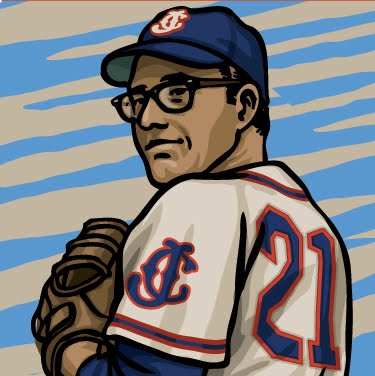


This is my final installment of Mickey Mantle's days in the minor leagues. The story of The Mick's Yankee days are well known, told and re-told by writers much better than I. However, like a lot of the stars I've featured in the Infinite Baseball Card Set, I like to look into the time before these guys became famous and see how their seasons in the bush leagues forged the player they eventually became. Mantle's pre-Yankee history is a little different than most. Right from the start he was proclaimed the next Yankee superstar, and his seasons in Independence, Joplin and Kansas City open a unique window through which we can see how a kid from the country painfully tries to live up to the expectations so many people have riding on him. Whether you are a Yankee fan or not, Mickey Mantle's minor league story will give even the most cynical baseball fan an appreciation for a boy who was picked to take the mantle of the next great Yankee superstar before he even played a single game in organized baseball.
Yankees' general manager George Weiss was nervous. More than nervous - his God damned heart was palpitating... Here it was, first day of 1951 spring training, and the most valuable kid to ever come out of the team's farm system failed to show up. What could it be? More money? The kid was signed for a song, maybe he and his Okie father were getting wise and wanted some more cash. Or maybe he was having some personal problems. Harry Craft, his manager for the past two seasons reported the kid had some sort of confidence issues. Or it could be vice. In Joplin he was starting to hang around with some unsavory characters and had developed a taste for the sauce. It could be it was a broad. A kid with all that talent would be a prime target for some seasoned chippy with keen foresight. After all, he was heralded as the successor to Joe DiMaggio without even having played a major league game.
Weiss couldn't take it anymore. He picked up the phone and put a call through to Commerce, Oklahoma. A few minutes later the Yankees general manager relaxed with a deep sigh. Turns out the kid hadn't received his transportation money to Phoenix. His own front office had screwed up. The future star of the best ball club on earth was biding his time working as an electrician's assistant 500 feet underground in a zinc mine. Weiss told the kid to stay the hell above ground and immediately wired the travel money.
The Yankees in 1951 was a team in transition. The most popular team in the country was starting to gray around the edges. What remained of the pre-war stars were fading fast and Stengel was in the tough position of trying to flawlessly transform the old team into a new team while not losing their position as the best in the league. Clearly Mickey Mantle was a key component in making the transition from old to new, but there was a problem for the impatient Yankees - the kid just wasn't a major league shortstop. Stengel and his coaches wisely acknowledged that it would take at least two seasons of additional minor league experience to bring his fielding up to professional standards. On any other ball club that would be acceptable but not for the Yankees. If the kid was supposed to be the successor to the great DiMaggio, why not make him an outfielder?
You would think that the great Yankee outfielder Joe DiMaggio would have been the perfect teacher, but he would have absolutely no part of his chosen successor. As with so many things in his life, the touchy DiMaggio imagined he was being insulted. Perhaps no one on the team was more unfriendlier to the rookie than the aging star. When the coaching staff decided on remolding the kid into an outfielder, DiMaggio told the press he didn't agree with the decision.
He was the only one.
Casey Stengel brought in outfielder Tommy Henrich specifically to tutor him. Henrich had retired the season before and was now one of Stengel's coaches. "Old Reliable" lived up to his name and after working with Mickey every day turned out a respectable right fielder. Mantle for his part was happy with the change in position. He told The Sporting News "I like the idea of shifting to the outfield. It is not as tough as the infield, and out there I get to use my legs."
The sportswriters went nuts covering the rookie superstar and he didn't disappoint.
Everything about the kid was special - hell, even his name was special. The name "Mickey" was always a nickname, a great baseball name, but a nickname given by someone else, short for Michael or something. This kid's given name was Mickey. Like his prodigious talents he brought with him from Oklahoma, he came with that great name. In all respects he was the complete package.
If anyone had any lingering doubts about the kid, what happened on Monday, March 26th would put them all to rest. Playing at Bovard Field against the University of Southern California, Mantle clubbed two home runs, a bases loaded triple and single. One of the homers was a 650 ft bomb that not only went over the outfield wall but it also cleared the football field behind it as well. After the game the Yankees' bus was almost tipped over when over-excited fans swarmed trying to get the kid's autograph. By the time the team headed East for opening day, right fielder Mickey Mantle was hitting well over .400. Center fielder Joe DiMaggio couldn't crack .200.
The rookie started off just like he was supposed to. Wearing number 6 on the back of his jersey, one couldn't help but notice it was the next number after DiMaggio's own number 5. Ruth had been 3, Gehrig 4. It was only natural the next great Yankee star follow in order. Throughout the first month of the season he was above .300 and batting second in the lineup. But then things started to fall apart. With the Korean War raging, many angry people were asking why this human God was wearing Yankee pinstripes instead of army green. It was a good question. The name "draft dodger" started being thrown around. In fact, Mantle had been given a military physical by his draft board in Tulsa twice, once in 1949 and again just days before opening day. Each time he was rejected as 4F. Due to an earlier injury he suffered from osteomyelitis, a bone infection that never completely goes away. He might be healthy now, but if he was inducted in the service and it flared up, the government would be on the line for a lifetime of disability payments. Because of the liability the military unilaterally flatly turned down anyone with osteomyelitis. Still, no matter how hard the Yankee publicity machine tried to explain the truth, Mickey was heckled on the field as a draft dodger and angry parents sent him hate mail on a staggering level.
The cold shoulder from fellow outfielder DiMaggio also made the rookie's life unnecessarily tough. In their first game against the Red Sox, photographers ushered DiMaggio and Mantle together with Ted Williams for a picture. DiMaggio greeted Williams but consciously neglected to introduce Mickey. After an awkward and wholly unnecessary silence, Williams took it upon himself to put out his hand and make the new kid's acquaintance.
For a rookie not yet 20 years-old, the pressure started to build. The way he was playing would have been more than acceptable for any other rookie, but Mickey wasn't any other rookie. He was supposed to be the next DiMaggio. To be a big league ballplayer was the only thing he was raised to be. Each slump or lapse on the field unleashed his uncontrollable temper. Inside he was seething at himself, unfortunately that anger sometimes overflowed and was propelled outward. After striking out he would swear loudly on his way back to the dugout. When one elderly season ticket owner rebuked him after one particularly nasty outburst he told the woman to "shut your God-damned mouth!"
Off the field his life got complicated as well. With his long-time girlfriend back in Commerce, the most eligible rookie in New York started slipping around with a showgirl named Holly Brooke. Burke introduced the country boy to the glittering lights of Broadway. In order to cover his awkwardness at cocktail parties he discovered the magic of scotch whiskey. Shyster businessmen circled the 19 year-old kid and he quickly fell prey to countless uneven business deals that took whole teams of Yankee attorneys to extricate the naive rookie from.
His strike outs soon started snowballing. Stengel moved him up and down in the lineup like a slide ruler and was forced to answer daily questions from the beat writers about when he was going to admit defeat and send the kid back to the minors. Stengel stuck to his guns as long as he could but after he started striking out at least once in every game, he submitted to the inevitable. With real tears in his eyes, Stengel told the kid he was being sent down. To make room for a much needed additional pitcher, Mickey Mantle was optioned to the Kansas City Blues. It was back to the minors.
The Kansas City team Mickey joined in the summer of 1951 was a seething pot of dissension. Just like today, the Yankees never had to rely much on a farm system. Being the most successful team in the biggest market, the Yankees could purchase ready-made ballplayers unlike most other teams who had to grow their own. Though Kansas City was New York's top farm team, it wasn't so much stocked with budding stars as filled with has-beens and never-will-be's. While many on the team knew they would never show their mugs in the majors, everyone knew Mantle was just in K.C. temporarily. Before he was even with the team he was resented.
The guy at the helm of the Blues was probably the only man who could relate to Mantle's position as having to replace a legendary Yankee star. On opening day in 1935, George Selkirk put on a Yankees jersey with number 4 on the back and took Babe Ruth's place in right field. If anyone knew the pressure Mantle was under, Selkirk sure did.
Joining the team on the road, Mantle was handed a used jersey with number 20 on the back and promptly continued his batting slump. In his first handful of games he went 3 for 18. The first hit was a swinging bunt which he speedily beat out for a hit. When he reached the dugout at the end of the inning Selkirk chastised the kid. "We know you can bunt, Mick" he said. "You're not here to bunt. You're here to get some hits and get your swing back." Scorned by his teammates, ripped by the press and feeling more alone than ever before, he became depressed. But he did start to hit. When the team rolled into Milwaukee he had one 4 hit game, then began belting the home runs. In Indianapolis he hit two - one from each side of the plate. Against the Toledo Mud Hens he hit for the cycle and then added an additional homer for good measure. By the time the Blues headed back to Kansas City, Mickey was batting a nice .345.
Yet each night he sat in his hotel room and poured over the Yankee box scores. The longer he stayed in Kansas City, the less sportswriters mentioned him in the papers. He was fading away and fast. In Mantle's mind, no matter how many home runs he hit down in the minors, he was sure he'd blown his chance with New York. He was lonely and scared. He wrote to showgirl Holly Brooke and begged her to join him in Kansas City, knowing correctly she'd never hitch her star to a lowly minor leaguer. Each day brought more hate mail that piled up in his room. Especially hurting was the ones from the parents of soldiers calling him a draft dodger.
When the Blues opened up their home stand at Municipal Stadium he started slumping again and making errors in the field. The depression closed in on him and he needed help. He craved some kind of advice from a friendly face. He called his father Mutt and told him he wanted to go home.
Mickey's father Mutt jumped in his truck and made the half-day drive to Kansas City. If he was expecting a pat on the back and sweet words, he was in for a rude surprise. In his son's hotel room after the day's game was rained out, Mutt listened stoically as his boy explained how he was a failure and wanted to quit and go home to Oklahoma. In what would be known as the most famous and successful pep talk in baseball history, Mutt Mantle stood up and started packing his son's clothes, telling him that he thought he'd raised a man. "I see I raised a coward." Emptying the dresser drawers into a suitcase, the father told his son he could come home and work in the mines with him. The shock treatment did the trick.
After convincing his father to stop the packing, Mantle realised that if he quit now, that would be the real failure. He resolved himself to stick it out. Mutt got in his truck and drove back to Oklahoma, alone. With the rain gone, Mickey belted two home runs in the next game. He averaged over two RBI's a game and on top of all that, the kid was almost single-handedly leading the Blues on a late-season run for the American Association pennant.
On August 20th, he got the call he was hoping for: New York wanted him back. Trading in his number 20 Kansas City jersey for a set of pinstripes with number 7 on the back, Mickey Mantle rejoined the New York Yankees.
As with the two other stories about Mantle's early days, I'd like to dedicate them to my Uncle Eddie, a great fan of The Mick. As a boy, my Uncle Eddie would come to my baseball games when my father couldn't make it, something I was always thankful for. More than 30 years later my uncle pinch hit for my Pop again, this time helping my brother and I settle my mother's affairs since her death in this past summer. Thanks again Uncle Ed, this ones for you.
SOURCES
- The Sporting News (March 21, 1951)
- The Kansas City Star, column by Joe Posnanski (August, 1, 2001)
- Castro, Tony Mickey Mantle: America's Prodigal Son (Potomac Books, 2002)


