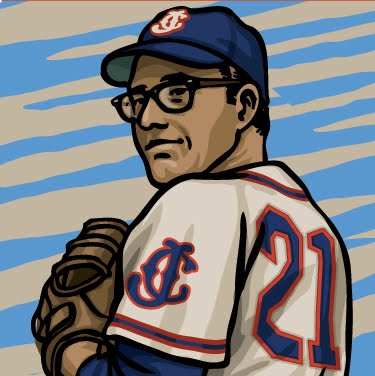
I just got back from two long business trips. Looking out the window as the place followed the Ohio River toward the airport, I got that "it's good to be back" feeling, and when my plane touched down in Kentucky, I can't tell you how glad I felt that this was my home. So, in honor of my adopted state, I thought I'd share a larger illustration I did of one of baseball's greatest players, and tell you a bit how he got his start in ol' Kentucky...
Future New York Yankees president Ed Barrow was managing the Paterson Silk Weavers in New Jersey when he discovered Honus Wagner. The big, bow-legged kid from Pennsylvania turned out to be a tremendous hitter - but a liability in the field. None the less Barrow could see Wagner’s potential and convinced Barney Dreyfuss, owner of the Louisville Colonels to sign him in 1897.
Louisville was a National League team at the time and Wagner hit big league pitching at a .330 clip. He also turned himself into a superior third baseman and by 1899 was one of the best players in the National League. Despite his ungainly physique, Wagner was one of the era’s most daring and successful base runners and in 1898 he was the first player to steal second, third and home in succession.
Wagner was a big hit with the Louisville fans. He won a throwing contest by hurling a ball 403 feet. To make the most of his popularity his likeness was used to sell locally made cigars - a practise he famously discontinued a decade later when he forced the removal of his baseball card from cigarette packs. The few copies that survive are the most sought after and valuable piece of sports memorabilia in existence.
The National League contracted from twelve to eight teams after the 1899 season and the Louisville franchise was eliminated. Barney Dreyfuss bought into the Pittsburgh club and took Wagner with him. In his first season in Pittsburgh Wagner won the first of eight batting crowns he would win during his Hall of Fame career. And even though Honus Wagner left Kentucky after 1899, he returned in 1905 to sign a contract with Hillerich & Bradsby becoming the first ball player to have his own signature model Louisville Slugger bat.
I don't like to get too personal about my life when writing this blog. I keep politics and all that stuff out because everyone comes here to read about baseball, not get a lecture or anything. However, life does get in the way sometimes, and I have to say this has been a rough couple of months for me and my family. My brother-in-law (and one of the groomsman at my wedding) passed away after a valiant battle with the very same cancer he spent his life researching. Then one of my closest and oldest friends decided that living was too much and took his own life. That's all I'm gonna say about all that except that those were among the reasons the content has been light over the last few months. I just wasn't all that inspired to write anymore.
But the other night a good friend of mine fired up that spark again.
My wife was in Oklahoma City with her sister's family and I was home alone. I called up my friend Vic and he crossed the river to my home in Kentucky to watch one of the Mets playoff games with me. As we walked to one of the local taverns here in Fort Thomas, Vic kept remarking how nice the town I lived in was. The streets were clean and tidy, people wave to you as you walk by and kids were out playing as the sun slowly went down. I couldn't help but agree, I do live in a special place.
That walk inspired today's story. The town of Fort Thomas is named for the military installation that still stands today. Though many of the buildings are gone, a good number still remain and the property is now owned by the city. The old water tower disguised as a Medieval stone parapet still guards the entrance to the fort. The tree lined streets that once reverberated with the sound of marching boots now allows walkers and joggers a picturesque setting in which to exercise. Many of the stately old officer's houses are restored and lovingly maintained by their civilian owners. The VA operates a large outpatient facility on the grounds and the old gymnasium is now open to the public. A small museum manned by enthusiastic local historians tells of the fort's past and a large playground entertains the children who will one day be the town's future. For a history buff like me it's a great place to wander around, and being a baseball fan, I looked for something to tie my two interests together.
I didn't have to look far. As recent as the 1968 Fort Thomas had a deep connection with baseball: Pete Rose and Johnny Bench did their Army Reserve duty at the fort serving with A Company of the 418th Engineering Battalion and you can find pictures of the heart and soul of the Big Red Machine peeling potatoes and doing KP duty in their fatigues.
But I like older stories so I dug deeper. Since the Civil War the U.S. Army embraced baseball. Not only was it a healthy activity for troops but it also instilled teamwork and regimental pride in the men. The 6th Infantry Regiment stationed at Fort Thomas on the Ohio River was no exception. In the 1890’s the regiment’s commanding officer was Colonel Melville Cochran. The Civil War veteran from Maine was an early and tremendous fan of the national pastime and had formed baseball teams at every post he was stationed, from Fort Apache to his new command in Northern Kentucky.
In tribute to the team’s founding father, the 6th Infantry club was named The Cochrans and the men’s jerseys bore their patron's name in bold letters across their chests. The Colonel’s dedication to the team’s success as so complete that he was known to order key players locked up in the brig the night before a big game to ensure their sobriety. He also turned a blind eye when the fort's provost let members of the team out of the brig to participate in a big game.
A large part of the Cochran’s success was that big league ballplayers who lived in the area used the Fort Thomas’ large indoor athletic facilities to keep in shape over the winter. Connie Mack, Bill Wilson and Jesse Tannehill were among the players who used the indoor batting cages and equipment. In return, the Cochran’s benefited from being coached by real major leaguers. This impressive athletic hall still stands on the grounds of the old fort and still serves in its original capacity as a community gym.
Throughout the 1890’s the Fort Thomas Cochrans fielded the best baseball team in the U.S. Army until 1898 when the regiment left to fight in Cuba. The star of the Cochrans during their heyday was a sergeant from Baltimore named John Thomas Grimes. A veteran of the Sioux Indian War, it’s not known when Grimes began playing baseball, but by the time he was posted to Fort Thomas he was a talented twirler.
When not hurling for the Cochrans, Grimes hired his services out to teams as far away as Indiana when they needed a professional arm. He made headlines in 1894 when he whipped the Cincinnati Reds of the National League while pitching for the semi-pro Newport Reds.
In 1897 Sergeant Grimes wrangled four months of leave and began playing minor league ball in Evansville, Indiana. He was an instant success and became extremely popular with the Evansville fans - so much so that he acquired a "groupie", Rose Stewart, who cause a sensation by leaving home to follow the dashing soldier on a road trip. The scandal made all the Indiana papers and Grimes was momentarily accused of wrong-doing but quickly cleared when it became known he hadn't encouraged Rose's affections. Seems Miss Stewart was a bit of a Victorian hell-raiser and perpetual runaway.
By the end of the summer Grimes, now called “Soldier Boy”, had made it all the way to the majors with the St. Louis Browns. On July 31, 1897 Grimes made history by hitting a record six Louisville batters in one game - though to be fair it appears that he did it on purpose! Apparently there was some bad blood between the two clubs and Grimes was dishing out some retribution. In all he pitched 3 games in the majors, lost 2 and had an admirable .286 batting average. After his leave was up, Grimes returned to the army where he served in the Spanish-American War and World War I before retiring with the rank of captain.
As an interesting side note, you might have noticed that I obscured Grimes' face. See, John Grimes is one of the only men to play in the Major Leugues of whom there is no known photograph. I was rather shocked by this as not only did he play minor league ball and was quite popular but he was a wildly sought after semi-pro mercenary. On top of that he was a soldier for more than 40 years, surely there is a photo of him somewhere? Enjoying a good hunt, I scoured the local archives for hours on end. At the Fort Thomas Museum I found a team photo of the Cochrans - but Grimes was absent that day! So the search continues. Hopefully some day I can revise his portrait, dropping his hands to his side and re-introduce the face of the man who made Rose Stewart leave home back in 1897...
Those
who have met me in person know I'm not the kind of guy to toot my own
horn. In fact, much to my detriment, I'm lousy about promoting myself.
That's why it's hard for me to ask this, but this is something that
needs to be done: if you bought a copy of The League of Outsider
Baseball, can you please take the time to write a review of it on Amazon, Barnes and Noble or Good Reads?
It would mean a lot to me and most importantly give future publishers
an idea of what the book reading public thinks of my work. Almost all of
the existing reader's reviews have been flattering, but every once in a
while some crackpot writes a clunker out of jealousy or boredom. I for one often look at the reviews
on those sites before I spend my money on a book. Reviews aren't the
only thing I rely on in my purchasing process but it's certainly a
factor, and that's why I'm asking you to please take the time to write
your thoughts about my work.
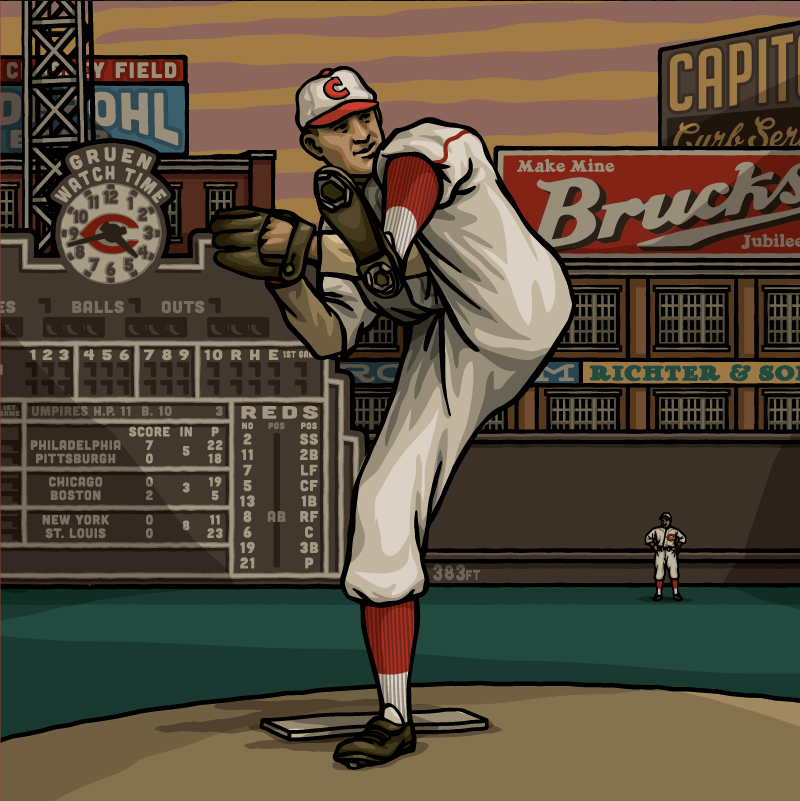
This week I wanted to showcase a large illustration I recently completed of Paul Derringer. Besides wanting to bring the old Reds ace to life in full color, I also looked forward to re-creating the scoreboard and factories that formed the outfield walls of Crosley Field. Turned out to be one of my favorite drawings...
One would think a pitcher with a record of 7-27 would find himself back in the minor leagues, right? Not Paul Derringer - he got a $2,500 raise. In 1933, the year he put up those terrible stats, Derringer had an ERA of 3.30, better than league average, and his walks and home runs allowed per inning was among the lowest in both leagues.
Paul Derringer’s career had more dramatic peaks and valleys than Kentucky's Red River Gorge. He came from Springfield, the son of a prosperous Kentucky tobacco farmer and former baseball player. Built like a line backer and over six feet tall, Derringer had a blazing fastball delivered with a dizzying leg kick and pin-point control. By 1931 he was pitching for the Cardinals where the rookie won 18 games as St. Louis went to the World Series. Then he had the misfortune of going from the best team in the National League to the worst when he was traded to the Cincinnati Reds. That’s the season he lost 27 games.
Derringer was a surly fellow and he often ended arguments with his fists. His decade-long feud with former Cardinals teammate Dizzy Dean culminated in a full-blown on-field brawl in 1939. Perhaps due to all his pent-up rage (or maybe he was just tired of losing), Derringer began winning despite a lousy Reds ball club. In ‘36 he won 22 games and by 1938 the Reds had themselves a good ball club. Derringer’s 25-7 record in 1939 was the best winning percentage in the league as the Reds won their first pennant in twenty years. In 1940 the big right hander won 20 games and then 2 more in the World Series as Cincinnati won it all.
Derringer retired after his 16 wins helped the Cubs to their last pennant in 1945. He finished with 223 career wins and is the third most winningest pitcher in Cincinnati Reds history.
Those
who have met me in person know I'm not the kind of guy to toot my own
horn. In fact, much to my detriment, I'm lousy about promoting myself.
That's why it's hard for me to ask this, but this is something that
needs to be done: if you bought a copy of The League of Outsider
Baseball, can you please take the time to write a review of it on Amazon, Barnes and Noble or Good Reads?
It would mean a lot to me and most importantly give future publishers
an idea of what the book reading public thinks of my work. Almost all of
the existing reader's reviews have been flattering, but every once in a
while some crackpot writes a clunker - like the creep on Good Reads
that said I should have had someone who knows English write the copy
(that was a surprise as Simon & Schuster's editing process is
quite impressive and very rigorous). I for one often look at the reviews
on those sites before I spend my money on a book. Reviews aren't the
only thing I rely on in my purchasing process but it's certainly a
factor, and that's why I'm asking you to please take the time to write
your thoughts about my work.
In today's game it's quite common for a ball player to go from Double A ball to the majors. Most players today have at least a few seasons of college ball under their belt before they even appear in the minors. With today's structured and very regimented scouting and farm systems, major league teams know fairly quickly whether a player has what it takes to make The Show. Thirty major league teams means there are almost twice the number of positions available than there were fifty tears ago and that extra room enables clubs to take more risks than they did decades ago - like bringing up rookies after only a single season in the low minors.
That's what makes Mahlon Higbee's story quite interesting. Back in the summer of 1922 Higbee was a 20 year-old outfielder for the Hopkinsville Hoppers of the Kentucky-Indiana-Tennessee League (thankfully called the "KITTY League" for short). The KITTY was classified a Class D loop, equivalent to today's Rookie League level and pretty much the bottom rung of Organized Baseball. By late July the Louisville native was hitting .385 with 16 homers, 101 RBI and 31 stolen bases. Despite playing in a low-level league far from the big cities of the major leagues, the New York Giants got wind of Higbee's numbers.
In the early 1920's the New York Giants were the best and most feared organization in the game. Firmly managed by John McGraw, the Giants boasted no less than six future Hall of Famers in their regular line up and could boast of having beaten the upstart Yankees in the 1921 World Series. In short, back in 1922 the New York Giants were what the Yankees would become in just a few short years - the embodiment of baseball excellence.
So Mahlon Higbee must have made one heck of an impression on the Giants scouts that summer. John McGraw bought Higbee's contract from Hopkinsville for a nice $2,500. Back in the days before minor league teams had working agreements with major league teams, selling young players at the end of a season often meant the difference between finishing the year with their books in red or black ink.
By the time Mahlon Higbee packed his bag and took the train north, the Giants had clinched the National League pennant by seven games. On September 27th Higbee took his position in left field as the Giants hosted the Philadelphia Phillies at the Polo Grounds. The rookie struck out twice as Jimmy Ring pitched shut out ball. Higbee did record a sacrifice hit which must have pleased John McGraw, letting him know the young slugger could also play "small ball" which the Giants skipper much preferred to the new home run game being made popular by Babe Ruth and the Yankees. After seven innings the Phils led 2-zip but the Giants came alive in the eighth. Higbee got his only hit of the game, a two run single which tied the game and later scored the go ahead and ultimately winning run.
The next game was a double header on Saturday September 30 against the Boston Braves. Higbee sat out the first game, a 5-1 loss. Playing left field in the night cap, Higbee went 2 for 4 with an RBI as the Giants beat Garland Braxton and the Braves 5 to 3. The late editions of the New York papers showed that the Giants rookie was batting a lofty .429.
Sunday, October 1st was the last day of the season and another double header against Boston. Higbee sat on the bench as the Braves shut out New York 3 nothing. In the second and last game Higbee played right field. In his first two at bats the rookie failed to get a hit but in the sixth he came to bat again. With a man on first Higbee took an Al Yeargin pitch deep for a two run homer making it 3-0 Giants. The last two innings went fast and uneventful as New York closed out 1922 with a final win.
With the end of the regular season came the final statistics and Mahlon Higbee's 1922 line was fantastic: 10 at bats; 4 hits; 5 RBI; 1 home run and a sterling .400 average. Since he was brought up too late to qualify to play in the World Series, Higbee had to ride the bench as the Giants creamed the Yankees 4 games to 1. It was a given that the rookie would be invited to the Giants' spring training the next year and he was.
Although the Giants were overflowing with outfield talent, beat writers following the team in San Antonio that April tabbed Higbee as the forth outfielder, backing up Irish Meusel and Hall of Famers Casey Stengel and Ross Youngs. Then, right before the Giants broke camp, Higbee wrenched his left ankle. Now instead of holding a train ticket with "New York City" on it he found himself headed to Denver, Colorado.
The Denver Bears played in the Western League and had a loose working agreement with the Giants. The Western League had a classification of A, about same or a little lower than what Single A is today. Higbee played well for the Bears, hitting 2 points shy of .300 with 10 homers and 31 doubles, but it was far from the numbers he put up in 1922. At the end of the season the Giants sent Higbee to the Portsmouth Truckers in exchange for some low-level minor leaguers. The once promising Giants phenom now found himself in Class B ball, one rung backwards. He hit .279 with 12 homers but a collision with the outfield wall in Richmond effectively ended his career.
Higbee was back with Portsmouth in 1925 but he only managed to play 26 games. After batting a disappointing .188 with Evansville in 1927 he called it quits.
Today Mahlon Higbee is just a single line in the baseball record books - but oh what a line it is. Since 1900 roughly 10,000 ball players played less than 10 games in the big leagues. It's called having a "Cup of Coffee", meaning their time spent in The Big Show was barely long enough to consume a cup of joe. Most of those guys have completely uneventful numbers, not leaving much to the imagination as to why they didn't stick. Mahlon Higbee is different. He actually left a line of stats a guy could be proud of and one that makes the casual reader wonder what the heck happened... and now you do.

Now that my book
is wrapped up and on the book shelves, I returned to a series I've been working on for a few years:
Bluegrass Baseball. Kentucky is my adapted home and I wanted to do a
baseball tribute to the wonderful place that has welcomed this journeyman artist with open arms. While there aren't dozens of
Hall of Famers that hailed from Kentucky, there are quite a few
interesting characters that played a significant part in the history of
our National Pastime. Over the past couple of years I've featured a few
of them: Happy Chandler, Fred Toney, Casey Stengel, Mickey Stubblefield, Pee Wee Reese, Humpty Badel and Bob Bowman. As anyone who's followed my blog over the years knows, I'm particularly drawn to the history of the Negro Leagues in Baltimore, especially the Elite Giants. One of the early stories and illustrations I posted was of the Elites' second baseman Sammy T. Hughes. All but forgotten today, Hughes was considered by most Negro League players and writers as the best second baseman blackball produced. When I lived in Charm City back in the late 80's and 90's, every old fan I interviewed spoke of the Elites' "Sammy T". Hughes was also a native of Kentucky so when I began planning my Bluegrass Baseball book I knew Sammy T. needed a full page illustration.
The only problem with the Baseball Hall of Fame is that Sammy T.
Hughes ain’t in it.
During the 1930’s and 40’s Hughes was the best
second baseman in blackball. According to Cum Posey, owner of the Homestead Grays, Sammy T. was the best second sacker he'd ever seen. This from a guy whose involvement with Negro League baseball stretched back to the 1910's.
Born in Louisville, Kentucky in 1910, Hughes started out
as a first baseman with his hometown semi-pro Louisville White Sox in
1929 and two years later the team turned pro and joined the Negro
National League. 1932 saw Hughes join the Washington Pilots where he
switched to second base. When that franchise folded later that year
he joined the Nashville Elite Giants.
Owned by black businessman Tom
Wilson, the Elite Giants started out in Nashville but were destined to
keep changing home base as they searched for a city with an
appreciative fan base. Hughes
was a true rarity for the time, a franchise player back when contracts
meant nothing and jumping from one club to another was just another part
of the game. Hughes was the Elites’ man at second through
their moves from Nashville to Columbus to Washington, D.C. and finally
in 1938, Baltimore, Maryland.
In Charm City the Elite
Giants found a town with thousands of fans hungry for a black team. The great black
newspaper, The Afro-American, was based in Baltimore and provided good
coverage of the Elites during their tenure in the city. The team
thrived in the environment and the fans were rewarded in 1939 when they
won the Negro National League Championship in a 4-team playoff between
the Homestead Grays, Philadelphia Stars, Newark Eagles and Elite Giants.
Over 6'-3" and close to 200lbs, Sammy
T. Hughes was described by his contemporaries as a superior base runner, line drive hitter and artful bunter. At second he possessed the dexterity of a ballerina equipped with a rifle for an arm. On top of all that, Sammy T. played the game smart and he was a leader on the field. Fans acknowledged his
skill and Hughes was voted to the annual East-West All-Star game five times in
his career, more than any other second baseman. Usually batting second in the lineup, he consistently batted
over .300 and executed the hit-and-run play like he invented it. From 1935 to 1942 Sammy T. was like an automatic double machine, either leading the league or finishing in the top five for two base hits each year. In exhibition games against Major Leaguers Hughes hit the white pitching at a .350 clip.
An event that never actually happened provides the best proof that Sammy T. was one of the best ball players produced by the Negro Leagues: In 1942 the Communist newspaper
“The Peoples Voice” arranged a tryout with the Pittsburgh Pirates for three Negro Leaguers. Of all the untapped blackball talent it was Hughes along with Roy Campanella and pitcher Dave Barnhill who were chosen for the historic tryout. All three men showed up in Pittsburgh but Pirates owner William Benswanger backed out at the last minute. The aborted tryout received much press coverage at the time and sports writers both black and white
figured Hughes to be a can’t-miss candidate to break the color line. This high appraisal of Sammy T. wasn't just due to his statistics: like Jackie Robinson, Hughes was evaluated for the way he conducted himself off the field. Sammy T.'s decade of loyalty to the Elite Giants spoke to his dedication towards his team and his clean-living made him stand out from many ball players regardless of color. New York Black
Yankees player Dick Seay had this to say of Hughes: “a nice fellow. He
wasn’t one of those guys that was drinking and all. He’d stay in the
hotel and go get his girl and visit her.”
Unfortunately we never got to see what Sammy T. could do in the major leagues. World War II interrupted Hughes' career and he served three years in the Pacific. After his discharge from the Army he returned to Baltimore, but only after holding out for a bigger pay check. Although he hit only .277, Sammy T. rendered an even greater
service by acting as mentor the Elites’ young second baseman Junior
Gilliam. The veteran's unselfish tutoring made Gilliam into an All-Star second baseman for the Brooklyn and Los Angeles Dodgers. With Gilliam firmly in place as his replacement, Hughes
settled down in Los Angeles and worked for Hughes Aircraft and Pillsbury, passing
away in 1981.
Every time the Hall of Fame convenes one of their Negro League committees, Sammy T. Hughes' name makes the conversation but he's always pushed aside by players of lesser talent who played for more well-known teams or had more friends among the powers-that-be. Someday the Elites' second baseman may get the recognition he deserves, but until then Cooperstown will not complete until Sammy T. gets in there.
Those
who have met me in person know I'm not the kind of guy to toot my own
horn. In fact, much to my detriment, I'm lousy about promoting myself.
That's why it's hard for me to ask this, but this is something that
needs to be done: if you bought a copy of The League of Outsider
Baseball, can you please take the time to write a review of it on Amazon, Barnes and Noble or Good Reads?
It would mean a lot to me and most importantly give future publishers
an idea of what the book reading public thinks of my work. Almost all of
the existing reader's reviews have been flattering, but every once in a
while some crackpot writes a clunker - like the creep on Good Reads
that said I should have had someone who knows English write the copy
(that was a surprise as Simon & Schuster's editing process is
quite impressive and very rigorous). I for one often look at the reviews
on those sites before I spend my money on a book. Reviews aren't the
only thing I rely on in my purchasing process but it's certainly a
factor, and that's why I'm asking you to please take the time to write
your thoughts about my work.
 Ah, Super Bowl Sunday. For a die-hard baseball fan like myself, no day makes baseball season seem as far away as Super Bowl Sunday. As a nod to football, yet keeping baseball in the forefront, I give you Shipwreck Kelly. Hard-core football historians (if there are any of them) know Kelly was a star running back for the University of Kentucky in the late 20's - early 30's and then was one of the first stars of the fledgling NFL. He also played baseball.
This little story about Shipwreck Kelly is part of a
series I've been working on for a few years:
Bluegrass Baseball. Now that my book
is wrapped up and at the publisher (on track for a May 5, 2015
release), I returned to this hardball tribute to my adapted home. While there aren't dozens of
Hall of Famers that hailed from Kentucky, there are quite a few
interesting characters that played a significant part in the history of
our National Pastime. Over the past couple of years I've featured a few
of them: Happy Chandler, Fred Toney, Casey Stengel, Mickey Stubblefield, Pee Wee Reese, Humpty Badel and Bob Bowman.
Hailing from Springfeld, Kentucky, John Simms Kelly was the University of Kentucky’s first star running back. He earned the nickname “Shipwreck” because of what he did to the opposing team’s defensive line. Kelly won the All-Southern Conference honors in 1929, 1930 and 1931 and still holds the university record for most yards gained in a game (280). Before one game he called a press conference to predict a 50 yard touchdown run (he did!).
Ah, Super Bowl Sunday. For a die-hard baseball fan like myself, no day makes baseball season seem as far away as Super Bowl Sunday. As a nod to football, yet keeping baseball in the forefront, I give you Shipwreck Kelly. Hard-core football historians (if there are any of them) know Kelly was a star running back for the University of Kentucky in the late 20's - early 30's and then was one of the first stars of the fledgling NFL. He also played baseball.
This little story about Shipwreck Kelly is part of a
series I've been working on for a few years:
Bluegrass Baseball. Now that my book
is wrapped up and at the publisher (on track for a May 5, 2015
release), I returned to this hardball tribute to my adapted home. While there aren't dozens of
Hall of Famers that hailed from Kentucky, there are quite a few
interesting characters that played a significant part in the history of
our National Pastime. Over the past couple of years I've featured a few
of them: Happy Chandler, Fred Toney, Casey Stengel, Mickey Stubblefield, Pee Wee Reese, Humpty Badel and Bob Bowman.
Hailing from Springfeld, Kentucky, John Simms Kelly was the University of Kentucky’s first star running back. He earned the nickname “Shipwreck” because of what he did to the opposing team’s defensive line. Kelly won the All-Southern Conference honors in 1929, 1930 and 1931 and still holds the university record for most yards gained in a game (280). Before one game he called a press conference to predict a 50 yard touchdown run (he did!).
Besides a gridiron star, Kelly was one of the Wildcat’s varsity outfielders from 1929 to 1931. When UK dropped their baseball program in 1932, Kelly and many of the other Wildcats hired themselves out to the various semi-pro teams around Lexington.
After graduation Kelly played professional football in the NFL’s New York Giants and Brooklyn Dodgers. His larger than life personality and wealth made him one of the most popular sports stars of the 1930’s. After his playing days Kelly bought the Dodgers football team. During World War II he worked with the FBI as a spy tracking the movements of Nazi agents in South America and the Caribbean. A charter member of the Kentucky Athletic Hall of Fame, Kelly later became both a champion golfer and world-class big game hunter and is a relative of Giants quarterback Phil Simms.
I wish everyone a great Christmas, Hanukkah or whatever you may celebrate this time of year. I for one am looking forward to Christmas with my wife and her family in Southern California. This month between Thanksgiving and Christmas was a busy one. The biggest news is that I am down to the final edits on my book, The League of Outsider Baseball". It's slated to be in bookstores May 8th of next year, just in time for Father's Day. The whole process has been both unbelievably fun and nerve-racking for me. Fun because I have been able to finally present what I have been doing on the website for almost four years to a larger audience and in a format you can hold in your hands. Websites are fine for some, but I'm an old-school type of guy and love the feeling of something substantial in my fingers. That this will be a 240 page hard cover tome really gets me excited! The nerve-racking part comes when I realize that 240 pages isn't nearly enough to showcase all the great stories and drawings I want to! Each time Simon & Schuster sends me a new draft to edit I get pangs of regret about the players I had to leave out, but that's just my self-depreciating personality - when I look at the book objectively even I have to admit that this is going to be an unbelievably great book. I made the book I always hoped to find in a bookstore ever since I was a kid. With a bit of luck, the book will be a big enough success that I get the opportunity to do a volume 2. I thought you might be interested to see what one of these massive drafts looks like, so I took a quick picture:

Well, let's get on to the main reason this site exists - baseball stories and drawings! Today's story is one I have had on the back burner ever since I devoured Neal Lanctot's masterpiece "Fair Dealing and Clean Playing: The Hilldale Club and the Development of Black Professional Baseball, 1910-1932". Among the great players that once graced the Hilldale Club's lineup was a guy they called "The Hawk". While he isn't normally mentioned in the same breathe as Josh Gibson or Satchel Paige, Clint Thomas was among the best all-around ballplayers of the 1920's and 30's. Recognized by his peers as one of those rare "complete ballplayers", The Hawk not only hit for average and power, but his skill in the outfield, accurate arm and base running ability made one of the most dangerous players to take the field.

Clint Thomas was born in Greenup, Kentucky, a town along the banks of the Ohio River in 1896. According to Thomas, he didn't play much baseball as a kid because there wasn't any ball fields for he and his friends to play on. It wasn't until his family moved to the more urban surroundings of Columbus, Ohio where the teenager began his baseball career. He played a little ball when he wasn't working in a grocery store, but then World War I began. Thomas served a year in the Army and was a Sergeant by the time his year hitch ended. He returned to Columbus and began playing ball more serious. Within a year he'd migrated to New York after he heard the Brooklyn Royal Giants were looking for a third baseman. That after only a single summer of semi-pro ball Thomas felt he was ready for the big time speaks highly of his confidence. The Royal Giants were on the down-side of being one of the premier blackball outfits and still boasted legend John Henry Lloyd at short and Jesse Hubbard on the mound. While Thomas' confidence was at a pro level his skills weren't and after batting under .200 returned to Columbus.
Fortunately for Thomas the newly formed Negro National League put a franchise in Columbus called the Buckeyes. His teammate from the Royal Giants, John Henry Lloyd, was the new team's manager and Thomas played the 1921 season hitting just shy of .300. Still, all the pieces weren't right for Thomas. Because of his speed he was always shifted between second and third base but never felt comfortable at either position. Then the Buckeye's folded and Thomas was cut loose.
His contract was acquired by the Detroit Stars 1922. He was still floundering at second base when fate stepped in. Regular center fielder Jessie Barber got injured and when the right fielder was switched to center, Thomas took his place in right. It was a stroke of genius. The fleet footed Kentuckian snatched up anything that can near him including balls meant for the center fielder. The next game he was switched to center and a Negro League legend was born. More comfortable in his new position, Thomas loosened up and finished 1922 as the Star's best hitter. The following year Hilldale, an eastern powerhouse club located just outside Philadelphia, poached Thomas away.
With Hilldale he became known as "The Hawk" for his fielding skills, gliding all over the outfield making plays with a skill so graceful that old-timers could clearly remember one Hawk play or another through the fog of decades gone by. Ted Page, a Negro League star from the mid 1920's to the mid-1930's recalled that Thomas "attacked the ball the way a dog attacked raw meat." Hall of Famer Monte Irvin grew up in Paterson, New Jersey watching the best black and white teams of the 1930's and, starting in 1937, played in both the Negro and Major Leagues. His opinion should be taken very seriously when out of all the black players he
witnessed, it was Clint Thomas who Irvin called “the black Joe DiMaggio". To draw a more contemporary comparison the Hall of Famer said "Clint was a Pete Rose type of player, he always went all out".
That aggressive attitude didn't just apply to batting and fielding - Thomas quickly established himself as one of blackball's best base runners as well. Buck Leonard, Hall of Famer and contemporary of Thomas remembered "when he got on base we all knew what was on his mind. He had stealing on his mind." Judy Johnson, another Hall of Famer and contemporary called him one of the best he ever saw play and said "I called him "Racehorse" because he ran to first so fast that he almost had to turn around backwards to stop".
The Hawk was Hilldale's clean-up hitter throughout the 1920's. Thomas, along with Judy Johnson, Frank Warfield, Biz Mackey and Louis Santop, Thomas powered Hilldale to three consecutive Eastern Colored League pennants from 1923-25. This may have been one of the greatest blackball teams of all-time and no less than four players: Judy Johnson, Biz Mackey, Louis Santop and John Henry Lloyd have plaques hanging in Cooperstown.
After dominating the east coast baseball scene for almost a decade, Hilldale began to hemerage players to other teams with bigger pocket books. At this time finances for black baseball teams were precarious at best and Thomas spent the next couple years surfing the dollar sign around from team to team. As the best clean-up man in the game, The Hawk was a much sought after item and after periods with the Atlantic City Bacharachs and Homestead Grays, Thomas returned to New York City where his pro career began. He hooked up with the old Lincoln Giants, a once proud powerhouse now winding down as an independent team playing in the lucrative Metropolitan semi-pro scene. Even though New York had a huge black population with disposable income to burn, Negro League teams found it hard to build a strong team in the city. Shady gangster "Soldier Boy" Semler took over the remains of the Lincoln Giants and formed the New York Black Yankees in 1931. Semler hired Clint Thomas and John Henry Lloyd to add some credibility to a team of underpaid kids and washed up vets. Despite their grandiose name, the Black Yankees were the whipping boys of the Negro Leagues. Still the team was monetarily successful due to their monopoly on the New York City market. Unfortunately Semler used the team primarily to launder his underworld profits and did nothing to improve the Black Yankees talent pool. Still, Thomas continued to shine. It was during this period that he was able to demonstrate his considerable talent to the largest audience. Unlike Hilldale which primarily stayed close to Philadelphia, the Black Yankees not only played in Yankee Stadium but also toured extensively.
During one such road trip Clint Thomas made what has gone down to be the greatest catch in blackball history. Gus Greenlee, owner of the Pittsburgh Crawfords, built a grand stadium to house the virtual All-Star team he was assembling. For the very first game in Greenlee Field, the Crawfords hosted the Black Yankees. With Satchel Paige on the mound the Craws expected opening day at the only black-owned sports complex to be an easy win for the home team. Unfortunately Clint Thomas had other ideas. With the Black Yanks up 1-0 and a few Crawfords on base slugger Josh Gibson pounded a long fly ball to deep left center. The Hawk turned on his heels and peeled off for the fence, his back to the plate. The left fielder ran along side yelling "got it Hawk, got it?" Thomas just ran as fast as he could and when he reached the wall, stretched his arm out high and snagged the ball right at the top of the wall. The air went out of the Crawfords after that and the Black Yankees beat Paige. Ted Page, a member of the Crawfords that day remarked "Clint could chase that ball into another world".
The Hawk wrapped up his career in 1938. He drove a delivery truck for the Ballantine Scotch Company then segued into a small real estate business. Finally The Hawk settled in West Virginia where he became a staff supervisor for the state's Department of Mines and then a messenger for the State Senate, a post he held well into his 80's. Thomas was one of the most likable players of his time and when The Hawk turned the big eight-oh in 1976, his old home town of Greenup, Kentucky honored him with a birthday party that became the very first Negro League reunion. Long before the big collector-fueled heyday of Negro League collecting of the 1990's, the annual Greenup reunion was an intimate affair where the old superstars of segregated baseball congregated to relive their past glory. At the center of it all was The Hawk.
Since I began this website I always liked to feature a special story for Memorial Day and Veterans Day. Indeed some of my favorite stories have been part of this little series: Eddie Grant, Bill Niemeyer and Sam Kau to name a few. This Veteran's Day I'm reminded that not all vet's served in combat. Some men served in peacetime like Sig Jakucki and Torpedo Mills, and then there were those who for whatever reasons were spared the horrors of battle.
Jackie Robinson was one of those men.
In the summer of 1944 2nd Lieutenant Jack Robinson found himself at Camp Breckinridge, an infantry replacement training depot in the hills of western Kentucky. The war had been rough for Robinson - not on the battlefields of France or a nameless island in the Pacific, but at home in a racial war whose injuries were not physical but mental.
Before the war Jackie Robinson was a well-known collegiate athlete. His exploits as a track star at UCLA set numerous records and his skills on the gridiron made the sports page from coast to coast. If he had been white, Jackie Robinson would have had to fight off offers from National Football League teams upon graduation. Instead Robinson took a position with a government-run athletic program which quickly folded. Looking for employment, Robinson took the most lucrative sports job he could find - semi-pro football in Hawaii. After a successful 1941 season, Robinson booked passage on a steamship back to Los Angeles. On Sunday, December 7th, 1941 he was contemplating his next move when the Japanese decided it for him.
The 23 year-old Robinson received his draft notice in early 1942. After basic training with a cavalry regiment he and several other black soldiers requested a transfer to officer's candidate school. Robinson's natural leadership qualities and UCLA education made him ideal officer material but his skin color worked against him. His transfer was put on the back-burner until boxer Joe Lewis stepped in to help open the gate allowing black soldiers to attend officer's school. By January 1943 the former college star was 2nd Lieutenant Jack Robinson,U.S. Army.
Robinson was assigned to the 761st Tank Battalion at Ft. Hood Texas. Known as the "Black Panthers", the 761st would go on to earn a distinguished combat record serving under General Patton in Europe. For two reasons Lt. Robinson wasn't one of them.
Years of strenuous athletic activity had left Robinson with an old ankle injury that required testing to guarantee he was combat-ready. On afternoon while awaiting the results of the test, Robinson boarded an integrated Army bus and took a seat near the front. When the driver told Robinson to sit in the back he flatly refused. The driver reported the incident to the Military Police who took the insolent lieutenant in custody. The commander of the 761st flatly refused to prosecute his young officer but the matter was taken out of his hands when Robinson was transferred to another battalion. His new commanding officer happily signed off on court-martial proceedings before the ink was dry on his transfer papers.
After a humiliating trial in which he was acquitted of all charges, Robinson found himself a soldier without an army. His unit had deployed to Europe during his court martial and medical tests found his ankle was tender enough to keep him out of combat. The trial had made news and his superiors at Ft. Hood didn't want him around so he was transferred to another black unit, the 372nd Infantry Regiment.
The 372nd had a brilliant battle record from the first world war. The units shoulder patch was a red hand on a white disk trimmed in blue and red. This striking insignia was bestowed on the regiment by the French Army of Africa with which the unit had fought with in 1918. By the time Lt. Robinson caught up with the regiment at Camp Breckinridge, Kentucky it was being used as a feeder unit that trained replacement infantry troops. As a distinguished college athlete, Robinson was named the regiment's athletic director.
It was only a temporary assignment. Robinson's fight against the bogus court marshal gained him a reputation as a hard case, and with a bum ankle he wasn't any good for combat. The army decided to discharge him. In the meantime, Robinson waited for the slow moving paperwork to wind its way through Army bureaucracy by keeping the recruits occupied with baseball.
One afternoon Robinson happened upon a soldier throwing big league curve balls on the baseball field. The soldier was Ted Alexander, a former pitcher with the Kansas City Monarchs of the Negro American League. Robinson had had a brush with Negro League baseball back before the war when a traveling blackball team had played a pickup team which Robinson was a part of. When the game ended the team took off without giving Robinson his agreed upon money for the exhibition. The whole experience left Robinson with a bad taste in his mouth and a lingering distrust of black baseball operations. When Robinson told Alexander of his concerns about post-army employment, the pitcher revealed the the Monarchs were always hiring good talent. The war had hit black baseball as hard as the white version with many of its good players in the service. However with many blacks now employed in high paying war industry jobs, blackball was the most popular diversion for their new-found disposable income. The Negro Leagues were experiencing their most profitable period in their history.
The former Monarchs pitcher surely related all this to Robinson and before the two men parted ways Alexander had given the Lieutenant Kansas City Monarchs' owner Tom Baird's contact information. When he received his honorable discharge in November of 1944, Robinson wrote to the Monarchs inquiring about a position. In the meantime he took a job as athletic director at Sam Huston College in Austin, Texas. When spring rolled around the Monarchs sent Robinson a $400 a month contract and instructed him to report for spring training.
Jackie Robinson's baseball career had begun.
This was a neat story I stumbled on when seeking players for my Kentucky Baseball book project. Much has been written about Jackie Robinson, yet I found it a much neglected side bar that the roots of his professional baseball career actually dated back to a late summer afternoon in western Kentucky. This was a fun illustration to work on especially since his army regiments insignia was so unique - I just knew that red hand would make the drawing. My old pal Will Arlt, owner of Ideal Cap Co. was in town last week and I showed him my illustration. We both agreed that the cap I depicted Jackie wearing would have to be an eventual offering from Ideal, so be on the look out for it next year.
Next week I will revert to the customary baseball card format for my drawings - it just so happens that I recently completed two full-page illustrations for the Kentucky project and I thought it would be a shame to shoe-horn them into a smaller format.
Anyway, this post is dedicated to all the men and women who have served in the United States military. It was your sacrifices and sense of duty that allowed me the life I am fortunate to enjoy. I think of that every day, not just on Memorial and Veteran's Day. Thank you from this very grateful artist.
Now that my book is wrapped up and at the publisher (on track for a May 8, 2015 release), I returned to a series I've been working on for a few years: Bluegrass Baseball. Kentucky is my adapted home and I wanted to do a baseball tribute to this wonderful place. While there aren't dozens of Hall of Famers that hailed from Kentucky, there are quite a few interesting characters that played a significant part in the history of our National Pastime. Over the past couple of years I've featured a few of them: Happy Chandler, Fred Toney, Casey Stengel, Mickey Stubblefield, Pee Wee Reese, Humpty Badel and Bob Bowman.
Like I said, some aren't too well known, but today I'd like to show you a full-page illustration I just finished of a Kentuckian who is quite well-known and does indeed have a plaque in Cooperstown - Jim Bunning.
In the spring of 1964 veteran right hander Jim Bunning was easing into his first season in the National League. Bunning had been the Detroit Tigers' ace since the late 1950's and one of the only brights spots in a dismal ball club. Besides his fastball Bunning had a tough slider and nice curve, all delivered in a 3/4 sidearm motion that often left him flying off the mound like an out of control starfish. It was unorthodox, but it worked. In his first full season, 1957, he led the American League pitchers with 20 wins and subsequently posted seasons of 19, 17 and 17 victories. His trade to Philadelphia in 1964 was expected to be final piece needed to push the Phillies to a pennant. In his first two starts he struck out a combined total of 20 Mets and Cubs, then on May 23rd he was 6 2/3 innings through a perfect game before a pop fly got the best of aging outfielder Wes Covington. By Father's Day the 32 year-old pitcher was 6-2 and looked like he was on his way to his finest season.
That Father's Day weekend the Phillies were in New York playing the Mets for the first time at their new ballpark, Shea Stadium. The World's Fair was also in full swing and Bunning had his wife Mary and his daughter Barbara join him for a mini Manhattan getaway. The other eight Bunning children stayed at their Cherry Hill, N.J. home that weekend. Friday June 19th was a doubleheader, both ends won by Philadelphia and the Mets managed to take the Saturday game. Sunday was Father's Day and another doubleheader was scheduled. Bunning was to pitch the first game.
That morning Bunning family, devout Catholics, attended mass at St. Patrick's Cathedral then feasted on a breakfast of sausage and eggs. The morning was already showing signs of the 90 plus degree weather forcast for that afternoon. While many players bemoaned playing in flannel uniforms in such high temperatures, Bunning loved pitching in the heat. Sometimes he'd sweat through three jerseys during the course of a game.
By noon the Phillies Ace was in Queens warming up for the 1:15 afternoon game. Though Bunning didn't feel any different warming up, manager Gene Mauch said later that he could tell something was special about the way his starter was throwing.
The Phillies started off the first inning with a walk, sacrifice and run scored on a single. Bunning set down the Mets with a strike out, grounder and pop fly. Philadelphia scored again in the second giving Bunning a 2 run cushion. Again he set down the Mets one two three. In the fifth Bunning got Joe Christopher to pop up to shortstop Cookie Rojas, bringing up Mets catcher Jesse Gonder. The big catcher hit a screaming liner between first and second that looked like a hit - but suddenly second baseman came flying out of nowhere and knocked down the ball. Crawling on his knees he retrieved the ball and threw to first nailing Gonder.
Philadelphia broke the game wide open in the top of the sixth. First Jimmy Callison hit a solo home run, followed by a walk to Wes Covington. Mauch sent Bobby Wine in to pinch run and a single by Tony Taylor put runners on first and second. Gus Triandos hit a Tracy Stallard fastball into center field scoring Wine and then Bunning hit a bases clearing double to make it 6 nothing.
Now there is that old baseball superstition that teammates never talk about a no-hitter or perfect game in progress - to do so is supposed to be a jinx. Bunning apparently had no such qualms, telling his teammates "C'mon, dive, do something out there. Let's get this perfect game!"
The Mets continued to be set down in order in the sixth, seventh and eighth innings. Now the Mets fans began cheering for Bunning. No National League pitcher had thrown a perfect game since 1880 - this was real history unfolding before them.
Charley Smith led off the bottom of the ninth and promptly popped a ball foul. Bobby Wine raced in from shortstop to haul it in for out number one. Now in today's game, it's considered bad form to put in a pinch hitter to try to break up a no-hitter or perfect game - not so in 1964. With the exception of his decade of piloting the Yankees in the 1950's, Mets manager Casey Stengel had been humiliated most of his managerial career. As leader of more inept ball clubs than anyone else in modern memory Stengel had also been on the short end of the first of Johnny Vander Meer's back-to-back no-hitters in 1938. If he could help it, there was no way he was going to be a victim a second time to baseball history. Looking down his bench he sent George Altman in to pinch hit for Amado Samuel.
As pinch hitter Altman strode to the plate, Bunning signaled for his catcher Gus Triandos to join him on the mound. Thinking he was there to discuss how to pitch to Altman, he was taken aback when Bunning asked him to tell him a joke. Triando, thinking his pitcher was nuts, laughed nervously and jogged back to home plate. For a second it looked like Stengel had found the right man to derail Bunning's masterpiece - Altman smashed a fly ball to right that finally hooked foul and dropped into the stands. He then fouled the next pitch behind home plate for strike two. Bunning bore down and threw a third strike past the swinging Altman for the second out.
Now the crowd was wild. From their box seat Mary and Barbara Bunning stood breathless along with 32,000 others. All across the tri-state people were glued to their TV and radios. In Cherry Hill, N.J. Bunning's other 8 kids watched their father's perfect game unfold on their television.
Again Stengel tried to bust up Bunning's masterpiece. He took his line up card and crossed out his pitcher and sent John Stephenson in to pinch hit. Fortunately Bunning had faced Stephenson in the first week of the season and knew he had a hard time with the curve. He wielded back and threw a breaking ball which Stephenson swung on an missed. Strike one.
The second pitch was another curve. Stephenson watched it break over the corner of the plate for strike two.
Two curves. Surely the next pitch was going to be a fastball, right? Wrong. The 32 year-old veteran broke off another curve which Stephenson missed by a mile. Strike three. It was Bunning's 90th pitch of the afternoon and his 10th strike out.
Today in 2014 it's hard to imagine just how special Bunning's perfect game was. It had been more than 80 years since the last National League perfecto had been tossed and it came during a season that had Philadelphia chasing their first pennant in over a decade. As we all know that pennant proved elusive as the Phil's ended the season in a nosedive that remained legendary until the 2007 Mets season-ending crash. Jim Bunning's great day was the icing on a Hall of Fame career. After he retired from the game the pitcher went into politics and represented Kentucky in the United States Congress, first as a Representative from 1987 to 1999 and then as a Senator for two terms.
While Kentucky may not be able to boast as many Hall of Famers as other states, we can say that the Bluegrass State has been home to two men who are not only Baseball Hall of Famers but also served as United States Senators - Jim Bunning and Happy Chandler.
This post has been over 20 years in the making, and much like the path my life has taken, there's a bit of wandering on the way the to the point, so bear with me 'cause it's worth it.
I grew up in Northern New Jersey, and up until I left for art school in Baltimore, I'd never experienced life outside a 50 mile radius of Manhattan. When I graduated college I swore to myself that I would use my career as a designer and illustrator to live in as many different parts of the United States as I possibly could. I wanted to experience and see first hand everything this great country had to offer, but not as a visitor - I wanted to know what it was like to live in all these vastly different places.
After Baltimore, the first stop in what would become a long odyssey was Cincinnati, Ohio. It was as far removed from where I was from as the moon. As I would repeat in every other place I called home, I threw myself into exploring every nook and cranny I could. I was particularly intrigued by mysterious and inviting land just across the Ohio River: Kentucky. I was 25, 26 years-old at the time and after work on Fridays I'd pack the saddlebags of my old motorcycle with a tent, sleeping bag and cans of food and cross the river into Kentucky. I'd ride the back roads south as long as it was light, then stop in a small town hotel or camp in an open field. In that manner I explored much of the beautiful Bluegrass State and met hundreds of people that a kid from the streets of New Jersey could have only imagined existed. On one of those weekend journeys I wound up in a roadside tavern somewhere in the state's coal region. Of course a Reds game was on the television behind the bar and I struck up a conversation with an old fella on the next stool. We traded baseball trivia and after a few Negro League teasers he lobbed one at me that made me swing and miss:
Who was the first black ballplayer signed to play for a team below the Mason-Dixon Line?
I figured it was someone from the Brooklyn Dodgers organization and I racked my brain trying to come up with a good candidate. I forget now who I threw out there, but it didn't matter, I was wrong. "The answer", said the old fella, "was a pitcher named Bob Bowman in 1951".
I confessed I never heard of him before and dutifully noted his name in my pocket sketchbook, filing Bob Bowman away for future research. Months later I was in the Cincinnati Public Library and I stumbled on the little note. I got a stack of old Spalding Guides from the reference desk and micro film of The Sporting News and looked up Bob Bowman. I found he'd played for the Middlesboro Athletics of the Class D Mountain States League in 1951. It was at the tail end of a long career in organized baseball stretching back to the 1930's including a 4 year stretch in the majors with the Cardinals, Giants and Cubs. Clearly Bob Bowman was not black, but white. In fact he carved out his own niche in baseball infamy as the St. Louis Cardinals pitcher who beaned Joe Medwick in 1940. Medwick was the National League's best slugger at the time and was never the same after Bowman brained him. The injury, besides being horrific even by the rough standards of the day, was significant in that it brought about he adaptation of modern batting helmets.
So, Bob Bowman was indeed an interesting guy, but not a pioneer of baseball integration. A dead end - or so I thought.
Fast forward to last week. In my spare time I'm working on a little personal book project featuring ballplayers who either hailed from or spent a significant portion of their career in Kentucky. I had already written about Mickey Stubblefield who integrated the KITTY League back in 1952 and Happy Chandler, a semi-pro ballplayer in Lexington back in the 1920's who went on to become the baseball commissioner who green-lighted the signing of Jackie Robinson. I was at the library hoping to find some interesting Bluegrass ballplayers to feature when I picked up "Bat, Ball and Bitumen: A History of Coalfield Baseball in the Appalachian South" by L.M. Sutter. The book features West Virgina, Virginia and Kentucky coal town baseball so I put it on my stack of books and checked out. Later that night I was thumbing through it and lo and behold there was a photograph of Bob Bowman, pitcher of the Middlesboro Athletics. Not former Cardinals pitcher and white guy Bob Bowman, but black guy Bob Bowman. Turns out L.M. Sutter was a much more diligent researcher than I was and, fortunately for baseball history, was able to uncover the forgotten story of the first black ballplayer to be signed to a team below the Mason-Dixon Line.
Bob Bowman hailed from the Appalachian coalfields of Virginia. As a boy his family moved over the border to Middlesboro, Kentucky, the place he would call home for the rest of his life. The young Bowman grew up big and strong, eventually topping out at 6 foot 2 inches. By incessantly skipping stones across water as a boy, Bowman developed a devastating sidearm throwing motion that translated nicely to baseball when he took up the game.
He developed a unique fastball which he gripped by overlapping his index finger over his middle one and delivered with a submarine delivery from the right side. By 1930 he was a local baseball star around Kentucky's coal region playing with the semi-pro Middlesboro Blue Sox. The Blue Sox was an all-black team that played local amateur white teams from the mines and visiting Negro League clubs. Bowman pitched for the Blue Sox throughout the 1930's and eventually took over as the team's manager. Then as the 1937 season began Bowman disappears from Middlesboro. Author L.M. Sutter speculates that Bowman was picked up by the Ethiopian Clowns, a novelty traveling blackball team. The Clowns made annual trips to Middlesboro and a few of Bowman's teammates on the Blue Sox were recruited by the Clowns during this time. It isn't much of a stretch to see why the Clowns would snatch up Middlesboro's star hurler as well.
Since the Clowns played ball mixed with slap-stick sketch comedy that the serious-minded Bowman would have found distasteful, he never really discussed his time with the barnstormers. The addition of Bowman did much to raise the Clowns' level of play and by 1940 the club had become as respected for their baseball as they were for drawing a cheap laugh from a crowd. For whatever reasons, life with on the road wasn't to the pitcher's liking. He was a family man and three or four summers of playing baseball in a different town everyday with a bunch of ballplayer/comedians had probably wore thin. By 1941 he was back home in Middlesboro with the Blue Sox.
The popularity of black baseball during World War II led to Bowman again leaving home, this time with the Ashville Blues of the Negro Southern League. The NSL was sort of a minor league for the Negro National and American Leagues. Besides playing teams from their league, Ashville played a heavy schedule against town and factory teams throughout the eastern part of the United States. The hard toll such traveling took on Negro League players is well known but for around $275 a month Bowman stuck it out through 1950 when he returned to Middlesboro. He was back with the Blue Sox when history came calling.
Middlesboro had an entry in the Class D Mountain States League. Though Jackie Robinson and a handful of other black ballplayers had broke the minor league color barrier in 1946, the Mountain States League was still lily-white. In 1950 one of the leagues teams tried to field a black ballplayer but tapped out when faced with opposition from the rest of the circuit. The following season the Middlesboro Athletics tried.
Bob Bowman was an obvious choice to be the man to become the first black player to join a team based south of the Mason-Dixon Line. Though he was 45, the submariner was well-known to local white fans from his decades with the Blue Sox and his ability to pitch on a professional level was proven. On May 8, 1951 he signed a contract with the Athletics and that very night took the mound in relief against the Big Stone Rebels. By all accounts the Athletic's 45 year-old rookie received a warm standing ovation when he entered the game during the 8th inning. Middlesboro was up 9-7 but runners were on second and third with one out. Bowman, perhaps nervous, walked the first batter he faced, then unleashed a wild pitch that let a run to score. Now Bowman's veteran instints took over and he whiffed the next two batters. Middlesboro scored an insurance run in their half of the eighth to make it 10-8. Bowman got the first batter on a fly out then proceeded to walk the bases loaded. As he had done the previous frame, the big veteran bore down and got the next two Rebels in order to preserve the win. It wasn't exactly a barn-burner of a debut, but the important thing was no one refused to play against a black ballplayer and there wasn't a race riot. Bob Bowman had quietly integrated Dixie.
Bowman solidified his position as as the ace of the Athletics staff after he one-hit the Norton Braves at the end of May. The other Bob Bowman was the pitcher/manager for the Braves and that is where the confusion over the two men stems from. What the former major leaguer thoughts were when his struggling Braves team was one-hit by Bowman and subjected to a 27 run onslaught is not recorded. The submariner also baffled Braves batters as he sent 17 back to the bench on strike outs.
Behind the veteran right hander Middlesboro climbed to the top rungs of the standings for the first time in their 3 year existence. Author L.M. Sutter found that the club's home attendance spiked during the teams 1951 revitalization as they battled the Hazard Bombers for the pennant. As good as the Athletics were, the Bombers featured a teenage Johnny Podres. The 18 year-old went 21-8 and in 2 years would be a star with the Brooklyn Dodgers. The aged Bowman finished up with an admirable 17-6 record, making him the second best in the Mountain States League behind the Brooklyn-bound Podres.
Middlesboro faced the Morristown Red Sox in the first round of the playoffs. "Big Bob" as he was now called was on the mound for the final deciding game. Bowman pitched the game of his life, striking out 11 Red Sox in 12 innings of shutout ball. He finally gave out in the 13th when he walked in the winning run. It was called the greatest game ever seen in that part of the Appalachins and was Bowman's last game in organized baseball.
The old right hander retired as an active player but kept his hand in the game by coaching the local kids who tried to emulate their heroes' sidearm delivery. In 1975 Bob Bowman suffered a stroke that eventually led to his death on June 25th. He was 69 years old and except for grateful fans in Middlesboro, Kentucky, all but forgotten for his role in integrating the game he loved.
My synopsis of Bowman's short but important career in organized baseball pales when compared to the chapter on him in "Bat, Ball and Bitumen". Hopefully it will introduce a new round of baseball history buffs to a forgotten ballplayer who played a small but important part in breaking down baseball's color line. After I read the chapter about Bowman I emailed the author, L.M. Sutter with a few lingering questions I had about him. Sutter enthusiastically answered all my inquiries and told me that finding Bob Bowman remains one of her proudest moments. I can see why - without Sutter's dogged research one of baseball's integration pioneers would have remained anonymous and eternally confused with the career of a white ballplayer who happened to share the same name.