Showing posts with label Washington Senators. Show all posts

Sunday, February 12, 2012

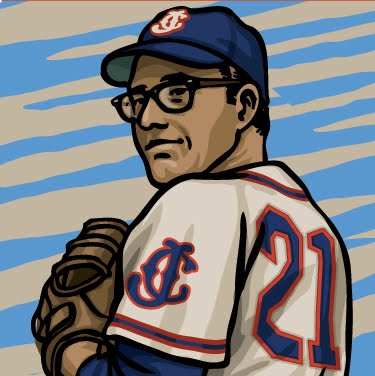
105. Eddie Boland: Major League Recycling


Let’s play a game: It’s 1943 and you’re the owner of a cellar-dwelling major league baseball team. What good players you’ve managed to scrounge up for your team have been drafted into the service and won’t be back for the foreseeable future. The Cuban players you imported to fill their place all scurried back home when they realized as residents of the U.S. they too were liable for the draft. As you contemplate your lot in life, you gaze out your office window which happens to look onto the magnificent baseball stadium that is named after you. Two semi-pro teams are warming up to play a game while your big league team is on the road (probably losing, you think to yourself). You notice the crowd. There’s over 10,000 fans in the stands and this isn’t even a major league game - in fact most sports fans have no idea who these players are. Trying hard not to think of your own team and to avoid the temptation to check the scores, you settle down to watch this baseball game below.

Right away, three players catch your attention and you follow their play during the course of the game:

Player A is a 23 year-old right handed pitcher. Over the course of 9 innings he strikes out 3 and gives up a single walk. Besides a spot of trouble in the 3rd inning where he gave up 4 hits, he scatters 5 hits harmlessly across 9 innings of work. Not a strike-out power-pitcher, he lets the batters hit the ball harmlessly to his fielders. This player is not currently in organized ball and is available to be signed immediately.

Player B is a 35 year-old right fielder. Over the course of the game he hits a single and a double in 4 at bats and commits an error when he misplays a fly ball. Asking around you find he once played for Philadelphia 8 years ago and in 38 games he hit just under .250. This player is not currently in organized ball and is available to be signed immediately.

Player C is a 31 year-old catcher. He smashes an RBI triple and a home run in your cavernous ballpark that was so impressive the entire crowd of 10,000 stood as one and cheered wildly. Looking at the crowd you can see he is the most popular player on the field. This player is not currently in organized ball and is available to be signed immediately.

Now all of these players are available to be signed to your team ASAP. In fact, they would love the opportunity to play in the big leagues. As a veteran appraiser of athletic ability, you can spot major league talent like no one else and you decide to offer a contract to one of those three men you watched today. Which one would it be? Washington Senators’ owner Clark Griffith was put in this same position as he watched those 2 teams play in his stadium in 1943 and was faced with the exact choice of ballplayers I offered above.

Griffith chose to sign Player B. But before we find out about Griff's pick, let‘s take a quick look at the 2 players he passed up:

If you picked Player A, you decided on Johnny Wright. He was the young ace of the Homestead Grays, one of the two teams playing that day. He was selected to pitch in the East-West All-Star Game that year as well as finish the season with a 31-5 record against all levels of competition. He would go on to be signed by Branch Rickey along with Jackie Robinson to break the color barrier in 1946. Although his major league career wasn’t terribly successful, he only got his chance after serving 2 years in the Navy during the war so he was not at his prime as a player. In 1943, he was.

Player C was the indomitable Josh Gibson. Although he might have been slowing down a touch at age 31, Gibson was still an unbelievable slugger whose home run totals in Griffith Stadium usually surpassed the home run total hit in that stadium by the entire Senators team. His average for the 1943 season was an astonishing .474 and the next year it was .345. Along with Satchel Paige, Gibson was the most popular black baseball player in 1943 and his presence on a major league team would bring in a huge amount of fans just to see him play.

But to Griffith, Player A and Player C have a major flaw: Wright and Gibson are black. While Griffith had to have realized that their talent was better than anyone on his roster, he was not a brave man and being the first to integrate the majors was not something he could bring himself to do. Upholding a sinister unwritten ban on blacks was more important than fielding a winning team his fan base could be proud of. No, Griffith looked over the field that day and decided on Player B: Eddie Boland.

Eddie Boland was a 35 year-old ex-pro ballplayer from New York City who was playing outfield for the Brooklyn Bushwicks that day in 1943 against Wright, Gibson and the Homestead Grays. Boland had spent 8 years toiling in the minor leagues and had a cup of coffee in the majors with the Philadelphia Phillies in 38 games spread over 2 seasons where hit just under .250. Stuck in the high minors with Buffalo, Boland called it quits after the 1938 season and went home to New York where he took a job with the Department of Sanitation.

Back in the 1920’s-40’s the metropolitan area was a hotbed of sizzling semi-pro ball clubs, some equalling the level of a AAA minor league team. The New York City public servants such as the police, fire and sanitation department all fielded highly competitive ball clubs chock-full of major league castoffs.

Boland played for the best of the city servant teams, the Department of Sanitation, and his skills so renown that he also played for 4 other top-draw semi-pro teams. His extra-curricular schedule for 1943-44 was kind of hard to believe:

Thursday: night game for the Stamford (Connecticut) Pioneers
Friday: night game for Cederhurst, Long Island club
Saturday: day game for the inmates at Kings Park prison
Sunday: double-header day games for Mt. Vernon plus a night game with Cederhurst again.

If you weren’t counting, that makes a total of 6 games a week. Boland was definitely in playing shape if nothing else. So while he was no where near as talented as Wright, let alone Gibson, Boland was a decent prospect considering the depleted talent pool to choose from.

When the Senators approached him with a contract, initially Boland balked - his job at the Department of Sanitation was much more steady than restarting a big league career at age 35. Eventually he agreed to play the outfield for Washington, but only during his annual vacation from his job and with one major stipulation - that he be free to participate in the annual game between his Sanitation team and the New York City Police Department in the Polo Grounds in September.

So while other garbage men took their late summer vacations at the Jersey Shore or up in the Poconos, Eddie Boland spent it roaming the outfield for the Washington Senators. In 19 games he batted a respectable .271 with 4 doubles and 14 RBI’s. Not bad for a guy that was, as the the sportswriters of the day liked to say, was "literally picked off the scrap heap."

The next season Boland decided to give in to the temptation of professional ball again and played for Buffalo in the International League but the war ended and he was out of pro ball again after 1947.

While the white press made much out of the signing of Boland, kind of a rags-to-riches, feel-good underdog story, the black press had a conniption over it. It was bad enough that the majors brought up sub-standard talent to keep the leagues going, and sure it was really tough to stand by and watch as teams like the Senators imported foreigners to fill their depleted rosters, but Boland’s signing was just too tough to take. Here was 2 whole leagues (the Negro National and Negro American Leagues) filled with at least 2 dozen can’t-miss major leaguers and the Senators go and sign up a has-been semi-pro garbage man?

It was a slap in the face to black Americans and the outrage it caused helped spur on the movement to get the major leagues to integrate. In the late summer of 1944, that moment was barely 2 years away...


Wednesday, September 28, 2011

91. Bullet Benson: A Cup of Coffee with the Senators


From the beginning, the best unplanned benefit I get out of this website is the new people I meet through it. Since the origins of this site stemmed from the sudden death of my Pop and my lack of having anyone to share those stories of obscure baseball players with anymore, the amount of baseball history fans I've met in the past year and a half has just been staggering. Through many of them, I've learned about players that I've never heard of before, which is always a welcome thing. About 2 weeks ago Mark Hornbaker emailed me about a pitcher for the old Washington Senators, Allen "Bullet Ben" Benson. Mark had researched and wrote an article about Bullet Ben and once he gave me a brief description of why this fella was interesting, I knew he had to have his own card and story. Fingers crossed, I invited Mark, a writer by trade, to be the newest guest author here at the The Infinite Baseball Card Set...

A few weeks ago I visited Gary Cieradkowski’s website for the first time. I was extremely impressed with Gary’s baseball stories and his custom baseball cards. I could tell right away Gary and I had something in common. We both like to share stories about ball players most people have forgotten.
I sent Gary an e-mail and told him about a story I just wrote for MASNsports.com, titled Bullet Ben's cup of coffee with the Washington Senators. After Gary read the story he contacted me to tell me he really enjoyed the story. Gary also wanted to know if I would share Bullet Ben’s story with his readers and he would create a custom baseball card of Bullet Ben. It didn’t take me long to reply back to Gary and tell him yes, I would like to share the story with your readers.
..

Since April 2007, I've been writing stories mostly about Washington D.C. baseball history at Nationals Daily News. A lot of my stories are based off of a date in time in D.C. baseball history. Today's story is about a pitcher, Allen "Bullet Ben" Benson, who made his Washington Senators debut this week in 1934.

What makes this story so different than any of my other stories is the way I learned about Benson. It happened a little less than two years ago when I received an e-mail from a person who wrote the following message to me:

"Mark, I have spent the last 20 years of my life trying to find more information out about my grandfather's career. He played with the Senators in 1934; he got a call up in August of that year, and pitched in two games. His name is Allen "Bullet Ben" Benson. Do you have any info on this subject??"

The person who sent me the message did not give me their name, only an e-mail address. Name or not, I was happy Benson's grandson took the time to reach me. I like to put on my detective hat on whenever I get the chance. After reading his question, I wasted no time in researching Benson's baseball past.

First, I looked his name up at baseball-reference.com. Even though there wasn't much more than the basic player profile there, I did see something that caught my eye. Allen Benson made his major league debut with the Washington Senators on August 19, 1934 and played in his last major league game one week later on August 26. Benson's grandson was right, his grandfather only played in only two games with the Senators. Not much of a story, if you are only interested in big names and big historical events.

For some reason, I kept on searching for more information about this player with the cool "Bullet Ben" nickname. I am glad I did because a half-hour later I found a Web site that listed major league players who were born in South Dakota. It was at this site I found a great deal of information about Benson's baseball career. Below is what was written about him:

"Allen Wilbert Benson was born in Hurley (Turner County), SD, on March 28, 1905 (prior to 2009, his birth date was listed incorrectly as July 12, 1908). He lived there his whole life.

"As a young man, Allen played amateur ball in and around Hurley. He also played with a Sioux City Stockyards team and professionally in the Texas League. In 1925 he was in one game for Waco and, in 1927, he pitched 5 games for Dallas (2-1, 2.74). It was also reported in "The Sporting News" that he appeared in games that year for Waterloo, IA.

"Benson's 1928 season was at Akron of the Central League where he appeared in 14 games with a 4-10 record and a 3.57 ERA. He started out with them again in 1929 (35 games, 12-7, 4.67) and then went to the Minneapolis Millers with whom he was in 3 games (16 innings) with a 0-1 record and an 8.44 ERA. In 1929 he returned to his preferred life on the ranch in South Dakota. "TSN" also reported that he had played in Charlerol, Des Moines, Wilkes-Barre and the House of David for three years.

"In a "TSN" article in August 1934, it was reported that he had to return to baseball because making a living on his land became very difficult under conditions during the Depression. In the summer of 1934 he was with The House of David team (beard and all) and was signed by Washington after the manager of Albany, Joe Cambria, saw him pitch an exhibition in Baltimore. [Benson told the team that he also had an 18-5 record for the amateur team - the Benton Harbor Tourists.] Cambria set up a try out for him where he pitched against the Senators' regular players. Washington management decided that he had sufficient speed, a good curve ball and change up to be inked to a contract.

"He first started a major league game on August 19, for the seventh place Joe Cronin led team and lasted until the 8th inning when he was removed with a blistered finger. When he arrived with the team, he continued to have facial hair. There were reports of his Senators' teammates being upset with his whiskers because they found 'the addition to their ranks of a sideshow curiosity as belittling their profession and take the view this pan should be operated on by a barber if he really is a pitcher and not merely a clown.' Senators' management said he could keep the whiskers, fans were sharply divided and Benson himself was said to be 'undecided ... but seemed inclined to favor retention...'

"Jaded members of the press charged that the signing of Allen was actually as a box office attraction similar to team owner Clark Griffith's employing characters such as Germany Schaefer, Nick Altrock, Al Schacht and Art Shires.

"In two starts that year, Benson pitched 9 2/3 innings and allowed 19 hits, 5 walks and struck out 4 for a 0-1 record with a 12.10 ERA. His son, Donald, wrote in 2004 that all he mentioned about his days with the Senators was 'I was in the major leagues just long enough to have a cup of coffee.' After his less then great pitching performance for the Senators, the beard was shaved.

"His nickname during his baseball years was "Bullet Ben" and in 1935 he made 2 stops to complete his pro career - at Albany of the International League (1-2) and Harrisburg of the New York-Penn league (8-9, 3.07).

After baseball, Allen returned to the Hurley area to farm and 'feed cattle' for more than 50 years. He died on Nov. 16, 1999."

I was very pleased with my findings, so I sent the information to Benson's very grateful grandson. Since that time, I read a very interesting ESPN story, "The Greatest Moments in Baseball Hair History" that was written by Paul Lukas in April 2008. In the story Lukas notes, "1934: Minor league journeyman Allen Benson gets a cup of coffee in the majors, appearing in two games with the Washington Senators. He sports a full beard, making him the first bearded big leaguer in 50 years - and the last one for nearly 40 more". I personally was pleased to find out Benson's cup of coffee with the Washington Senators was truly a little piece of baseball history.

Mark Hornbaker grew up in Darnestown, Maryland, where he was an avid Washington Senators fan. He currently resides in Poolesville, Maryland, with his wife Linda. Mark has been writing about the Nats and the history of baseball in Washington D.C. at Nationals Daily News since April, 2007. He also shares his views on baseball in D.C. at MASNsports.com.

http://www.nationalsdailynews.com/history/

http://www.nationalsdailynews.com/columnists/?blog=mark

http://www.masnsports.com/index_nationals.php

https://www.facebook.com/groups/60009109815/

http://twitter.com/#!/ezmark