
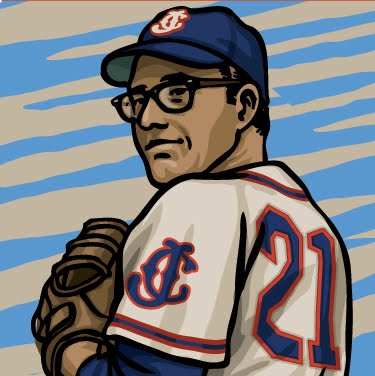


Sometimes you just stumble on interesting things when you least expect it. Besides baseball history, I'm also interested in military history, particularly World War I and earlier and it was while researching something on the Canadian Expeditionary Force that I stumbled on a newspaper article mentioning a former New York Giant outfielder earning a medal for hurling grenades like baseballs at the Germans. Now that was something worth looking into!
Toronto native Billy O'Hara started out in professional baseball with the Syracuse Stars in 1902, batting a nice .342 before moving on to Montreal later that year. He spent the next couple of years bouncing around the United States, moving up the food chain of minor leagues and by 1905 O'Hara was the star leftfielder of the Baltimore Orioles. He hit in the .300 range but he was more known for his defensive abilities and his rifle arm. Runners soon learned not to test the Canadian's arm - he was as accurate as a hunting rifle. John McGraw bought him from the Orioles and he was the Giants starting leftfielder during the 1909 campaign. Besides cracking the team's starting lineup he also earned cardboard immortality by being included in the famous T-206 set of baseball cards. O'Hara's average of .236 was the lowest of all the Giants starters that year, but he made only 5 errors in 226 chances. Unfortunately for O'Hara, McGraw had slugger Fred Snodgrass in the wings and traded O'Hara to the Cardinals. In 1910 he played only 9 games and was released to Toronto of the International League, right back where he started. O'Hara rebounded from his disappointing big league experience and gave his hometown Maple Leafs 4 great seasons that saw him become not only the team's star leftfielder, but also one of the most popular players with the Toronto fans. He was described as "an Irishman of the true-blue type, a scrapper and also a born gentleman." A natural comedian, he mixed easily with the Broadway crowd and counted George M. Cohan as one of his many friends. In the summer of 1915 his average tapered off, finishing with a disappointing .170, but he had other things on his mind besides throwing runner out at the plate.
Canada had joined with Great Britain and declared war on Imperial Germany. Like many men of that age, O'Hara felt the pull to become a part of the greatest adventure of his time. Right beyond his position in leftfield was the Curtiss Aviation School where their instructors worked round the clock to train new military aviators. An envious O'Hara watched them fly overhead and finally took private flying lessons. When the season ended the team threw him a gala dinner party for the leftfielder had joined the Royal Flying Corp. By Christmas, 1915 he was commissioned a Flight Lieutenant and was on his way to war.
Stationed on the English Channel, O'Hara flew defensive patrols until he crashed his plane in a non-combat accident. As punishment for destroying The King's Property he was transferred to the balloon corp, but O'Hara had signed up for action. He requested the infantry and was promptly sent to the trenches. Serving with the 24th Canadian Battalion he got his first taste of battle at the Battle of Ypres, somehow emerging unscathed. During the summer of 1916 the exhausted French Army pressed the British to launch an offensive to take the pressure off their own armies at Verdun. The resulting offensive, known as The Battle of the Somme, turned into the worst blood bath the British had ever suffered. On July 1st, following a massive bombardment, the Allied troops left their trenches and charged the German lines - in 10 minutes the British lost 60,000 men. O'Hara's battalion went over the top not once, but twice to try to dislodge the Germans. Turned back the first time, the Canadians were successful the second time but in the process of gaining the first line enemy trench lost 950 out of 1,200 men. While clearing the trench O'Hara came face to face with a German officer and took the top of his head off with a well-placed shot from his .45 automatic.
After weeks of futile attacks failed and both sides had reverted to trench warfare again, O'Hara and his men were sent into the front lines. It was here on The Somme in October of 1916 that Billy O'Hara put his baseball skills to another use. Canadian troops were renown for their particular zeal in night-time trench raids. These typically entailed small squads of about 10-20 men led by a lieutenant crawling through the barbed wire of no-mans-land and slithering undetected into the German lines unleashing a barrage of grenades and mayhem, hopefully culminating in the capture of a few of the enemy and returning back to their own lines unharmed.
Billy O'Hara, the leftfielder remembered for his accurate and powerful throwing arm, had found another use for the skills once used while manning his position in the Polo Grounds. The standard British No. 5 Mills Bomb was the standard issue grenade used during O'Hara's time in the trenches. The No. 5 weighed about 3 times more than an Official National League baseball but it's size and shape, unlike the cumbersome German stick grenade, enabled Canadian troops, like O'Hara who had grown up playing baseball, to throw it accurately as opposed to lobbing it like European troops who were not accustomed to throwing anything overhand. This simple skill that North American boys take for granted earned Billy O'Hara one of the most coveted decorations the British government could bestow on one of her soldiers.
While leading a bombing party on a trench raid, Lieutenant William A. O'Hara, 24th Battalion, Canadian Expeditionary Forces, was recommended for the Military Cross "...in recognition of his bravery and skill in hurling bombs..."
The Military Cross was awarded only to officers and is roughly equivalent to the Silver Star in the U.S. Army.
After the Somme, O'Hara and the rest of the Canadians scored a spectacular victory at the Battle of Vimy Ridge. Vimy Ridge is to Canadians what Iwo Jima or Guadalcanal is to Americans. During the battle a shell landed next to Lieutenant O'Hara and buried him under a mound of French soil. He woke up later in a hospital behind the lines. It appears that physically O'Hara was unhurt but he was put out of action by the effects of rheumatism, brought on by too many nights in the wet trenches. Reading between the lines it can also be assumed that besides rheumatism he was suffering from severe shell shock - getting exploded and buried would do that to even the hardiest warriors. He was eventually sent back to Canada to recuperate in the Spring of 1918 and he lectured extensively about the horrors as well as the lighter side of life in the trenches.
After the war, instead of returning to baseball, Billy O'Hara decided to pursue the life of a trapper in the Echo Lake region of Northern Ontario, near the town of Kapuskasing - in other words, smack-dab in the middle of nowhere. His reasons for doing so are unknown - one would suspect it was his way of seeking solitude and dealing with the wholesale slaughter he had witnessed in the trenches during the preceding 3 years. While guys like Hemingway, Fitzgerald and Dos Passos retreated to the bright lights of Paris, others like O'Hara retreated to the peace of nature. Unfortunately his attempt to make a living as a conventional trapper came to nothing when his trap lines failed to produce much prey, but as always, Billy O'Hara was resourceful.
With a nod to the knowledge learned elsewhere, O'Hara decided to apply the deadly skills he had learned in the war to help him earn a living in the wild. In 1920 he petitioned the Canadian government to use surplus observation balloons to track the animals that eluded his traps and once found, use a machine gun mow down the unsuspecting herds of moose and deer, the same way his comrades had been mowed down on the Somme in 1916. His revolutionary ideas had made the papers at the time and although there was no follow up, I think it is safe to say that his proposal was denied.
Whatever the outcome, Billy O'Hara eventually emerged from the frozen North and in 1927 took the reigns of this hometown Maple Leafs. He managed the team through 1928 when he switched over to become their business manager. He was traveling with the team on one of their road trips in June of 1931 when he suffered a fainting spell in Newark, N.J. After being examined by doctors he was told he had a serious heart ailment and would not last the year. O'Hara continued to function as the team's business manager and it was while performing his duties that he started to feel ill while accompanying the team in Buffalo. He stayed with his team but by the time they arrived in Jersey City for a series against the Skeeters, he was unable to leave his bed at the Plaza Hotel. Billy O'Hara was surrounded by friends when he suffered a convulsion and died before doctors could arrive.
So now when someone tries telling you that baseball is just a sport and has no application to the real world, tell 'em about Billy O'Hara, the grenade-throwing leftfielder...

