Monday, July 23, 2012

1927 Yankees Catching Squad


First off, thank you to everyone who sent me notes about my Mom's passing, your kind works meant a lot to me.

In place of a new card and story this week, I thought I'd show a small part of a larger project I have been working on lately. For a while I have been toying with the idea of picturing a whole ball club, not in a team picture type of situation but in a long vertical formal, casually standing around. The idea came to me when I was thinking of something to do for an art show sponsored by the Cincinnati Reds Hall of Fame. I thought about doing a large size full team picture of the 1940 team. Unfortunately I got side-tracked by other work and didn't get a chance to get started on it. When I finally started kicking around the idea again I decided on the famed 1927 New York Yankees.

Now, those of you who know me know that I am the furthest thing from a Yankee fan. However, the 1927 team is interesting for a few reasons, the first being that it is well documented with photographs. This is of note because i want to show every player, trainer and batboy, as well as the owners. I figure there will be something like 25 ballplayers and about 8 non-players in the competed drawing. As you can see from the 3 catchers above, I plan on drawing all the men in casual poses, almost like they were captured warming up before a game in 1927. Being as interested in vintage graphic design and advertising as I am in baseball history, lining all the guys up against a background of outfield wall featuring old colorful advertising was a bonus and will be fun to do.

As I complete more sections of the drawing I will post them, no telling how long it will take, but it should be an interesting project!

Saturday, June 30, 2012

123. Reggie Jackson: This One's For You Mom!


This week's post ain't about Reggie Jackson, per se, or even about baseball for that matter. This post is about my Mom, Pattie. At the young age of 64 and just 3 years since her husband died, Mom is lying in a New Jersey hospital room on "comfort care." That pleasant term is the nice phrase for the "death watch". Mom was diagnosed with cancer a month ago and in that short period suffered a stroke, endured brain surgery to remove 2 bleeding tumors and is now in a coma dying from a third inoperable hemorrhaging tumor. By the time I post this, she may already have passed away. But that's neither here nor there.

My mother was never a huge baseball fan, she much preferred football, and much later, due to my brother's interest, soccer. However back in the late 1970's and early 1980's my Mom was caught up in that whole Reggie Jackson Mania that was sweeping North Jersey where we lived. Most of my friends and neighbors were as well (including my gorgeous 3rd grade teacher, Ms. Keslo, who broke my virgin heart the day she tacked a poster of a shirtless Bucky Dent on the wall next to my desk). But I, brought up as the third generation of a staunch line of bitter Yankee-haters, didn't have that option. No, instead of reveling in the Yankees' seemingly endless string of World Series victories in that gleaming cathedral in the Bronx, I was left with the 5th-rate Mets and that bus station in Queens called Shea Stadium.

From 1977 on, while my Pop and I suffered through sickening seasons of Metropolitan's baseball, my Mom gleefully latched onto the biggest wave of baseball euphoria since Babe Ruth, Reggiemania. While I tortured myself by staying up late huddled under the covers with my blue transistor radio listening to the Mets drop another game to the Padres, Mom tuned the t.v. in to watch the Yankees making chumps of the Red Sox. I spent my money on packs of baseball cards hoping to get another one of the Mets also-rans while chewing that copper-flavored gum that came with the cards. Mom came home from the market with boxes of scrumptious looking Reggie Bars. The fact that they were made with nuts which I was allergic to just made it seem personal, like a kick to the balls.

I'm kind of rambling here, but bear with me. I guess what I'm trying to get at here is that my Mom seemed to take the game for what it was, a game. Me and my Pop, we took every Yankee win as a person affront, irrefutable proof that there was no fairness in the world. To he and I, the whole world was against us, and they were winning. Mom took the whole ride for just what it was, being part of something exciting.

Reggie Jackson seemed to embody late 70's New York City. He was bigger than life, fallible but he came through when you thought he was all but finished. They booed the hell out of him, even in his own house and still he bounced off the ropes and forced you to admire his talent as he rounded the bases on the way to beating the hell out of you. He fought with the press and they loved it. He pouted and complained and sulked. And he won. Jackson made things exciting again. I can't think of any player in my lifetime who made the game as exciting as I imagined Babe Ruth did. If Muhammad Ali played right field and wore God-awful ugly tinted glasses, I imagine he would have been like Reggie Jackson.

I remember when he said something about being "the straw that stirs the drink" on the Yankees. When asked about team captain and universally admired Thurmun Munson, Jackson replied maybe he stirred it up too, but only in a bad way. The papers exploded and so did the fans. No one ever dared to disparage Munson, and Reggie became the guy you loved to hate on a team full of guys you loved to hate.

Now more than 30 years later even a casual fan knows of Reggie Jackson while most know Munson as that guy who crashed his plane.

I hated Reggie Jackson. I held him responsible for all the bad things in my life. The kids I fought with in the neighborhood all wore Yankee caps. The girls I thought were pretty all turned their backs on me, the large number 44 and "JACKSON" arched above it the being last thing I saw as they walked quickly away. Reggie played in a building that was as close to the Sistine Chapel as us Americans can build and my team played in a cruelly enlarged version of the locker room at the Y.

My Mom loved Reggie. She squealed with laughter as he propelled his team to yet another pennant. She felt sorry for him when those mooks in the bleachers threw batteries at him as he stood in right field. When he hit all those home runs to win another world series, Mom spent the winter happy with  boundless optimism for the distant spring.

And when Reggie was traded and the Yankees stopped winning, Mom found something else positive in life to root for. It's just the way she was. Well, I'm rooting for you Mom, but like the 1978 Mets, I know it's a lost cause. But I'm still rooting, just the same. It's just the way I am.

Postscript: Like my '78 Mets, Mom didn't make it. She passed away quietly on Sunday morning, July 1st, 2012. Rest easy Mom and tell Pop I said hi.

Friday, June 22, 2012

122. Curly Williams: A Good First Impression That Lasts and Lasts


For the second week in a row I've been fortunate to have two guest authors take the writing reins from me and highlight a player that they felt needed the Infinite Card Set "treatment." Besides offering a another perspective, writing style and different players than I would have chosen, it also gives me a break from writing and researching. You see, a few weeks ago my mother was diagnosed with terminal cancer and the past couple of weeks have been spent back in New Jersey visiting her in the hospital and trying to gather up all the loose ends that a sudden illness always exposes. That's enough about all that now, but I'd like to thank last week's author, Gary Bedingfield and this week's, Jay-Dell Mah, for pinch hitting for me when I needed them.

Last year when working on the Satchel Paige All-Stars story I came across a really interesting website dedicated to baseball in Alberta, Saskatchewan and Manitoba. The proprietor of the site, Jay-Dell Mah, has graciously accepted my offer to be a guest author here at the Infinite Baseball Card Set.

Willie “Curly” Williams had a knack of making a good first impression. In Triple-A with Toledo, in the White Sox organization, Williams won three steak dinners and a savings bond for a triple which knocked in the first runs of the 1952 season for the Mud Hens. With Colorado Springs the previous season, he belted a game-winning two-run homer in the bottom of the ninth inning as the Sky Sox scored seven times for a season-opening victory.

In Canada, the admiration was long-lasting. “Curly Williams was one of the finest gentlemen that I ever met”, said Slim Thorpe the Saskatchewan team’s president. “He was always helping the kids. We'd get these young college boys and Curly was in there talking to them, showing them how to do it.”

The youngest of seven children, Williams, whose father died when he was just six months old, grew up in Orangeburg, South Carolina where he became widely recognized for his athletic achievements both in baseball and football. As a teenager Williams won a spot on the local Orangeburg Tigers (along with his life-long buddy Modie Risher, once touted as a successor to Roy Campanella) who often competed against barnstorming Negro League teams. It was during his Tigers tenure in the latter part of the 1940s that the famous Newark Eagles of the Negro National League took notice. He became the Eagles’ shortstop both in Newark and, upon the team’s re-location, in Houston and New Orleans. In 1950, as a member of the Houston Eagles, he was selected to play in the Negro League’s East-West All-Star Game at Comiskey Park in Chicago.

A few months later, in winter ball in Puerto Rico, with Mayaguez, the left-handed swatter attracted interest at the major league level especially after a memorable six-day stretch in which he clubbed seven home runs.

The White Sox came calling. The 5’10”, 175 pound shortstop was assigned to Colorado Springs in the Western League and further impressed with a .297 batting average and .547 slugging percentage. But, not feeling anywhere near comfortable with continued sleights against black players, Williams left the club to head back to the Negro League Eagles, now in New Orleans, and hit .351 with 11 home runs in less than half a season.

Convinced to return to the White Sox system, he lined up with Toledo for the start of the 1952 campaign. Williams’ recollections of Spring Training at Avon Park, Florida, didn’t focus on the diamond, but a restaurant kitchen. The kitchen where he was forced to sit for his meals while his white teammates enjoyed the service on the other side of the door at tables in the eatery. He didn’t get to stay at the team’s hotel either. The club found a preacher in the community who agreed to house Williams.

In July, a trade found the infielder in the St. Louis Browns’ farm system, assigned to Scranton of the Eastern League and then the first black player to sign with San Antonio in the Texas League. But, Williams decided to go north, not south, in 1953. He crossed the border to Canada to play in the ManDak (Manitoba-Dakota) League with dozens of other former Negro Leaguers including future Hall of Famers Willie Wells and Leon Day. The integration of the majors and the subsequent decline of the Negro Leagues had reduced playing opportunities for black players and many found a home in the ManDak circuit. The 1950 league champion Winnipeg Buffaloes sported an all-black lineup.

When Williams took the field with the Carman, Manitoba, Cardinals it must have seemed like a Negro League reunion. Under playing-manager Chet Brewer, the club featured, among others, Joe Atkins, Lyman Bostock, Willie Hutchinson, Lester Lockett, Chick Longest, Benjamin Lott, Walter McCoy, Jimmy Newberry, Andy Porter, Herb Souell and Williams, who, in spite of a late start almost won the home run crown blasting 12 in fewer than 200 at bats.

In 1954, he returned for a final season in Negro ball with the Birmingham Black Barons and again was among the loop’s top sluggers.

The following summer it was back to Canada, this time to a small prairie town – Lloydminster – split by the provincial border between Alberta and Saskatchewan. He felt so comfortable he kept coming back to put on the Meridians’ jersey.

“(In Canada) we were treated so well up there that's why I stayed up there so long ... We had so much fun there and everybody was accepted, you know, didn't have problems going any place we wanted to eat. Just wonderful people. May not have made a whole lot of money but people were excited and they enjoyed you and would invite you to their homes."

In his first season in Lloydminster, he hit .280 and, as a third baseman, led the league in fielding. The following year, he was in the top five in average while producing an on-base percentage of .457. Again, he led the league in fielding, this time at shortstop.

Williams was a perennial all-star who also took a turn as manager of the club. In his first full month at the helm, in 1961, he led the Meridians to 25 wins in 32 games, including tournament victories at Lacombe and Lethbridge. Curly loved the big tourney at Lacombe. In the 1960 event he reached base 14 times in 15 appearances. In the 1961 go-round, Williams had three hits and scored twice in the semi-final match as a warm-up for the final in which in homered, tripled and doubled, drove in four runs and scored a pair.

Curly retired after the 1963 season and ten seasons in Canada. Fittingly, he went out with a blast -- a .391 average.

Williams played with and against many of the giants of major league and Negro league baseball – Satchel Paige, Jackie Robinson, Roy Campanella, Willie Mays, Don Newcombe and Monte Irvin.

"Such a nice man, beautiful, just beautiful", said Risher "too nice sometimes. I used to get on him about it, telling him you can't be the saviour for everybody".

In 1997, the Sarasota, Florida Council declared "Curly Williams Day" in honour of his efforts to raise funds (through the Curly Williams Foundation) to provide college scholarships for needy students.

Williams was also a major figure in winning pension benefits for many Negro Leaguers who had, based on their color alone, been denied an opportunity to play in the majors.

He died in August, 2011 at Sarasota, Florida at age 86.

Jay-Dell Mah is a former radio and television news reporter for the Canadian Broadcasting Corporation in Toronto. Since his retirement from the CBC, in the late 1990s, baseball research has been a prime activity. His web site – www.attheplate.com – documents semi-professional and amateur baseball in Canada (mainly in Alberta, Saskatchewan and Manitoba) and the northeastern United States from the early 1900s to the mid 1970s. A highlight of his baseball career came in the summer of 2010 with induction into the Saskatchewan Baseball Hall of Fame. In late 2010, he was selected as one of the top 100 most influential figures in baseball in Canada. The native of the prairie border city of Lloydminster, is co-author of Black Baseball Players in Canada: A Biographical Dictionary, 1881-1960 (McFarland & Company, 2009). He’s a member and former webmaster of SABR, the Society for American Baseball Research. Mah now lives in the British Columbia interior community of Nakusp.

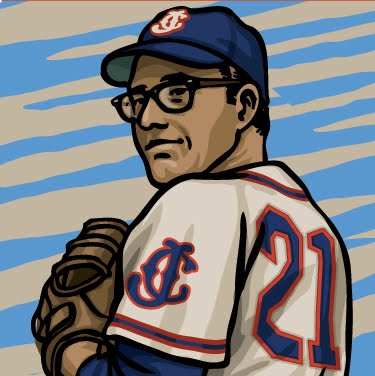
Wednesday, June 6, 2012

121. Tom Woodruff: Speed on the Field, Speed in the Air


One of my favorite baseball websites I always check in on is www.baseballinwartime.com. Writer/researcher Gary Bedingfield has created the best clearinghouse of information and stories related to baseball and World War II, from the hundreds of service teams to all-star tours of the war zones to a painstakingly researched list of ballplayers killed in the line of duty. It is a fascinating glimpse of how the sport of baseball helped the United States get through some tough times and it also pays tribute to the hundreds of sports heroes who selflessly put their careers aside in order to help defeat the evil that was threatening our world. When I did my card and story on Bill Niemeyer a few weeks ago, it was Gary's site that I turned to first. Looking over his new creation, Baseball's Greatest Sacrifice, I had an idea - why not have Gary pick one of his ballplayers, I'll do the illustration and we'll give everyone a reason to check out his unbelievable research on wartime baseball...

Tom Woodruff was a league-leading base stealer his first two years in the minors. Five years later he was inflicting heavy damage on Japanese shipping as a US Navy fighter pilot roaming the Pacific from the deck of the USS Enterprise. After earning a string of awards for extraordinary heroism against the enemy, Tom's luck ran out in November 1944.

Thomas J. Woodruff attended St. Louis University High School, where he was a three-sport athlete and an honors student. He was a varsity baseball teammate of Joe Schultz, who enjoyed a nine-year career as a major league catcher with the Pirates and Browns, and went on to manage the Seattle Pilots and Detroit Tigers. Another teammate, William Quinn, became the first governor of the state of Hawaii and president of Dole Pineapple. Yet another, Bob Hyland, became a pioneer in the radio business, becoming the vice-president of CBS radio and creating the talk-radio call-in format. [1]

Following graduation in 1936, Woodruff enrolled at St. Louis University, and was on the Track team and Freshmen basketball squad before signing with the St. Louis Browns in 1938. The Browns sent the young shortstop to the Corpus Christi Spudders of the Class D Texas Valley League, and he batted .271 with 6 home runs, 20 triples, 71 RBIs and a league-leading 44 stolen bases. He also led the team with 84 base on balls and 13 sacrifice hits. In 1939, he joined the Paragould Browns of the Class D Northeast Arkansas League and batted .279 in 120 games with 10 home runs, 56 RBIs, a team-leading 115 runs scored and a league-leading 62 stolen bases. [2]

The 22-year-old began the 1940 season with the Springfield Browns of the Class B Three-I League, playing alongside future major leaguers Ray Coleman, Earl Jones, Ed Busch and Len Schulte. But after batting only .248 in 55 games he joined the St. Joseph Autos of the Class C Michigan State League on July 9. Bringing outstanding speed on the basepaths and combining with manager Elmer Kirchoff to make a neat double play combination, Woodruff helped put the Autos on a winning streak. In 27 games, he was batting .404 and had stolen 17 bases when he broke his leg in a game against Grand Rapids in August. But despite his limited playing time he was voted to the Michigan State League All-Star team picked by the loop's sports editors and team managers.

Woodruff's option was taken up by Springfield at the start of 1941. The team he had played for before joining St. Joseph, and the young infielder was torn between the desire of stepping up into Class B competition and returning to the Autos. "If you consider the calibre of play, the playing conditions, teammates, and the two cities of St. Joseph and Springfield, I'd probably rather come back to the Autos," he told the Benton Harbor News Palladium. "But I've got to also look at it from the baseball angle that the Three-Eye circuit naturally carries more prestige than the Class C Michigan League and baseball men give more recognition to you if you're from a class B loop," he added. [3]

Nevertheless, and with his military draft call looming, he was back with St. Joseph by mid-April. He was batting .278 with 18 RBIs, 4 home runs and 12 stolen bases in 19 games when military service requested his presence June 6. May 28 was the date of the popular shortstop's last game and the event was dubbed "Tommy Woodruff Night" as the Autos faced Grand Rapids before a crowd of 850 at Edgewater Park. Batting in his usual number two spot Woodruff was hitless at the plate but safely handled five chances in the field. As the Autos headed to Lansing to play the cellar-dwelling Senators, Woodruff headed home to St. Louis and reported for induction. [4]

Woodruff began his military life at the Army Replacement Center at Jefferson Barracks, Missouri, where he was attached to the public relations staff, having studied journalismn at St. Louis University. He later transferred to the Navy and as an aviation cadet, trained at Pensacola Naval Air Station, earning his wings as a fighter pilot in June 1942. Lieutenant Junior Grade Woodruff flew the Grumman F6F Hellcat, and saw action in the Pacific from August 1944, as part of Fighter Squadron VF-20 aboard the USS Enterprise. He made fighter sweeps over the Bonin Islands, Yap Island and in support of the landings at Peleliu in September. In October, strikes were made against Okinawa, Luzon and in support of the Second Battle of the Philippine Sea. Woodruff was awarded the Distinguished Flying Cross, Air Medal and Navy Cross for his aerial combat achievements.

During November, he made attacks against land targets in the Philippines and enemy convoys including the November 11 attack on an enemy convoy at Ormoc Bay. On that day, the Navy pilots encountered stiff opposition from ant-aircraft fire but sank two destroyers.

On November 14, 1944, he flew a mission against Clark Field in the Philippines that was the most trying for the pilots of VF-20. Anti-aircraft batteries of all sizes had been greatly strengthened since previous strikes and were finding their targets with alarming accuracy. Six fighters were shot down that day, including Woodruff. His body was never recovered and a year later he was officially declared dead.

Woodruff was posthumously awarded a gold star in lieu of a second Distinguished Flying Cross for his part in the attack against the Japanese convoy on November 11, 1944. He is memorialized at the Manila American Cemetery at Fort Bonifacio in the Philippines.

Lt (jg) Woodruff's Navy Cross citation:
The President of the United States of America takes pleasure in presenting the Navy Cross to Lieutenant, Junior Grade Thomas Joseph Woodruff (NSN: 0-145682), United States Naval Reserve, for extraordinary heroism in operations against the enemy while serving as Pilot of a carrier-based Navy Fighter Plane in Fighting Squadron TWENTY (VF-20), attached to the U.S.S. ENTERPRISE (CV-6), in strikes against the Japanese Fleet on 24 - 25 October 1944, east of the Philippines. On 25 October Lieutenant, Junior Grade, Woodruff participated in a coordinated attack on a large formation of enemy warships and in spite of intense anti-aircraft fire scored rocket hits on a destroyer. On 20 October with complete disregard for his own personal safety and in the face of intense anti-aircraft fire he attacked and obtained a direct bomb hit on a light cruiser inflicting severe damage. His courage and skill were at all times in keeping with the highest traditions of the United States Naval Service.

General Orders: Commander 1st Carrier Task Force Pacific: Serial 046 (January 31, 1945)
Action Date: October 24 - 25, 1944
Service: Naval Reserve
Rank: Lieutenant Junior Grade
Company: Fighting Squadron 20 (VF-20)
Division: U.S.S. Enterprise (CV-6)

About Gary Bedingfield As an Englishman, my enthusiasm for baseball may seem a tad strange. Baseball is not popular in Britain, and yet I developed a passion for the American national pastime at a tender age. And since 1999, I've been researching the impact of war on professional baseball. Why? Well, it gives me an opportunity to combine two things that fascinate me in life – World War II and the great game of baseball.

Coinciding with the release of my first book on the subject, "Baseball in World War II Europe" in 2000, I launched the now popular BaseballinWartime.com website as a way of sharing the information I was uncovering. A major part of this website was a section entitled "In Memoriam," dedicated to baseball players who lost their lives during World War II. It amazed me that no prior listing had ever been compiled relating to the National Pastime's commitment to the war in relation to deaths and I took it upon myself to rectify the situation. In 2009, McFarland publishers released my second book, "Baseball's Dead of World War II," a collection of 127 biographies of players who lost their lives while serving with the military during World War II. Since the release of "Baseball's Dead" the list has grown to 142 and I decided to look beyond World War II and see what players made the ultimate sacrifice in other conflicts, or even while serving in the military in peacetime.

The result of this research is BaseballsGreatestSacrifice.com, launched in January 2012, and dedicated to the 381 players who died in service. It serves as the only Internet source dedicated to these men and will eventually include biographies for every player I am able to uncover, from major league to amateur.

What do I hope will become of this information? Well, one day, I’d love to see Major League Baseball recognize the players who died in service. Maybe a plaque inscribed with their names. C’mon guys, it’s time they were honored.

www.baseballinwartime.com

www.baseballsgreatestsacrifice.com


Thursday, May 31, 2012

120. Mickey Mantle: The Miner's Son Becomes A Miner


The Yankee organization was plenty pleased with Mickey Mantle's freshman performance with the Independence Yankees. In the spring of 1950 Mickey was invited to come to St. Petersburg, Florida where the big club training. Despite no one knowing who this teenager was, the kid from Oklahoma quickly stood out.

Batting left-handed he knocked ball after ball over the left field wall and switching sides he scattered hits all over the field. Even among the Yankee legends on the field, DiMaggio, Berra and Bauer, this kid was something else. After watching one particularly impressive blast, Manager Casey Stengel was said to have cried out "What'sis name? Mantle?" When the Yanks broke camp and headed North, Casey went back to New York dreaming of when this kid would be sitting on his bench.

The Yankee management agreed with Stengel's evaluation and the consensus was that he had the rare skills to be able to skip the many rungs of the minor leagues and go right into AA level, the highest level of the minors (now reclassified as AAA). While the temptation to do so must have been excruciating, cooler heads prevailed and it was decided to bring Mickey along slowly. He was just 18 and known to be somewhat homesick and lacking a strong self-esteem. The Yankees had a Class-B farm team in Joplin, Missouri, less than 30 miles away on the old Route 66. The youngster would have the comfort of staying close to home as well as having a familiar face in the dugout - his manager in Independence, Harry Craft, was also moved up and was taking the helm of the Joplin Minors.

At the Miners' spring training camp in Branson, Missouri Mickey continued to awe with his unprecedented hitting performance. He'd beefed up since the previous season and took to rolling up the sleeves of his flannel jersey to make room for his muscles.

When Lee MacPhail, director of personnel for the organization and son of former Yankees owner Larry MacPhail came to Joplin to watch a pre-season exhibition game, he told friends that Mickey Mantle was the strongest and fastest man in organized baseball. There was talk already around the Yankees front office that this kid was going to be the usurp the mantle of the aging Joe DiMaggio.

Buoyed by one successful season under his belt and glad to be close to his family, Mickey exploded. Encouraged by Harry Craft to swing away, Micky was soon leading the Western Association in almost every offensive department. In a night game in Joplin he smashed one home run left-handed, then turned around and did the same right-handed. It was obvious to his teammates, fans and opposing players that this kid was something special.

Mickey was allowed to go home to his family after games played in Joplin. The kid had begun hanging out at a local pool hall and discovered beer. Manager Harry Craft figured letting the kid go home every night to his family would help keep him straight. But having his family close was a double-edged sword. After on game where he went 3 for 4 with a home run, his father Mutt told him that he would have got 4 hits had he hustled on a ground ball. The kid had a quick temper as well which he directed at himself, always believing he could do better.

The only problem was his fielding.

Try as he might, Mickey couldn't seem to improve his play at shortstop. Fly balls were so troubling to him that his own teammates would yell for him to stay away when one came towards short. He committed 55 errors in 137 games and his arm, though strong as hell, was so erratic that legend has it the box seats beyond first base were left empty for fear of getting hit by one of Mickey unpredictable throws.

As the 1950 season came to a close, Mickey could look back on an impressive year. He grabbed hold of the next rung of the Yankee farm system and improved by leaps and bounds over his first season. He was popular with his teammates and fans alike and could bask in all the attention lavished on him. The Yankees, on their way to a repeat pennant that year, rewarded the 18 year-old with a September call-up to the majors. For the final 2 weeks of the 1950 season Mickey watched the big leaguers from the security of the Yankees' dugout. Shy and reserved he couldn't even muster the nerve to talk to idol Joe DiMaggio, the man he was destined to replace. Though he didn't get into a single game, that first experience of being a big league ballplayer would help him get him used to what was ahead.

Like my previous post on Mickey's 1949 season, I'd like to dedicate it to my Uncle Eddie, a great Mickey Mantle fan and the guy who came to my little league games when my father could not. Nick Diunte's article in the Examiner was particularly helpful in this story, check that and his other articles out, he's quite a good writer and focuses on New York City baseball.

Friday, May 25, 2012

Memorial Day 2012


By the morning of March 4th, 1945, the boys of G Company, 2nd Battalion, 11th Infantry Regiment, 5th Infantry Division had become hardened veterans. Most had just arrived in Europe barely 3 months before and now those same freshly minted young soldiers had checked the Germans at the Battle of the Bulge, chased their asses back across the Rhine and were now slugging their way into the Third Reich itself. The war was close to being over with, the Allies gaining more momentum everyday and the enemy knew it. If the Germans were only fighting the western powers they most likely would have caved in already. However, on the other side of Germany the Soviets were smashing towards Berlin and every day they held out meant more Germans could make their way west to be captured or at least get to an area occupied by the western Allies. No one wanted to be around when the Russians came so the war ground on.

The boys of G Company probably didn’t care much about the reason why the Germans still fought them tooth and nail. Each man had had his life interrupted and shipped half way around the globe to stop an evil that was threatening to swallow the whole world. The boys of G Company had left pretty young wives, anxious mothers, college classrooms or good jobs and took up a Garand Rifle to do their part. Complaining about what they were missing out on was pointless - the fella next to you had the same story. Maybe even better than yours. Nah, complaining wouldn’t do any good. Best thing was to keep marching forward and get this over with. As they wearily crossed the makeshift bridge built over the Kyll River they just cared about the fight they had ahead of them that afternoon and the one after that and the one after that until these Krauts threw in the towel.

If any of the boys in G Company were still sleepy, chances are the mortar fire that greeted them as the crossed the bridge woke them up. The enemy they’d been chasing since Luxembourg had dug in around the town of Erdorf. As the German lines collapsed and contracted the enemy became more dense, more desperate. Besides regular infantry, G Company was marching right into redeployed artillery and Panzer units. As they pushed forward the resistance became stiffer and more determined. Each gain was met with vicious counter-attacks and artillery barrages.

G Company was deployed to sweep the fields around the village of Erdorf. This was pleasant farm land of rolling little green hills and blooming trees. To the boys of G Company, the area they were clearing of enemy troops looked a lot like familiar places in the northeast and Midwest United States. Perhaps more than a few were suddenly lost in thoughts of an afternoon spent in surroundings much like this. The boys of G Company thought back to little places they left behind called Sussex County, Washington Courthouse, Mechanicsburg or Crescent Springs.

To the officers of G Company, this place was just called Hill 378.

The company spread out and took a low hill like they had countless other times in the last three months. All very textbook. Regrouping and moving forward, they entered a wooded area where entrenched German troops and the Panzer tanks were waiting. This obstacle, too, was eventually beaten aside by G Company and just like every other hill and wood and field G Company had cleared in the past three months, they left behind some of their own. As the troops emerged on the other side of the wood and continued eastward into Germany, one of the 32 boys they left behind that afternoon was 22 year-old Private First Class Bill Niemeyer of Crescent Springs, Kentucky. The life he had put on hold in order to beat back the evil that darkened the world consisted of his young wife Marie, infant daughters Deanna Gail and Mary Johanna and a promising pitching career in the Chicago Cubs organization.

Even though Bill Niemeyer never made it up to the Cubs, I wanted to depict Bill in a Chicago uniform. Was he good enough to have eventually made it to Wrigley Field? I don’t know. We will never know. The same as we will never know what any of the other boys in G Company who died that afternoon in Germany would have accomplished in their lives. The one thing I do know is that is their sacrifices, all veteran’s sacrifices, made it possible for me to have a good life in the greatest country in the world. As I sit here writing this, I can see and hear my neighbors enjoying this beautiful Memorial Day weekend. The shouts of the boys next door, the couple across the street putting a pair of mountain bikes in their SUV and the girl on the corner attempting to train her new puppy on her green front lawn. In a few hours I will be going over to see my girlfriend who I love very much, and share a nice, lazy summer evening. All that I see and hear right at this very moment was possible because of men and women like Bill Niemeyer, a 22 year-old promising ballplayer who once lived right down the street from where I sit right now, the place he left to go off to war and never saw again.

Many thanks to Gary Bedingfield who is the foremost authority on baseball and World war II. While looking around for a ballplayer to feature this Memorial Day I of course consulted his amazing website www.baseballinwartime.com. Consulting a page he constructed showing the many professional ballplayers who died fighting for our country, Bill Niemeyer jumped off the screen. He was born and raised right where I was sitting. I might even pass his relatives at the market or live next door. The fact that he came from this place made his sacrife a bit more personal for me, especially as I sat there with a nice fresh cup of coffee by an open window enjoying the beautiful Kentucky scenery he never saw again. The place of his death was even more interesting as that part of Germany looks very similar to what he had grown up in. I’m glad I found Bill’s name on that website and I encourage every other baseball fan to take a look at Gary Bedingfield’s monumental work. His site features in-depth articles about hundreds (actually it might even be thousands of entries by now!) of players who found themselves in the service during the war. Gary is also an author of two indispensable books on the subject, "Baseball's Dead of World War II: A Roster Of Professional Players Who Died" and one of my personal favorites, "Baseball In World War II Europe (part of the Images of Sports series)."

Thursday, May 17, 2012

119. Mickey Rutner: Man On Spikes


When I first started this blog a little over two years ago, I started receiving many requests for players to be profiled on here and given The Infinite Baseball Card Set "treatment." Out of all the emails I began to notice that it was not one particular player that was asked for the most, but rather a whole ethnic group: Jewish ballplayers. I did cards and stories on here of Sandy Koufax and Moe Berg, but I began slowly researching different players of the Jewish faith, trying to find characters who would fit in with the kind of stories I like to write. Guys with interesting stories who may not be known to the casual fan of baseball history. Mickey Rutner was one of those guys, and in fact he appears on page 15 of the Premier Issue of "21: The Illustrated Journal of Outsider Baseball." Ron Kaplan, founder of the highly informative baseball book review site Kaplan's Baseball Bookshelf, told me that no feature on Jewish ballplayers was complete without including Mickey. As far as I was concerned, including Mickey was a pleasure because not only was he the inspiration for a fine baseball novel and made-for-TV movie, but I had actually met him back in 2002 and had a nice talk with him while taking in a minor league ballgame in Round Rock, Texas.

Mickey Rutner wasn’t a great ballplayer, but he was a darn good one. His entire major league career consisted of 12 games with Connie Mack’s 1947 Philadelphia Athletics but it was his long, bittersweet minor league experience that inspired author Eliot Asinof to make him the hero of his best selling 1955 novel “Man On Spikes”. The novel follows hero “Mike Kutner” as he winds his way through the minor league system battling prejudices and the exploitation of the players toiling in its farm system. In Asinof’s novel the prejudice faced by the main character was due to his wearing of glasses - the real “Mike Kutner”- Mickey Rutner, faced anti-Semitism.

Mickey grew up in Hempstead, New York and after starring on his high school baseball team went on to play the sport at St. John’s University. In 1939 while playing in a semi-pro league sponsored by major league clubs and made up of college players, Rutner was teammates with another Jew from New York named Eliot Asinof. The team was run by manager Bill Barrett and after a losing streak approached Asinof telling him “there’s too many Heebs on this club. You’re fired.” Rutner got to stay.

After graduation Mickey was signed by the Detroit Tigers. Given a $3,000 signing bonus which he was later cheated out of, he was sent to play in their minor league system. While playing for Winston-Salem in 1941 Rutner’s manager was none other than Jake Atz, famed Texas League manager now in the last year of his long and successful career. Atz, also a Jew, told Rutner that his name Mickey and degree from St. John’s must have fooled the Detroit management into signing him. If they knew he was Jewish he wouldn’t have been offered a contract. The Tigers already had one Jew on the team, Hank Greenberg.

Mickey moved up a rung to Wilmington in 1942 and batted .277 along with a spot on the league All-Star team. His career seemed to be headed in the right direction when he was drafted. Mickey spent 3 prime years serving in Europe with the 45th Division before rejoining Wilmington in the Spring of 1946. Now playing third base, Rutner exploded batting .310, 126 RBI’s and his 36 doubles lead the league. He made his second All-Star game appearance that year as well. Moving up to the Birmingham Barons in 1947 Mickey responded by hitting .327, earning his promotion to the major leagues.

Playing his first game in an Athletics uniform on September 11th, Mickey went 2 for 4 against the White Sox. In his first appearance at Yankee Stadium, Mickey had the thrill of getting a game-winning base hit off ace Yankee relief pitcher Joe Page. All told Mickey played in 12 games for Philadelphia and hit .250 including a double and home run. He was invited take spring training with the Athletics the next year but by the start of the season he was sent back to Birmingham. Veteran Hank Majeski was the regular third baseman and although Mickey was good, he wasn’t better than Majeski.

Rutner continued to post good numbers playing in the high minors- .312 for Birmingham in 1948, .287 for Tulsa in ‘49, .286 for Toronto in ‘50 - but the majors never called again. The parent team of every club he played for had a good player already manning third base. First it was Majeski in Philly then Vern Stephens in Boston, then Grady Hatton in Cincinnati and finally Willie “Puddin' Head” Jones on the Phillies. As he grew older he slipped back down the ladder into the depths of the minor league system. After 10 years in the minors he hung up his spikes for good after the 1953 season ended. His lifetime average was just shy of .300. It was two years later that Mickey Rutner’s futile plight in the minor leagues was made famous by his former teammate now novelist Eliot Asinof. The book was further popularized when it was made into a television movie later that year.

In his later years Mickey retired to Texas where he took up a job with the Roundrock Express baseball club as the team’s official luxury suites greeter. Shaking hands and telling baseball stories, the old Man On Spikes wound down his last years again working around the game he loved. While undergoing surgery for a torn rotator cuff, Mickey developed a fatal staph infection and passed away at the age of 88.

The Premier Issue of "21: The Illustrated Journal of Outsider Baseball" is finally released and can be purchased by clicking on the tab right below the arrow on the main header of this blog.


Friday, May 11, 2012

118. Cannonball Dick Redding: Clean livin' and a fast fastball


When I started to watch that HBO series "Boardwalk Empire", about prohibition and crime in 1920's Atlantic City, I kept wondering if they were going to mention the great Negro league team that once represented that resort city. As I got through the whole first season, the show touched on the large black community of Atlantic City but came up short in regards to showing anything of the baseball team that once called the town home. Originally formed in Jacksonville, Florida and known as the Duval Giants, the team was convinced to relocate to New Jersey by a couple of local black politicians. Making the move north in time for the 1916 season they were renamed the Atlantic City Bacharach Giants after the corrupt major of town, Harry Bacharach. The team had a good following due to the seaside town's vacationers looking for entertainment as well as the quality of the players the Bacharachs put on the field. Besides Negro league stars Dick Lundy, Nip Winters and Oliver Marcelle, the Bacharachs boasted one of the greatest pitchers of any color to ever stand on a mound, Cannonball Dick Redding.

Perhaps the fastest pitcher of all time, Dick Redding’s fastballs were thrown in an assortment of different deliveries from hesitation wind-ups to compact throws from the waist. His match-ups with fellow Negro league legend Smokey Joe Williams attained mythical status through their retelling. Among the major league teams he defeated were the Boston Braves and the N.Y. Giants and against the Jersey City Giants he struck out 24 men. In 1922 Babe Ruth fanned on three straight pitches from Redding and he once out-dueled Carl Mays 2-1 in 15 innings. Redding would often pitch both ends of a double-header and is reported to have thrown 30 no-hit games in his career. Though he was big and burly, Redding never argued balls and strikes and prided himself on living a clean life, no smoking drinking or cursing. When his career ended in the 1920’s he turned to managing and skippered the Brooklyn Royal Giants until 1932.


Thursday, April 19, 2012

116. Pee Wee Reese: The Name Ain't What You Think


My brother called me yesterday to ask me about Jackie Robinson. See, Jay's a public middle school teacher in Jersey City and he was having his class read a novel that mentions Robinson and the Brooklyn Dodgers throughout the text. That the book has Robinson and the Dodgers in it has a deeper local connection - in Journal Square downtown there is a giant bronze statue of Robinson reaching skyward, a silent but striking tribute to the day in 1946 when he stepped onto the field in Jersey City's Roosevelt Stadium to become the first black man to play organized baseball in the 20th century.

Being a big Robinson admirer I probably told my brother much more than he desired to know about his first season in the majors but I didn't care, I was on a roll talking baseball. One thing I told him was that despite the way coverage has been skewed the past couple of years portraying him as a lone-crusader, Robinson had quite a few solid and courageous teammates who helped him through that most difficult year. Manager Leo Durocher, for example, single-handedly squashed a budding team mutiny by telling the players that all he cared about was the Dodgers winning and if the white players didn't hustle and win he had no problem replacing them with blacks who could. He told them that more black players were following Robinson and they had better get used to the idea. As for the anti-Robinson petition that was supposedly circulating, the players could "wipe their ass with it." To cap it off he declared: "I don't care if he is yellow or black or has stripes like a fucking zebra. I'm his manager and I say he plays."

There was one other player that came to mind when I was telling that Durocher story to my brother. While Durocher showed his support with tough-guy talk, this one particular teammate of Robinson's showed his with a silent but far-reaching gesture.

Before he was known as "The Little Colonel" and "The Captain", they called him "Pee Wee". The nickname evokes a vision of a diminutive fella, but in fact, Pee Wee Reese was not small at all, 5'-10", and 160lbs, average size for ballplayer during the era he played in. No, the nickname "Pee Wee" came from being a champion marbles player as a kid and a "peewee" is what players call a 1/2" sized marble. Reese was such a good player that he was runner-up in a city-wide peewee marbles championship held by his hometown Louisville Courier-Journal newspaper.

Like I said earlier, Reese wasn't small by any means, but in high school he was skinny and frail looking and this kept him from playing much on his high school baseball team. His love of the game was satisfied by playing for his his church team, New Covenant Presbyterian. With pro ball the farthest thing from his mind, Reese took an apprenticeship with the local telephone company where the constant climbing of poles built up his slight body adding strength to his frame. When his church team won the 1937 Louisville City League Championship, things began to change quickly for Reese.

The Louisville Colonels were the local minor league team and a scout made sure he snatched up the New Covenant shortstop after the series. For a $200 bonus and a promise of $150 a month, Pee Wee Reese became a professional ballplayer.

The new kid did pretty decent his first season, batting .277. Reese beat out former major leaguer Ray French to become the Colonels' starting shortstop and although he was just average at the position, manager Bert Niehoff could tell he just needed to play in order to hone his natural skills. He was fleet afoot and in 24 stealing attempts was successful in 23 of them. Being from Louisville didn't hurt and the good-natured Reese quickly became the hometown's favorite player.

The Colonels played in the American Association which was equivalent to today's AAA classification. In 1938 the Louisville team was what was termed "unaffiliated" which meant that it was under no working agreement with any major league club. This left the ownership open to offers to buy their players from a variety of different teams instead of having to sell to just one. At the end of the season a group of businessmen bought the Louisville club. The identity of the members of the group which made the purchase was intentionally kept ambiguous but it eventually became known that Tom Yawkey, owner of the Red Sox was behind it. The reason for the purchase was the team's shortstop, Pee Wee Reese. Yawkey wanted to make sure no other club sunk their teeth into this kid which his scouts said had the makings of a great major league shortstop.

The next year Reese built on his rookie season, batting .279 and stealing 35 bases in 36 tries. The 19 year-old was so respected in the league that at mid-season he was voted onto the American Association All-Star team. Opposing managers described him as the best infielder in the American Association, despite his youth.

Reese was pretty much guaranteed a place on the Red Sox except for one thing - their player-manager Joe Cronin, who happened to play that very same position as the kid from Louisville. Cronin was notoriously sub-par in the field and sensitive as hell about it. The Red Sox had a decent ballclub at the time, having clawed their was up from being a perennial second-division team. With young players like Bobby Doerr and Ted Williams mixed with veterans Jimmie Foxx and Lefty Grove, the Red Sox were beginning to gain back ground and respectability in the league. The only problem was that manager Cronin was terrified of being beaten out of his shortstop job by a younger player. While other Boston scouts reported the merits of the budding superstar in Louisville, Cronin told Yawkey that Reese was just too small and sickly-looking to play in the bigs. Boston's owner listened to his manager and tried to recoup his Louisville investment by selling Reese to the Brooklyn Dodgers for $35,000.

At the time of the purchase, the Red Sox were in second place behind the mighty New York Yankees and looked like the next big powerhouse of the American League. Now suddenly Reese found himself headed not for a first-rate team but to the joke of the National League, the Brooklyn Dodgers.

Like the Red Sox, Brooklyn had been the league's bottom feeder for decades. The difference was Boston's owner Tom Yawkey spent money on his players with reckless abandon and the Red Sox had turned their fortunes around. Brooklyn on the other hand had just recently avoided bankruptcy and their record was anything but encouraging. In '38 the team finished in 7th place, 18 1/2 games out and in '39 12 1/2 games back in 3rd place. The sporting papers were chock full of the stories about the team's incompetence - 3 guys winding up on the same base, outfielders being hit on the head with the ball and crazed fans driving the opposing team's players as well as the home team's mad with their incessant heckling.

No, Brooklyn was as far away from Boston as you could get. When informed by a sportswriter that Louisville's star player was soon to be a Dodger, Reese instinctively replied: "Oh - not Brooklyn!"

Of course Pee Wee Reese went on to become one of the Dodgers' most popular and successful players, the anchor that held together 2 generations of great Brooklyn teams in the 1940's and 50's. His leadership both on the field and in the clubhouse kept the Dodgers cool and collected during some of the most competitive pennant races in baseball history. But beyond that, it was Reese that became the example for his fellow ballplayers when it came time to integrate the team in 1947. When other players chose to shy away from making any statement about Jackie Robinson's presence on the team, it was Reese, a southerner by birth, who had the courage to stand by Robinson's side during that challenging 1947 season.

Perhaps no story says it better than the often repeated one about a May afternoon at Crosley Field in Cincinnati. There had been KKK death threats before the game. A sniper was supposedly poised to take down Robinson if he dared to take the field. The capacity crowd was extremely hostile against Jackie's presence on the field and the game hadn't even started yet. As the Dodgers took batting practice the Reds players began shouting racial slurs from their dugout. In this seething cauldron of hatred, Pee Wee Reese walked over to the solitary Robinson and casually put his arm around Jackie's shoulder in a show of friendship. Legend has it the stadium responded in a single, collective gasp. With that single gesture, Reese told the world that Robinson was accepted and from here on in, they had better get used to it.

Talking to Roger Kahn, author of the classic Brooklyn Dodgers book "The Boys of Summer", Reese said: "I was just trying to make the world a little bit better. That's what you're supposed to do with your life, isn't it?"

SABR, The Society of American Baseball Researchers has compiled a comprehensive book on the 1947 Brooklyn Dodgers called "The Team That Changed Baseball And America" in which every single player who wore a Brooklyn jersey that year has their own well-researched biography. While as a whole it tells the complete story of that fabled team, each individual 3-4 page biography tells the story of one man's journey to play professional baseball. If my word holds any water when it comes to suggesting reading materials, let it be known that I highly recommend this gem...


Tuesday, April 10, 2012

A Little Interior Decoration

For the rest of the month of April, the company who prints my posters has offered me a little discount which I'm passing down to anyone who would like to own one of my art posters. There are quite a few different themes and styles and you can see most of them HERE. I also have a store on ETSY which you can see even more HERE. The limited time pricing is for 16x24" size prints for $70 postage included. Payment is through Paypal and you can order a poster by clicking on the BUY IT NOW bar below, just REMEMBER TO WRITE IN THE NAME OF THE POSTER YOU WANT...


Name of Poster You'd Like: