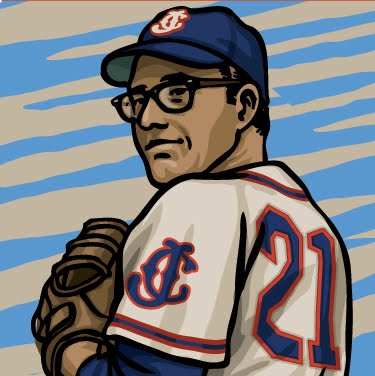
Just as I did when I was a kid, the first thing I do upon entering a ballpark is to buy a scorecard. Not a program, nor a yearbook - a scorecard. Even if I choose not to score the game, I always write down the day's lineup, pitchers, the date, weather conditions and who went with me to the game. It's just a thing I've always done. To me, a scorecard is the one thing I can't live without when going to a ball game. Same with a hot dog. If I have enough left over after buying the scorecard, I'll slap my money down for a Cincinnati Brat, Dodger Dog, White Sox Italian Sausage, a Nathan's frank, etc., depending what ballpark I'm at. It's just what I've always done, just like my Pop and his Pop before him. Until recently it never dawned on me just how those two things became so synonimus with baseball. That's how I found out about a man whose name I've seen all my life but never gave a second thought to, Harry M. Stevens.
Never heard of him?
Well, no person in history has had a bigger impact on the way Americans experience a sporting event than Harry M. Stevens...
Columbus, Ohio Summer of 1887
Harry M. Stevens was tired. He'd spent the morning and afternoon lugging a leather suitcase door-to-door trying to get the residents of Columbus, Ohio excited about what he had to offer. No one, it seemed, was interested in a subscription set of the collected works of William Shakespeare. When the famous mid-west summer humidity got to be too much, Harry decided to take a break. Half the town, it seemed, was headed into the city's ballpark where the Columbus Senators were playing a game.
Stevens had not grown up playing baseball. He was born in England and moved his wife and son over to America when he was 27 years-old. Back in England he was something of a child-prodigy - not in music or academics - but as a street corner kid preacher. Harry was blessed with a set of booming pipes that could make the walls of Jericho crumble and he was charismatic well beyond his age. But, despite the promising beginning, so far he'd been unable to turn these abilities into a secure living. That's why he packed up his family and moved across the pond. He had family in Niles, Ohio and quickly secured himself a job in a steel mill. That gig quickly ended when the workers went on strike and owners shut the mill down. After a few dead-end jobs Harry took to the roads of the mid-west hawking volumes of The Bard. At the time subscription book series were very popular and salesmen like Harry went door-to-door offering books on every subject imaginable. Ulysses S. Grant's memoirs were a hot item as was the biography of the recently massacred General Custer. But Shakespeare, Harry realized while flipping through his empty order book, seemed to be a dud.
Now as he sat in the stands watching the Columbus Senators play ball, he found himself surrounded by opportunity.
Like everyone else entering the ballpark that afternoon, Harry had bought a scorecard. Inside the single sheet of folded card stock was a grid upon which a fan could use an intricate system of initials and symbols to record all the action that unfolded on the field. As Harry turned the simple piece of ephemera around in his hands he saw unlimited profit where no one else did. Using his people skills honed years before as the kid preacher, Harry offered the Senators owner the princely sum of $500 for the rights to supply scorecards to the ballpark. Columbus' owner figured he was not only getting an unexpected bonus check but also ridding himself of the extra job getting scorecards printed up and sold. Harry thought he'd just won the Irish Sweepstakes.
Withing days Harry had not only made back his $500 investment but turned a $200 profit without printing a single card. Harry's brilliant idea was to sell advertising space on the scorecards. It was a stroke of genius. Everyone who went to a ballgame bought a scorecard. It was a perfect captured audience and that's the way Harry sold the idea to Columbus' shop and business owners. When the scorecards were printed up and ready to sell, Harry reached back to his street corner days and pulled out all his showman talents. Dressed in a bright red suit complete with a silk top hat he held his scorecards high and called out the now famous slogan: "You can't tell they players without a scorecard!"
Withing a few years Harry expanded his scorecard operation beyond Columbus into Toledo and Wheeling, West Virginia. Then he went big league into Pittsburgh, Boston and Washington, D.C. In 1893 he became partners with Ed Barrow, a Pittsburgh hotel manager and baseball fan. The partnership did not last long as Barrow wanted to pursue a career in baseball management. The two men remained strong friends and it was Harry who supplied the financing when his friend bought the Paterson Silk Stockings team in 1894. While owner of the team Barrow discovered an awkward infielder from the coal mines of Pennsylvania named Honus Wagner. Barrow went on to run a succession of successful ballclubs and his relationship with Harry would come to full fruition when he later became general manager of the New York Yankees.
Always wanting to be part of the action, Harry was right there in the ballparks with his employees selling his ubiquious scorecards, always on the make for more opportunities. His next area of expansion was culinary. Most ballparks had independent vendors that sold items like peanuts and lemonade. There was no fixed percentage that was kicked back to the ballclub and the quality of the items sold varied. Harry changed all that. His approach was to not only handle the scorecard responsibilities but to also bring all the food concessions under one responsible and professional umbrella. Teams were paid a fixed percentage for the rights to sell in the ballpark and in turn the fans could expect reasonably priced fare of a consistent quality. Harry's vendor stands not only offered peanuts and lemonade but soda water, ice cream and chocolate. When he saw the clouds of tobacco smoke wafting above the field he saw opportunity and added cigar and cigarettes to his repertoire of tempting offerings. When the game began attracting women and young children he branched out by selling small souvenirs that these new fans could purchase as a memento of their day at the park.
By the 1893 Harry's work made a day at the ballpark quite enjoyable and people noticed. Although baseball was the game of the land, it was only played in the warm months. To fill the gaps Harry introduced his concession ideas to boxing, bicycle racing and horse tracks - anything that attracted a crowd.
For a recent immigrant, Harry was doing very well for himself and his growing family. Many men would have been quite happy to sit back and enjoy the fruits of his hard work, but not Harry. Boston, Washington and Pittsburgh were swell, but there was one place that so far eluded the Harry M. Stevens empire: New York City. That changed one day in 1894 when the New York Giants came to Pittsburgh for a series. "Scorecard Harry's" mug was by now familiar to the ballplayers and the affable Brit had befriended many of the game's top stars. The Giants manager John Montgomery Ward was one of his high profile pals and it was he who convinced Harry that his talents were sorely needed in New York.
As it is today, New York City at the time was the gleaming beacon of opportunity. With two major league and a dozen minor league teams plus countless other sporting venues all within a 60 mile radius, New York City was epicenter of American sport. Harry moved his base of operations to Manhattan and immediately secured the scorecard and food concessions for New York Giants and Brooklyn Trolley Dodgers. Then he secured the year-round contract for all the events held at Madison Square Garden and the other indoor sporting venues. Like a web, Harry's empire spread forth. Don't be mistaken, Harry wasn't getting these lucrative contracts because of a silver tongue presentation or well-placed bribes - he was offering a quality service that was greatly appreciated by the fans. The smart owners realized that a good experience at a game brought a fan back again and again. And those owners also knew that with Harry they were dealing with a man of strong character, a fair professional. For instance, in 1901 millionaire William Collins Whitney bought the Saratoga Race Course. The venue had long been neglected and Whitney wanted to remake the area into the country's premier horse racing attraction. When his horse Volodyowski won the English Derby, Whitney held court in the track's clubhouse. In celebration, the proud owner ordered champagne for everyone in the club. When it came time to present Whitney with the bill, the track's concessionaire took the opportunity to charge full market price for the expensive bubbly. A smart businessman would have given a thoughtful discount on the huge order, keeping this important client happy, thus likely to repeat the expensive gesture. But this concessionaire was not of the smart mindset. His big paycheck turned out to be his last - Whitney called in Harry M. Stevens to come take over the lucrative Saratoga concessions.
And so it went all over the country. But again, while lesser men would have rested, Harry trudged forward, searching for opportunity. One day while working an event at Madison Square Garden he realized that in order to take a swig from a bottle, a fan had to take his eyes off the action for an instant - and the modern drinking straw was born. When he witnessed one fan too many become frustrated because he missed a great play because he left his seat to buy a snack, Harry dispatched his vendors into the stands to bring the food to them. As a true sports fan, Harry was able to recognize the different needs that fans of each sport desired. Boxing meant cigars and mineral water. Baseball was peanuts. Horse racing aficionados required a menu of heavy food. And while he provided tried and true staples, Harry was able to adapt when necessity and opportunity presented itself. This led to the invention of the one thing that is now indelibly intertwined with our National Pastime.
It was a cold day at the Polo Grounds, sometime in April of 1901. The crowd was bundled up trying to concentrate on the game. For several innings Harry watched as his vendors returned with their unsold consignments of lemonade and chocolates. No one wanted something that was cool and refreshing in this weather. As a sports fan, Harry thought about what he would want to eat if it was he who was sitting in the bleachers. He turned to one group of vendors and dispatched them to buy all the sausages they could find. He deployed a second group to purchase rolls and French bread. When they returned Harry had his men boil the sausages and put them into the rolls - a perfect hot sandwich that was easy to hold and eat. With his old street preacher flair he dispatched his men back into the stands and instructed them to call out "Get your red hots! Get 'em while they're hot!" And just like that an American culinary classic was born.
Granted, some food historians disagree that Harry was the first person to put a sausage and roll together, however he is the man who found the perfect venue for its consumption. And baseball being the most popular spectator event in the nation ensured that the hotdog's fame would quickly spread by word of mouth. The naming of the snack is a whole other story. The most popular one is that Harry named it a "Dachshund Sandwich" after the dog it resembles. Somehow it was shortened to "hot dog", some say because a cartoonist couldn't spell "dachshund", though the cartoon in question has never been found as far as I know. And as popular as the treat was with cold, hungry sportsmen it took a bit of reassuring before it became a staple outside the ballpark - many people took the name literally and believed it was made from real dog meat!
Harry soon moved into opulent Manhattan hotel suites and circulated in the city's top sporting circles. As one of the most respected sportsmen in the nation, Harry became a trusted confidant to the athletes. Babe Ruth himself called Harry "his second Dad". Turns out that early in the Babe's Yankee career Harry convinced the slugger to invest a portion of his savings for the future. While many of his contemporaries found themselves struggling financially once their careers ended, the Babe led a life of luxury due to his wise investments. Sportswriters, too, flocked to the ebullient Brit who liked to quote Shakespeare at he drop of a hat. In the era before team owners got smart and provided a press club stocked with free food and booze, it was Harry's office that offered the scribes a much welcomed snack and drink after the game.
In his private time Harry was a well-read man, specializing in his beloved Shakespeare whose works he was unable to sell back in the 1880's. Contemporary newspapers remarked on being well-versed in English literature and a keen amateur historian. He was also a very generous man for whenever baseball moguls were reported to have made donations to various charities, "Harry M. Stevens" was always listed along side the more familiar names. When his children came of age he brought them into the family business, learning the ropes from the bottom up.
After a few nasty bouts of pneumonia, Harry passed away in May of 1934, aged 78. More than 500 people turned out for his funeral service including Babe Ruth, Yankee skipper Joe McCarthy, Giants owner Charles Stoneham, National League President John Heydler and many other luminaries of the sporting world. By that time his sons had taken over running his company. In his absence the family took The Harry M. Stevens Company to new heights. Besides expanding the reach of his food, souvenirs and scorecard empire, the company operated fancier dining options, pioneering what today we call Stadium Clubs. When the Giants moved west in 1958, they brought Harry M. Stevens with them to handle their concessions. No sports victory was complete without the Harry M. Stevens people setting up a spread in the locker room. When I was going to Shea Stadium in the 1970's and 80's, the Harry M. Stevens people were selling more than 40,000 hotdogs at each and every Mets game. Every scorecard, beer cup and souvenir pennant bore the name of the man who embodied The American Dream. Remember that Saratoga contract inked back in 1901? It was renewed every season until 1994 when the company was finally swallowed up by the giant international conglomerate, Aramark.

Those
who have met me in person know I'm not the kind of guy to toot my own
horn. In fact, much to my detriment, I'm lousy about promoting myself.
That's why it's hard for me to ask this, but this is something that
needs to be done: if you bought a copy of The League of Outsider
Baseball, can you please take the time to write a review of it on Amazon, Barnes and Noble or Good Reads?
It would mean a lot to me and most importantly give future publishers
an idea of what the book reading public thinks of my work. Almost all of
the existing reader's reviews have been flattering, but every once in a
while some crackpot writes a clunker out of jealousy or boredom. I for
one often look at the reviews on those sites before I spend my money on a
book. Reviews aren't the only thing I rely on in my purchasing process
but it's certainly a factor, and that's why I'm asking you to please
take the time to write your thoughts about my work.
Ever been to Moline, Muskogee or Martinsburg? How about Clarksburg, Charleroi or Cumberland? Pitcher
Bill Sisler not only hung his hat in all of those places but also over
40 more towns across America and Canada in a career that spanned from
1923 through 1953!
This is the second of what should be close to forty
posts I will periodically do covering the minor league odyssey of Bill
Sisler. This series will be fun for a few different reasons, the
foremost being that I love researching and illustrating old uniforms,
and Sisler's appearing for over 40 different teams lets me
really show a wide variety. To make this whole series a bit easier is
that Sisler kept himself in top physical condition throughout his
playing days in order to be ready to play at a moment's notice. This
means he didn't gain weight or otherwise change his body shape with age.
For all my Sisler illustrations I am going to use the same pose, but
each uniform graphic will change to represent a new team. Likewise the
backgrounds will vary to reflect each town he played in. In addition, as
the years tick by, the glove, cap and uniform style will change to
reflect the modernization of the equipment. For instance, today's post
shows Bill on his second pro team, the Rutland Sheiks. Since this is 1924, Sisler is using a Spalding
split-finger style glove as was common at the time. The webbing between
the thumb and index is a solid piece of leather, not leather lacing as
was common later in the decade. His jersey has the "sun collar" which
was the standard for baseball uniforms up until the mid-1930's, and the
cap has a shorter brim as was common in mid-1920's.
So, who was Bill Sisler?
He
was born in Rochester, New York in the first year of the 20th century,
1900. By all newspaper stories I've read about him, Sisler is described
as a sturdy and stocky fellow who stood a compact 5'-6" - just below
average for a ball player at the time and considerably shorter than what
was the accepted height for a pitcher. None-the-less, Sisler must have
had something on his fastball, and his being a lefty probably didn't
hurt either.
1924 was Bill Sisler's sophomore season in professional baseball. His unremarkable record with Elmira the previous season apparently didn't earn him a call-back to the New York Penn League so, as he would every year for the rest of his career, Bill Sisler packed up his glove and found another league.
In 1918 almost every minor league in the U.S. and Canada had disbanded due to the man power shortage of World War I. By 1924 the minor leagues were beginning to find the financial footing they enjoyed before the war, and besides the restarting of the old leagues, several new ones sprang up. The Quebec-Ontario-Vermont League was one of them, and it was here that Bill Sisler found a spot.
This Class B international league consisted of six teams including the awesomely named Monpelier Goldfish, Quebec Bulldogs and the Rutland Sheiks. Sisler joined the latter club, who presumably took their monicker from the wildly popular Rudolph Valentino film "The Sheik". Bill's time with the Sheiks was short, but it wasn't due to his performance on the mound - on July 15, 1924 both Rutland and Montpelier folded, leaving only the four Canadian teams.
Cut loose, Bill Sisler looked around for another team...
One
more thing - I'm not too big to know when I need help with something.
While I'm a pretty good researcher with a vast archive of uniform
reference, some of Bill Sisler's teams remain elusive for me. If anyone
can help with photographs of some of his teams, I'd be most grateful.
You can see a list of his stops HERE.
Since we just passed the 70th
anniversary of the day Jackie Robinson took the field for the Montreal Royals
in Jersey City, I think it's important to celebrate an often overlooked event
that occurred a few days later on April 24, 1946. That was the day Johnny
Wright emerged from the bullpen in Syracuse's MacArthur Park and became organized baseball's
first black pitcher in the 20th century.
Now, I'm not going to go over the "forgotten man" ground that often
is the gist of any piece on Johnny Wright. Instead I'll try to retell his story
as comprehensively as possible. That's not an easy task - many modern articles
about Wright have confusing and sometimes just plain wrong details. Even the
black press at the time seemed to drop Wright like a hot potato after he was
demoted from Montreal. In writing this piece I dug up as many contemporary
newspaper sources as I could, not only about his brief stint in organized
baseball, but for his Negro League career as well.
Today, Wright's time in
Montreal is seen as a brief footnote to Jackie Robinson's story. But
the way I want to tell this story is a little different - I'm going to attempt
to flip it the other way around - that those six weeks with Montreal was just a
brief footnote in Johnny Wright's story...
Johnny Wright was born in New Orleans, Louisiana in 1916. His pop Richard was a
railroad man who rented a house in the Holly Grove neighborhood for his wife
Hazel, daughter Isabel and his youngest, Johnny. In high school Wright developed
a scorcher of a fastball delivered with total control. He was just shy of 6
foot, angular and thin, attributes that earned him the nickname "Needle
Nose". As he matured he augmented his fastball with an arsenal of sharp
breaking curves that left a wake of frustrated batters. In most bios of Wright,
including a profile written by the Pittsburgh Courier in 1946, it's stated that
he began his career with the New Orleans Zulus, a local barnstorming outfit,
but in researching this story I could find nothing linking Wright and this
team. Still, the Zulus were named as his first paying job in baseball and in
the 1930's it was common for black ball players to get their start on these vaudeville-comedy
teams. Like the better-known Indianapolis Clowns, the Zulus mixed slapstick
comedy routines with baseball, usually while dressed up in "exotic"
costumes. Today we recoil in horror at the thought of what passed as
entertainment back then, but at the time it was a decent paying job and a way to
travel the country. Since these teams often played exhibition games against
professional Negro League teams, it was also a good way to have one's talent scouted
by the real pros.
A few stories about Wright report
that he was discovered by the Newark Eagles while playing with the Zulus in
Louisville, Kentucky. Whether that's true or not, somehow the New Orleans speed
baller got the attention of the Eagles who invited him to their spring training
camp at Louisburg, North Carolina in 1937. Although he was good enough to make
the team, the Newark Eagles had a solid rotation consisting of future Hall of
Famer Leon Day plus Terris "The Great" McDuffie and Robert Evans.
Wright drew favorable mentions for his hard throwing but he remained strictly a
second-line pitcher with the Eagles. During the 1938 season he was loaned out
to the Atlanta Black Crackers for a spell before returning to Newark. When Max
Manning joined the squad in 1939 Wright moved over to the Pittsburgh Crawfords.
The Craws had been a powerhouse Negro League team from 1933 through 1936, but
had quickly declined after most of the team defected to the Dominican Republic
in 1937. The team struggled to find a home and Wright pitched for the club
through their moves from Pittsburgh to Toledo to Indianapolis.
Wright's entry into professional ball coincided with his starting a family. He married Mildred Creecy in 1937 and they had their first child, daughter Joyce, in 1939, followed a year later by a son named Sylvester. Mildred and the kids lived in the Lafitte Housing Project in New Orleans while Johnny was on the road during the baseball season. That Wright had a family will have an important bearing on his baseball career further down the road.
In 1941 Wright signed with the Homestead Grays, the pride of the Negro National
League. The Grays were in the middle of an impressive run in which they won the
pennant nine consecutive seasons. It took Wright two full seasons before he
became a Grays starter, but when he did, he sure made his mark.
Johnny Wright's 1943 season was truly one for the ages. Now 26 years old,
Wright had six seasons of blackball under his belt and the best bats in the
game behind him. His fastball drew comparisons to Satchel Paige, some even saying it was Wright who was the faster of the two. As good as his fastball was, it was his overhand curve that was his money pitch. While many pure speed pitchers have a problem throwing an effective curve because the ball arrived at the plate too quickly to break, Wright's had broke just in time to throw a batter's timing off. He also picked up a slider and knuckle ball, giving himself a wide variety of pitches to choose from. You'd expect a guy with Satchel Paige speed to be a strikeout pitcher, but Wright's success lay in working a batter, allowing him to put the ball in play and letting his fielders make the play. On a team of veterans like the Grays, it was a recipe for success. Throughout the summer Wright won game after game, including a
streak of eight in a row. This was the season that Washington Senators owner Clark Griffith would wistfully look out
his office window in Griffith Stadium as the Grays
pulled in more customers than his own big league team could in their own
stadium.
In a rare blackball game allowed in Wrigley Field in September, the Grays met
up with their bitter rivals, the Kansas City Monarchs. The Monarchs had humiliated
the Grays in the 1942 Negro World Series and although this was an exhibition
that didn't count in the standings, the game was an eagerly awaited rematch.
The Grays jumped all over Satchel Paige and he was run out of the box after
giving up seven runs. Except for a bad fourth inning when three runs scored,
Wright pitched magnificently, striking out seven Monarchs and walking just one.
Grays owner Cum Posey was so impressed with Wright's performance that midway
through the summer he did the unthinkable and raised his ace's paycheck $150 a
month above what his signed contract called for. In statistics recently
compiled by baseball archeologist Scott Simkus, Wright is credited as winning just
under 30 games during the season. This tally includes both league and
exhibition games. Against Negro National and American League clubs Wright's record was 22-3 with 4 shutouts. In official Negro National League games he won 14 and lost
just one. He led the league in wins, strikeouts and ERA, the Triple Crown of pitching. In a league that played just over 30
official games that year, Wright's fourteen wins really was impressive and it's
why Cum Posey credited him with pitching the Grays to the 1943 pennant.
That fall the Grays met the Birmingham Black Barons in the Negro World Series. In
an attempt to attract the largest crowds, the Negro World Series was played in
several different cities. In the best of seven series Wright lost the first
game but came back to pitch a shutout victory in game four. Four days later he
repeated his performance, blanking the Barons in game six. In the final game
eight (game two had ended in a tie) Wright left after six innings down by two
runs but the Grays came back for the win and the World Championship.
Then just weeks after returning home to his wife and kids in New Orleans,
Johnny Wright got his induction notice for service in the United States
Navy.
Luckily for Wright, his fame preceded him into the Navy. After basic training,
the pitching ace of the Negro World Champs was stationed at Great Lakes Naval
Training Center just outside Chicago. Great Lakes had a formidable all-white
baseball team lead by Hall of Famer Mickey Cochrane and manned by an endless
supply of ex-Major Leaguers who flowed through the base. The Navy was still
segregated and the base had their own all-black ball club called the Great
Lakes Sailors. Besides Johnny Wright the team boasted Larry Doby and Earl Richardson of the
Newark Eagles, Zack Clayton of the Chicago American Giants, Herb Bracken of the
St. Louis Stars and Sonny Randall of the Grays. University of Toledo star
athlete Chuck Harman also played on the squad. Harmon would later go on to play
in the NBA as well as become the first black player on the Cincinnati
Reds.
As the team's ace, Wright ran up a 16-4 record including a no-hitter and led
his team to the Midwestern Serviceman's Baseball Championship. In 1945 Wright
was stationed in New York where he pitched for the Floyd Bennett Field Naval
Air Base. Unlike Great Lakes, Wright played along side whites at Bennett and he
got the opportunity to pitch against three different Major League teams. The Red
Sox beat him 9-6 and the Dodgers defeated him 6-4, but he won his last game
against the White Sox, 9-6. When asked about how he got along with white
teammates, Wright told the Pittsburgh Courier "the white boys treated me swell;
we had nothing but agreeableness and harmony." During the 1944 and 1945
seasons Wright also managed to play a few games for the Grays. Since he played
these games while on shore leave from the Navy, Wright used the alias
"Leroy Leafwich". He won his two appearances in 1944 and followed
that up with another three incognito wins in '45. Grays owner Cum Posey later
said he kept Wright on the Grays payroll throughout his Navy hitch, paying him
$250 a month to add to his $65 monthly salary as a sailor.
Ever since Johnny Wright became the second man picked to integrate organized
baseball, the question of why, out of all the great pitchers in the Negro
Leagues, did Branch Rickey picked him. Besides his spectacular 1943 season and
his subsequent service record, a good reason might be a game he pitched right
before his discharge. Brooklyn Dodgers coach Charlie Dressen organized a five game
series pitting his team of big league stars against a team of Negro League
players. Held in Ebbets Field, Dressen's pick up team had All-Stars Eddie Stanky,
Whitey Kurowski, Tommy Holmes, Ralph Branca, Frank McCormick and Virgil
"Fire" Trucks. The Negro League All-Stars had future Hall of Famers Roy
Campanella, Willie Wells and Monte Irvin plus many Newark Eagles regulars. The
white stars won the first four games but in the final game played on Sunday
October 14th they were opposed by Leroy Leftwich, aka Johnny Wright. The Grays
ace had the big leaguers shut out on three hits when the game was called after
six inning due to darkness. This was the series of games that led to Branch
Rickey summoning Roy Campanella to discuss playing for the Brooklyn
organization. It's inevitable that Branch Rickey would have also noticed
Wright's pitching performance right there in his own ballpark and filed it away
for later use.
When he was mustered out of the Navy on Christmas Eve 1945, Johnny Wright
looked poised for a triumphant return to the Negro Leagues. However, just as he
was getting used to civilian life came the blockbuster news that the Brooklyn
Dodgers had signed Jack Roosevelt Robinson to a minor league contract.
The news of Robinson's signing sent the Negro League owners into a tailspin.
Unmentioned by the white press was the fact that Branch Rickey signed Jackie
Robinson even though he was technically property of the Kansas City Monarchs.
Rickey famously instructed Robinson to not sign a Monarchs contract for 1946 -
however, just like white "organized baseball", players were bound to
a team by the reserve clause, only relinquished through a trade or and outright
release. The Negro League owners knew that Rickey's snatching of Robinson set a
terrible precedent and they were powerless to stop its repercussions.
Back in Pittsburgh, Cum Posey frantically rounded up all his men returning from
the service. Among the players he made sure to reach out to was his 1943 ace,
Johnny Wright. That $250 he had sent to Wright during the war wasn't purely out
of the goodness of his heart but basically an unspoken retainer that Posey
hoped would keep Wright loyal to the Grays. Now with Robinson's signing that
insurance money he shelled out seemed all the more pertinent. The two men spoke
in early January and Posey recalled that the pitcher reassured him he wasn't
going to leave because the team had "been too good to him". That's
why the Grays owner reacted with shock and rare uncharacteristic anger when he
found out a week later that John Richard Wright of New Orleans had signed a
minor league contract with the Brooklyn Dodgers.
Unlike the Robinson signing a few months earlier, Wright's went more or less
under the radar. Robinson had been fairly well known to both blacks and whites
due to his college football career at UCLA while Wright was known only among those
who followed the Negro Leagues. From the moment he signed the Brooklyn contract,
Johnny Wright would be forever known as "the other man", completely
eclipsed by Robinson's talent, personality and determination.
Wright became acquainted with his Montreal manager on the train headed to
spring training. By chance the two men were on the same train and were
introduced by a mutual friend, former big leaguer Dutch Meyer. What Clay Hopper
discussed with Wright is unrecorded. It would have been an interesting
conversation. Hopper was from Mississippi and was not all that happy to be
Montreal's rookie manager the same year Rickey was trying to break the race
barrier. Hopper was being put in a tough spot and he knew it, but he was a
baseball man and determined to do his job. If Robinson and Wright could play
ball he would play them. If nothing else, Clay Hopper was going to give
Robinson and Wright a fair and equal chance to make the team.
The story of Jackie Robinson's first spring training has been retold many
times, both in print and on film. But the one thing that is often left out is Johnny
Wright. The awkwardness upon meeting his all-white teammates? Johnny was there.
When Robinson had to be whisked out of town in the middle of the night because
of death threats? Johnny was whisked away too. Those times Robinson was prohibited
from joining his team on the field due to Jim Crow ordinances? So too was Johnny
Wright. All the indignities both subtle and overt, Johnny Wright bore them all,
right along side Robinson. History is sometimes complicated and short cuts are
taken to simplify understanding. For many people, bringing Johnny Wright into
the equation simply gets too complex. Racism is better understood when it is
distilled to its most basic elements and Johnny Wright's memory and story was
the sacrifice.
Throughout spring training Johnny Wright flashed of promise followed by
collapse. His trademark control seemed to have disappeared and he was knocked
around pretty good in intersquad games. Besides the racial aspects
overshadowing Wright, there was also the normal pressure of a player trying to
make the team. Montreal was loaded with right handed pitching. There were two 20
game winners on the staff and a half-dozen other prize prospects. Wright went
through the grueling fielding practice and running drills without complaint and
despite some iffy outing was still considered by some the dark horse of spring
training.
Negro League veterans also lent their support behind the former Homestead Gray.
Alex Pompez, owner of the New York Cuban Stars and a future Hall of Famer,
predicted that Wright would win 15 games for the Royals. Manager Ben Taylor, a
veteran of more than 30 years of blackball, said that Wright "can't help
but make good in the International (League). That league won't touch him, mark
my word for it". The only man who regarded Wright as a possible dud was
his former owner Cum Posey. Shortly after Brooklyn announced Wright's signing,
Posey exploded during a phone conversation with sportswriter Sam Lacy. Posey
angrily listed Wright's weaknesses that included his inability to keep runners
on base and his ineptness at fielding his position, especially bunts. Rickey's
stealing of his prized ace was the final nail in the ailing Posey's coffin. Shortly
before Wright made his Montreal debut the Grays owner spoke to sportswriter
Harry Keck from his hospital deathbed. "Don't let them (Brooklyn) take my
best pitcher,”
he pleaded. A week later Cum Posey was dead.
When the Brooklyn Dodgers came around to play the Royals Jackie Robinson took
the opportunity to shine against the big leaguers. When Wright was given
the ball he was tagged for 8 runs on 10 hits in five innings. Then in his last
game before the Royals broke camp, Wright walked four and hit a batter in his
only inning of work. Still, Hopper and the Brooklyn management thought enough
of Wright that he made the club.
The Royals opened the 1946 International League season on the road. Their first
game was in Jersey City to face the Giants' top farm club, also called the
Giants. 25,000 people jammed into Roosevelt Field to see the game. Normally
every opening day in Jersey City was a sell out - for years the city's corrupt
mayor Frank Hague had made it mandatory for city employees to purchase tickets
to ensure his city routinely broke International League attendance records. But
with Montreal boasting the first two black ball players in the modern era,
history was being made on the field and that ensured a full house.
Wright didn't appear in any of the Jersey City games. Hopper held him back
until the April 24 game in Syracuse against the Chiefs. Starter Jack Banta got
roughed up for 4 runs in the fourth and was sent to the showers after giving up
a two out bases-clearing triple. Clay Hopper waved Johnny Wright in from the
bullpen. It was the first appearance of a black pitcher in the modern era. With
the pressure on, Wright got the first batter to pop up to end the inning.
However, what started out promising quickly fell apart. He walked the first
batter to lead off the fifth. Then, as if to make Cum Posey look clairvoyant,
the runner easily stole second. He scored when the next batter singled. That
was followed by another single that scored a run when Wright threw away the
ball trying to pick off the base runner. In the sixth Wright walked the first
two batters. This was followed by an RBI double and a sacrifice scored another
run. Wright got through the seventh unscathed but was lifted for a pinch hitter
in the top of the eighth.
Not an auspicious beginning but not as disastrous as it is sometimes made out.
Wright sat on the bench for the rest of the Syracuse series. Next Montreal came
to Baltimore. Wright had played in Charm City many times when the Grays played
the Elite Giants. But this time Wright was
playing in front of a hostile white crowd. To go along with its vibrant black
community, Baltimore had a vehemently racist white element that was typical of Mason-Dixon
border cities. Rachel Robinson noted that in Florida the racists called her
husband names behind their hands but in Baltimore they openly screamed them
out. The crowd gave Robinson the worst reception of all the International
League cities and the same awaited Wright if and when he got the ball.
That time came on the night of Saturday April 27. The Orioles were pounding the
Royals 12-5 and had already chased four Montreal pitchers off the mound. With
the bases loaded and two out, Clay Hopper sent Johnny Wright in.
In baseball, there isn't a more stressful situation for a pitcher than to take
the mound with the bases full. That the Orioles already had substantial lead
didn't matter much, this was Wright's chance to shine in the face of steep odds
and he did just that, getting his man to pop up to end the inning. When he took
the mound in the bottom of the eighth his fastball was sizzling. His pitches
hit right where he wanted them to and his curve was as sharp as it had been in
the summer of '43. Three Orioles stepped to the plate and Wright struck them
all out. He came on in the ninth and again held the O's hitless. Unfortunately
the Royals couldn't close the gap and lost 12-7, Wright's valiant outing going
to waste.
A week later the Dodgers announced the signing of left-handed pitcher Roy Partlow
to a Montreal contract. Like Wright, Partlow was a seasoned veteran of the
Negro Leagues. Along with Don Newcombe and Roy Campanella who were several rungs
down the Dodger farm system at Nashua, Brooklyn had five black ball players in
their pipeline, three just below the major leagues.
The Royals came home to Montreal for the first time after opening on the road.
Hometown fans immediately got to see Jackie Robinson in action but Wright sat
on the bench. And then he was gone. At the end of the month the Dodgers
announced that Johnny Wright was sent to the Class C Trois Rivieres team of the
Canadian-American League. With four black players still positioned in the top
tiers of the minor league system, Wright's demotion didn't possess the sting it
might have if he and Robinson were the only ones. The black press consciously
chose to focus on Robinson and on a lesser extent Newcombe and Campanella who were
dominating the New England League.
At first Wright didn't relish his new assignment. On the baseball map Trois
Rivieres smack-dab in the middle of nowhere. He split his first few decisions
but then two things happened that turned the season around for him. The first
was that Roy Partlow also found himself shipped out to Trois Rivieras after an
unimpressive stint with Montreal. Having a friendly face who also had been
demoted was probably comforting to Wright. The other thing was he now had the
chance to pitch regularly. His old control seemed to return and his 12 wins,
combined with Roy Partlow's 11-1 record, helped lead Rivieres to the pennant.
To cap it off he pitched the game that gave Trois Rivieres the league
championship. After the season ended Wright told sportswriters that he expected
to hear from the Dodgers after Christmas.
Meanwhile Jackie Robinson finished off a spectacular debut season by leading
the Royals to the International League pennant. Montreal then faced the
Louisville Colonels in the Junior World Series. Robinson was outstanding and
the Royals won in six games. It was undeniable that next season he would be in
a Dodger uniform.
In the custom of the day, Jackie Robinson cashed in on his newly earned fame by
organizing a barnstorming tour. Assembled by a Pittsburgh promoter,
"Jackie Robinson's All-Stars" was the first of several post-season tours
in which Robinson led a squad of black ball players through the south and
western United States. Including its namesake, Robinson's 1946 team boasted three
other future Hall of Famers: Larry Doby, Roy Campanella and Monte Irvin. Other standouts
included Don Newcombe, Artie Wilson and Johnny Wright. The
tour enabled black fans in rural towns the chance to see in person the players
who were in or would soon be in organized baseball. However, despite his
presence on the Jackie Robinson tour and his redeeming record at Trois Rivieres,
Johnny Wright never received the expected call back from the Dodgers.
Some histories attribute Wright's Montreal flame out on his inability to deal
with the racial animosity heaped upon he and Robinson. While no one who never
lived through the race hatred of the time can ever say what the effect could be
on a person, reflecting on the two ball players one could almost say that of
the two, it was Wright that had the edge in dealing with the hate. Unlike
Robinson who had been brought up in Southern California and attended UCLA, Wright
was from and still lived in New Orleans. Wright had spent his whole life living
within the sick parameters that the South's Jim Crow laws and customs held
blacks to. Many descriptions of Wright from this 1946 period call him timid and
quiet, trying to blend into the background. These character traits are often
used to explain why Wright didn't make it with Montreal. Another way to look at
his personality is that it was the way Jim Crow taught southern blacks like
Johnny Wright to exist in the white world, not making any waves, blending in. Today
that's a hard to understand, let alone accept, but for decades that was the
best way to exist in a world that did its best to marginalize an entire race on
account of their skin color.
It's interesting to wonder what would have happened had some big league team
tried to integrate in the early 1930's. This was before World War II, an event
that forced Americans, both black and white, to at least tolerate each other's
existence in the service and in factories. Prior to the war it was rare that
the two races would mix let alone work together. In this much different
atmosphere, a black ball player with the personality of Johnny Wright might
have been the right one to have successfully integrated the game in the 1930's.
But this was 1946, and times were changing. For this reason, it was Jackie
Robinson's silent but forceful and bold approach that was needed to integrate
baseball, not Wright's. Whether this had any effect on the pitcher during his
six weeks with Montreal is not known.
There's also another detail that might have had an impact on Wright's 1946 season. Jackie Robinson had married just after signing with the Dodgers and his wife Rachel accompanied him to spring training and then Montreal. Robinson often told how Rachel's presence helped him deal with the pressure heaped upon him. The two acted as a team and this contributed to Robinson's success on and off the field. Johnny Wright had two kids in grade school and they stayed in New Orleans with Mildred. So while Robinson had his wife at his side during this very stressful and trying period, Wright was on his own.
Most pieces on Johnny Wright simply end at this point - a quick mention of a two-year
return to the Homestead Grays and then retirement. This abrupt end to a
promising career makes it seem like the pitcher gave up on the game when the
call from the Dodgers never materialized. It makes a dramatic and easy to
digest story, but it isn't true at all. Wright actually played professional
ball for more than eight years before retiring for good.
After the Jackie Robinson
All-Stars tour ended in California, Wright returned home to be with his family
for the holidays, and then he headed to Puerto Rico. Since the mid-1930's the
Puerto Rico Winter League had attracted white, black and Hispanic players and
boasted a league that rivaled Cuba's famous winter loop. Wright joined the
Ponce Leones where he won 8 of the team's 60 games, making him one of the best
hurlers on the island. The '46-'47 Ponce team won the league championship and
has gone down as one of the best ever fielded on the island. But while Wright
helped pitch Ponce to the pennant, he was not with the team for the final
series due to a salary dispute with the owners. Wright balked at not being paid
for post-season games and the ownership claimed his salary was for the whole
season, post season included. Neither side budged and Wright sat out the final
series while Ponce won without him.
With the death of Cum Posey, the
Homestead Grays limped on. Several of their young players had signed on with
minor league teams, but the Grays had always been a veteran team and most of
their starters were too old to be considered viable prospects by organized
baseball. Posey's death also meant that Wright was able to rejoin the club. The
Grays failed to win the pennant for the second straight year though Wright
contributed a good 8-4 record for them. He was also named to his second
East-West All-Star team. Pitcher Wilmer Fields who was Wright's teammate at
this time said "John never talked much about his experience with the
Dodgers. He was a happy-go-lucky person who was in the wrong place at the wrong
time.” A winning record, All-Star appearance and being called
"happy-go-lucky" doesn't seem like a guy ready to pack it in. It sounds
like a pro ballplayer who wanted to put a single bad season behind him and get
on with his career.
Since
his salary dispute made a return to the Puerto Rico Winter League impossible,
Wright set a course for Venezuela. Like Puerto Rico and Cuba, Venezuela had a
thriving baseball league that attracted players of all races. Wright joined the
Lácteos de Pastora (Pastora Milkers) which had a perrenial rivalry with the
Gavilanes de Maracaibo (Maracaibo Sparrowhawks), the two teams usually
finishing first and second every year. Among the other foreigners who played
that year were future big leaguers Roy Campanella, Don Newcombe, Luke
Easter and Joe Black.
At
the conclusion of the season Wright re-joined the Homestead Grays. Reports from
spring training state that the Grays were pinning their pitching hopes on
Wright but this never came to fruition. He appears to have stayed with the team
through June but then he and fellow pitcher Groundhog Thompson jumped to the
Mexican League. Since the late 1930's the Negro League owners had had problems
with players skipping out on their contracts. Their answer was always a blanket
banishment from the league, and on July 31, Wright and Thompson were officially
blacklisted. Even without Wright's services, the team had enough in them for
their final gasp of glory, winning the last Negro National League pennant. The
Grays went on the beat the Birmingham Black Barons, a team that featured a 17
year-old outfielder named Willie Mays, in the Negro World Series.
By now the Negro Leagues were collapsing - the Homestead Grays and New York
Black Yankees called it quits after the 1948 season and the Negro National and
American Leagues merged into a single two division loop. That meant positions were
drying up as the teams that were still around changed their focus from winning
pennants with dependable veterans to signing young players who could be sold to
organized baseball and turn a profit. In the wake of the Grays and Black
Yankees demise, the Negro American League redistributed the players among the
remaining teams. His name picked out of a hat at an owner's meeting, Wright was
made property of the Louisville Buckeyes. In 1949 Johnny Wright was 32 years
old, a dinosaur in baseball years, and his options were running out. While he
may have had some stuff left in his arm, he already had his shot at the majors
and no one was going to take a chance on him again, especially with a new,
younger crop of talent to choose from.
In the winter of 1948-49
Wright returned to Venezuela where he switched to Pastora's bitter rival, Gavilanes
de Maracaibo. With the Negro Leagues all but finished, Wright ignored his transfer
to Louisville and instead headed south to Mexico. Back in 1946 when he and
Robinson were integrating organized baseball, the Mexican Baseball League had
lured several white big league players south of the border where they joined
many Negro League and Latin stars for one spectacular season of integrated
play. High salaries and threats of banishment from the Major and Negro Leagues quickly
put the brakes on any hopes that the Mexican League would grow and the loop
lost most of their stars. Though the quality dropped dramatically, the league
still offered a last chance for many older players like Johnny Wright who still
wanted to earn a paycheck playing ball. In 1950 Wright split the year playing
for San Luis Potosi Tuneros and the Veracruz Azules and compiled a 13-14 record
with a 2.80 ERA in 36 games. The following year he appeared for both the Nuevo
Laredo Tecolotes and the Torreon Algodoneros and broke even with 14-14 and a
1.37 ERA in 37 games.
After Mexico Wright moved over to the Dominican Republic where he played for
Escogido in 1952 and 1953 and in 1954 for Águilas Cibaeñas. His record there
was an unimpressive 4 wins against 16 losses, but in May of 1954 he took a
no-hitter into the 9th inning before giving up a game winning single.
Now we come to the real end of
Johnny Wright's baseball career. As if to come full circle, Wright returned to
the States and signed on with the Indianapolis Clowns. Like the very first
professional team he played with back 1n 1936, the New Orleans Zulus, the
Clowns were a vaudeville-baseball comedy troupe. The Clowns were in what remained
of the old Negro American League, playing teams like the once-proud Kansas City
Monarchs who were now no better than semi-pro level. Wright pitched a few good games for the Clowns before hanging up
his spikes for good. Work in outsider baseball was quickly drying up and he was
now almost 40. It was time head home to Mildred and the kids in New Orleans.
The retired pitcher took a job in
a gypsum plant. A 1998 article in his hometown New Orleans Times-Picayune
states that Wright never discussed his baseball career and a friend of his later
said that Wright's co-workers probably never even knew he was a ballplayer.
Johnny Wright passed away in 1990 without leaving any interviews or insights
into his life in baseball. It's my hope that this story reveals a little more
about Johnny Wright, that he wasn't just a footnote but a real ballplayer who at
one time was the best pitcher in the Negro National League, a man whose talent
earned him the once in a lifetime shot at integrating the game he excelled at.
Those
who have met me in person know I'm not the kind of guy to toot my own
horn. In fact, much to my detriment, I'm lousy about promoting myself.
That's why it's hard for me to ask this, but this is something that
needs to be done: if you bought a copy of The League of Outsider
Baseball, can you please take the time to write a review of it on Amazon, Barnes and Noble or Good Reads?
It would mean a lot to me and most importantly give future publishers
an idea of what the book reading public thinks of my work. Almost all of
the existing reader's reviews have been flattering, but every once in a
while some crackpot writes a clunker out of jealousy or boredom. I for
one often look at the reviews on those sites before I spend my money on a
book. Reviews aren't the only thing I rely on in my purchasing process
but it's certainly a factor, and that's why I'm asking you to please
take the time to write your thoughts about my work.