Monday, November 26, 2012

137. Len Koenecke: Trains, Planes and Fire Extinguishers


On the advice of a few colleagues, I've been actively searching around for someone to represent my baseball illustrations. After many years in my line of work I've built up an impressive body of work, but through it all I know one thing - I'm a terrible business man - most artists are. Talking about my work has always been a tough thing for me to do, I've always been shy about tooting my own horn and as a result I've never been able to take advantage of opportunities a more savvy professional would have leaped at, and I'm finally come to the point where I'm seeking someone to handle that. That said, if anyone has any suggestions, I'd be most appreciative.

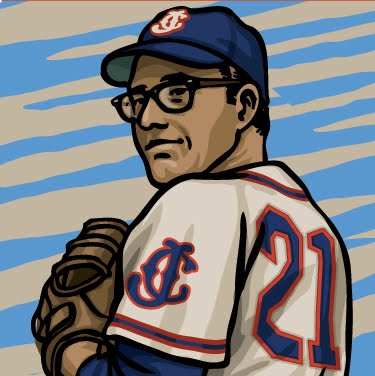
But back to baseball... I've been working on this week's story for quite some time. The illustration was completed 6 months ago and it's one of my favorites so far. What artist could turn away from that striking dark blue Indianapolis Indians flannel uniform with the white socks? The subject of the story has a chiseled granite mug that no illustrator would pass up the opportunity to render. But it's the story that makes this week's chapter worth while. Len Koenecke was always fascinating to me - he's a footnote, a trivial oddity you come across in quite a few baseball anthologies  and I've been looking forward to researching it from the perspective of contemporary accounts. My Grandfather, who was a die-hard Brooklyn Dodger fan at the time Koenecke was roaming center field at Ebbets Field, would talk about him every so often and I suppose it's through him that I heard of him first. Over the past months I've amassed a nice-sized binder of clippings and accounts and finally gotten 'round to putting the whole thing together this Thanksgiving weekend...

It seemed like some crazed pulp magazine story but it was really happening.

The lone passenger picked himself up off the floor and drew his broad 6' frame up as tall as the cramped airplane cabin would allow, which wasn't much. The cabin of the single-engine Stinson SM-1 Detroiter wasn't much bigger than a modern Chevy Suburban. Surprised that the man still had it in him to get up, the exasperated co-pilot tore a portable fire extinguisher from the cabin wall, determined to defend the cockpit from this maniac who was equally determined to crash the plane. Behind him, the pilot struggled to keep the Stinson SM-1 airplane steady in the early morning skies over Toronto. The fight had pitched the plane violently and the pilot had lost all navigational bearings just trying to keep the plane level. All three men were yelling incoherently but with the noise from the engine nothing could be heard, just the twisted faces of two men desperately fighting for their lives and a third trying his best to end it for them all. 

The passenger pulled his head down into his broad shoulders and lunged forward. Drawing the metal fire extinguisher across his body the co-pilot hit the charging man as hard as he could. With a noiseless scream he easily deflected the heavy metal canister which spun through the air and hit the pilot in the shoulder. Defenseless, the co-pilot was no match for the crazed passenger who now hammered on his body with ham-sized fists until he slumped to the cabin floor.

Now nothing stood between him and the pilot. 

Seeing his friend and co-pilot rendered useless, the pilot, with one hand on the controls, reached down at his feet and grabbed hold of the fire extinguisher. While the co-pilot was a slightly-built man, the pilot was a former star athlete and tonight he would need all his strength to save his life. In the dim cockpit lighting he could see the shadow of the passenger quickly looming behind his seat. Blindly he swung the extinguisher behind him and hit something - it was the co-pilot's head. The pilot swung the extinguisher again and this time hit the looming passenger in the side of the face. With the big man momentarily stunned, the pilot drew back and swung, again hitting the passenger in the face. Blood splashed in all directions and the pilot swung again, another head shot, and then another. And another. The man took a step back and crumpled into the back seat in a pool of rapidly spreading blood. As the man slumped forward, he brought the heavy canister down once more onto the top of his head before the blood made the extinguisher slip from his grasp and roll away into the dark recesses of the cabin. 

This time he wasn't getting up. The lone passenger, Len Koenecke, outfielder of the Brooklyn Dodgers, was definitely dead.

Len Koenecke's career had been about as rocky and turbulent as his last airplane ride. He was from a Wisconsin railroad family, hard-working men who made the giant steam engines run. Following in his Pop Herman's footsteps, young Len took a job as a fireman, shoveling coal into the hungry fires that propelled the Chicago & North Western locomotives across the midwest. The work hardened the boy's 6' bony frame and he developed hulking shoulders and powerful arms. More importantly though, young Koenecke was assigned the Escanaba to Ispheming run where he met brakeman Murray Boyle. 

Before Murray Boyle was a brakeman he was a minor league ballplayer, but now managed the Escanaba town team. One week Boyle knew Escanaba needed a catcher for that weekend's game and he asked the athletically-built Koenecke if he'd care to play. Though he never caught before he did a good enough job that he kept playing and soon jumped to another semi-pro team where he was spotted by a fella who told a friend who knew the manager of the Class B Springfield Senators of the Three I League. Koenecke took a leave of absence from the railroad and headed south to Illinois. Unfortunately his skills behind the plate were poor for a class B team and he was dropped in May without ever playing a game. He slipped over to Moline which was a class D level and when the Plowboy's regular outfielder got injured, Koenecke took his place. In 117 games he his 20 homers and batted a nice .343. In the fall he returned to the Chicago & Northwestern where he shoveled coal throughout the off season. 

When spring came, Koenecke rejoined the Moline Plowboys. From the hard railroad work he was a physical specimen to behold, but found it took weeks to finally unlimber his massive back muscles and swing a bat comfortably. He increased his average to .389 for 1928 and was sold to the Class B Quincy Indians at the end of the season. Quincy was in turn owned by the  Indianapolis Indians and the big club had Koenecke join them for the remainder of the American Association season. Indianapolis was Class AA, the highest rung of the minor leagues. Getting into 17 games Koenecke  hit .394 and clocked 4 homers. In October he went back to Wisconsin and rejoined the railroad.

1929 was much the same as 1928 with the long spring training spent getting his body back to baseball form. He was sent down to Quincy in the first part of the season and when his swing came back he moved up to Indianapolis. The books show he hit .323 for the year. Again, winter was spent with the railroad where his leave of absences was starting to rub the other workers the wrong way. Koenecke's Pop Herman was an engineer on the line and no doubt his position and seniority had everything to do with his son's excessive leaves each summer. Fact of the matter was that each time Koenecke returned he pushed out another well-trained worker. Baseball just didn't pay enough for Koenecke to take the winter off nor was he sure his career would go anywhere. The constant back and forth between the mid and high minors left him uncertain of his future so he needed to keep his railroad job as long as he could. In February he married Gladys Stoltenberg which made his position even more precarious. He needed to keep both feet in, it was just the smart way to play it.

That spring he again wound up in the lower Class B level and stayed there except for 67 games with Indy where he his a disappointing .250. The long time it took each spring to work back into baseball shape was taking its toll on him and when he returned to the railroad in the fall, he was confronted with a decision: work or play. No more leaves of absence. Koenecke chose baseball.

In the spring he came barreling into training camp and made the Indianapolis roster to stay. Throughout the season he prowled the outfield like a hungry leopard and hit everything in sight. He punished the American Association pitchers at a .353 clip, second best on the team. He led Indianapolis in hits (224), triples (19) and home runs (24). In one great leap Koenecke went from human pinball machine to top-rung minor league star. And important people were watching.

John McGraw, long-time manager of the mighty New York Giants, was looking around for a new outfielder. The Cardinals and Cubs had usurped the Giants as the best teams in the National League and the hated Yankees were now THE New York team to root for. McGraw was determined to find a ballplayer of immense quality to plug the gaps of his sinking ship, win pennants and fill the stands. Although he was in ill-health, McGraw boarded a train west and personally scouted the Indianapolis Indians' phenom from the stands. Liking what he saw, the Giants manager bought Koenecke for an unbelievable $70,000.

When he boarded the train to Los Angeles for spring training, Koenecke left behind a trail of Indianapolis baseball records that still stand: 5th highest season batting average (.353); 3rd in hits (224); 1st in runs scored (141); 4th in triples (19) and 3rd in RBI (131).

In sunny L.A., Koenecke was the talk of the camp. His high price tag made him a sure topic for the newspaper boys and McGraw fed them lines proclaiming that his new outfielder was sure to "be a bright star in the National League". On the field he performed well, seeming to live up to the hype that swirled around him.When the Giants suited up for Opening Day, Len Koenecke was right along with them wearing number 31.

1932 was a dismal year for New York. No matter what McGraw tried his boys slipped further and further down the standings. The Old Man was not well and perhaps this rubbed off on the team. The Giants were beginning a transition from the old-time baseball of their manager and the modern-day tactics of the heir-apparent, outfielder Bill Terry. The new $70,000 wonder-boy had a hard time breaking into the veteran lineup. The outfield consisted of future Hall of Famers Mel Ott and Freddie Lindstrom and 2 time National League MVP and 5 time All-Star Jo-Jo Moore. None-the-less McGraw played Koenecke off and on but after 40 games he was barely batting .250. Most insulting to McGraw was his 5 errors in the outfield including an unforgivable misplay on a ball that gave Cardinals pitcher Dizzy Dean an inside-the-ballpark home run.

The New York Giants at this time was a close-knit fraternity and difficult for any outside ballplayer to break in. McGraw was a hard man to play for and many players failed to make good solely because of his criticism and acidic personality. Besides being an over-aged rookie, Koenecke reportedly was quiet and had a fragile ego, a trait that didn't bode well for a new ballplayer, especially one who had the press clippings and expectations that he came with. To make an already bad situation worse, somehow he'd gotten under the skin of Bill Terry, McGraw's right-hand man. When the Old Man retired after the first 40 games of the season, any protection he was getting from McGraw evaporated. New skipper Bill Terry had enough on his plate than worry about bringing along a 28 year-old rookie he had personal problems with. Despite what his mentor might have thought of Koenecke's talent, Terry sent the $70,000 Man across the Hudson River to the minor league Jersey City Skeeters.

While it must have been frustrating for Koenecke to again be swung back and forth between teams, he performed well with the Skeeters. The Giants might not have a place or time for him but his .355 with 18 homers got the Brooklyn Dodgers interested and they swapped Lefty O'Doul and Watty Clark for him and infielder Sam Leslie. Brooklyn let Koenecke spend another season in the minors and he batted .334 with the Buffalo Bisons for the 1934 season.

When Spring rolled around again the 30 year-old Koenecke was now an old man in baseball years. He had a reoccurring foot injury that made him sit out games but he was still strong and eager to make good. The Brooklyn team that was training in Orlando was a miserable bunch. Besides youngster Van Mungo and the elderly Ray Benge the pitching staff was a collection of never-were's and the majority of the bench were has-beens. It was Casey Stengel's first season as a Major League manager and he worked hard to make something of the rubble calling themselves Dodgers. 

In what is one of the only cases of that I've heard of Casey Stengel going out of his way to tutor a ballplayer, Brooklyn's new manager drilled Koenecke all spring. Newspapers gave Stengel credit for giving the former bonus baby back the confidence he left on the Giants locker room floor back in 1932. Where Koenecke was a good outfielder before, Stengel put Koenecke through the paces until he caught anything that came near him. When the Dodgers headed north to start the 1934 season, Koenecke was raring to go.

Go he did. Batting clean-up, the re-born Koenecke batted .320 against National League pitching, second best on the team. While not a speed-demon, he was smart and sure-footed on the base paths but it was in the field where he excelled. In 123 games Koenecke made but 2 errors - a .994 fielding percentage and still a National League record. While the Dodgers finished in 6th place, 23 1/2 games behind the Cardinals, Brooklyn finally had something to look forward to in the coming season. With Len Koenecke, the Dodgers had a bonafide star.

The off-season was spent making the usual rounds a newly minted star did back then - steak and potatoes testimonial dinners and drinks on the house from coast-to-coast. While newspapers back east speculated on the glories Koenecke was going to lead the Dodgers to in 1935, Koenecke bulked up back home in Wisconsin. The formerly reserved and emotionally tender ballplayer rolled into Brooklyn's training camp in Orlando with a swelled head and body to match. 

If you look at the record book for 1935 and isolated all other years, on the surface Leonard George Koenecke didn't have too bad of a season: .283 average in 100 games ain't nothing to sneeze at. Under the hood however, the numbers tell a different story: where he only struck out 38 times in 536 at bats the previous year he now swished 45 times in only 374 chances. His power seemed to disappear over the winter and his already bad feet now all but hobbled him through out the summer. His record-making fielding dissipated as well and he was charged with 8 errors. Stengel watched with horror as his protege of the previous year crumbled before his eyes. The team as a whole was falling apart, too. Where the year before the rookie skipper was the darling of the sports page, he soon discovered his corny jokes and witticisms only make you look stupid when your team is stinking up the National League.

As the summer churned into the humid days of September, Stengel was at the end of his rope. Losing his cool he lashed out at his team for making him look bad. Koenecke in particular drew his ire due to his disappointing record. As September began the Brooklyn skipper let the press know that there was changes a-comin' - and he was cleaning house. Word leaked that Stengel was trying pawn Koenecke off on any team that would take him - minor league teams. All these Stengel-fueled rumors swirled around the team as they brought their losing show on the road. In Boston last year's hero went 5 for 8 then 2 for 18 against Pittsburgh and Cincinnati. When the Dodgers turned up in Chicago, Koenecke sat out the first game then went 1 for 4 before being benched for the last game at Wrigley Field. In the 9th inning Stengel tapped Koenecke to pinch hit. He grounded out. Didn't matter anyway. He could have hit a grand slam and it wouldn't have mattered. When the team arrived in St. Louis the following day, Stengel had arranged for Koenecke and two other slackers, Bob Barr and Les Munns, to go to Buffalo. Len Koenecke was sent back to the minor leagues again.

You have to try get in the head of Len Koenecke to fully understand what led up to the event described in the beginning of this story. Baseball lore has twisted the story of Len Koenecke's demise so many ways it is hard to tell what really happened in his final hours, but let's try. Here he was, 31 years-old, been sent up and down the rungs of organized baseball so many times he had to look in a mirror and read his jersey to see what ball club he was with on any given day. He was a married man with a 5 year-old girl waiting for him in their apartment in Brooklyn. The Great Depression was in full swing and the once lucrative security of his railroad job was long gone. His feet were bad and he'd been thrown off two major league teams in disgrace, both times after garnering high praise and expectations. With a fragile ego that was probably coming apart at the seams, Koenecke packed his bags once again. Before he picked up his plane ticket back to New York he paused and wrote a postcard to his daughter Anne: "Hurrah, I'll be with you tomorrow."

The Brooklyn Dodgers' use of airplane travel was rare for 1935, especially since the three men the reservations were made for were being demoted. Whatever the front office's motives behind the swanky travel plans, Munns, Barr and Koenecke took a cab to St. Louis' airport and boarded an American Airlines flight to Chicago. From there they would change planes in Detroit before arriving in Newark, New Jersey the next day. It was a long journey but much shorter than taking the train. Somewhere on the way to the airport the ballplayers picked up a bottle or two of whiskey. What better way to drown your sorrows and cover up any anxieties of flying than with booze?

The first leg of the trip went off fine. They were late to Chicago but made the flight to Detroit. Witnesses reported seeing Koenecke with a bottle of whiskey in his hand. Once on board the three men were rapidly becoming intoxicated. Koenecke, who I've read wasn't known as a big drinker, was by far the worse of the former Dodgers that day. Juiced-up and combative, the large-framed Koenecke started a fight with a fellow passenger. When a stewardess tried to calm things down Koenecke knocked her down as well. The former railroad fireman's hulking size and strength made him extremely dangerous in the confined space of the primitive aircraft and it took a handful of men to wrestle Koenecke to the ground and tie him up. The plane's co-pilot came out of the cockpit in order to personally sit on the ballplayer until they landed in Detroit.

He was carried off the plane passed out and snoring by Munns and Barr who unceremoniously deposited their former teammate into a waiting room chair. A representative from American Airlines tore up his connecting ticket and refunded the Dodgers' money - there was no way they were going to let him on another flight. Munns and Barr left Koenecke snoozing on a bench and boarded their own flight back to the minor leagues.

Sometime after midnight Koenecke snapped awake. Realizing he was marooned in Detroit he frantically looked around the deserted airport for a way home to his wife and daughter. Suddenly the door opened and a leather jacketed man walked in off the runway. Quickly assuming correctly he was a pilot, Koenecke offered to charter a plane to New York and home. The pilot, William Mulqueeney, owned a single engine Stinson Detroiter. The small passenger plane could seat six including the pilot and despite the late hour and the disheveled state of the man before him, he decided to accept. The catch was he would go only as far as Buffalo. Koenecke thought it over and decided he could catch the morning train to New York City and be home in Brooklyn for lunch.

Mulqueeney, either thinking he may have some trouble with the intoxicated passenger or just wanted some company on the flight back, asked his friend Irwin Davis to join him. Though Davis was later referred to as a co-pilot, he was in fact just Mulqueeney's pal. He was also known as "The Human Bat" for his dare-devil parachute stunt where he would jump out of a plane in a black bat-wing parachute. In 1935 people ate that stuff up and he was fairly well-known in the Midwest.

Davis later described Koenecke as being under "a great stress" as the three men boarded the Stinson. Mulqueeney squeezed in behind the controls on the left side of the cockpit and Koenecke sat next to him in the co-pilot's chair. The Human Bat stretched out by himself on the plush bench seat behind them. They were cleared to taxi and took off into the night sky.

Both men said later that Koenecke was quiet for the first few minutes of flight. Then he started nudging the pilot. No one knows what the hell he was thinking. Maybe he was just being funny. Lord knows liquor makes many a man a bad comedian. But this just wasn't funny. In 1935 there was no auto-pilot, flying a plane back then was a full time operation. In the confines of a primitive airliner like the Stinson, any false move could be a pilot's last. Mulqueeney told him to quit it. He did. Then he started up again. He poked Mulqueeney. Then he nudged him with his shoulders - those huge rock-solid shoulders. The plane swayed. Mulqueeney told him to knock it off. Koenecke made a grab for the controls and at that point the pilot had enough of the sole passenger. Reluctantly Mulqueeney and Davis coaxed Koenecke into the back seat. But it was far from over.

Koenecke lost his mind. He tried again to shove the pilot. Davis did his best to restrain the hulking ballplayer but he was just too small. He knocked him back a few times, every time thinking he would just pass out in his drunken stupor, but then it would start over. It was getting serious now - both Davis and Mulqueeney said later they were convinced Koenecke was trying to crash the plane. Davis tried to fight Koenecke back but the big man pounded on him, even bit his shoulder, then pounded him some more.

That's when the fire extinguisher came into play.

With the passenger crumpled in a bloody mess on the floor of the cabin, Mulqueeney brought the Stinson in for a forced landing on the first flat clear spot he could find. Both he and Davis were dripping with blood and on top of the dead man lying in the cabin, when the two men opened the door and spilled out onto the grassy earth, what they thought were wild animals charged out of the darkness at them. Fortunately they were just the guard dogs of the caretaker of the country club they had landed on. They were in Toronto, Canada. In their airborne do-or-die fight they had over shot their destination of Buffalo by miles.

The next morning all the newspapers carried the story of Koenecke's wild flight. Mulqueeney and Davis were swiftly arrested and charged with murder. Photographers snapped pictures of the two men with torn, bloody clothes and shocked expressions. A reporter caught Stengel in St. Louis before that day's game against the Cardinals and he was uncharacteristically shaken: "I can't believe it - I won't believe it" he said. It was the manager's demotion of Konecke that put him on that plane. His teammates were devastated. The Dodgers organization circled their wagons and said nothing to the press except condolences. Team secretary John Gorman later released a statement to eager newspapermen that Koenecke "apparently was not depressed when he left the team."

Lawyers were hired and the rumors began. Some carried the line the big outfielder was trying to kill himself in one last blaze of glory. Others said it was some kind of murder, motive unknown. Another claimed Koenecke made unwanted sexual advances towards the two men - put into play by the two survivor's lawyer who was probably throwing anything out there to get his clients off the hook fast. 

Researching the story I can't honestly say what his motivations were. Some modern accounts I've read play up that Koenecke was a brawler who got violent when he drank, yet I can't find any contemporary accounts supporting this and I have no clue where those writers got it from. Maybe it's just an obvious guess - many ballplayers back then were tough boozers, God knows I've written about quite a few on this site myself. But the things I've read seem to indicate Koenecke wasn't a bad-tempered tough guy and he didn't appear to drink more than anyone else. However, it is known he was tanked up on that final day of his life. Hell, who wouldn't hit the bottle after being canned from their job and faced with an uncertain future? But intentionally try to kill himself and two innocent people, too? It just doesn't seem right and I can't believe it was anything more sinister than a man mentally at the end of his rope filled with so much whiskey he didn't fully comprehend what he was doing. Koenecke's widow Gladys refused to believe he would try to commit suicide and the upbeat postcard to his daughter seemed to back it up. The Toronto authorities fully investigated the whole incident and held Mulqueeney and Davis in custody until a jury sifted through the evidence. When the Canadian court ruled it self-defense the story quickly went away.

All that remained was a grieving widow, a fatherless daughter and one heck of a story that became a classic of baseball lore.

 SOURCES
  • The Sporting  News (December 20, 1934)
  • The Pittsburgh Press (May 7, 1935)
  • The Telepraph Herald (August 10, 1934)
  • The Milwaukee Journal (March 21, 1934)
  • Ludington Daily News (August 8, 1938)
  • New York Daily News (April 7, 2003)
  • Toronto Sun (June 1, 2009)
  • The New York Times (September 17, 1935)

Thursday, November 15, 2012

136. Henry Wiggen: 200 Miles from Perkinsville to Cooperstown

3 years ago, I had a crazy idea of honoring my Pop and the time we spent talking about old ballplayers with a never-ending card set. On random scraps of paper, cocktail napkins and service station receipts I made crazed lists of the players I wanted to depict. Besides creating drawings and stories for real-life ballplayers, I also wanted to do the same for those memorable fictional characters from movies and literature. Roy Hobbs, Mayday Sam Malone, Bump Bailey, Chief Gedsudski... they all have a place right beside Babe Ruth and Pee Wee Reese here at The Infinite Baseball Card Set. There's one more character that I seem to get a number of requests for each year and that's Henry "Author" Wiggen, star of Mark Harris' baseball trilogy. I always put off doing a Wiggen card for the simple reason that I don't remember all that much from reading the books. Not wanting to fake it, I sat back and waited for someone who was more intimately familiar with Harris' work. 

Enter Bill Schubert, author of this week's story...

Baseball is great for nicknames. It seems the better the player, the more colorful the moniker. George Herman Ruth was “The Babe” and “The Sultan of Swat”. Bob Feller was “Rapid Robert” and “The Heater From Van Meter”. Henry Aaron became “Hammerin’ Hank”. Reggie Jackson was “Mister October” and Roy Hobbs was simply “The Natural”. It goes on and on: “Catfish”, “Charlie Hustle”, “The Rocket”, “Goose”, “The Splendid Splinter”, “Mudcat”, and “The Wizard”.

The dominant New York Mammoths teams of the early 1950s had some of the best nicknames in history. Led by Manager Herman “Dutch” Schnell, they had “Lucky” Judkins, “Sunny Jim” Trotter, and “Swanee” Wilks patrolling the outfield, “Ugly” Jones, “Coker” Roguski and “Canada” Smith in the infield, and the veteran catcher “Red” Traphagen flashing the signs to pitchers “Horse” Byrd, “Knuckles” Johnson, and “Sad Sam” Yale.

When the young southpaw Henry Wiggen joined the Mammoths in 1952, he had a brash confidence to go along with his blazing fastball, wicked curve, and nearly unhittable screwball. By the end of his rookie year Henry had won a league best 26 regular season games and 2 World Series games (New York beat Philadelphia to take the ’52 Series 4 games to 1). He took home both the MVP Award and the Sid Mercer Memorial Award of the Baseball Writers Association as Player of the Year. What Henry Wiggen did not have was a proper nickname.

Over the off-season Wiggen wrote a book, The Southpaw (“Punctuation freely inserted and spelling greatly improved by Mark Harris”), about his early life in Perkinsville, New York, his two years with the AA Queen City Cowboys, and his magnificent rookie campaign. Henry paints a vivid picture of life in the small town of Perkinsville and of his baseball-crazed early days. He was raised by his father, a former minor league pitcher with Cedar Rapids and star of the local semi-pro team the Perkinsville Scarlets. Henry’s whole world revolved around the grand old game. Henry starred on the mound for Perkinsville High. He cheered his Dad. He walked from his house to Fred Levine’s cigar store in town to buy “The Baseball Digest”, “Ace Diamond Tales”, and “The Sporting News”. He stole the local library’s copy of Sam Yale -- Mammoth and read it over so many times that he was able to quote whole passages to “Sad Sam” himself when eventually they were teammates in New York. He cut a picture of Sam out of the stolen book and carried it in his wallet next to a picture of his “Pop”. He made Sam’s “Rules to Live By” his own: always play hard, live a clean life, listen to your coaches, and, especially, have faith in yourself. Henry always played hard, never smoked or chewed tobacco or drank alcohol during his playing years, and had the utmost confidence in his abilities.

I believe that some day I will be counted amongst the immortals and have my statue in the Hall of Fame at Cooperstown. Connie Mack says Lefty Grove was the greatest and maybe so, and some say Mathewson and some say Walter Johnson, some say Bobby Feller and some say Satchel Paige. Yet you will see some writers that say that on my best days I am better and faster than any, and I believe them. ( The Southpaw, 17) 
 
When the Mammoths reassembled in Aqua Clara for spring training in 1953, Henry got his nickname. He was then and ever after Henry “Author” Wiggen. As if to live up to the nickname, Henry would go on to author three more books about his life on and off the diamond, Bang The Drum Slowly, A Ticket For A Seamstitch, and It Looked Like Forever.

1955 should have been another great year for “Author” and the Mammoths. Henry was an All-Star for the third year in four, and New York made it back to the World Series, this time beating Detroit behind two victories by Henry. But that season, chronicled in Henry’s bitter-sweet second book, Bang The Drum Slowly (“Certain of his enthusiasms restrained by Mark Harris”), was played under a cloud, the knowledge that back-up catcher Bruce Pearson was dying of Hodgkins disease. Henry and Bruce drove down to Aqua Clara together that spring. On the way they decided to keep Bruce’s condition a secret from everyone for fear that the Mammoths would release Pearson if they knew the awful truth. They made a detour to visit Bruce’s folks in his tiny hometown of Mill, Georgia. Eventually they shoved off for spring training without even sharing the truth with Bruce’s parents. Once in Aqua Clara, Henry sat in the stands watching his teammates practice. He was holding out for more money. Finally, Henry and the club settled on a figure, but “Author” was not through negotiating. He would not sign until a clause was written into his contract saying that he and Bruce “…will stay with the club together. Whatever happens to one must happen to the other, traded or sold or whatever. We must be tied in a package on any deal under the sun.” (p. 67, Bang The Drum Slowly) Manager Dutch Schnell did not like the unusual request, saying, “What is up between you 2? A roomie is a roomie, Author, not a Siamese twin brother fastened at the hip.” ( Bang The Drum Slowly, 70) Eventually the manager relented and the clause was put into Henry’s contract.

On Memorial Day, with spring turning to summer, the Mammoths were under-performing. They could not put any distance between themselves and Washington. They clung to a slim 1 1/2 game lead despite Sid Goldman hitting home runs on a pace to break “Babe” Ruth’s single season mark of 60. With 16 of the roster’s 25 players veterans of the 1952 World Series Championship team, they should have had a perfect mix of experience and youth. But, something was not right in the clubhouse. The players were ragging each other, especially their small town back-up catcher, Bruce Pearson. “It takes him longer than most to discover a thing like that.... It is easy pickings, like punching a punching bag that can not punch back.” ( Bang The Drum Slowly, 121) Wiggen and Pearson’s secret was like an anvil around the neck of the mammoths; it was holding them back, dragging them down.

The bigger the secret, the harder it can be to keep, and, eventually, the truth about Bruce’s diagnosis spread through the clubhouse and front office. As the disease began to take its toll on Pearson, the club rallied around him. They pulled together and began to play to their potential. Before he became too weak, Bruce was able to make significant contributions on the field, but soon the disease was too much. He played for the last time on a rainy day after Labor Day in Washington. Henry described it this way,

... and then everybody begun running, for the rain come in for sure now, and he seen everybody running, but he did not run, only stood there. I started off towards the dugout, maybe as far as the baseline, thinking he was following, and then I seen that he was not. I seen him standing looking for somebody to throw to, the last pitch he ever caught, and I went back for him, and Mike and Red were there when I got there, and Mike said, ‘it is over, son,’ and he said, ‘Sure’ and trotted on in. ( Bang The Drum Slowly, 237-238)

Bruce stayed with the club. He sat in the dugout in his uniform, too weak to play, cheering his teammates. Though he grew thinner and paler day by day, and his hands shook, his spirits remained high. He was there in Cleveland when they clinched the pennant, and he was there in New York when they took the first two games of the World Series. But, he did not feel up to the trip to Detroit, saying, “I will see you in the spring. I will be back in shape by spring.” ( Bang The Drum Slowly, 242) The Mammoths swept the Tigers for the title. Pearson died on October 7. Henry went down to Georgia where he helped carry Bruces’s casket. Then he returned home to write about the 1955 season and about Bruce Pearson. “He was not a bad fellow, no worse than most and probably better than some, and not a bad ballplayer neither when they give him a chance, when they laid off him long enough. From here on in I rag nobody.” (Bang The Drum Slowly, last paragraph)

1970 was Henry’s last season with the Mammoths. He won only three games and they did not offer him another contract. Like so many players, he was not ready to walk away from the game, not ready to hang up his spikes. Self-confidence is often the last thing a veteran ballplayer loses, long after his legs, his arm, his eye, and his reflexes have abandoned him. Rare is the man like Sandy Koufax who retired at or near his best after the 1966 season, a year that saw him put up his career best ERA (1.73) while winning 27 games and his third Cy Young Award. Much more common is the sad sight of a formerly great player, like Willie Mays, rendered average or worse by the passage of time, yet seemingly the last to notice.

Henry was aware of his diminishing skills, “The ball done what I told it. The only thing it could not do was go fast. My fastball come up nothing,…” ( It Looked Like Forever, 65) Yet, he spent months making phone calls and taking trips in hopes of catching on with another club. He even travelled to Japan to investigate the possibility of joining the Oyasumi Cobras. Finally, in June, “Suicide” Alexander, owner of California’s club, signed “Author” as a relief pitcher. Henry resumed his career on June 16th, and in his first nine appearances out of the pen he went nine innings giving up just one hit and allowing no runs. But, his comeback would be short-lived. On July 2nd, in San Francisco, Wiggen was brought into the game in the eighth inning with one out and a man on first. “Muddy” Rivers came to the plate. Henry got ahead of him quickly with two consecutive curves, but the third pitch, another curveball, did not fool Rivers.

Now and then, with a small glass of sherry, I use to run California 1
more time through my TV cassette machine in the belief that may be that boy
name of Muddy Rivers would change his mind about my third pitch. He
never did. Strike 1. Strike 2. Then smash, and the next thing you see I
am flat on the ground unconscious. It give me the headache.... After a while
I no longer required the film but give it to the Hall of Fame at Cooperstown,
N. Y., along with many other silvernears (sic) of time gone by. (It Looked Like
Foever, last paragraph)

Between his emergence as a green nineteen year old September call-up in 1951, when he gave the Mammoths one perfect inning against Boston, and his fateful final pitch to Muddy Rivers just four days shy of his fortieth birthday, Henry “Author” Wiggen fashioned a magnificent career. Over nineteen full seasons, he pitched 4,824 innings. When he retired he had 247 wins, tying him with “Iron Man” McGinnity and John Powell for twenty-seventh on the all-time list. He was a perfect 4-0 in the four World Series games he pitched (The Mammoths won the crown in both 1952 and 1955). He was a multiple all-star and an MVP.

When Henry’s minor league Manager, Mike Mullrooney, told him that he was being called up to the big leagues, his simple advice was to listen to the veteran catcher Red Traphagen; “When he says something that has got to do with baseball you must hang on his every word as if it was the word of God. He is the smartest ballplayer in baseball today.” ( The Southpaw, 118)

In his own book, Backing Up First, Traphagen wrote, “I have expressed my aversion to superlatives. Nevertheless, the ‘best’ pitcher I ever caught was Henry Wiggen.”

It must be true. 

Thanks again to Bill Schubert for the story. Not only did Bill graciously take on the task of crafting a great Wiggen biography, but he patiently answered all my silly little questions about what the character looked like and other little details that helped me make a card. A little about what went into creating Wiggen's card: Since the books are written in first-person, Harris doesn't really give a comprehensive description of the hero. Over 6'-3" tall, broad shoulders, 195 lbs... and that's pretty much it. Same for the Mammoths' uniforms. That real poor movie with Robert DeNiro, "Bang The Drum Slowly" (yeah I said it - and I don't like "Bull Durham", either) had the ballplayers in Yankee-esque pinstripes with a terrible intertwined "NY" logo. As a designer, it gives me agida to see the characters run around in those lousy jerseys and caps, so I sure as hell wasn't going to copy them for my card. There was a television play done in 1956 and I found a couple of stills from that but the uniforms were kind of generic and didn't look up to the level that a National League team would have worn at the time, so that, too, was no help. Harris only mentions that instead of "MAMMOTHS" on the front it simply carried the name of the city of New York. Too bad for me because I would have loved to create a jersey that had "MAMMOTHS" on the front! So anyway, I wanted to stay as true as possible to what Harris envisioned when he wrote the books. As you just read in Bill's story, Henry Wiggen's career began in 1952 so I wanted the card to depict him between his rookie year and 1955 when the Mammoths won the World Series. I picked orange and blue for the Mammoths colors. I know Mark Harris was a New York Giants fan, and in fact had the pleasure of making his acquaintance at a Giants Spring Training game years ago. But, I didn't want to just copy the old Giants look. Using the blue which the Giants wore when Harris was a boy in the 1930's and 40's and the orange from the time period the books take place seemed like a good solution. Besides, what can I say, as an old Mets fan, I happen to like orange and blue. The logo, though you can't see it very clearly due to the size of the card, is a kind of Medieval script that I thought fit the era and was sufficiently different than any other team at the time. I also chose to pose Wiggen far away so as not to have to depict his face too well - everyone who reads a good book has their own idea of what a character looks like and I didn't want to stand in the way of that. And finally, the ballpark in the drawing is a take on the old Polo Grounds, a place Mark Harris knew well as a boy and its cavernous double-decked stands promised to make a fine background on which to place his hero...


Thursday, November 8, 2012

135. Rap Dixon: The Negro Leagues' Best Left Fielder

Every so often I get requests for ballplayers to feature on the site. This week's player was suggested by a reader over a year ago and not only did he ask me to feature this particular player, but he also took the time to write out a nice outline of his career to get me started. It took me quite a long time to assemble everything, research, drawing and actually writing it all down, but finally, here it is...

Now the first thing you think about when you here that a ballplayer's nickname is "Rap" is a massive slugger, right? Rap has got to be derived from the sound the ball makes when it "raps" into the outfield wall. Well, in Herbert Albert Dixon's case, "Rap" was short for the Rappahannock River. Why was he named after a river in Virginia? I have no idea. He was born in Kingston, Georgia and grew up in Steelton, Pennsylvania. I'll make an educated guess and throw it out there that perhaps Dixon's family, after leaving Georgia, briefly settled in Virginia, somewhere along the banks of that river. Moving to urban Pennsylvania it was probably just natural his nickname reflected the place he'd come from. But, like I said, it's all just a guess. What is known for sure is that by his teens Dixon was living in Steelton where his Pop was a steelworker.

Colonel Strothers, the owner and manager of the semi-pro Harrisburg Giants, spied the 20 year-old "Rap" Dixon playing sandlot ball in Steelton, Pennsylvania and snatched him up for his own ball club. Strothers was in the process of turning his semi-pro Giants into a big league quality team and the was Dixon played the outfield Strothers knew this kid would be an integral part of what he envisioned for his club. 

By 1924 the Harrisburg Giants had become that pro club the Colonel envisioned. To compliment his young left fielder, Struthers signed Oscar Charleston to play center and brought in Fats Jenkins to anchor right field. The Dixon-Charleston-Jenkins combo became what may have been the greatest outfield of all-time. 

The Giants joined the Eastern Colored League in 1924 and Dixon began what should be a hall of fame career. In 47 games he hit a .265 but did slug 4 homers and demonstrated solid skills on the base paths. His fielding out in left field was so impressive that there was no question he would be in that same place the next season. Playing full time in 1925 Dixon responded by knocking the ball around for a  .344 average. After the regular season, Dixon was invited to go to the West Coast and play in the winter league around Los Angeles. Off-season baseball work was scarce and only the best ballplayers were offered slots in the winter league so it speaks highly of Dixon's talent at the age of 23 that he was granted a berth on one of those all-star teams. 

Back east with Harrisburg again in 1926 he's credited with a .310 average and many Negro teams tried to get Dixon to jump the Giants and join their clubs, to no avail. The left fielder was tall and bony, just over 6 feet tall. His legs were stripped down and built for speed and his arms were the only thing on him that could be called muscular, which was the source of his cannon arm and the reason he could scatter booming line drives all over a ball field. By 1927 no one remembered that "Rap" had anything to do with a river. To blackball fans, "Rap" was what he did to a baseball, and that was that.

Instead of heading out west in the winter of 1927 and stopping at Los Angeles, Dixon was recruited by famed catcher Biz Mackey to join his team which was headed to the Orient to play ball. The team, dubbed the Philadelphia Royal Giants, stopped off in many exotic locations including the Philippines and Japan, spreading the brand of ball playing they played in the Negro leagues. Japan particularly embraced the American visitors and Dixon in particular. The fans were captivated by his "shadowball" pantomime routine before games and one of his home runs was so impressive that a plaque was erected to commemorate it. His batting performance in Japan was so impressive that it earned him a special trophy from the Emperor Hirohito. 

When the tour ended Dixon took his brand of ball playing to the Baltimore Black Sox. Baltimore had consistently fielded a competitive team but always seemed to fall short at the end of the season. The addition of Rap Dixon to the lineup was that missing part of the machine. After batting .382 in 1928, the Black Sox finally put it all together the next season and they won the league championship, Dixon's .369 tally adding considerably to a well-balanced ball club. Unfortunately the league disbanded after that and while the 1930 Black Sox were considered even better than the previous edition, they were an independent club and it's not easy to gauge in retrospect how good they were. 

One thing is for certain however, and that is that Rap Dixon was a superstar. In July of 1930 Yankee Stadium was officially opened up to black teams and the Black Sox were there to play the hometown Lincoln Giants in the House that Ruth Built. By the time the game ended that afternoon Dixon had gone down in the history books as not only the first black ball player to hit a home run in Yankee Stadium, but he hit three of them that day. It was a monstrous demonstration of power in front of a huge crowd in the largest city in the nation. If anyone didn't know about Rap Dixon by the morning before that game, they sure did afterwards. 

Unfortunately along with fame comes a whole cart full of unwanted baggage and Dixon fell victim to two of the most common ones - booze and ego. That drinking went along with the transient lifestyle of a ballplayer is not sup prizing. Black or white, many great careers were damaged by the sauce and Dixon was no different. Alcohol combined with a swollen head made for an unpleasant teammate. But, just like his white counterparts, as long as you performed on the field such unpleasantness's were overlooked.

Like many stars of blackball, Dixon now began the life of ball player for hire, frequently switching teams and showing up bat in hand to whichever team offered him the most money. One thing everyone who followed Negro baseball was that when Rap Dixon came to join your team, he was bringing speed, power and the the best fielding skills around. Dixon's appearance in the lineup was like money in the bank. In 1931 he was roaming left field in a Hilldale uniform. 1932 found him on the Pittsburgh Crawfords, one of the best ball clubs ever assembled, black, white, brown or any other color. The next season he was recruited by the Philadelphia Stars and creamed the ball for a .370 average. When the voting for the very first All-Star Game was tallied in July of that year, Rap Dixon was the East's starting left fielder of course. He promptly stole the first base in All-Star history.

When he went south to Puerto Rico in the winter of 1933-34, Dixon was at the top of his game. Then it all ended. Sliding into second base, Dixon severely injured his spine. The all-star spent almost half a season in the hospital and when he finally returned to the game he wasn't even half the player he was before. Philadelphia cut Dixon loose but Baltimore took a chance on their old star and hired him as manager of the Black Sox. While he was one of the best ballplayers to ever step on a ball field, he wasn't a skilled enough manager to make a difference with the lack-luster club Baltimore saddled him with and the club folded. The Brooklyn Eagles picked up his contract the next season bu he didn't stick and he bumped around a series of teams in quick succession before hanging up his spikes after the 1937 season. He stayed in the game as a manager of a few low-level teams including a reconstituted Harrisburg Giants in the 1940's. Though Harrisburg's level of play wasn't one the same level as a Negro National League team, it was notable for another reason - it was an integrated ball club - a rarity back then and perhaps one of the many reasons which proved why Jackie Robinson should be given a shot at professional ball in 1946.

After a good 15 years of heavy drinking, Rap Dixon succumbed to tuberculosis in July of 1944. His heath had been declining steadily since his hospitalization ten years earlier and his death wasn't much of a surprise to those who knew him. When Oscar Charleston was creating his all-time dream lineup of Negro league players in 1949 he chose his old Harrisburg teammate to be the starting left fielder. Quite a compliment considering the source and the vast pool of talent he had to choose from. The Hall of Fame had Dixon on their ballot in 2006 but he failed to garner enough votes. Perhaps one day when guys like Gil Hodges and Sammy T. Hughes get their just rewards, the name Herbert Albert "Rap" Dixon will be right along with them.

Tuesday, October 23, 2012

134. Charlie Sweasy: Cincinnati's first second baseman


I'm angry. And disappointed, too. Once again my ball club has let me down. I wrote a long and recklessly eloquent intro piece on how the Reds blew the playoffs this year and my explanation of why they did. Oh, it was magnificent in its unrelenting venom and just looking at the card of Charlie Sweasy of the 1869 Red Stockings I had designed specifically for the day when the Reds clinched the 2012 National League pennant made me angry all over again. Then all at once I stopped. It wasn't worth it. Anyone who comes here can simply read the same thing at countless other blogs all over the internet - disappointed Angels fans, angry Cardinals nuts and perennially pissed-off White Sox aficionados probably wrote more or less the same stuff I had. 

So I pressed delete. 

Who the heck needs another rant? Let's get to some good old-time base ball...

It was the end of August, 1870. For the past 2 years the Cincinnati Red Stockings criss-crossed the nation destroying all who were foolish enough to engage them on the field of battle. They were the first all-professional baseball team  assembled and they lived up to all the expectations anyone ever had of them, but by the time the team disembarked from a river steamer at Portsmouth, Ohio their success was such that it was starting to work against them.

The novelty of seeing a Red Stockings game no longer had that certain shine any longer - they were going to win and that was that. Attendance suffered. Once you saw them there wasn't any reason to go again such was the usual lopsidedness of the exhibitions. The team also became a victim of their success on the field. The ballplayers who were once held to vows of abstinence from alcohol was now starting to cut loose. Where once the Red Stockings were the only professional team in the nation, two years after their founding many of the players were being courted to jump the Red Stockings and join newly formed pro teams for more money. With the threat of being tossed off the only paying ball club now irrelevant, the ballplayers became lax on and off the field and it was starting to show.

On the ball field at Portsmouth, the once invincible Red Stockings were losing to the half-rate local Riverside Base Ball Club. When the 9th inning rolled around Portsmouth was ahead 27-23. After Cal McVey and Charlie Gould made 2 quick outs, it looked like the Red Stockings were about to lose their 3rd game of the year. With one out needed to secure a Portsmouth win, Fred Waterman chiseled out a base hit when the shortstop dropped an easy play. Doug Allison and Harry Wright singled to keep the inning alive and suddenly the bases were full of Red Stockings. Andy Leonard then launched an easy fly ball to left field and as the Portsmouth outfielder settled under it for the final out, Leonard slammed down his bat and swore. But the left fielder lost track of the ball, then found it again and made a jumping catch for what appeared to be the final out. Waterman and Allison had crossed the plate but it was in vain as the umpire ruled it an out, game over.

Cincinnati manager Harry Wright ran over to the umpire and claimed it wasn't a catch, that he saw the left fielder drop the ball. Wright and the umpire went out to the left fielder who was picking himself up off the grass. Astonishingly, he willingly admitted he did in fact drop the ball. The umpire ruled a hit and Waterman and Allison runs counted bring the score to 27-25 Portsmouth.

Asa Brainard came up next and his single loaded the bases once again. That brought up Cincinnati's second baseman Charlie Sweasy. He was the team's leading slugger that season, and that afternoon in Portsmouth, Ohio, he certainly didn't disappoint. With a mighty wallop, Sweasy drilled the ball to deep center. Watching the ball carry, Wright, Leonard and Brainard roared around the bases followed closely by Sweasy. Since there was no outfield fence, the center fielder eventually came up with the ball and threw towards the infield - but it was too late. Charlie Sweasy's inside the ballpark home run put Cincinnati ahead 29-27.

It was a close one - too close. To all present it was obvious the quality of the Cincinnati Red Stockings ball playing had seriously deteriorated. While the Portsmouth win was certainly exciting, there was no reason it should have even been close. Nightlife and offers of more cash had taken its toll on the greatest best ball team in history.

As the sun set, the Red Stockings boarded the river steamer Fleetwood for the overnight trip back to Cincinnati. Because of the mixed emotions of that day's game, the team settled into the steamers restaurant and drank freely. The teams once stringent alcohol policy was all but forgotten by now, and most of the men drank continuously through the night. The tanked-up ballplayers became more and more agitated and the air was right for something to happen. When breakfast was being served, Charlie Sweasy, the hero of the previous day's win, began fighting his teammates. Reporters accompanying the team didn't say what the argument was all about, but it's easy to assume it was over his teammates' lousy play of late. Sweasy was in the process of taking on 2 or 3 other Red Stockings when the Fleetwood's captain threatened to run the ship aground if the fighting didn't stop. 

The thought of being marooned somewhere along the rural Ohio River wisely put an end the brawl. When the team returned to Cincinnati, its executives decided to suspend Sweasy from the team. Discipline had been breaking down for some time and it was obvious Harry Wright was losing control of his men. 

So now Charlie Sweasy, Cincinnati's first second baseman was now professional baseball's first suspended ballplayer.

Charlie Sweasy was a product of Newark, New Jersey's bleak and seamy slums. The city made the young man strong and tough, and it was inevitable that this athletic scrapper would become roped in by the area's burgeoning baseball scene. The game had been popular since before the Civil War, and by the time Sweasy picked up a bat North Jersey boasted some of the most competitive baseball in the country. After cutting his teeth with a few of the many sandlot teams in Newark, Sweasy was recruited by the New Jersey Irvingtons. This was the ball club that launched Sweasy as well as his teammate Andy Leonard to stardom. Their play with the popular Irvingtons got them both a lucrative offer from the Cincinnati Buckeyes from whom they were in turn snatched away from when the Red Stockings formed in 1869. 

With Cincinnati, Sweasy became their solid and dependable second baseman. While not their best hitter, he was 2nd on the team with 30 home runs in 1869 and first the next year with 18, securing his reputation as the Red Stockings' premier slugger. When he felt his $800 salary for 1869 was not enough for the following season, Sweasy held out for a couple hundred more and became baseball's first hold-out.

But the man the Red Stockings swiped from the Buckeyes was to prove a complicated fellow. At times belting out popular songs and appearing gregarious and witty, he was also cranky and irritable. By the time the Red Stockings swiped him off the Buckeyes' bench, Sweasy was known as a troublesome character. Booze was mostly to blame, and the Red Stockings' enforced abstinence kept Sweasy from becoming his own worst enemy for most of 1869 and 1870. When fame started destroying the team in the late summer of 1870, Sweasy was its first casualty.

The suspension of the team's best slugger was unpopular with the press and fans, resulting in a quick reinstatement. The decision further brought out the Red Stockings' problems: when the team completed its schedule it was announced that Harry Wright was taking the Red Legs name and most of the marquee players and heading for Boston. Sweasy, though he led the team in home runs, wasn't one of the players invited to join. More than anyone else, Harry Wright knew that left to his own devices, Charlie Sweasy was a shipwreck waiting to happen. Though he didn't take his old second baseman to Boston he did vouch for him to other clubs, being careful to tell them that he performs best when held under strict guidelines to ensure sobriety. Along with old pal Andy Leonard he went to Washington but his play never came close to what he'd become known for with Cincinnati and he left after a season. From then on his career was like a pinball machine - Cleveland, Boston, Brooklyn, Baltimore, St. Louis, Cincinnati, Providence and finally back in Newark. Somewhere he picked up rheumatism to add to his alcoholism and he dropped out of the game, spending the rest of his life peddling oysters on the dank streets of Newark.

 SOURCES
  • Rhodes, Greg and Erardi, John, The First Boys of Summer: The 1869-1870 Cincinnati Red Stockings (Road West Publishing, 1994)
  • Guschov, Stephen D., The Red Stockings of Cincinnati (McFarland & Company, 1998)
  • Wheeler, Lonnie and Baskin, John, The Cincinnati Game (Orange Frazer Press, 1988)
  • This Game of Games (thisgameofgames.blogspot.com)


Wednesday, October 17, 2012

133. Melo Almada: Not quite Mexican, Not quite American

My girlfriend, who happens to be as much of a degenerate baseball fan as I am, casually asked me one night "when did it become bad form to bunt to try to break up a no-hitter?" 

The reason she brought that up was earlier this season Justin Verlander of the Tigers was throwing a no-hitter against her L.A. Angels. Erick Aybar tried to get on base by laying down a bunt in the 8th inning. Fundamental baseball, right? Not to Verlander. Detroit's ace was pissed someone would dare try to put his no-hitter in jeopardy. He went so far as to call Aybar a "bush-leaguer" for trying to get on base and get the Angels moving. Apparently "big leaguer" Verlander thought a no-hitter was something the other team was just supposed to hand over to you after a certain amount of innings had been played. What is that magic inning number? The 7th? 8th? What is it? 

When did baseball become like youth soccer? Maybe Verlander should be playing right wing or some other stupid position on a community soccer field somewhere. In my opinion, if you can't deal with a bunt in the late innings then you don't deserve a no-hitter - you don't even deserve to wear that Detroit ball cap. Bush league. Hell, with an attitude like that Verlander should just pull up his socks, pull on some ad-riddled polyester jersey and hit the soccer field. At least between the goals no one will call you a sissy if you fall down and writhe around in pain if you get bumped.

It used to be that baseball was a tough sport. The outfield walls weren't padded. Guys slid hard into a base and someone in the opposing dugout always found something in your ethnic background to needle you ceaseless with. You broke up a double play with your body and every time you stepped up to the plate the chances of having an 82 mph fastball thrown directly at your head was frightfully good.

It was a tough game and unfortunately, it wasn't always for everyone, no matter how good they were. So that brings me to Melo Almada, the first Mexican-born ball player to make it to the majors.

He was born Baldomero Almada Quiros but everyone called him Melo or Mel. He was recklessly handsome, olive skinned with a thousand watt grill that made the broads go limp. He was musically inclined and his travel luggage included a state-of-the-art radio which he immediately installed in each hotel room, keeping up with the newest hits. His manners were as impeccable as one of those mustachioed stars you saw in a Hollywood musical. And he was a heck of a promising young ballplayer.

His Pop was the Mexican Consul in Los Angeles, a position he accepted because the governorship of Baja California he was initially posted to came with an incumbent who didn't seem to want to vacate. The hundred-man private army he surrounded himself with made any attempt at collecting the keys to the governor's mansion seem, well, stupid. And Melo's father was anything but stupid.

The Almada's traced their lineage right back to Spain and countless "Dons" and "Donas" dangled from the family tree. By the time Almada Senior was handed the Baja governor's job his family controlled silver mines and their vast land holdings amounted to the size of Belgium. When the Mexican revolution broke out in 1910 the Almada's and their wealth became a prime target of the angry peasants and quite a few Almada's were victims of the violence that Mexico descended into. So in 1914 when Almada Senior realized the odds of him becoming governor of Baja was a certain death wish, he wisely realized the time had come to get the heck out of Mexico. 

Melo was but a year old when the family settled in Los Angeles. Both he and his older brother Lou quickly adapted to life in America and of course that included baseball. Their father also developed a passion for the game and encouraged his boys to play the sport. Lou was good enough that he turned pro in 1927 and within a year was well on his way to becoming the first Mexican-born major leaguer when he was injured. Meanwhile younger brother Melo was back in high school breaking every athletic record he could find. Track and field, football, baseball - you name it Melo excelled at it. But, and Melo was the first to admit this, his older brother was the better baseball player. After Melo graduated high school, Lou, who was now with the Seattle Indians of the Pacific Coast League, invited his little brother to spring training in Santa Cruz. The younger of the two Almada boys was in a quandary whether to go to college or play baseball. Melo chose baseball.

Though he originally pitched like his older brother, Seattle recognized Melo's speed and power and quickly converted him to be an outfielder.In a twist that was eerily similar to the DiMaggio brothers, Melo actually swiped his brother's place on the team. It wasn't that Lou was a poor ballplayer - it just made fiscal sense since he was holding out for a bigger contract. 

For Melo, the speed came naturally but fielding did not and he struggled to learn his trade. Throughout the 1932 season Melo batted an impressive .311 and before anyone knew it, the rookie was the team's regular left fielder. Over in San Francisco older brother Lou was slugging .320 for the Mission Reds who picked him up after being let go by the Indians.

By the time 1933 season was half way over Melo was the best outfielder on the coast and being touted as the guy who would become the first Mexican national in the big leagues. While the Mexican fans in the cities around the league honored the kid with "Melo Almada Day's" and the sports page coined all kinds of dopey nicknames utilizing his Mexican heritage, Almada always thought of himself as a regular ol' American. In interviews he stressed this point, telling the Sporting News "...you see, I am very much an American."

The Red Sox came calling first and the $40,000 they paid Seattle reportedly saved the club from financial ruin. On September 8th, 1933 Melo Almada emerged from the Red Sox dugout and took his place in center field, the first Mexican American to make it to the majors. Boston kept him up with the big club for the remainder of the season and the next year sent him to their American Association farm team for seasoning. Playing outfield for the Kansas City Blues, Almada clobbered the ball at a .328 clip, swiped 30 bases, was named the teams' most valuable player and made the all-star team before the Red Sox saw enough and sent for him. He batted only .233 in just over 20 games but the Sox liked the speedy outfielder and when 1935 began Melo was with Boston for good. Six months later he'd hit .290 and was being called the best Red Sox outfielder since the mythical Tris Speaker.

And just as fast as it came, it quickly started to fade away. Baseball was a tough sport back in the depression years. Guys held onto their jobs with all means necessary. Every man knew that the farm teams that littered the countryside were chock-full of kids desperately trying to claw their way into their very seat in the dugout. Desperate times leads to desperate measures and as a result, big league baseball was not for the feint of heart. Clinging to their big league berths, ballplayers used every edge they could find to get the jump on the opposition. Somewhere, sometime around 1938 Almada was beaned by a pitch. Like I said, this wasn't an uncommon occurrence, hell, the brush back was a just another pitch in a pitcher's arsenal. 

Thing was, Melo took it all personally. Coupled with the expected racial ribbing he received for being Mexican, a fastball at the noggin took on a more sinister meaning to Almada. He was convinced opposing teams singled him out and were trying to hurt him. And as he tortured himself by thinking about where the next pitch was going to be aimed, his batting average plummeted. 

Was there a big league conspiracy to drive the first Mexican out of the majors? Nah, no way. Melo's own brother Lou thought he was wrong, telling him that those guys were throwing at him not because he was Mexican, they were throwing at him because he was a batter. In 1937 it was just part of the game. What probably happened was opposing pitchers caught on to Melo's fear and soon everyone was brushing him back. For many, once you get beaned even a mildly close fastball is enough to throw off your concentration and that fear was an edge any pitcher worth his salt would exploit to their benefit. 

The Red Sox dealt Almada to the Senators who in turned passed him down to the Browns. He rebounded a few times but by 1939 the perceived head-hunting drove him out of the majors. After a disappointing season back where it al started in the Pacific Coast League Melo headed south to the land of his birth.

Melo Almada was the highly-touted player-manager of the Torreon Union Laguna team. His experience as a successful major leaguer should have made him the keystone of the fledgeling Mexican League which was trying to establish itself as a professional level entity. Unfortunately, that was not meant to be. Though he was batting .343, Almada quit in early May. Seems that the very thing that should have made him a star in the Mexican League was what drove him back north. Almada, though considered Mexican by American fans and sportswriters, was considered "Americanized" by Mexicans who resented his success up north and his privileged upbringing. In the States he was "olive-skinned," down there he was "high-white." The rough characters in the league threw at him with a vengeance and his own players refused to respect him. After 26 days he threw in the towel and quit the game.

Back in Southern California Almada's good looks got him some movie parts and when the war started he served in the U.S. Army. In the mid-1950's he gave baseball another try and managed the Sonora team in the Mexican Pacific Coast League. This time it went much better and the league's rookie of the year award is called the Baldomero Almada Trophy.

So was it a tragedy that bean balls and brush backs ran Melo Almada out of the majors? Sure. A few guys who played with and against Almada went so far as to say if he played today he might have enough to be Hall of Fame material. But in Almada's time, baseball was a tough game. Still is. Nothing is handed to you. It's up to every man who puts on a uniform to play his best and win the game for his team. Back in 1938 bean balls and brush backs helped a pitcher do just that, and until this season, I though a well-placed bunt did as well. To Erick Aybar and the Los Angeles Angels it still does, but I guess to Justin Verlander it's a thing of the past.


SOURCES
  • Nowlin, Bill, Mel Almada (SABR Bio Project)
  • The Sporting News (Sept. 5, 1935)
  • The Sporting News (August 29, 1988)
  • Wilson, Nick, Early Latino Ballplayers in the United States (McFarland and Company, 2005)

Wednesday, October 3, 2012

132. Artie Wilson: Last of the .400 Hitters


A few months ago Larry Blakely wrote to me suggesting Artie Wilson, last of the .400 hitters, as a suitable candidate for The Infinite Baseball Card Set. Larry spelled out Wilson's credentials - a key member of the Negro League Champion Birmingham Barons, one of the first blacks to play in the majors, teammates with Willie Mays both in the Negro and Major leagues, a legend in Puerto Rico for his batting prowess and all-around fan favorite in his later years in the minors out on the west coast. As if that wasn't enough to convince me that Artie Wilson did indeed deserve a place on this site, Larry also sent along a copy of an article he'd published a few years ago about Wilson. After reading it I instantly knew that no one was better qualified to write about the subject so I asked Larry if he'd consider letting me run his article as-is along with a card I illustrated. Larry graciously agreed, updated the earlier published piece with some new tidbits, and, well, here it is...

Almost every baseball fan knows Jackie Robinson broke Major League Baseball’s color barrier in 1947. Less well known is the fact that integration of baseball thereafter was a slow process, taking far longer than it should have. After Robinson joined the Brooklyn Dodgers, the door of opportunity for African American players was ajar but not yet fully open, the stream of blacks entering the majors was initially more like a trickle.

True, the integration of baseball was faster than the glacial “all deliberate speed” of school desegregation in America that began in 1954. Nonetheless, for several seasons after Robinson’s breakthrough, tapping into the existing pool of talented Negro League veterans was more sluggish than swift. For reasons ranging from simple to complex, clear to obscure, many star players didn’t get the call. Some, like Josh Gibson in 1947, had died young. Some, like James “Cool Papa” Bell, had played their best ball a decade earlier. And some, though clearly qualified to play in the major leagues, had a break or two go against them. Case in point: Artie Wilson.
 
In July of 1959 the Boston Red Sox became the last major league team to shake its Jim Crow heritage and include an African American on its roster. Elijah “Pumpsie” Green modeled his game after a speedy shortstop who played professionally for the Oaks in nearby Oakland when Green was growing up. His name: Artie Wilson.
 
Who was the last big leaguer to hit .400? No, it’s not that Red Sox slugger who ended the 1941 season with a .406 batting average. It was a different left-handed hitter known for knocking line drive singles to the opposite field. The year was 1948 (Ted Williams only managed a paltry .369 that year). The player: Artie Wilson.
 
1948 was a very good year for Arthur Lee Wilson. Besides hitting .402 in the regular season and winning his second batting title in a row, he played in the East-West All-Star game as well as the Negro Leagues World Series. After the Series he went to Puerto Rico for winter ball where he led the Mayaguez Indians to a Cuban league title, hitting .379. Oh yeah, in 1948 Wilson also met Dorothy Daniels, the manager of a Birmingham record store, and later left her tickets for a game. Turned out she and her father were big baseball fans. The following year “Dotty” became his bride.
 
Artie Wilson first played professional baseball in 1944-48, five seasons with the Birmingham Black Barons. Four times he was selected to play in the All-Star game, a huge event in black baseball that usually drew 40,000-50,000 fans to Comiskey Park. The only year he missed, 1945, the shortstop chosen was a rather talented Kansas City Monarch rookie, Jackie Robinson. Wilson played in the Negro Leagues World Series three times, including the final one in 1948, each time losing to the powerful Homestead Grays. “Those guys could play,” Wilson said in a classic bit of understatement. “Even their pitchers could hit.” 

1948 was also the year that a fellow Alabama native, 16-year-old Willie “Buck” Mays, joined the Black Barons. Wilson, who had once played against Willie’s father “Cat” in Birmingham’s semipro industrial league, said the elder Mays was a terrific all-around player who covered center field like a tarp. “He’d played real shallow, practically in the infield,” he recalled, “but he could run down anything hit his way.” In fact, in his entire career, Wilson says he never saw a player better than Willie Mays Sr. though he conceded son had better home run power than dad. Wilson’s wife said her husband was like a second father to young Willie. In 2006 the Wilsons attended a banquet in Beverly Hills where Mays honored four surviving Black Barons teammates. He said his Birmingham mentors knew he could, with a little guidance and a little luck, play in the majors. “What they did for me, I’ll never forget.”
In the spring of 1949, two years after Jackie Robinson made sports history, it appeared Wilson was likewise headed to the major leagues.
 
The Cleveland Indians, after winning the 1948 World Series with Larry Doby, the American League’s first African American player, and an aging yet ageless Satchel Paige on their roster, purchased the rights to Wilson from Barons president Tom Hayes Jr. In February of 1949 Cleveland’s flamboyant president Bill Veeck personally flew to Puerto Rico to sign Wilson, 28, who they had been scouting for a year. Earlier, between the regular season and winter ball, Wilson had barnstormed with Satchel Paige’s All-Stars, playing Bob Feller’s white All-Star team in venues all over the country. In addition to Rapid Robert, he hit against top pitchers such as Warren Spahn, Bob Lemon and Spud Chandler. So when he arrived at the Indians’ Arizona spring training site in 1949, a confident Wilson commented, “I’ve hit major league pitching before. I think I can do it again.”
 
1949 was also the year the New York Yankees signed a raw talent from Oklahoma who could likewise get wood on a baseball: Mickey Mantle. Unfortunately, the Yanks also thought they had secured the rights to one of the Negro Leagues brightest prospects: Artie Wilson.
New York General Manager George Weiss, sounding very much like he’d just eaten a large serving of sour grapes, claimed Veeck’s signing Wilson was unethical if not illegal.
To the middle infielder caught in the middle who simply wanted a chance to play Major League Baseball, the controversy was difficult to fathom. “New York made me an offer. I didn’t accept it,” Wilson told a newspaper reporter. “Cleveland came along with another offer. I liked it. I accepted it and signed. That’s all there is to it.”
 
Well, so it seemed.
 
Except the Yankees, being the Yankees, weren’t about to let a rival best them in the pursuit of new talent. They were probably still stinging from Cleveland’s taking the 1948 World Series title, a title held the previous year by the Bronx Bombers (and for five consecutive years starting in 1949). The fight for Wilson wound up in the commissioner’s office for resolution. At the same time a second contract dispute developed between the Indians and Yankees involving former Negro League outfielder Luis Marquez who, unlike Wilson, had signed with New York. In biblical times, King Solomon threatened to split the baby. In this case, baseball commissioner “Happy” Chandler switched the players. He voided both contracts, sending Marquez from the Yankees’ farm club in Newark to the Cleveland organization and Wilson to Newark. Unhappily, neither player would make it to the majors for another two years.
 
Truth be told, in those days the Negro Leagues owners knew, with integration finally becoming a reality, their teams’ days were numbered. Some were less than straightforward with both their own players and the major league teams seeking to sign their best players. So it’s possible Hayes, unbeknownst to Wilson, conveniently backed out on the Yanks when a better offer came along. Or the Yankees simply muscled the commissioner’s office into wiping out a legitimate deal. Or perhaps Chandler was pushing his own hidden agenda.
In any event, after the decision was announced, the Yankees promptly traded Wilson to the Oakland Oaks of the Pacific Coast League where he played his first season of integrated ball one year after the PCL color barrier was broken. 

One day a cocky second baseman arrived and overheard someone mention that Wilson didn’t have a roommate. “Yeah, he’s got a roommate,” said 20-year-old Billy Martin. “I’m his roommate.” Wilson fondly recalled Martin was both a good player and a good person. In those days, of course, it was not exactly common for teammates of different races to share a room on the road. Although the fiery Martin matched with the even-tempered Wilson seems an odd couple, Wilson said they—sharing a passion for the game—got along great.
 
That year Wilson quickly became the Oaks most popular player while topping the league in both hitting (.348) and stolen bases (47). After the 1949 season, the Yankees bought the rights to second baseman Billy Martin. Yet it was another year, during which he helped Oakland win the 1950 pennant, before the shortstop who played next to Martin got an opportunity to move up. It was not the Yankees but New York’s Giants who signed Wilson, and in the spring of 1951 it appeared he was finally going to be playing on major league diamonds. In Florida, he shined in spring training, once collecting 5 of the Giants 11 hits in a game. In one of his typical at-bats reflective of the faster, more freewheeling style of the Negro Leagues, Wilson laid down a bunt and rocketed to first, stole second and then scored on a single. During a short barnstorming tour after spring training, Wilson had a team-high .480 batting average.

Well into his 80s, Negro League veteran, New York teammate and Hall of Famer Monte Irvin retained an encyclopedic memory of his baseball career. He compared Wilson to major leaguer Ichiro Suzuki and said, “You couldn’t get Artie out. As soon as his bat hit the ball it seemed like he was already halfway to first base.” Irvin added, “Artie was great in the clubhouse. He kept us loose and laughing, always had a joke to tell. That’s why Leo Durocher loved him so much.” Heading into the regular season, an April 3 New York Times headline touted the versatile Wilson as being slated for a regular berth. In fact, when asked about the highlight of spring training, Giants manager Durocher said, “This fellow Wilson. In my book he has been terrific and I don’t see how I’m going to keep him out of the line-up. A fellow who can field and hit the way he can is going to take somebody’s job, make no mistake about that.”
 
It never happened.

On the road toward full integration of the game, at the intersection of talent and opportunity, Wilson hit a roadblock. After the regular season started Wilson played only sparingly for the Giants, getting only 22 at bats in 19 games, sometimes as a pinch hitter, other times while playing second or even first base. He once commented, “The only time I got into a game was when somebody got hurt or kicked out.” One day Durocher, who Wilson admired in spite of “The Lip” routinely stealing his cologne while he was in the shower, asked him to play center field. According to a newspaper account, Wilson replied, “You’ve got the best center fielder in baseball down in Minneapolis. Why don’t you get him up here?” Indeed, a 20-year-old on the Giants’ farm club was torching AAA pitching at a .477 clip after 35 games. 

Willie Mays was called up. After initially batting a less than spectacular 1-for-26, he soon became, well, Willie Mays. And to make room on the roster for the Say Hey Kid, Wilson was sent down. Thus a dependable leadoff man who consistently hit well over .300, a speedster who ran like a cheetah on caffeine, a slick-fielding shortstop who had a strong arm and a soft glove, a player who was popular with fans and players alike, was gone.

After Bobby Thomson hit his famous Shot Heard ’Round the World in a playoff against Robinson’s Dodgers, that Giants team went on to the World Series in 1951. They lost to a Yankees squad that included Joe DiMaggio in the twilight of his career and a blond rookie on the ascent, Mickey Mantle.
 
As for Wilson, was it simply bad luck because the Giants younger shortstop and co-captain, Alvin Dark, was in his prime? A lack of home run power? Concern that the 31-year-old’s stellar skills might soon decline? Or another possibility that can neither be proved nor ruled out: an unwritten racial quota in play behind the scenes. This much is known: in 1951 only six of the 16 major league teams carried at least one African American player on their rosters. A few owners like Veeck aggressively pursued Negro Leaguers, whereas other teams were more interested in bringing a young black player along through the minor league ranks than signing an established veteran. And some simply and steadfastly maintained a certain uniformity of skin color. With Mays in uniform, the 1951 Giants were also about to field the first all-black outfield in major league baseball and had another African American, catcher Ray Noble, on the roster. A cynic might wonder if someone in upper management was a bit twitchy about the team becoming too dark too fast.

Instead of playing for Giants minor league clubs, Wilson—with Dotty’s blessing—eventually decided to return to Oakland where he earned more money than his major league salary and, even more importantly, could play every day. Major league cities only went as far west as St. Louis until 1959, and in the ‘50s the PCL was often called the third major league as its level of talent was nearly on a par with the major leagues. Upon his return to Oakland Wilson was greeted by a big floral display purchased by fans. His first game back, attendance was four times greater than a normal weeknight crowd. Like the previous two seasons, hordes of youngsters waited after the game to get his autograph, and the friendly shortstop always accommodated the fans.

Wilson hit over .300 each of his first four years after returning to the Pacific Coast League and earned three more batting titles. Obviously his skills had not eroded. But he never again got a look with a major league club. Wilson finished his career in the PCL in 1957 after playing for the Oaks, Seattle Rainiers and Portland Beavers. In an odd twist, the 1955 Beaver team included a couple of former Negro League stars, Luis Marquez and Artie Wilson. And 1955, by the way, was also the first year the Yankees fielded an African American player, Elston Howard. Two years earlier, Jackie Robinson had publicly questioned whether the Yankees had an unwritten pigmentation policy. In a follow-up magazine article, the front office strongly denied it. But their scout who had earlier passed on Willie Mays was quoted, “I got no use for him or any of them. I wouldn’t want any of them on a club I was with.” Policy or no, I’m guessing he wasn’t the only scout to harbor such views.

For over 50 years the Wilsons lived in Portland, Oregon, where they raised two children and Artie sold cars for many years after his professional career was over. Wilson never really left baseball, however, and when he still played in old-timers games in his 70s, the 5’ 11” former shortstop remained within a pound or two of his 163 pound playing weight. At age 85, the man who “loved to hit” threw out the first pitch when the Yankees played the Mariners in Seattle. When asked what would happen if he stepped into the batter’s box, his eyes lit up, he flashed a sly smile and said, “Well, I wouldn’t be leaving the bat on my shoulder, that’s for sure.”
 
Some 60 years after the fact, Wilson received official recognition for his Negro League stardom. The ESPN Baseball Encyclopedia named him both Rookie of the Year and Most Valuable Player in the Negro American League for 1944. In addition, historian John Holway’s Complete Book of Baseball’s Negro Leagues named Wilson and Marquez winners of the Fleet Walker Award (MVP) for their respective leagues in 1947. “There have been only two geniuses in the world,” actress and notorious free spirit Tallulah Bankhead once said, “Willie Mays and Willie Shakespeare.” A few years ago Mays told an audience, “Artie broke me in. I wish I could somehow pay him back.”
 
A few centuries ago that other Willie wrote, “Let us not burden our remembrance with a heaviness that’s gone.” By these words Artie Wilson lived, happy in the moment, unfettered by regret. Some have speculated that Josh Gibson’s fatal stroke at age 35 was due in part to heartache after being passed over by major league baseball in favor of Jackie Robinson. If in fact the man known as the black Babe Ruth was haunted by thoughts of what might have been, this definitely cannot be said of Wilson. The mild-mannered player who was never—not once—tossed from a ball game, was completely comfortable in his own skin, fully satisfied with the way things turned out for him both within and without baseball.
 
Still, one fact is inescapable: in slightly different circumstances he could have played for the Indians with Bob Feller and Satchel Paige. Or the Yankees with Mickey Mantle and Billy Martin. Or the Giants with Willie Mays and Monte Irvin. But Wilson was definitely not one to waste time on idle speculation, not inclined to curse the baseball gods (or owners, if they are different), not the sort of man to bemoan a tricky curveball of fate. Sure, early in his career he was forced to play in the shadows of segregated ball due to a nation’s shameful racism. And for four seasons post-Jackie Robinson, he didn’t get a shot at the major leagues. His typically tranquil reaction, per one newspaper account, “Why be angry about it? There’s a time for all things. It just wasn’t the time.”
 
Several years ago, following a lengthy discussion about his playing days, Wilson stood on the porch of his comfortable Portland home and gazed down the tree-lined street where he and Dotty lived for a half century. Finally, in a voice scarcely more than a whisper, he said, “Those were some good old days.” A pause. “I had a nice career. That’s good enough.”
Playing across the U.S. and Latin America against some of the all-time best players, both black and white. Batting and stolen base titles. Negro Leagues World Series. Multiple pennants. Pacific Coast League Hall of Fame. All-Star. Rookie of the Year and Most Valuable Player, albeit belatedly. Mentor to Willie Mays. Last of the .400 hitters.
 
For Artie Wilson, good enough was plenty good. The last of the .400 hitters died in October 2010 a few days after his 90th birthday.

A Little About the Author... Before he retired, Larry Blakely wrote sports for a number of publications including Chicago Sports Weekly. Dust and Dreams, his collection of short fiction, is out of print but he hopes to bring it back soon as an e-book.