Wednesday, May 22, 2013

151. Al Schacht: Fun & Games


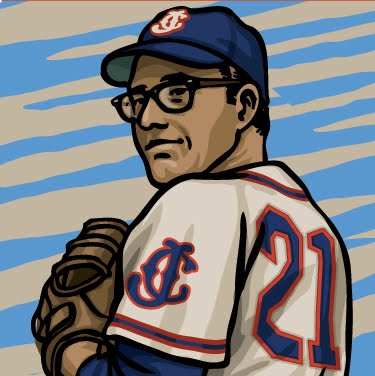
When I first started this blog a little over 3 years ago, I started receiving many requests for players to be profiled on here and given The Infinite Baseball Card Set "treatment." Out of all the emails I began to notice that it was not one particular player that was asked for the most, but rather a whole ethnic group: Jewish ballplayers. I did cards and stories on here of Sandy Koufax and Moe Berg, but I began slowly researching different players of the Jewish faith, trying to find characters who would fit in with the kind of stories I like to write - guys with interesting stories who may not be known to the casual fan of baseball history. Al Schacht was one of those guys, and in fact he appears on page 7 of the Premier Issue of "21: The Illustrated Journal of Outsider Baseball." While many baseball fans may know of him from the comedy routines he did with Nick Altrock, Al Schacht was actually a real pro ballplayer and had a nice career before he started his second career as a comedian. His story of doing everything possible to attain his goal of playing in the major leagues was both funny and inspiring to me, as I hope it is to you...

Al Schacht was a product of the teaming slums of the Lower East Side. The son of Russian immigrants, Al defied his parents wishes by embracing the American pastime of baseball. His mother, daughter of the village Rabbi back in Russia, was especially against the game, fearing he’ll turn out to be a bum or a loafer if he continued. Despite the warning, Schacht poured his heart and soul into the game. After the family moved to the more rural Bronx, Schacht would walk all the way to the Polo Grounds in Harlem to see his beloved New York Giants play. He went beyond being a  casual fan however and soon made himself useful to the team by running errands for the players. Christy Mathewson especially became a favorite of Schacht and the two struck up a friendship of sorts. Mathewson even taught the young kid how to throw his famed “fadeaway” pitch.

Because of being 5’-11” and only 125 pounds, Schacht was overlooked for his high school team so he put his talents to use on the sandlot and with semi-pro teams. Although he eventually made his high school team, he was later found illegible because of his having played semi-pro ball for pay. So Schacht dropped out of school all together and pursued a career in professional baseball. 

Catching on with a team in Walton, N.Y. he promptly won 16 consecutive games. Before one game he learned that a scout from the Cincinnati Reds was in the stands to watch him. Fearing his diminutive size would work against him before he even had a chance, Schacht pulled on double pairs of socks and a couple of sweatshirts along with sliding pads to make himself seem bigger. The afternoon was hot and the struggling Schacht lost 2-0, but he was called to Cincinnati and put in front of owner Clark Griffith. Seeing that he was much smaller than described, Griffith offered him a minor league contract. Schacht declined, knowing he could make more playing semi-pro ball than in the low minors.

Schacht played around the Northeast for various clubs and after a stint in the army during the First World War, where he did little more than play baseball, Al signed with the Jersey City Skeeters in 1919. The Skeeters were a miserable team, winning only 45 games during the whole season. However, Schacht was the winner of 20 of those contests. After each win Schacht would anonymously send a newspaper clipping of the game to Clark Griffith. Now owner of The Washington Senators, Griffith himself travelled to Jersey City to look Schacht over. After his 10th shutout of the year, Griffith signed Al to play for the Senators. He was a good pitcher for a few seasons but it was his second talent on the diamond that he became known for. 

Al Schacht was a natural clown. Teaming up with former player Nick Altrock, the two made the stands howl with laughter as they went through silent vaudeville routines between innings. Besides being clowns, the two men served as 1st and 3rd base coaches. By all reports Schacht was a well respected coach while with the team. By 1921 Altrock and Schacht were performing all over the league as well as at the World Series. Somewhere along the way however, Altrock and Schacht had a falling out. No one really knows the reason why, some say it was an anti-Semitic remark Altrock made while drunk, others say it was jealousy over Schacht's younger age. Whatever the reason the two silently feuded for years before breaking up the act in 1936. 

Clad in his trademark top hat and tails over a baseball uniform and known as the “Clown Prince of Baseball” Schacht was famous all over the country, even appearing on stage with such celebrities as Bing Crosby. During the Second World War Al volunteered to entertain the troops. Appearing in such remote places as North Africa and the South Pacific, Schacht helped bring a smile to homesick servicemen. After the war he opened up a restaurant in Manhattan which became a hang out for ballplayers and celebrities. The affable Schacht worked the room entertaining his customers.

Throughout his long career Al Schacht never hid that he was a Jew, famously remarking: "There is talk that I am Jewish-just because my father was Jewish, my mother was Jewish, I speak Yiddish and once studied to be a rabbi and a cantor. Well, that's how rumors get started." 

Thursday, April 18, 2013

149. Jackie Robinson: A Great Day in Jersey City


Today's post is a re-working of one of my oldest ones on the site. While I liked the original drawing, times change and my style has evolved a bit so when I wanted to include Jackie in my new edition of 21, I decided it was time to give him an update. Since Robinson's first appearance in 1946 was such a momentous occasion, and being from New Jersey, I wanted to show a bit of the old ballpark in Jersey City where the game took place. That's Roosevelt Stadium's distinctive scoreboard in the background. I liked this drawing so much I made it a full-page illustration in 21. I tried to depict Robinson as being full of confidence, ready to take the field for the first time, the weight of a whole race upon his able shoulders. It was an important day and I wanted to make this an important drawing.

67 years ago today, Jackie Robinson sat in the visitor's locker room of Jersey City's Roosevelt Stadium. Suiting up with his Montréal Royals teammates, Robinson was about to do what no black man had done since 1899 - play in an organized baseball game. Johnny Wright, another black ballplayer was on the roster that day, too, but Wright was a pitcher and was not going to play. Once the bands stopped and Mayor Hague threw out the first ball, Robinson was on his own. Opening Day in Jersey City was a big deal back then, a city-wide holiday. The Hague political machine that ran the city since 1917 expected every single municipal employee to purchase a ticket in order to give Jersey City the largest opening day crowd every year. Although 25,000 fans streamed through the turnstiles that afternoon, twice than number was sold. Still, with 25,000, Jersey City easily led the International League in attendance that day, and they got to witness history being made.

From the story accompanying the illustration in 21:

When Jackie Robinson took the field at Jersey City’s Roosevelt Stadium on April 18, 1946 he became the first black ballplayer in organized baseball since 1899. Robinson’s fame as a college athlete, his university education, and experience as an army officer made him the perfect man for a very difficult job. Many Negro League ballplayers expressed disappointment that he was to be the first to integrate the game. His manager with Montréal silently questioned whether or not a black man was even human. Bob Feller, who pitched against Robinson in 1945, thought so little of his talent said “If he were a white man, I doubt if they would even consider him big league material, except perhaps as a bat boy.” Robinson faced it all with quiet dignity and strength. In that first game in Jersey City he went 4 for 5, including a three-run homer, scored 4 runs, drove in 3 and stole 2 bases. Overcoming immense racial pressure, Jackie won over his teammates and fans with his natural physical ability and intense drive to win. Sparked by his play, Montréal won the Little World Series of 1946 and the next year he was playing for Brooklyn. Through his sheer determination Jackie Robinson not only paved the way for the desegregation of the major leagues but also the modern civil rights movement. 

Don't forget the card I posted yesterday of Happy Chandler, the Commissioner of Baseball who backed up Branch Rickey when he wanted to bring Jackie Robinson to the Dodgers.

Wednesday, April 17, 2013

148. "Happy" Chandler: Instrumental to Integration


With all the hoopla these past few weeks about Jackie Robinson and the integration of baseball, I thought before I wheel out my new Robinson card and story this week, I'd feature one man who was directly responsible for the destruction of the color line. He's a guy that I will include in the next edition of 21, which will have a "Baseball in Kentucky" theme in tribute to my adopted state. While Brooklyn Dodgers general manager Branch Rickey gets the well-deserved lions share of ink for his part in integrating the modern game, Happy Chandler played an instrumental, though not well-recognized part.

 He was one of those old-time baby-kissing, glad-handing southern politicians with a billion-watt smile, the kind you see in cartoons. He was elected governor of the Commonwealth of Kentucky two separate times, represented the state in the United States Senate and was the second Commissioner of Baseball. But before all of that, Happy Chandler was a shortstop.

In the long line of Commissioners of Baseball, Happy Chandler is the only one to have played the game professionally. He was a star athlete in high school and played ball for Transylvania College. He reportedly tossed a no-hitter playing for Grafton in North Dakota's Red River Valley League in 1920 (the town even named the local baseball field after him) and was invited to a tryout with the Saskatoon Quakers but returned to college instead.

During the summers of 1922 and 1923 he played for the Lexington Reos of the Blue Grass League. The Blue Grass League was a Class D circuit, the lowest classification at the time, but it was professional baseball and one of his teammates was future Hall of Famer and member of the famed 1927 Yankees, Earle Combs. Chandler played in less than 20 games but for a time considered pursuing baseball as a career. He also served as a league umpire during the two seasons he spent with the Reos before deciding to attend Harvard Law School.

Chandler worked his way up the ladder of Kentucky politics, first in Woodford County then on to the state level. He was a fiscally conservative Democrat and by 1935 was elected governor. He switched over to the United States Senate in 1939 and it was there that he was approached to become the second Commissioner of Baseball.

Kennesaw Mountain Landis had held the post since 1920 and upon his death the team owners elected Chandler to succeed him. In the period between Landis' death and Chandlers appointment, Brooklyn Dodgers general manager Branch Rickey  signed Jackie Robinson and Johnny Wright to Montreal Royals contracts making them the first blacks to play professional ball since Hippo Galloway in 1899

After the 1946 season, Rickey wanted to transfer Robinson's contract to the Dodgers, something that the Commissioner's office had to approve. Rickey went to personally see Chandler who gave his complete support. The Dodgers' general manager later said that without Chandlers full support he would not have been able to bring Robinson to Brooklyn.

Why did Chandler give his support to something his predecessor had vehemently opposed? There are two quotes attributed to him in regards to his approval of the smashing of the color line. The first was given right after he was named Commissioner. Ric Roberts of the Pittsburgh Courier asked Chandler about blacks playing pro ball to which he responded: "If they can fight and die in Okinawa, Guadalcanal, in the South Pacific, they can play baseball in America." Coming after more than 25 years of double-talk and out right lies by the former Commissioner, Chandler's statement came as a bombshell, not just for it's strait-forwardness but because of where he was from. Kentucky in 1946 was still a Jim Crow state and Chandler's words were sure to upset more than a few of his constituents. 

The second quote shows the way he was thinking not just about baseball but the whole idea of institutionalized racism. From his autobiography Chandler had this to say to Branch Rickey at their meeting in 1946:

"I've already done a lot of thinking about this whole racial situation in our country. As a member of the Senate Military Affairs Committee, I got to know a lot about our casualties during the war. Plenty of Negro boys were willing to go out and fight and die for this country. Is it right when they came back to tell them they can't play the national pastime? You know, Branch, I'm going to have to meet my Maker some day. And if He asks me why I didn't let this boy play, and I say it's because he's black, that might not be a satisfactory answer. If the Lord made some people black, and some white, and some red or yellow, he must have had a pretty good reason. It isn't my job to decide which colors can play big league baseball. It is my job to see that the game is fairly played and that everybody has an equal chance. I think if I do that, I can face my Maker with a clear conscience."

As Commissioner Chandler did as much as he could to limit the on-field racism Robinson and the other black players faced. When the St. Louis Cardinals threatened to strike if they had to face Robinson he pledged that any player who failed to take the field would be immediately suspended. After Phillies manager Ben Chapman disgraced himself and the game with sickening racial taunts when his team faced the Dodgers, Chandler made it clear that any more of that would earn him and the team severe disciplinary measures.

Besides his part in integrating the game, Chandler was known as the “Players Commissioner." After the Pittsburgh Pirates almost went on strike for more players rights, Chandler established the first pension fund using the proceeds from selling the radio broadcast rights to the World Series. He also tried to keep the game free of the threat posed by gamblers and gangsters when he suspended Brooklyn manager Leo Durocher before the 1947 season. While popular culture has often portrayed Durocher's suspension being brought on by his affair with the married actress Lorraine Day, in actuality he earned it by palling around with Bugsy Siegal and other seedy underworld figures.

For all he did for the game, Chandler's reign as Commissioner came to an abrupt end in 1951 when he resigned after the team owners twice refused to extend his contract. It was a loss for the game as Chandler was its most forward-thinking leader for many decades. He went back to politics and in 1955 was re-elected governor during which he over-saw the integration of the states' public school system. He was inducted to the Kentucky Sports Hall of Fame in 1957 and in 1982 he took his place in the National Baseball Hall of Fame. Still smiling, he lived until the age of 92, dying of a heart attack in 1991.

Though he isn't remembered today as reverently as Branch Rickey or Jackie Robinson, Happy Chandler was indeed instrumental in the games' integration.

Thursday, April 11, 2013

Infinite Baseball Card Set On the Air


 Last week I was surprised by the invitation to be interviewed on the Stealing Home podcast. Since I mostly listen to podcasts and books on tape while I work everyday, I was familiar with Stealing Home and subscribe to it. If you haven't heard it before, it's put together by David Temple and offers an hour-long discussion on baseball history and related subjects. Besides covering interesting subjects and David's insightful observations, Stealing Home is a thoroughly professional production that actually surpasses most talk radio shows. The episode I was asked to participate in was Number 6: Art. On it I talk about why I started the Infinite Baseball Card Set, the why and how I choose the players I do and what makes my drawings different than other baseball artists. It was a fun conversation and while I have a hard time talking about my work, David's radio experience put me entirely at ease and made the whole interview easy for me. I hope you take the time to check out the episode and also check out the other installments in David's unique series. My part starts about 29 minutes into the show.


Tuesday, March 26, 2013

147. Ford Meadows: Better Than The Babe


I love those "what if?" questions in history. You know, those major events in history that hinged on one minor and insignificant event or individual: what if Hitler had gotten into art school or what would America be like now if Lee Oswald was a lousy shot? Baseball has plenty of those great "what if's" as well, and it was one of those minor turn of events that gave the game its greatest player.

In the spring of 1914, Baltimore Orioles owner and manager Jack Dunn looked over his roster for the coming season and knew he had a problem - left-handed pitching, or more precisely, the lack of it. Fortunately Baltimore and the surrounding countryside was an untapped gold mine of amateur talent. Though the city had a major port, world-class universities and a many top-notch semi-pro teams, Baltimore's pool of ballplayers was often overlooked due to the close proximity of Washington, Philadelphia and New York City. For years the savvy Jack Dunn had it all to himself and he was famous for his meticulous scouting of local talent. When the time came for him to fill that left-handed spot in his pitching rotation Jack Dunn knew exactly who he wanted.

For a year Dunn had been following a local 19 year-old student at an Xaverian school who was mowing down every team he pitched against. He was a big fella and like most left-handers had a bit of a reputation for being a bit eccentric. To Dunn, a veteran judge of baseball talent, this kid was one of the greatest lefties he'd ever seen. In early February of 1914 the Orioles owner took his former third baseman and now New York Yankee Fritz Maisel along to talk to the Brothers who ran the school the young phenom attended. Dunn figured that by bringing along Maisel, a local boy, would make it easier to get the Xaverians to give up their star player if they could see that being signed by the Orioles was a stepping stone to the big time.

Brother Gilbert, the schools baseball coach and athletics director, met with the two men apprehensively. While one one hand he wanted the young man to succeed, on the other he also wanted a winning ball club for the upcoming season and this kid was his ace. Brother Gilbert thought about how he could keep him for just one more season and settled on the old bait and switch tactic.

"Sure my boy is great" he told the two men, "but this other lefty we faced last season was even better". Dunn, intrigued, must have wondered who this other unknown star was. 

"Ruth from St. Mary's" was Brother Gilbert's reply.

See, the pitcher Jack Dunn had scouted and called one of the greatest left-handers he'd ever seen was not the young Babe Ruth, but a student at Mount St. Josephs College named Ford Bernard Meadows. 

At the time, Meadows was hands-down the best pitcher in Baltimore. In the 1913 season the kid had shut out Georgetown, Boston College and Holy Cross - all in one week. His games were given as much coverage in the Baltimore newspapers as the Washington Senators and Orioles. There was no doubt that Meadows was a budding superstar. As far as anyone was concerned, no one had heard of this Ruth kid over at St. Mary's that Brother Gilbert had spoke of.

And in truth, the Xaverian Brother and baseball coach was fibbing a bit: he'd never actually seen Ruth pitch before. In all the games Mount St. Josephs played against St. Mary's Ruth appeared as a left-handed catcher. The big kid impressed Brother Gilbert not with his pitching but with his bat, a skill he used to eat up any pitcher Mount St. Josephs threw at him. Because both St. Mary's and Mount St. Josephs College were run by Xaverian brothers, Gilbert was familiar with Ruth's coach, Brother Matthias, and through him had learned of Ruth's strong and accurate arm. 

It was a brilliant tactic and Jack Dunn fell for it. Within days he'd signed the young George Herman Ruth without ever seeing him play an inning of baseball, all based on the little white lie of an Xaverian Brother who was trying to keep his prized ball club intact for one more season.

But what became of Ford Meadows? 

Well, he continued to dominate the collegiate scene. He kicked off the 1914 season with a brilliantly pitched game against the Orioles. Though he lost, the newspapers reported that had he been backed by a capable catcher and right fielder, Meadows would have defeated the Birds. A few weeks later he pitched a no-hitter and at the end of the college season was in Frederick, Maryland playing semi-pro ball and making headlines with his pitching feats. So while Ruth played half a season with the Orioles and made it up to the Boston Red Sox, Meadows was still an amateur, though a well-known and highly touted one. 

After school ended in the spring of 1915, Jack Dunn swooped in and finally signed the southpaw he'd originally wanted. Dunn's Orioles has been forced to relocate to Richmond after they were beaten at the box office by the upstart Baltimore Terrapins of the Federal League. While with Richmond the former phenom was less than mediocre. He was consistently wild and in 13 games could only muster an 0-2 record. But the New York Yankees saw something in him and in late August Dunn sold Meadows to New York for a $5000 profit. 

Meadows rode the Yankees bench for the rest of the season, never getting into a game but was invited to join the team in Macon, Georgia the next year for spring training. Unfortunately for Meadows he pitched poorly and was quickly let go, rejoining the Orioles, who had again set up shop in Baltimore after the demise of the Federal League. 

Now Jack Dunn began to sour on the former college star. Throughout the spring he failed to impress. He couldn't find the plate and Dunn complained he was sorely out of shape. Exasperated with Meadow's performance and attitude, Dunn suspended him. In what was a pretty ballsy move for the time, the southpaw filed a grievance with the minor league baseball commission and Dunn was told to play him or let him go. This kind of insubordination from one of his players couldn't have sat well with the autocratic manager and owner. While Dunn was well known for treating his ballplayers with unheard of respect, the Orioles were his team, an extension of himself. That one of his boys would have the stones to file a grievance against him and challenge his authority to run the club as he saw fit must have angered him immensely.

Dunn reluctantly took him back into the fold. 

Ford Meadows, the guy who was more highly touted than Babe Ruth, would finally get his own place in the baseball history books, but not in a good way. On June 30, 1916 Dunn put him in as a relief pitcher against Richmond. Down 8-2, Meadows took the mound for the home half of the sixth and started walking everyone in sight. By the time it was over he issued free passes to 11 Richmond batters and set what was then a record. Dunn, his point made, gave Meadows his unconditional release later that day.

As far as I can tell, Meadows never appeared in another professional game. He did, however, find love and on August 4th married Miss Grace Miller. Meadows was still so well known that the Baltimore newspapers wrote about his wedding and one article reported that the couple honeymooned in Atlantic City and that since his release from the Orioles he had been playing amateur ball around Baltimore. 

With the World War raging in Europe it was just a matter of time before Meadows, 22 at the time, was caught up in it. He served with the 514th Pioneer Infantry in France where he dislocated his shoulder and had his ear shot off in the fighting. He returned home on a transport ship with thousands of other wounded doughboys almost six months after the war was over.

I couldn't find any other traces of Ford Meadows after that. Most likely he returned to his wife and made a life for himself around Baltimore. While his ball playing career might not have lived up to the promise many expected from him, he was instrumental in launching the career of the greatest baseball player of all time.

Wednesday, March 20, 2013

146. Charlie Hoover: Talented But Troubled


When I was looking for any kind of reference on Humpty Badel, I could find only one other person who had written about him in the last 90 or so years - Thom Karmik. His website Baseball History Daily is a joy to read, a fact that I can personally testify to. After reading the Badel story I found myself going deeper and deeper into his archive of past stories until I had to restrain myself - I was getting dangerously off the track of my Badel research. His endless trove of interesting ballplayers and new (to me) stories had me hooked. Seeing that we both share a similar taste in obscure players and stories, I emailed Thom and asked him if he'd be interested in writing a story for my site as a guest author. Lo and behold he agreed and quickly sent me this great bit of original research on a really interesting guy from the early days of the game. So, without further delay, I'll turn it over to Thom Karmik...

Charles E. Hoover is one of a select group; Major League players for whom no information is available about when or where he died.  Like many 19th Century ballplayers he eventually became better known for his demons than for his ability, and eventually faded into obscurity.

Hoover was born in Mound City, Illinois in September of 1865; the town, upriver from Cairo was incorporated just seven years earlier and was the site of the Union Army’s largest hospital in the west and a shipyard that produced three Union ironclads:  the U.S.S. Cairo, the U.S.S. Mound City, and the U.S.S. Cincinnati.

Nothing is known about Hoover’s childhood, but at some point he settled in Hannibal, Missouri, where he would return throughout his life. 

His professional career began in 1886 with the Lincoln Tree Planters in the Western League.  Hoover played for three teams in the Western League in 1887, and his .342 batting average and growing reputation as a solid catcher with an excellent arm earned him a contract with A.G. Spalding’s Chicago White Stockings. 

Between the 1887 and ’88 seasons Hoover’s troubles began.

He was drunk in Lincoln, Nebraska (some contemporary papers said the incident happened in Kansas, but it appears Lincoln was the site) in early December of 1887 when he was arrested for shooting at a carriage driver.  In January a wire service report which appeared in several papers said Hoover had been released from jail and would be joining the white Stockings in the spring:

“(Hoover) has written a letter to President Spalding in which he proves by the court record that the charge preferred against him was entirely fictitious and the work of two men he whipped in a fight.”

The story said a fight broke out between Hoover and the two men and the gun “accidently discharged” and, “Spalding, after investigating all the evidence at hand has come to the conclusion that Hoover, while perhaps a little hotheaded, did nothing especially reprehensible.”

Hoover joined the White Stockings in the spring, but was released to the Western Association before the season began.  The catcher split time between the Chicago Maroons and the Davenport Onion Weeders.  He was purchased for $8500 at the end of the season by the Kansas City Cowboys in the American Association and made his major league debut in October, appearing in three games for the Cowboys.

The following season in Kansas City was a stormy one.  There were numerous reports that he and Kansas City manager Bill Watkins did not get along, and Hoover’s reputation as a talented, but “troubled” player grew.

After another disagreement with Watkins in July, The Sporting Life said:
“Hoover is a peculiar ball player. Fines, bad treatment and threats of expulsion don't seem to  have any effect on him. The management had tried everything on him. It was thought for a time that he would be released, but yesterday he was put in to catch and caught the best game ever played in this city. His work was simply wonderful.”

Then, a few days before the end of the season, Hoover fought with a fan in Kansas City.  The Sporting Life was not ready to give up on him and provided his defense, despite acknowledging he was probably drunk:

“Many a ball player has done worse and has been forgiven readily. Hoover had been drinking. He was mad and angry and when a spectator insulted him, he lost his temper altogether.”

Besides, The Sporting Life said “He did some of the best catching this season in the American Association.”

Despite his defenders, Hoover was finished with Kansas City. When he returned to the Western Association the following season, The Denver Republican said:

“(He) is a good backstop, an excellent thrower, fair hitter and rapid baserunner.  He is cursed however, with a tinder-like temper, which no manager has yet been able to control.”

There are no available statistics for the1890 season.  Hoover began the season with the Kansas City Blues and was acquired in August by the Lincoln Rustlers. 

Hoover’s troubles continued.  The Omaha World-Herald reported that summer that Hoover’s “Mistress” in Lincoln, was the “Keeper of a disreputable house at 6th and M Streets,” and shortly after the end of the 1891 season Hoover was arrested in Lincoln another incident involving Hoover shooting at someone while drunk.

The erstwhile catcher managed to avoid prosecution again when he was signed to a contract with the Sacramento Senators of the California League.  In February, The World-Herald said:

 “At 5 o’clock this morning Charley Hoover was escorted to the Burlington depot by an officer and put upon a train bound for California… (The) ballclub telegraphed $150 and from it he extracted $25 and paid his fine.  If he ever shows up in Lincoln again he will be prosecuted for assault with intent to kill.”

The Sporting Life said Hoover “Who but for his besetting sin, drink, would be one of the great catchers of the profession…He has signed a contract to abstain from liquor, a forfeiture of salary being the penalty for a violation of his agreement.”

By late May Sacramento manager John McCloskey had tired of Hoover and the catcher was released.  Hoover went first to Hannibal, and then signed a contract to play for a semi-pro team in Bozeman, Montana.  The next season he signed with the Omaha Omahogs of the Western League.  The World Herald said Hoover was:

“One of the best backstops in the business…he has been signed on the condition that he keeps straight.”

He didn’t, and was released before the season began.  Hoover spent the year working as a bricklayer in Butte, Montana.

He was next heard from in January of 1893 when The Sporting Life said “Hoover got into several scrapes in Butte, so the town became so hot for him that he shook the dust off his feet and returned to his Hannibal, MO home.”

That spring, Charlie Comiskey was desperate for a catcher to back up Farmer Vaughn and signed Hoover.  The Sporting Life’s opinion of Hoover had soured, and the paper did not support the move:

"Comiskey is sufficiently hard up for a catcher to take chances with an unreliable man, notwithstanding costly experience. He is trying Charlie Hoover, the ill-tempered and bibulously inclined ex-Kansas City catcher."

Hoover’s last chance at the Major Leagues ended when Comiskey chose to stick with Morgan Murphy, who had hit .197 and committed 18 errors in 74 games the previous season, as Vaughn’s backup.  Hoover dropped out of sight for the remainder of 1893, but returned the next two seasons playing in the Southern and Western Associations—the 29-year-old’s professional career was over after the 1895 season.

Hoover returned to Hannibal and was not heard from again until 1899.  Hoover was drunk when he attempted to pass a bad check at the Stillwell Packing Company in Hannibal.  He was arrested, and for the first time convicted and sentenced to prison—for five years. 

In 1902, Missouri Governor Alexander Dockery pardoned Hoover.  The St. Louis Republic said:
 

"Hoover’s propensity to gaze upon the wine when it was red has caused him all his trouble.”

But the paper was hopeful for Hoover’s future:

“He is considering several offers to play ball and will probably accept one of them.”
 

The 36-year-old Hoover did not sign with any professional team.  That was last that was heard from Hoover--one of the few who reached the Major Leagues and disappeared without a trace.

Be sure to visit Baseball History Daily. When I asked Thom to write about what his site is all about, this is what he said: 

“In the days before electronic media the players who toiled in hundreds of small and medium sized towns across North America were heroes, idols and sometimes villains; and they were household names.  While organizations like SABR have provided reams of research on professional baseball, so many of those household names, and the teams and the leagues in which they played, have been lost in the mists of time.”

"What I’ve also discovered is that just as many stories of the players who reached the pinnacle of their profession and played in the largest cities in country have also faded into obscurity."

"What has made it especially fun and satisfying for me is that I have actually heard from ancestors of some of the players I’ve profiled and had them tell me they learned something about a great-grandfather or uncle that they hadn’t known. I’m a former broadcast journalist and also worked on political campaigns for a decade;  I relocated to Las Vegas a year ago and no longer do either of those things." 

Friday, March 1, 2013

145. Humpty Badel: Almost Major League


Although I'm originally from New Jersey, I've come to adopt the Commonwealth of Kentucky as my home. It wasn't a quick decision - over the years I'd moved here and then left 2 times - yet last year when I was looking for a place to settle after 6 years in Los Angeles there was only one place that truly felt like home - Kentucky. I live right across the Ohio River from Cincinnati and within minutes I can go from a Reds game to the beautiful farm where my girlfriend boards her horse, Lefty (great name, huh?). For some reason, of all the places I've called home over the years, Jersey, Baltimore, Chicago, Colorado - Kentucky is where I want to be. And as a little private way to say thanks to my adapted state, I like to feature players with Kentucky roots like Pee Wee Reese, Carl Mays and Bill Niemeyer.

But there's one team I always wanted to do a card for: the short-lived Covington Blue Sox. Covington, Kentucky is the city directly across the Ohio River from Cincinnati and in 1913 was host to a franchise in the newly-formed Federal League. That first season was a trial run for what in 1914 would become almost a third major league. The Blue Sox lasted only a few months before they were forced to move west to Kansas City, becoming known as the Packers. Since I lived in Covington and know the spot Federal Park once stood, I have been avidly searching for the perfect player to represent Covington's brush with baseball history. After rummaging through pages and pages of 1913 Cincinnati newspaper files, I found that certain player and his story was better than I could have hoped for...

At a time when the only way someone with a handicap could get onto a professional ball club was as a mascot, hunchback Fred Badel came surprisingly close to making the major leagues. Badel came from Carnegie, one of the many gray steel towns outside Pittsburgh. He was born in 1881, or maybe before that, we just don't know for sure - like many ballplayers throughout the history of the game, he probably shaved a couple of years off as he grew older. Newspaper stories during his playing career make note of his peculiar accent and that he spoke German so he was probably the son of immigrants, of which the greater Pittsburgh area had no shortage of. He suffered from a severe curvature of the spine called Kyphosis which caused a hump to form on Badel's back. In those pre-politically correct times it inevitable he would be known as "Humpty". He could neither read nor write and contemporary sportswriters weren't shy in declaring Badel a bit on the slower side of things. He apparently had trouble remembering simple instructions and one manager said he lacked common sense. Newspaper articles called him "odd" and "picturesque." Humpty could, however, play ball.

Badel got his professional start around 1902 or 1903 playing for Youngstown in the Ohio-Pennsylvania League. In 1905 he surfaced with the Johnstown Johnnies of the "outlaw" Tri-State League. The "outlaw" brand meant that the league wasn't affiliated with the minor or major leagues which fell under the umbrella of the National Association. While playing outfield for the Johnnies, Badel attracted the attention of the Buffalo Bisons of the Class A Eastern League, which was the equivalent of today's AAA.

The manager of the Bisons was George Stallings, later manager of the 1914 World Champion Boston Braves. Stallings became very smitten with Badel during spring training. Accounts state that he was above average contact hitter with a good eye. On the base paths he was described as a "whirlwind" and fearless. Moreover, Badel used his disability to his advantage: due to his hump and curved spine his strike zone was quite small making him a hard man to pitch to. By the time the Bisons broke camp and headed towards Buffalo, he was penciled in as the starting right fielder.

Playing their way north, the Bisons stopped in Cincinnati to play the Reds. After a short series between the two clubs reds manager Ned Hanlon offered Stallings $5,000 then and there for Badel but was rebuffed. Stallings felt he had a budding star and wanted him for himself. 

The presence of a hunchback on the club was as much a source of interest and amusement for press as it was for his new teammates. It was a different time and like black children and midgets, hunchbacks were considered good-luck charms by superstitious ballplayers. "Rubbing the hump" for luck was as time-honored a tradition in baseball as spitting. Unfortunately for Badel, some of his new teammates couldn't differentiate between the ball-playing Badel and the lucky hunchback Badel.

Bisons' ace pitcher Rube Kisinger was so infatuated with Badel's hump that he would wait for him to come in from the outfield after each inning and rub his hump all the way to the dugout. While Kisinger probably meant no disrespect doing what a newspaper at the time called an "affectionate demonstration", Badel was mortified by the superstitious ritual and pleaded to the Bisons' management for relief. None came. Rube Kisinger was a former big leaguer and the best pitcher on the Bisons. Though Badel was warmly accepted by the Buffalo fans and he was holding his own in the league, by July the "humpstroking business" became unbearable. He was also having a hard time learning the club's field and batting signs and his teammates began to poke fun at his illiteracy and ignorance. Badel was also disgruntled with his pay on the Bisons which was less than what he was getting in outlaw ball. A 1907 Sporting Life article relates that Badel borrowed $100 from Stallings then told him he was jumping the club. A hundred bucks in 1906 was a hefty sum and Stallings had to have his lawyer talk him out of physically attacking Badel and beating his money out of him. On July 6th he quit the club.

By leaving the Bisons Badel effectively KO'ed his chances at making the majors. Breaking a professional baseball contract, especially one in the high minors, was career suicide. Not only would a club think twice about signing a known "jumper" but in most instances couldn't because the rebellious ballplayer would be blacklisted from any league that was part of the National Association. That's exactly what happened to Badel who had no other choice but to return to Johnstown. He hit a nice .302 for the remainder of the season but suffered a setback when health problems and the death of his mother and brother kept him off the diamond in 1907.

Back with the Johnnies in 1908, Badel played for Ed Ashenback, a life-long minor leaguer who also wrote a very funny and insightful book about his career called "Humor Among the Minors". Ashenback describes how Badel couldn't comprehend simple hit-and-run signs or any other instructions for that matter. Discovering Badel spoke fluent German like himself, Ashenback tried simply shouting base running instructions in that language. This too came to naught since Badel would become excited while speaking German and get picked off base. 

Badel spent the next decade in and out of baseball, mostly in the low minors or Midwestern independent and outlaw leagues. In 1912 he was with the outlaw Cincinnati Pippins. The Pippins were part of the United States League which was formed to challenge the National Association's vice-grip on professional baseball. The league tried to place teams in many big league markets but their brand of ball was of a much lower standard than the majors and fans stayed away. Badel was popular with the sparse Cincinnati fans who did turn out for Pippins games and in May was batting a smooth .364. Unfortunately poor attendance and sub-standard talent forced the league to fold after less than 30 games.

In late July Badel surfaced in the South Atlantic League where he managed the Columbia Comers. Stats show he hit a paltry .203 but he made headlines when he took the mound for the Comers and pitched a complete game win over Columbus. 

For 1913 Badel returned to the Cincinnati area. Crossing the Ohio River to Kentucky he joined up with the Covington Blue Sox. Covington was a franchise in the new Federal League which grew in part out of the ashes of the defunct United States League. The 1913 season was to be a trial run for the Federals who aspired to become a third major league. By this time Badel was mostly playing first base, likely due to his age being somewhere in the mid-thirties range. He apparently still possessed his legs because in June he was listed as leading the Federal League in doubles. The Blue Sox played in a bread box of a stadium called Federal Park that held a cozy 6,000 and boasted outfield dimensions of 218 feet down the right field line, 267 feet to center and 194 feet down the right field line. With the big league Reds a trolly car ride away, the Blue Sox couldn't make ends meet and wisely moved to Kansas City in June.

Badel had one more year of baseball with Maysville, Kentucky of the Ohio State League, batting .246 before he was released in June. After that I could find no other mention of Badel anywhere. Giving it one last try I stumbled on a very impressive blog by Thom Karmik called Baseball History Daily. Karmik wrote the only modern summary of Badel that I've come across and it was through his story that we can get one last glimpse of him (as well as his approximate date of birth and name of the condition he suffered). According to his World War I draft registration, Badel moved back to Ohio and became a carpenter. After 1919 he simply disappears from history.

SOURCES
  • The Sporting Life (July 1, 1905)
  • The Sporting Life (March 2, 1907)
  • Washington Evening Star (January 23, 1907)
  • Washington Times (August 3, 1912)
  • Ashenback, Edward, Humor Among the Minors (M.A. Donohue & Company, 1911)
  • Okkonen, Marc, The Federal League of 1914-1915 (Society for American Baseball Research, 1989)
  • Thom Karmik (Baseball History Daily)


Monday, February 4, 2013

142. Stan Musial: Do widzenia Stashu!


The halfway point on the drive between New Jersey and Kentucky is Donora, Pennsylvania. Besides being my own personal milestone of almost being home or almost being to my Grandmother's house, Donora is the birthplace of 2 Hall of Fame ballplayers. I say 2, but it's actually just 1 at the moment - Ken Griffey, Jr. hasn't gone through the formalities of being inducted, but he will. In 35 years of watching baseball in person, Griffey was the absolute greatest ballplayer I had the pleasure of seeing in person. So I call him a Hall of Famer. The other Hall of Famer who hailed from that town of Donora was Stan Musial. Stashu. That Man. Stan The Man. 

He was THE budding superstar of the early 1940's. On a St. Louis Cardinals team that was loaded with talent, young Stan Musial stood out. Unlike tough and rough teammates like Whitey Kurowski or Enos Slaughter, Musial was a quiet, friendly fella. So nice was he that when radio announcers pronounced his Polish last name wrong, Stan was too nice of a guy to bring it to their attention. Thus, Musial (pronounced "Mu-shill") became Musial (pronounced "Mu-see-al"). He seemed to have come out of nowhere - a converted pitcher from the sticks of Pennsylvania who hit .315 and quietly forced his way into the starting lineup of the best team in the National League. It was while he was still relatively unknown that Stan got his famous nickname. Dodger fans at Ebbets Field began referring to the new ballplayer as "that man", as in "oh shit, it's that man again" when he came to bat against Brooklyn. It seemed that every time "that man" came to bat he tore Brooklyn pitching apart. Eventually it evolved to "The Man", the name he was forever known by. That rookie season was just a teaser - in 1943 he led the league in hits, doubles, triples, batting average, slugging percentage - being named the National League MVP was just a formality. 1944 was pretty much a repeat of the previous year and for the third year in a row the Cardinals went to the World Series. But there was that thing called World War II going on and it was inevitable that The Man would have to take part. Brooklyn's Pete Reiser pushed hard to get Stan to join the Army and play on his Fort Riley ball club but Musial wanted Navy instead. 

Seaman Stan Musial was posted to Bainbridge Naval Training Center in Maryland. During the war all military bases had football, basketball and baseball teams to keep the servicemen occupied and out of trouble. Team sports helped build an esprit de corps among the recruits and many of the larger bases fielded varsity teams loaded with former big leaguers. Teams like the Bainbridge Commodores, which Musial played on, would play exhibition games against major league teams and local semi-pro outfits for the benefit of the troops. Free admission to see Bainbridge take on the Philadelphia Athletics or Brooklyn Dodgers kept many a sailor out of trouble for the afternoon and take his mind off of what was to come when they shipped overseas.

While with Bainbridge Musial played with Lum Harris (A's), Dick Wakefield (Tigers), Thurman Tucker (White Sox), Stan Spence (Senators) and Dick Sisler (Cardinals). Not a bad variety of talent for a Navy base. It was while stationed there that Musial decided to tinker with his batting mechanics enabling him to pull the ball. Pulling the ball allowed him to hit more home runs to entertain the sailors. Besides making the white hats happy, the adjustment turned a great hitter into a power hitter.

Musial continued to play ball when he was shipped out to Hawaii. In 1945 the island was an arsenal of talent and it can be argued that the level of ball being played on any given weekend in Hawaii was better than what was being offered by the Major League back in the States. Playing ball the entire two years in the Navy gave Musial the edge when he rejoined the Cardinals for the 1946 season. He led the National League in all the same offensive categories that he did in 1943 and of course was again given the MVP Award as the Cardinals won the World Series over Boston. 

The Man went on to have one of the best careers in baseball history. Besides being arguably the best hitter of all-time, Stan was also one of the most respected. His cheerful personality and fair sense of sportsmanship earned him the respect of millions of fans. There's a story from 1947 that sums up what Stan Musial was all about. During a Dodger-Cardinals game, Jackie Robinson, playing first, was intentionally spiked by Enos Slaughter. This was Robinson's first year and he was under strict orders not to fight back. To do so would jeperdise the whole integration effort. Players from the other teams knew this as well and it was open season on Robinson. Enos Slaughter took full advantage. Out by a mile, Slaughter leaped into the air and slid his spikes down the defenseless Robinson's calf as he stretched for the ball. When Robinson got himself on base a few innings later, he stood on first, poised to spike the hell out of whoever was covering second. Stan was playing first for St. Louis and told Robinson that saw what happened and he wouldn't blame him for spiking whoever was covering second. Musial's sense of sportsmanship and empathy struck Robinson and made him realise that not everyone was against him. Stan's words that day totally defused a situation  that could have gotten totally out of control had Robinson intentionally hurt who ever happened to be covering second.

When Stan passed away last week at the age of 92, baseball lost a great man. What more can I say except Do widzenia Stashu!

Wednesday, January 30, 2013

In the meantime...


Yeah, I know I've been very behind in adding a new card and story to the site. See, for the past 2 weeks I've been working in South Jersey writing the descriptions for a sports memorabilia auction catalog. It's an interesting job and great people to work with and on top of that, I get to handle and write about some extremely interesting sports memorabilia. How many people can say they've held a real T-206 Honus Wagner card in their hands? Or a a bat last used by a member of the 1924 St. Louis Browns? Anyway, I'm fortunate that the auction house is near where my Grandmother lives so I have been able to spend all my time off with her. I brought the research for 4 or 5 stories with me on my trip but I haven't had the urge to really sit down and write. When I get back to my real life in Kentucky next week I should have some real good stories coming up. Until then, I hope that if you're impatient about reading something you check the list over to the left and click on a player you might not have read about yet. Going back through the past, here are a few of the stories and cards I particularly like:

Farmer Dean: I thought this story was just too good to be true when I stumbled on it, but by God, it is!

Ray White: Ray's family recently wrote to say they like the story so that's reason enough for me.

Tom Lasorda: The Dodgers skipper was one tough character back in the day.

Alabama Pitts: One of my favorite stories so far. Sing Sing, botched robberies and roadhouses...

Sig Jakucki: Perhaps the baddest mutha ever to grace the big leagues.

Chief Tokohama: How McGraw almost integrated the game half a century before Robinson.

Frankie Zak: And what list is complete without the Patron Saint of the Infinite Baseball Card Set?

If anyone else would like to recommend a favorite post that others might enjoy, please do in the comments section below...

Sunday, January 6, 2013

141. Mickey Mantle: Got Them Kansas City Blues...


This is my final installment of Mickey Mantle's days in the minor leagues. The story of The Mick's Yankee days are well known, told and re-told by writers much better than I. However, like a lot of the stars I've featured in the Infinite Baseball Card Set, I like to look into the time before these guys became famous and see how their seasons in the bush leagues forged the player they eventually became. Mantle's pre-Yankee history is a little different than most. Right from the start he was proclaimed the next Yankee superstar, and his seasons in Independence, Joplin and Kansas City open a unique window through which we can see how a kid from the country painfully tries to live up to the expectations so many people have riding on him. Whether you are a Yankee fan or not, Mickey Mantle's minor league story will give even the most cynical baseball fan an appreciation for a boy who was picked to take the mantle of the next great Yankee superstar before he even played a single game in organized baseball.

Yankees' general manager George Weiss was nervous. More than nervous - his God damned heart was palpitating... Here it was, first day of 1951 spring training, and the most valuable kid to ever come out of the team's farm system failed to show up. What could it be? More money? The kid was signed for a song, maybe he and his Okie father were getting wise and wanted some more cash. Or maybe he was having some personal problems. Harry Craft, his manager for the past two seasons reported the kid had some sort of confidence issues. Or it could be vice. In Joplin he was starting to hang around with some unsavory characters and had developed a taste for the sauce. It could be it was a broad. A kid with all that talent would be a prime target for some seasoned chippy with keen foresight. After all, he was heralded as the successor to Joe DiMaggio without even having played a major league game.

Weiss couldn't take it anymore. He picked up the phone and put a call through to Commerce, Oklahoma. A few minutes later the Yankees general manager relaxed with a deep sigh. Turns out the kid hadn't received his transportation money to Phoenix. His own front office had screwed up. The future star of the best ball club on earth was biding his time working as an electrician's assistant 500 feet underground in a zinc mine. Weiss told the kid to stay the hell above ground and immediately wired the travel money.

The Yankees in 1951 was a team in transition. The most popular team in the country was starting to gray around the edges. What remained of the pre-war stars were fading fast and Stengel was in the tough position of trying to flawlessly transform the old team into a new team while not losing their position as the best in the league. Clearly Mickey Mantle was a key component in making the transition from old to new, but there was a problem for the impatient Yankees - the kid just wasn't a major league shortstop. Stengel and his coaches wisely acknowledged that it would take at least two seasons of additional minor league experience to bring his fielding up to professional standards. On any other ball club that would be acceptable but not for the Yankees. If the kid was supposed to be the successor to the great DiMaggio, why not make him an outfielder?

You would think that the great Yankee outfielder Joe DiMaggio would have been the perfect teacher, but he would have absolutely no part of his chosen successor. As with so many things in his life, the touchy DiMaggio imagined he was being insulted. Perhaps no one on the team was more unfriendlier to the rookie than the aging star. When the coaching staff decided on remolding the kid into an outfielder, DiMaggio told the press he didn't agree with the decision. 

He was the only one.

Casey Stengel brought in outfielder Tommy Henrich specifically to tutor him. Henrich had retired the season before and was now one of Stengel's coaches. "Old Reliable" lived up to his name and after working with Mickey every day turned out a respectable right fielder. Mantle for his part was happy with the change in position. He told The Sporting News "I like the idea of shifting to the outfield. It is not as tough as the infield, and out there I get to use my legs."

The sportswriters went nuts covering the rookie superstar and he didn't disappoint. 

Everything about the kid was special - hell, even his name was special. The name "Mickey" was always a nickname, a great baseball name, but a nickname given by someone else, short for Michael or something. This kid's given name was Mickey. Like his prodigious talents he brought with him from Oklahoma, he came with that great name. In all respects he was the complete package.

If anyone had any lingering doubts about the kid, what happened on Monday, March 26th would put them all to rest. Playing at Bovard Field against the University of Southern California, Mantle clubbed two home runs, a bases loaded triple and single. One of the homers was a 650 ft bomb that not only went over the outfield wall but it also cleared the football field behind it as well. After the game the Yankees' bus was almost tipped over when over-excited fans swarmed trying to get the kid's autograph. By the time the team headed East for opening day, right fielder Mickey Mantle was hitting well over .400. Center fielder Joe DiMaggio couldn't crack .200.

The rookie started off just like he was supposed to. Wearing number 6 on the back of his jersey, one couldn't help but notice it was the next number after DiMaggio's own number 5. Ruth had been 3, Gehrig 4. It was only natural the next great Yankee star follow in order. Throughout the first month of the season he was above .300 and batting second in the lineup. But then things started to fall apart. With the Korean War raging, many angry people were asking why this human God was wearing Yankee pinstripes instead of army green. It was a good question. The name "draft dodger" started being thrown around. In fact, Mantle had been given a military physical by his draft board in Tulsa twice, once in 1949 and again just days before opening day. Each time he was rejected as 4F. Due to an earlier injury he suffered from osteomyelitis, a bone infection that never completely goes away. He might be healthy now, but if he was inducted in the service and it flared up, the government would be on the line for a lifetime of disability payments. Because of the liability the military unilaterally flatly turned down anyone with osteomyelitis. Still, no matter how hard the Yankee publicity machine tried to explain the truth, Mickey was heckled on the field as a draft dodger and angry parents sent him hate mail on a staggering level.

The cold shoulder from fellow outfielder DiMaggio also made the rookie's life unnecessarily tough. In their first game against the Red Sox, photographers ushered DiMaggio and Mantle together with Ted Williams for a picture. DiMaggio greeted Williams but consciously neglected to introduce Mickey. After an awkward and wholly unnecessary silence, Williams took it upon himself to put out his hand and make the new kid's acquaintance.

For a rookie not yet 20 years-old, the pressure started to build. The way he was playing would have been more than acceptable for any other rookie, but Mickey wasn't any other rookie. He was supposed to be the next DiMaggio. To be a big league ballplayer was the only thing he was raised to be. Each slump or lapse on the field unleashed his uncontrollable temper. Inside he was seething at himself, unfortunately that anger sometimes overflowed and was propelled outward. After striking out he would swear loudly on his way back to the dugout. When one elderly season ticket owner rebuked him after one particularly nasty outburst he told the woman to "shut your God-damned mouth!" 

Off the field his life got complicated as well. With his long-time girlfriend back in Commerce, the most eligible rookie in New York started slipping around with a showgirl named Holly Brooke. Burke introduced the country boy to the glittering lights of Broadway. In order to cover his awkwardness at cocktail parties he discovered the magic of scotch whiskey. Shyster businessmen circled the 19 year-old kid and he quickly fell prey to countless uneven business deals that took whole teams of Yankee attorneys to extricate the naive rookie from.

His strike outs soon started snowballing. Stengel moved him up and down in the lineup like a slide ruler and was forced to answer daily questions from the beat writers about when he was going to admit defeat and send the kid back to the minors. Stengel stuck to his guns as long as he could but after he started striking out at least once in every game, he submitted to the inevitable. With real tears in his eyes, Stengel told the kid he was being sent down. To make room for a much needed additional pitcher, Mickey Mantle was optioned to the Kansas City Blues. It was back to the minors.

The Kansas City team Mickey joined in the summer of 1951 was a seething pot of dissension. Just like today, the Yankees never had to rely much on a farm system. Being the most successful team in the biggest market, the Yankees could purchase ready-made ballplayers unlike most other teams who had to grow their own. Though Kansas City was New York's top farm team, it wasn't so much stocked with budding stars as filled with has-beens and never-will-be's. While many on the team knew they would never show their mugs in the majors, everyone knew Mantle was just in K.C. temporarily. Before he was even with the team he was resented.

The guy at the helm of the Blues was probably the only man who could relate to Mantle's position as having to replace a legendary Yankee star. On opening day in 1935, George Selkirk put on a Yankees jersey with number 4 on the back and took Babe Ruth's place in right field. If anyone knew the pressure Mantle was under, Selkirk sure did.

Joining the team on the road, Mantle was handed a used jersey with number 20 on the back and promptly continued his batting slump. In his first handful of games he went 3 for 18. The first hit was a swinging bunt which he speedily beat out for a hit. When he reached the dugout at the end of the inning Selkirk chastised the kid. "We know you can bunt, Mick" he said. "You're not here to bunt. You're here to get some hits and get your swing back." Scorned by his teammates, ripped by the press and feeling more alone than ever before, he became depressed. But he did start to hit. When the team rolled into Milwaukee he had one 4 hit game, then began belting the home runs. In Indianapolis he hit two - one from each side of the plate. Against the Toledo Mud Hens he hit for the cycle and then added an additional homer for good measure. By the time the Blues headed back to Kansas City, Mickey was batting a nice .345.

Yet each night he sat in his hotel room and poured over the Yankee box scores. The longer he stayed in Kansas City, the less sportswriters mentioned him in the papers. He was fading away and fast. In Mantle's mind, no matter how many home runs he hit down in the minors, he was sure he'd blown his chance with New York. He was lonely and scared. He wrote to showgirl Holly Brooke and begged her to join him in Kansas City, knowing correctly she'd never hitch her star to a lowly minor leaguer. Each day brought more hate mail that piled up in his room. Especially hurting was the ones from the parents of soldiers calling him a draft dodger. 

When the Blues opened up their home stand at Municipal Stadium he started slumping again and making errors in the field. The depression closed in on him and he needed help. He craved some kind of advice from a friendly face. He called his father Mutt and told him he wanted to go home.

Mickey's father Mutt jumped in his truck and made the half-day drive to Kansas City. If he was expecting a pat on the back and sweet words, he was in for a rude surprise. In his son's hotel room after the day's game was rained out, Mutt listened stoically as his boy explained how he was a failure and wanted to quit and go home to Oklahoma. In what would be known as the most famous and successful pep talk in baseball history, Mutt Mantle stood up and started packing his son's clothes, telling him that he thought he'd raised a man. "I see I raised a coward." Emptying the dresser drawers into a suitcase, the father told his son he could come home and work in the mines with him. The shock treatment did the trick. 

After convincing his father to stop the packing, Mantle realised that if he quit now, that would be the real failure. He resolved himself to stick it out. Mutt got in his truck and drove back to Oklahoma, alone. With the rain gone, Mickey belted two home runs in the next game. He averaged over two RBI's a game and on top of all that, the kid was almost single-handedly leading the Blues on a late-season run for the American Association pennant. 

On August 20th, he got the call he was hoping for: New York wanted him back. Trading in his number 20 Kansas City jersey for a set of pinstripes with number 7 on the back, Mickey Mantle rejoined the New York Yankees.

As with the two other stories about Mantle's early days, I'd like to dedicate them to my Uncle Eddie, a great fan of The Mick. As a boy, my Uncle Eddie would come to my baseball games when my father couldn't make it, something I was always thankful for. More than 30 years later my uncle pinch hit for my Pop again, this time helping my brother and I settle my mother's affairs since her death in this past summer. Thanks again Uncle Ed, this ones for you.

SOURCES
  • The Sporting  News (March 21, 1951)
  • The Kansas City Star, column by Joe Posnanski (August, 1, 2001)
  • Castro, Tony Mickey Mantle: America's Prodigal Son (Potomac Books, 2002)