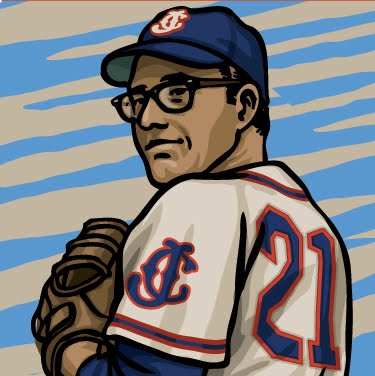
I said it before, but I'll say it again: the greatest thing about writing and illustrating this blog has been all the friends I've made through it. While I started this out of my feeling of loss and loneliness after my Dad died, the many acquaintances I've made through this site have been an unexpected blessing. This week's story comes from one of those new acquaintances. Writing back and forth, he (name withheld by his request) asked me if I'd thought about doing a card of Larry MacPhail. While I never wanted to do cards of owners or executives, MacPhail would prove to be the obvious exception. I thought I'd like to concentrate on his early years in Columbus and Cincinnati, before the Dodgers and Yankees, but I didn't have any reference to start my research. A few weeks later a box arrived at my studio with a big book on MacPhail and some other photocopied material on his Columbus and Cincinnati period. It was all I needed to start writing about this underrated baseball savant - the only thing left was to figure out how to illustrate loud plaids in the Infinite Baseball Card style...
Since baseball became the National Pastime, there have been countless innovators that have moved the game forward: Branch Rickey with integration and the farm system, Dummy Hoy with universal hand signals for umpires, Roger Bresnahan's invention of catching equipment... but perhaps no man had more to do with the advancement of the game, and at the same time is more overlooked, than Larry MacPhail.
Columbus, Ohio 1931.
Larry MacPhail was busted out. After pouring his life's savings into developing a medical arts building that went under after the stock market crash, he was without a job and available. But that didn't worry Larry MacPhail: something would turn up, it always did. He lived his life on the edge, a brilliant mind coupled with a gambler's wit. He followed genius moves with stupid mistakes and each time rebounded to greater height. He was a banker's son from Michigan. Started out as a lawyer in Chicago, then the manager of a Nashville department store. Restless, he wrangled a commission in the army and went to France with an artillery regiment. Six months later he was wounded, promoted to captain and helped lead a daring and booze-fueled raid to capture the Kaiser who was hiding out in neutral Holland. Getting away with his life and one of the Kaiser's ashtrays, MacPhail returned to America and settled in Columbus, Ohio. That's where he was living when he went bust.
As smooth a networker as a Southern senator, MacPhail made friends easy and it wasn't long before some of them came through with his next opportunity. The minor league Columbus Senators were hemorrhaging money like a bottomless boat and hadn't been above 5th place in decades. Fans stayed away from their dumpy ballpark like it was festering with the plague and there was every reason to believe the team would either fold or move away. Local businessmen believed that this would be a tragedy. With the country slipping deeper and deeper into the depression, the Columbus business community believed that the population needed baseball as a diversion from the economic disaster around them and help restore their morale. But they needed a winning team. With Larry MacPhail out of a job, he was asked to see what he could do with the Senators.
Like everything in his life, MacPhail threw his entire weight behind re-forging the franchise into a success. Like a whirlwind of action, he was soon called "Hurricane Larry". Within weeks he'd convinced Branch Rickey to make the Columbus club part of the Cardinals farm system. MacPhail knew that doing so was the future of minor league baseball and the constant flow of players provided by being a part of the Cardinals organization would make his team competitive. The Senators became the Red Birds and soon a steady stream of fresh young talent were putting on Columbus uniforms.
MacPhail slapped new paint on the beat up ballpark, dressed the ushers in colorful uniforms and started fun promotions to lure the fans to the park. At the end of the season the Red Birds were perched in 4th place - the highest in the standings that anyone could easily recall.
By the time the 1932 season started, MacPhail was named to the league's governing body and led the initiative to revamp the play-off system. He instituted a player-incentive program to ensure teams stayed competitive to the end of the season. It was all new and brilliant and by the following season other minor leagues had adapted it to survive the depression.
In June of 1932 he put his team in a brand new stadium which was opened up with unprecedented fanfare and even attracted the Commissioner of Baseball Kennisaw Mountain Landis. Not content with just a merely new stadium, MacPhail insisted lights be permanently installed atop the new ballpark. He began special days where he let unemployed fans see a game for free and started Red Birds fan clubs to get the local kids involved. The Red Birds finished second and actually drew in 100,000 more fans than the parent Cardinals did! It was pure genius and he made headlines from coast-to-coast, but, like every stage in his life, it would come crashing down.
The Red Birds jumped off to a spectacular start in 1933 and were tabbed as the league's favorite. MacPhail continued to make headlines but not always in a good way. Always a first-class boozer, MacPhail sometimes lost control during a binge, such as the time he accompanied the team on a road trip. After an all-night drinking session with the hotel manager ended with an argument, MacPhail made his team pack up and move lodgings right then and there. While some laughed it off, in St. Louis someone was watching.
While Branch Rickey found much to admire about Larry MacPhail, he also had much to despise. Rickey was a teetotaler; MacPhail, of course, drank to excess. The Cardinals president was a model of modesty, the Red Birds' president dressed in flashy clothes to match his personality. And worst of all, MacPhail was quickly out-shining Rickey in the baseball world.
There were two things that ended MacPhail's reign in Columbus. The first was when Rickey saw how well-appointed MacPhail's office was in the new ballpark: walnut paneled walls and plush Oriental carpets. It was more extravagant than any of the major league owners and Rickey seethed with resentment when he thought of how much club money MacPhail had spent on his own regal comfort. When the Red Birds president tried to explain that the walnut panels were installed at a discount by a grateful contractor and that the rugs were obtained after a furniture store had a fire-sale, Rickey was too upset to listen. This brash display of immodesty coupled with the hard time MacPhail gave Rickey when he wanted to promote one of the Red Birds' players during the pennant race sealed the new president's fate. By mid-1933 MacPhail was unemployed.
And, like every other time, he bounced back higher: 100 miles south of Columbus, a ball club was in trouble; a Big League ball club.
The Cincinnati Reds were a miserable club in 1933. Ever since the early 1920's, the team had dived deeper and deeper into the second division. The owner Sidney Weil lost all he had and turned the team over to a local bank. Now in last place with no where else to go, they needed a miracle. They sent for Hurricane Larry.
As he had in Columbus, MacPhail's first months in Cincinnati was a whirlwind of re-painting and re-thinking. He dressed the ushers in fancy garb, hired pretty girls to roam the stands selling cigarettes and cigars. Promotions abounded - ladies nights, kid's days - but still he needed a winning team. MacPhail took stock of his surroundings and set his sights on the richest man in town: Powell Crosley. The local businessman owned a radio and appliance manufacturing company and a brace of radio stations. He took risks, was an innovator in his field and loved his hometown. He was the perfect match for MacPhail. After bombarding the businessman for weeks with reasons he should buy the team, Crosley finally purchased the struggling Reds from the bank. Now MacPhail now had his bankroll.
He got rid of every malcontent and slacker in a Reds uniform. Good, bad, it didn't matter, to MacPhail they were all losers. When star outfielder Babe Herman complained he didn't receive a bonus for hustling that he had in his contract, MacPhail bad mouthed him to the press and kicked him off the team. When he found manager Bob O'Farrell more infatuated with a new golf club than with his team which was on a losing streak, MacPhail fired him then and there. Trades were announced on what seemed like a daily basis. To
cut down on train travel, he occasionally put his boys on a pair of
Ford Tri-Motors and flew them to far away cities. Using St. Louis as a model, the Reds created a sprawling farm system to harvest new ballplayers at a minimum cost. The sportswriters ate
that stuff up, and to make sure they continued to do so, MacPhail built a well-stocked open bar lounge just for them.
Utilizing Crosley's pioneering radio empire, the Reds hired a Floridian announcer named Red Barber and began broadcasting every single game. Major league owners resisted broadcasting their games, fearing fans would just stay home instead of journeying to the ballpark. MacPhail knew they were wrong: the 50,000 watt station WLW could be heard from Texas to Manhattan and soon the broadcasts created a whole legions of Reds fans around the country. Then he allowed three other stations to carry the games as well - the more broadcasts the more Reds fans - and he charged each station two grand for the right to do so. MacPhail
worked with the railroad companies for special excursion trains to
bring all the new Reds fans created by the radio broadcasts to
Cincinnati at a reduced rate.
And then he brought lights to the big leagues. Backed by Crosley's cash, MacPhail installed lights on the re-named Crosley Field. First, he had to convince the other National League owners who were vehemently against the lights. Through deals, arm twisting and flattery, MacPhail managed to have 7 night games for 1935, one with each National League team. It was a smash hit. The first game was linked by a remote link to the White House where President Roosevelt threw the switch lighting up Crosley Field. Every game was a sell-out and though wary, the other team owners agreed to continue the idea.
When Puerto Rico invited the Reds to spend spring training on the island, MacPhail flew the team down there and became the first major league team to visit that Caribbean territory. And through it all, the Reds started to rise. 8th place in 1934; 6th place in 1935 and then 4th place in 1936.
But then, like every stage in his life, it would come crashing down.
Always a boozer and prone to making a scene, MacPhail was on a collision course with Cincinnati's Midwestern values. As his grandson famously said about him:
"My grandfather was bombastic, flamboyant, a genius when sober, brilliant
when he had one drink and a raving lunatic when he had too many."
For a while everyone looked the other way, but by 1936 he had reached the level of "too many. When a drunken MacPhail slugged it out with a police sergeant in the elevator of the Netherland Plaza Hotel, Powell Crosley sent him packing.
It was an inglorious way to exit the big leagues, but to Hurricane Larry, it was the only way. And,
like every other time, he bounced back higher: by 1938 he was running the Brooklyn Dodgers.
That's where I'm ending this story. Most fans of baseball history know how MacPhail assembled the great Dodgers teams of the 1940's and then the post-war Yankees dynasty of the late 40's and 50's. He was elected to the Hall of Fame in 1978. He started his own personal baseball dynasty as his kids and grand kids went on to great heights on the business end of the game. But, as far as an innovator, no one can ever match Larry MacPhail.
Thanks again to the baseball fan who sent me the book and photocopies without which this story could never have been done. It was a fun one to draw, Larry MacPhail was notorious for his loud and flashy clothes. Illustrating baseball uniforms gives me great artistic pleasure, but the chance to draw a sharp suit of clothes, well, that I really couldn't pass up!
SOURCES
- Warfield, Don, The Roaring Redhead (Diamond Communications, 1987)
- McKelvey, G. Richard, The MacPhails (McFarland & Company, 2000)
- Golenbock, Peter, Bums (Putnam, 1984)
- Grandson's quote on Larry MacPhail (Baltimore Sun, November 9, 2012)
When I was looking for any kind of reference on Humpty Badel, I could find only one other person who had written about him in the last 90 or so years - Thom Karmik. His website Baseball History Daily is a joy to read, a fact that I can personally testify to. After reading the Badel story I found myself going deeper and deeper into his archive of past stories until I had to restrain myself - I was getting dangerously off the track of my Badel research. His endless trove of interesting ballplayers and new (to me) stories had me hooked. Seeing that we both share a similar taste in obscure players and stories, I emailed Thom and asked him if he'd be interested in writing a story for my site as a guest author. Lo and behold he agreed and quickly sent me this great bit of original research on a really interesting guy from the early days of the game. So, without further delay, I'll turn it over to Thom Karmik...
Charles E. Hoover is one of a select group; Major League players for whom no information is available about when or where he died. Like many 19th Century ballplayers he eventually became better known for his demons than for his ability, and eventually faded into obscurity.
Hoover was born in Mound City, Illinois in September of 1865; the town, upriver from Cairo was incorporated just seven years earlier and was the site of the Union Army’s largest hospital in the west and a shipyard that produced three Union ironclads: the U.S.S. Cairo, the U.S.S. Mound City, and the U.S.S. Cincinnati.
Nothing is known about Hoover’s childhood, but at some point he settled in Hannibal, Missouri, where he would return throughout his life.
His professional career began in 1886 with the Lincoln Tree Planters in the Western League. Hoover played for three teams in the Western League in 1887, and his .342 batting average and growing reputation as a solid catcher with an excellent arm earned him a contract with A.G. Spalding’s Chicago White Stockings.
Between the 1887 and ’88 seasons Hoover’s troubles began.
He was drunk in Lincoln, Nebraska (some contemporary papers said the incident happened in Kansas, but it appears Lincoln was the site) in early December of 1887 when he was arrested for shooting at a carriage driver. In January a wire service report which appeared in several papers said Hoover had been released from jail and would be joining the white Stockings in the spring:
“(Hoover) has written a letter to President Spalding in which he proves by the court record that the charge preferred against him was entirely fictitious and the work of two men he whipped in a fight.”
The story said a fight broke out between Hoover and the two men and the gun “accidently discharged” and, “Spalding, after investigating all the evidence at hand has come to the conclusion that Hoover, while perhaps a little hotheaded, did nothing especially reprehensible.”
Hoover joined the White Stockings in the spring, but was released to the Western Association before the season began. The catcher split time between the Chicago Maroons and the Davenport Onion Weeders. He was purchased for $8500 at the end of the season by the Kansas City Cowboys in the American Association and made his major league debut in October, appearing in three games for the Cowboys.
The following season in Kansas City was a stormy one. There were numerous reports that he and Kansas City manager Bill Watkins did not get along, and Hoover’s reputation as a talented, but “troubled” player grew.
After another disagreement with Watkins in July, The Sporting Life said:
“Hoover is a peculiar ball player. Fines, bad treatment and threats of expulsion don't seem to have any effect on him. The management had tried everything on him. It was thought for a time that he would be released, but yesterday he was put in to catch and caught the best game ever played in this city. His work was simply wonderful.”
Then, a few days before the end of the season, Hoover fought with a fan in Kansas City. The Sporting Life was not ready to give up on him and provided his defense, despite acknowledging he was probably drunk:
“Many a ball player has done worse and has been forgiven readily. Hoover had been drinking. He was mad and angry and when a spectator insulted him, he lost his temper altogether.”
Besides, The Sporting Life said “He did some of the best catching this season in the American Association.”
Despite his defenders, Hoover was finished with Kansas City. When he returned to the Western Association the following season, The Denver Republican said:
“(He) is a good backstop, an excellent thrower, fair hitter and rapid baserunner. He is cursed however, with a tinder-like temper, which no manager has yet been able to control.”
There are no available statistics for the1890 season. Hoover began the season with the Kansas City Blues and was acquired in August by the Lincoln Rustlers.
Hoover’s troubles continued. The Omaha World-Herald reported that summer that Hoover’s “Mistress” in Lincoln, was the “Keeper of a disreputable house at 6th and M Streets,” and shortly after the end of the 1891 season Hoover was arrested in Lincoln another incident involving Hoover shooting at someone while drunk.
The erstwhile catcher managed to avoid prosecution again when he was signed to a contract with the Sacramento Senators of the California League. In February, The World-Herald said:
“At 5 o’clock this morning Charley Hoover was escorted to the Burlington depot by an officer and put upon a train bound for California… (The) ballclub telegraphed $150 and from it he extracted $25 and paid his fine. If he ever shows up in Lincoln again he will be prosecuted for assault with intent to kill.”
The Sporting Life said Hoover “Who but for his besetting sin, drink, would be one of the great catchers of the profession…He has signed a contract to abstain from liquor, a forfeiture of salary being the penalty for a violation of his agreement.”
By late May Sacramento manager John McCloskey had tired of Hoover and the catcher was released. Hoover went first to Hannibal, and then signed a contract to play for a semi-pro team in Bozeman, Montana. The next season he signed with the Omaha Omahogs of the Western League. The World Herald said Hoover was:
“One of the best backstops in the business…he has been signed on the condition that he keeps straight.”
He didn’t, and was released before the season began. Hoover spent the year working as a bricklayer in Butte, Montana.
He was next heard from in January of 1893 when The Sporting Life said “Hoover got into several scrapes in Butte, so the town became so hot for him that he shook the dust off his feet and returned to his Hannibal, MO home.”
That spring, Charlie Comiskey was desperate for a catcher to back up Farmer Vaughn and signed Hoover. The Sporting Life’s opinion of Hoover had soured, and the paper did not support the move:
"Comiskey is sufficiently hard up for a catcher to take chances with an unreliable man, notwithstanding costly experience. He is trying Charlie Hoover, the ill-tempered and bibulously inclined ex-Kansas City catcher."
Hoover’s last chance at the Major Leagues ended when Comiskey chose to stick with Morgan Murphy, who had hit .197 and committed 18 errors in 74 games the previous season, as Vaughn’s backup. Hoover dropped out of sight for the remainder of 1893, but returned the next two seasons playing in the Southern and Western Associations—the 29-year-old’s professional career was over after the 1895 season.
Hoover returned to Hannibal and was not heard from again until 1899. Hoover was drunk when he attempted to pass a bad check at the Stillwell Packing Company in Hannibal. He was arrested, and for the first time convicted and sentenced to prison—for five years.
In 1902, Missouri Governor Alexander Dockery pardoned Hoover. The St. Louis Republic said:
"Hoover’s propensity to gaze upon the wine when it was red has caused him all his trouble.”
But the paper was hopeful for Hoover’s future:
“He is considering several offers to play ball and will probably accept one of them.”
The 36-year-old Hoover did not sign with any professional team. That was last that was heard from Hoover--one of the few who reached the Major Leagues and disappeared without a trace.
Be sure to visit Baseball History Daily. When I asked Thom to write about what his site is all about, this is what he said:
“In the days before electronic media the players who toiled in hundreds of small and medium sized towns across North America were heroes, idols and sometimes villains; and they were household names. While organizations like SABR have provided reams of research on professional baseball, so many of those household names, and the teams and the leagues in which they played, have been lost in the mists of time.”
"What I’ve also discovered is that just as many stories of the players who reached the pinnacle of their profession and played in the largest cities in country have also faded into obscurity."
"What has made it especially fun and satisfying for me is that I have actually heard from ancestors of some of the players I’ve profiled and had them tell me they learned something about a great-grandfather or uncle that they hadn’t known. I’m a former broadcast journalist and also worked on political campaigns for a decade; I relocated to Las Vegas a year ago and no longer do either of those things."

This is my final installment of Mickey Mantle's days in the minor leagues. The story of The Mick's Yankee days are well known, told and re-told by writers much better than I. However, like a lot of the stars I've featured in the Infinite Baseball Card Set, I like to look into the time before these guys became famous and see how their seasons in the bush leagues forged the player they eventually became. Mantle's pre-Yankee history is a little different than most. Right from the start he was proclaimed the next Yankee superstar, and his seasons in Independence, Joplin and Kansas City open a unique window through which we can see how a kid from the country painfully tries to live up to the expectations so many people have riding on him. Whether you are a Yankee fan or not, Mickey Mantle's minor league story will give even the most cynical baseball fan an appreciation for a boy who was picked to take the mantle of the next great Yankee superstar before he even played a single game in organized baseball.
Yankees' general manager George Weiss was nervous. More than nervous - his God damned heart was palpitating... Here it was, first day of 1951 spring training, and the most valuable kid to ever come out of the team's farm system failed to show up. What could it be? More money? The kid was signed for a song, maybe he and his Okie father were getting wise and wanted some more cash. Or maybe he was having some personal problems. Harry Craft, his manager for the past two seasons reported the kid had some sort of confidence issues. Or it could be vice. In Joplin he was starting to hang around with some unsavory characters and had developed a taste for the sauce. It could be it was a broad. A kid with all that talent would be a prime target for some seasoned chippy with keen foresight. After all, he was heralded as the successor to Joe DiMaggio without even having played a major league game.
Weiss couldn't take it anymore. He picked up the phone and put a call through to Commerce, Oklahoma. A few minutes later the Yankees general manager relaxed with a deep sigh. Turns out the kid hadn't received his transportation money to Phoenix. His own front office had screwed up. The future star of the best ball club on earth was biding his time working as an electrician's assistant 500 feet underground in a zinc mine. Weiss told the kid to stay the hell above ground and immediately wired the travel money.
The Yankees in 1951 was a team in transition. The most popular team in the country was starting to gray around the edges. What remained of the pre-war stars were fading fast and Stengel was in the tough position of trying to flawlessly transform the old team into a new team while not losing their position as the best in the league. Clearly Mickey Mantle was a key component in making the transition from old to new, but there was a problem for the impatient Yankees - the kid just wasn't a major league shortstop. Stengel and his coaches wisely acknowledged that it would take at least two seasons of additional minor league experience to bring his fielding up to professional standards. On any other ball club that would be acceptable but not for the Yankees. If the kid was supposed to be the successor to the great DiMaggio, why not make him an outfielder?
You would think that the great Yankee outfielder Joe DiMaggio would have been the perfect teacher, but he would have absolutely no part of his chosen successor. As with so many things in his life, the touchy DiMaggio imagined he was being insulted. Perhaps no one on the team was more unfriendlier to the rookie than the aging star. When the coaching staff decided on remolding the kid into an outfielder, DiMaggio told the press he didn't agree with the decision.
He was the only one.
Casey Stengel brought in outfielder Tommy Henrich specifically to tutor him. Henrich had retired the season before and was now one of Stengel's coaches. "Old Reliable" lived up to his name and after working with Mickey every day turned out a respectable right fielder. Mantle for his part was happy with the change in position. He told The Sporting News "I like the idea of shifting to the outfield. It is not as tough as the infield, and out there I get to use my legs."
The sportswriters went nuts covering the rookie superstar and he didn't disappoint.
Everything about the kid was special - hell, even his name was special. The name "Mickey" was always a nickname, a great baseball name, but a nickname given by someone else, short for Michael or something. This kid's given name was Mickey. Like his prodigious talents he brought with him from Oklahoma, he came with that great name. In all respects he was the complete package.
If anyone had any lingering doubts about the kid, what happened on Monday, March 26th would put them all to rest. Playing at Bovard Field against the University of Southern California, Mantle clubbed two home runs, a bases loaded triple and single. One of the homers was a 650 ft bomb that not only went over the outfield wall but it also cleared the football field behind it as well. After the game the Yankees' bus was almost tipped over when over-excited fans swarmed trying to get the kid's autograph. By the time the team headed East for opening day, right fielder Mickey Mantle was hitting well over .400. Center fielder Joe DiMaggio couldn't crack .200.
The rookie started off just like he was supposed to. Wearing number 6 on the back of his jersey, one couldn't help but notice it was the next number after DiMaggio's own number 5. Ruth had been 3, Gehrig 4. It was only natural the next great Yankee star follow in order. Throughout the first month of the season he was above .300 and batting second in the lineup. But then things started to fall apart. With the Korean War raging, many angry people were asking why this human God was wearing Yankee pinstripes instead of army green. It was a good question. The name "draft dodger" started being thrown around. In fact, Mantle had been given a military physical by his draft board in Tulsa twice, once in 1949 and again just days before opening day. Each time he was rejected as 4F. Due to an earlier injury he suffered from osteomyelitis, a bone infection that never completely goes away. He might be healthy now, but if he was inducted in the service and it flared up, the government would be on the line for a lifetime of disability payments. Because of the liability the military unilaterally flatly turned down anyone with osteomyelitis. Still, no matter how hard the Yankee publicity machine tried to explain the truth, Mickey was heckled on the field as a draft dodger and angry parents sent him hate mail on a staggering level.
The cold shoulder from fellow outfielder DiMaggio also made the rookie's life unnecessarily tough. In their first game against the Red Sox, photographers ushered DiMaggio and Mantle together with Ted Williams for a picture. DiMaggio greeted Williams but consciously neglected to introduce Mickey. After an awkward and wholly unnecessary silence, Williams took it upon himself to put out his hand and make the new kid's acquaintance.
For a rookie not yet 20 years-old, the pressure started to build. The way he was playing would have been more than acceptable for any other rookie, but Mickey wasn't any other rookie. He was supposed to be the next DiMaggio. To be a big league ballplayer was the only thing he was raised to be. Each slump or lapse on the field unleashed his uncontrollable temper. Inside he was seething at himself, unfortunately that anger sometimes overflowed and was propelled outward. After striking out he would swear loudly on his way back to the dugout. When one elderly season ticket owner rebuked him after one particularly nasty outburst he told the woman to "shut your God-damned mouth!"
Off the field his life got complicated as well. With his long-time girlfriend back in Commerce, the most eligible rookie in New York started slipping around with a showgirl named Holly Brooke. Burke introduced the country boy to the glittering lights of Broadway. In order to cover his awkwardness at cocktail parties he discovered the magic of scotch whiskey. Shyster businessmen circled the 19 year-old kid and he quickly fell prey to countless uneven business deals that took whole teams of Yankee attorneys to extricate the naive rookie from.
His strike outs soon started snowballing. Stengel moved him up and down in the lineup like a slide ruler and was forced to answer daily questions from the beat writers about when he was going to admit defeat and send the kid back to the minors. Stengel stuck to his guns as long as he could but after he started striking out at least once in every game, he submitted to the inevitable. With real tears in his eyes, Stengel told the kid he was being sent down. To make room for a much needed additional pitcher, Mickey Mantle was optioned to the Kansas City Blues. It was back to the minors.
The Kansas City team Mickey joined in the summer of 1951 was a seething pot of dissension. Just like today, the Yankees never had to rely much on a farm system. Being the most successful team in the biggest market, the Yankees could purchase ready-made ballplayers unlike most other teams who had to grow their own. Though Kansas City was New York's top farm team, it wasn't so much stocked with budding stars as filled with has-beens and never-will-be's. While many on the team knew they would never show their mugs in the majors, everyone knew Mantle was just in K.C. temporarily. Before he was even with the team he was resented.
The guy at the helm of the Blues was probably the only man who could relate to Mantle's position as having to replace a legendary Yankee star. On opening day in 1935, George Selkirk put on a Yankees jersey with number 4 on the back and took Babe Ruth's place in right field. If anyone knew the pressure Mantle was under, Selkirk sure did.
Joining the team on the road, Mantle was handed a used jersey with number 20 on the back and promptly continued his batting slump. In his first handful of games he went 3 for 18. The first hit was a swinging bunt which he speedily beat out for a hit. When he reached the dugout at the end of the inning Selkirk chastised the kid. "We know you can bunt, Mick" he said. "You're not here to bunt. You're here to get some hits and get your swing back." Scorned by his teammates, ripped by the press and feeling more alone than ever before, he became depressed. But he did start to hit. When the team rolled into Milwaukee he had one 4 hit game, then began belting the home runs. In Indianapolis he hit two - one from each side of the plate. Against the Toledo Mud Hens he hit for the cycle and then added an additional homer for good measure. By the time the Blues headed back to Kansas City, Mickey was batting a nice .345.
Yet each night he sat in his hotel room and poured over the Yankee box scores. The longer he stayed in Kansas City, the less sportswriters mentioned him in the papers. He was fading away and fast. In Mantle's mind, no matter how many home runs he hit down in the minors, he was sure he'd blown his chance with New York. He was lonely and scared. He wrote to showgirl Holly Brooke and begged her to join him in Kansas City, knowing correctly she'd never hitch her star to a lowly minor leaguer. Each day brought more hate mail that piled up in his room. Especially hurting was the ones from the parents of soldiers calling him a draft dodger.
When the Blues opened up their home stand at Municipal Stadium he started slumping again and making errors in the field. The depression closed in on him and he needed help. He craved some kind of advice from a friendly face. He called his father Mutt and told him he wanted to go home.
Mickey's father Mutt jumped in his truck and made the half-day drive to Kansas City. If he was expecting a pat on the back and sweet words, he was in for a rude surprise. In his son's hotel room after the day's game was rained out, Mutt listened stoically as his boy explained how he was a failure and wanted to quit and go home to Oklahoma. In what would be known as the most famous and successful pep talk in baseball history, Mutt Mantle stood up and started packing his son's clothes, telling him that he thought he'd raised a man. "I see I raised a coward." Emptying the dresser drawers into a suitcase, the father told his son he could come home and work in the mines with him. The shock treatment did the trick.
After convincing his father to stop the packing, Mantle realised that if he quit now, that would be the real failure. He resolved himself to stick it out. Mutt got in his truck and drove back to Oklahoma, alone. With the rain gone, Mickey belted two home runs in the next game. He averaged over two RBI's a game and on top of all that, the kid was almost single-handedly leading the Blues on a late-season run for the American Association pennant.
On August 20th, he got the call he was hoping for: New York wanted him back. Trading in his number 20 Kansas City jersey for a set of pinstripes with number 7 on the back, Mickey Mantle rejoined the New York Yankees.
As with the two other stories about Mantle's early days, I'd like to dedicate them to my Uncle Eddie, a great fan of The Mick. As a boy, my Uncle Eddie would come to my baseball games when my father couldn't make it, something I was always thankful for. More than 30 years later my uncle pinch hit for my Pop again, this time helping my brother and I settle my mother's affairs since her death in this past summer. Thanks again Uncle Ed, this ones for you.
SOURCES
- The Sporting News (March 21, 1951)
- The Kansas City Star, column by Joe Posnanski (August, 1, 2001)
- Castro, Tony Mickey Mantle: America's Prodigal Son (Potomac Books, 2002)
 On the advice of a few colleagues, I've been actively searching around for someone to represent my baseball illustrations. After many years in my line of work I've built up an impressive body of work, but through it all I know one thing - I'm a terrible business man - most artists are. Talking about my work has always been a tough thing for me to do, I've always been shy about tooting my own horn and as a result I've never been able to take advantage of opportunities a more savvy professional would have leaped at, and I'm finally come to the point where I'm seeking someone to handle that. That said, if anyone has any suggestions, I'd be most appreciative.
But back to baseball... I've been working on this week's story for quite some time. The illustration was completed 6 months ago and it's one of my favorites so far. What artist could turn away from that striking dark blue Indianapolis Indians flannel uniform with the white socks? The subject of the story has a chiseled granite mug that no illustrator would pass up the opportunity to render. But it's the story that makes this week's chapter worth while. Len Koenecke was always fascinating to me - he's a footnote, a trivial oddity you come across in quite a few baseball anthologies and I've been looking forward to researching it from the perspective of contemporary accounts. My Grandfather, who was a die-hard Brooklyn Dodger fan at the time Koenecke was roaming center field at Ebbets Field, would talk about him every so often and I suppose it's through him that I heard of him first. Over the past months I've amassed a nice-sized binder of clippings and accounts and finally gotten 'round to putting the whole thing together this Thanksgiving weekend...
It seemed like some crazed pulp magazine story but it was really happening.
The lone passenger picked himself up off the floor and drew his broad 6' frame up as tall as the cramped airplane cabin would allow, which wasn't much. The cabin of the single-engine Stinson SM-1 Detroiter wasn't much bigger than a modern Chevy Suburban. Surprised that the man still had it in him to get up, the exasperated co-pilot tore a portable fire extinguisher from the cabin wall, determined to defend the cockpit from this maniac who was equally determined to crash the plane. Behind him, the pilot struggled to keep the Stinson SM-1 airplane steady in the early morning skies over Toronto. The fight had pitched the plane violently and the pilot had lost all navigational bearings just trying to keep the plane level. All three men were yelling incoherently but with the noise from the engine nothing could be heard, just the twisted faces of two men desperately fighting for their lives and a third trying his best to end it for them all.
The passenger pulled his head down into his broad shoulders and lunged forward. Drawing the metal fire extinguisher across his body the co-pilot hit the charging man as hard as he could. With a noiseless scream he easily deflected the heavy metal canister which spun through the air and hit the pilot in the shoulder. Defenseless, the co-pilot was no match for the crazed passenger who now hammered on his body with ham-sized fists until he slumped to the cabin floor.
Now nothing stood between him and the pilot.
Seeing his friend and co-pilot rendered useless, the pilot, with one hand on the controls, reached down at his feet and grabbed hold of the fire extinguisher. While the co-pilot was a slightly-built man, the pilot was a former star athlete and tonight he would need all his strength to save his life. In the dim cockpit lighting he could see the shadow of the passenger quickly looming behind his seat. Blindly he swung the extinguisher behind him and hit something - it was the co-pilot's head. The pilot swung the extinguisher again and this time hit the looming passenger in the side of the face. With the big man momentarily stunned, the pilot drew back and swung, again hitting the passenger in the face. Blood splashed in all directions and the pilot swung again, another head shot, and then another. And another. The man took a step back and crumpled into the back seat in a pool of rapidly spreading blood. As the man slumped forward, he brought the heavy canister down once more onto the top of his head before the blood made the extinguisher slip from his grasp and roll away into the dark recesses of the cabin.
This time he wasn't getting up. The lone passenger, Len Koenecke, outfielder of the Brooklyn Dodgers, was definitely dead.
Len Koenecke's career had been about as rocky and turbulent as his last airplane ride. He was from a Wisconsin railroad family, hard-working men who made the giant steam engines run. Following in his Pop Herman's footsteps, young Len took a job as a fireman, shoveling coal into the hungry fires that propelled the Chicago & North Western locomotives across the midwest. The work hardened the boy's 6' bony frame and he developed hulking shoulders and powerful arms. More importantly though, young Koenecke was assigned the Escanaba to Ispheming run where he met brakeman Murray Boyle.
Before Murray Boyle was a brakeman he was a minor league ballplayer, but now managed the Escanaba town team. One week Boyle knew Escanaba needed a catcher for that weekend's game and he asked the athletically-built Koenecke if he'd care to play. Though he never caught before he did a good enough job that he kept playing and soon jumped to another semi-pro team where he was spotted by a fella who told a friend who knew the manager of the Class B Springfield Senators of the Three I League. Koenecke took a leave of absence from the railroad and headed south to Illinois. Unfortunately his skills behind the plate were poor for a class B team and he was dropped in May without ever playing a game. He slipped over to Moline which was a class D level and when the Plowboy's regular outfielder got injured, Koenecke took his place. In 117 games he his 20 homers and batted a nice .343. In the fall he returned to the Chicago & Northwestern where he shoveled coal throughout the off season.
When spring came, Koenecke rejoined the Moline Plowboys. From the hard railroad work he was a physical specimen to behold, but found it took weeks to finally unlimber his massive back muscles and swing a bat comfortably. He increased his average to .389 for 1928 and was sold to the Class B Quincy Indians at the end of the season. Quincy was in turn owned by the Indianapolis Indians and the big club had Koenecke join them for the remainder of the American Association season. Indianapolis was Class AA, the highest rung of the minor leagues. Getting into 17 games Koenecke hit .394 and clocked 4 homers. In October he went back to Wisconsin and rejoined the railroad.
1929 was much the same as 1928 with the long spring training spent getting his body back to baseball form. He was sent down to Quincy in the first part of the season and when his swing came back he moved up to Indianapolis. The books show he hit .323 for the year. Again, winter was spent with the railroad where his leave of absences was starting to rub the other workers the wrong way. Koenecke's Pop Herman was an engineer on the line and no doubt his position and seniority had everything to do with his son's excessive leaves each summer. Fact of the matter was that each time Koenecke returned he pushed out another well-trained worker. Baseball just didn't pay enough for Koenecke to take the winter off nor was he sure his career would go anywhere. The constant back and forth between the mid and high minors left him uncertain of his future so he needed to keep his railroad job as long as he could. In February he married Gladys Stoltenberg which made his position even more precarious. He needed to keep both feet in, it was just the smart way to play it.
That spring he again wound up in the lower Class B level and stayed there except for 67 games with Indy where he his a disappointing .250. The long time it took each spring to work back into baseball shape was taking its toll on him and when he returned to the railroad in the fall, he was confronted with a decision: work or play. No more leaves of absence. Koenecke chose baseball.
In the spring he came barreling into training camp and made the Indianapolis roster to stay. Throughout the season he prowled the outfield like a hungry leopard and hit everything in sight. He punished the American Association pitchers at a .353 clip, second best on the team. He led Indianapolis in hits (224), triples (19) and home runs (24). In one great leap Koenecke went from human pinball machine to top-rung minor league star. And important people were watching.
John McGraw, long-time manager of the mighty New York Giants, was looking around for a new outfielder. The Cardinals and Cubs had usurped the Giants as the best teams in the National League and the hated Yankees were now THE New York team to root for. McGraw was determined to find a ballplayer of immense quality to plug the gaps of his sinking ship, win pennants and fill the stands. Although he was in ill-health, McGraw boarded a train west and personally scouted the Indianapolis Indians' phenom from the stands. Liking what he saw, the Giants manager bought Koenecke for an unbelievable $70,000.
When he boarded the train to Los Angeles for spring training, Koenecke left behind a trail of Indianapolis baseball records that still stand: 5th highest season batting average (.353); 3rd in hits (224); 1st in runs scored (141); 4th in triples (19) and 3rd in RBI (131).
In sunny L.A., Koenecke was the talk of the camp. His high price tag made him a sure topic for the newspaper boys and McGraw fed them lines proclaiming that his new outfielder was sure to "be a bright star in the National League". On the field he performed well, seeming to live up to the hype that swirled around him.When the Giants suited up for Opening Day, Len Koenecke was right along with them wearing number 31.
1932 was a dismal year for New York. No matter what McGraw tried his boys slipped further and further down the standings. The Old Man was not well and perhaps this rubbed off on the team. The Giants were beginning a transition from the old-time baseball of their manager and the modern-day tactics of the heir-apparent, outfielder Bill Terry. The new $70,000 wonder-boy had a hard time breaking into the veteran lineup. The outfield consisted of future Hall of Famers Mel Ott and Freddie Lindstrom and 2 time National League MVP and 5 time All-Star Jo-Jo Moore. None-the-less McGraw played Koenecke off and on but after 40 games he was barely batting .250. Most insulting to McGraw was his 5 errors in the outfield including an unforgivable misplay on a ball that gave Cardinals pitcher Dizzy Dean an inside-the-ballpark home run.
The New York Giants at this time was a close-knit fraternity and difficult for any outside ballplayer to break in. McGraw was a hard man to play for and many players failed to make good solely because of his criticism and acidic personality. Besides being an over-aged rookie, Koenecke reportedly was quiet and had a fragile ego, a trait that didn't bode well for a new ballplayer, especially one who had the press clippings and expectations that he came with. To make an already bad situation worse, somehow he'd gotten under the skin of Bill Terry, McGraw's right-hand man. When the Old Man retired after the first 40 games of the season, any protection he was getting from McGraw evaporated. New skipper Bill Terry had enough on his plate than worry about bringing along a 28 year-old rookie he had personal problems with. Despite what his mentor might have thought of Koenecke's talent, Terry sent the $70,000 Man across the Hudson River to the minor league Jersey City Skeeters.
While it must have been frustrating for Koenecke to again be swung back and forth between teams, he performed well with the Skeeters. The Giants might not have a place or time for him but his .355 with 18 homers got the Brooklyn Dodgers interested and they swapped Lefty O'Doul and Watty Clark for him and infielder Sam Leslie. Brooklyn let Koenecke spend another season in the minors and he batted .334 with the Buffalo Bisons for the 1934 season.
When Spring rolled around again the 30 year-old Koenecke was now an old man in baseball years. He had a reoccurring foot injury that made him sit out games but he was still strong and eager to make good. The Brooklyn team that was training in Orlando was a miserable bunch. Besides youngster Van Mungo and the elderly Ray Benge the pitching staff was a collection of never-were's and the majority of the bench were has-beens. It was Casey Stengel's first season as a Major League manager and he worked hard to make something of the rubble calling themselves Dodgers.
In what is one of the only cases of that I've heard of Casey Stengel going out of his way to tutor a ballplayer, Brooklyn's new manager drilled Koenecke all spring. Newspapers gave Stengel credit for giving the former bonus baby back the confidence he left on the Giants locker room floor back in 1932. Where Koenecke was a good outfielder before, Stengel put Koenecke through the paces until he caught anything that came near him. When the Dodgers headed north to start the 1934 season, Koenecke was raring to go.
Go he did. Batting clean-up, the re-born Koenecke batted .320 against National League pitching, second best on the team. While not a speed-demon, he was smart and sure-footed on the base paths but it was in the field where he excelled. In 123 games Koenecke made but 2 errors - a .994 fielding percentage and still a National League record. While the Dodgers finished in 6th place, 23 1/2 games behind the Cardinals, Brooklyn finally had something to look forward to in the coming season. With Len Koenecke, the Dodgers had a bonafide star.
The off-season was spent making the usual rounds a newly minted star did back then - steak and potatoes testimonial dinners and drinks on the house from coast-to-coast. While newspapers back east speculated on the glories Koenecke was going to lead the Dodgers to in 1935, Koenecke bulked up back home in Wisconsin. The formerly reserved and emotionally tender ballplayer rolled into Brooklyn's training camp in Orlando with a swelled head and body to match.
If you look at the record book for 1935 and isolated all other years, on the surface Leonard George Koenecke didn't have too bad of a season: .283 average in 100 games ain't nothing to sneeze at. Under the hood however, the numbers tell a different story: where he only struck out 38 times in 536 at bats the previous year he now swished 45 times in only 374 chances. His power seemed to disappear over the winter and his already bad feet now all but hobbled him through out the summer. His record-making fielding dissipated as well and he was charged with 8 errors. Stengel watched with horror as his protege of the previous year crumbled before his eyes. The team as a whole was falling apart, too. Where the year before the rookie skipper was the darling of the sports page, he soon discovered his corny jokes and witticisms only make you look stupid when your team is stinking up the National League.
As the summer churned into the humid days of September, Stengel was at the end of his rope. Losing his cool he lashed out at his team for making him look bad. Koenecke in particular drew his ire due to his disappointing record. As September began the Brooklyn skipper let the press know that there was changes a-comin' - and he was cleaning house. Word leaked that Stengel was trying pawn Koenecke off on any team that would take him - minor league teams. All these Stengel-fueled rumors swirled around the team as they brought their losing show on the road. In Boston last year's hero went 5 for 8 then 2 for 18 against Pittsburgh and Cincinnati. When the Dodgers turned up in Chicago, Koenecke sat out the first game then went 1 for 4 before being benched for the last game at Wrigley Field. In the 9th inning Stengel tapped Koenecke to pinch hit. He grounded out. Didn't matter anyway. He could have hit a grand slam and it wouldn't have mattered. When the team arrived in St. Louis the following day, Stengel had arranged for Koenecke and two other slackers, Bob Barr and Les Munns, to go to Buffalo. Len Koenecke was sent back to the minor leagues again.
You have to try get in the head of Len Koenecke to fully understand what led up to the event described in the beginning of this story. Baseball lore has twisted the story of Len Koenecke's demise so many ways it is hard to tell what really happened in his final hours, but let's try. Here he was, 31 years-old, been sent up and down the rungs of organized baseball so many times he had to look in a mirror and read his jersey to see what ball club he was with on any given day. He was a married man with a 5 year-old girl waiting for him in their apartment in Brooklyn. The Great Depression was in full swing and the once lucrative security of his railroad job was long gone. His feet were bad and he'd been thrown off two major league teams in disgrace, both times after garnering high praise and expectations. With a fragile ego that was probably coming apart at the seams, Koenecke packed his bags once again. Before he picked up his plane ticket back to New York he paused and wrote a postcard to his daughter Anne: "Hurrah, I'll be with you tomorrow."
The Brooklyn Dodgers' use of airplane travel was rare for 1935, especially since the three men the reservations were made for were being demoted. Whatever the front office's motives behind the swanky travel plans, Munns, Barr and Koenecke took a cab to St. Louis' airport and boarded an American Airlines flight to Chicago. From there they would change planes in Detroit before arriving in Newark, New Jersey the next day. It was a long journey but much shorter than taking the train. Somewhere on the way to the airport the ballplayers picked up a bottle or two of whiskey. What better way to drown your sorrows and cover up any anxieties of flying than with booze?
The first leg of the trip went off fine. They were late to Chicago but made the flight to Detroit. Witnesses reported seeing Koenecke with a bottle of whiskey in his hand. Once on board the three men were rapidly becoming intoxicated. Koenecke, who I've read wasn't known as a big drinker, was by far the worse of the former Dodgers that day. Juiced-up and combative, the large-framed Koenecke started a fight with a fellow passenger. When a stewardess tried to calm things down Koenecke knocked her down as well. The former railroad fireman's hulking size and strength made him extremely dangerous in the confined space of the primitive aircraft and it took a handful of men to wrestle Koenecke to the ground and tie him up. The plane's co-pilot came out of the cockpit in order to personally sit on the ballplayer until they landed in Detroit.
He was carried off the plane passed out and snoring by Munns and Barr who unceremoniously deposited their former teammate into a waiting room chair. A representative from American Airlines tore up his connecting ticket and refunded the Dodgers' money - there was no way they were going to let him on another flight. Munns and Barr left Koenecke snoozing on a bench and boarded their own flight back to the minor leagues.
Sometime after midnight Koenecke snapped awake. Realizing he was marooned in Detroit he frantically looked around the deserted airport for a way home to his wife and daughter. Suddenly the door opened and a leather jacketed man walked in off the runway. Quickly assuming correctly he was a pilot, Koenecke offered to charter a plane to New York and home. The pilot, William Mulqueeney, owned a single engine Stinson Detroiter. The small passenger plane could seat six including the pilot and despite the late hour and the disheveled state of the man before him, he decided to accept. The catch was he would go only as far as Buffalo. Koenecke thought it over and decided he could catch the morning train to New York City and be home in Brooklyn for lunch.
Mulqueeney, either thinking he may have some trouble with the intoxicated passenger or just wanted some company on the flight back, asked his friend Irwin Davis to join him. Though Davis was later referred to as a co-pilot, he was in fact just Mulqueeney's pal. He was also known as "The Human Bat" for his dare-devil parachute stunt where he would jump out of a plane in a black bat-wing parachute. In 1935 people ate that stuff up and he was fairly well-known in the Midwest.
Davis later described Koenecke as being under "a great stress" as the three men boarded the Stinson. Mulqueeney squeezed in behind the controls on the left side of the cockpit and Koenecke sat next to him in the co-pilot's chair. The Human Bat stretched out by himself on the plush bench seat behind them. They were cleared to taxi and took off into the night sky.
Both men said later that Koenecke was quiet for the first few minutes of flight. Then he started nudging the pilot. No one knows what the hell he was thinking. Maybe he was just being funny. Lord knows liquor makes many a man a bad comedian. But this just wasn't funny. In 1935 there was no auto-pilot, flying a plane back then was a full time operation. In the confines of a primitive airliner like the Stinson, any false move could be a pilot's last. Mulqueeney told him to quit it. He did. Then he started up again. He poked Mulqueeney. Then he nudged him with his shoulders - those huge rock-solid shoulders. The plane swayed. Mulqueeney told him to knock it off. Koenecke made a grab for the controls and at that point the pilot had enough of the sole passenger. Reluctantly Mulqueeney and Davis coaxed Koenecke into the back seat. But it was far from over.
Koenecke lost his mind. He tried again to shove the pilot. Davis did his best to restrain the hulking ballplayer but he was just too small. He knocked him back a few times, every time thinking he would just pass out in his drunken stupor, but then it would start over. It was getting serious now - both Davis and Mulqueeney said later they were convinced Koenecke was trying to crash the plane. Davis tried to fight Koenecke back but the big man pounded on him, even bit his shoulder, then pounded him some more.
That's when the fire extinguisher came into play.
With the passenger crumpled in a bloody mess on the floor of the cabin, Mulqueeney brought the Stinson in for a forced landing on the first flat clear spot he could find. Both he and Davis were dripping with blood and on top of the dead man lying in the cabin, when the two men opened the door and spilled out onto the grassy earth, what they thought were wild animals charged out of the darkness at them. Fortunately they were just the guard dogs of the caretaker of the country club they had landed on. They were in Toronto, Canada. In their airborne do-or-die fight they had over shot their destination of Buffalo by miles.
The next morning all the newspapers carried the story of Koenecke's wild flight. Mulqueeney and Davis were swiftly arrested and charged with murder. Photographers snapped pictures of the two men with torn, bloody clothes and shocked expressions. A reporter caught Stengel in St. Louis before that day's game against the Cardinals and he was uncharacteristically shaken: "I can't believe it - I won't believe it" he said. It was the manager's demotion of Konecke that put him on that plane. His teammates were devastated. The Dodgers organization circled their wagons and said nothing to the press except condolences. Team secretary John Gorman later released a statement to eager newspapermen that Koenecke "apparently was not depressed when he left the team."
Lawyers were hired and the rumors began. Some carried the line the big outfielder was trying to kill himself in one last blaze of glory. Others said it was some kind of murder, motive unknown. Another claimed Koenecke made unwanted sexual advances towards the two men - put into play by the two survivor's lawyer who was probably throwing anything out there to get his clients off the hook fast.
Researching the story I can't honestly say what his motivations were. Some modern accounts I've read play up that Koenecke was a brawler who got violent when he drank, yet I can't find any contemporary accounts supporting this and I have no clue where those writers got it from. Maybe it's just an obvious guess - many ballplayers back then were tough boozers, God knows I've written about quite a few on this site myself. But the things I've read seem to indicate Koenecke wasn't a bad-tempered tough guy and he didn't appear to drink more than anyone else. However, it is known he was tanked up on that final day of his life. Hell, who wouldn't hit the bottle after being canned from their job and faced with an uncertain future? But intentionally try to kill himself and two innocent people, too? It just doesn't seem right and I can't believe it was anything more sinister than a man mentally at the end of his rope filled with so much whiskey he didn't fully comprehend what he was doing. Koenecke's widow Gladys refused to believe he would try to commit suicide and the upbeat postcard to his daughter seemed to back it up. The Toronto authorities fully investigated the whole incident and held Mulqueeney and Davis in custody until a jury sifted through the evidence. When the Canadian court ruled it self-defense the story quickly went away.
All that remained was a grieving widow, a fatherless daughter and one heck of a story that became a classic of baseball lore.
SOURCES
- The Sporting News (December 20, 1934)
- The Pittsburgh Press (May 7, 1935)
- The Telepraph Herald (August 10, 1934)
- The Milwaukee Journal (March 21, 1934)
- Ludington Daily News (August 8, 1938)
- New York Daily News (April 7, 2003)
- Toronto Sun (June 1, 2009)
- The New York Times (September 17, 1935)
My girlfriend, who happens to be as much of a degenerate baseball fan as I am, casually asked me one night "when did it become bad form to bunt to try to break up a no-hitter?"
The reason she brought that up was earlier this season Justin Verlander of the Tigers was throwing a no-hitter against her L.A. Angels. Erick Aybar tried to get on base by laying down a bunt in the 8th inning. Fundamental baseball, right? Not to Verlander. Detroit's ace was pissed someone would dare try to put his no-hitter in jeopardy. He went so far as to call Aybar a "bush-leaguer" for trying to get on base and get the Angels moving. Apparently "big leaguer" Verlander thought a no-hitter was something the other team was just supposed to hand over to you after a certain amount of innings had been played. What is that magic inning number? The 7th? 8th? What is it?
When did baseball become like youth soccer? Maybe Verlander should be playing right wing or some other stupid position on a community soccer field somewhere. In my opinion, if you can't deal with a bunt in the late innings then you don't deserve a no-hitter - you don't even deserve to wear that Detroit ball cap. Bush league. Hell, with an attitude like that Verlander should just pull up his socks, pull on some ad-riddled polyester jersey and hit the soccer field. At least between the goals no one will call you a sissy if you fall down and writhe around in pain if you get bumped.
It used to be that baseball was a tough sport. The outfield walls weren't padded. Guys slid hard into a base and someone in the opposing dugout always found something in your ethnic background to needle you ceaseless with. You broke up a double play with your body and every time you stepped up to the plate the chances of having an 82 mph fastball thrown directly at your head was frightfully good.
It was a tough game and unfortunately, it wasn't always for everyone, no matter how good they were. So that brings me to Melo Almada, the first Mexican-born ball player to make it to the majors.
He was born Baldomero Almada Quiros but everyone called him Melo or Mel. He was recklessly handsome, olive skinned with a thousand watt grill that made the broads go limp. He was musically inclined and his travel luggage included a state-of-the-art radio which he immediately installed in each hotel room, keeping up with the newest hits. His manners were as impeccable as one of those mustachioed stars you saw in a Hollywood musical. And he was a heck of a promising young ballplayer.
His Pop was the Mexican Consul in Los Angeles, a position he accepted because the governorship of Baja California he was initially posted to came with an incumbent who didn't seem to want to vacate. The hundred-man private army he surrounded himself with made any attempt at collecting the keys to the governor's mansion seem, well, stupid. And Melo's father was anything but stupid.
The Almada's traced their lineage right back to Spain and countless "Dons" and "Donas" dangled from the family tree. By the time Almada Senior was handed the Baja governor's job his family controlled silver mines and their vast land holdings amounted to the size of Belgium. When the Mexican revolution broke out in 1910 the Almada's and their wealth became a prime target of the angry peasants and quite a few Almada's were victims of the violence that Mexico descended into. So in 1914 when Almada Senior realized the odds of him becoming governor of Baja was a certain death wish, he wisely realized the time had come to get the heck out of Mexico.
Melo was but a year old when the family settled in Los Angeles. Both he and his older brother Lou quickly adapted to life in America and of course that included baseball. Their father also developed a passion for the game and encouraged his boys to play the sport. Lou was good enough that he turned pro in 1927 and within a year was well on his way to becoming the first Mexican-born major leaguer when he was injured. Meanwhile younger brother Melo was back in high school breaking every athletic record he could find. Track and field, football, baseball - you name it Melo excelled at it. But, and Melo was the first to admit this, his older brother was the better baseball player. After Melo graduated high school, Lou, who was now with the Seattle Indians of the Pacific Coast League, invited his little brother to spring training in Santa Cruz. The younger of the two Almada boys was in a quandary whether to go to college or play baseball. Melo chose baseball.
Though he originally pitched like his older brother, Seattle recognized Melo's speed and power and quickly converted him to be an outfielder.In a twist that was eerily similar to the DiMaggio brothers, Melo actually swiped his brother's place on the team. It wasn't that Lou was a poor ballplayer - it just made fiscal sense since he was holding out for a bigger contract.
For Melo, the speed came naturally but fielding did not and he struggled to learn his trade. Throughout the 1932 season Melo batted an impressive .311 and before anyone knew it, the rookie was the team's regular left fielder. Over in San Francisco older brother Lou was slugging .320 for the Mission Reds who picked him up after being let go by the Indians.
By the time 1933 season was half way over Melo was the best outfielder on the coast and being touted as the guy who would become the first Mexican national in the big leagues. While the Mexican fans in the cities around the league honored the kid with "Melo Almada Day's" and the sports page coined all kinds of dopey nicknames utilizing his Mexican heritage, Almada always thought of himself as a regular ol' American. In interviews he stressed this point, telling the Sporting News "...you see, I am very much an American."
The Red Sox came calling first and the $40,000 they paid Seattle reportedly saved the club from financial ruin. On September 8th, 1933 Melo Almada emerged from the Red Sox dugout and took his place in center field, the first Mexican American to make it to the majors. Boston kept him up with the big club for the remainder of the season and the next year sent him to their American Association farm team for seasoning. Playing outfield for the Kansas City Blues, Almada clobbered the ball at a .328 clip, swiped 30 bases, was named the teams' most valuable player and made the all-star team before the Red Sox saw enough and sent for him. He batted only .233 in just over 20 games but the Sox liked the speedy outfielder and when 1935 began Melo was with Boston for good. Six months later he'd hit .290 and was being called the best Red Sox outfielder since the mythical Tris Speaker.
And just as fast as it came, it quickly started to fade away. Baseball was a tough sport back in the depression years. Guys held onto their jobs with all means necessary. Every man knew that the farm teams that littered the countryside were chock-full of kids desperately trying to claw their way into their very seat in the dugout. Desperate times leads to desperate measures and as a result, big league baseball was not for the feint of heart. Clinging to their big league berths, ballplayers used every edge they could find to get the jump on the opposition. Somewhere, sometime around 1938 Almada was beaned by a pitch. Like I said, this wasn't an uncommon occurrence, hell, the brush back was a just another pitch in a pitcher's arsenal.
Thing was, Melo took it all personally. Coupled with the expected racial ribbing he received for being Mexican, a fastball at the noggin took on a more sinister meaning to Almada. He was convinced opposing teams singled him out and were trying to hurt him. And as he tortured himself by thinking about where the next pitch was going to be aimed, his batting average plummeted.
Was there a big league conspiracy to drive the first Mexican out of the majors? Nah, no way. Melo's own brother Lou thought he was wrong, telling him that those guys were throwing at him not because he was Mexican, they were throwing at him because he was a batter. In 1937 it was just part of the game. What probably happened was opposing pitchers caught on to Melo's fear and soon everyone was brushing him back. For many, once you get beaned even a mildly close fastball is enough to throw off your concentration and that fear was an edge any pitcher worth his salt would exploit to their benefit.
The Red Sox dealt Almada to the Senators who in turned passed him down to the Browns. He rebounded a few times but by 1939 the perceived head-hunting drove him out of the majors. After a disappointing season back where it al started in the Pacific Coast League Melo headed south to the land of his birth.
Melo Almada was the highly-touted player-manager of the Torreon Union Laguna team. His experience as a successful major leaguer should have made him the keystone of the fledgeling Mexican League which was trying to establish itself as a professional level entity. Unfortunately, that was not meant to be. Though he was batting .343, Almada quit in early May. Seems that the very thing that should have made him a star in the Mexican League was what drove him back north. Almada, though considered Mexican by American fans and sportswriters, was considered "Americanized" by Mexicans who resented his success up north and his privileged upbringing. In the States he was "olive-skinned," down there he was "high-white." The rough characters in the league threw at him with a vengeance and his own players refused to respect him. After 26 days he threw in the towel and quit the game.
Back in Southern California Almada's good looks got him some movie parts and when the war started he served in the U.S. Army. In the mid-1950's he gave baseball another try and managed the Sonora team in the Mexican Pacific Coast League. This time it went much better and the league's rookie of the year award is called the Baldomero Almada Trophy.
So was it a tragedy that bean balls and brush backs ran Melo Almada out of the majors? Sure. A few guys who played with and against Almada went so far as to say if he played today he might have enough to be Hall of Fame material. But in Almada's time, baseball was a tough game. Still is. Nothing is handed to you. It's up to every man who puts on a uniform to play his best and win the game for his team. Back in 1938 bean balls and brush backs helped a pitcher do just that, and until this season, I though a well-placed bunt did as well. To Erick Aybar and the Los Angeles Angels it still does, but I guess to Justin Verlander it's a thing of the past.
SOURCES
- Nowlin, Bill, Mel Almada (SABR Bio Project)
- The Sporting News (Sept. 5, 1935)
- The Sporting News (August 29, 1988)
- Wilson, Nick, Early Latino Ballplayers in the United States (McFarland and Company, 2005)