Showing posts with label Brooklyn Dodgers. Show all posts

Saturday, May 13, 2017

229. Luis Olmo: Minor league kidnapping, Harlem safehouses and other obstacles encountered on the way to the Big Leagues


A few weeks ago, a 97 year-old ball player passed away. This just wasn't any ball player, but a guy whose 1943 debut marked him as only the second Puerto Rican to play in the major leagues. While that's something, Luis Olmo's story encompasses so much more than race, or an ethnic first (or, in his case, a "second"). It's the age-old story of a kid, born in a far away place, who had a dream of making the major leagues. It's a story of big shot baseball executives pulling out all the stops in order to get their hands on the talented and unsuspecting young man. And it's a story of how a former big leaguer lived out the final chapters of his life graciously sharing the story of his modest part in the history of the game he loved so much. Because much has already been written about his major league career, I'll recount the early part of Luis Olmo's journey, which, if you ask me, is much more fascinating than coughing up a list of firsts, dates and hard statistics.

Luis Francisco Rodriguez Olmo was born in Arecibo, Puerto Rico in 1919, the third of four sons born to carpenter Jose Francisco and his wife Ana Olmo. Of the four boys, Luis was the only athlete, encouraged by his oldest brother, Jose. Luis would later relate that he had been playing baseball since he was born, but he also excelled in several other sports such as basketball, soccer and track. At first, Olmo aspired to become a major league pitcher, but an injury suffered throwing a javelin ended his mound hopes at age 15. Luis' older brother Jose was a subscriber to The Sporting News, and through its pages the younger Olmo idolized Cubs second baseman Billy Herman, so he made the switch to the keystone sack. Continuing his schooling, Olmo moved to the city of Caguas to attend high school. Because the school offered no other sport except baseball, Olmo perfected his game without distraction. Playing second base, outfield and occasionally catching, Olmo evolved into a promising ballplayer, but Caguas was a long way away from the big leagues.

With the Great Depression in full swing, the road to the minor leagues in America was choked with thousands of American-born hopefuls trying to gain a foothold in organized baseball. Besides being born far away from the nearest minor league team, Olmo's dream of becoming a big leaguer was further hindered by the language barrier. A Spanish-speaking prospect had to show promise above and beyond an ordinary English-speaking player in order for a team to take a chance on him. And before that, he had to first catch the eye of a scout. Fortunately, Luis Olmo came of age at the perfect time in Puerto Rican baseball history. 

Though Puerto Rico had a rich amateur baseball circuit, the island did not have the professional league that neighboring Cuba did. That changed in 1938 when the Puerto Rican Winter League was formed. For the first time, Puerto Rican players could showcase their talent at home as a group instead of scattering to other countries around the Caribbean and North America. The undisputed attraction that initial season was Millito Navarro, the first Puerto Rican to play in the Negro Leagues and a bonafide star. But that inaugural year also introduced the baseball world to a few young up and comers, among them pitcher Hi Bithorn of the San Juan Senators and Luis Olmo of the Caguas Creoles.

The teenage Olmo was recruited by his hometown team for the princely sum of $7 a week. Although he was young, the Creoles player-manager, Pito Álvarez de la Vega, knew in Olmo he had something special. The older man carefully mentored Olmo throughout the season, correctly assessing that this kid had what it took to make the major leagues one day. Olmo responded by hitting .335 his rookie season, generating much praise as the guy to watch in the near future.

Among those impressed with Olmo that first season was Jose Seda, a Puerto Rican baseball lifer who also scouted on the side for the Brooklyn Dodgers. The Dodgers had just begun a resurgence under the leadership of new general manager Larry McPhail. Flush with money and grandiose plans, McPhail hired Cardinals GM Branch Rickey's son, Branch Jr., to create and oversee a Dodgers farm system modeled on what his father had built for St. Louis. Seda had kept an eye on Olmo throughout the season, evaluating him as a prospective Dodger. However, Seda wasn't the only one with connections who was taking an interest in Olmo. A traveling salesman named Miguel Lloreda contacted Eddie Mooers, owner of the minor league Richmond Colts. The Colts were the only unaffiliated club in the Class B Piedmont League, and while the other teams relied on their parent club to provide players, independent owners relied on freelance tips such as Lloreda's to score talent. Whatever Lloreda wrote, it was impressive enough that Mooers decided to take a chance on the 19 year-old. At the conclusion of the 1938-39 season, the Colts wired Olmo money to take the steamship Barranquilla to New York where a team representative would meet him and accompany him to Richmond where he would sign a contract.
 
Now things began to get a little cloak and dagger. Just as Luis was getting on the ship to America, Jose Seda wired Branch Rickey, Jr.: 

"Good ballplayer named Luis Olmo arriving on Barranquilla. Stop. Get him. Stop. -Jose." 

Branch Jr. rushed down to the docks and waded through the disembarking passengers until he identified a guy who looked like a ballplayer. Using high school Spanish, Branch, Jr. was able to convince Olmo to accompany him back to the Dodgers offices in Brooklyn. Unfortunately, Rickey's Spanish wasn't good enough to convince the young Puerto Rican to put his name on a Dodgers contract. Rickey then bundled Olmo into his car and drove over to the home of Alberto Flores, a Puerto Rican third baseman that Rickey was on the verge of signing to a Brooklyn contract. Olmo was familiar with Flores, but when he and Rickey arrived, the third baseman was gone - he'd just signed a contract with the Richmond Colts.

Temporarily foiled, Branch, Jr. stalled for time while he decided how to proceed, stashing Olmo at a Dodgers safe house up in Harlem with another Puerto Rican prospect. In the meantime, the Richmond representative was desperately trying to track down the star import. With some pro sleuthing, Richmond's man was able to deduce that Olmo was Shanghaied by Branch, Jr., and then correctly figured he'd hide him with the Dodgers only remaining Spanish speaking prospect. Before morning, Olmo was located, his signature inked on a Richmond Colts contract, and on his way south to Virginia. Luis Olmo had slipped through the Dodgers fingers - for now...

Richmond placed their young import with the Tarboro Goobers of the lower level Coastal Plain League. The Goobers had no place for him so he was released and then optioned to the Wilson Tobs of the same league. Olmo got into 56 games and batted a credible .329. He returned to Caguas after the season fully expecting a contract for the next year - only it never arrived.
  
The reason he did not hear from the Colts was that the contract was sent to the wrong name and address: Roberto Olmo of Cuba. How the Richmond front office made that mistake is unknown, but by the time the 1939-40 Puerto Rican Winter Season began, Luis Olmo figured he was now a free agent. 

Olmo once again manned the outfield for the Creoles. Word of the league's successful inaugural 1938-39 season had spread, and its sophomore year saw an influx of first-rate Negro League talent including Satchel Paige, Josh Gibson, Leon Day and Bill Byrd. Even when thrown into the mix with seasoned outsider baseball giants, Olmo continued to impress. Another Dodgers scout, Ted McGrew, approached the budding star about signing with Brooklyn, and, with no word from Richmond by March, Olmo signed a Dodgers minor league contract. Branch, Jr.'s reaction is unrecorded, but one can imagine the younger Rickey sinking into his leather chair behind his desk and lighting a celebratory cigar, just like his old man.

Olmo traveled to Macon, Georgia for spring training with the Elmira Pioneers. In one of his first exhibition games, Olmo's career almost ended when he tried breaking up a double play by coming into second base standing. He broke up the play, but at the expense of being beaned in the right ear by the throw. After being out for a half hour, Olmo recovered his senses, vowing to slide in the future. Meanwhile, Richmond noticed that their foreign import not only was absent from spring training, but his contract and all correspondence gone unanswered. Somehow word got back to Eddie Mooers in Richmond that Olmo was camped out in Macon with Elmira, the Dodgers newest acquisition. Now confronted with a second attempt by Brooklyn to poach his property, Mooers filed a protest with Minor League Baseball president William G. Bramham.

The Colts owner was able to convince Bramham that he did tender a contract in good faith before the contract deadline, even though it was mis-addressed. Olmo was awarded to Richmond for the 1940 season and the Dodgers contract voided. The Puerto Rican outfielder has slipped through Brooklyn's fingers - for the second time.

The name and nationality confusion prompted Luis' older brother Jose to write to The Sporting News correcting the misinformation printed about his kid brother. In a small piece printed in the April 18th edition, Jose penned: "His correct name is Luis Rodríguez Olmo, but he is known as Luis Olmo, and he is a Puerto Rican, a proud American citizen. No doubt the contract was not received by my brother because it was incorrectly addressed. So far his name has been given out correctly only once, when you published the reserve lists. Later he was called Lewis Elmo and now as Roberto Olmo. Some confusion with Spanish names.” 

Richmond sent Olmo back to the Wilson Tobs. At once it was clear he was well beyond the Class D level. By July he was batting just below the .350 mark with 18 homers. His superior play and potent bat had pushed the Tobs to a comfortable 18 game lead and locked in for the Coastal Plains pennant. He was called up to Richmond where he hit .271 to help the Colts take the Piedmont League pennant. Olmo returned to Caguas were he continued hitting, leading the Creoles to the Puerto Rican Winter League Championship. Olmo had turned a hat trick of pennant winners. 1940 was capped off with his marriage to Emma Paradis, a union that was still going strong when the old outfielder passed away seven decades later.

By now, Olmo was exclusively playing the outfield where his speed helped him make tremendous running catches. One of his trademarks was the basket catch. This later became a Willie Mays and Roberto Clemente staple, but Olmo had adapted this a decade before. There was a difference in styles, however: Mays caught his at waist level while Olmo positioned his glove chest-high. Clemente later credited his fellow countryman with teaching him the basket catch when he was in the minor leagues. Olmo was also blessed with a strong, accurate arm that made many runners think twice about taking an extra base. 

1941 saw Olmo return to Richmond. Despite interest from major league organizations, Eddie Mooer held onto his prized foreigner, figuring another season or two of good stats would drive up his selling price. Olmo benefited from the extra seasons in Richmond, mostly due to his manager, Ben Chapman. Today, Chapman is known solely for his warped racism and the sick invectives hurled against Jackie Robinson when he was the Phillies manager in 1947. But before all that, Chapman was a truly outstanding ballplayer with several major league clubs. He was the Yankees lead off hitter in the early 1930's, and his bat and base running skills earned him a spot in the very first All-Star Game in 1933. He also had a fiery temper that got him into numerous on-field fights and led to his numerous uniform changes while in the majors. By the early 1940's, Chapman's career as a big leaguer was through, but he still had enough talent to become a respected player-manager in the minors. Whatever Chapman's feelings were towards Latinos, he became a huge influence on Luis Olmo, and the ball player later credited his Richmond skipper with teaching him more about the game than any other manager, coach or scout. The two men apparently were friendly away from the field as well. Olmo was a very talented pool player and he played his manager almost every day before lunch, loser buying the other man's meal.

I'll pause here to address the ever-present issue of race. Although Latinos had played in the majors since the early 1900's, they were still few and far between. Part of the reason was the language barrier, which could only be overcome by a player learning English. No team was going to spring for a translator when you could just reach into the minors and get a comparable English speaking replacement. Therefore, a Latino trying to make it to the majors had to be extraordinary. This was still a time of accepted ethnic stereotypes - heck, even Life Magazine ran a feature on Joe DiMaggio in 1939 that read: "Although he learned Italian first, Joe, now 24, speaks English without an accent and is otherwise well adapted to most U.S. mores. Instead of olive oil or smelly bear grease, he keeps his hair slicked with water. He never reeks of garlic and prefers chicken chow mein to spaghetti." 

Imagine what the perception of Puerto Ricans were to a public unfamiliar with the people or the culture of the island. Indeed, several of the profiles written about Olmo before or just after he made the majors made sure to remark how his mild manner was quite different from the stereotypical perception of the fiery Latin. This line from the April 8, 1943 edition of The Sporting News serves as an example: "Although of Latin lineage, Olmo is not hot-tempered". 

Besides the perceived temper issues Latinos had to contend with, there was also the added problem of color. A whole rigid system of skin colors dictated what was and what was not acceptable in order to be labeled "white". Fortunately for Luis Olmo, his skin tone fell within the acceptable range. He was further fortunate in that his face was said to resemble Tony Lazzeri, the Yankees star second baseman of acceptable Italian heritage.

Despite a mug that resembled a Yankees All-Star, Olmo still had to deal with the occasional racial taunt and bean ball at the plate. These, he took in stride - he had to. The game was a whole lot rougher in the days before million dollar salaries and union reps. Gaining an edge in a game often came down to getting into the opposing player's heads - name calling and bean balls were two ways to achieve that. In order to make the majors, Olmo knew he had to accept and deal with these obstacles, and this he did, telling The Sporting News "But that is baseball. So I get up and hit again."

Olmo finished the 1941 season first in home runs and triples, second in hits and slugging percentage and fifth in batting average. In September he was given additional reason to celebrate when he and Emma welcomed their first child, a daughter they named Ana Lucy. In the winter he returned to the Winter League where he augmented Chapman's teachings by playing with and against Negro League superstars such as Josh Gibson, Lenny Pearson, Roy Campanella and Bill Byrd, the later pair his teammates on the Caguas Creoles.

Olmo had developed a batting stance that he later said was based on Joe DiMaggio's. He stood back in the box, feet spread and firmly planted, the bat gripped at the end and cocked way back. Olmo favored a Louisville Slugger of the Joe Medwick or Babe Ruth model, 35 inches in length and weighting 32 ounces.

The next year, Olmo again dominated the Piedmont League, this time leading in home runs, hits, triples and slugging, coming in second in batting average and doubles. He voted the most popular player in the league, but was edged out of the MVP Award by his manager Ben Chapman. Olmo's stock could get no higher in Richmond and Eddie Mooers knew this. The Luis Olmo bidding began, and in the thick of it was Branch Rickey, Jr.

Rickey had never forgotten the Puerto Rican outfielder that twice slipped from his grasp. Now that he was available, Branch Jr. made sure the Dodgers were in there with an offer. There was one big problem - his father, Branch Rickey, Sr. The elder Rickey had by now heard of Luis Olmo. The elder recognized the hustle and spark shown by Olmo, just the kind of player he favored for his Cardinals. Branch, Jr. knew this, and began maneuvering to keep his father out of the negotiations with Mooer. This covert operation was hampered by the fact that both men were staying under the same roof at the Rickey estate outside St. Louis. Branch, Sr. had an idea of what was transpiring, but his son successfully kept the old man out of the estate's telephone room while he hammered out a deal with Richmond. Branch, Jr's. evasive action worked, and Luis Olmo finally became property of the Brooklyn Dodgers.

While the phone lies were burning up between Richmond and St. Louis, Luis Olmo was traveling the long route back home for the winter. The war had made long distance travel a nightmare, and it took more than a week of waiting in Mami for Olmo to get a seat on a flight to Puerto Rico.

Waiting for him when he landed was his older brother Jose, bursting with news that he would be joining his childhood idol Billy Herman as teammates on the Brooklyn Dodgers.

This is story is just the very beginning of Luis Olmo's baseball odyssey. When he took the field as a Dodger rookie on July 18, 1943*, he was only the second Puerto Rican-born player in the majors (Hi Bithorn was the first, debuting with the Cubs in 1942). Olmo would later join the outlaw Mexican League in 1946, and then return to the Dodgers in 1949 where he became the first Puerto Rican to play and homer in a World Series. Before he ended his career in the mid-1950's, Olmo had playedball in not only the United States and his native Puerto Rico, but also Canada, Mexico, Dominican Republic, Cuba, and Venezuela, earning the nickname "America’s Baseball Player." In retirement he became the elder statesman of Puerto Rican baseball, active in his local SABR chapter and a living link to the island's first season of professional winter baseball that endures to this very day. Luis Olmo passed away on April 28, 2017. 

*Olmo's debut game on July 18, 1943 was the second game of a doubleheader against Boston. The game was halted in the 6th inning locked a 4-4. The game was continued September 13, 1943, resulting in a 7-6 Boston victory. Purists may therefore say that Olmo's true debut was on July 23 against the Reds...

Special thanks to my friend Angel Colon, Puerto Rican Winter League historian who introduced me to Luis Olmo's story.

Saturday, January 7, 2017

226. Ralph Branca: Because he was strong enough.


Except for scattered clumps of disheveled, half crocked men back-slapping one another and chirping kids darting back and forth from the light of one street light to another, the parking lot was mostly deserted. Ralph could see his fiancee's Chrysler parked at the far end of the fenced-in player's lot, but he didn't move until she gently took his elbow and guided him through the doorway and into the October night. The security guard at the door nodded and Ralph could detect what he perceived to be a wry smile turn up the edges of his mouth. As his fiancee Ann took one side, family friend, Father Pat Rowley, sidled up on the other, and the threesome crossed the long emptiness of the Polo Grounds parking lot. 
Ralph's ears could still hear the echoing of the cheers reverberating in the air, or was it a deafening silence? He couldn't tell. 

As the little group paused while Ann fished around in her clutch for the keys to the Chrysler, Ralph looked at Father Rowley and asked "Why me?"

Without hesitation the Jesuit priest replied "Ralph, God chose you because he knew you’d be strong enough to bear this cross.”

And so he did.

Growing up in Northern New Jersey, I knew the name "Ralph Branca" ever since I could remember. I was born twenty years after he threw that single pitch that Bobby Thomson hit out of the Polo Grounds to win the 1951 National League pennant, and both the teams in the game no longer existed anymore, yet that game and the players who took part were as a part of my childhood. 

Everyone I grew up with had an endless supply of family stories about where so-and-so was when Branca gave up that home run: My grandma was working in a cookie factory and the game was so important that it was broadcast to the workers over loudspeakers. An uncle of mine was 7,800 miles away in war-torn Korea and listened via Armed Forces radio as the pennant was snatched away from his beloved Brooklyn Dodgers. I had a friend who could send his grandfather into a snarling, swear conjuring rage just by imitating Russ Hodges' dreaded call of "the Giants win the pennant! the Giants win the pennant!" And thirty years after that home run it was humiliating to me when the shortstop on my team yelled "nice one, Branca" after I gave up a cheap home run that lost us a ballgame. It wasn't a playoff game, or even the 9th inning, but man, it was an insult that cut worse than any swear word we had in our already salty vocabularies.

No other moment in sports history comes close to that single game in October, 1951. Countless non-fiction books have been written about the '51 pennant race, the game, what happened to the home run ball, and the players after the cheering died down. Thomson's home run has been employed as a plot device for shelves of fiction novels and TV shows, and hardly an autobiography of a person alive in 1951 could escape mentioning where they were on that day.

Ralph Branca grew up a New York Giants fan, an irony not lost on bitter Brooklyn fans many years later. After a high school tryout with the Giants ended with their scouts telling the tall string bean to get lost, Branca enrolled in NYU and soon his physique developed into an imposing 6'-3", 205lb. After his freshman year at NYU, the 18 year-old found himself on the mound in Ebbets Field as a Brooklyn Dodger. This was 1944, and unlike most of the wartime replacement players rushed into the majors just to keep the game going, Branca and his 95 mph fastball had what it took to stick. 

He bounced from the high minors and Brooklyn in 1945 and when the veterans came back from the war in '46, Branca was good enough to make the club full time. Manager Leo Durocher used the big righty as a spot starter and reliever, all the while letting the kid soak up the knowledge passed down to him by the Dodgers' two grizzled veterans, Kirby Higbe and Hugh Casey. In one of the most exciting pennant races up to that time, the Dodgers fought the Cardinals tooth and nail into September. Durocher turned Branca loose down the stretch and his pitching helped land the Dodgers in a best-of-three playoff with St. Louis for the National League pennant. Branca was tapped for Game 1, but the Cardinals scored three runs and knocked him out of the box in the third inning. The Dodger bats couldn't rally, and Brooklyn lost the game 4-2. They were then crushed 8-4 in Game 2 and the Cardinals went to the World Series.

Ralph Branca blossomed into the Dodgers' ace the next year. At the age of 21, Branca had now matured into a confident, although sometimes cocky, starter. He tempted fate by wearing number "13" - something superstitious ballplayers avoided lest they anger the baseball Gods. Not Branca. For him 13 was a lucky number. He led he league in starts and came in second with 21 wins that got the Dodgers into the World Series. But, as great as he was on the mound in '47, Branca was always prouder of what he did off the field that summer. 

Nineteen forty-seven was the year Jackie Robinson integrated the game, and Ralph Branca was right there for the whole spectacle. While several Dodgers were openly hostile to Robinson, most of the other players simply ignored the newcomer. Not Ralph Branca. The ace of the staff went out of his way to befriend Robinson, and the two men laid the foundation of a friendship that would last until Jackie's death in 1972. It was Branca who unhesitatingly stood next to Robinson on Opening Day, and told skeptical teammates that unless they were blind, it was easy to see that they could win the pennant with Robinson as their teammate. It was Jackie's powerful drive to win that eventually won over his teammates, but a small part of his acceptance has to be credited to Ralph Branca. On trains in between games the pitcher ate his meals with Robinson and then encouraged him to join his teammates in the shower after a game instead of waiting until everyone had finished. To have the Dodgers' number one pitcher in his corner went a long way to making Jackie feel a bit more accepted.

Branca won one game and lost one as the Dodgers fell to the Yankees in the '47 Series. The next summer he had 10 wins under his belt at the all-star break when he was pegged in the shin by an errant throw during batting practice. The injury developed into an infected bone lining, and he spent three long weeks in the hospital. In the meantime, the Dodgers blew the pennant to Boston. The next season Branca's arm just wasn't the same. His 13-5 record looked good when printed in the sports section, but the velocity was no longer there and he was pitching on smarts most of the time. By 1950 he was relegated to the bullpen, number 13 called in only to mop up after a game was already blown or just to soak up some innings. 

Then, the following spring, the heater came back. All the throwing he did in the bullpen the last two years contributed to reviving his ailing arm. Ralph became a spot starter and the Dodgers seemed to have the 1951 pennant wrapped up going into September. For his part Branca had a great 13-5 record, but then the wheels came off the Brooklyn pennant train. After being a dozen games in front, the team played .500 ball for the rest of the year. Branca dropped seven games and couldn't nudge his win number past that number 13. The Giants went on a 37-7 tear and remarkably caught the Dodgers on the last day of the season. 

The best-of-three series for the pennant began with Ralph Branca on the mound in Ebbets Field for Brooklyn. Branca gave up just six hits, but two of them were home runs by Monte Irvin and a game winner by Bobby Thomson, and the Dodgers lost 3 to 1. The next game was played in the Polo Grounds and the Dodgers crushed the Giants 10-nothing. 

Now the pennant came down to a winner-take-all Game 3. Big Don Newcombe held the Giants back and took a 4-1 lead into the ninth. Now Newk tired, giving up a run on a pair of singles and a double. Bobby Thomson, hero of Game 1, came to the plate and rookie Willie Mays knelt menacingly on deck. With runners on second and third with one out, Dodgers manager Chuck Dressen looked to his bullpen. Two righties were up and throwing, Carl Erskine and Ralph Branca. Dodgers coach Clyde Sukeforth told Dressen that Erskine had just bounced a curve in the dirt, and just like that it, number 13 jogged out of the bullpen and into infamy. 

It was in the dark hours after Bobby Thomson hit the "Shot Heard Round the World" that Branca asked Father Rowley "why me?" and received the important answer of "Ralph, God chose you because he knew you’d be strong enough to bear this cross.”

Branca was now the most reviled man in Brooklyn. His name was cursed from Flatbush to Green Point. While many a man would have wilted or cracked under the stress of it all, Branca took Father Rowley's advice to heart. He posed for goofy and humiliating publicity shots with Thomson during the World Series and even sang a dopey novelty re-working of “Because of You” with his foe. Some might have looked upon all this as a guy making the best of a bad situation, but for Brooklyn fans, seeing Branca make nice with the man who snatched the pennant from them made Number 13 a hated man. 

In the aftermath of the playoff loss, coach Clyde Sukeforth lost his job and many thought the same should have happened to Branca. Whispers opined that the only reason the pitcher wasn't traded to the Browns or some other backwater team was because in the off-season he had married his fiancee, Ann, whose family owned the Brooklyn Dodgers. So, if Branca was now untouchable, that didn't mean his uniform wasn't - come spring the front office forced Branca to turn in his number 13 and replace it with what was hoped to be a luckier number 12 instead. Despite all the publicity surrounding the pitcher ditching his unlucky digits - there were photos Branca dumping the old jersey in a garbage can - he never got a chance to redeem himself in the eyes of Dodger fans after that fateful pitch to Thomson.

In the spring of '52 Branca was playing cards in the clubhouse when his chair tipped backwards and he landed on a coke bottle. The heavy glass container knock his spine out of line and Branca was never an effective pitcher again. He was out of baseball by 1956, a once promising career now reduced to a single bad pitch.

Instead of shrinking into the shadows and avoiding any reminder of that terrible day, Branca leveraged his part in social history into a new line of work. For better or for worse, everyone in the Metropolitan area knew the name "Ralph Branca", and he turned this into a lucrative career in insurance. As an executive in Manhattan throughout the 1960's, Branca frequently ran into his old teammate Jackie Robinson who was an executive himself with Chock Full of Nuts Coffee. 

While lesser men would have spent their remaining years bitter about the bad shake baseball had given them, Branca spent the rest of his life giving back. He became a leading figure in the Baseball Assistance Team (B.A.T.), which lent a helping hand to old ballplayers who needed financial help. The old pitcher also appeared frequently with Bobby Thomson at autograph signings and TV shows that marked the October 3 anniversary of the "Shot Heard Round the World". Branca was a graceful figure in defeat, yet as inspiring as he was, he had a deep secret he kept to himself. 

As early as 1953, Branca knew that the Giants had installed an elaborate sign-stealing system in the Polo Grounds. A spotter with a telescope hidden high up in the Giants office windows in the scoreboard relayed the opposing catcher's signs via a buzzer system. The pitch was signaled to the batter who could choose to use this insider knowledge or not. As Giants players were traded off the '51 club, word eventually made its way back to Branca and by the 1960's the Giants sign stealing plot was an open secret. 

What kind of inner strength did it take for him not to scream out to the world "Thomson knew what was coming!"

The whole affair was given the big league treatment in Joshua Prager's indispensable book "The Echoing Green: The Untold Story of Bobby Thomson, Ralph Branca and the Shot Heard Round the World". The pitcher later told interviewers that his friendship with Thomson was never the same after Prager's 2008 book because Thomson refused to even acknowledge the sign steeling scheme to Branca. Standing next to Thomson at all those card shows co-signing thousands of baseballs suddenly lost its appeal, and the two drifted apart. Still, Branca was gracious enough not to speak his mind as long as Thomson was alive. Those words spoken to him back in the parking lot of the Polo Grounds made all the difference in how he led his life since 1951 and he stuck to it.

So, Ralph Branca passed away this past month. Of course, all the headlines went something like "Ralph Branca, who gave up 'Shot Heard 'Round the World,' dies" or "Ralph Branca, beloved Brooklyn Dodgers pitcher who gave up ‘Shot Heard ‘Round the World’ home run, dead at 90". It was inevitable, and something Branca himself probably would have smiled at. After all, he proved he was strong enough to bear that cross.

Notes on the Illustration: I was originally hesitant to do a Ralph Branca story and illustration. Whenever a ballplayer dies there's always a glut of hastily written tributes, especially on the internet, and I didn't feel like I could add anything worthwhile. However, a fella named Shaun that I met at a presentation I gave last summer sent me a very well thought out and inspirational email about Branca's passing, particularly stressing the pitcher's strength of character in the aftermath of the home run. Because of Shaun's eloquent and personal take on Branca's passing, I was persuaded to do a piece on him.

When it came time to starting the drawing, I knew I wanted to depict that dreaded number "13" on his back. It was simply too ironic and iconic not to. That done, I then ran into the problem of what background to choose. I did a few different ones showing the Polo Grounds box seats, and then one of him in front of the section of wall where Thomson's homer sailed over, but it just didn't seem right. Then I thought up the background you see now. Since the Giants had the hidden telescope in the office windows in the center field scoreboard, I knew that was the only background for this card. The Chesterfield sign, the green scoreboard and those dark, mysterious windows... it just made sense.


Read more here: http://www.sacbee.com/sports/mlb/article116826993.html#storylink=cpy

Monday, May 18, 2015

197. Rex Barney: Trying To Find His Way Home


WDNC Radio Broadcast of the June 4, 1943 game between the Durham Bulls and Norfolk Tars:

...now on the mound for the Bulls making his professional debut this afternoon is Rex Barney. Just weeks ago the 18 year-old was in his senior year in high school back in Omaha, Nebraska. As soon as he had that diploma in his paws he was signed by the Brooklyn Dodgers organization who sent him here to our Durham Bulls. Barney fires a few warm ups in to catcher Jack Phillips. The Dodgers scouts all praise his blazing fastball and the velocity at which this kid can throw. Before the game this afternoon Bulls manager Bruno Betzel was already comparing Rex Barney's speed to the great Bob Feller. Now folks, that's some good company to be in! Ok, Barney is finished with his warm ups and Grady Dunlap steps into the box to lead it off the 7th inning for Norfolk. Barney looks in for the sign from Phillips. Big sweeping windup and high leg kick - here's the pitch...

(Sound of a thump followed by paper shuffling and muffled yell)

Sorry about that folks - Barney's pitch sailed 5 feet over Jack Phillip's head and came right through the chicken wire of our radio and press booth. Right through it! The ball hit old Bill Parker of the Herald-Sun square in the noggin', but the rest of us are all ok, shaken but ok. Bill, are you - ok, he's ok. The umpire puts a new Spalding in play and Barney again looks in for the sign. Look out folks, this kid's pitching style is of the compass variety - he throws in the general direction of the plate...

That was Rex Barney's first pitch in organized baseball. 

Throughout the course of the summer of 1943, Barney went from the Durham Bulls to the Montreal Royals and finally on August 18th he made his big league debut at Ebbets Field. With the exception of precious few moments, Rex Barney' major league career echoed that first pitch in Durham. Try as he might, he never could get that heater of his over the plate. 

I had heard about Rex Barney many times as a kid from my Grandfather. As most of you already know, Grandpa Joe was a Brooklyn Dodgers man going back to the 1920's. When ever there was talk of a young pitcher with tremendous speed my grandfather would bring up Rex Barney. The old man loved to mention how Barney no-hit the hated New York Giants in '48. Grandpa never tired or retelling that one. But, like Karl Spooner and Pete Reiser, Rex Barney embodied the notion of unfulfilled expectation - the big "what if?"

As an 18 year-old in 1943 Barney went 2 and 2 before he was drafted into the service. He drove a tank across Belgium and into Germany and then returned to the Dodgers in 1946. Barney was wild as hell, but his speed captivated the Brooklyn management - besides he was only 21, there was plenty of time for him to learn control. Barney went 3-5 for 1946 then 5-3 in '47. Still the wildness remained. One minute he'd be burning them in over the plate and the next he'd throw a ball 20 feet over the catcher's head and into the box seats. The first thought was he simply wasn't concentrating or bearing down. It was true, Barney was a husky good-looking guy who loved the broads. He was a clothes horse and as the most heavily-touted pitcher in the Dodgers organization he held virtual movie star status throughout the borough of Brooklyn. 

Nineteen forty-eight looked like the year he figured it all out. The big Nebraskan won 15 games including a no-hitter against the Dodgers hated rivals, the New York Giants. The home plate umpire for that No-no said later that Bob Feller, at the time recognized as the fasted man to ever pitch, had nothing on Barney's fastball. The season's totals showed his ERA was the fifth best in the National League and he'd finally recorded more strike outs than walks. 

The Dodgers organization was pleased with his progress - there was only one problem. In the last week of the '48 season Barney slid hard into second base breaking his ankle. It wasn't thought to be especially worrisome - he had the entire winter to take his time and recover. 1949 was going to be Rex Barney's breakout year.

Only it wasn't.

No one, not even Rex himself could pinpoint why he lost his control again. Barney often said that his pitching motion was altered after the broken ankle. The Dodgers brought teams of specialists, both of the physical and psychological variety, in a search for answers. What ever it was, Barney began a quick and merciless decent out of the majors. 1949 ended in a 9-8 record followed by 2-3 in 1950. The minor leagues followed and then a rung lower into the semi-pros. All the while Barney sought help from any source trying to regain his control. There was a heartbreaking article in the April 1954 edition of Collier's Magazine entitled "Can't Anybody Help Me?"

Unfortunately no one could. 

Years later Barney told author Peter Golenbock that after he found himself without a job or career he contemplated suicide. Rex Barney had never thought of a life without baseball. After bouncing around for a decade Barney broke into radio. By 1965 he was in Baltimore hosting his own sports talk show. It was there in Charm City that Rex Barney made the majors again, this time at the Orioles PA announcer. For over three decades Rex called out the pitching changes and public announcements. The Baltimore fans fell in love with his rich voice intoning "Thankyoooooooou!" after every announcement. His his catch phrase of "give that fan a contract!" after a spectator made a great catch of a foul or home run ball made him a local legend as big as Brooks Robinson and Earl Weaver. 

It was in this later capacity that I got to meet Rex Barney. I was 21 and had been one of the designers of the graphics at the new Oriole Park at Camden Yards. I was having a lunch meeting with the Orioles VP who drove the whole Camden Yards project, Janet Marie Smith, when in walks Rex Barney. Now I have been fortunate in my life to have met many big name ball players and entertainment personalities. Names that would make your head spin and a paparazzi cameraman get the shakes with expectation. But very few could compare to the glee I had in meeting old Rex Barney. When Janet Marie Smith realized that I knew who the old man limping into the restaurant was, she happily introduced me to the ballplayer. Rex gave me a warm handshake and listened politely as I mumbled something about my grandfather telling me about his no-hitter against the Giants. In a game full of so many lousy characters, Rex was a class-act and I couldn't wait to call my grandfather and tell him that.

Dogged by declining health, Rex Barney passed about four years later. The city of Baltimore, which gave Rex Barney a second chance at the big leagues, mourned the passing of its adapted son. As a tribute to his tremendous speed, to this day coaches in the Dodgers organization describe a pitcher with blinding speed but no control as possessing a "Rex Barney Fastball".

Thursday, March 12, 2015

194. Johnny Frederick: A Diamond in the Muck


I'm usually not one to blame a manager on the overall performance of his team. There's usually a combination of circumstances that lead to a stink-o season and the manager is simply a cog in the whole broken machine. There are exceptions however. Take Dusty Baker. He had no less than three great ball clubs under his care: the '02 Giants, '04 Cubs and the '12 Reds. Let's give Baker the benefit of the doubt and take the '02 Giants out of the equation because I think the it can be argued the Angels and Giants were equally matched that year. In the case of the Cubs and Reds, Baker was completely out-managered by the skippers of teams fielding less talented ballplayers. Then there is Bobby Valentine of the turn-of-the-century Mets. Bobby V had a virtual National League All-Star team right there in his club house, yet he couldn't crack down and whip those idiots into the dynasty they should have been. While those two examples are relatively recent, we can go back to the 1920's where we find the hapless Wilbert Robinson of the Brooklyn Robins.

Brooklyn had gone to the World Series in 1916 and again in 1920, and although both trips ended in defeat, fans still had vivid memories and the faint taste of past glory. However, by the late 1920's that memory and taste of glory became bitter, a feeling of insurmountable failure setting in. A combination of infighting between the owners, failure to develop young talent and a dwindling bank account led to the ball club's quick slide into the second division. 

On top of all this, the team's manager Wilbert Robinson seemed utterly defeated and out of his element by the mid 1920's. Robinson had once been a superstar catcher with the fabled Baltimore Orioles of the 1890's. He followed his pal John McGraw to the Giants and worked as his coach until a terrific rift between the two sent Robinson over the East River to manage Brooklyn in 1914. At first Robinson was successful, leading the team to the 1916 and 1920 pennant and the franchise was even renamed "The Robins" after the popular manager. But after a few losing seasons Robinson just gave up. The once formidable baseball sage was now known as "Uncle Robbie", a lovable, comical and overweight loser. The only reason he kept his job was that the majority owner felt a loyalty to the washed up manager, much to the chagrin of the other owners and fans. Though the team was stocked with has-beens, never-were's, and out-right novelty acts like Pea Ridge Day, Brooklyn actually had some solid ballplayers. Babe Herman was a real bonafide slugger whose fielding ineptitude had been much exaggerated by the press to sell papers. First baseman Del Bissonette always finished in the league's top home run leaders and third baseman Harvey Hendrick was a feared batsmen. Dazzy Vance was as solid a starting pitcher as you could get and despite a career spent with Robinson's losers he still managed to make it to Cooperstown. Because of no run support Watty Clark had a losing record but consistently finished the season with one of the lowest ERA's in the National League. So the Robins had the makings of a good team but unfortunately Uncle Robbie did nothing to turn around the culture of complacency and depression in the club house.

Into this cesspool of failure fell a few very talented ballplayers whose careers were completely wasted because they wound up wearing a Brooklyn uniform. Perhaps the most talented was a slight outfielder from out West named John Henry Frederick.

By the time he made it to Brooklyn, Johnny Frederick was 27 and had toiled away in the minor leagues for seven years. He was tall and wiry and possessed such speed that when he played center field he made the left and right fielders obsolete. Twice he came excruciatingly close to making the big leagues. The first was in 1923 when the Washington Senators tried to buy Frederick from the Salt Lake City Bees. The Bees' owner, Bill Lane, held out for $50,000 and the Senators folded, picking out a more modestly priced outfielder instead. The next season the Cardinals showed interest. Everyone from Frederick's manager on the Bees to opposing PCL players told St. Louis GM Branch Rickey that Frederick was a big league material. However, one person planted a bug in the GM's ear that Frederick had an inaccurate arm so Rickey hopped a train to Utah to see for himself. Always the savvy flesh trader, Rickey used the rumor of a bad arm to try to muscle Lane into reducing Frederick's sale price. To complicate the matter, Frederick's manager made the mistake of informing the kid that the Cardinals GM was in the stands, specifically to see how he handled throws from center field. Knowing this was his chance to make The Show, he chomped at the bit to show off his rifle-accurate arm. Neither Rickey or Frederick had long to wait. Branch Rickey sat in the press box and watched as Salt Lake's pitcher gave up a triple in the first inning. Then came Frederick's chance. With a man on third, the next batter sent a line drive rocketing towards left field. Frederick charged over from center and cut off the left fielder, making a beautiful one-handed shoe string catch. He then quickly wheeled around and threw to home plate to catch the runner from scoring. Frederick was off balance and the ball sailed completely off course - right at the press box. Sports writers said that if there hadn't been a screen Rickey would have caught the ball right between his eyes. Rickey caught the next train back to St. Louis and Frederick stayed in Utah.

Though a solid .340 hitter in the Pacific Coast League, no other big league club wanted to take a chance on him. See, Frederick was a throwback to the dead ball era, a contact hitter who turned his singles into doubles and triples with his speed. But this was the mid 1920's and every team wanted their own Babe Ruth, a guy who could wallop the horsehide, score a run with a single stroke. So even though he was hitting the ball at a .340 clip, all the big league clubs passed - all except Brooklyn.

Even before spring training started in March of 1929, the Brooklyn newspapers were heralding Frederick's arrival as a change in the team's fortunes. After a slow start he began to tear the cover off the ball and easily made the big club as their starting center fielder. Playing between Rube Bressler who hit .318 and Babe Herman who hit .389, the Robins had one of the hardest hitting outfields in the league.

For Frederick, 1929 was a rookie year for the ages. In 628 at bats he struck out just 34 times. Because of his tremendous speed, 52 of his 206 hits went for doubles, a big league record at the time and still the most in the history of the Dodgers franchise. His .328 batting average and 75 RBI made him the National League's best lead-off hitter. If there had been a Rookie of the Year Award back in '29, there's no question Frederick would have taken that home with him in the fall. The next year he was even better, batting .334 and again striking out a mere 34 times. With Frederick's bat added to the the club, Brooklyn managed to stay in the pennant race all summer, just falling short the last week of the season. But as Brooklyn's pennant hopes began to fade in September, so to did Frederick's career. First he suffered an severe bone bruise in the joint between the thumb and forefinger of his left hand. The joint never healed properly and gave him trouble the rest of his career. Then, with two weeks left in the season, Frederick dove for a sinking liner and landed hard on his right ankle. Though he limped off the field under his own steam, x-rays showed he'd broken it, ending his 1930 season early. 

For 1931 the Robins added Lefty O'Doul, making the Brooklyn outfield on paper look like the second coming of Murder's Row. But paper's paper and baseball's baseball. Though his team looked good on the line up card, old Uncle Robbie could do nothing right. Every time he was handed a new way to successfully manage his club, he went right back down his well traveled freeway to failure. For instance, his coaches realized every team in the National League knew and were stealing the Robins' signals. There were a few reasons for this: 1. Robbie hadn't changed them in decades. 2) Every time a player was traded from Brooklyn he informed the his new team of Robinson's signal system and 3) he made no effort to hide his signals, lazily flashing them in full view of the opposing team's dugout. After a losing streak, a coach delicately suggested they try playing a few games without using hand signals. Robinson, at wits end, agreed. Without telegraphing the opposition what was coming, Brooklyn promptly won the next two games, yet just a quickly Uncle Robbie went back to the old hand signals. The losing continued.

Frederick muscled through 1931, hitting a respectable .270 average with 17 homers, but by the time 1932 dawned, Frederick was fading fast. His legs never regained their pre-1931 speed and the multiple injuries he'd suffered necessitated a long pre-game ritual of adhesive taping and bandaging. It was a shame because the team's owners had finally dumped Uncle Robbie and replaced him with Max Carey. The team, now re-named the Dodgers, responded by finishing in third place.

Although Frederick's speed was gone, he still had his batting eye and became the best pinch hitter in Dodgers history. In the 62 times he was sent in to pinch hit, Frederick connected for 19 hits, a remarkable .309 average. 1932 was his best year hitting in the pinch, going 9 for 29. What's most remarkable is that of those nine hits, all but one was for extra bases and of those 8 extra base hits, SIX were home runs! This was a major league record that stood until Dave Hanson and Craig Wilson hit seven apiece in 2000 and 2001 respectively (all be it in a 162 game season against the 154 game season of Frederick's time). 

Relegated to part-time, Frederick posted .308 and .296 for 1933 and 1934 with a marked reduction in his power at the plate. The Dodgers replaced Max Carey with Casey Stengel for 1934 and the team quickly took on the same air of failure that existed earlier under Robinson. Stengel covered up his managerial ineptitude by cracking jokes at his players expense and pandering to beat writers so he looked like a genius surrounded by fools. As would happen later when he managed the Boston Braves and New York Mets, his players became discouraged and the ball club sank into the depths of the standings. Amid all this wreckage, Frederick failed to run out a single and was subjected to Stengel's wrath. At the end of the season he told Frederick that he "didn't fit into his plans for 1935". Apparently Stengel's plans for the season included a fifth place finish, 29 1/2 game back.

When no other team picked up his contract, he expressed a desire to be signed by a west coast minor league team so he could be close to home. Sacramento in the Pacific Coast League gladly snatched up the former Dodger where he became a star attraction. Back where he started, Frederick hit .363 and in 1936 he moved over to the Portland Beavers where his .352 average led the team to the Coast League championship. He played through 1940, retiring at age 38 and never hitting below .300. Frederick put his glove on the shelf and began a second career running a combination ranch/tourist camp outside Portland. The best pinch hitter in Dodgers history passed away in 1977 at the age of 75.

Besides his Dodgers franchise record for doubles and the MLB record for pinch hitting home runs, the rangy outfielder can also claim another spot in the record books for his part in developing a piece of equipment used today by every baseball player. Remember that thumb injury at the end of the 1930 season? Since the bone never healed properly, any contact with the ball became excruciatingly uncomfortable. Frederick remedied the situation by taping up his thumb with football padding to put a layer of cushion between the bat and bone, something he did for the remained of his career. While it might not seem that extraordinary, no one had done that before on a permanent basis. At the same time teammate Lefty O'Doul remedied a temporary hand injury by wearing an ordinary leather glove to add some cushion while he batted. The combination of the two Brooklyn outfielder's home-made remedies gave birth to what we now know as the batting glove...

Wednesday, January 28, 2015

188. Dazzy Vance: Dazzy's Last Dance


This is the third of 5 Bushwicks Stories in 5 days. For the introduction to the Bushwicks and this series please go HERE first. 

One of the greatest attraction for Bushwicks fans was the revolving door of former big league stars who suited up at Dexter Park. George Earnshaw, Waite Hoyt, Jeff Tesareau and Dazzy Vance were among the aging marquee names that played a last season or two with the semi-pros. 

Dazzy Vance was by far the Bushwick fan's favorite. For more than a dozen years Vance had toiled for the Brooklyn Dodgers. Although he'd won the MVP Award in 1924, led the National League in strike outs seven consecutive times and wins twice, Vance never seemed to get the adulation he deserved, solely because he played for a lousy ball club. Still, the cowboy from Iowa kept a cheery attitude and went out there every time determined to win. By the time he was released by the Dodgers in August of 1935, Vance had won just three game shy of 200 games all for a team that very rarely finished over .500. It was this determination in the face of overwhelming odds endeared him to the blue collar Brooklyn fans. Vance was a well-traveled 44 years of age when the Dodgers handed him his walking papers. Over the hill as he might be, Vance still felt he had life left in his arm and someone, somewhere would want him on their side. He didn't have to look far. 

Max Rosner quickly put together a lucrative package to lure the pitcher to Woodhaven: $4,000 for 2 months work. This was a tidy sum back in 1935 and when adjusted for inflation would be about $69,000 today. For Rosner, the four grand was pretty much a guarantee that the Bushwicks would pull in sold out crowds for the rest of the season. 

While today it might seem sad to see a former star playing for a semi-pro team, Vance for one didn't think so. He was going from the worst team in the National League to a team that not only drew more fans than the Dodgers but also could probably beat his old team in a short best of seven series. Another factor was Vance would get to pitch at least for a little while longer before a crowd that totally idolized him. What aging ballplayer wouldn't want to hear that roar a few more times before slipping away into the history books?

There was one last reason Vance was eager to take the Bushwicks offer, something he couldn't get with any major or minor league team. The pitcher told reporters "I'm having my first fling, too, at pitching against Negro teams".

Dazzy Vance's debut for the Bushwicks was on August 30th. Before a huge crowd Vance threw 2 hitless innings against the semi-pro Springfield Greys, striking out three. Two days later he faced his first Negro League opponent, the Nashville Elite Giants of the Negro National League, the big leagues of blackball. Although the pitcher was sick earlier in the day, once he saw the 15,000 who packed into Dexter Park to see him, he suited up. The old hurler was terrific, scattering three hits through seven innings and striking out five.

And so it went. On September 8 the bearded House of David came to Dexter Park. Pitching for the House was an even older ex-big leaguer than Vance - Grover Cleveland Alexander. Alex was barely holding himself together at this point in his career, his 49 year-old body ravaged by alcohol abuse and years of neglect. Still, 20,000 fans watched as the two dinosaurs faced off one last time. Alex lasted barely two innings, but Vance put on quite a show, six shutout innings and striking out eleven of the beards that day. 

A week later he faced another Negro National League team, the Philadelphia Stars, going six innings and leaving the game down 4-3. Seven Stars were strike out victims. Five days later he lasted three innings against the Elmhurst Grays, a local white semi-pro team. On the 29th Vance pitched against the New York Cubans, striking out nine in six innings of work. If Vance truly wanted to test his mettle against the best Negro League clubs, the Elites, Stars and Cubans were among the best around, and for an aging 44 year-old, he did pretty good. 

The crowds that turned out to watch Vance's swan song certainly made Max Rosner's $4,000 investment worth while. It was now midway through October and the weather was getting cold and wet. Baseball season would soon be over, but there was still one big game left. On October 13th the rival Brooklyn Bay Parkways came to play, this time with the great Babe Ruth on their team. 

15,000 fans braved football weather to see the two oldsters face off. Vance was in top form, holding the 40 year-old Ruth hitless his first two at bats. When The Babe came to the plate the third time, the fans razzed the big man, all of which he took in stride. "Hell" he yelled to the crowd "I'm tryin' to get a hit!" Vance turned around and waved his outfielders in, the ultimate in baseball showmanship, a direct challenge to The Babe. Vance fired one straight down the middle for strike one. No one ever knew what the next pitch was because Ruth knocked it over the right field wall for a home run. Smiling broadly, The Babe circled the bases as the crowd went insane.

Dazzy Vance and The Babe faced off one last time a week later. Ruth went 1 for 3 and Vance, playing his last game, pitched five innings before calling it a career. The ancient pitcher retired to Florida, leading an active life and frequent guest at Brooklyn Dodgers reunions up until his death in 1961.

Thursday, April 18, 2013

149. Jackie Robinson: A Great Day in Jersey City


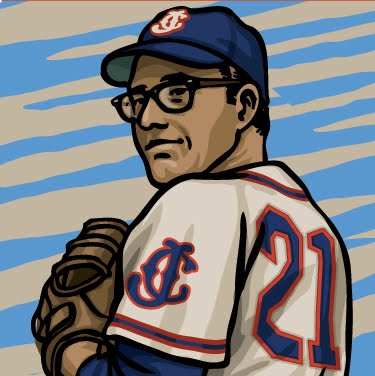
Today's post is a re-working of one of my oldest ones on the site. While I liked the original drawing, times change and my style has evolved a bit so when I wanted to include Jackie in my new edition of 21, I decided it was time to give him an update. Since Robinson's first appearance in 1946 was such a momentous occasion, and being from New Jersey, I wanted to show a bit of the old ballpark in Jersey City where the game took place. That's Roosevelt Stadium's distinctive scoreboard in the background. I liked this drawing so much I made it a full-page illustration in 21. I tried to depict Robinson as being full of confidence, ready to take the field for the first time, the weight of a whole race upon his able shoulders. It was an important day and I wanted to make this an important drawing.

67 years ago today, Jackie Robinson sat in the visitor's locker room of Jersey City's Roosevelt Stadium. Suiting up with his Montréal Royals teammates, Robinson was about to do what no black man had done since 1899 - play in an organized baseball game. Johnny Wright, another black ballplayer was on the roster that day, too, but Wright was a pitcher and was not going to play. Once the bands stopped and Mayor Hague threw out the first ball, Robinson was on his own. Opening Day in Jersey City was a big deal back then, a city-wide holiday. The Hague political machine that ran the city since 1917 expected every single municipal employee to purchase a ticket in order to give Jersey City the largest opening day crowd every year. Although 25,000 fans streamed through the turnstiles that afternoon, twice than number was sold. Still, with 25,000, Jersey City easily led the International League in attendance that day, and they got to witness history being made.

From the story accompanying the illustration in 21:

When Jackie Robinson took the field at Jersey City’s Roosevelt Stadium on April 18, 1946 he became the first black ballplayer in organized baseball since 1899. Robinson’s fame as a college athlete, his university education, and experience as an army officer made him the perfect man for a very difficult job. Many Negro League ballplayers expressed disappointment that he was to be the first to integrate the game. His manager with Montréal silently questioned whether or not a black man was even human. Bob Feller, who pitched against Robinson in 1945, thought so little of his talent said “If he were a white man, I doubt if they would even consider him big league material, except perhaps as a bat boy.” Robinson faced it all with quiet dignity and strength. In that first game in Jersey City he went 4 for 5, including a three-run homer, scored 4 runs, drove in 3 and stole 2 bases. Overcoming immense racial pressure, Jackie won over his teammates and fans with his natural physical ability and intense drive to win. Sparked by his play, Montréal won the Little World Series of 1946 and the next year he was playing for Brooklyn. Through his sheer determination Jackie Robinson not only paved the way for the desegregation of the major leagues but also the modern civil rights movement. 

Don't forget the card I posted yesterday of Happy Chandler, the Commissioner of Baseball who backed up Branch Rickey when he wanted to bring Jackie Robinson to the Dodgers.

Monday, November 26, 2012

137. Len Koenecke: Trains, Planes and Fire Extinguishers


On the advice of a few colleagues, I've been actively searching around for someone to represent my baseball illustrations. After many years in my line of work I've built up an impressive body of work, but through it all I know one thing - I'm a terrible business man - most artists are. Talking about my work has always been a tough thing for me to do, I've always been shy about tooting my own horn and as a result I've never been able to take advantage of opportunities a more savvy professional would have leaped at, and I'm finally come to the point where I'm seeking someone to handle that. That said, if anyone has any suggestions, I'd be most appreciative.

But back to baseball... I've been working on this week's story for quite some time. The illustration was completed 6 months ago and it's one of my favorites so far. What artist could turn away from that striking dark blue Indianapolis Indians flannel uniform with the white socks? The subject of the story has a chiseled granite mug that no illustrator would pass up the opportunity to render. But it's the story that makes this week's chapter worth while. Len Koenecke was always fascinating to me - he's a footnote, a trivial oddity you come across in quite a few baseball anthologies  and I've been looking forward to researching it from the perspective of contemporary accounts. My Grandfather, who was a die-hard Brooklyn Dodger fan at the time Koenecke was roaming center field at Ebbets Field, would talk about him every so often and I suppose it's through him that I heard of him first. Over the past months I've amassed a nice-sized binder of clippings and accounts and finally gotten 'round to putting the whole thing together this Thanksgiving weekend...

It seemed like some crazed pulp magazine story but it was really happening.

The lone passenger picked himself up off the floor and drew his broad 6' frame up as tall as the cramped airplane cabin would allow, which wasn't much. The cabin of the single-engine Stinson SM-1 Detroiter wasn't much bigger than a modern Chevy Suburban. Surprised that the man still had it in him to get up, the exasperated co-pilot tore a portable fire extinguisher from the cabin wall, determined to defend the cockpit from this maniac who was equally determined to crash the plane. Behind him, the pilot struggled to keep the Stinson SM-1 airplane steady in the early morning skies over Toronto. The fight had pitched the plane violently and the pilot had lost all navigational bearings just trying to keep the plane level. All three men were yelling incoherently but with the noise from the engine nothing could be heard, just the twisted faces of two men desperately fighting for their lives and a third trying his best to end it for them all. 

The passenger pulled his head down into his broad shoulders and lunged forward. Drawing the metal fire extinguisher across his body the co-pilot hit the charging man as hard as he could. With a noiseless scream he easily deflected the heavy metal canister which spun through the air and hit the pilot in the shoulder. Defenseless, the co-pilot was no match for the crazed passenger who now hammered on his body with ham-sized fists until he slumped to the cabin floor.

Now nothing stood between him and the pilot. 

Seeing his friend and co-pilot rendered useless, the pilot, with one hand on the controls, reached down at his feet and grabbed hold of the fire extinguisher. While the co-pilot was a slightly-built man, the pilot was a former star athlete and tonight he would need all his strength to save his life. In the dim cockpit lighting he could see the shadow of the passenger quickly looming behind his seat. Blindly he swung the extinguisher behind him and hit something - it was the co-pilot's head. The pilot swung the extinguisher again and this time hit the looming passenger in the side of the face. With the big man momentarily stunned, the pilot drew back and swung, again hitting the passenger in the face. Blood splashed in all directions and the pilot swung again, another head shot, and then another. And another. The man took a step back and crumpled into the back seat in a pool of rapidly spreading blood. As the man slumped forward, he brought the heavy canister down once more onto the top of his head before the blood made the extinguisher slip from his grasp and roll away into the dark recesses of the cabin. 

This time he wasn't getting up. The lone passenger, Len Koenecke, outfielder of the Brooklyn Dodgers, was definitely dead.

Len Koenecke's career had been about as rocky and turbulent as his last airplane ride. He was from a Wisconsin railroad family, hard-working men who made the giant steam engines run. Following in his Pop Herman's footsteps, young Len took a job as a fireman, shoveling coal into the hungry fires that propelled the Chicago & North Western locomotives across the midwest. The work hardened the boy's 6' bony frame and he developed hulking shoulders and powerful arms. More importantly though, young Koenecke was assigned the Escanaba to Ispheming run where he met brakeman Murray Boyle. 

Before Murray Boyle was a brakeman he was a minor league ballplayer, but now managed the Escanaba town team. One week Boyle knew Escanaba needed a catcher for that weekend's game and he asked the athletically-built Koenecke if he'd care to play. Though he never caught before he did a good enough job that he kept playing and soon jumped to another semi-pro team where he was spotted by a fella who told a friend who knew the manager of the Class B Springfield Senators of the Three I League. Koenecke took a leave of absence from the railroad and headed south to Illinois. Unfortunately his skills behind the plate were poor for a class B team and he was dropped in May without ever playing a game. He slipped over to Moline which was a class D level and when the Plowboy's regular outfielder got injured, Koenecke took his place. In 117 games he his 20 homers and batted a nice .343. In the fall he returned to the Chicago & Northwestern where he shoveled coal throughout the off season. 

When spring came, Koenecke rejoined the Moline Plowboys. From the hard railroad work he was a physical specimen to behold, but found it took weeks to finally unlimber his massive back muscles and swing a bat comfortably. He increased his average to .389 for 1928 and was sold to the Class B Quincy Indians at the end of the season. Quincy was in turn owned by the  Indianapolis Indians and the big club had Koenecke join them for the remainder of the American Association season. Indianapolis was Class AA, the highest rung of the minor leagues. Getting into 17 games Koenecke  hit .394 and clocked 4 homers. In October he went back to Wisconsin and rejoined the railroad.

1929 was much the same as 1928 with the long spring training spent getting his body back to baseball form. He was sent down to Quincy in the first part of the season and when his swing came back he moved up to Indianapolis. The books show he hit .323 for the year. Again, winter was spent with the railroad where his leave of absences was starting to rub the other workers the wrong way. Koenecke's Pop Herman was an engineer on the line and no doubt his position and seniority had everything to do with his son's excessive leaves each summer. Fact of the matter was that each time Koenecke returned he pushed out another well-trained worker. Baseball just didn't pay enough for Koenecke to take the winter off nor was he sure his career would go anywhere. The constant back and forth between the mid and high minors left him uncertain of his future so he needed to keep his railroad job as long as he could. In February he married Gladys Stoltenberg which made his position even more precarious. He needed to keep both feet in, it was just the smart way to play it.

That spring he again wound up in the lower Class B level and stayed there except for 67 games with Indy where he his a disappointing .250. The long time it took each spring to work back into baseball shape was taking its toll on him and when he returned to the railroad in the fall, he was confronted with a decision: work or play. No more leaves of absence. Koenecke chose baseball.

In the spring he came barreling into training camp and made the Indianapolis roster to stay. Throughout the season he prowled the outfield like a hungry leopard and hit everything in sight. He punished the American Association pitchers at a .353 clip, second best on the team. He led Indianapolis in hits (224), triples (19) and home runs (24). In one great leap Koenecke went from human pinball machine to top-rung minor league star. And important people were watching.

John McGraw, long-time manager of the mighty New York Giants, was looking around for a new outfielder. The Cardinals and Cubs had usurped the Giants as the best teams in the National League and the hated Yankees were now THE New York team to root for. McGraw was determined to find a ballplayer of immense quality to plug the gaps of his sinking ship, win pennants and fill the stands. Although he was in ill-health, McGraw boarded a train west and personally scouted the Indianapolis Indians' phenom from the stands. Liking what he saw, the Giants manager bought Koenecke for an unbelievable $70,000.

When he boarded the train to Los Angeles for spring training, Koenecke left behind a trail of Indianapolis baseball records that still stand: 5th highest season batting average (.353); 3rd in hits (224); 1st in runs scored (141); 4th in triples (19) and 3rd in RBI (131).

In sunny L.A., Koenecke was the talk of the camp. His high price tag made him a sure topic for the newspaper boys and McGraw fed them lines proclaiming that his new outfielder was sure to "be a bright star in the National League". On the field he performed well, seeming to live up to the hype that swirled around him.When the Giants suited up for Opening Day, Len Koenecke was right along with them wearing number 31.

1932 was a dismal year for New York. No matter what McGraw tried his boys slipped further and further down the standings. The Old Man was not well and perhaps this rubbed off on the team. The Giants were beginning a transition from the old-time baseball of their manager and the modern-day tactics of the heir-apparent, outfielder Bill Terry. The new $70,000 wonder-boy had a hard time breaking into the veteran lineup. The outfield consisted of future Hall of Famers Mel Ott and Freddie Lindstrom and 2 time National League MVP and 5 time All-Star Jo-Jo Moore. None-the-less McGraw played Koenecke off and on but after 40 games he was barely batting .250. Most insulting to McGraw was his 5 errors in the outfield including an unforgivable misplay on a ball that gave Cardinals pitcher Dizzy Dean an inside-the-ballpark home run.

The New York Giants at this time was a close-knit fraternity and difficult for any outside ballplayer to break in. McGraw was a hard man to play for and many players failed to make good solely because of his criticism and acidic personality. Besides being an over-aged rookie, Koenecke reportedly was quiet and had a fragile ego, a trait that didn't bode well for a new ballplayer, especially one who had the press clippings and expectations that he came with. To make an already bad situation worse, somehow he'd gotten under the skin of Bill Terry, McGraw's right-hand man. When the Old Man retired after the first 40 games of the season, any protection he was getting from McGraw evaporated. New skipper Bill Terry had enough on his plate than worry about bringing along a 28 year-old rookie he had personal problems with. Despite what his mentor might have thought of Koenecke's talent, Terry sent the $70,000 Man across the Hudson River to the minor league Jersey City Skeeters.

While it must have been frustrating for Koenecke to again be swung back and forth between teams, he performed well with the Skeeters. The Giants might not have a place or time for him but his .355 with 18 homers got the Brooklyn Dodgers interested and they swapped Lefty O'Doul and Watty Clark for him and infielder Sam Leslie. Brooklyn let Koenecke spend another season in the minors and he batted .334 with the Buffalo Bisons for the 1934 season.

When Spring rolled around again the 30 year-old Koenecke was now an old man in baseball years. He had a reoccurring foot injury that made him sit out games but he was still strong and eager to make good. The Brooklyn team that was training in Orlando was a miserable bunch. Besides youngster Van Mungo and the elderly Ray Benge the pitching staff was a collection of never-were's and the majority of the bench were has-beens. It was Casey Stengel's first season as a Major League manager and he worked hard to make something of the rubble calling themselves Dodgers. 

In what is one of the only cases of that I've heard of Casey Stengel going out of his way to tutor a ballplayer, Brooklyn's new manager drilled Koenecke all spring. Newspapers gave Stengel credit for giving the former bonus baby back the confidence he left on the Giants locker room floor back in 1932. Where Koenecke was a good outfielder before, Stengel put Koenecke through the paces until he caught anything that came near him. When the Dodgers headed north to start the 1934 season, Koenecke was raring to go.

Go he did. Batting clean-up, the re-born Koenecke batted .320 against National League pitching, second best on the team. While not a speed-demon, he was smart and sure-footed on the base paths but it was in the field where he excelled. In 123 games Koenecke made but 2 errors - a .994 fielding percentage and still a National League record. While the Dodgers finished in 6th place, 23 1/2 games behind the Cardinals, Brooklyn finally had something to look forward to in the coming season. With Len Koenecke, the Dodgers had a bonafide star.

The off-season was spent making the usual rounds a newly minted star did back then - steak and potatoes testimonial dinners and drinks on the house from coast-to-coast. While newspapers back east speculated on the glories Koenecke was going to lead the Dodgers to in 1935, Koenecke bulked up back home in Wisconsin. The formerly reserved and emotionally tender ballplayer rolled into Brooklyn's training camp in Orlando with a swelled head and body to match. 

If you look at the record book for 1935 and isolated all other years, on the surface Leonard George Koenecke didn't have too bad of a season: .283 average in 100 games ain't nothing to sneeze at. Under the hood however, the numbers tell a different story: where he only struck out 38 times in 536 at bats the previous year he now swished 45 times in only 374 chances. His power seemed to disappear over the winter and his already bad feet now all but hobbled him through out the summer. His record-making fielding dissipated as well and he was charged with 8 errors. Stengel watched with horror as his protege of the previous year crumbled before his eyes. The team as a whole was falling apart, too. Where the year before the rookie skipper was the darling of the sports page, he soon discovered his corny jokes and witticisms only make you look stupid when your team is stinking up the National League.

As the summer churned into the humid days of September, Stengel was at the end of his rope. Losing his cool he lashed out at his team for making him look bad. Koenecke in particular drew his ire due to his disappointing record. As September began the Brooklyn skipper let the press know that there was changes a-comin' - and he was cleaning house. Word leaked that Stengel was trying pawn Koenecke off on any team that would take him - minor league teams. All these Stengel-fueled rumors swirled around the team as they brought their losing show on the road. In Boston last year's hero went 5 for 8 then 2 for 18 against Pittsburgh and Cincinnati. When the Dodgers turned up in Chicago, Koenecke sat out the first game then went 1 for 4 before being benched for the last game at Wrigley Field. In the 9th inning Stengel tapped Koenecke to pinch hit. He grounded out. Didn't matter anyway. He could have hit a grand slam and it wouldn't have mattered. When the team arrived in St. Louis the following day, Stengel had arranged for Koenecke and two other slackers, Bob Barr and Les Munns, to go to Buffalo. Len Koenecke was sent back to the minor leagues again.

You have to try get in the head of Len Koenecke to fully understand what led up to the event described in the beginning of this story. Baseball lore has twisted the story of Len Koenecke's demise so many ways it is hard to tell what really happened in his final hours, but let's try. Here he was, 31 years-old, been sent up and down the rungs of organized baseball so many times he had to look in a mirror and read his jersey to see what ball club he was with on any given day. He was a married man with a 5 year-old girl waiting for him in their apartment in Brooklyn. The Great Depression was in full swing and the once lucrative security of his railroad job was long gone. His feet were bad and he'd been thrown off two major league teams in disgrace, both times after garnering high praise and expectations. With a fragile ego that was probably coming apart at the seams, Koenecke packed his bags once again. Before he picked up his plane ticket back to New York he paused and wrote a postcard to his daughter Anne: "Hurrah, I'll be with you tomorrow."

The Brooklyn Dodgers' use of airplane travel was rare for 1935, especially since the three men the reservations were made for were being demoted. Whatever the front office's motives behind the swanky travel plans, Munns, Barr and Koenecke took a cab to St. Louis' airport and boarded an American Airlines flight to Chicago. From there they would change planes in Detroit before arriving in Newark, New Jersey the next day. It was a long journey but much shorter than taking the train. Somewhere on the way to the airport the ballplayers picked up a bottle or two of whiskey. What better way to drown your sorrows and cover up any anxieties of flying than with booze?

The first leg of the trip went off fine. They were late to Chicago but made the flight to Detroit. Witnesses reported seeing Koenecke with a bottle of whiskey in his hand. Once on board the three men were rapidly becoming intoxicated. Koenecke, who I've read wasn't known as a big drinker, was by far the worse of the former Dodgers that day. Juiced-up and combative, the large-framed Koenecke started a fight with a fellow passenger. When a stewardess tried to calm things down Koenecke knocked her down as well. The former railroad fireman's hulking size and strength made him extremely dangerous in the confined space of the primitive aircraft and it took a handful of men to wrestle Koenecke to the ground and tie him up. The plane's co-pilot came out of the cockpit in order to personally sit on the ballplayer until they landed in Detroit.

He was carried off the plane passed out and snoring by Munns and Barr who unceremoniously deposited their former teammate into a waiting room chair. A representative from American Airlines tore up his connecting ticket and refunded the Dodgers' money - there was no way they were going to let him on another flight. Munns and Barr left Koenecke snoozing on a bench and boarded their own flight back to the minor leagues.

Sometime after midnight Koenecke snapped awake. Realizing he was marooned in Detroit he frantically looked around the deserted airport for a way home to his wife and daughter. Suddenly the door opened and a leather jacketed man walked in off the runway. Quickly assuming correctly he was a pilot, Koenecke offered to charter a plane to New York and home. The pilot, William Mulqueeney, owned a single engine Stinson Detroiter. The small passenger plane could seat six including the pilot and despite the late hour and the disheveled state of the man before him, he decided to accept. The catch was he would go only as far as Buffalo. Koenecke thought it over and decided he could catch the morning train to New York City and be home in Brooklyn for lunch.

Mulqueeney, either thinking he may have some trouble with the intoxicated passenger or just wanted some company on the flight back, asked his friend Irwin Davis to join him. Though Davis was later referred to as a co-pilot, he was in fact just Mulqueeney's pal. He was also known as "The Human Bat" for his dare-devil parachute stunt where he would jump out of a plane in a black bat-wing parachute. In 1935 people ate that stuff up and he was fairly well-known in the Midwest.

Davis later described Koenecke as being under "a great stress" as the three men boarded the Stinson. Mulqueeney squeezed in behind the controls on the left side of the cockpit and Koenecke sat next to him in the co-pilot's chair. The Human Bat stretched out by himself on the plush bench seat behind them. They were cleared to taxi and took off into the night sky.

Both men said later that Koenecke was quiet for the first few minutes of flight. Then he started nudging the pilot. No one knows what the hell he was thinking. Maybe he was just being funny. Lord knows liquor makes many a man a bad comedian. But this just wasn't funny. In 1935 there was no auto-pilot, flying a plane back then was a full time operation. In the confines of a primitive airliner like the Stinson, any false move could be a pilot's last. Mulqueeney told him to quit it. He did. Then he started up again. He poked Mulqueeney. Then he nudged him with his shoulders - those huge rock-solid shoulders. The plane swayed. Mulqueeney told him to knock it off. Koenecke made a grab for the controls and at that point the pilot had enough of the sole passenger. Reluctantly Mulqueeney and Davis coaxed Koenecke into the back seat. But it was far from over.

Koenecke lost his mind. He tried again to shove the pilot. Davis did his best to restrain the hulking ballplayer but he was just too small. He knocked him back a few times, every time thinking he would just pass out in his drunken stupor, but then it would start over. It was getting serious now - both Davis and Mulqueeney said later they were convinced Koenecke was trying to crash the plane. Davis tried to fight Koenecke back but the big man pounded on him, even bit his shoulder, then pounded him some more.

That's when the fire extinguisher came into play.

With the passenger crumpled in a bloody mess on the floor of the cabin, Mulqueeney brought the Stinson in for a forced landing on the first flat clear spot he could find. Both he and Davis were dripping with blood and on top of the dead man lying in the cabin, when the two men opened the door and spilled out onto the grassy earth, what they thought were wild animals charged out of the darkness at them. Fortunately they were just the guard dogs of the caretaker of the country club they had landed on. They were in Toronto, Canada. In their airborne do-or-die fight they had over shot their destination of Buffalo by miles.

The next morning all the newspapers carried the story of Koenecke's wild flight. Mulqueeney and Davis were swiftly arrested and charged with murder. Photographers snapped pictures of the two men with torn, bloody clothes and shocked expressions. A reporter caught Stengel in St. Louis before that day's game against the Cardinals and he was uncharacteristically shaken: "I can't believe it - I won't believe it" he said. It was the manager's demotion of Konecke that put him on that plane. His teammates were devastated. The Dodgers organization circled their wagons and said nothing to the press except condolences. Team secretary John Gorman later released a statement to eager newspapermen that Koenecke "apparently was not depressed when he left the team."

Lawyers were hired and the rumors began. Some carried the line the big outfielder was trying to kill himself in one last blaze of glory. Others said it was some kind of murder, motive unknown. Another claimed Koenecke made unwanted sexual advances towards the two men - put into play by the two survivor's lawyer who was probably throwing anything out there to get his clients off the hook fast. 

Researching the story I can't honestly say what his motivations were. Some modern accounts I've read play up that Koenecke was a brawler who got violent when he drank, yet I can't find any contemporary accounts supporting this and I have no clue where those writers got it from. Maybe it's just an obvious guess - many ballplayers back then were tough boozers, God knows I've written about quite a few on this site myself. But the things I've read seem to indicate Koenecke wasn't a bad-tempered tough guy and he didn't appear to drink more than anyone else. However, it is known he was tanked up on that final day of his life. Hell, who wouldn't hit the bottle after being canned from their job and faced with an uncertain future? But intentionally try to kill himself and two innocent people, too? It just doesn't seem right and I can't believe it was anything more sinister than a man mentally at the end of his rope filled with so much whiskey he didn't fully comprehend what he was doing. Koenecke's widow Gladys refused to believe he would try to commit suicide and the upbeat postcard to his daughter seemed to back it up. The Toronto authorities fully investigated the whole incident and held Mulqueeney and Davis in custody until a jury sifted through the evidence. When the Canadian court ruled it self-defense the story quickly went away.

All that remained was a grieving widow, a fatherless daughter and one heck of a story that became a classic of baseball lore.

 SOURCES
  • The Sporting  News (December 20, 1934)
  • The Pittsburgh Press (May 7, 1935)
  • The Telepraph Herald (August 10, 1934)
  • The Milwaukee Journal (March 21, 1934)
  • Ludington Daily News (August 8, 1938)
  • New York Daily News (April 7, 2003)
  • Toronto Sun (June 1, 2009)
  • The New York Times (September 17, 1935)