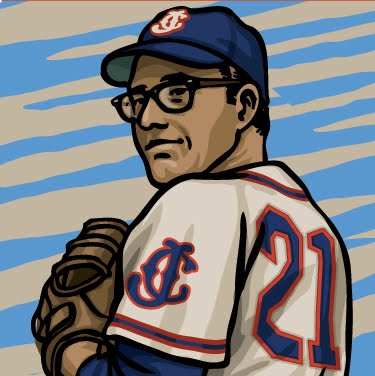
This week we'll continue to go backwards through baseball history and examine the single-season home run leaders of the pre-steroid era. Today we have Tony LaZerre. Never heard of him? How about Tony Lazzeri - you know him, right? Victim of Pete Alexander's big strikeout in the '26 World Series, member of the Yankees' Murderer's Row and first superstar ballplayer of Italian heritage - well back before he was with the Yanks he made baseball history under a different name...
Saturday, May 23. Salt Lake City, Utah
Cesare Rinetti was in the stands enjoying the unofficial game of his adapted homeland: baseball. The afternoon was perfect, right around 65, sunny and mild. The hometown Salt Lake City Bees were hosting the Seattle Indians. In a true rarity at Bonneville Park, usually a hitter's paradise, the game began as a pitcher's duel. Seattle's John Miljus was holding the Bees to just a pair of singles while the home team's starter Elmer Ponder had scattered 5 harmless hits. Then, in the bottom of the fifth, the Bees began to sting. A single sandwiched between a pair of Seattle errors started a rally for Salt Lake. In the stands, Rinetti and the rest of the crowd began to stir. Just like that, three runs scored before Miljus managed to get two outs. That brought the home crowd roaring to their feet. Now, with runners at the corners, Salt Lake's rookie hitting sensation Tony LaZerre stepped to the plate. Seven weeks into the 1925 season, the shy shortstop from San Francisco was simply murdering the ball: a .358 average and 9 for 18 in his last at bats.
Caught up in the excitement of the moment, Cesare Rinetti couldn't contain his enthusiasm. For Rinetti, this wasn't just his hometown team taking the lead, but the man who stood at the plate was his paisan - a fellow Italian-American - his "Tone." In the two months since Tony came to town, Rinetti had made it his mission to befriend and take care of his fellow Italian and his wife Maye. As the co-propriator of the Rotisserie Inn, Rinetti had been feeding the young slugger all the Italian fare he could eat. He couldn't swear by it, but inside Rinetti knew his friendship and good food played a part in the success Tony was experiencing so far in the season. So it wasn't just passion for his home team that got Rinetti all worked up, it was the pride in witnessing a fellow Italian-American making good playing America's game.
Eying the runners at the corners, Rinetti searched through his limited data bank of English phrases, searching for the right one to yell at that moment - something that would inspire "Tone," as he called him, to get a hit and advance those runners. When his mental search came up empty, Rinetti improvised. He cupped his hands to his mouth, and in his accented English he hollered out: "Push 'em up, Tone!" The fans nearby were puzzled by the expression, but as Rinetti yelled it a second, then third time, stressing the the first word, they picked up the curious chant.
"Poosh 'em up, Tone!" "Poosh 'em up, Tone!" "Poosh 'em up, Tone!"
Then, as if on cue, Tony sent a Miljus fastball over the left field wall. Three runs scored - Tone had indeed pushed 'em up.
Anthony Michael Lazzeri was the first born son of Augustine and Julia Lazzeri. His parents had immigrated from Italy and settled in the Cow Hollow section of San Francisco. Though its name evokes peaceful pastures, Cow Hollow was a rough part of Frisco, and the young Tony quickly knew how to used his fist to defend himself. Baseball also piqued his interests, and he began playing sandlot
ball around the neighborhood.
Besides the disadvantages that went with being the son of immigrants, Tony was born with epilepsy. There isn't much written about how this affected his early life, but it must have been a hard thing to live with back in 1910's San Francisco. Virtually nothing was known about epilepsy back then, and people afflicted with it were often shunned and discriminated against socially, especially if a seizure was witnessed. The frequency with which he experienced his seizures is not recorded, but the fact that he was able to lead the life of a normal teenager says that perhaps the episodes were not very frequent.
Preferring boxing and baseball to books, Tony was expelled from school at the age of 15. He joined his pop as a boilermaker's assistant which paid dividends for him very quickly. Besides getting a steady union paycheck, the job also gave the teen an excuse to play baseball for the company team and a semi-pro team on Sundays. It also led to his being introduced to a teammate's sister, Maye Janes. The two began a relationship that would endure until the end of Tony's life.
Word of Tony's prowess spread beyond the industrial leagues and on to Duffy Lewis. The former Red Sox star was now the manager of the Salt Lake City Bees of the Pacific Coast League, one step below the majors. Lewis invited the 18 year old to the Bees spring training camp in Modesto. Lewis liked what he saw and took the kid back to Salt Lake when the season opened. From the start it was obvious that the rookie was out of his league. He hit a paltry .92 in 45 games and committed 11 errors. Yet Duffy Lewis knew a diamond in the rough when he saw one. He arranged for the teenager to be sent to a lower minor league for seasoning.
Following spring training in 1923, the Bees sent Tony to the Peoria Tractors of the Illinois-Indiana-Iowa League. The Three-I League was a few rungs below the PCL and a good place for him to play everyday and get used to professional ball. Despite being sent down, the Salt Lake Tribune remarked that he was a "young player with extraordinary talent. He is a first-class fielder and has the best arm seen in the Coast League since Salt Lake entered the circuit." Pretty high praise for an 19 year-old being demoted. Tony didn't show up in Peoria alone - he married his long time girlfriend Maye and the couple traveled east together.
While his .248 average didn't exactly shatter any Three-I League records at Peoria, he did bang out 14 home runs and his fielding improved dramatically. When the season ended, Salt Lake called Tony back and he quickly showed the big club how much he'd matured in Peoria. On September 27 he went 4 for 5 with a double against San Francisco, then on October 5 he went a perfect 4 for 4 with a double against Los Angeles. At the end of the season he'd hit .354 in 39 games. Still, the Salt Lake management felt he needed some more experience and assigned him to the Lincoln Links for 1924.
Right from the start it was apparent he was far to talented for the Western League - in 84 games he belted 28 home runs and batted .328. Besides shortstop, he filled in at any spot in the infield. In August the Bees recalled him and he added 16 more round trippers to bring his season total to 44 home runs. Salt Lake's management finally felt the kid was ready, and sold their 1924 starting shortstop, Pinky Pittenger, to the Cubs.
At the Bees spring training camp in Long Beach, California, Tony dazzled both the sportswriters and the Bees new manager Oscar Vitt. While one could say he was a bit raw on the inside and rough
around the edges, it was obvious the kid had the makings of a big
leaguer, and it wasn't just his hitting. In the field the quiet newcomer dazzled the veterans with what
was labeled as "the best arm in baseball," but it was his bat that
really did the talking for him.
Now let's take a time out to put what Tony Lazzeri did in 1925 into historical (and statistical) perspective.
The Pacific Coast League in which the Bees played in was one of America's premier minor leagues. Rated a "Class AA" circuit, this archaic designation is the equivalent of today's AAA minor league. In its heyday, the PCL played a long 200 game season, thereby providing the canvas in which some crazy-looking season totals were accomplished. When looked at today without the benefit of context, it's easy to think that the pitchers in the PCL were just overpowering (multiple 25+ game winners were common) and the hitters were automatic hit machines. Up until the 1940's, the PCL was fiercely independent, meaning they could sell (or not sell) their players to whatever team they chose. In Lazzeri's time, the Chicago Cubs had a "working agreement" with Salt Lake, but all that meant was they had first dibs on a Bees player; they still had to pay Salt Lake's price. So, with stat totals artificially inflated due to 40 more games in their schedule, it was inevitable that expectations placed on PCL players to deliver in the majors were unreasonably high.
Another factor that must be considered when talking about Lazzeri's 1925 season is the ballpark he played his home games in. Since the Bees came to town in 1915, their home grounds was Bonneville Park. Salt Lake City is over 4,300 feet above sea level, and the rarefied air put an extra zing into every ball hit at Bonneville. Add to that the park's cozy dimensions of 308' to left, 408' to center and 320' to right and you had a hitter's paradise. In fact, in the 11 years the Bees called Salt Lake City home, the team led the PCL in home runs nine times and in batting eight. With the PCL's long 200 game seasons and Salt Lake's long ball-friendly atmosphere, Bees batters produced some eye-popping statistics. Case-in-point: Two years earlier, in 1923, Salt Lake's Paul Strand, a former pitcher with the Boston Braves turned outfielder, had one of the most impressive seasons in the history of the PCL. Strand won the Triple Crown with a .394 average, 43 home runs (a new PCL record) and 187 RBI. On top of that, he set the organized baseball record for most hits in a season with 325. Now keep Strand in mind because we'll come back to him a little later.
When Tony made the Bees lineup for good in 1925, he also acquired a new surname: "LaZerre" (or alternately "Lazerre"). This is a little odd, because when he was in town for
short stints in 1922, 1923 and 1924, the local papers spelled his name
correctly, but when he was back to stay 1925, the scribes modified it to the
less Italian, but no less exotic "LaZerre." Whatever the reason
- whether he was too shy to correct it, or that he just didn't care -
for the remainder of his minor league career he would be "Tony LaZerre."
 Tony started the season slow, but soon went full throttle. Vitt positioned the kid in the number 5 spot. Batting behind the big bats of Johnny Frederick, Oscar Vitt, John Kerr and Lefty O'Doul gave Tony space to relax - with at least one of those guys usually on base when he came to bat, pitchers didn't have to option to pitch around him. He hit his first home run on April 16 against Portland, and added a second one before the game ended in a 18-9 win. He victimized Portland for another one the next afternoon as well. By late May he was batting in the .370's.
It was at this point that he received his peculiar nickname "Poosh 'em Up Tony." A sportswriter for the Salt Lake City Tribune named John C. Derks happened to take notice of the crowd's chant and crafted it into a memorable headline for the next morning's paper. Playing on the stereotypical broken English and speech cadence of Italian immigrants, Derk's headline read:
"Poosh Um Up, Tone,' Yella Da Fan, an' Tone She Push"
You couldn't get away with mocking an immigrant's speech today, but back in 1925 people had thicker skin and were amused by that sort of stuff. Plus, it was down right catchy. Derks' nickname stuck and for the rest of his career he was "Poosh 'em Up Tony" Lazzeri.
Starting on June 10, Tony began hitting home runs at a pace that seemed down-right Ruthian. In the June 28 game against San Francisco, Tony hit three home runs, one to each field to make his point. By July he was past the 20 mark, but inevitably there had to be a slump. For the better part of July, Tony lagged at the plate. One explanation might be stage fright. The slugging of Tony, Lefty O'Doul and Johnny Frederick brought forth a swarm of scouts that attended every Bees game, studying their every move and dispatching their reports back to the big club. Fortunately, Tony broke out of his slump in style during the July 29 game against Sacramento. He not only hit for the cycle (a single, double, triple and home run), but twice cleared the bases during the game, once with a double and the second time with a grand slam. He was credited with driving in nine runs in the Bees 23-11 win.
The Chicago Cubs had that working agreement with Salt Lake, and their scouts had been keeping tabs on the rookie's progress all season. But while the reports were overwhelmingly favorable regarding his play on the field, his history of "fits" made them pass. The Cincinnati Reds and Washington Senators both showed interest but ultimately shied away for the same reason as the Cubs. Looking back, it's hard to understand why big league teams weren't lining up to take a chance on the PCL home run leader. That the Senators passed could be excused - they were on the verge of winning their second consecutive pennant and had no reason to take an expensive risk. Cincinnati and Chicago, however, are a different story. Cincinnati was stuck in second place and needed that extra something that would send them over the top. The Cubbies on the other hand were mired in the cellar and should have grasped at anything that could have meant a better showing in the standings. But back in '25, epilepsy was a frightening and mysterious affliction. A bum ankle or broken arm could be easily treated and monitored, but a malady that came on without warning was too much for the folks in 1925 to understand.
There was also one other factor that made teams leery of spending big bucks on the Salt Lake sensation: Paul Strand. Remember him? He was the Bees' 1923 Triple Crown winner and baseball's all-time single season hit leader. After his record setting year, Connie Mack opened up his miserly change purse and shelled out $35,000 and five good players (including Pinky Pittenger who Tony replaces at shortstop) for Strand. The PCL phenom started the '24 season with the A's, but was unceremoniously dumped off on Toledo after 47 games, zero home runs and a .228 average. Strand's crash and burn and Mack's financial bath was still fresh in the minds of the other big league execs as Tony LaZerre was burning up the PCL a year later.
In early August, only one team was willing to take a chance on Tony, and it was the one thought least likely to need another home run hitter: the New York Yankees. The Yanks had sent several scouts west to take a look at the kid, and while they dutifully reported back about his "fits", the stories of his hitting power and strong throwing arm excited general manager Ed Barrow. Beginning in early July, the New Yorkers had been trying to buy him, but were continuously rebuffed by Bees owner Frank Lane. Scout Ed Holly put an offer of fifty grand on the table but Lane refused. It wasn't that he didn't need the cash - in fact Lane's Salt Lake franchise was in deep financial trouble in the summer of 1925. Even with his exciting lineup of powerhouse sluggers, the Bees were only pulling in an average of 900 fans per game. The other PCL teams, who were all located along the west coast, disliked traveling so far inland to Salt Lake, especially when their part of the gate following a series with the Bees didn't cover their travel costs. The only thing that kept less fans going to Bonneville Stadium was a marquee attraction like their slugging shortstop. If he was to leave, how many fans would leave, too? Lane's refusal to sell Tony to the Yankees in July was him trying to stave off the inevitable. The Bees owner was now riding the fine line between keeping his franchise above water and open for business and cashing in his most valuable asset and risk closing shop.
Lane delayed parting with Tony throughout July, trying to wring any financial advantage the publicity of his sparkling season was reaping at the gates. But he couldn't hold out forever - in the beginning of August Lane was ready to sell. After extensive consultation with multiple medical experts eased Barrow's apprehensiveness over the ballplayer's "fits," the Yankees handed over a reported $50,000 cash and five players for Tony LaZerre.
In the meantime, since he wasn't due to report to New York until following spring, there was still the remainder of the 1925 PCL season to play.
At the time of his purchase on August 2, Tony had past the 35 home run mark. This was just eight shy of the PCL record Paul Strand had set in 1923, and there was still more than 50 games to go. It began to look like Tony could not only beat Strand but that he had a good shot at the all-time minor league record of 55 set by Clarence "Big Boy" Kraft set just a year before.
Tony not only beat Strand's record on September 13, but he annihilated it, bashing three home runs in a doubleheader against the Angels. A week later Tony had 50, but there he stalled. Unlike his July-long stage fright, according the newspapers PCL pitchers weren't giving the Salt Lake slugger anything to work with. It took him until October 2 to break Kraft's record, and then he stalled again when pitchers refused to challenge him. Tony's frustration came to the surface when the normally quiet shortstop disputed a call at second base and was ejected from the second game of a doubleheader. Finally, on October 11 came home runs 57 and 58, putting him one away from matching Babe Ruth's record of 59 set back in 1921.
Of course back in 1925 you had the haters who tried to pooh-pooh what was going on in Salt Lake. One of the first things mentioned was the PCL's extended season, more than forty more games than the major leagues and most minor leagues. Noted too, was that Tony was what the papers called a "Salt Lake Hitter," attributing his home run production with that rarefied air in Bonneville Park. It was a cold fact that 39 of his homers hit in 1925 were at home. Now that the PCL season coming to a close with Salt Lake's remaining games all on the road, Tony had to prove he wasn't just a "Salt Lake Hitter."
Saturday October 17 found the Bees in Sacramento for the final three games of the season. In the first game Tony tied Ruth with number 59. That left only a Sunday doubleheader in which to make history. To give him more chances at the plate, Oscar Vitt moved Tony up from the 5th spot to lead off. Sacramento conceded an edge to Salt Lake by positioning their outfielders as far away from left field as possible. Even with these favorable conditions he managed nothing more than a double in five tries in the first game. Then in the nightcap he came up empty in his first two tries. Finally in the seventh he got hold of one and lined a ball to deep left field. As the outfielders chased the ball to the wall, Tony circled the bases for an in the park home run. Though a bit tainted, he had set the new single season record for home runs.
That was all she wrote for Tony LaZerre. The following spring he had made the New York Yankees as Tony Lazerri and helped spark the Yanks to the first of six pennants they'd win with him in their lineup. Not only did he go on to a Hall of Fame career, but Lazzeri also was the first star ballplayer of Italian heritage, paving the way for guys like DiMaggio, Crosetti, Rizzuto and Berra.
As far as those dreaded "fits" went, it seems they had no bearing on his career. Ed Barrow later wrote that he was always concerned that something might occur, but they never did on the field. After he left the game, Tony returned to San Francisco where he and Maye raised a family and the old ballplayer ran a bar. On August 6, 1946, Maye returned from a trip out of town to find her husband collapsed inside their home, dead of a heart attack at age 42.
As with the rest of my stories, I relied heavily on contemporary newspaper stories. I also have to acknowledge Hal Schindler's 1993 article about Lazzeri's 1925 season. Unlike almost every other story about Lazzeri's nickname, Schindler actually dug deep and found the actual headline and story in the Salt Lake Tribune that used "Poosh Um Up, Tone" for the first time. That was some good research. Also, Richard Ian Kimball's "Bringing Fame to Zion" article in Nine, volume 14.2 offered some good background on what was going on in Salt Lake back in 1925. Since Lazzeri's big league career has been covered countless times, I concentrated solely on his Salt Lake City days. To find out the rest of Lazzeri's story I recommend Paul Voltano's Tony Lazzeri: A Baseball Biography and Fred Glueckstein's biography of him on the SABR website.
*The post's title, "Joosta Like Babe-A-Da Ruth," comes from a 1928 tin pan alley tune written by James Kendis. The title plays on the same Italian immigrant accent stereotype that Lazzeri's nickname derived from. I have no idea what "Joosta Like Babe-A-Da Ruth" sounded like, but I'm sure it was a helluva foot tapper.

When
I first started this blog back in 2010, I started
receiving many requests for players to be profiled and given The
Infinite Baseball Card Set "treatment." Out of all the emails, I began
to notice that it was not one particular player that was asked for the
most, but rather an ethnic group: Jewish ballplayers. Early on I had illustrated cards
and written stories on the site of Sandy Koufax and Moe Berg, but I began slowly researching different players who shared the Jewish faith,
trying to find characters who would fit in with the kind of stories I
like to write - players with interesting stories who may not be known to
the casual fan of baseball history. The modest research I did culminated in the Test Issue of "21: The Illustrated Journal of Outsider Baseball" which featured 12 profiles of Jewish ballplayers. This prototype became the model in which I based the current incarnation of "21".
I was never happy with that original product, and eventually I plan to do a more elaborate "21" dedicated to Jewish ballplayers. In the years since the original, I have been steadily adding to my Jewish ballplayers file, one the characters in there being Cy Malis.
Cy's single game for the 1934 Phillies earned him place in all the books on Jewish ballplayers, but it is the rest of his story that makes him so much more interesting. Plus, digging into Cy's career was for me a researchers delight, as I found that the extent of his pro career that can be found in record books and online is quite incomplete. Old box scores and creative searching enabled me to fill out Cy's minor league career quite a bit more than any other source that I've been able to find. And then, from an artistic point of view, the uniforms worn by one of Cy's semi-pro teams were so visually stunning that I couldn't wait to depict Cy in full color.
So, with that teaser, I'll get right into Cy's story...
Cy Malis was born in Philadelphia, the second son of Frank and Anna (called "Ray") Malis. Both Frank's parents were from Russia while Ray's father immigrated from Jerusalem and her mother from Russia. Frank worked an an inspector for the Philadelphia Rapid Transit Company and Ray kept house in the family's apartment on 10th Street. Ray and Frank were married around 1905 and their son Charles was born shortly afterward. The Malis' second son, Cyrus came along on February 26, 1907. Both boys played baseball, working their way up the sandlot ranks. Charles was an infielder while Cyrus - who was now going by "Cy" - was, appropriately enough, a pitcher. While Charles played for Central High, Cy starred for Brown Prep School, lettering in basketball and football as well as baseball. In his sophomore season with Brown, Cy posted a 15-4 record and struck out 22 in a game against Villanova Prep. It appears that Cy left school after his second year, joining the vibrant semi-pro baseball circuit around Philadelphia.
Like other large eastern cities, Philly boasted many top-rank semi-pro clubs. Youngsters began playing for their local neighborhood athletic clubs, then, if they were good enough, were either hired by a large company who sponsored a team or was invited to join one of the semi-pro traveling clubs who were just a step below the minor leagues.
Cy Malis' first stop was with the Waco Athletic Club. His brother Charles may have preceded him on the team, for both their names frequently appear in box scores at this time. Waco played other medium-level teams in Philadelphia and South Jersey. Then, in mid-August, Cy began pitching for the formidable Hebrews club.
The Hebrews, also known as the Sphas (South Philadelphia Hebrew Association), were one of the better semi-pro clubs in the Philly-Trenton area. The South Philadelphia Hebrew Association began sponsoring athletic teams around World War I, and by the early 1920's had become known not only for baseball, but for their basketball team as well. In fact, the basketball team actually turned pro, first joining the Eastern League in 1929, then the American Basketball League in 1933. When the NBA was formed after World War II, the Sphas best players splintered off to form the nucleus of the Philadelphia Warriors.
With the baseball Sphas, Cy not only had a first rate ball club backing him up, but he also had good press coverage with would help further his career. His competition was also of a higher class, playing against the various traveling teams that criss-crossed the country before World War II, such as Jim Thorpe's Indians and various Negro League clubs.
Cy's half season with the Sphas earned him an invitation to spring training with the minor league Wilkes-Barre Barons in 1925. The April 24 edition of the Scranton Republican said the Malis "has shown plenty of form in the preliminary workouts", but just two days later he was back in Philly pitching for the Waco A..A. and later the Sphas again. Still only a teenager, Cy had plenty of time to develop into professional material.
Malis' second chance at organized ball came along the following spring when he was signed by Petersburg Broncos of the Virginia League. In his professional debut on April 14, 1927, Malis was sent in to relieve Petersburg starter Lefty Fowlkes, pitching an inning and third, allowing a hit and two walks plus a balk. Richmond scored a run, but it was charged as an error since the outfielder dropped the ball. Soon both Cy and Lefty Fowlkes were shipped to the Northampton Red Sox of the Eastern Shore League. Malis started off the season well, winning five consecutive games, but overuse took a toll on his arm. When Cy asked management for some time off to rest his tired flinger, the Red Sox handed their ace pitcher his release. 1920's baseball was a cruel and impersonal sport, and back then a pitcher, especially a young one, was expected to pitch a complete game every time he took the mound. With minor league rosters consisting of only 15-18 players, clubs couldn't afford to carry too many pitchers, so the ones they had were used as often as possible. When Cy raised an issue about over use, it was only natural that the club would choose to jettison their ace instead of working with him, the reason probably being that if his arm is feeling fatigue now at this low level, how could he make it all the way to the majors? Minor league teams back then made their payroll by selling off their good players to higher level clubs - thus, a sore arm pitcher was of no monetary value to them. Sound front office reasoning in 1927. Fortunately for Cy, one other team in the league, the Cambridge Canners, were willing to take a chance with him. Working out of the bullpen, he finished out 1927 with a 5-6 record.
Despite a mediocre record, a team quite a bit higher up the food chain than the Cambridge Canners became interested in Cy - his hometown Philadelphia Phillies.
Like
most big league teams, the Phillies were always on the look out for
home grown talent, a native son that could blossom into a star that
would in turn put more fans in the stands. As the Phils were perennially mired in last place, it would take something or someone interesting to get fans to shell out the money to watch a lousy team. With his well publicized
mound exploits with Brown Prep and the Sphas, Cy Malis was a perfect candidate to be that someone interesting. The
Phils signed him for 1928 and shipped him off to their Lynn Papooses farm team in the New England League. From the skeleton of statistics it looks like control was Cy's biggest obstacle - for instance in the June 1, 1928 game against Salem, Cy pitched the first 3 2/3 innings, giving up 4 bases on balls and a hit batter, taking the loss. On June 12 Cy lasted 5 1/3 inning against Brockton, issuing five free passes and 12 hits for another loss. By mid-June his record was no wins and four losses in 12 innings pitched. The Papooses released him, and Cy went back to the Philly semi-pro circuit.
Every source I found on Cy Malis has no professional record for him in 1929, but I dug up some newspaper articles that say otherwise. A small article written about Cy a year after his death in 1971 states that he had played in the Philadelphia A's farm system. I thought that perhaps this was a misprint, mistaking the Philadelphia Phillies for the Philadelphia A's. Or, I thought it might have been Cy or a relative of his doing a little creative remembering, switching out the last place Phillies for the 1929 World Champion A's. Much to my relief (I don't relish debunking little white myths held dearly by old ball players and their descendents), the article actually held up to my research.
Seems that Cy had attracted the eye of his hometown's other big league team, Connie Mack's Philadelphia Athletics. The A's were right at the beginning of what would be an incredible three pennants and two World Championships, a team thought to be the greatest ever assembled in Major League history. The A's signed Cy to a minor league contract, sending him to their Martinsville White Elephants team in the Blue Ridge League. I found several box scores that record his record with Martinsville. On April 25, 1929, Cy pitched 4 innings, giving up 6 hits, 2 walks and striking out 2 against Hagerstown. On May 11 he gave up 5 hits in 5 1/3 innings of relief, walking no one and picking up the win over Chambersburg. Cy pitched one more game before he was released, his final 1929 record set at 13 hits, 6 runs, 13 walks, 3 strike outs and a wild pitch in 16 innings.
Once again Cy returned to the Philadelphia scene where he was now a much sought after arm for hire. Besides his regular gig with the mighty Sphas, box scores show Cy appearing for several other teams in the area. The Jersey Shore was a particularly lucrative spot for semi-pro ball, as all the beach communities competed against one another to field the best ball team. Not content to hire just a few ringers to supplement their team, some town hired complete semi-pro outfits to represent them. Cy was with the Trenton Club when they were rented out to represent the town of Bradley Beach.
In 1933 Cy was hired by the Berlin, Maryland team to help them beat rival Dagsboro in the five-game Eastern Shore Championship Series. Malis pitched Game 2, shutting out Dagsboro on six hits. The "Quaker City speedball artist" was tabbed to pitch the deciding Game 5, but served up three home runs early on which gave Dagsboro the game and championship.
In 1934 he was back with the Sphas. On July 29, Malis pitched and won a 14 inning marathon at Paterson, N.J., then came back to Philly where the next night he pitched a one-hitter for the Bartram club. Cy's continued good press inevitably was noticed by the moribund Phillies. For the second time, Philadelphia signed Cy Malis to a contract, but where as back in 1927 he was farmed out to the sticks, this time he was issued a uniform with number 49 on the back and sent to join the big club.
On Friday, August 17, 1934 Cy Malis made his major league debut against the Cardinals at Sportsman's Park in St. Louis. The Gas House Gang Cardinals were on their way to a World Championship with a line up that featured future Hall of Famers Joe Medwick, Frankie Frisch, Pepper Martin and sluggers Ernie Orsatti and Ripper Collins. Their mound corps was led by the Dean Brothers, Dizzy and Paul, who would collectively win 49 games that summer. In the bottom of the 5th, the Cards were up 7-2 with Phillies reliever Reggie Grabowski on the mound. Burgess Whitehead led off with a single and with one out, advanced to second when Frankie Frisch got a base on balls. Joe Medwick smashed a long single to center, scoring Whitehead and moving Frisch to third. Medwick then stole second, sending Grabowski to the showers.
Phillies manager Jimmy Wilson waved Cy Malis in from the bullpen. With men on second and third, Malis faced Ripper Collins who quickly hit a double to riht field, scoring Frisch and Medwick. Cy got Bill Delancey to fly out to center field but then lost Chick Fullis to a base on balls. Now with two on and two away, Leo Durocher stepped in and hit a flyball to right which was caught to end the inning. Wilson left Malis in to pitch the 6th, during which he gave up a single to lead off hitter Paul Dean, then got two quick pop outs. Frankie Frisch reached base on an error but Malis got Medwick to fly out to left, ending the 6th. Cy Malis' spot was first up in the top of the 7th and he reached base when he was drilled by a Paul Dean pitch. Malis watched Dean expertly dispose of the next three Phillie batters and was left standing on second base when the inning ended. In the bottom of the 7th Malis gave a lead off walk to Ripper Collins who was then caught stealing second. A fly ball out and a strike out ended the seventh. The Phils failed to score in the top of the 8th and the score remained 10-2. In the Cards half, Mailis gave up a single to Durocher, followed by a Paul Dean fly out. Burgess Whitehead ripped a triple to left-center, scoring Durocher. Whitehead scored on a long fly out to right field but an infield pop fly by Pat Crawford ended the inning. All the Phillies could manage in their last frame was a harmless single as St. Louis clobbered Philadelphia 12-2. Paul Dean picked up his 13th win of the year and Phillies starter Cy Moore took the loss.
All told, Cy's big league debut wasn't a disaster, but it wasn't lights out either: 3 2/3 innings, 4 hits, 2 runs, 2 walks and a strikeout. Remember, he was facing the eventual World Champions with a lineup overflowing with powerful bats. Still, that single game was to be the extent of Cy Malis' major league career. The Phillies released him shortly afterward.
Now a free agent, Malis was invited to spring training with the Los Angeles Angels of the Pacific Coast League. Despite reporting to camp overweight, Malis worked hard and lost twenty pounds in three weeks. Sportswriters were impressed with the hard work he put in, as were the Angels, especially after he held the team's veterans to a measly three hits in an intramural game. At this time the Angels were the top farm club of the Chicago Cubs and usually finished at, or near the top of the PCL each season. The Angels pitching staff boasted future Brooklyn Dodgers ace Hugh Casey, 28 game winner Fay Thomas, 20 game winner Mike Meola and future journeyman major leaguer Newt Kimball, but Cy's hard work gained him a spot as a reliever when the 1935 season started.
On March 28, Malis relieved Hugh Casey in the sixth inning when the Padres jumped on him for 6 runs. and pitched three innings, giving up three runs on three hits. In the April 3 game against Oakland, Malis was thrown in to stop an Oaks rally, but quickly got knocked off the mound himself as Oakland bulldozed two other Angels pitchers on the way to a 12-3 win. Malis then came down with the flu, which sidelined him for a few games. He pitched 1 1/3 inning of relief on April 12, giving up a hit and two walks. Two days later threw three innings against Portland, relinquishing 5 hits and 2 runs in the 10-4 loss. On April 16, the Angels handed Malis his walking papers. As he had back in Philly, Malis fell back on the semi-pro scene to make a living. In Los Angeles, Cy was eagerly picked up by Twentieth Century-Fox, which played in a league made up of all the major Hollywood movie studios.
Being recruited by a film studio not only let Cy keep a foot in baseball, but also opened up the door to his second career - acting. Malis made his celluloid debut in the MGM boxing picture "The Crowd Roars", as an uncredited extra. At this time dozens of studios were filming in the Los Angeles area and Cy found plenty of work. By 1940, he was married to an Alabama native named Jane, and the couple were living in a residential enclave of movie people on North Argyle Street in LA. Cy listed his occupation as "actor" and was recorded in the 1940 census and pulling in the nice yearly salary of $1500, a nice bump above the average worker at that time.
In 1942, a 35 year-old Cy enlisted in the Navy. It was during his short stint in the service that his life took an unexpected, and what could have been a tragic, turn. While undergoing gunnery training, one of the massive gun turrets swung around and slammed into Cy, breaking his neck and back. The accident landed him in the hospital for what would be a long, painful recovery period. From the start, the pain was so intense that Cy was unable to help loudly thrashing around in his bed and gnashing his teeth. To save both Cy's teeth and let the other patients get an undisturbed night's sleep, doctors prescribed morphine, the highly addictive opiate commonly used at the time for pain management. In small doses, under strict observance and over a short period of time, morphine was perfect for the job. However, in a crowded Naval hospital in wartime, Cy's use of morphine went unchecked.
Months later, when he finally was able to get his broken body out of bed, Cy came to the realization he could not function without morphine. He was hooked. Like shell shock (now called PTSD), morphine addiction was one of those little-talked about side effects of war. Thousands of wounded soldiers were treated and released back to their civilian lives with a dependence on the morphine that was supposed to heal them. Addiction to drugs and alcohol was something not fully understood during this time, yet Cy somehow recognized that his dependence was something he needed to get control of. With no program or treatment readily available to him, Cy began the difficult process of weening himself off the drug. However, behind Cy's morphine dependence was the still crushing pain of his injured neck and back. To make this constant pain manageable, the old ballplayer turned to alcohol. Looking back from the 21st century, we know that this was just substituting one evil for another, but in 1943 being alcohol dependent was much more acceptable than being a junkie. In the spring of 1943 the Navy gave Cy his discharge and he returned to civilian life. While his back and neck gradually healed, Cy went to work ratcheting down his intake of alcohol as a pain killer. It must have been unbelievably hard work, taking almost superhuman inner strength, but somehow he managed to do it.
With his part in the war through and his addiction under control, Cy threw himself back into Hollywood. He quickly became an often used extra, working with famed directors John Ford, William Wellman and Robert Wise. The list of actors he shared the screen with reads like a who's who of Hollywood's Golden Age: Gregory Peck and Lauren Bacall (Designing Woman), Lucille Ball (The Fuller Brush Girl), Cary Grant and John Garfield (Destination Tokyo), John Wayne and Richard Widmark (The Alamo), even Shirley Temple (The Story of Seabiscuit). Malis is even credited with being a stand in in for two different Stooges, Larry and Shemp. Besides his work in front of the camera, Cy was able to leverage his pro baseball experience into a couple technical advisor rolls on the baseball pictures "It Happened in Flatbush" and "Flashing Spikes".
Through all this Hollywood work, Cy still had to deal with his morphine and alcohol withdrawal. In 1953, a forward thinking LA Sheriff's narcotics detective approached an Alcoholic Anonymous member with the idea that a similar organization focusing on drugs might help the growing number of heroin and speed addicts in his city. In mid-July, the very first meeting of what would become Narcotics Anonymous was held in a church in the Moore Park neighborhood of Los Angeles. Among the handful of people present was Cy Malis and Jimmy Kinnon. The small group hashed out the pillars of the budding organization and in a few weeks Kinnon would be elected Narcotics Annonymous' first leader and accepted "founder".
Despite being present at the very beginning and taking part in its initial program, Cy charted his own course separate from NA. In his spare time he appeared before groups telling the story of his own addiction and the long, painful route he traveled in order to kick it. In the 1950's this was a very brave thing to do as drug addicts were considered the lowest of the low, and to admit to being one took an awful lot of guts. By the late 1950's Cy realized that while groups such as Narcotics Anonymous helped people out on the streets, nothing was being done for addicts behind bars. It was in the prison system that Cy Malis found his calling.
Cy Malis now became the main driving force behind helping convicts overcome their addiction and subsequent withdrawal. So successful was Cy that when the assistant warden of San Quentin was being interviewed about drug addiction problems in his prison, the jailer responded "they have improved vastly since Mr. Malis started his program. But perhaps the greatest compliment came from a former inmate and admitted addict who, when introduced to Cy called him "the best friend we dope fiends have". This wasn't a hollow compliment - back in the 1960's when this took place, dope addicts were an ignored and disparaged part of society, one for which good people did not consort with, let alone try to help. In this hostile atmosphere, Cy Malis bravely stepped forward to offer a hand to those who needed it, and he in turn was revered for it.
In between acting and technical advising in Hollywood and offering a lifeline to thousands of addicts behind bars, Cy also found time to coach Little League. The old ballplayer even managed his club to the league championship in his first summer as skipper. A kick by a horse on the set of a movie injured Cy to the point that it effectively ended his movie career and his health deteriorated. Cy's brother told a sports writer that shortly before Cy's death in 1971, the two brothers were visiting New York when a friend showed Cy a copy of the 1970 Philadelphia Phillies yearbook. Inside was a list of all the players who appeared in a Phillies uniform over the course of the team's history. There, under M's was Cy Malis. Charles told the sports writer that his brother was quite pleased at the remembrance of his one day as big leaguer.
Cy passed away on January 12, 1971, just 63 years old.
Cy Malis' big league career might have lasted but a single afternoon and takes up no more than a single line of statistics, yet his life can not be measured in stats or amount of space in a record book. Cy's personal experience of taking a tragic turn of events and making it mean something helped thousands of people. With them, Cy Malis' winning percentage was 1.000, no matter what the record book shows.