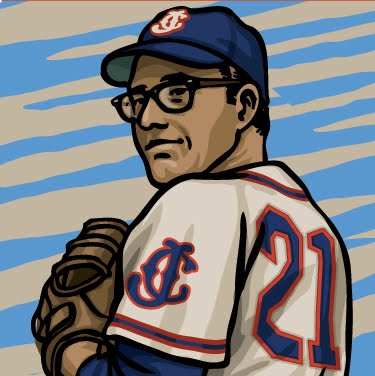
Thanks to everyone who sent good wishes on my marriage, it means a lot to Andrea and I. After a beautiful wedding (Andrea looked amazing) and a relaxing honeymoon on Coronado Island (where the new Mr. and Mrs. Cieradkowski took in a Padres-Mets game at Petco Field), I'm back in my studio in Kentucky. As such, I'd like to introduce you to a little-known part of Hall of Famer Casey Stengel's baseball career. Of course known by all as the long-time manager of the 1950's Yankees, Stengel had a long career before that as a manager of last place ball clubs, and before that as a decent major league journeyman outfielder with Brooklyn, Pittsburgh, Philadelphia, New York and Boston. But before even that, Stengel got his start in professional baseball right here in Kentucky playing in the aptly named Blue Grass League.
Before he was Casey, he was known as Dutch. At the turn of the century all peoples of Germanic stock were called "Dutchmen" or "Dutch" (case-in-point, the "Pennsylvania Dutch" actually hail from Germany and Honus Wagner, of German decent, was called "The Flying Dutchman"). The nickname came from the German word "Deutsch" meaning "German people", but disinterested Anglo ears simply heard "Dutch" instead. So all Germans became Dutchmen. Enjoying a comfortable middle-class upbringing, Stengel's old man was an insurance salesman and while he tolerated his son's interest in sports, he pushed the boy to aspire to higher goals in life.
At Kansas City's Central High, Charley was an outstanding athlete, playing football, basketball and baseball with equal ease. In the summer of 1908 at age 16, Stengel joined the semi-pro Kansas City Benton's. The Benton's barnstormed as far west as Utah and Wyoming playing army and factory teams every day to turn a profit. While it was a great learning experience for the teen and a step towards becoming a pro-ballplayer, a career in baseball wasn't Stengel's ultimate goal: Dental college was his aim and baseball was a great way to save up for the tuition.
In his junior year, the 18 year-old's pitching garnered a bit of regional notoriety when the
Central High baseball team became the Missouri State champions. In the deciding game Stengel, the team's left-handed ace, injured his pitching arm. When summer came, Stengel rejoined the Benton's, now re-named the Red Sox and embarked on another season barnstorming around the west. To rest his arm he took to playing the infield and outfield to stay in the lineup.
Dutch returned to Central High for his senior year but dropped out in February when he was offered a tryout by the local Kansas City minor league team. The Kansas City Blues played in the Class AA (equivalent to today's AAA) American Association, one of the country's three
top minor leagues. When the team sent Dutch a contract calling for a $135 a month salary, the teen was so overtaken with nerves that he turned pale. Being under age, his father reluctantly signed it for him. It was after all temporary, his boy was going to become a dentist.
Joining the Blues, Stengel soon found the competition to be way over his head. Seeing that the 19 year-old's pitching wasn't close to Class AA league standards, Danny Shay, the team's manager, put Stengel in the outfield to see what he could do. Though still not up to American Association quality, he showed significant promise and Kansas City sent kid to Illinois to play for the Class D (equivalent to today's A) Kankakee Kays. Stengel got into 59 games and was batting .251 when the league disbanded in July.
With the summer half over, Stengel was assigned to the Class D Blue Grass League in Kentucky. By the end of July he was roaming the outfield for the last place Shelbyville Blues. The low minors being a precarious business back then, the Shelbyville team couldn't turn a profit and was soon bought by a group of businessmen from nearby Maysville for $500.
It was with the Maysville Colts that Stengel began to learn the trade of a professional ballplayer. Though mired in last place, the citizens of Maysville showered their new team with enthusiasm usually saved for a pennant winner. Stengel even had his first fan, a young Maysville boy named Robert Willocks who would carry his spikes and glove to the ballpark where his idol would in-turn get him into the game for free. Though he was barely hitting .220, Stengel earned himself a few prizes with his bat: in September he hit the team's first home run and received a box of candy and safety razor shaving kit. A second round-tripper the next week added a $3 hat to his prize winnings. Late in the summer the Old Mill Tobacco Company included the rookie outfielder in the set of trading cards they inserted in their cigarette packs. The grim faced boy who stares back at you from the orange-boardered 1910 card is a far cry from the grizzled and wrinkled old man who appears 54 years later on his last baseball card as manager of the New York Mets.
It was also in Maysville that Stengel began showing his gift for colorful shenanigans which he later became famous for in the majors. The Colts' home field, League Park, had an insane asylum just beyond its outfield wall. Running to the dugout from his center field position after each inning, Stengel, who was told that he needed to work on his sliding technique, would make a practice slide into third base. The inmates of the asylum watched from their windows and cheered him on with enthusiasm - they thought he was one of their own. On another occasion Stengel drew attention to himself when he pursued a fly ball past the boundaries of an un-walled in ballpark and caught the ball standing ankle-deep in a moving stream.
When the Bluegrass League season ended, the Kansas City Blues called him up for the rest of their season. Stengel got into 4 games and hit .273 with a double. The 19 year-old ended his first season in professional baseball with a combined .237 with 18 doubles, 6 triples and 3 homers spread out over 4 teams and 3 leagues and was retained by Kansas City for the next season. But more than that, Stengel had made enough money playing ball during the 1910 season that he was able to enroll in Kansas City's Western Dental College, his ultimate goal.
And so, that might have been the last we ever heard of Charley Stengel had it not been for his being left-handed: most dental tools were manufactured for righties and Stengel had a terrible time trying to use the equipment. After 2 winters studying at Western, Stengel gave up and decided to become a professional ballplayer. And the rest, as they say, is history - but wait - where did he get the name "Casey" from? Well, as a rookie with Brooklyn in 1912, his teammates took to calling him "Kansas City" after his hometown, later shortened to "K.C." and still later to "Casey".

This is my final installment of Mickey Mantle's days in the minor leagues. The story of The Mick's Yankee days are well known, told and re-told by writers much better than I. However, like a lot of the stars I've featured in the Infinite Baseball Card Set, I like to look into the time before these guys became famous and see how their seasons in the bush leagues forged the player they eventually became. Mantle's pre-Yankee history is a little different than most. Right from the start he was proclaimed the next Yankee superstar, and his seasons in Independence, Joplin and Kansas City open a unique window through which we can see how a kid from the country painfully tries to live up to the expectations so many people have riding on him. Whether you are a Yankee fan or not, Mickey Mantle's minor league story will give even the most cynical baseball fan an appreciation for a boy who was picked to take the mantle of the next great Yankee superstar before he even played a single game in organized baseball.
Yankees' general manager George Weiss was nervous. More than nervous - his God damned heart was palpitating... Here it was, first day of 1951 spring training, and the most valuable kid to ever come out of the team's farm system failed to show up. What could it be? More money? The kid was signed for a song, maybe he and his Okie father were getting wise and wanted some more cash. Or maybe he was having some personal problems. Harry Craft, his manager for the past two seasons reported the kid had some sort of confidence issues. Or it could be vice. In Joplin he was starting to hang around with some unsavory characters and had developed a taste for the sauce. It could be it was a broad. A kid with all that talent would be a prime target for some seasoned chippy with keen foresight. After all, he was heralded as the successor to Joe DiMaggio without even having played a major league game.
Weiss couldn't take it anymore. He picked up the phone and put a call through to Commerce, Oklahoma. A few minutes later the Yankees general manager relaxed with a deep sigh. Turns out the kid hadn't received his transportation money to Phoenix. His own front office had screwed up. The future star of the best ball club on earth was biding his time working as an electrician's assistant 500 feet underground in a zinc mine. Weiss told the kid to stay the hell above ground and immediately wired the travel money.
The Yankees in 1951 was a team in transition. The most popular team in the country was starting to gray around the edges. What remained of the pre-war stars were fading fast and Stengel was in the tough position of trying to flawlessly transform the old team into a new team while not losing their position as the best in the league. Clearly Mickey Mantle was a key component in making the transition from old to new, but there was a problem for the impatient Yankees - the kid just wasn't a major league shortstop. Stengel and his coaches wisely acknowledged that it would take at least two seasons of additional minor league experience to bring his fielding up to professional standards. On any other ball club that would be acceptable but not for the Yankees. If the kid was supposed to be the successor to the great DiMaggio, why not make him an outfielder?
You would think that the great Yankee outfielder Joe DiMaggio would have been the perfect teacher, but he would have absolutely no part of his chosen successor. As with so many things in his life, the touchy DiMaggio imagined he was being insulted. Perhaps no one on the team was more unfriendlier to the rookie than the aging star. When the coaching staff decided on remolding the kid into an outfielder, DiMaggio told the press he didn't agree with the decision.
He was the only one.
Casey Stengel brought in outfielder Tommy Henrich specifically to tutor him. Henrich had retired the season before and was now one of Stengel's coaches. "Old Reliable" lived up to his name and after working with Mickey every day turned out a respectable right fielder. Mantle for his part was happy with the change in position. He told The Sporting News "I like the idea of shifting to the outfield. It is not as tough as the infield, and out there I get to use my legs."
The sportswriters went nuts covering the rookie superstar and he didn't disappoint.
Everything about the kid was special - hell, even his name was special. The name "Mickey" was always a nickname, a great baseball name, but a nickname given by someone else, short for Michael or something. This kid's given name was Mickey. Like his prodigious talents he brought with him from Oklahoma, he came with that great name. In all respects he was the complete package.
If anyone had any lingering doubts about the kid, what happened on Monday, March 26th would put them all to rest. Playing at Bovard Field against the University of Southern California, Mantle clubbed two home runs, a bases loaded triple and single. One of the homers was a 650 ft bomb that not only went over the outfield wall but it also cleared the football field behind it as well. After the game the Yankees' bus was almost tipped over when over-excited fans swarmed trying to get the kid's autograph. By the time the team headed East for opening day, right fielder Mickey Mantle was hitting well over .400. Center fielder Joe DiMaggio couldn't crack .200.
The rookie started off just like he was supposed to. Wearing number 6 on the back of his jersey, one couldn't help but notice it was the next number after DiMaggio's own number 5. Ruth had been 3, Gehrig 4. It was only natural the next great Yankee star follow in order. Throughout the first month of the season he was above .300 and batting second in the lineup. But then things started to fall apart. With the Korean War raging, many angry people were asking why this human God was wearing Yankee pinstripes instead of army green. It was a good question. The name "draft dodger" started being thrown around. In fact, Mantle had been given a military physical by his draft board in Tulsa twice, once in 1949 and again just days before opening day. Each time he was rejected as 4F. Due to an earlier injury he suffered from osteomyelitis, a bone infection that never completely goes away. He might be healthy now, but if he was inducted in the service and it flared up, the government would be on the line for a lifetime of disability payments. Because of the liability the military unilaterally flatly turned down anyone with osteomyelitis. Still, no matter how hard the Yankee publicity machine tried to explain the truth, Mickey was heckled on the field as a draft dodger and angry parents sent him hate mail on a staggering level.
The cold shoulder from fellow outfielder DiMaggio also made the rookie's life unnecessarily tough. In their first game against the Red Sox, photographers ushered DiMaggio and Mantle together with Ted Williams for a picture. DiMaggio greeted Williams but consciously neglected to introduce Mickey. After an awkward and wholly unnecessary silence, Williams took it upon himself to put out his hand and make the new kid's acquaintance.
For a rookie not yet 20 years-old, the pressure started to build. The way he was playing would have been more than acceptable for any other rookie, but Mickey wasn't any other rookie. He was supposed to be the next DiMaggio. To be a big league ballplayer was the only thing he was raised to be. Each slump or lapse on the field unleashed his uncontrollable temper. Inside he was seething at himself, unfortunately that anger sometimes overflowed and was propelled outward. After striking out he would swear loudly on his way back to the dugout. When one elderly season ticket owner rebuked him after one particularly nasty outburst he told the woman to "shut your God-damned mouth!"
Off the field his life got complicated as well. With his long-time girlfriend back in Commerce, the most eligible rookie in New York started slipping around with a showgirl named Holly Brooke. Burke introduced the country boy to the glittering lights of Broadway. In order to cover his awkwardness at cocktail parties he discovered the magic of scotch whiskey. Shyster businessmen circled the 19 year-old kid and he quickly fell prey to countless uneven business deals that took whole teams of Yankee attorneys to extricate the naive rookie from.
His strike outs soon started snowballing. Stengel moved him up and down in the lineup like a slide ruler and was forced to answer daily questions from the beat writers about when he was going to admit defeat and send the kid back to the minors. Stengel stuck to his guns as long as he could but after he started striking out at least once in every game, he submitted to the inevitable. With real tears in his eyes, Stengel told the kid he was being sent down. To make room for a much needed additional pitcher, Mickey Mantle was optioned to the Kansas City Blues. It was back to the minors.
The Kansas City team Mickey joined in the summer of 1951 was a seething pot of dissension. Just like today, the Yankees never had to rely much on a farm system. Being the most successful team in the biggest market, the Yankees could purchase ready-made ballplayers unlike most other teams who had to grow their own. Though Kansas City was New York's top farm team, it wasn't so much stocked with budding stars as filled with has-beens and never-will-be's. While many on the team knew they would never show their mugs in the majors, everyone knew Mantle was just in K.C. temporarily. Before he was even with the team he was resented.
The guy at the helm of the Blues was probably the only man who could relate to Mantle's position as having to replace a legendary Yankee star. On opening day in 1935, George Selkirk put on a Yankees jersey with number 4 on the back and took Babe Ruth's place in right field. If anyone knew the pressure Mantle was under, Selkirk sure did.
Joining the team on the road, Mantle was handed a used jersey with number 20 on the back and promptly continued his batting slump. In his first handful of games he went 3 for 18. The first hit was a swinging bunt which he speedily beat out for a hit. When he reached the dugout at the end of the inning Selkirk chastised the kid. "We know you can bunt, Mick" he said. "You're not here to bunt. You're here to get some hits and get your swing back." Scorned by his teammates, ripped by the press and feeling more alone than ever before, he became depressed. But he did start to hit. When the team rolled into Milwaukee he had one 4 hit game, then began belting the home runs. In Indianapolis he hit two - one from each side of the plate. Against the Toledo Mud Hens he hit for the cycle and then added an additional homer for good measure. By the time the Blues headed back to Kansas City, Mickey was batting a nice .345.
Yet each night he sat in his hotel room and poured over the Yankee box scores. The longer he stayed in Kansas City, the less sportswriters mentioned him in the papers. He was fading away and fast. In Mantle's mind, no matter how many home runs he hit down in the minors, he was sure he'd blown his chance with New York. He was lonely and scared. He wrote to showgirl Holly Brooke and begged her to join him in Kansas City, knowing correctly she'd never hitch her star to a lowly minor leaguer. Each day brought more hate mail that piled up in his room. Especially hurting was the ones from the parents of soldiers calling him a draft dodger.
When the Blues opened up their home stand at Municipal Stadium he started slumping again and making errors in the field. The depression closed in on him and he needed help. He craved some kind of advice from a friendly face. He called his father Mutt and told him he wanted to go home.
Mickey's father Mutt jumped in his truck and made the half-day drive to Kansas City. If he was expecting a pat on the back and sweet words, he was in for a rude surprise. In his son's hotel room after the day's game was rained out, Mutt listened stoically as his boy explained how he was a failure and wanted to quit and go home to Oklahoma. In what would be known as the most famous and successful pep talk in baseball history, Mutt Mantle stood up and started packing his son's clothes, telling him that he thought he'd raised a man. "I see I raised a coward." Emptying the dresser drawers into a suitcase, the father told his son he could come home and work in the mines with him. The shock treatment did the trick.
After convincing his father to stop the packing, Mantle realised that if he quit now, that would be the real failure. He resolved himself to stick it out. Mutt got in his truck and drove back to Oklahoma, alone. With the rain gone, Mickey belted two home runs in the next game. He averaged over two RBI's a game and on top of all that, the kid was almost single-handedly leading the Blues on a late-season run for the American Association pennant.
On August 20th, he got the call he was hoping for: New York wanted him back. Trading in his number 20 Kansas City jersey for a set of pinstripes with number 7 on the back, Mickey Mantle rejoined the New York Yankees.
As with the two other stories about Mantle's early days, I'd like to dedicate them to my Uncle Eddie, a great fan of The Mick. As a boy, my Uncle Eddie would come to my baseball games when my father couldn't make it, something I was always thankful for. More than 30 years later my uncle pinch hit for my Pop again, this time helping my brother and I settle my mother's affairs since her death in this past summer. Thanks again Uncle Ed, this ones for you.
SOURCES
- The Sporting News (March 21, 1951)
- The Kansas City Star, column by Joe Posnanski (August, 1, 2001)
- Castro, Tony Mickey Mantle: America's Prodigal Son (Potomac Books, 2002)
My girlfriend, who happens to be as much of a degenerate baseball fan as I am, casually asked me one night "when did it become bad form to bunt to try to break up a no-hitter?"
The reason she brought that up was earlier this season Justin Verlander of the Tigers was throwing a no-hitter against her L.A. Angels. Erick Aybar tried to get on base by laying down a bunt in the 8th inning. Fundamental baseball, right? Not to Verlander. Detroit's ace was pissed someone would dare try to put his no-hitter in jeopardy. He went so far as to call Aybar a "bush-leaguer" for trying to get on base and get the Angels moving. Apparently "big leaguer" Verlander thought a no-hitter was something the other team was just supposed to hand over to you after a certain amount of innings had been played. What is that magic inning number? The 7th? 8th? What is it?
When did baseball become like youth soccer? Maybe Verlander should be playing right wing or some other stupid position on a community soccer field somewhere. In my opinion, if you can't deal with a bunt in the late innings then you don't deserve a no-hitter - you don't even deserve to wear that Detroit ball cap. Bush league. Hell, with an attitude like that Verlander should just pull up his socks, pull on some ad-riddled polyester jersey and hit the soccer field. At least between the goals no one will call you a sissy if you fall down and writhe around in pain if you get bumped.
It used to be that baseball was a tough sport. The outfield walls weren't padded. Guys slid hard into a base and someone in the opposing dugout always found something in your ethnic background to needle you ceaseless with. You broke up a double play with your body and every time you stepped up to the plate the chances of having an 82 mph fastball thrown directly at your head was frightfully good.
It was a tough game and unfortunately, it wasn't always for everyone, no matter how good they were. So that brings me to Melo Almada, the first Mexican-born ball player to make it to the majors.
He was born Baldomero Almada Quiros but everyone called him Melo or Mel. He was recklessly handsome, olive skinned with a thousand watt grill that made the broads go limp. He was musically inclined and his travel luggage included a state-of-the-art radio which he immediately installed in each hotel room, keeping up with the newest hits. His manners were as impeccable as one of those mustachioed stars you saw in a Hollywood musical. And he was a heck of a promising young ballplayer.
His Pop was the Mexican Consul in Los Angeles, a position he accepted because the governorship of Baja California he was initially posted to came with an incumbent who didn't seem to want to vacate. The hundred-man private army he surrounded himself with made any attempt at collecting the keys to the governor's mansion seem, well, stupid. And Melo's father was anything but stupid.
The Almada's traced their lineage right back to Spain and countless "Dons" and "Donas" dangled from the family tree. By the time Almada Senior was handed the Baja governor's job his family controlled silver mines and their vast land holdings amounted to the size of Belgium. When the Mexican revolution broke out in 1910 the Almada's and their wealth became a prime target of the angry peasants and quite a few Almada's were victims of the violence that Mexico descended into. So in 1914 when Almada Senior realized the odds of him becoming governor of Baja was a certain death wish, he wisely realized the time had come to get the heck out of Mexico.
Melo was but a year old when the family settled in Los Angeles. Both he and his older brother Lou quickly adapted to life in America and of course that included baseball. Their father also developed a passion for the game and encouraged his boys to play the sport. Lou was good enough that he turned pro in 1927 and within a year was well on his way to becoming the first Mexican-born major leaguer when he was injured. Meanwhile younger brother Melo was back in high school breaking every athletic record he could find. Track and field, football, baseball - you name it Melo excelled at it. But, and Melo was the first to admit this, his older brother was the better baseball player. After Melo graduated high school, Lou, who was now with the Seattle Indians of the Pacific Coast League, invited his little brother to spring training in Santa Cruz. The younger of the two Almada boys was in a quandary whether to go to college or play baseball. Melo chose baseball.
Though he originally pitched like his older brother, Seattle recognized Melo's speed and power and quickly converted him to be an outfielder.In a twist that was eerily similar to the DiMaggio brothers, Melo actually swiped his brother's place on the team. It wasn't that Lou was a poor ballplayer - it just made fiscal sense since he was holding out for a bigger contract.
For Melo, the speed came naturally but fielding did not and he struggled to learn his trade. Throughout the 1932 season Melo batted an impressive .311 and before anyone knew it, the rookie was the team's regular left fielder. Over in San Francisco older brother Lou was slugging .320 for the Mission Reds who picked him up after being let go by the Indians.
By the time 1933 season was half way over Melo was the best outfielder on the coast and being touted as the guy who would become the first Mexican national in the big leagues. While the Mexican fans in the cities around the league honored the kid with "Melo Almada Day's" and the sports page coined all kinds of dopey nicknames utilizing his Mexican heritage, Almada always thought of himself as a regular ol' American. In interviews he stressed this point, telling the Sporting News "...you see, I am very much an American."
The Red Sox came calling first and the $40,000 they paid Seattle reportedly saved the club from financial ruin. On September 8th, 1933 Melo Almada emerged from the Red Sox dugout and took his place in center field, the first Mexican American to make it to the majors. Boston kept him up with the big club for the remainder of the season and the next year sent him to their American Association farm team for seasoning. Playing outfield for the Kansas City Blues, Almada clobbered the ball at a .328 clip, swiped 30 bases, was named the teams' most valuable player and made the all-star team before the Red Sox saw enough and sent for him. He batted only .233 in just over 20 games but the Sox liked the speedy outfielder and when 1935 began Melo was with Boston for good. Six months later he'd hit .290 and was being called the best Red Sox outfielder since the mythical Tris Speaker.
And just as fast as it came, it quickly started to fade away. Baseball was a tough sport back in the depression years. Guys held onto their jobs with all means necessary. Every man knew that the farm teams that littered the countryside were chock-full of kids desperately trying to claw their way into their very seat in the dugout. Desperate times leads to desperate measures and as a result, big league baseball was not for the feint of heart. Clinging to their big league berths, ballplayers used every edge they could find to get the jump on the opposition. Somewhere, sometime around 1938 Almada was beaned by a pitch. Like I said, this wasn't an uncommon occurrence, hell, the brush back was a just another pitch in a pitcher's arsenal.
Thing was, Melo took it all personally. Coupled with the expected racial ribbing he received for being Mexican, a fastball at the noggin took on a more sinister meaning to Almada. He was convinced opposing teams singled him out and were trying to hurt him. And as he tortured himself by thinking about where the next pitch was going to be aimed, his batting average plummeted.
Was there a big league conspiracy to drive the first Mexican out of the majors? Nah, no way. Melo's own brother Lou thought he was wrong, telling him that those guys were throwing at him not because he was Mexican, they were throwing at him because he was a batter. In 1937 it was just part of the game. What probably happened was opposing pitchers caught on to Melo's fear and soon everyone was brushing him back. For many, once you get beaned even a mildly close fastball is enough to throw off your concentration and that fear was an edge any pitcher worth his salt would exploit to their benefit.
The Red Sox dealt Almada to the Senators who in turned passed him down to the Browns. He rebounded a few times but by 1939 the perceived head-hunting drove him out of the majors. After a disappointing season back where it al started in the Pacific Coast League Melo headed south to the land of his birth.
Melo Almada was the highly-touted player-manager of the Torreon Union Laguna team. His experience as a successful major leaguer should have made him the keystone of the fledgeling Mexican League which was trying to establish itself as a professional level entity. Unfortunately, that was not meant to be. Though he was batting .343, Almada quit in early May. Seems that the very thing that should have made him a star in the Mexican League was what drove him back north. Almada, though considered Mexican by American fans and sportswriters, was considered "Americanized" by Mexicans who resented his success up north and his privileged upbringing. In the States he was "olive-skinned," down there he was "high-white." The rough characters in the league threw at him with a vengeance and his own players refused to respect him. After 26 days he threw in the towel and quit the game.
Back in Southern California Almada's good looks got him some movie parts and when the war started he served in the U.S. Army. In the mid-1950's he gave baseball another try and managed the Sonora team in the Mexican Pacific Coast League. This time it went much better and the league's rookie of the year award is called the Baldomero Almada Trophy.
So was it a tragedy that bean balls and brush backs ran Melo Almada out of the majors? Sure. A few guys who played with and against Almada went so far as to say if he played today he might have enough to be Hall of Fame material. But in Almada's time, baseball was a tough game. Still is. Nothing is handed to you. It's up to every man who puts on a uniform to play his best and win the game for his team. Back in 1938 bean balls and brush backs helped a pitcher do just that, and until this season, I though a well-placed bunt did as well. To Erick Aybar and the Los Angeles Angels it still does, but I guess to Justin Verlander it's a thing of the past.
SOURCES
- Nowlin, Bill, Mel Almada (SABR Bio Project)
- The Sporting News (Sept. 5, 1935)
- The Sporting News (August 29, 1988)
- Wilson, Nick, Early Latino Ballplayers in the United States (McFarland and Company, 2005)