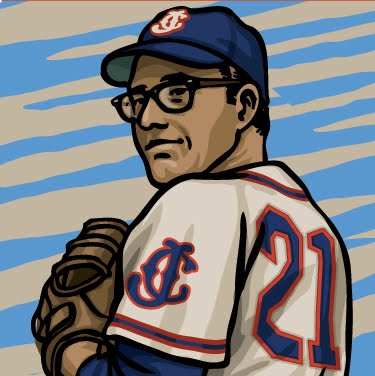
Showing posts with label Philadelphia Stars. Show all posts

Thursday, November 8, 2012

135. Rap Dixon: The Negro Leagues' Best Left Fielder

Every so often I get requests for ballplayers to feature on the site. This week's player was suggested by a reader over a year ago and not only did he ask me to feature this particular player, but he also took the time to write out a nice outline of his career to get me started. It took me quite a long time to assemble everything, research, drawing and actually writing it all down, but finally, here it is...

Now the first thing you think about when you here that a ballplayer's nickname is "Rap" is a massive slugger, right? Rap has got to be derived from the sound the ball makes when it "raps" into the outfield wall. Well, in Herbert Albert Dixon's case, "Rap" was short for the Rappahannock River. Why was he named after a river in Virginia? I have no idea. He was born in Kingston, Georgia and grew up in Steelton, Pennsylvania. I'll make an educated guess and throw it out there that perhaps Dixon's family, after leaving Georgia, briefly settled in Virginia, somewhere along the banks of that river. Moving to urban Pennsylvania it was probably just natural his nickname reflected the place he'd come from. But, like I said, it's all just a guess. What is known for sure is that by his teens Dixon was living in Steelton where his Pop was a steelworker.

Colonel Strothers, the owner and manager of the semi-pro Harrisburg Giants, spied the 20 year-old "Rap" Dixon playing sandlot ball in Steelton, Pennsylvania and snatched him up for his own ball club. Strothers was in the process of turning his semi-pro Giants into a big league quality team and the was Dixon played the outfield Strothers knew this kid would be an integral part of what he envisioned for his club. 

By 1924 the Harrisburg Giants had become that pro club the Colonel envisioned. To compliment his young left fielder, Struthers signed Oscar Charleston to play center and brought in Fats Jenkins to anchor right field. The Dixon-Charleston-Jenkins combo became what may have been the greatest outfield of all-time. 

The Giants joined the Eastern Colored League in 1924 and Dixon began what should be a hall of fame career. In 47 games he hit a .265 but did slug 4 homers and demonstrated solid skills on the base paths. His fielding out in left field was so impressive that there was no question he would be in that same place the next season. Playing full time in 1925 Dixon responded by knocking the ball around for a  .344 average. After the regular season, Dixon was invited to go to the West Coast and play in the winter league around Los Angeles. Off-season baseball work was scarce and only the best ballplayers were offered slots in the winter league so it speaks highly of Dixon's talent at the age of 23 that he was granted a berth on one of those all-star teams. 

Back east with Harrisburg again in 1926 he's credited with a .310 average and many Negro teams tried to get Dixon to jump the Giants and join their clubs, to no avail. The left fielder was tall and bony, just over 6 feet tall. His legs were stripped down and built for speed and his arms were the only thing on him that could be called muscular, which was the source of his cannon arm and the reason he could scatter booming line drives all over a ball field. By 1927 no one remembered that "Rap" had anything to do with a river. To blackball fans, "Rap" was what he did to a baseball, and that was that.

Instead of heading out west in the winter of 1927 and stopping at Los Angeles, Dixon was recruited by famed catcher Biz Mackey to join his team which was headed to the Orient to play ball. The team, dubbed the Philadelphia Royal Giants, stopped off in many exotic locations including the Philippines and Japan, spreading the brand of ball playing they played in the Negro leagues. Japan particularly embraced the American visitors and Dixon in particular. The fans were captivated by his "shadowball" pantomime routine before games and one of his home runs was so impressive that a plaque was erected to commemorate it. His batting performance in Japan was so impressive that it earned him a special trophy from the Emperor Hirohito. 

When the tour ended Dixon took his brand of ball playing to the Baltimore Black Sox. Baltimore had consistently fielded a competitive team but always seemed to fall short at the end of the season. The addition of Rap Dixon to the lineup was that missing part of the machine. After batting .382 in 1928, the Black Sox finally put it all together the next season and they won the league championship, Dixon's .369 tally adding considerably to a well-balanced ball club. Unfortunately the league disbanded after that and while the 1930 Black Sox were considered even better than the previous edition, they were an independent club and it's not easy to gauge in retrospect how good they were. 

One thing is for certain however, and that is that Rap Dixon was a superstar. In July of 1930 Yankee Stadium was officially opened up to black teams and the Black Sox were there to play the hometown Lincoln Giants in the House that Ruth Built. By the time the game ended that afternoon Dixon had gone down in the history books as not only the first black ball player to hit a home run in Yankee Stadium, but he hit three of them that day. It was a monstrous demonstration of power in front of a huge crowd in the largest city in the nation. If anyone didn't know about Rap Dixon by the morning before that game, they sure did afterwards. 

Unfortunately along with fame comes a whole cart full of unwanted baggage and Dixon fell victim to two of the most common ones - booze and ego. That drinking went along with the transient lifestyle of a ballplayer is not sup prizing. Black or white, many great careers were damaged by the sauce and Dixon was no different. Alcohol combined with a swollen head made for an unpleasant teammate. But, just like his white counterparts, as long as you performed on the field such unpleasantness's were overlooked.

Like many stars of blackball, Dixon now began the life of ball player for hire, frequently switching teams and showing up bat in hand to whichever team offered him the most money. One thing everyone who followed Negro baseball was that when Rap Dixon came to join your team, he was bringing speed, power and the the best fielding skills around. Dixon's appearance in the lineup was like money in the bank. In 1931 he was roaming left field in a Hilldale uniform. 1932 found him on the Pittsburgh Crawfords, one of the best ball clubs ever assembled, black, white, brown or any other color. The next season he was recruited by the Philadelphia Stars and creamed the ball for a .370 average. When the voting for the very first All-Star Game was tallied in July of that year, Rap Dixon was the East's starting left fielder of course. He promptly stole the first base in All-Star history.

When he went south to Puerto Rico in the winter of 1933-34, Dixon was at the top of his game. Then it all ended. Sliding into second base, Dixon severely injured his spine. The all-star spent almost half a season in the hospital and when he finally returned to the game he wasn't even half the player he was before. Philadelphia cut Dixon loose but Baltimore took a chance on their old star and hired him as manager of the Black Sox. While he was one of the best ballplayers to ever step on a ball field, he wasn't a skilled enough manager to make a difference with the lack-luster club Baltimore saddled him with and the club folded. The Brooklyn Eagles picked up his contract the next season bu he didn't stick and he bumped around a series of teams in quick succession before hanging up his spikes after the 1937 season. He stayed in the game as a manager of a few low-level teams including a reconstituted Harrisburg Giants in the 1940's. Though Harrisburg's level of play wasn't one the same level as a Negro National League team, it was notable for another reason - it was an integrated ball club - a rarity back then and perhaps one of the many reasons which proved why Jackie Robinson should be given a shot at professional ball in 1946.

After a good 15 years of heavy drinking, Rap Dixon succumbed to tuberculosis in July of 1944. His heath had been declining steadily since his hospitalization ten years earlier and his death wasn't much of a surprise to those who knew him. When Oscar Charleston was creating his all-time dream lineup of Negro league players in 1949 he chose his old Harrisburg teammate to be the starting left fielder. Quite a compliment considering the source and the vast pool of talent he had to choose from. The Hall of Fame had Dixon on their ballot in 2006 but he failed to garner enough votes. Perhaps one day when guys like Gil Hodges and Sammy T. Hughes get their just rewards, the name Herbert Albert "Rap" Dixon will be right along with them.

Friday, August 13, 2010

44. Slim Jones - The Greatest Pitcher of 1934


One of my favorite things about baseball, and history in general for that matter, is the big "what if..." question. You know, what if the South won the Civil War, what if Babe Ruth stayed a left- handed pitcher, questions that would have changed everything in a radically different way than events turned out. And then there are the little what if questions. Stuart "Slim" Jones is one of those nagging little questions and for a long time a player I have been fascinated with...

Jones was was a tall thin lefty from Baltimore and although he grew up playing softball, hardball was where the money was if you wanted to escape the grim depression then gripping the country back in the early 30's. Like Leon Day shortly after him, Jones tried joining the hometown Baltimore Black Sox. The once proud powerhouse had fallen on hard times and all its stars had fled to better paying teams, but the club still attracted the best black local talent and gave many players their start in professional baseball. So Stuart, now nicknamed "Slim" for obvious reasons, brought his 6'-6" frame to a tryout with the Sox but just didn't have enough to stick with the team. The next year he had developed a nice curve to compliment his blazing fastball and under manager Dick Lundy's watchful eye Jones stuck with the club and registered a 4-2 record for 1933.

Back before the 1960's most ballplayers, no matter how good they were, black or white, had to have a job during the winter to support themselves and family. Some of the most talented were able to get a berth on a team in the Cuban, Puerto Rican, California, Mexican or South American winter leagues. Because spaces on the teams were limited and players of all colors and nationalities were trying out, only the best were eligible to play down in paradise. In the winter of 1933, Slim Jones, with barely 1 year of professional experience with a marginal ballclub, made the Puerto Rican Winter League. It was down there that Jones really had his breakthrough. The reason for his dramatic rise is lost to history, maybe it was the experience of being around great veteran players in the islands or perhaps the 21 year-old just matured, but Jones struck out a resounding 210 men down there and the Philadelphia Stars of the Negro National League came looking for that tall lefty as soon as he and his luggage arrived back in the States.

1934 was all about Slim Jones. Right from the start of the season everyone that followed negro league baseball knew that someone special was in their midst. Jones simply dominated not only the various semi-pro and town teams the Stars played against, but the professional teams in the Negro National League as well. By mid-season Jones garnered enough fan votes for the annual East-West All-Star Game to eclipse the reining giant of negro league ball, Satchel Paige. Slim started the game instead of Satchel, a clear indication of his popularity with the fans and a nod to his talent on the mound. Pitching against the best players the West had to throw at him, Jones kept them hitless in the first inning but in the second he gave up a walk and a hit and now had runners on second and third with no outs. Slim bore down and struck out the powerful Sam Bankhead for the first out. Larry Brown of the Chicago American Giants was up next and hit a scorcher to third baseman Jud Wilson who knocked it down and threw out Mule Suttles at the plate as he tried to score. Two out, two men on base. Nashville's Sammy T. Hughes was up next. Hughes was one of the best clutch hitters who ever wore spikes but he too hit the ball to Wilson who made the long throw to first, inning over. Jones pitched the third inning as well and all told against the best negro league players of 1934 he pitched 3 innings, gave up 1 hit, walked 1 and fanned 4. Not bad for a 20 year-old in his first year in professional ball.

Negro League baseball has always been known for its showmanship as well as talent and in 1934 fans had the perfect storm. Everyone wanted a duel between the one and only Satchel Paige and the young upstart Slim Jones. On September 9th, the stars aligned at Yankee Stadium in New York City as the Paige's Pittsburgh Crawfords met Jone's Philadelphia Stars. Paige drove all night from a freelance pitching assignment and slept in his car outside the stadium. Jones told his teammates before the game "get me 2 runs and I'll win."

From the start everyone knew they were watching something special. Paige and Jones fanned batter after batter, double plays were turned as if it were a life or death battle and through 6 innings both men were pitching 1 hit shutouts. Then in the top of the 7th Dewey Creacy got a hit off Paige and scored on a double by Slim's catcher Biz Mackey. With 2 outs Jake Dunn hit a long fly to right fielder Ted Trent to made a spectacular shoe-string catch. The base umpire called it a trapped ball however and Mackey scored from second but then the home plate umpire ruled it a legit catch. No run scored, inning over and the score remained 1-0 Philadelphia.

For Slim's half of the 7th an error by second baseman Dick Seay and 2 singles tied the ballgame before he could extradite himself out of the inning. The next inning both pitchers ran into trouble but each time they pitched themselves out of it. Night was starting to descend on Yankee Stadium and going into the 9th each pitcher bore down harder. Fans were already calling it the greatest game ever played and Slim Jones retired the Crawfords in the top of the inning. Satch took the mound in the bottom of the ninth and set the Stars down one after another to end the inning. By now it was too dark to continue and fans ran on the field. Slim Jones had struck out 9 and gave up 3 hits, Paige wiffed 12 and relinquished 6 hits. The greatest game ever played was frozen for all eternity in a 1-1 tie.

Press coverage was incredible and the fans clamored for more. This is America after all, there has to be a winner and a loser. There must be a re-match! One week later, the two teams met again at Yankee Stadium in front of 30,000 fans. Dancer and honorary Mayor of Harlem Bill "Bojangles" Robinson presented both pitchers with a set of leather luggage - a very thoughtful gift seeing how much traveling the negro league teams did at the time. Jones struck out 6 and spread 5 hits over 9 innings, but Paige and the Crawfords bested the Stars, winning by a score of 3-1. Paige struck out 18 that day, gave up but 2 hits and forever sealed his reputation as the best clutch pitcher in the negro leagues.

So by the end of the 1934 season Jones had racked up the wins going 22-3 in league games and winning an additional 10 more games against semi-pros and lesser competition. In the hot pennant race of 1934 the Stars won the second half of the split season and now faced the first half winners, the venerable Chicago American Giants. In game one Jones came on in the ninth inning of a tie 1-1 game. Dewey Creacy made a bad throw on an easy out and Mule Suttles got a cheap hit through the infield scoring the winning run. Jones started game two but lost to Chicago's Ted Trent 3-0. Philly then evened the series forcing an eighth game after the 7th game ended in a tie due to darkness. Jones was at his best spreading 5 hits over the course of 9 innings and even smashed a double in the seventh scoring a run as the Stars cruised to a 2-0 shutout championship.

What else could top off such a spectacular year for a 20 year-old? How about pitching against the best pitcher in the white major leagues? The great Dizzy Dean, fresh off his 30 win season and marvelous world series performance against Detroit was barnstorming around the country with his brother Paul, also a star pitcher (19 wins) and a pick-up team of semi-pro players. Although the quality of Deans backing players may be suspect, Slim Jones still beat the Dizzy Dean All-Stars at Shibe Park capping off what may be the single greatest season ever recorded by a pitcher in baseball history.

So where do you go from here? Unfortunately for Slim, it was all down hill, and fast. Feted as the greatest pitcher in generations, Jones made the rounds of the bars and taverns in the off-season basking in the attention and indulging way too much. When he reported to the Stars at the start of the 1935 season he was out of shape and his ego inflated to a monstrous porportion. He fought with the management demanding a higher salery and at one point left the team in protest. His skills had eroded over the winter and by the middle of the season had still not registered a win. The fans still loved Slim and he received the second highest amount of votes for a pitcher that year for the East-West Game. Slim performed magnificently throwing 3 shut-out innings and had 2 hits including a two-run homer. But while that one day in Chicago may have reminded everyone of Jone's great promise, he finished 1935 with a 5-10 record. Winter of 1935-6 was spent back in Baltimore making the rounds of the clubs and bars cashing in on his reputation and when he returned to Philadelphia in 1936 his drinking had spiraled out of control. He finished the year 1-2, was 1-1 in 1937 and then 2-1 in 1938.

By the winter of 1938 Slim Jones, now a hopeless alcoholic barely holding on to a career as a ballplayer was out of cash and desperate. That winter was one of the worst in Baltimore history and Jones wired the Philadelphia Stars owner Ed Bolden for an advance on his next years salary. Bolden refused, partly because of Jone's declining performance and partly because of the precarious financial position his club was in. Like all negro league clubs the Stars barely turned a profit year after year and money, especially in the off-season, was tight. So now Jones, formerly the greatest pitcher in the world was desperate and thirsty wandering the streets of Baltimore searching for a drink. He sold his only overcoat to buy a bottle of whiskey and caught pneumonia. He died just before New Years, aged just 25.

Baseball is littered with stories like Slim, players who for a little while seemed to be the greatest in the game, only to have it all go away in a flash. Dizzy Dean, who Slim bested in 1934 had his brilliant career curtailed in 1936 due to an arm injury as did his equally talented brother Paul. Countless players drank themselves out of the game or were used up too fast because the fans wanted to see their hero pitch every time they went to the ballpark. But not many players had such a remarkable single season as Jones did in 1934 and he remains, at least for me, one of the biggest "what if" questions in baseball history.