Showing posts with label Fictional Players. Show all posts

Wednesday, April 6, 2016

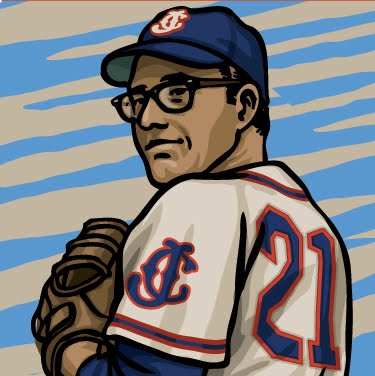
215. Al Fowler: The New York Knights Ace


After spending all that time researching and then illustrating real life Chicago Cubs Hall of Famers, I thought it would be a nice change of pace to pick a fictitious character from literature or movies. Because this is The Infinite Baseball Card Set and there are no set rules, guys like Mayday Sam Malone of "Cheers", Henry Wiggen from "Bang The Drum Slowly" and J.D. Salinger's Chief Gedsudski all take their place beside Babe Ruth and Mickey Mantle.

Bernard Malamud’s “The Natural” has always been my favorite baseball novel, and over the years I've created cards and back stories for two of the main characters, Roy Hobbs and Bump Baily. I thought today I’d create a card and biography for the New York Knights’ ace, Al Fowler.

Detroit Tigers scouts signed the 17 year-old Al Fowler right off the Rochester sandlots where he was regularly striking-out 15 batters per game. Rated one of the best pitchers in the minors, the New York Knights traded a handful of proven veterans to get the services of the young left-hander.Fowler debuted in the majors just before his twentieth birthday and he finished with a 3-1 record and what looked to be a promising future.

Fowler’s detractors say he tried to strike out every single batter he faced, there-by tiring himself out before the ninth inning. While this criticism may be true, it was something Fowler felt necessary due to the poor offence and defence provided by his Knights teammates. Contemporary sportswriters liked to quip that besides being among the leaders in strike-outs, Fowler also led the league in suspensions for breaking training rules. His late night cavorting with teammate Bump Baily was often cited as the only thing that stood in his way of becoming the best southpaw in the National League. Syndicated columnist Max Mercy famously described Fowler as “the 23 year-old who looks 30”.


Fowler’s luck turned around completely in 1939 when the 35 year-old rookie Roy Hobbs joined the Knights. With a potent offence finally behind him, the right-hander won a career high 15 games. He also picked up the win in the one-game playoff against Pittsburgh, though he pitched poorly. Rumors persist to this day about Fowler’s role in a plot by gamblers to “fix” the pennant, though he was never formally accused or prosecuted. Fowler tried to dispel any suspicions by pitching magnificently in the World Series, and his 3-hit shutout in Game 2 was the only Knights victory in the 5 game loss the Yankees.


Fowler suffered an arm injury warming up before the 1940 All-Star Game and never pitched effectively again. He was traded to the Cubs in 1942 and retired a year later. He worked as a salesman for the Ballentine Brewery and later owned a successful chain of liquor stores in the Rochester area.


Thursday, November 15, 2012

136. Henry Wiggen: 200 Miles from Perkinsville to Cooperstown

3 years ago, I had a crazy idea of honoring my Pop and the time we spent talking about old ballplayers with a never-ending card set. On random scraps of paper, cocktail napkins and service station receipts I made crazed lists of the players I wanted to depict. Besides creating drawings and stories for real-life ballplayers, I also wanted to do the same for those memorable fictional characters from movies and literature. Roy Hobbs, Mayday Sam Malone, Bump Bailey, Chief Gedsudski... they all have a place right beside Babe Ruth and Pee Wee Reese here at The Infinite Baseball Card Set. There's one more character that I seem to get a number of requests for each year and that's Henry "Author" Wiggen, star of Mark Harris' baseball trilogy. I always put off doing a Wiggen card for the simple reason that I don't remember all that much from reading the books. Not wanting to fake it, I sat back and waited for someone who was more intimately familiar with Harris' work. 

Enter Bill Schubert, author of this week's story...

Baseball is great for nicknames. It seems the better the player, the more colorful the moniker. George Herman Ruth was “The Babe” and “The Sultan of Swat”. Bob Feller was “Rapid Robert” and “The Heater From Van Meter”. Henry Aaron became “Hammerin’ Hank”. Reggie Jackson was “Mister October” and Roy Hobbs was simply “The Natural”. It goes on and on: “Catfish”, “Charlie Hustle”, “The Rocket”, “Goose”, “The Splendid Splinter”, “Mudcat”, and “The Wizard”.

The dominant New York Mammoths teams of the early 1950s had some of the best nicknames in history. Led by Manager Herman “Dutch” Schnell, they had “Lucky” Judkins, “Sunny Jim” Trotter, and “Swanee” Wilks patrolling the outfield, “Ugly” Jones, “Coker” Roguski and “Canada” Smith in the infield, and the veteran catcher “Red” Traphagen flashing the signs to pitchers “Horse” Byrd, “Knuckles” Johnson, and “Sad Sam” Yale.

When the young southpaw Henry Wiggen joined the Mammoths in 1952, he had a brash confidence to go along with his blazing fastball, wicked curve, and nearly unhittable screwball. By the end of his rookie year Henry had won a league best 26 regular season games and 2 World Series games (New York beat Philadelphia to take the ’52 Series 4 games to 1). He took home both the MVP Award and the Sid Mercer Memorial Award of the Baseball Writers Association as Player of the Year. What Henry Wiggen did not have was a proper nickname.

Over the off-season Wiggen wrote a book, The Southpaw (“Punctuation freely inserted and spelling greatly improved by Mark Harris”), about his early life in Perkinsville, New York, his two years with the AA Queen City Cowboys, and his magnificent rookie campaign. Henry paints a vivid picture of life in the small town of Perkinsville and of his baseball-crazed early days. He was raised by his father, a former minor league pitcher with Cedar Rapids and star of the local semi-pro team the Perkinsville Scarlets. Henry’s whole world revolved around the grand old game. Henry starred on the mound for Perkinsville High. He cheered his Dad. He walked from his house to Fred Levine’s cigar store in town to buy “The Baseball Digest”, “Ace Diamond Tales”, and “The Sporting News”. He stole the local library’s copy of Sam Yale -- Mammoth and read it over so many times that he was able to quote whole passages to “Sad Sam” himself when eventually they were teammates in New York. He cut a picture of Sam out of the stolen book and carried it in his wallet next to a picture of his “Pop”. He made Sam’s “Rules to Live By” his own: always play hard, live a clean life, listen to your coaches, and, especially, have faith in yourself. Henry always played hard, never smoked or chewed tobacco or drank alcohol during his playing years, and had the utmost confidence in his abilities.

I believe that some day I will be counted amongst the immortals and have my statue in the Hall of Fame at Cooperstown. Connie Mack says Lefty Grove was the greatest and maybe so, and some say Mathewson and some say Walter Johnson, some say Bobby Feller and some say Satchel Paige. Yet you will see some writers that say that on my best days I am better and faster than any, and I believe them. ( The Southpaw, 17) 
 
When the Mammoths reassembled in Aqua Clara for spring training in 1953, Henry got his nickname. He was then and ever after Henry “Author” Wiggen. As if to live up to the nickname, Henry would go on to author three more books about his life on and off the diamond, Bang The Drum Slowly, A Ticket For A Seamstitch, and It Looked Like Forever.

1955 should have been another great year for “Author” and the Mammoths. Henry was an All-Star for the third year in four, and New York made it back to the World Series, this time beating Detroit behind two victories by Henry. But that season, chronicled in Henry’s bitter-sweet second book, Bang The Drum Slowly (“Certain of his enthusiasms restrained by Mark Harris”), was played under a cloud, the knowledge that back-up catcher Bruce Pearson was dying of Hodgkins disease. Henry and Bruce drove down to Aqua Clara together that spring. On the way they decided to keep Bruce’s condition a secret from everyone for fear that the Mammoths would release Pearson if they knew the awful truth. They made a detour to visit Bruce’s folks in his tiny hometown of Mill, Georgia. Eventually they shoved off for spring training without even sharing the truth with Bruce’s parents. Once in Aqua Clara, Henry sat in the stands watching his teammates practice. He was holding out for more money. Finally, Henry and the club settled on a figure, but “Author” was not through negotiating. He would not sign until a clause was written into his contract saying that he and Bruce “…will stay with the club together. Whatever happens to one must happen to the other, traded or sold or whatever. We must be tied in a package on any deal under the sun.” (p. 67, Bang The Drum Slowly) Manager Dutch Schnell did not like the unusual request, saying, “What is up between you 2? A roomie is a roomie, Author, not a Siamese twin brother fastened at the hip.” ( Bang The Drum Slowly, 70) Eventually the manager relented and the clause was put into Henry’s contract.

On Memorial Day, with spring turning to summer, the Mammoths were under-performing. They could not put any distance between themselves and Washington. They clung to a slim 1 1/2 game lead despite Sid Goldman hitting home runs on a pace to break “Babe” Ruth’s single season mark of 60. With 16 of the roster’s 25 players veterans of the 1952 World Series Championship team, they should have had a perfect mix of experience and youth. But, something was not right in the clubhouse. The players were ragging each other, especially their small town back-up catcher, Bruce Pearson. “It takes him longer than most to discover a thing like that.... It is easy pickings, like punching a punching bag that can not punch back.” ( Bang The Drum Slowly, 121) Wiggen and Pearson’s secret was like an anvil around the neck of the mammoths; it was holding them back, dragging them down.

The bigger the secret, the harder it can be to keep, and, eventually, the truth about Bruce’s diagnosis spread through the clubhouse and front office. As the disease began to take its toll on Pearson, the club rallied around him. They pulled together and began to play to their potential. Before he became too weak, Bruce was able to make significant contributions on the field, but soon the disease was too much. He played for the last time on a rainy day after Labor Day in Washington. Henry described it this way,

... and then everybody begun running, for the rain come in for sure now, and he seen everybody running, but he did not run, only stood there. I started off towards the dugout, maybe as far as the baseline, thinking he was following, and then I seen that he was not. I seen him standing looking for somebody to throw to, the last pitch he ever caught, and I went back for him, and Mike and Red were there when I got there, and Mike said, ‘it is over, son,’ and he said, ‘Sure’ and trotted on in. ( Bang The Drum Slowly, 237-238)

Bruce stayed with the club. He sat in the dugout in his uniform, too weak to play, cheering his teammates. Though he grew thinner and paler day by day, and his hands shook, his spirits remained high. He was there in Cleveland when they clinched the pennant, and he was there in New York when they took the first two games of the World Series. But, he did not feel up to the trip to Detroit, saying, “I will see you in the spring. I will be back in shape by spring.” ( Bang The Drum Slowly, 242) The Mammoths swept the Tigers for the title. Pearson died on October 7. Henry went down to Georgia where he helped carry Bruces’s casket. Then he returned home to write about the 1955 season and about Bruce Pearson. “He was not a bad fellow, no worse than most and probably better than some, and not a bad ballplayer neither when they give him a chance, when they laid off him long enough. From here on in I rag nobody.” (Bang The Drum Slowly, last paragraph)

1970 was Henry’s last season with the Mammoths. He won only three games and they did not offer him another contract. Like so many players, he was not ready to walk away from the game, not ready to hang up his spikes. Self-confidence is often the last thing a veteran ballplayer loses, long after his legs, his arm, his eye, and his reflexes have abandoned him. Rare is the man like Sandy Koufax who retired at or near his best after the 1966 season, a year that saw him put up his career best ERA (1.73) while winning 27 games and his third Cy Young Award. Much more common is the sad sight of a formerly great player, like Willie Mays, rendered average or worse by the passage of time, yet seemingly the last to notice.

Henry was aware of his diminishing skills, “The ball done what I told it. The only thing it could not do was go fast. My fastball come up nothing,…” ( It Looked Like Forever, 65) Yet, he spent months making phone calls and taking trips in hopes of catching on with another club. He even travelled to Japan to investigate the possibility of joining the Oyasumi Cobras. Finally, in June, “Suicide” Alexander, owner of California’s club, signed “Author” as a relief pitcher. Henry resumed his career on June 16th, and in his first nine appearances out of the pen he went nine innings giving up just one hit and allowing no runs. But, his comeback would be short-lived. On July 2nd, in San Francisco, Wiggen was brought into the game in the eighth inning with one out and a man on first. “Muddy” Rivers came to the plate. Henry got ahead of him quickly with two consecutive curves, but the third pitch, another curveball, did not fool Rivers.

Now and then, with a small glass of sherry, I use to run California 1
more time through my TV cassette machine in the belief that may be that boy
name of Muddy Rivers would change his mind about my third pitch. He
never did. Strike 1. Strike 2. Then smash, and the next thing you see I
am flat on the ground unconscious. It give me the headache.... After a while
I no longer required the film but give it to the Hall of Fame at Cooperstown,
N. Y., along with many other silvernears (sic) of time gone by. (It Looked Like
Foever, last paragraph)

Between his emergence as a green nineteen year old September call-up in 1951, when he gave the Mammoths one perfect inning against Boston, and his fateful final pitch to Muddy Rivers just four days shy of his fortieth birthday, Henry “Author” Wiggen fashioned a magnificent career. Over nineteen full seasons, he pitched 4,824 innings. When he retired he had 247 wins, tying him with “Iron Man” McGinnity and John Powell for twenty-seventh on the all-time list. He was a perfect 4-0 in the four World Series games he pitched (The Mammoths won the crown in both 1952 and 1955). He was a multiple all-star and an MVP.

When Henry’s minor league Manager, Mike Mullrooney, told him that he was being called up to the big leagues, his simple advice was to listen to the veteran catcher Red Traphagen; “When he says something that has got to do with baseball you must hang on his every word as if it was the word of God. He is the smartest ballplayer in baseball today.” ( The Southpaw, 118)

In his own book, Backing Up First, Traphagen wrote, “I have expressed my aversion to superlatives. Nevertheless, the ‘best’ pitcher I ever caught was Henry Wiggen.”

It must be true. 

Thanks again to Bill Schubert for the story. Not only did Bill graciously take on the task of crafting a great Wiggen biography, but he patiently answered all my silly little questions about what the character looked like and other little details that helped me make a card. A little about what went into creating Wiggen's card: Since the books are written in first-person, Harris doesn't really give a comprehensive description of the hero. Over 6'-3" tall, broad shoulders, 195 lbs... and that's pretty much it. Same for the Mammoths' uniforms. That real poor movie with Robert DeNiro, "Bang The Drum Slowly" (yeah I said it - and I don't like "Bull Durham", either) had the ballplayers in Yankee-esque pinstripes with a terrible intertwined "NY" logo. As a designer, it gives me agida to see the characters run around in those lousy jerseys and caps, so I sure as hell wasn't going to copy them for my card. There was a television play done in 1956 and I found a couple of stills from that but the uniforms were kind of generic and didn't look up to the level that a National League team would have worn at the time, so that, too, was no help. Harris only mentions that instead of "MAMMOTHS" on the front it simply carried the name of the city of New York. Too bad for me because I would have loved to create a jersey that had "MAMMOTHS" on the front! So anyway, I wanted to stay as true as possible to what Harris envisioned when he wrote the books. As you just read in Bill's story, Henry Wiggen's career began in 1952 so I wanted the card to depict him between his rookie year and 1955 when the Mammoths won the World Series. I picked orange and blue for the Mammoths colors. I know Mark Harris was a New York Giants fan, and in fact had the pleasure of making his acquaintance at a Giants Spring Training game years ago. But, I didn't want to just copy the old Giants look. Using the blue which the Giants wore when Harris was a boy in the 1930's and 40's and the orange from the time period the books take place seemed like a good solution. Besides, what can I say, as an old Mets fan, I happen to like orange and blue. The logo, though you can't see it very clearly due to the size of the card, is a kind of Medieval script that I thought fit the era and was sufficiently different than any other team at the time. I also chose to pose Wiggen far away so as not to have to depict his face too well - everyone who reads a good book has their own idea of what a character looks like and I didn't want to stand in the way of that. And finally, the ballpark in the drawing is a take on the old Polo Grounds, a place Mark Harris knew well as a boy and its cavernous double-decked stands promised to make a fine background on which to place his hero...


Monday, October 24, 2011

94. Sam "Mayday" Malone: Cheers to a TV Icon


A few weeks ago I finally got around to drawing a card for "Cheers" bartender Sam Malone. Ted Danson's beloved character on the long-running tv show was at one time a relief pitcher for the Boston Red Sox and his former pitching coach named, well, "Coach" was an employee behind the bar in the shows early years. Although I wasn't a particularly devoted fan of the show when it was on, I have always wondered what a "Mayday" Malone baseball card would look like. After a few hours of work at the drawing table I had my answer, but, like I said, Cheers wasn't my favorite show (I was more of a "Rockford Files" kind of guy) so I decided to ask for help with this week's post. Enter Tom Zappala. Tom, besides being a Red Sox fan, is also author of a book - "The T206 Collection - The Players and Their Stories" - of which I own a well-used copy. Tom and his co-authors wrote a nice biography of each and every player featured in the famous T206 tobacco card set and for a fan interested in baseball at the turn-of-the-century, this book is a must-have. So not only was I happy to get some time off from researching a story, but I got to meet the author of a book I particularly enjoy. So with out further chit-chat, I'll let Tom tell you about Sam "Mayday" Malone...

If Sam “Mayday” Malone paid as much attention to honing his pitching skills as he did to booze and beautiful women, he would have gone down in Red Sox annals as one of the greatest relief pitchers in the history of that organization.

One of the most colorful characters to ever don the Red Sox uniform, Sam was drafted as a “bonus baby” in 1966 right out of Sudbury High. Known for his “slider of death” as well as his nasty curve ball, Malone at 6 feet 3 inches tall was a can’t miss prospect. However, he languished in the minors for six years because of poor pitch command and poor judgment outside of the lines.
In 1971 Malone finally put together a decent season in the minors, going 7-2 as a reliever, while being mentored by Pawtucket Red Sox pitching coach Ernie Pantusso. As a result, Malone was finally called up to the big dance in 1972. In his first MLB appearance, he hit the two first batters he faced and then proceeded to strike out the next three.
Over the next six years “Mayday” showed flashes of brilliance, but became a gate attraction because of his off-field antics. The nickname was given to him because one never knew when disaster would strike while Sam was on the mound. A key member of the American League Pennant winning team in 1975, Malone walked over to the Boston Beer Factory in uniform after the clincher, jumped over the bar and became the unofficial bartender for the remainder of the night. Unfortunately, he drank more beer than he served, and was suspended from the playoffs.
For the next few seasons Sam Malone toiled for the Sox. He was released in 1978 after he gave up 4 consecutive home runs in a game and walked off the field while tipping his hat to the crowd that was actually cheering for him, because they had never seen anything like that before!
Malone eventually addressed his drinking, successfully completing a rehab program, and today, although a green tea drinker, is a very successful tavern owner in Boston. Not only does he accommodate patrons and fans with pictures and stories about his MLB days, but he is also one of the most charitable sports personalities in Boston. “Mayday” Malone has raised thousands of dollars for children's charities and elderly causes throughout the city of Boston. His “Mayday Charity Baseball Game” held the first Saturday in May at Fenway draws thousands. Today he is a beloved Boston hero, and his antics during his playing days simply add to his renown.

Tom Zappala
is a businessman in the Greater Boston area who has a passion for anything related to baseball history. He has had a particular interest in the T206 collection for about 20 years, focusing on player profiles and backgrounds, and enjoys the hunt for new and exciting information on the lesser-known players. He is also the cohost of a popular talk radio show broadcast in northern Massachusetts and southern New Hampshire. He loves his wife, his four great kids, and his Red Sox. Those things, along with a Grey Goose martini and two baseball-size olives, make life great.

Monday, October 10, 2011

92. John Gedsudski: All Hail The Chief


Unlike most of the other fathers in their neighborhood out on Staten Island, John Gedsudski's pop pushed his boy to go farther than just high school. Tadeusz Gedsudski valued a good education and his boy was going to be a college man, and God willing, a lawyer or doctor. Mr. Gedsudski and his wife Zofia were from the old country and fully grasped the opportunity their new country offered not just to them, but to their only son. As far as those two were concerned, the sky was the limit for young Johnny.

Although stocky and but 5'-4" tall, John Gedsudski was a star athlete at Curtis High School, lettering in 3 sports (basketball, football and baseball). Clever with his hands as well as mind, as a Boy Scout he made the coveted Eagle rank in what was at the time a record three years and in school led the debate team to the state finals. His play on the gridiron induced New York University to offer Gedsudski a scholarship and he easily made the varsity squad his freshman year. Besides a full academic schedule (Gedsudski now had the ambition of becoming a lawyer) he supplemented his income by working for a youth program called "The Comanche Club" designed to keep young city kids out of trouble in their spare time. It was his role as leader of his Comanche Club group that he became known as "Chief", a moniker he initially shied away from, but over time it stuck fast, ultimately usurping John as his first name for the rest of his life.

In 1926 "The Chief" just missed being named to the College Football All-American team when he was beat out (by a single vote) by Lloyd Yoder of Carnegie Tech. On the diamond he held down first base for N.Y.U. batting .389 in his first year and .453 his sophomore year. More over, Gedsudski finished both seasons without a single error, the first time it had been done by a N.Y.U. player.

Of course it was only a matter of time before John McGraw of the New York Giants got wind of the stocky young first baseman. In the late spring of 1926 Gedsudski received a hand written note most cordially inviting him to try out for the New York Giants' baseball club at the Polo Grounds.

On the morning of May 23rd, 1926, Chief Gedsudski made the trek up to Harlem and knocked on the clubhouse door at the Polo Grounds. Traveling secretary Jim Tierney showed the young man around the clubhouse and outfitted him in a well-used Giants road uniform before accompanying him onto the field to be introduced to John McGraw.

The Giants in 1926 were a team in transition, some of the older stars who made the team world champions at the beginning of the decade were being replaced or retired and the team now was about half fresh talent handpicked by the Giants' savvy manager. Older first baseman Highpockets Kelly was being moved to second to make room for the rookie phenom Bill Terry, and The Chief, knowing how highly acclaimed Terry was, knew he had a slim chance of replacing him at his natural position.

Tierney and Gedsudski walked across the outfield grass towards the Giants dugout. Deep inside the shaded recess McGraw was studying a newspaper which, upon approach was revealed to be a racing form. A tall, thin man, too old to be a player so probably a coach, stood next to him. "Mr. McGraw, this is John Gedsudski" said Tierney. The stubby looking McGraw looked up slowly and squinted at the two men and suddenly a flash of recognition washed over him and he enthusiastically responded "yes, yes, of course, the N.Y.U. first baseman. Glad you could make it, son."

Far from being the angry, imposing man the newspapers all wrote about, Gedsudski later said that McGraw emanated a sort of casual regality, a powerful man comfortable with his position and secure in the knowledge that he need not lord it over anyone. In this split second between McGraw's greeting and Gedsudski's response, The Chief made a fateful decision - knowing Bill Terry had first base all but tied up, he mentally scanned the Giants line up and noted the weakest spot. The Chief shook McGraw's hand and said: "Pleasure to meet you Mr. McGraw, I am also a left fielder."

McGraw's eyes widened a bit. He turned slightly and nodded to the tall, thin coach who made a note on a folded piece of paper. The Giants starting left fielder was Irish Meusel, a 10-year veteran who was as of late fast showing his age in the Polo Grounds' vast left field. Although his average hovered around .280, his days were clearly numbered. McGraw nodded his square head at the tall, thin coach, and then: "Good. Take a bat and let me see you swing in the cage."

Gedsudski grabbed one of the bats spread out in front of the dugout (one of Frankie Frisch's The Chief later said) and followed McGraw and the tall, thin coach to the batting cage. Without a word, using his beefy hands to communicate, McGraw pulled Ross Youngs out of the box and directed Gesudski to the plate. He swung a few times to limber up and then faced the pitcher. The first pitch was a fastball which he promptly lined into left field. The next pitch was knocked into left center just behind the where the shortstop would be and the next 2 pitches The Chief pounded into the upper deck. Initially nervous, Gedsudski now swung free and easy, peppering the field with his hits. When he swung a missed a few, he remained unshaken and followed those rare misses with towering shots that fell into far-away grandstands.

He was in such a natural groove that it took the pitcher to straiten up and stop throwing for The Chief to realize McGraw had called a halt to the pitching exhibition. The manager talked with the tall, thin coach who finally called out to Gedsudski to grab his glove and go out to left field.

Being a first baseman, Gedsudski of course only had a first baseman's mitt with him. Designed to take throws from the infield, the design of a first baseman's mitt was decidedly different than the type an outfielder would use. Armed with the wrong equipment, The Chief jogged out to left field and stationed himself in front of the blue Arrow Collars sign.

John McGraw himself lumbered out to the plate and hit screaming liners out to Gedsudski whose 5'-4" stocky body struggled to field. Solidly built for a first baseman, he was just not properly constructed to roam the Polo Grounds' cavernous left field. His first baseman's mitt also hampered him as he tried to make running catches - the ball popped out time after time. After about a dozen or so missed opportunities, The Chief could see McGraw stop and look intently at him. After a long moment he waved the tall, thin coach over who shrugged his shoulders and walked slowly back behind the batting cage. McGraw grabbed another baseball and hit a high pop-up to shallow left, just behind the infield dirt. Gedsudski ran his fastest but the ball dropped about a foot in front of him. By the time he recovered and looked towards the plate, McGraw was walking back to the dugout and the tall thin coach was walking out towards him, crossing something out on that folded piece of paper.

It was a long ride back downtown from the Polo Grounds, but The Chief was undaunted. He may have failed his tryout with the mighty New York Giants but he truly was more interested in getting accepted into N.Y.U.'s law school next fall. Sports were fun and rewarding, but more than that they were a vehicle with which he could use to obtain a higher profession in life. Where as his father could hope to do no better than his job as a cutter in the garment industry, The Chief had the goal of becoming a prosecutor for the City of New York. Two months after his tryout with the Giants he was formally accepted into New York University School of Law.

With the need to earn money to support himself while in law school, Gedsudski took a larger role in the Comanche Club's activities. One of the few club leaders who held a driver's license, Gedsudski worked extra hours driving the organizations' converted school bus. The Chief poured himself into his leadership role and taught his boys how to play football, baseball, box and build fires (not actually lawful in Central Park, but Gedsudski was an expert at putting out fires as well as starting them). The first aid expertize the Chief displayed when mending a wounded Comanche coupled with his unwavering honesty in umpiring their sporting events earned the unbending respect of a whole generation of grammar school street toughs. When the sun was too hot or the rain too hard, The Chief would gather his boys around inside the converted bus and tell stories to pass the time. Some, told in his shy, modest way, recalled his past stardom on the football field and the Comanche's never tired of hearing about his brush with the great John McGraw. But it was the fictional stories, told in serialized form, which The Chief made up out of thin air that really fascinated the boys. Some were so good his Comanche's actually wished for a rainy day in order to hear the next installment. One, which he called "The Laughing Man" featured a hideously mutilated superhero accompanied by a wolf, a giant, a dwarf and a strikingly beautiful half European-half Asian girl who spent their time fighting evil Chinese bandits.

Even with his law studies and Comanche Club duties, Gedsudski found the time to fall in love. Mary Hudson was a fellow law student and though both were from very different backgrounds (her family was the Connecticut Hudsons, her grandfather was Pierce Hudson III, founder of the New York and Northeastern Railroad), the two hit it off on an intellectual level. When Mary showed up at a Comanche Club baseball game and playfully demanded a place on one of the teams, her surprise prowess with the bat and speed on the bases not only won over the boys but made The Chief love her even more. Then, as so often happens, Mary and The Chief found themselves in a bit of trouble - Mary was pregnant.

The Hudson's, already biting their tongue at Mary's relationship with the son of recent immigrants who they deemed to be below their daughter's station, now brimmed over with anger and resentment. The contemporary plan of action called for Mary to be sent on an extended vacation (say 6 months in a secluded Swiss resort for women), returning perhaps a few pounds heavier but sans an embarrassing baby and her suitor to be rebuffed and sometimes paid to walk away.

The Chief had other plans.

After many heart filled and some downright inflammatory conversations with Mary, The Chief made the decision to leave law school and take a job beside his father in the garment factory. It wasn't high wages, but it would be enough to raise a family on. They would be married as soon as possible so as to avoid unpleasant rumors. The Chief pledged his love to Mary. One afternoon the boys in the Comanche Club, watching from a far, even saw him get down on one knee before her.

In May of 1928 Mary went to Switzerland and John finished law school.

Upon graduation, The Chief took a position with a small but respectable firm on Long Island that specialized in immigration law. Sometime around 1934 or so, The Chief boarded a train to Jersey City where he waited patiently on the dock for a small boy recently arrived from overseas on the S.S. Bremen. Carrying a Swiss passport, the stocky 6 year-old was quickly processed through Ellis Island and was deposited on the New Jersey shore. The Chief, his tongue twisted like a pretzel trying to speak hastily-learned French, welcomed his son home. On the long train ride back to Long Island, The Chief entertained the boy with the first installment of a new fictional story.

His son, chin resting on his knee, listened intently.

------------------------------------------------------------------------------------
Thanks to J.D. Salinger.

Friday, July 29, 2011

86. Teang Wong Foo: The Greatest Story Ever Told (sort of?)


March, 1887
Shanghai, China


No one thought much when the sturdy looking Chinaman in the yellow silk tunic and matching sash approached the men playing a pick-up game of baseball in a clearing just beside the docks. The two teams battling that afternoon were made up of New England sailors from the clipper ship Cyclopes and Navy men from the gunboat U.S.S. Monocacy. Although the crowd was originally filled with the few Americans that knew of and appreciated the game, by the 4th inning a sizable crowd had assembled. The bars of Shanghai's infamous Blood Alley had emptied of all U.S. Navy men who'd come to cheer on their own and hopefully scrap with the clipper men or who ever else looked eligible at the game's conclusion. The clipper's cheering section had grown to include a few missionaries and assorted bookkeepers and clerks from the American companies whose offices overlooked the bustling waterfront. A smattering of Europeans, mainly British and French, sauntered over to see what those curious Americans were up to now. A growing number of Chinese workers paused to look on, talking quietly amongst themselves, lest they be shooed away by the white devils.

The clipper men were leading by 2 runs but now the gunboat sailors had runners on first and second and their best hitter, Boatswain's Mate 2/c Spalding, was at the plate. Boatswain's Mate 2/c Spalding was from Chicago and in the not-to-distant past had played baseball around the windy city and held his own against the best semi-pros in town. When the Chinaman walked directly onto the field and made a bee-line for the pitchers mound, the Americans finally took notice of Teang Wong Foo.

According to Protestant missionary Reverend Herbert Chestnut who officiating at the game, the mysterious Chinaman gestured to the clipper's pitcher for the ball and out of sheer good-naturedness, he tossed the big fellow the ball. Slight laughter wafted from the players and spectators and a cacophony of Chinese voices welled up from the growing group of Chinese who had stopped to watch the curious game.

Foo took the ball without a word. He shifted his braided pony-tail over his shoulder and spat twice on the ground. Looking over his broad shoulders, three times he checked the runners on base. A few cat-calls (which the good Reverend Chestnut refused to record) emanated from the gunboat sailor's bench, bringing howls of laughter from the clipper men on the other side of the field. With a smile, Boatswain 2/c Spalding took up his batters stance.

Foo rocked quickly back on his right leg, curled his left around behind him and then swung his body almost completely around before snapping back and releasing the ball overhand.

There was a sound - some say it was like a train in the distance or the noise a canvas sail makes before hitting the deck - and Boatswain 2/c Spalding wound up in a heap before home plate. The crowd was silent until the sailor jumped up and dusted himself off. Then the jeers started. The clipper men cheered their "relief pitcher" and the gunboat sailors cried fowl, all the while was the incessant jingle-jangle of Mandarin being hollered from the growing Chinese section. Boatswain 2/c Spalding held up his arm to silence the crowd and regained his batting stance before home plate.

The clipper's catcher threw Foo the ball which he caught with his bare hand. Looking in, Foo duplicated his pretzel-like windup and threw another ball past Boatswain 2/c Spalding who didn't even take the bat off his shoulder. Again the crowd erupted in cheers, jeers and Mandarin. Boatswain 2/c Spalding rushed the mound dragging the Reverend/umpire Chestnut by the collar, demanding to see the ball. Standing next to Foo, who now everyone realised was quite large for a Chinaman, about 6 foot, Boatswain 2/c Spalding and Chestnut examined the ball. Besides normal grime and a few scuffs, there wasn't a thing altered on the sphere. Boatswain 2/c Spalding shook his head in amazement and walked slowly back to the plate. The Reverend returned the ball to an apathetic-looking Foo and called for play to resume.

With his former smile replaced by lips tightly closed, a determined Boatswain 2/c Spalding faced Foo. Again the curious wind-up and just like that, Boatswain 2/c Spalding swung and missed the ball. "Strike Three!" cried the Reverend/umpire Chestnut, thrusting three fingers skyward.

Roars engulfed the playing field and coins could be heard clanging as bets were settled in a dizzying array of languages. Boatswain 2/c Spalding shouldered his bat and started back to the bench. Half-way there he stopped, reversed course and headed towards the mound where Foo stood. The gunboat men rose as one and picked up bats, bracing for a fight. The clipper men discussed amongst themselves whether to stick up for "their Chinaman" or sit this one out. The British stood fast, observing, and the French evaporated into the crowd. In the ever larger Chinese section, all was quiet.

Boatswain 2/c Spalding held out his right hand. Foo, his chin slightly raised, handed the ball to him. Boatswain 2/c Spalding pushed it aside, instead shaking Foo's right hand and smiling broadly. Foo's face broke out into a wide grin as well.

The crowd erupted once again. The gunboat sailors put down their bats. The clipper men walked cautiously toward "their Chinaman" with open arms. The British noted the Americans "good show of sportsmanship" and the French reappeared and led the charge towards Foo. The Chinese started throwing firecrackers onto the field.

With Foo surrounded by his new-found admirers, missionary Chestnut translated for Foo. "he is from the village of Uwachu in the province of Kiangton. He learned to throw from need to hunt small birds after he was orphaned as a boy. A local warlord happened to see his skill killing birds with stones and adapted the young boy, elevating him at the age of 10 to be the warlord's Chief Hunt Master."

The crowd pushed closer to hear Chestnut translate and the missionary milked the undivided attention for all it was worth.

"It was in his capacity of the Chief Hunt Master that brought him to Shanghai this day, purchasing provisions for his master in Kiangton."

"I've never seen a ball curve like that!" exclaimed Boatswain's Mate 2/c Spalding. "Ask him if he can do that every time." Chestnut relayed the question to Foo.

"He says he can. He says he developed it that way because after many dead birds the game in his province became wise to Foo's great accuracy with a a stone. He says he trained himself to throw a stone around a tree so he could remain hidden from a bird's sight."

"Amazing!" exclaimed Boatswain's Mate 2/c Spalding. "Let's try something here."

Boatswain's Mate 2/c Spalding ran towards the bench his team had been using and returned with 3 bats. The first bat he erected about 20 feet in front of the pitching mound. He paced off about 10 more feet and started embedding a bat there. Seeing what he had in mind an unnamed Englishman came forward and took the other bat and with a nod from Boatswain's Mate 2/c Spalding, erected it just in front of home plate. Boatswain's Mate 2/c Spalding took a stone about 4 inches round and placed it upon the end of the bat before home plate. He walked briskly back towards Foo.

"Tell him to hit the stone." Boatswain's Mate 2/c Spalding instructed Chestnut. Informed of the plan, Foo kicked the dirt at his feet and the crowd backed off slowly, making a clear shot towards home plate. With that curious motion, Foo twisted around and fired the ball to the left side of the first bat where it abruptly curved right, cleared the second bat and abruptly curved again striking the stone on the bat at home plate.

"Amazing!" exclaimed Boatswain's Mate 2/c Spalding again and again. The way the good Reverend Chestnut relates it, Foo repeated the same throw 3 more times before darkness descended upon the Shanghai waterfront and broke up the crowd. The gunboat sailors, with the exception of Boatswain's Mate 2/c Spalding, headed back to the bars of Blood Alley. The clipper men returned to the clipper ship Cyclopes which was scheduled to depart the next morning for the long trip back to New England. The British and the French headed to their private clubs for dinner, all the while sniffing about how the Americans were always mingling with the Chinese too much for their taste.

The dispersal of the crowd left only the Reverend Chestnut, Boatswain's Mate 2/c Spalding and Teang Wong Foo. Speaking through the Reverend, Boatswain's Mate 2/c Spalding asked for and received Foo's contact address (really only the names of the province his Master had his palace) and promised to be in touch with him. Duly translated by Chestnut, Foo shrugged his shoulders and headed off into Chinese section of Shanghai.

While his shipmates drank and brawled on Blood Alley, Boatswain's Mate 2/c Spalding headed towards Shanghai's main telegraph office. He had an important wire to send to his cousin in Chicago.

02 MARCH 1887
MR. ALBERT GOODWILL SPALDING
SPALDING SPORTING GOODS CO.118 RANDOLPH STREET CHICAGO, ILLINOIS U.S.A. AL - DISCOVERED NATIVE RIGHT-HANDED PITCHER WITH UNRIVALED CURVE BALL FOR YOUR WHITE STOCKINGS. BALL BREAKS 3 FEET. AM NOT INTOXICATED NOR UNDER NARCOTIC INFLUENCE. LONG DETAILED LETTER TO FOLLOW. TEANG WONG FOO, KIANGTON PROVINCE, VILLAGE UWACHU. WIRE REV HERBERT CHESTNUT, GRACE CHURCH, SHANGHAI FOR MEDIATION. -COUSIN THOMAS (BM 2/C U.S.N.)

Boatswain's Mate 2/c Spalding's cousin happened to be THE Albert Goodwill Spalding, part owner of the Chicago White Stockings of the National League. Always one to cover all the angles when it came to baseball, Albert Spalding capitalized on a successful career as a pitching star when he established what would quickly become the world's largest sporting goods outlet.

Upon receipt of the telegram, Albert Spalding immediately set about contacting his foreign prospect. He knew his cousin well enough that despite his propensity towards drink, was quite an astute judge of baseball flesh. Not one to exaggerate, Albert Spalding trusted his cousin implicitly. His own White Stockings, despite the aging superstar Cap Anson at 1st base, were mired in 3rd place behind the Detroit Wolverines. A whirlwind of a pitcher could be the difference between 1st and 3rd place. Besides, imagine the spike in attendance from the addition of not only a Chinaman on the White Stockings, but a damn-talented Chinaman!

After a series of telegrams sent to the Reverend Chestnut, translated and relayed by runner to Foo in Kiangton, Spalding was able to negotiate the terms that would bring Teang Wong Foo to America as a member of the 1888 Chicago White Stockings. Besides the salary Foo would earn as a White Stocking, a modest sum was settled upon to appease Foo's master in Kiangton to compensate for the loss of his adapted son and Chief Hunt Master and Albert Spalding also made a not-insignificant donation to the Reverend Chestnut's Grace Church Mission in Shanghai.

In Albert Spalding's eyes, one major obstacle remained before the was truly comfortable with adding Teang Wong Foo to his roster: White Stocking team captain and superstar, Cap Anson. Known as a hot-head and notoriously racially intolerant, Anson famously made headlines by repeatedly refusing to play against teams that fielded Negro ballplayers. Why, just as recently as this season Anson refused to have his team play against the Newark Little Giants when they sent Negro League star George Stovey out to the mound to pitch against Chicago. Spalding tried to gauge his star player's level of intolerance and whether or not he'd be adverse to playing along side a Chinaman. "I don't care what hue the fellow is" Anson reputedly said "...as long as he is on my team. If he is playing against us, by God I'll holler until he is taken out of the damned game!"

A single article, though slightly embellished and containing a few of the politically-incorrect jabs of the time, appeared in the Chicago Mail newspaper. Calling Foo "a terror in the pitcher's box as has never been known in baseball circles" it goes on to warn the Detroit team of Foo's imminent arrival in Chicago. Things were going smoother than annual contract negotiation with his own Cap Anson. All that remained was the formality of permission to immigrate to the United States.

22 NOVEMBER 1887MR. ALBERT GOODWILL SPALDING SPALDING SPORTING GOODS CO.118 RANDOLPH STREET CHICAGO, ILLINOIS U.S.A.CITING CHINESE EXCLUSION ACT OF 1882 UNITED STATES CONSUL SHANGHAI DENIES PERMISSION OF IMMIGRATION FOR TEANG WONG FOO, CHINESE NATL. -RESPECTFULLY, E.B. HODGES ASST. U.S. CONSUL SHANGHAI

The Chinese Exclusion Act was ratified into law five years previous to all but end the immigration of Chinese to the west coast of the United States. The multitudes of native Chinese, once tolerated because of their hard work ethic and cheap labor, were now seen as a threat to American jobs and no longer deemed useful. Teang Wong Foo was just one of thousands caught up in this unfortunate racist policy of the United States.

Despite a flurry of telegrams sent to his influential friends in Washington, Albert Spalding realized that he would have to do without Teang Wong Foo and his amazing curve ball at least for the 1888 season. Through the Reverend Chestnut, Spalding kept tabs on Foo who did not wander far from his Master's palace in Kiangton. Via clipper ship, Spalding sent a crate of state-of-the-art baseball equipment from his Chicago store, including a complete White Stocking uniform. What Teang Wong Foo or any of his country men in the palace thought of these gifts was not recorded.

Despite leading the National League in batting, the Chicago White Stockings still finished 9 games behind the New York Giants in 1888. It's hard to say how many times Albert Spalding's mind wondered about how many games Teang Wong Foo's curve ball could have won for Chicago that season, but to think it wasn't on his mind would be far from the truth. Albert Spalding, as always, covering all the angles when it came to baseball, had an idea.

It would be the greatest world tour ever attempted to promote the American game of baseball world-wide. Starting in Chicago, Spalding would lead a 2 teams of major league stars west to California, then across the Pacific to Hawaii, New Zealand and Australia. The tour would then head north-west stopping in Shanghai, China. Before the expedition boarded the steamship to continue on to Europe, Albert Spalding intended to increase his wards by one more - a Chinaman by the name of Teang Wong Foo.

Spalding was playing the odds that amongst all the fanfare surrounding the tour, the addition of one more of those exotic ballplayers wouldn't be noticed. Perhaps he was planning to hide him as a valet or porter, we just don't know for sure. What is known is that the appropriate telegrams were sent and arrangements were made for Foo to meet the group when they arrived in Shanghai January 9th, 1889 on the steamship S.S. Salier.

But alas, it was not to be. After successful baseball exhibitions in Australia and New Zealand, Albert Spalding ran up against something he had absolutely no control over - the weather. A late-season typhoon followed by a succession of inclement rain storms postponed the S.S. Salier's departure for 2 weeks. In the meantime the tour's European facilitators warned against delaying or missing the Italian and French dates - too many Royal spectators were scheduled to attend and it would look bad for a bunch of sportsmen from the United States to cancel on them.

With a heart-felt dread, Albert Spalding cancelled the China leg of the trip and the S.S. Salier set a course for Ceylon, en route to Egypt and Europe.

What happened to Teang Wong Foo after January of 1889 was never documented. A check of immigration records reveal no Chinese national by that name ever coming to these shores and it would have been unlikely he found a way to circumvent the Chinese Exclusion Act before its 1943 repeal. It goes without saying the name "Foo" does not appear in any records of the old National League. In fact the only real public record of the whole Teang Wong Foo incident is the single article in the Chicago Mail. Albert Spalding of course went on to great financial success with his sporting goods and publishing empire. His White Stockings were renamed the "Colts" in 1890, then briefly became the "Orphans" before finally taking on their current moniker of the "Cubs" in 1903. The fate of Boatswain's Mate 2/c Spalding, besides his earning a Spanish American War campaign medal, honorable discharge from the Navy in 1910 and his death at the age of 82, is unknown. Through church records we find that the Reverend Herbert Chestnut left Shanghai in 1892 for a remote mission near Hangkow in the Yangtze Valley and was one of the many missionaries that went missing during the Boxer Rebellion of 1899-1900. His name appeared on the Rebellion Memorial Wall of Grace Church in Shanghai until it was removed by the communist government in the 1950's and the church destroyed to make room for a cultural center and soccer training complex.

Thanks for indulging me with this fun little story. The seeds of it began with a small article David MacDonald wrote in issue 20 of The National Pastime. In it MacDonald quotes from the actual Chicago Mail newspaper article from 1887 describing the imminent arrival of one Chinaman named Teang Wong Foo on the Chicago White Stockings. The article, riddled with the tasteless racial stereotypes of the time, was obviously a hoax. However the tie in with Albert Goodwill Spalding's real 1888-1889 World Tour and notorious racist Cap Anson was too good to pass up! I contacted David McDonald about the story and he told me it was found while researching something else entirely. Seems like we find a lot of other really great forgotten stories that way. Hope you enjoyed it and a special thanks to David MacDonald for taking the time to talk with me and for writing that neat little story in the first place.

Sunday, July 3, 2011

83. Roy Hobbs: A Tale of 2 Roy's


Like most baseball fans, I ran out to watch Barry Levinson's 1984 movie "The Natural." As a budding baseball history geek, I was enthralled with the attention to detail the set decorators, costume designers and graphic artists had spent bringing to life the sights and sounds of 1939 baseball. As a testament to the talent of those men and women, the New York Knights jersey is still sold by many companies and I spy at least one at every major league ballgame I go to. I've talked about all this before in the story and card I did of his teammate on the Knights, Bump Baily.

The movie begins with the teenage Roy and girlfriend Iris (very distractingly and unconvincingly played by Glenn Close and Robert Redford who were, what, 50 something at the time?) making love on the eve of Roy's call-up to the Chicago Cubs. As most everyone knows, Hobbs gets shot by a deranged woman and his career and life gets sidetracked and 16 years later he reemerges as a 35 year-old rookie for the moribund New York Knights. An all-around good guy with the virtues of a slightly-jaded Christy Mathewson, Redford's Roy Hobbs smiles his way through a doomed love affair with his manager's fem-fatale niece Memo Paris, mid-season batting slump and temptations from shady gamblers. The spectacular final scene during the playoff game against the Pirates caps off an inspiring movie as the hero finds out he is indeed the father of Iris's kid and sends a Spalding baseball into the Knights Field lighting system, winning not only ownership of the team for Pop Fisher, but baseball immortality, Hobbs' life-long dream. The closing sequence shows Roy playing catch with his son, safe and sound back on the farm where he started from. I assume Iris, who's not featured in the shot, is in the kitchen putting the finishing touches on a pie or something. The newly reunited Hobbs' family lives happily ever after.

Nice. So years later I snatched up a used paperback copy of the book by Bernard Malamud that the movie was based on. I sat on it for a while, not really all that gassed up to just read what the movie ably portrayed on screen. But when my buddy Charlie Vascellaro, the famed sportswriter and raconteur, saw it laying around and told me it wasn't anywhere near what I thought it was, I finally did crack it open. Boy was I surprised! The Roy Hobbs in the novel was the exact opposite of Redford's sugary version.

The book had a dark tone to it. Hobbs wasn't a fresh-faced teen in the beginning but a normal jock who just cares about himself. There was no teenage love affair with a corn-fed Iris from back home. In the book Iris was a frumpy middle-aged single mom and groupie he alternately bangs and ignores whenever the Knights are in Chicago to play the Cubs. He finally drops her like a bad habit when she tells him that she is a grandmother. He's mean to kids, doesn't get along with his teammates and is driven by that one thing: "When I walk down the street I want people to say: There goes Roy Hobbs. The best there ever was..." He doesn't really care about Pop Fisher and his sob story about losing the Knights to his partner, the evil Judge Banner. Hobbs is constantly preoccupied with turning a buck, continually complaining to The Judge to give him a raise because of how good he is. He even takes the Judge's money to throw the final game so he has a nest egg to run off with the manager's niece. When he finally gets pangs of regret after Iris lets him know she's knocked up with his kid he decides to become the hero and win the game. But unlike in the movie, he strikes out to end the game. The last scene in the book reveals a broken Roy Hobbs, passing a newspaper seller hawking papers reporting his expulsion from baseball and the compete erasure of his name and statistics from the record book.

Wow.

Now imagine if that was the movie. Would you have liked it better? Would "The Natural" have stayed such a popular baseball movie with an anti-hero and an ending like that? Would I see New York Knights jerseys with the number 9 on the back at major league ballgames? I don't know, probably not. Leaving the theater after seeing Hobbs blow up the scoreboard at Knights Field fills you with such a sense of euphoria and child-like glee that I think if the movie ended as sudden and demoralizing as the book it would not have had the same lasting impact. I do, however, feel like THAT would have been a movie I would have liked much better. Watching Redford as Roy Hobbs now 25 years later I see how schmaltzy his acting is. And his ever-present 70's man foppy hair-do bothers my historically accurate nerves (I read that he has a clause in his contracts that makes him exempt from changing his dopey hair style!). The silly love story with Iris is just a patch-work ploy to find a place for Glenn Close in the script. Here's a little something to show you how deep the scriptwriter was: did you realize that the young pitcher who gives up Hobbs' homer at the end of the movie is supposed to be the kid in the beginning of the movie who receives the baseball from young Roy after he strikes out "The Whammer"?

Anyway, flaws aside, I'd still watch this movie over any other baseball movie, even, yes, I'm going to say it: even over the darling of the baseball crowd: "Bull Durham." I'm sorry, I really didn't buy Tim Robbins as a ballplayer back then and I sure as hell don't now. And you know, I thought Annie Savoy was friggin' annoying. Yeah, I said that too. I went to art school and knew whole roomfuls of Annie Savoy's, chicks from medium-sized towns that talked like a thesaurus and believed that a few Edith Piaf LPs and becoming a self-appointed aficionado of something as pedestrian as baseball would make them the big, cool fish in the stagnant pond of whatever mediocre burg they were from. Yeah, see, I dated a few of them, trust me. But I will say this: Kevin Costner was good as catcher Crash Davis. And speaking of him, how about that movie where he relives his life story while pitching a no-hitter at Yankee Stadium? My Mom rented me that movie one Christmas when I was visiting. I really didn't want to watch it, but was glad I did because I thought it was pretty good. Quite a few baseball guys I know quietly admit to liking it as well. Just don't tell anybody...

But anyway, Back to Roy Hobbs. When I decided to do a Hobbs card, I was torn between the good Hobbs of the movie and the bad Hobbs of the novel. Liking the novel much more, I decided on the bad one when writing the back of the card. To save everyone's eye sight I'll reproduce the text below:

Roy Edward Hobbs
Bats: Left Throws: Left
Born: Aug. 10, 1905 Sabotac Valley, Iowa
Died: March 18, 1966 Grainger, Texas

Signed as a pitching phenom by the Cubs in 1923, Hobbs’ promising career was cut short when a deranged woman shot him. Hobbs slowly regained his skills playing semi-pro ball and at age 35 made a come-back with the New York Knights. He made a splash from the start by knocking the cover off the ball in his first major league at bat. He broke the record for doubles by a rookie and his 46 home runs spearheaded the Knights drive to the pennant. After he went 0 for 4 in the one-game playoff against Pittsburgh it was shown that Hobbs and pitcher Al Fowler were bribed by Knights owner Judge Albert Banner to lose the game. The commissioner of baseball banned Hobbs from baseball and removed all traces of him from the record books. A broken man, he died an oil field accident in 1966.

Thursday, June 10, 2010

32. Bump Baily

Like many baseball fans, I was fascinated by the 1984 movie "The Natural" when it came out. The story was pretty mediocre and in fact it took me a few watches to realize that Glen Close's son was actually Roy Hobbs' son also. Maybe I was too busy paying attention to Kim Basinger at the time to fully comprehend such a slow curve of a plot twist. But anyway, the one thing that truly stands out is the great portrayal of baseball in 1939. I mean everything looked good, the uniforms, the outfield wall advertising, the stadiums, the way the ball players looked and talked, even the newspaper articles they showed close-ups of. It all looked absolutely fantastic. As a designer, I have to tip my hat to the artist that developed the uniforms for the fictional New York Knights because they looked like they would have been around in 1939. As someone who does graphic props for Hollywood, one of the hardest things for a movie designer to do is to get the right feel and look for a particular time period. So many details can throw the piece off like typeface, color, phrasing or style. So many movie sets fail to get the details right and it ruins the whole movie for nit-wits like me who spent way too many hours studying such minutia as typography and design history and wonder why the stupid artist couldn't do the same. But that's enough about films that didn't do it right because "The Natural" did.

I mentioned earlier about the mediocre plot. When I found out the movie was based on a book by Bernard Malamud I dug up a copy and read it expecting to read the same story as the movie. What a big shock, but it wasn't the same story. Not even close. The beginning was basically the same, young phenomenon on his way to a sure-thing tryout with the Chicago Cubs gets shot by a deranged psychopathic nymphomaniac. But now Malamud's Roy Hobbs becomes a dark, mean spirited jerk. He had a dishonest streak perhaps driven into him by the hard road he travelled after being shot and now that he has crawled his way back to the majors after 16 years he will let no one stop him in his quest to become the best there ever was. Robert Redford's Hobbs seemed like a nice guy, humbled by his experiences. Malamud's Hobbs is the opposite. He is just out for himself. Guy doesn't even like kids who ask him for his autograph. I won't spoil the rest of the book, because it will make a good, fast summer read for anyone who hasn't read it, but I will say the ending sure ain't like the movie!

Now back to the cards. I have been wanting to do a card of a New York Knights player and settled on one of Bump Baily. He was the Knights' star outfielder who died when he crashed through the outfield wall, paving the way for Roy Hobbs to get into the lineup. Bump was also a thug, womanizer and crooked. He was being bribed by the Knights owner to throw games so the team did not win the pennant. In the movie tough guy Michael Madsen portrayed Bump rather well. He had a rough voice and the proper thuggish attitude that the book described. When I decided to do a Bump Baily card, I made my depiction a hybrid of Madsen and another great slugger of the late 1930's - Joe Medwick. I leaned heavily on Medwick because he was exactly as I would picture Baily - a rough, mean and a powerful slugger. He was cocky because he was that good, he even won the Triple Crown in 1937. He was quick with is fists to the point of KOing his own pitcher during a game when he dared to criticize Medwick's error in fielding a ball. Teammate Dizzy Dean said of Medwick "Dawgonnit. That Medwick don't fight fair at all. You argue with him for a bit and then he beats you before you've even had a chance to speak your piece." (To set the record strait, Medwick was all these things BUT not a dishonest ballplayer.) For the fictional 1939 statistics on the card I went through some old newspapers and figured out what Medwick was batting in mid-May of '39, the time when Bump Baily met his demise in the outfield of Knights Field. The drawing leans heavily on the facial features of Michael Madsen combined with the scowl and slouching, cock-sure body language of Joe Medwick. The last thing was how to spell his name. In the book Malamud spells it "Baily" and in the movie it is spelled "Bailey". I like the story in the book better so I stuck with the original. Malamud must have had his reasons and who the heck am I to change it. So here you have it, Batholomew "Bump" Baily on his first and only baseball card.