 This post is by guest author Dan Cichalski, whose research interest lies in fellow Notre Dame alumni who made it from that prestigious Midwestern university to the major leagues. One of the reasons (besides giving me a little break) I try to encourage "guest authors" on my site is because it helps broaden the subject matter covered here. See, my main interests rest mostly with players from the 1930's and 40's
 -
I have a pretty good working knowledge of players, both black and white, as far back as the turn of the century, but it is always a great benefit when someone else with different interests can step in and introduce us to a new time period and genre of story. The history of this great game of ours is so long and varied that sometimes I fear I can get too myopic in the subject matter I write about. Thanks to Dan and all the other writers who graciously donated their personal research efforts to make this site as varied and interesting as possible...
John Henry Mohardt was born in Pittsburgh on Jan. 21, 1898, but grew up in Gary, Indiana - from one steel town to the next. His high school education stopped after the 10th grade, when he dropped out to work in the steel mills to help support his family. This was in Gary's infancy - the settlement first took root in 1906 and became a city - with 16,000 inhabitants - only in 1909. By 1920, 55,000 people lived in Northwest Indiana's largest city.
After two years in the mills, Mohardt applied to Notre Dame and, as written in Cappy Gagnon's
Notre Dame Baseball Greats, was given two tests (according to Mohardt's son): running and throwing. The right-hander passed these "tests" - presumably with flying colors - and enrolled at Notre Dame in the fall of 1918, when he was 20.
Mohardt saw athletic action right away - as the third-string right halfback on the Fighting Irish football team, playing under their first-year head coach, Knute Rockne, and assistant Walter Halas, whose brother would soon found the Chicago Bears. A year later, Mohardt had moved over to left half as the third-stringer behind starter George Gipp, whom he backed up the following fall. In 1921, after Gipp's untimely death, Mohardt became the starter and led the Irish with his feet and his arms - 781 rushing yards, 10 touchdowns, 995 passing yards (completing 53 of 98 attempts) and nine touchdowns - in an All-American campaign. His passing numbers wouldn't be surpassed until Angelo Bertelli threw for 1,027 yards in '41 and 10 TDs a year later. Mohardt's rushing records were not bettered until Creighton Miller rushed for 911 in '43 and Neil Worden scored 11 times in 1953.
From 1919-21, with Mohardt on the team, the Irish were 28-1, winning a national championship in 1920. Besides the legendary Gipp, his teammates included Paul Castner, who also had a brief Major League career, and Curly Lambeau, who went on to found the Green Bay Packers. When he wasn't playing football, Mohardt was a part of Notre Dame's baseball and track teams, serving as captain of the Notre Dame nine in '21. In his three years on the squad - from 1919-21 - Mohardt played center field and third base and compiled a 6-1 record on the mound.
In the summer of 1920, he was one of several Irish players who suited up for a semi-pro ballclub in Iowa - a common practice at the time. Though it was against the rules, it was a regulation that was not strictly enforced. Still, Mohardt and his teammates took some precaution, using aliases during their summer employment. As Jake Kline, then a teammate and later the coach of Notre Dame's baseball team for four decades, recalled, he hit .394 that summer to Mohardt's .309. But Mohardt - who used as his alias the name John Cavanaugh - scored off the field, falling in love with a local Iowa girl. She wrote to him when he returned to campus, but because Mohardt never revealed his actual name, her letter addressed to John Cavanaugh at Notre Dame went to the priest of that name - who happened to be the university president. Though Cavanaugh was not pleased with this development, Mohardt went unpunished.
No discipline resulted from Mohardt's summer ballgames in Iowa, but in January 1922, he found himself caught up in a major football scandal after it was discovered that several Irish players had suited up for a match in what was described as the "bitter rivalry" between the Illinois towns of Taylorville and Carlinville on Nov. 27, 1921. An Associated Press story that appeared in
The New York Times on Jan. 30, 1922, reported that "Carlinville people bet approximately $50,000 on the game, it is said, after hiring ten college players for their eleven, only to find that Taylorville had learned of the plan and procured nine Illinois athletes for its team, which won, 16 to 0." Taylorsville was said to have played its regular "townies" for the first half, taking a 7-0 lead into halftime, then bringing out the Illini ringers to close out the game.
The nine Illinois players were disqualified from further college competition, but the investigation revealed that only eight Domers showed up to play for Carlinville for an alleged $200 apiece. While Mohardt was originally one of the 10 Irish suspected of playing in the game, the eight who actually did play - and were thereafter suspended from college competition - exonerated Mohardt and Gus Desch, a bronze medalist in the 400-meter hurdles at the Antwerp Olympics. The 17 college players who were disqualified all claimed that they took no money for playing in the game.
Though Mohardt was cleared in that scandal, he later admitted to playing for Racine in an exhibition game against Lambeau's Packers on Dec. 4, 1921, in Milwaukee. Though the investigation didn't lead to Mohardt's admission until February 1922, local papers in Wisconsin reported openly on his performance in the days after the game: "Johnny Mohardt, late of Notre Dame, made his first professional appearance." As a senior, Mohardt's football career had ended by that point, but the university suspended him from playing baseball the following spring. A science major, he went on to graduate on schedule and enroll in medical school. But in order to pay for it, he needed to earn some money first, so he turned pro in both baseball and football. His football career lasted from 1921-26, during which time he suited up for the NFL's Chicago Cardinals, Racine Legion and Chicago Bears, as well as the Dayton Triangles of the American Professional Football Association and the Chicago Bulls of the American Football League. Alongside the 27-year-old Mohardt in that 1925 Bears backfield was a 22-year-old Red Grange, both of them playing under the papa Bear, George Halas.
Mohardt's baseball career, however, lasted just five games. Courted by the Pirates, Indians, Reds, Cubs and Cardinals, he signed with the Tigers on Feb. 6, 1922, after player/manager Ty Cobb assured Mohardt that he'd be able to leave the team in the fall in time to begin medical school. A feature with the headline "Mohart student as well as athlete" in the
Sporting News on March 16, 1922, described "the flash of Notre Dame" as having "all the prospects in the world, and that he is likely to add professional baseball honors to the list of his achievements." Record-keeping back then wasn't nearly the science it is today, so the article lists Mohardt's accomplishments in general terms:
"Johnny sports baseball, football and track insignia, earned while a student in South Bend. He has registered fast time in the sprints; he has won fame in the gridiron and he has batted for something like .330 for his years in college. But it is also said that when Mohardt entered Notre Dame he assumed one of the stiffest academic courses available and he leaves the institution with a ranking of something above 90 per cent."
Mohardt made Cobb's squad out of spring training and made his Major League debut in the Tigers' third game, on April 15 at Cleveland, drawing a walk in a pinch-hitting appearance for center fielder Ira Flagstead. After scoring a run, Mohardt finished the game in center. The next day, at Chicago's Comiskey Park (where the Bulls played their home games four years later), Mohardt was sent into the game as a defensive replacement for first baseman Lu Blue, but never came to the plate.
Back in Detroit on April 20, Mohardt got into his third game, finishing out the first game of a doubleheader in left field in place of Bobby Veach, but again not getting a turn at bat. That at-bat would come the next day, when he again replaced Veach in left. Mohardt singled, setting his batting average at 1.000 and upping his on-base percentage to 2.000, but was caught stealing on the basepaths. Finally, on April 22, Cobb sent himself in to pinch-hit for pitcher Ole Olsen in the seventh, then asked Mohardt to run for him. Mohardt came around to score his second career run.
With the Tigers' outfield packed with Cobb, Veach and Harry Heilmann, Mohardt was sent to Syracuse of the Class AA International League. He hit .185 in 21 games before finishing the season in the Class A Western League with the Denver Bears, for whom he hit .188 in 10 games. The next summer, he signed on with the Greenville Spinners in the Class B South Atlantic League, but called it a career after playing just 15 games and batting .280.
Medical school and his desire to become a surgeon were too hard to resist. After earning his degree and beginning his career, part of which was spent on staff at the Mayo Clinic in Minnesota, Mohardt used his talents and steady hands to serve his country. When World War II broke out, he enlisted in the Army, eventually serving with the 12th General Hospital Unit in North Africa and Italy and earning his discharge as a Lieutenant Colonel. Later, he went back into government service as the chief surgeon at a veterans hospital and the assistant director of the V.A. Surgical Service. Sadly, on Nov. 24, 1961, Mohardt took his own life at age 63, bleeding to death at his home in La Jolla, Calif., after cutting the femoral artery in his groin. He is buried in Fort Rosecrans National Cemetery in San Diego.
Mohardt's legacy covers two sports, four major leagues and the deadliest war of the 20th Century. He played under the legendary Knute Rockne, Ty Cobb and George Halas and counted among his teammates George Gipp, Curly Lambeau, Red Grange, Harry Heilmann and the same Cobb. He served his country under FDR. And he remains one of just 66 no longer active players to have a career batting line that reads 1-for-1, 1.000.
Dan Cichalski
is a writer and editor who ruminates on the national pastime at www.njbaseball.net
His latest obsession is collecting cards, autographs or photos of the 77 players who went on to the Major Leagues from Notre Dame, hence this post. Other profiles in the ND to MLB series can be found at http://njbaseball.blogspot.com/search/label/ND%20to%20MLB

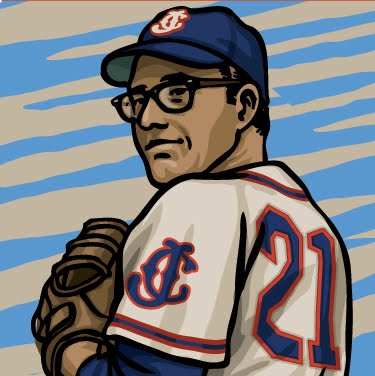

 Ah, Super Bowl Sunday. For a die-hard baseball fan like myself, no day makes baseball season seem as far away as Super Bowl Sunday. As a nod to football, yet keeping baseball in the forefront, I give you Shipwreck Kelly. Hard-core football historians (if there are any of them) know Kelly was a star running back for the University of Kentucky in the late 20's - early 30's and then was one of the first stars of the fledgling NFL. He also played baseball.
