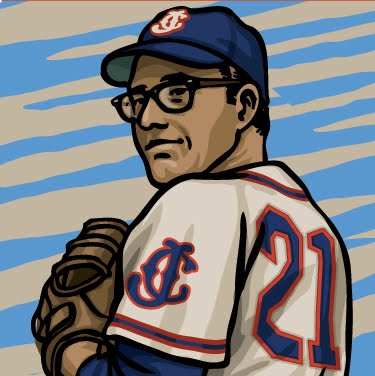
Like most baseball fans, I ran out to watch Barry Levinson's 1984 movie "The Natural." As a budding baseball history geek, I was enthralled with the attention to detail the set decorators, costume designers and graphic artists had spent bringing to life the sights and sounds of 1939 baseball. As a testament to the talent of those men and women, the New York Knights jersey is still sold by many companies and I spy at least one at every major league ballgame I go to. I've talked about all this before in the story and card I did of his teammate on the Knights, Bump Baily.
The movie begins with the teenage Roy and girlfriend Iris (very distractingly and unconvincingly played by Glenn Close and Robert Redford who were, what, 50 something at the time?) making love on the eve of Roy's call-up to the Chicago Cubs. As most everyone knows, Hobbs gets shot by a deranged woman and his career and life gets sidetracked and 16 years later he reemerges as a 35 year-old rookie for the moribund New York Knights. An all-around good guy with the virtues of a slightly-jaded Christy Mathewson, Redford's Roy Hobbs smiles his way through a doomed love affair with his manager's fem-fatale niece Memo Paris, mid-season batting slump and temptations from shady gamblers. The spectacular final scene during the playoff game against the Pirates caps off an inspiring movie as the hero finds out he is indeed the father of Iris's kid and sends a Spalding baseball into the Knights Field lighting system, winning not only ownership of the team for Pop Fisher, but baseball immortality, Hobbs' life-long dream. The closing sequence shows Roy playing catch with his son, safe and sound back on the farm where he started from. I assume Iris, who's not featured in the shot, is in the kitchen putting the finishing touches on a pie or something. The newly reunited Hobbs' family lives happily ever after.
Nice. So years later I snatched up a used paperback copy of the book by Bernard Malamud that the movie was based on. I sat on it for a while, not really all that gassed up to just read what the movie ably portrayed on screen. But when my buddy Charlie Vascellaro, the famed sportswriter and raconteur, saw it laying around and told me it wasn't anywhere near what I thought it was, I finally did crack it open. Boy was I surprised! The Roy Hobbs in the novel was the exact opposite of Redford's sugary version.
The book had a dark tone to it. Hobbs wasn't a fresh-faced teen in the beginning but a normal jock who just cares about himself. There was no teenage love affair with a corn-fed Iris from back home. In the book Iris was a frumpy middle-aged single mom and groupie he alternately bangs and ignores whenever the Knights are in Chicago to play the Cubs. He finally drops her like a bad habit when she tells him that she is a grandmother. He's mean to kids, doesn't get along with his teammates and is driven by that one thing: "When I walk down the street I want people to say: There goes Roy Hobbs. The best there ever was..." He doesn't really care about Pop Fisher and his sob story about losing the Knights to his partner, the evil Judge Banner. Hobbs is constantly preoccupied with turning a buck, continually complaining to The Judge to give him a raise because of how good he is. He even takes the Judge's money to throw the final game so he has a nest egg to run off with the manager's niece. When he finally gets pangs of regret after Iris lets him know she's knocked up with his kid he decides to become the hero and win the game. But unlike in the movie, he strikes out to end the game. The last scene in the book reveals a broken Roy Hobbs, passing a newspaper seller hawking papers reporting his expulsion from baseball and the compete erasure of his name and statistics from the record book.
Wow.
Now imagine if that was the movie. Would you have liked it better? Would "The Natural" have stayed such a popular baseball movie with an anti-hero and an ending like that? Would I see New York Knights jerseys with the number 9 on the back at major league ballgames? I don't know, probably not. Leaving the theater after seeing Hobbs blow up the scoreboard at Knights Field fills you with such a sense of euphoria and child-like glee that I think if the movie ended as sudden and demoralizing as the book it would not have had the same lasting impact. I do, however, feel like THAT would have been a movie I would have liked much better. Watching Redford as Roy Hobbs now 25 years later I see how schmaltzy his acting is. And his ever-present 70's man foppy hair-do bothers my historically accurate nerves (I read that he has a clause in his contracts that makes him exempt from changing his dopey hair style!). The silly love story with Iris is just a patch-work ploy to find a place for Glenn Close in the script. Here's a little something to show you how deep the scriptwriter was: did you realize that the young pitcher who gives up Hobbs' homer at the end of the movie is supposed to be the kid in the beginning of the movie who receives the baseball from young Roy after he strikes out "The Whammer"?
Anyway, flaws aside, I'd still watch this movie over any other baseball movie, even, yes, I'm going to say it: even over the darling of the baseball crowd: "Bull Durham." I'm sorry, I really didn't buy Tim Robbins as a ballplayer back then and I sure as hell don't now. And you know, I thought Annie Savoy was friggin' annoying. Yeah, I said that too. I went to art school and knew whole roomfuls of Annie Savoy's, chicks from medium-sized towns that talked like a thesaurus and believed that a few Edith Piaf LPs and becoming a self-appointed aficionado of something as pedestrian as baseball would make them the big, cool fish in the stagnant pond of whatever mediocre burg they were from. Yeah, see, I dated a few of them, trust me. But I will say this: Kevin Costner was good as catcher Crash Davis. And speaking of him, how about that movie where he relives his life story while pitching a no-hitter at Yankee Stadium? My Mom rented me that movie one Christmas when I was visiting. I really didn't want to watch it, but was glad I did because I thought it was pretty good. Quite a few baseball guys I know quietly admit to liking it as well. Just don't tell anybody...
But anyway, Back to Roy Hobbs. When I decided to do a Hobbs card, I was torn between the good Hobbs of the movie and the bad Hobbs of the novel. Liking the novel much more, I decided on the bad one when writing the back of the card. To save everyone's eye sight I'll reproduce the text below:
Roy Edward Hobbs
Bats: Left
Throws: Left
Born: Aug. 10, 1905 Sabotac Valley, Iowa
Died: March 18, 1966 Grainger, Texas
Signed as a pitching phenom by the Cubs in 1923, Hobbs’ promising career was cut short when a deranged woman shot him. Hobbs slowly regained his skills playing semi-pro ball and at age 35 made a come-back with the New York Knights. He made a splash from the start by knocking the cover off the ball in his first major league at bat. He broke the record for doubles by a rookie and his 46 home runs spearheaded the Knights drive to the pennant. After he went 0 for 4 in the one-game playoff against Pittsburgh it was shown that Hobbs and pitcher Al Fowler were bribed by Knights owner Judge Albert Banner to lose the game. The commissioner of baseball banned Hobbs from baseball and removed all traces of him from the record books. A broken man, he died an oil field accident in 1966.