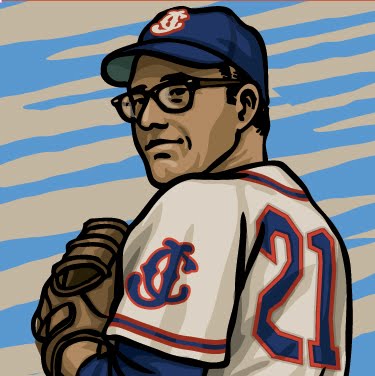
Showing posts with label Kansas City Monarchs. Show all posts

Thursday, November 6, 2014

182. Jackie Robinson: Veterans Day 2014


Since I began this website I always liked to feature a special story for Memorial Day and Veterans Day. Indeed some of my favorite stories have been part of this little series: Eddie Grant, Bill Niemeyer and Sam Kau to name a few. This Veteran's Day I'm reminded that not all vet's served in combat. Some men served in peacetime like Sig Jakucki and Torpedo Mills, and then there were those who for whatever reasons were spared the horrors of battle.

Jackie Robinson was one of those men. 

In the summer of 1944 2nd Lieutenant Jack Robinson found himself at Camp Breckinridge, an infantry replacement training depot in the hills of western Kentucky. The war had been rough for Robinson - not on the battlefields of France or a nameless island in the Pacific, but at home in a racial war whose injuries were not physical but mental.

Before the war Jackie Robinson was a well-known collegiate athlete. His exploits as a track star at UCLA set numerous records and his skills on the gridiron made the sports page from coast to coast. If he had been white, Jackie Robinson would have had to fight off offers from National Football League teams upon graduation. Instead Robinson took a position with a government-run athletic program which quickly folded. Looking for employment, Robinson took the most lucrative sports job he could find - semi-pro football in Hawaii. After a successful 1941 season, Robinson booked passage on a steamship back to Los Angeles. On Sunday, December 7th, 1941 he was contemplating his next move when the Japanese decided it for him. 

The 23 year-old Robinson received his draft notice in early 1942. After basic training with a cavalry regiment he and several other black soldiers requested a transfer to officer's candidate school. Robinson's natural leadership qualities and UCLA education made him ideal officer material but his skin color worked against him. His transfer was put on the back-burner until boxer Joe Lewis stepped in to help open the gate allowing black soldiers to attend officer's school. By January 1943 the former college star was 2nd Lieutenant Jack Robinson,U.S. Army.

Robinson was assigned to the 761st Tank Battalion at Ft. Hood Texas. Known as the "Black Panthers", the 761st would go on to earn a distinguished combat record serving under General Patton in Europe. For two reasons Lt. Robinson wasn't one of them.

Years of strenuous athletic activity had left Robinson with an old ankle injury that required testing to guarantee he was combat-ready. On afternoon while awaiting the results of the test, Robinson boarded an integrated Army bus and took a seat near the front. When the driver told Robinson to sit in the back he flatly refused. The driver reported the incident to the Military Police who took the insolent lieutenant in custody. The commander of the 761st flatly refused to prosecute his young officer but the matter was taken out of his hands when Robinson was transferred to another battalion. His new commanding officer happily signed off on court-martial proceedings before the ink was dry on his transfer papers.

After a humiliating trial in which he was acquitted of all charges, Robinson found himself a soldier without an army. His unit had deployed to Europe during his court martial and medical tests found his ankle was tender enough to keep him out of combat. The trial had made news and his superiors at Ft. Hood didn't want him around so he was transferred to another black unit, the 372nd Infantry Regiment.

The 372nd had a brilliant battle record from the first world war. The units shoulder patch was a red hand on a white disk trimmed in blue and red. This striking insignia was bestowed on the regiment by the French Army of Africa with which the unit had fought with in 1918. By the time Lt. Robinson caught up with the regiment at Camp Breckinridge, Kentucky it was being used as a feeder unit that trained replacement infantry troops. As a distinguished college athlete, Robinson was named the regiment's athletic director.

It was only a temporary assignment. Robinson's fight against the bogus court marshal gained him a reputation as a hard case, and with a bum ankle he wasn't any good for combat. The army decided to discharge him. In the meantime, Robinson waited for the slow moving paperwork to wind its way through Army bureaucracy by keeping the recruits occupied with baseball.

One afternoon Robinson happened upon a soldier throwing big league curve balls on the baseball field. The soldier was Ted Alexander, a former pitcher with the Kansas City Monarchs of the Negro American League. Robinson had had a brush with Negro League baseball back before the war when a traveling blackball team had played a pickup team which Robinson was a part of. When the game ended the team took off without giving Robinson his agreed upon money for the exhibition. The whole experience left Robinson with a bad taste in his mouth and a lingering distrust of black baseball operations. When Robinson told Alexander of his concerns about post-army employment, the pitcher revealed the the Monarchs were always hiring good talent. The war had hit black baseball as hard as the white version with many of its good players in the service. However with many blacks now employed in high paying war industry jobs, blackball was the most popular diversion for their new-found disposable income. The Negro Leagues were experiencing their most profitable period in their history.

The former Monarchs pitcher surely related all this to Robinson and before the two men parted ways Alexander had given the Lieutenant Kansas City Monarchs' owner Tom Baird's contact information. When he received his honorable discharge in November of 1944, Robinson wrote to the Monarchs inquiring about a position. In the meantime he took a job as athletic director at Sam Huston College in Austin, Texas. When spring rolled around the Monarchs sent Robinson a $400 a month contract and instructed him to report for spring training. 

Jackie Robinson's baseball career had begun.

This was a neat story I stumbled on when seeking players for my Kentucky Baseball book project. Much has been written about Jackie Robinson, yet I found it a much neglected side bar that the roots of his professional baseball career actually dated back to a late summer afternoon in western Kentucky. This was a fun illustration to work on especially since his army regiments insignia was so unique - I just knew that red hand would make the drawing. My old pal Will Arlt, owner of Ideal Cap Co. was in town last week and I showed him my illustration. We both agreed that the cap I depicted Jackie wearing would have to be an eventual offering from Ideal, so be on the look out for it next year.

Next week I will revert to the customary baseball card format for my drawings - it just so happens that I recently completed two full-page illustrations for the Kentucky project and I thought it would be a shame to shoe-horn them into a smaller format.

Anyway, this post is dedicated to all the men and women who have served in the United States military. It was your sacrifices and sense of duty that allowed me the life I am fortunate to enjoy. I think of that every day, not just on Memorial and Veteran's Day. Thank you from this very grateful artist.

Tuesday, June 25, 2013

153. Mickey Stubblefield: Integrating The KITTY League


Though it's hard for me to focus on one subject for too long, I've been slowly accumulating a roster of ballplayers for my next edition of "21". Unlike the last book, this one will focus on baseball in Kentucky. Why Kentucky you might ask? Though I was born and bred in North Jersey and over the course of my career have lived in many places, Kentucky is my adapted home. Moving to this area back in 1995, I instantly fell in love with the people and coziness of the place. So many places around the country have bled together and lost their uniqueness. It was that regional distinctiveness that made the Cincinnati-Northern Kentucky area something special to me. I like how people still go nuts over fireworks, fight over whether Graeters or Aglamesis Brothers make better ice cream and that crazy Opening Day Parade. Still, my Gypsy blood (honestly, I actually do descend from Carpathian Roma) made me wander away not once, but twice over the years. In an odd twist of fate, I'm probably the only human being who was not born in this area that voluntarily moved here three separate times! There was good reason: The best friends I've ever had were made right here and, right after moving back here for the third time, I met the woman who in 6 short weeks will be my wife. Kentucky has been good to me and this little book will be my way of saying thanks. Over the years I've featured a few Kentucky ballplayers such as Pee Wee Reese and Happy Chandler, but looking deeper there are many more interesting characters who played ball here in the Blue Grass State and I'm excited to shine a light on these neat ballplayers.

Though Jackie Robinson is the man everyone thinks of when it comes to integration of the National Pastime, Robinson broke the color barrier in only two leagues. At the time he took the field for the Brooklyn Dodgers in 1947, there were 52 minor leagues operating in North America, and though Robinson had integrated the International League in 1946, it was up to 51 other brave and talented black men to integrate the remaining circuits. On June 26, 1952, Mayfield, Kentucky's own Mickey Stubblefield became one of those men.

Outside the Mayfield Clothiers' locker room, 1,500 people packed Graves County War Memorial Park. Although Maysfield was mired in last place, the game was completely sold out and the crowd had overflowed into the football stadium bleachers beyond the park's right field wall. Something was happening that day and that something was integration. Maysfield native Mickey Stubblefield was about to become the first black ballplayer in the Kentucky-Illinois-Tennessee League, commonly called the "Kitty League". Buttoning up his home white jersey with "Clothiers" across the front, the team's new pitcher listened with apprehension to the rumble of the crowd. It wasn't the size that bothered him, heck, with the Kansas City Monarchs he'd played to Major League sized crowds. No, it wasn't the size of the crowd, it was the uncertainty of it. The Kitty League had always been a whites-only circuit. Even the Negro Leagues, which had teams in all parts of the country including the deep south, had failed to take hold in any of the towns the Kitty League represented. This was Jim Crow territory and by stepping out onto that field, Mickey Stubblefield was about to deal him a mighty blow.

Mickey was born not too far from the ballpark he was now scheduled to pitch in. The fifth of six kids, his real name was Wilker, after his mother's family. "Mickey" was a nickname given to him as a boy, derived not from the star catcher of the Athletics and Tigers, Mickey Cochrane, but from the oversize used shoes he had to wear: they reminded everyone of Mickey Mouse. Before he was a teen he was orphaned and was shuttled around from one relative to another. One of the only constant things in his life was baseball. At 11 he became the batboy to the Mayfield Clothiers, the Kitty League team he would one day pitch for.

When the war came, Mickey joined the Navy and served at various bases stateside. When he was cut loose from the service in 1946, Mickey didn't have a vocation to return to. When a Navy buddy wrote to him about a spot on a barnstorming baseball team out of Nebraska, and even offered to send money for a ticket, he jumped at the chance.

The Omaha Rockets were an all-black traveling team that covered the dusty plains playing in the small towns professional baseball never reached. Black barnstorming teams were an annual treat for isolated baseball fans and the Omaha Rockets were one of the last of their kind. Soon the advent of television and the recent lifting of baseball's color barrier would spell the end of this rural tradition. 

For the organized Negro Leagues too, baseball's integration marked the beginning of the end. As all the best players were relentlessly signed away, fresh blood was needed to keep the proud black institution operating. The venerable Kansas City Monarchs, winners of over ten Negro American League pennants, were no exception and Mickey Stubblefield soon found himself wearing the uniform of black baseball's premier franchise.

Joining the team for spring training, Mickey had to grow up fast. The Monarchs boasted one of the best pitching staffs in blackball. The rotation was of All-Star calibre: Hilton Smith, Lefty LaMarque, Connie Johnson and of course, the legendary Satchel Paige. Later Mickey would tell how Paige took him under his wing and taught him how to throw his special curve ball. At 5'-9" Mickey was dwarfed by the 6'-3" Paige, thus earning him the nickname "Little Satch". Due to his small stature he wasn't a fireballer like Paige and LaMarque. Mickey had to rely on an arsenal of junk balls and various curves which he threw from various angles to make them break differently.

It was a tough squad to crack. The Monarch's star pitchers were reserved for league games that counted and rookies like Mickey were used to face the semi-pro and town teams the Monarchs took on to turn a profit. The traveling was hard and the team sometimes played two games a day in different towns. When they slept in hotels it was usually a seedy rooming house and meals were either eaten on the bus in transit or at a rare black-friendly roadside diner. It was a tough life and many players succumbed to the temptations of the road. Mickey was more disciplined than many his age and he avoided drinking much and never took up smoking. He even got married and began a family.

After spending the summer pitching to farmers and factory workers, integration finally gave Mickey a chance at the starting rotation. In July Satchel was signed by the Cleveland Indians and others left the Monarchs for the white minor leagues, giving Mickey the chance to pitch against Negro American League opponents. While no statistics exist from the many games he tossed against the semi-pros that summer, it is documented that he won the two league games he appeared in, both complete games, giving up a total of 10 hits and 3 runs. It wasn't a bad record considering it was his first season of pro ball and it earned him a call back for the 1949 season.

With Jackie Robinson firmly established as a superstar and many other blacks now playing in the majors, black newspapers stopped covering Negro League ball as close as they had previously. No record exists from the 1949 season to document Mickey's sophomore year in the Negro Leagues. Though the reasons are not known, he left the Monarchs late in the season and hooked up with the McCook Cats of the Nebraska Independent League. The Cats were an integrated top-notch semi-pro team and Mickey returned the following season where he went 13-6. 

By now Mickey was 24 and a married family man. Thinking about his future, he gave up pro ball and returned to Mayfield, Kentucky. To keep his love of the game alive he played semi-pro ball for the Dr. Pepper bottling plant he worked at. For a veteran of the Negro Leagues, playing industrial league ball was a piece of cake and his advanced level of play soon attracted the attention of the team he was once batboy for.

The Mayfield Clothiers was one of the lower rungs of the Pittsburgh Pirates farm system. The Pirates had barely limped through the war years but now boasted Branch Rickey, mastermind behind the Cardinals and Dodgers dynasties, at their helm. With him in Pittsburgh was his son, Branch Rickey, Jr. and he is the man credited for signing Mickey to a Pirates minor league contact.

Mayfield was stranded in last place and in dire need of pitching. Whether Mickey's signing was the acquisition of a promising prospect or a shrewd way to pack the stands with black fans or a combination of both, is not known. What is documented is that until June 26, 1952, the Kentucky-Illinois-Tennessee League was an all-white affair.

Which brings us back to Mickey and the sold out Graves County War Memorial Park. 

Grabbing his glove, Mickey emerged from the dugout and ran onto the field to start the game against the Paducah Indians. All apprehention subsided when he quickly realised the crowd was cheering for, not against him. Standing atop the mound, he could see that 1,500 black and white fans were on their feet giving him a standing ovation. When he struck out the first batter, Mickey also struck out Jim Crow. 

He won the game 5-4, giving up 6 hits and striking out six Indians. While it would be great to write that the addition of Mickey was the spark that ignited the Mayfield Clothiers to make a pennant run, it was not to be. The Clothiers still had a terrible team despite Mickey's decent pitching and finished dead last. A check of the 1952 Kitty League record book shows that Mickey Stubblefield won 7 and lost 6. His 3.71 ERA was pretty good considering that even the lousiest team in the league scored an average of 5 runs a game that summer. Hampering his usefulness was that only one other Kitty League team would allow him to pitch in their ballparks. Most of the cities that the league operated in still imposed segregation laws prohibiting the races from mixing in publicly owned stadiums. Paducah was the only team that allowed Mickey to pitch. Jackson, Tennessee was willing to have him appear in their park, but the game he was scheduled to pitch was rained out. Although he was probably the second best pitcher Mayfield had, a pitcher who was only available for home games stood in the way of him making his true value to the team apparent. 

Mixing of the races also played into 1952 being Mickey's only year in the Kitty League. The league agreed that beginning in 1953 no other black ballplayer would be signed because of the difficulty finding facilities that would accommodate them. While on one hand, finding separate hotels and restaurants that would serve blacks proved a problem, it was a technical way of saying that with the exception of Mayfield and Jackson, no other city was willing to change their Jim Crow laws just yet. 

But Mickey Stubblefield's year as a racial pioneer had deeper repercussions in the civil rights movement. His appearance in the previous all-white league joined with all the other individual strives made against segregation. Right there in Mayfield, the tide of integration once again swept into the little town in 1956. Ten black students enrolled in the all-white Mayfield High instead of the all-black Dunbar High, Mickey's Alma mater. It was a brave move and one that ended peacefully as the ten teens attended class without anything more serious happening than a meager walk-out demonstration. Within 2 years, segregated Dunbar High was a thing of the past.

As for Mickey, after the 1952 season he moved on to the Duluth Dukes of the Northern League. He was 2-0 when his arm went bad. Again, trying to mix a career with baseball, Mickey rejoined the McCook Cats and worked in a Chevy dealership. He liked Nebraska and made it his home, raising 10 kids. His days as a star ballplayer with the Cats made him a popular figure after he retired from the game. He even had his own radio show on WKTM called "Kick with Mick" and was the Grand Marshall of the 2011 Heritage Days Festival. With his kids grown, Mickey moved back to Mayfield in 1970. When he passed away in 2013, Mickey Stubblefield could look back with pride at the modest but important part he played in making baseball truly the National Pastime.

Friday, November 11, 2011

Buck O'Neil Illustrations at the Orioles' Spring Training Facility


Earlier this year I was honored to be commissioned to illustrate 3 panels depicting the baseball career of Buck O'Neil. Anyone who's watched Ken Burn's documentary "Baseball" knows who Buck is, his great camera presence and lively commentary on the Negro Leagues made him the instant star of that epic mini-series. I'd met Buck a few times in the late 80's and early 90's and illustrating this triptych to pay homage to one of the games' leading goodwill ambassadors was a great thrill. Buck would be 100 this year and the Baltimore Orioles made the great decision to honor Buck by naming their Twin Lakes, Florida complex after him.

From the Baltimore Sun...

Orioles to honor Buck O'Neil on Sunday

The Orioles will hold a ceremony Sunday to honor Negro leagues pioneer Buck O’Neil at their minor league facility in Sarasota, Fla.

O’Neil, who died in 2006, would have been 100 years old Sunday. The star first baseman and manager spent part of his childhood in Sarasota, home to the Orioles’ Buck O’Neil Baseball Complex at Twin Lakes Park. O’Neil, who went on to scout and coach in the major leagues, worked to preserve the history and promote awareness of the Negro leagues.

The Orioles will unveil three illustrated baseball cards of O’Neil created by artist Gary Cieradkowski, whose works honor Negro leagues players who never had cards of their own. The O’Neil cards have been displayed at the minor league complex. An honorary plaque will also be hung at the main entrance to the complex’s administrative building.

Sarasota County commissioners Carolyn Mason and Joe Barbetta will also proclaim Sunday Buck O’Neil Day in Sarasota.

I'd like to thank Orioles Vice-President of Planning and Development Janet Marie Smith for recommending me to Art Director Keith Kellner to commission me to do the Buck O'Neil illustrations.

Thursday, February 24, 2011

69. Satchel Paige: Hitting Rock-Bottom


I was searching the internet for something or other when I came across a website dedicated to baseball in Western Canada and found an unpublished photograph of Satchel Paige. Taken in Butte, Montana in 1939 or 1940, Paige looked weary and distracted, posing with a baseball fan. I'd seen hundreds of pictures of Satchel before but this one was different. Besides the distractingly sad look on his face, it was the jersey he wore that captured my attention - it simply said "PAIGE" - that was all. I've seen Paige in the uniform of the Monarchs, Baltimore Black Sox, Birmingham Black Barons, St. Louis Browns, Cleveland Indians, Homestead Grays, Pittsburgh Crawfords, New York Black Yankees... etc, etc... but never "PAIGE." Intrigued, I decided to do a drawing of this unique jersey and write about what the Great One was doing in 1939 and 1940...

Recognized as the best pitcher in baseball, Satchel Paige took his golden arm wherever the money and swag was good. 1938 found the great Paige in Mexico City being paid $2000 a month to hurl for Club Agrario. The fledgling Mexican League desperately wanted to bring an element of legitimacy to their league and a handful of American Negro League stars provided that while the great Satchel Paige was looked upon to provide the flash and headlines.

By the age of 33 Satchel had probably thrown more innings of ball than anyone ever had before and while much younger and stronger pitchers flamed out with arm injuries, Paige and his rubber arm never dimmed. But one afternoon warming up in the rarefied air of Mexico City, Paige threw a curveball and felt a snap in his shoulder. He retreated to his hotel room and treated the injury with a liberal dose of tequila and went to sleep. The next morning the arm was worse. The pain was incredible and quickly doubled when he tried to pitch. He managed to appear in a few games for Mexico City but with the league promoters angered and Mexican fans disappointed he finally gave up and fled across the border back into the United states.

Satch traveled around the country seeking specialists who could find out what was wrong with the greatest arm in baseball, but the only advice he got was "you'll never pitch again." Paige soon found himself running out of cash and had to start pawning his belongings in order to survive. He sank into a deep depression, realizing that he had nothing to show for all his success and absolutely no options left outside of baseball. His years of ignoring contracts and leaving teams whenever he was offered better money somewhere else had made him few friends. Only 1 man was willing to take a chance with Satchel, Kansas City Monarchs owner J.L. Wilkinson. Wilkinson put Satchel on the payroll and had him front the Monarchs second-rate traveling team. Now billed as the "Satchel Paige All-Stars" the team barnstormed all over the western part of North America, often teaming up with one of the bearded House of David teams and brought their game to the most rural of towns.

Wilkinson played up Satchels reputation for all it's worth, giving him top billing on all advertisements and guaranteeing him to pitch a few innings of each game. Paige endured the terrible pain game after game trying to alternately rest and pitch his arm back into shape. Wilkinson had the Monarchs' trainer, Frank "Jew Baby" Floyd travel with Satch and see if he could do anything to help him along. "Jew Baby" (don't even ask where his name came from, better men than I have failed to find out) rubbed Satchel down relentlessly before and after each appearance with a mysterious home-made potion, then alternated between steaming hot towel treatments and freezing cold water and ice.

Through it all Satchel Paige thrilled thousands of baseball fans who had never seen real ballplayers. The publicity surrounding Paige made him a mythical figure and the arrival of the All-Stars to a small town sometimes was the highlight of the whole year. Since the regular press didn't really write about Paige or other black players and teams, many had only heard of the great pitcher through word of mouth, pushing his already monumental reputation to biblical proportions. When the All-Stars weren't touring with the House of David they played against town teams and amateur clubs where players of all levels got the chance to try their best against the greatest pitcher in the world. Dizzy Dean or Carl Hubble would never visit the places the Paige All-Stars did and to get a chance like this was something that participants never tired of retelling throughout the years. Even in constant pain Paige gave the audience what they expected from him. His double and triple windmill wind-up, hesitation pitch and trash-talk was well worth the price of admission. That his famed fastball was now nothing more than a change-up didn't really seem to matter all that much. He relied on junk pitches and street psychology to get over on opposing batters that simply added to his mystique. However some came away disappointed by seeing Paige as a mere mortal and it was humbling for the proud Paige as well. Batters that would have hesitated to even step into the box and face him a few years earlier now hit line drives off of him and the second-rate traveling team who backed him up didn't always win.

Then on a warm Sunday in Oklahoma City, the arm came back. There are a few stories that supposedly tell the true circumstances surrounding his comeback: one relates how he was punched in the arm by a teammate resulting in the arm suddenly becoming painless, another had him making a pick-off throw to first, the ball unexpectedly rocketing to the first baseman with such velocity that the whole ballpark paused in a collective hush, and still another simply has him telling his catcher that he was feeling good that day and that was that. What all the stories have in common is that they all feature the arm suddenly, not gradually, regaining its power again. What that means and what was really wrong, we'll never know.

But one thing was for sure: Satchel Paige was back.

If you're interested in this phase of Paige's career or just want a great book about an average negro league ballplayer during the 1930's and 40's, you have to get a copy of "Catching Dreams by Frazier "Slow" Robinson. He was Satchel's catcher on the 1939 and 1940 All-Stars and his book relates what it was like playing along side Paige as his career hit rock-bottom. Robinson wasn't a star, after the Paige All-Stars broke up he bumped from team to team as a second-string backstop but his stories are top notch - not as interesting as Paige's nor as embellished as Buck O'Neil's, Robinson's book is indispensable for anyone interested in what life was really like for a typical journeyman during the golden years of the negro league baseball.

The website where I found the photograph of Paige that started this story: Baseball In Western Canada


Tuesday, May 11, 2010

28. Willard Brown

Back in 1947 as Jackie Robinson was breaking the color line in the National League, Willard Brown and Hank Thompson, two heavy weight negro league sluggers joined the American Leagues' St. Louis Browns. While Robinson was given a year of minor league seasoning to get acclimated to white organized ball, Brown and Thompson were sent directly to the big club. This move by the Browns ultimately hurt both the players and the team as they were not able to adapt to the huge cultural difference and senseless racism they encountered. They were unable to sleep in the same hotel as their teammates who were pretty much indifferent to their presence on the club. On August 13, 1947 Brown belted a Hal Newhouser pitch into the far reaches of Sportsmans Park and quickly rounded the bases for an inside the park home run, the first by a black player in the American League. Instead of celebrating the feat, teammate Jeff Heath, whose bat Brown used, broke it in half rather than have him use it again. After 21 games and a low batting average both Brown and Thompson were released. Thompson had a second chance with the Giants a few years later and made good but Willard Brown never made it back to the majors, spending the next 10 years in the negro and minor leagues where he continued his legendary status as one of the games best sluggers.

As the mighty Kansas City Monarchs' batboy, Willard Brown dreamed of playing for the Monarchs. In 1935 he realised that dream when he became the team's starting shortstop. Soon moved to the outfield to take advantage of his speed, Brown became black baseball's most prolific hitter. He hit for a high average and was also one of the fastest ballplayers of the late 1930’s. Brown was sometimes accused of being lazy in the field, saving his strength for larger crowds and more important games but at the same time he was considered to be a superior outfielder and was voted to the All-Star Game 8 times. He hit well above .300 for his whole negro league career and led the league in doubles, triple, home runs and stolen bases many times. The Monarchs of the late '30's and '40's were a powerhouse and Brown was instrumental in their winning the pennant 5 times during his time with the team. During the war Brown played on the champion ballclub that won the European Theater World Series and he hit the winning home run of the deciding game giving Leon Day the victory over Ewell Blackwell and Patton's 4th Army team made up of major league players. He then played ball in the negro and minor leagues until 1957. Popular with players and fans, Brown was elected to the Hall of Fame in 2006.