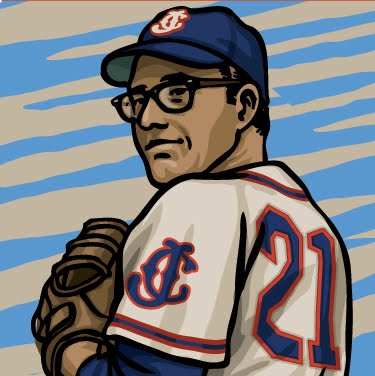
When I first started this blog a little over 3 years ago, I started receiving many requests for players to be profiled on here and given The Infinite Baseball Card Set "treatment." Out of all the emails I began to notice that it was not one particular player that was asked for the most, but rather a whole ethnic group: Jewish ballplayers. I did cards and stories on here of Sandy Koufax and Moe Berg, but I began slowly researching different players of the Jewish faith, trying to find characters who would fit in with the kind of stories I like to write - guys with interesting stories who may not be known to the casual fan of baseball history. Al Schacht was one of those guys, and in fact he appears on page 7 of the Premier Issue of "21: The Illustrated Journal of Outsider Baseball." While many baseball fans may know of him from the comedy routines he did with Nick Altrock, Al Schacht was actually a real pro ballplayer and had a nice career before he started his second career as a comedian. His story of doing everything possible to attain his goal of playing in the major leagues was both funny and inspiring to me, as I hope it is to you...
Al Schacht was a product of the teaming slums of the Lower East Side. The son of Russian immigrants, Al defied his parents wishes by embracing the American pastime of baseball. His mother, daughter of the village Rabbi back in Russia, was especially against the game, fearing he’ll turn out to be a bum or a loafer if he continued. Despite the warning, Schacht poured his heart and soul into the game. After the family moved to the more rural Bronx, Schacht would walk all the way to the Polo Grounds in Harlem to see his beloved New York Giants play. He went beyond being a casual fan however and soon made himself useful to the team by running errands for the players. Christy Mathewson especially became a favorite of Schacht and the two struck up a friendship of sorts. Mathewson even taught the young kid how to throw his famed “fadeaway” pitch.
Because of being 5’-11” and only 125 pounds, Schacht was overlooked for his high school team so he put his talents to use on the sandlot and with semi-pro teams. Although he eventually made his high school team, he was later found illegible because of his having played semi-pro ball for pay. So Schacht dropped out of school all together and pursued a career in professional baseball.
Catching on with a team in Walton, N.Y. he promptly won 16 consecutive games. Before one game he learned that a scout from the Cincinnati Reds was in the stands to watch him. Fearing his diminutive size would work against him before he even had a chance, Schacht pulled on double pairs of socks and a couple of sweatshirts along with sliding pads to make himself seem bigger. The afternoon was hot and the struggling Schacht lost 2-0, but he was called to Cincinnati and put in front of owner Clark Griffith. Seeing that he was much smaller than described, Griffith offered him a minor league contract. Schacht declined, knowing he could make more playing semi-pro ball than in the low minors.
Schacht played around the Northeast for various clubs and after a stint in the army during the First World War, where he did little more than play baseball, Al signed with the Jersey City Skeeters in 1919. The Skeeters were a miserable team, winning only 45 games during the whole season. However, Schacht was the winner of 20 of those contests. After each win Schacht would anonymously send a newspaper clipping of the game to Clark Griffith. Now owner of The Washington Senators, Griffith himself travelled to Jersey City to look Schacht over. After his 10th shutout of the year, Griffith signed Al to play for the Senators. He was a good pitcher for a few seasons but it was his second talent on the diamond that he became known for.
Al Schacht was a natural clown. Teaming up with former player Nick Altrock, the two made the stands howl with laughter as they went through silent vaudeville routines between innings. Besides being clowns, the two men served as 1st and 3rd base coaches. By all reports Schacht was a well respected coach while with the team. By 1921 Altrock and Schacht were performing all over the league as well as at the World Series. Somewhere along the way however, Altrock and Schacht had a falling out. No one really knows the reason why, some say it was an anti-Semitic remark Altrock made while drunk, others say it was jealousy over Schacht's younger age. Whatever the reason the two silently feuded for years before breaking up the act in 1936.
Clad in his trademark top hat and tails over a baseball uniform and known as the “Clown Prince of Baseball” Schacht was famous all over the country, even appearing on stage with such celebrities as Bing Crosby. During the Second World War Al volunteered to entertain the troops. Appearing in such remote places as North Africa and the South Pacific, Schacht helped bring a smile to homesick servicemen. After the war he opened up a restaurant in Manhattan which became a hang out for ballplayers and celebrities. The affable Schacht worked the room entertaining his customers.
Throughout his long career Al Schacht never hid that he was a Jew, famously remarking: "There is talk that I am Jewish-just because my father was Jewish, my mother was Jewish, I speak Yiddish and once studied to be a rabbi and a cantor. Well, that's how rumors get started."
 If you've been reading my stories for a while, you'd already know that before the 1950's, the best ballplayers weren't all in the major leagues. The Negro Leagues had their stars as did the Cuban and Puerto Rican leagues. Here in the States we had a thriving semi-pro circuit and that is where guys like Buck Lai plied their trade on Saturday and Sunday afternoons throughout the 1920's...
Three times Buck Lai came perilously close to becoming the first Asian-American to play Major League ball. The first time was 1915 when the Chicago White Sox invited Lai, then known as Lai Tin, to join the team for spring training. Sox manager Nixey Callahan had seen Lai play ball when he toured with the Chinese Travelers. The team was made up of Hawaiians and each summer toured extensively throughout the States. The son of Chinese immigrants and a native of Hawaii, Lai was a star athlete back in Honolulu not only in baseball but he held the high school record for the 100 yard dash and running broad jump. Though newspapers reported his expected presence at Chicago’s camp that spring, Callahan was sacked as manager and apparently so was Lai’s direct link to the the Sox.
By 1916 Buck had married a Brooklyn girl named Isabel and was living in Audubon, N.J. While working as an inspector for the Pennsylvania Railroad he played semi-pro ball against top-notch Negro League teams and other touring ball clubs, continuing to make a name for himself in the press becoming known by the nickname "Speed Demon". Two years later the Philadelphia Phillies came knocking and after a tryout was signed to their farm club in Bridgeport, Connecticut. His first year there he batted a respectable .293 and along with Chinese-American teammate Andy Yim, was a favorite of the Bridgeport Americans’ fans. According to newspaper accounts the two “Celestials” sometimes serenaded the crowd, Buck belting out the hits accompanied by Yim on ukulele.
The next year he suffered an injury to his hand which dogged him for the rest of his life and effectively ended his hopes of making the big leagues. Lai played a total of 4 seasons with Bridgeport and batted around .260, about average for the league.
Still keeping his day job, Buck joined the Brooklyn Bushwicks, a major league-quality semi-pro team and was their starting third baseman for more than 10 years. The Bushwicks played 4 games a week and often out-drew the Dodgers in attendance. Besides Buck the Bushwicks boasted quite a few former and future major league players and they played against the best teams in outsider baseball.
Baseball researcher Scott Simkus reviewed 248 Bushwick box scores for games played against top-tier Negro League competition and found Buck hit an astonishing .297! He then compared that record with another contemporary third baseman, Negro Leaguer and Hall of Famer Judy Johnson who hit .295 against the same teams as Buck. Since the Bushwicks were very well-known around the New York area, it was just a matter of time before John McGraw of the New York Giants came calling.
In the spring of 1928, 33 year-old Buck Lai travelled to Augusta, Georgia to join the Giants. Though Buck played third his whole career, New York already had the best third-sacker in the league, Freddie Lindstrom. Buck was offered the chance to win the job at second base but failed to make the cut. Newspaper accounts reported that while Buck was not the best fielder, he more than compensated with his base running, batting and all-around smart sense of the game. Despite all this the Giants thought he was too small to last a season in the majors. Reluctantly Buck agreed to join the Giants top farm club. Lai played 4 games for the Jersey City Skeeters before calling it quits and rejoining the Bushwicks.
In the mid-1930’s Buck formed his own travelling team called the All-Hawaiian Nine featuring the best players of Chinese, Japanese and Hawaiian decent. As the they toured the U.S. showcasing the skills of Asian-Americans, a few of his players were offered tryouts by pro ball clubs. Taking after his Pop, Buck’s teenage son, Lai Jr., joined the All-Hawaiians as well. By 1939 Buck had retired from playing ball and resettled back in Audubon, N.J. While working at a ship building company, Buck stayed active in the game by managing a few semi-pro teams in the Camden area and scouting for the Dodgers. With a lifetime of brilliant outsider baseball behind him, Buck Lai passed away in March, 1978 at the age of 83.
 On a day like today, Veteran's Day, I want to feature a real hero. These days it seems anyone who does anything can be termed a hero. We are losing the real meaning of that word and that is something that really bothers me, especially when I learn about ordinary men and women who somehow rise to the top and emerge as real heroes. Miners trapped in Chile may be survivors and noteworthy, but they are not heroes. But, instead of writing a bitter, angry introduction outing the many pseudo-heroes that the media seems to create and force-feed to us non-stop, I will let the story of a real, bona-fide hero speak for itself.
They called him "Harvard Eddie." At a time when most ballplayers barely had a high school education, third baseman Eddie Grant, Harvard Class of 1909, was a member of the Massachusetts Bar, a full-fledged lawyer. He was also a darn good third baseman, batting .322 for Jersey City and leading the Eastern League during his first year in pro ball. The next season, 1907, Grant was called up to the Philadelphia Phillies. He quickly gained attention, not from his bat or fielding skills, but for what he would say on the field: when calling out his claim on a pop fly, instead of yelling the common "I GOT it!", Harvard Eddie called out the proper phrase, "I HAVE it!" much to the amusement of his more modestly educated teammates.
On a day like today, Veteran's Day, I want to feature a real hero. These days it seems anyone who does anything can be termed a hero. We are losing the real meaning of that word and that is something that really bothers me, especially when I learn about ordinary men and women who somehow rise to the top and emerge as real heroes. Miners trapped in Chile may be survivors and noteworthy, but they are not heroes. But, instead of writing a bitter, angry introduction outing the many pseudo-heroes that the media seems to create and force-feed to us non-stop, I will let the story of a real, bona-fide hero speak for itself.
They called him "Harvard Eddie." At a time when most ballplayers barely had a high school education, third baseman Eddie Grant, Harvard Class of 1909, was a member of the Massachusetts Bar, a full-fledged lawyer. He was also a darn good third baseman, batting .322 for Jersey City and leading the Eastern League during his first year in pro ball. The next season, 1907, Grant was called up to the Philadelphia Phillies. He quickly gained attention, not from his bat or fielding skills, but for what he would say on the field: when calling out his claim on a pop fly, instead of yelling the common "I GOT it!", Harvard Eddie called out the proper phrase, "I HAVE it!" much to the amusement of his more modestly educated teammates.
During off seasons Grant returned to Boston to practice law, but each spring he took up baseball again. Traded to Cincinnati in 1911, he lost something at the plate and his batting average plummeted. The death of his wife after barely 9 months of marriage might have been the reason why. In 1913 the New York Giants picked Grant up and although he rode the bench more often than not, John McGraw took a liking to the scholarly third sacker and made him the Giants' bench coach. As much as he loved the game, Grant disliked the life of a part-time coach and player and a the age of 32, retired to pursue his law career full-time.
The Great War had been raging in Europe for 3 years by now and many of Grant's Harvard classmates were active participants even before the U.S. entered the war. Whether they drove ambulances for one of the volunteer organizations operating just behind the trenches or flew airplanes for the French in the Lafayette Flying Corps, college educated men of that era felt a sense of duty and adventure that sadly seems lacking these days. Once America entered the war in April of 1917, even more of these privileged men from wealthy families left their lucrative careers and easy lives to become officers in the rapidly expanding U.S. Army. Back then the Army assumed that a college educated man made a natural leader and "Harvard Eddie" was made Captain of Company H, 307th Infantry Regiment, 77th Division of the American Expeditionary Forces. After a period of training on Long Island with his men, Grant sailed for France in the summer of 1918.
The American Army was eager to prove itself to their Allies, France and Britain and the Meuse-Argonne Offensive was its chance. Launched on October 2nd, 1918, the Battle of the Argonne was one of the fiercest fights in American military history. The 77th Division charged into the Argonne Forest and strait into the solidly entrenched veteran German Army. It was during the confusing first day of the battle that Major Whittlesey, a New York attorney, got isolated and pinned down deep within the dense forest. Although forever known as "The Lost Battalion", Whittlesey knew exactly where he and his men were, it was just that no one else in the U.S. Army did. After a few anxious days, American aviators braved the dense German anti-aircraft fire and finally located Whittlesey and his battalion. Pilot Lieutenant Harold Goettler and his observer Lieutenant Erwin Bleckley volunteered to circle the forest with the idea that the place that did not fire back at them would be the the location of the lost battalion. They were right and after taking heavy fire which mortally wounded both men, their DH-4 aircraft crashed just short of the French lines. The French soldiers rushed forward to help the downed aviators. Goettler was already dead but Bleckley, with his last dying breath pressed a bloody note into the hands of the closest French soldier. On it was a map showing the location of Whittlesey and his men! With this new information, Captain Eddie Grant and Company H was among the units rushed into the Argonne to rescue the Lost Battalion.
By the morning of October 5th, Eddie Grant and his men had been on the front line and in the thick of the fighting for 4 days. No one, most of all Captain Grant, had had any time for sleep. Being awake and constantly under enemy fire for 4 days must have been a terrible feeling. Add on top of that the responsibility for the lives of the 150 men of his company and you can imagine the stress Grant must have been under. Taken out of the line that day for rest, a fellow officer described the captain as barely able to lift his arm to bring a cup of much needed coffee to his lips. But his company's reprieve was short-lived. The Lost Battalion had been found. When orders to move-out came, Grant got to his feet and took his place at the head of his Company. He led them right back into the Argonne.
The Germans threw everything they had at the Americans rushing into the forest. If Whittlesey and his dwindling men could be captured or killed it would be a devastating blow to the upstart fresh Americans as well as their weary Allies. The story of the Lost Battalion had made newspapers all over the globe and its rescue would come as a giant shot in the arm to the young nation eager to prove itself to the world in the greatest war mankind had ever known. As the 307th Regiment marched forward the German artillery pounded the road leading into the forest. Men and horses were torn to bits by the constant exploding shells but still Captain Grant and the American Army moved forward through the hail of shrapnel.
Among the wounded being brought back past the advancing infantrymen was Major Jay, commander of Grant's battalion. Recognizing Eddie he waved him over. All the other ranking officers were either dead or wounded. Harvard Eddie was now in charge of the battalion.
Though it didn't seem possible, the shelling increased. The Germans knew they had to destroy the Americans before they reached Whittlesey. The whole road had become a deathtrap but everyone knew they had to move forward. Grant called his officers together to brief them on the situation. At that moment a shell exploded, tearing apart the two young lieutenants standing next to Eddie. Grant tried yelling over the screams and explosions for a stretcher bearer. Signaling his men to take cover and waving his arms wildly in desperation for medics that never came, the next shell exploded directly on top of Harvard Eddie. He died instantly.
New York sports writer Damon Runyon was a war correspondent in France during war and had known Eddie Grant well during his time with the Giants. He wrote a stirring eulogy for the former third baseman entitled "Eddie Grant Sleeps In The Argonne Forest". The story was reprinted widely including in the 1919 Spalding Guide and Grant, the only major leaguer killed in the war, gained posthumous fame. In 1921 the New York Giants dedicated a plaque commemorating the former infielder and bench coach in front of which a wreath was placed each Memorial Day in a solemn ceremony started by his old friend, John McGraw. That plaque was famously stolen after the last Giants game at the Polo Grounds in 1957. Historians searched in vain for the plaque or any trace of who the scumbag was who stole it but it wasn't until 1999 that a couple moving into their new Hohokus, New Jersey home discovered a plaque wrapped in a blanket hidden in the attic. Turns out the home was formerly owned by a New York City cop named Gaetano Bucca. Officer Bucca, whose police beat in 1957 included the neighborhood surrounding the Polo Grounds, had apparently stolen the memorial. But baseball historians aren't positive the plaque is the real one stolen from the Polo Grounds. The San Francisco Giants for their part didn't seem to care as they try to distance themselves from their former life in Manhattan. First World War historians did however finally get the team to install a replacement in the new ballpark a few years ago. You can see it near the Lefty O'Doul entrance, but in this day and age of so many "heroes", this modest memorial to a fallen soldier who gave his life for his country just doesn't seem to be enough.
Dedicated to Captain Eddie Grant and every other serviceman and servicewoman who gave their life so I may live free in this great country of ours. Thank You.