
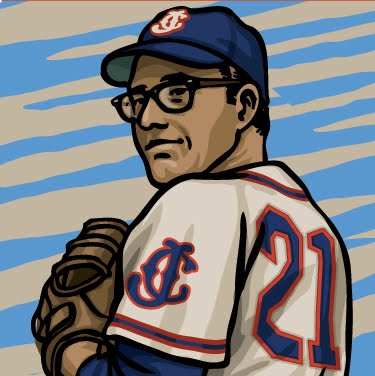


Over the years I've been fortunate enough to hear from several of the players whose portraits and stories I've included on my website, and that continued after my book "The League of Outsider Baseball" came out in May. One of the most memorable letters I received from a relative of Jimmy O'Connell. He's in the chapter entitled "The Bad Guys" due to his being thrown out of organized baseball for offering money to an opposing player to throw a game. Jimmy's great-niece wrote to say how bittersweet it was to find her great-uncle Jim in a chapter with a title of "Bad Guys". After telling me about how much she enjoyed the book she added this poignant passage: "So I'd like to put in a word for Jim O'Connell and let you know what a good guy he was. Devoted to his wife, my Aunt Esther, a loving uncle to my mom and her sister and madly in love with the game of baseball, long after it turned its back on him. ".
Those words stuck with me ever since. These ballplayers I illustrate and write about had families who loved them. The letter made Jimmy O'Connell not just a name from old newspaper articles and box scores, but a very real person. I want to thank Jimmy's relatives for taking the time to write this great piece. The story of Jimmy O'Connell and the 1924 pennant scandal is often told, but never to my knowledge has it been told from the family's perspective. I'm both honored and humbled to be able to showcase this story here on my website. and without further delay, here the O'Connell family's "guest author" post on the old ballplayer they called "Uncle Jim"...
We all know the curdled feeling you get when your ball team loses. It is always at its most intense when the game hinges on a single error and your team ends up sinking a bit deeper in the loss column. But brighter tomorrows come easily in baseball. With its lengthy season and ambling games that always breed hope, the crummy feelings dissipate and faith is restored with one swing of a bat. But for New York Giants outfielder James "Jimmy" O'Connell, a single error of judgement in the 1924 pennant race meant a lifetime ban from professional baseball. The stamp of his poor decision stayed affixed to him and his name has traveled down nine decades of baseball history with a scandal attached.
But for me, the name Jimmy O'Connell doesn't exist solely in places like Gary's excellent book The League of Outsider Baseball. He was also my mother's "Uncle Jim", her lovable, generous and incontrovertibly optimistic uncle, friend and hero. My mom Mary June, her sister Margaret and cousin Bette always kept stories of dashing Uncle Jim alive for their combined 21 children. Although they never denied the fact that in the pennant race of 1924, Jim offered another player $500 if he didn't "bear down too hard ", they also handed down the story, detailed in their aunt's anguished letters, of heartbreak and misguided faith in the men of baseball who held Jimmy's fate in their hands. They told us, too, about the life Jim lived after the scandal, spent on dusty Outlaw League diamonds, and then back in California where some of the shimmer of his days as a San Francisco Seal stood him in better light with old fans and admirers.
In 1921, my grandmother's sister Esther moved from Montana to San Francisco to look for work. She found a secretarial job at accountants Price-Waterhouse and one day she noticed a photo of a young ball player named Jimmy O'Connell in the newspaper and set her heart on him. The handsome Irish-American was a member of the San Francisco Seals and Esther, chaperoned by her visiting mother, left a note for the first baseman at Recreation Park. "We went down to 14th Street and Valencia and left a note at the Seals office. I asked him to call on me at the Palace Hotel, if he wished. I got a call that afternoon," said Esther in an interview recorded on cassette tape before her death in 1978. Their first date was spent at the Pantages Theater seeing comedian Georgie Jessel. Recalling the evening, Esther said, "In his monologue he said, 'Did you ever see O'Connell hit one?'"
The young couple was married on October 2, 1922 and not long after their honeymoon, O'Connell was in the newspapers on both coasts due to the record-breaking sum paid by the New York Giants for his contract. "Babe Ruth Has Nothing on Seals $75,000 Beauty" and "N. Y. Giants $75,000 'Rookie'" sang the headlines. O'Connell went straight to work at the Giants' training camp, gearing up for a switch to the outfield.
The early 1920s were a glittering time in New York City and Esther was a faithful correspondent, describing to her mother and sisters the glamorous Broadway revels and pure excitement of the Polo Grounds. A family of inveterate newspaper clippers, Esther's sisters saved every mention of Jimmy O'Connell from printed game stats to the items in the society page depicting the young O'Connell and his smartly dressed wife on the town.
Then the 1924 season came to a staggering end and with it, the baseball career of Jimmy O'Connell. Books like Judge Landis by J.G. Taylor Spink and John McGraw by Charles C. Alexander have reported the details of what happened on Sept. 27, 1924 and the ensuing meetings held in Judge Kenesaw Mountain Landis' office. The main fact was thus: In a game whose win would only be an insurance policy in a National League pennant race they had nearly captured, NY Giants rookie outfielder Jimmy O'Connell approached Philadelphia shortstop Heinie Sand and whispered, "It will be worth $500 to you if you don't bear down too hard against us today." Aghast, Sands refused and went straight to his manager to report the offer. Word traveled swiftly to the ears of baseball commissioner Landis and O'Connell and coach Cozy Dolan were immediately summoned to explain their part in Sands' accusation. (And as it turned out, the Giants didn't need any funny business to win their "fourth straight flag". "Why offer Philadelphia $500 to lose?" one wag quipped. "They're happy to lose for free.")
Esther's side of the story was delivered in a long, tear-stained letter she composed to her mother after sitting out all night with Jim in Central Park to avoid the hordes of reporters that had descended upon their residence. "He didn't want to but when he asked the older men what to do he was told, 'You know how thick McGraw and Dolan are, so it is orders.'" McGraw was brusque Giants owner John McGraw and those "older men" were future hall-of-famers Frank Frisch, Ross Youngs and George Kelly, who all denied saying anything and escaped punishment.
For a time, the couple remained hopeful. Jimmy never denied having made the offer to Sands, saying that he was told by coach Dolan to send out a feeler. And there is nothing that has ever been published (to my knowledge) that states that Jimmy O'Connell was solely responsible for the offer. Several baseball writers have asked, "Who put together the money?" and a couple have wondered aloud whether it was all a prank against a credible greenhorn. But adjudication was solely in the hands of Judge Landis and he handed Jimmy O'Connell and Cozy Dolan lifetime bans from professional baseball.
Stunned, Jim and Esther left New York and returned to Northern California. Esther wrote to her sister, "Jim has youth and health and we have each other and we can start over again in time." Jim's love for baseball (and his terrific athletic ability) drew him down to New Mexico to play outlaw baseball in a small league that hosted several other banned players and was looked upon with scorn by organized baseball. The Fort Bayard team was sponsored by a group of World War One vets, most of whom were bedridden with lingering wounds and tuberculosis in the post hospital. Jimmy was so popular with the fans and the vets that he eventually formed a team for the Southwest New Mexico League called "Jimmy O'Connell's All-Stars". Throughout his six years in New Mexico, Jim thrived in his roles of team captain and raiser-of-spirits to the men of Fort Bayard Hospital.
There was no shortage of calls and petitions for the reinstatement of Jimmy O'Connell made to Judge Landis. None other than the colorful writer Damon Runyon asked Landis to reconsider. "Don't you think this boy has been punished enough, Judge? I believe the public would be with you if you reinstate him." But Landis never budged and eventually Jim and Esther left the Southwest and headed back to California to begin another chapter in their lives. Jim took a job with Richfield Oil and enjoyed a long career with the oil company, starting as a refinery worker and ending his career in public relations, promoting the development of the Alaska Pipeline.
My mother, Mary June, described a visit to Uncle Jim and Auntie Esther in her 1940 diary, composed when she was nineteen years old. She flew from Cheyenne, Wyoming to San Francisco and stayed for a week in the O'Connell's Sausalito home. Each day she recorded a marvelous sightseeing trip with her Uncle Jim, culminating in a visit to the World's Fair. My mother always treasured the souvenir photograph that Uncle Jim gave her that day. And with good reason. There aren't many photos of Jimmy O'Connell in our family collection and very little memorabilia outside of a silver "Open Gate" medallion given to Jim by the NY Giants in 1924.
When Esther O'Connell returned home from Jim's funeral in Bakersfield in 1976, there was a baseball collector waiting in the driveway. Brushing past him and his inquiries, Esther made a bonfire in her backyard and threw Jim's mitts, uniforms and memorabilia on the flames. Jim had allowed himself to move on, but Esther's anger at baseball had never subsided. Mom's cousin Bette managed to save one box of Jim's things from the bonfire, but Esther had already torn the photos in two. A team photo of the SF Seals, a press photo of Jim and Sox player Willie Kamm, and a photo of Jim shaking hands with John McGraw were poignantly pieced back together with transparent tape. It is a small, but cherished, collection that I hope will spur the curiosity and baseball fever of my grandnieces and nephews as it has mine.
I am so very grateful to Gary Cieradkowski for including Jimmy O'Connell in his book and for creating such a wonderful illustration of Uncle Jim. I wasn't sure if I was just dispatching an email into the wild blue yonder when I wrote to Gary about another side of Jimmy O'Connell's story. HIs gracious reply has allowed me to share these personal reminiscences of my family and provide another view of a man who, by all surviving post-scandal accounts, was admired by just about everyone he came across.
I have been encouraged to write about Uncle Jim for many years by my Aunt Margaret. At 92, she is in full possession of her detailed memories of her beloved Uncle Jim. I dedicate this blog post to her. She is the last person in our family (and perhaps the world!) to have seen Jimmy O'Connell play baseball. She saw him play on the Richfield Oil company team on a visit to California in 1935. She was eleven years old.
I spoke to her on the phone the other day and asked her if Jim ever talked about his regrets or suffered from the anguish that plagued Esther. She said, "He never said a word about it. It was all in the past. When he walked in the room, he'd look me and Mary June in the eyes and say, "Shall we get an ice cream cone, girls?"
A Note About the Illustration: I wanted to show Jimmy back before he joined the Giants, circa 1923 while with the San Francisco Seals, when his future was bright and the sky was the limit for him. I depicted him in the time-honored baseball chore of "boning" his bat with a horse shoe. This was done back before players used 100's of bats each year. Players would spend spare time rubbing a horse shoe, Coke bottle or steak bone on the bat which closed the pores of the wood, making it rock-hard and less likely to break.

