Showing posts with label Roy campanella. Show all posts

Tuesday, October 1, 2013

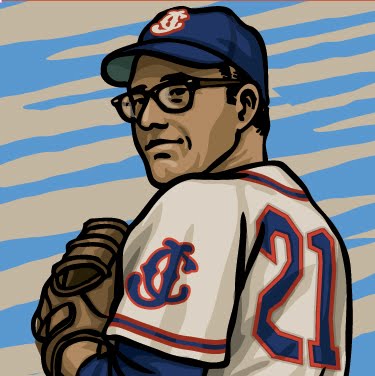
160. Biz Mackey: International Man of Clout


Here's a ball player I've been wanting to do a card of for a long time. Actually, I illustrated the thing long ago, I just hadn't felt I completed enough research on the guy to tell the story the way I wanted to. Back when I was in college in Baltimore, I got to asking many of the old timers about the Negro League stars, and when catcher came up, most of the oldsters said Biz Mackey was The Man. I asked about Josh Gibson, the great Homestead Grays slugger and sure enough most said that yeah, that Josh could hit the ball a mile, but Biz was the better all-around ball player. 

Strong words, and contradictory to most blackball history you read, but me, I'll side with people who were there every time. So, who was Biz Mackey?

Heard of Roy Campanella? The Tokyo Giants? Well, without Biz Mackey both might not have existed...

He grew up playing town ball with his brothers Ray and Ernest before going pro with the San Antonio Black Aces in 1918. When the team folded C.I. Taylor's Indianapolis ABC's bought his contract. The ABC's were among the elite black teams at the time and for a young kid like Mackey to be picked up by them was saying a lot about his raw talent. Serving his big league internship on a team filled with stars such as Oscar Charleston, Dizzy Dismukes, Crush Holloway and Ben Taylor benefited the burly young catcher and he batted .312, 329 and .365. 

In 1923 he moved to the Hilldale Club out of Darby, Pennsylvania. Hilldale was the classiest of the eastern blackball outfits and were about to embark on a tear of three pennants once the Eastern Colored League was founded the year Mackey joined them.Because Hilldale already had slugger Louis Santop behind he plate, Mackey often played in the infield so both his and Santop's bats could be in the lineup. It says a lot that a man of Mackey's size, about 6' and over 200 pounds, could play shortstop and third base with the same ease as he could catcher. When he did displace Santop behind the plate, Mackey's mastery of the position became legendary. His arm was so strong and accurate that he didn't have to stand up to throw a base runner out at second. No one had seen that before and soon Mackey was getting compared to Major League baseball's best catcher, Mickey Cochrane, who played across town with the Philadelphia Athletics. Oldtimers who saw both men play usually give Cochrane the slight edge with a bat, but overwhelmingly give Mackey the nod when it came to defence and calling a game.

Mackey was gregarious and jolly; his nickname "Biz" actually derives from his propensity to give batters "the business" as they tried to concentrate at the plate. Mackey would ask them questions, try to get the ump to examine their bat, anything to distract them. He loved the nightlife, too. Blackball players were royalty in the still segregated cities and Mackey took full advantage of all it had to offer. Extremely fond of the sauce, the big catcher was known for his epic nights on the town, but while other ball players eventually succumbed to its debilitating effects, Mackey avoided the slippery slope to alcoholism. While known to show up at a ball game still showing the effects of the night before, once he put on that uniform and crouched behind the plate he was all business.

Because Mackey was renown as one of the best players outside the majors he was much in demand to play during the winter months. Besides the Caribbean, which was a popular destination for black ball players since the early 1900's, by the 20's Southern California had a burgeoning winter baseball season as well. The California Winter League usually featured a few white teams made up of major leaguers and Pacific Coast League stars and a single black ball club stocked with the best the Negro Leagues had to offer. In the winter of 1926-1927, promoter Lonnie Goodwin assembled the Philadelphia Royal Giants, what may have been the greatest single-season team of black players ever to take the field. Joining Mackey was the Kansas City Monarchs' ace Bullet Rogan, Turkey Stearnes, Willie Wells, Andy Cooper and Bill Foster, all Hall of Famers. The Royal Giants buzz-sawed their way through the winter league and took the pennant with a 26-11-1 record against the white teams. In a few more seasons Commissioner Landis would put a stop to the major leaguers playing in the Winter League, but for a few years it was possible to see how black ball players could do against their white counterparts. 

After the Winter League season ended, the Royal Giants split up. Bullet Rogan and the other Kansas City Monarchs headed back east to start the 1927 Negro National League season, but Biz Mackey, Frank Duncan, Rap Dixon, Andy Cooper and a handful of others boarded a ship to Japan. Touring baseball teams were not all that uncommon in Japan; American college, Japanese-American semi-pro and white professional teams had been doing it since the turn of the century, but this was the first major tour of black ball players.

Like every other American ball club that toured Japan, The Royal Giants won nearly every game; 47 out of 48 games. Their single loss to the Daimai Club serves as an example of what made the Japanese appreciate the black players so much. In a close game against the
Daimai Club, a bad call by the local umpire gave the game to the Japanese: with one out and two on base, a Royal Giant hit a long fly ball to sacrifice score a run, but the second runner was doubled off first and tagged out. The umpire refused to allow the run to count and Daimai won. The Royal Giants took the loss in stride, something the Japanese deeply appreciated.

While other visiting teams came to the island and beat the hell out of the inexperienced Japanese, the Royal Giants subtly kept their scores low to not insult the locals. The blackball players knew how to play "the game", they'd done it countless times back in the states against white semi-pro and town teams where to run up the score and embarrass the locals could cost them their part of the gate receipts, or worse, a beating. The black ballplayers also knew that by keeping the score close, the possibility to see a win would keep fans interested and coming to the park. The 1922 Major League tour realized this too late and gate receipts greatly diminished by the time their tour ended. When the big leaguers did let the Japanese win a game, it was such a farce that it only embarrassed the locals even more.

The Royal Giants also brought some good old barnstorming entertainment to the island, driving the fans nuts with their shadow ball routines. The Japanese watched in amazement as the Royal Giants whipped the invisible ball around the field. The team also shared their knowledge of the game with the Japanese, Mackey's exhibition on how to throw to second base from a crouch especially drew eager students.

When the Royal Giants played in Tokyo's brand new Meiji Shrine Stadium, Mackey became the first man to hit a ball out of its massive environs. The blast was estimated at 427 feet and before the tour ended he'd hit two more out of the ball park, each to a different field.

The Japanese deeply appreciated the kindness of the Royal Giants and the tour did much to spread the game's popularity. Many of the college players who faced the Royal Giants in 1927 went on to have roles in the founding of the Japanese Baseball League in 1936. By keeping the scores low and not embarrassing the locals, the Americans played to the Japanese sense of honor and dignity, something no other team of Americans had in the past. The gesture helped bolster the Japanese player's confidence, which when dealing with a game as complex as baseball, becomes very important.


Mackey returned to Hilldale half-way through the 1927 season. In his absence, the team had finished dead-last in the league's first half, but climbed back to 3rd place in the second half with him behind the plate. If the catcher had been a major leaguer who abandoned his team to barnstorm for half a season, he'd have been banned from the game. But, Mackey was in the Negro Leagues, and it speaks volumes of the precarious nature of the league that his only punishment amounted to little more than a scolding. Biz Mackey was a superstar of black baseball and the Negro Leagues need him.

For the rest of his long career, Mackey continued to be among the best ball players in outsider ball. When the Negro Leagues had their first East-West All-Star Game in 1933, it was Mackey, not Josh Gibson, who received the most fan votes and was the game's starting catcher. When Mackey was playing for the Philadelphia Stars in 1935, there was a chubby local kid who kept hanging around the star catcher. Through persistence, a little raw talent and Mackey's mentoring, the kid showed promise. By 1938 Mackey was in Baltimore with the Elite Giants and had the kid take the train down to Charm City on weekends to play in exhibition games under his watchful eye. Over the course of a summer the boy transformed into Mackey's "mini me". Veterans said that unless the kid took the mask off, you swore it was the ol' Biz himself behind the plate. When Mackey went to the Newark Eagles in 1939, the Elite Giants' catching was left in the able hands of that kid: Roy Campanella.
In Newark Mackey found a whole new crew of youngsters to mentor and over the next decade brought Larry Doby, Monte Irvin and Don Newcombe's skills up to major league standards. With collapse of the black teams in the early 1950's, Mackey drove a forklift but was brought into the national spotlight when on May 7, 1959, Roy Campanella introduced his old mentor before a crowd of over 90,000 Dodgers fans as the man who made him who he was. It was a tremendous compliment to a man whose generosity and kindness helped influence ballplayers of many colors and nationalities.

And that's who Biz Mackey was.

SOURCES
  • Holway, John B., Blackball Stars (Meckler Books, 1988)
  • Fitts, Robert K., Banzai Babe Ruth (University of Nebraska, 2012)
  • Lanctot, Neil, Fair Dealing and Clean Play (Syracuse University, 2007)
  • Gary Ashwill, Agate Type Website


Sunday, January 30, 2011

66. Roy Campanella: The Goat Of The '42 Pennant Race?


Back when I lived in Northern Kentucky, I would spend one Sunday a month camped out in the University of Kentucky library microfilm room poring over the back issues of the Baltimore Afro-American. This was before computers made baseball research infinitely easier and discovering new facts and statistics pertaining to negro league history made me feel like a lower-case indiana jones. Each Sunday I would concentrate on gathering all the relevant articles and box scores I could on a specific year that the negro league Baltimore Elite Giants played in Charm City. Fortunately for my purposes the Afro-American was based in Baltimore and devoted extensive coverage to their hometown Elites after they moved to the city in 1938 after previous stops in Nashville, Columbus and Washington - the Elite Giants were the negro league version of the Atlanta Braves. Through the magic of microfilm I was able to read along as the seasons played themselves out before my eyes.

The Elite Giants were not as "sexy" a team as the Homestead Grays or Kansas City Monarchs and not much had been written about them other than it was the team that gave Roy Campanella his start. Diving into the 1938 box scores I found the very first mention of Campanella as a 16 year-old ballplayer, although his name was misspelled as "Campanello" - it actually took the beat writers from the Afro-American a year or two to finally get the kid catcher's name write in the box scores and post-game summaries.

The Elite Giants were blessed in that they had veteran catcher Biz Mackey on the squad during Campanella's first few years. Mackey was at one time the best catcher in black baseball and although he had slowed considerably by 1938 when Campanella joined the team, his natural leadership and mentor abilities made all the difference to the young catcher. Indeed, years later during a ceremony to honor Roy Campanella at Dodger Stadium, Roy called out his former mentor Biz Mackey, who was in the stands, and gave him the credit for making his career what it was.

By 1940 Roy had grown into the role of Elites starting catcher and Mackey was traded to the Newark Eagles. Baltimore had Bill Perkins and later Eggie Clark as adequate defensive back-ups to Campanella and the team embarked on a 3 year stretch where they battled the Homestead Grays for the Negro National League Championship every summer. Their rivalry became something like that between the Brooklyn Dodgers and New York Giants and the games played between the two were usually hard-fought, heavily attended affairs. The Negro National League played a split season with the winners of the first half of the season playing the winners of the second half in a play-off for the pennant.

Baltimore led for most of the first half of the 1940 season but stumbled at the end, winding up a half game behind the Grays. In the last weekend of the second half the Elites split a crucial double-header to the Newark Eagles, allowing the Grays, who won their games against the Philly Stars, to overtake Baltimore and snatch the pennant at the last moment. The following year the Elites lost 4 of their better players who jumped the team and went to Mexico along with other negro league stars who had been lured south of the border by offers of big money. Despite the loss of talent the team went on a tear but the Grays were always a game or two ahead and they won the first half of the season. In the second half the New York Cubans beat out the Elites and went on to play the Grays in the play-offs.

These close-but-no-cigar finishes were heartbreaking to the Baltimore fans who by this time really embraced the team. Baltimore had a vibrant black community at this time, mostly due to the strict segregation that was enforced in this southern city. In Baltimore, this exclusion bred a whole black society which operated parallel to the white one - blacks had their own doctors, lawyers, grocery stores, factories, gas stations, theaters and high society - everything the whites had, just owned and operated exclusively by blacks.

1942 was shaping up to be a big year for the Elite Giants. Their biggest slugger, Wild Bill Wright, returned to the team from Mexico along with second baseman Sammy Hughes and starting pitchers Lefty Glover and Pullman Porter. It was hoped that the now mature Campanella along with the extra fire-power provided by Wright would be the key to finally beating the Homestead Grays and bringing the pennant to Baltimore. The additional players indeed made all the difference and the Elites cruised to a comfortable first half victory in July. Campanella proved that he had arrived by not only handling the pitchers like a veteran but he was batting for average and came through in the clutch when most needed. The rest of the league took notice and he was elected for the second time to represent Baltimore in the East-West All-Star Game. But before he made it to the game, something happened.

Since the beginning of America's entry in World War II, various factions, both black and white, had been clamouring for the majors to integrate. While most owners were vehemently against it, a few made hesitant overtures that they might be interested. The miserable Pittsburgh Pirates were one team that led some of the black sports writers on, seeming to agree to give a few black players a tryout. Campanella was one of those players chosen and although the Pirates backed out at the last minute, Campy began to understand his worth not only to a black baseball team, but to a white one as well. On the eve of the East-West Game the Cleveland Buckeyes were scheduled to play against a team made up of white all-stars who were serving in the Army and Navy. This was a great opportunity to show the country what kind of talent existed in the negro leagues and prove once and for all that blacks could play ball just as good as white professionals. The Cleveland management invited two Baltimore players, Roy Campanella and Sammy Hughes to join their team for the special game. Unfortunately the Elites owner and also National League president Tom Wilson refused to grant them permission to go. Baltimore was locked in a drive to claim the first half pennant and losing the services of two of their key players could tip the balance to the Grays.

None-the-less, Campanella and Hughes jumped the team and went to Cleeveland. Wilson fined both players $200 and suspended them for a month. Campanella was forced to sit out the East-West Game as well. The suspension looks like it was never enforced because both players continued to appear in the lineup through August as the Elites battled neck and neck with the Grays. But Campanella was disgruntled by the way Wilson handled the affair and finally deserting the team around the 23rd of August. Jorge Pasquel, the shipping magnate and playboy who ran the Mexican Baseball League offered Roy a huge contract to finish out the season with the Monterrey Sultanes. When Campanella left he was batting .297 and was one of the team's premier players as well as a steadying influence on the pitching staff. Eggie Clark, the teams back-up catcher was a veteran who, while solid defensively, was no Campanella at the plate. In the standings Baltimore was 2 games behind the Grays going into the last 2 weeks of the season. On Friday August 28th they beat the last place New York Black Yankees 16-3 and then took the Sunday double-header by scores of 6-3 and 3-1. Now Baltimore was a half game behind the dreaded Grays.

It all came down to the final Labor day series. The Elites faced the 4th place Philadelphia Stars and needed to take 4 out of 5 games from them. The Grays faced the considerably stronger Newark Eagles and needed to take at least 2 to stay on top.

Saturday was a night game played at Parkside Park in Philadelphia. Baltimore won 8-3 and Campanella's replacement Eggie Clark went 1 for 4. The series moved south to Baltimore and a Sunday double-header at Bugle Field. In the first game it took 12 innings but Baltimore prevailed, Clark going 1 for 4 again. In the nightcap Clark went hitless in 3 at bats as Baltimore was defeated in a come-from-behind victory by the Stars. As long as Newark beat the Grays in their Monday game and Baltimore won both ends of the season finale double-header on Sunday, the pennant was theirs.

Both teams were back at Parkside Park for the holiday double-header. Baltimore's Bill Harvey tossed a terrific 1 hit shut-out and beat the Stars 6-0. Clark went hitless in 4 turns at bat. Up in Newark, N.J. the Grays and Eagles were slugging it out at Ruppert Stadium, the high scoring game still undecided as Baltimore and Philly squared off again for the last game of the season.

Baltimore lost 4-3, Eggie Clark going hitless again in 3 tries. Meanwhile the Grays out-scored Newark 14-12 and clinched the second-half pennant. What happened next is something that was unfortunately fairly common in the negro leagues. The play-off that was supposed to happen between the Elite Giants, winners of the first half and the Homestead Grays, winners of the second-half, never took place.

I've never found out any reason why, the Afro-American didn't report on it. Their focus quickly switched from the lost pennant to a series of 6 games against the all-white Baltimore Orioles of the International League. Playing against the white pros was more important it seems than playing the Kansas City Monarchs in the Negro World Series. Which brings me back to Roy Campanella.

While reading about the 1942 season in the Afro-American I was gripped by the tightness of the race and the disappointment when I read of Campanella and Hughes deserting the team for an exhibition game. I was even more upset when I discovered how Roy abandoned the team for Mexico during the last stretch. Seeing his replacement Eggie Clark go 2 for 18 and the Elites lose 2 crucial games by 1 run made me wonder how the team would have done with Campanella playing in those contests. Would they have won the pennant? The fortunes of the Elite Giants dwindled after that season. Failure to beat the Grays 3 years in a row may have hurt their fan base and the disappearance of Roy Campanella, a favorite with the fans, didn't help either. He played the entire 1943 season in Mexico while Baltimore sank into the second division.

Does Campanella deserve to be labeled as selfish and the goat of the 1942 season? Initially I thought so. Learning of Campanella's actions at the end of the '42 season went against everything I had ever read about the affable catcher. What kind of player deserts his team during a pennant drive? Then again, I go back to the Afro-American's reporting at the end of the season. Nowhere was there outrage over the lack of a play-off to decide the Negro National League Championship, nor was Campanella's desertion criticised. The Afro's writers were more focused on the Elite Giants showcasing their talent against the all-white Orioles. That made me think: by 1942 did most players and reporters think of the negro leagues as basically just a stepping stone to the eventual integration of baseball. Was a series of exhibition games played between a black team and a second-rate white minor league team really more important than the Negro World Series? For many generations we were told that the negro leagues were an entity all their own and made to exist parallel to the white leagues. Watching the 1942 season unfold made me think that by this time most players and fans were probably aware that integration was not that far off and that matters of a player jumping a team in order to better himself was not look upon as a bad quality, but simply what it was, a black man showing the world that his talents were as equal or better than others who happened to be white.

So in my book, Campanella gets a pass but, as a former Baltimore resident, I am rather chagrined to think about how the fortunes of the Elite Giants would have turned out if they had beat the Grays that year and faced the Monarchs and Satchel Paige in the 1942 World Series...