Showing posts with label Service Teams. Show all posts

Thursday, November 6, 2014

182. Jackie Robinson: Veterans Day 2014


Since I began this website I always liked to feature a special story for Memorial Day and Veterans Day. Indeed some of my favorite stories have been part of this little series: Eddie Grant, Bill Niemeyer and Sam Kau to name a few. This Veteran's Day I'm reminded that not all vet's served in combat. Some men served in peacetime like Sig Jakucki and Torpedo Mills, and then there were those who for whatever reasons were spared the horrors of battle.

Jackie Robinson was one of those men. 

In the summer of 1944 2nd Lieutenant Jack Robinson found himself at Camp Breckinridge, an infantry replacement training depot in the hills of western Kentucky. The war had been rough for Robinson - not on the battlefields of France or a nameless island in the Pacific, but at home in a racial war whose injuries were not physical but mental.

Before the war Jackie Robinson was a well-known collegiate athlete. His exploits as a track star at UCLA set numerous records and his skills on the gridiron made the sports page from coast to coast. If he had been white, Jackie Robinson would have had to fight off offers from National Football League teams upon graduation. Instead Robinson took a position with a government-run athletic program which quickly folded. Looking for employment, Robinson took the most lucrative sports job he could find - semi-pro football in Hawaii. After a successful 1941 season, Robinson booked passage on a steamship back to Los Angeles. On Sunday, December 7th, 1941 he was contemplating his next move when the Japanese decided it for him. 

The 23 year-old Robinson received his draft notice in early 1942. After basic training with a cavalry regiment he and several other black soldiers requested a transfer to officer's candidate school. Robinson's natural leadership qualities and UCLA education made him ideal officer material but his skin color worked against him. His transfer was put on the back-burner until boxer Joe Lewis stepped in to help open the gate allowing black soldiers to attend officer's school. By January 1943 the former college star was 2nd Lieutenant Jack Robinson,U.S. Army.

Robinson was assigned to the 761st Tank Battalion at Ft. Hood Texas. Known as the "Black Panthers", the 761st would go on to earn a distinguished combat record serving under General Patton in Europe. For two reasons Lt. Robinson wasn't one of them.

Years of strenuous athletic activity had left Robinson with an old ankle injury that required testing to guarantee he was combat-ready. On afternoon while awaiting the results of the test, Robinson boarded an integrated Army bus and took a seat near the front. When the driver told Robinson to sit in the back he flatly refused. The driver reported the incident to the Military Police who took the insolent lieutenant in custody. The commander of the 761st flatly refused to prosecute his young officer but the matter was taken out of his hands when Robinson was transferred to another battalion. His new commanding officer happily signed off on court-martial proceedings before the ink was dry on his transfer papers.

After a humiliating trial in which he was acquitted of all charges, Robinson found himself a soldier without an army. His unit had deployed to Europe during his court martial and medical tests found his ankle was tender enough to keep him out of combat. The trial had made news and his superiors at Ft. Hood didn't want him around so he was transferred to another black unit, the 372nd Infantry Regiment.

The 372nd had a brilliant battle record from the first world war. The units shoulder patch was a red hand on a white disk trimmed in blue and red. This striking insignia was bestowed on the regiment by the French Army of Africa with which the unit had fought with in 1918. By the time Lt. Robinson caught up with the regiment at Camp Breckinridge, Kentucky it was being used as a feeder unit that trained replacement infantry troops. As a distinguished college athlete, Robinson was named the regiment's athletic director.

It was only a temporary assignment. Robinson's fight against the bogus court marshal gained him a reputation as a hard case, and with a bum ankle he wasn't any good for combat. The army decided to discharge him. In the meantime, Robinson waited for the slow moving paperwork to wind its way through Army bureaucracy by keeping the recruits occupied with baseball.

One afternoon Robinson happened upon a soldier throwing big league curve balls on the baseball field. The soldier was Ted Alexander, a former pitcher with the Kansas City Monarchs of the Negro American League. Robinson had had a brush with Negro League baseball back before the war when a traveling blackball team had played a pickup team which Robinson was a part of. When the game ended the team took off without giving Robinson his agreed upon money for the exhibition. The whole experience left Robinson with a bad taste in his mouth and a lingering distrust of black baseball operations. When Robinson told Alexander of his concerns about post-army employment, the pitcher revealed the the Monarchs were always hiring good talent. The war had hit black baseball as hard as the white version with many of its good players in the service. However with many blacks now employed in high paying war industry jobs, blackball was the most popular diversion for their new-found disposable income. The Negro Leagues were experiencing their most profitable period in their history.

The former Monarchs pitcher surely related all this to Robinson and before the two men parted ways Alexander had given the Lieutenant Kansas City Monarchs' owner Tom Baird's contact information. When he received his honorable discharge in November of 1944, Robinson wrote to the Monarchs inquiring about a position. In the meantime he took a job as athletic director at Sam Huston College in Austin, Texas. When spring rolled around the Monarchs sent Robinson a $400 a month contract and instructed him to report for spring training. 

Jackie Robinson's baseball career had begun.

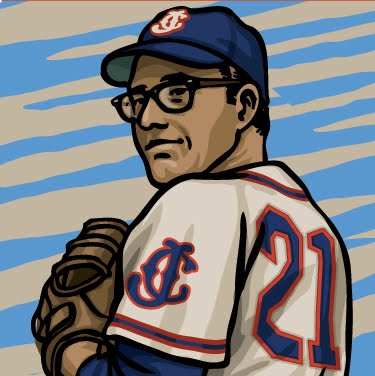
This was a neat story I stumbled on when seeking players for my Kentucky Baseball book project. Much has been written about Jackie Robinson, yet I found it a much neglected side bar that the roots of his professional baseball career actually dated back to a late summer afternoon in western Kentucky. This was a fun illustration to work on especially since his army regiments insignia was so unique - I just knew that red hand would make the drawing. My old pal Will Arlt, owner of Ideal Cap Co. was in town last week and I showed him my illustration. We both agreed that the cap I depicted Jackie wearing would have to be an eventual offering from Ideal, so be on the look out for it next year.

Next week I will revert to the customary baseball card format for my drawings - it just so happens that I recently completed two full-page illustrations for the Kentucky project and I thought it would be a shame to shoe-horn them into a smaller format.

Anyway, this post is dedicated to all the men and women who have served in the United States military. It was your sacrifices and sense of duty that allowed me the life I am fortunate to enjoy. I think of that every day, not just on Memorial and Veteran's Day. Thank you from this very grateful artist.

Wednesday, July 17, 2013

156. Torpedo Mills: Sinking the Opposition


One of my other passions in life, besides baseball, drawing and my soon to be wife, is military history. I'm especially drawn towards the United States Navy in China due to watching Steve McQueen in "The Sand Pebbles" as a kid. It's a fascinating topic, so don't get me started. Anyway, while working on a series of illustrations depicting the various uniforms worn by our Navy in China, I picked up a rare 1933-34 Navy Sports Annual. It's a nicely done hardback yearbook that depicts all the Navy's sports teams from golf and swimming to football and baseball. While flipping through it, I found a reference to a sailor named Torpedo Mills who was "going on to make good in the majors..." I was intrigued and looked him up - sure enough he did make it to the majors. So, thanks to obscure military history, a rare book and countless hours in newspaper archives, I bring you Howard "Torpedo" Mills...

The ex-sailor was big - 6-1, 190lbs - so the St. Louis sports writers gathered around him listened: you can call him "Lefty" or even "Torpedo", but you'd better not call him "Popeye The Sailor Man". Sitting in the Browns dugout at Sportsman's Park that August afternoon in 1934, Howard "Torpedo" Mills had sure come a long way...

Growing up in Dedham, Massachusetts, Howard Mills missed all the best parts of being a kid. Always on the scrounge for money, he chose odd jobs and caddying for swells at a golf course over playing baseball or football with the boys. He liked mechanics and tinkering, but regular school work just didn't interest him - years later they said someone had to burn down the schoolhouse to get Mills out of the 5th grade. When the Great Depression loomed over his corner of Massachusetts, the big 17 year-old found himself with no education or trade to speak of. With an eye to the future, the only viable option was the service. At least there he'd get a bed, three squares and learn a trade. Army, Navy or Marines? Throw in a young man's thirst to see the world and the choice was obvious: Navy.

Mills got his father's signature on the enlistment papers and set off to see the world. With his interest in mechanics, Mills gravitated towards airplanes and he was sent to training at North Island Navy Base in San Diego. Much to his chagrin, there he remained ashore for over 2 years before finally being posted to the U.S.S. Lexington, the Navy's premier aircraft carrier.

Life aboard the Lady Lex wasn't bad, especially considering that all around the country men were out of work and scrounging just to get by. The Lexington was based out of San Pedro, just south of Los Angeles, where the weather was as near perfect as could be and the Navy provided everything he needed. Still, every day while on the flight deck repairing the Boeing F4B-2's and Martin BM-1's, Mills could see a bunch of gobs who had it even easier than him - the sailors who played for the Lexington Minutemen - the carrier's baseball team.

Between the wars, the Navy as well as the other services fielded extremely competitive athletic teams. Winning trophies was a feather in any commanding officer's cap and soldiers and sailors who were especially adapt at athletics could expect fast promotions and easy duties. If  you've ever read the book or seen the movie "From Here To Eternity", you can get the idea of how rampant the favoritism showered on athletes was in the interwar military. In the Navy, the ships in the different fleets competed against each other and the winners advanced to championship series. MVP's were chosen and trophies awarded, it was a big moral booster for the thousands of sailors who cheered on their ships, helping to forge a tight esprit de corps. Football, boxing, rowing, golf, swimming and baseball all had a year-end series with the winning ship awarded the title of All-Navy Champion.

So every afternoon, Aviation Machinist's Mate 2/c Mills, wiping the grease from his hands after a hard day of keeping Boeing F4B-2's running, couldn't help but envy the boys who got off duty just to throw a ball around. Win or lose, the ballplayers even got extra shore leave. One morning Mills told his Chief Petty Officer he wanted the day off to try out for the baseball team. The Chief looked him over and eventually acquiesced - if a sailor from his section panned out, it would look good on the Chief. In the Navy, the good as well as the bad, tended to trickle down like that. 

Mills, who had never played baseball before, went ashore and headed towards the base ball fields. 

The Lex had a pretty good baseball team. The bigger ships of the fleet - the carriers, battleships and cruisers - tended to have the best teams due to their larger compliment of sailors. Plus, the larger ships could afford to carry a few extra ringers aboard who just played ball. The smaller ships didn't have that luxury. While the Minutemen had a decent team, since 1926 the U.S.S. Wright held the All-Navy Championship title. Try as they might, for seven long years the aircraft tender beat off all challengers to their trophy. That afternoon on the ball field at San Pedro, no one on the team figured the key to the All-Navy Championship was the tall, sturdy aircraft mechanic who asked for a tryout.

By all reports, Mills was terrible at first. Remember, he'd never played the game before. Still, visions of all the extra time ashore in San Pedro danced in his head and Mills set his mind to making the club. After a few days practice, it became evident that the newcomer could throw pretty fast from the port side. The coach, an old Chief Gunner's Mate by the name of Fenton, took the eager gob aside and taught him some pitches. Chief Fenton had coached Navy ball clubs for 32 years and knew a thing or two about pitching. Mills couldn't have asked for a better teacher and the Chief couldn't have asked for a better pupil. His fastball had something natural to it - someone said it "hops like two frogs going somewhere". And once the season started, it was soon clear that Mills' fastball wasn't the only thing going somewhere...

The 1933 Pacific Fleet Baseball League was made up of the Navy's most imposing ships, the battleships Arizona, Texas, Oklahoma, Maryland, West Virginia, Tennessee, Nevada, Pennsylvania and the Lexington's sister carrier Saratoga. One by one, Mills, now nicknamed "Torpedo" by his fellow gobs on the Lexington, mowed them down. 

It was obvious by the third game of the season that Mills was something special. Against the U.S.S. Maryland, the lefty beat the powerful battleship 8-1, his own throwing error being the only thing that kept him from tossing a shutout. On June 7, the Minutemen faced the California Bears, defending Pacific Fleet Champs. In front of two thousand bluejackets, Mills pitched a three hitter and struck-out 15 to beat the mighty battleship 4-2.

Meanwhile, the perk of being a ball playing bluejacket began to pay off. All that extra shore leave gave Mills the time to court Dana Rhodes, a local L.A. girl who would eventually become his wife.

Easily taking the Pacific Fleet title, the Lexington now faced the U.S.S. Wright, undefeated for seven years in the Battle Force Championship. In the whole history of the series, no Pacific Fleet ship had won. The Lexington aimed to change that. The best of three series was held at Trona Field in San Pedro. Over 8,000 sailors and civilians packed the ballpark for the first game. In every port that had a U.S. Navy ship in it, money changed hands over the big game. The odds were pretty even, the Wright was the seasoned veterans, but the Lexington had Torpedo Mills, undefeated all year. From Shanghai to Newport News, navy men crowded around their ships radio shack for the play-by-play transmitted over the wire. 

From the start, Mills and the Minutemen were in control. After setting down the Wrights 1-2-3 in the top of the first, the Minutemen got a hit, followed by a sacrifice and a homer and by the time Mills took the mound to start the 2nd, he had a for run lead. The Wrights scored a run thanks to a single and two errors by the second baseman in the fifth but came back with three more runs to wrap up the game 7-1. Mills struck out 15 and went 2 for 1 at the plate, a double.

A few days later Mills took the mound again for the Lexington. As 8,000 sailors watched from the stands and countless others followed around the world, Lefty Mills no-hit the Wrights as the Minutemen scored 14 runs to sweep the Battle Force Championship. 

Among the ecstatic bluejackets in the crowd was Willis Butler, west coast scout for the St. Louis Browns. Within weeks he had Mills' signature on a Browns contract. Problem was, to the Browns he may be Torpedo Mills - pitching prospect, but to the U.S. Navy he was still Aviation Machinist's Mate 2/c Mills. The Browns, perennial losers in the American League, were desperate for anyone who could put a spark in their line up. To the front office in St. Louis, Mills looked like that shining star every struggling ball club hopes for, except for one thing: his Navy contract. 

Mills had reenlisted for a two-year hitch the year before he picked up a baseball and was due to be discharged in the summer of 1934. The Browns wanted him asap and went so far as to enlist the help of congressman John J. Cochran to lobby the Navy for Mills' emancipation. The Navy refused to budge. Besides the fact that trained aircraft mechanics were highly prized, there was still another series to be played.

All across the globe, Navy and Marine Corps ball clubs competed in their divisions, vying to get to the All-Navy Championship, the best of three series held in September. The U.S.S. Dobbin, a destroyer tender, emerged the winner. The San Diego-based Dobbin was a dark horse - back then the Navy's fleet was based in San Pedro and no one knew much about the Dobbin. With a dearth of Navy ships to play against, the Dobbin's men honed their skills playing against strong San Diego semi-pro teams - the same baseball hotbed that gave birth to Ted Williams. First winning the Destroyer Squadron title, then the Scouting Force Championship, the Dobbins weighted anchor and headed to San Pedro to face the Lexington. 

The first game was a slug fest. Mills gave up 10 runs on 10 hits but still the Minutemen prevailed, scoring 16 runs. It wasn't pretty but it was a win. With the next game in 2 days, Mills' season was through. Anderson took the mound for the Minutemen and held fast as the Lex won 13-6. The U.S.S. Lexington were the Champions of Navy baseball.

In 14 games Mills was undefeated and with the exception of a 17-10 win over the Texas, he'd kept the opposition to under 3 runs a game and averaged 16 strike-outs every time he took the mound. At the end of the year a service-wide pole conducted by Navy Magazine voted him "The Navy's No. 1 Athlete". Better yet, a trophy and new Ford Coupe came with the title. It was a hell of a season for a guy who never played the game before and with a big league contract waiting for him when he got out of the service, the future looked bright indeed.

As most baseball fans know, the St. Louis Browns were one of the lowliest franchises in the history of the game. Once more popular than the Cardinals who shared their ballpark, the Browns began a quick decline in the 1920's that soon made then the worst team in the American League. While other teams embraced the farm system, the Browns tried to trade their way to the first division resulting in even more humiliating losing seasons. Time after time decent pitchers were sent to the Browns only to become run-down and discouraged by the lack of defense and run support. It was into this maelstrom that the newly civilianized Torpedo Mills stepped in 1934.

First he was sent to the San Antonio Missions of the Texas League. The newly civilianized Mills went 3-3 in 15 games and the Browns called him up to St. Louis in August. He got into his first game in Cleveland on August 10th when manager Rogers Hornsby threw the newcomer in to relieve Dick Coffman in the 8th inning. Down 4-1, Mills gave up 4 hits and two runs before he was able to get out of the inning. It wasn't an ideal start, but it was the major leagues.

The rest of the summer Mills pitched batting practice and rode the pines as Hornsby used the former bluejacket sparingly in 3 more games. He worked 7 .2 innings and gave up 6 hits  and 2 runs, but walked an unacceptable 11 batters. The old wildness was a continual hindrance in the majors against patient and seasoned batters. The Browns sent him back down, this time to the St. Paul Saints. Used as a starter, Mills turned in a 7-8 record for a miserable team. His control seemed to improve though, and in 146 inning he gave up 84 walks.

In the off season Mills returned to Southern California and married his girlfriend Dana, a by-product of his bonus baseball shore leave from the Lexington. Making their home in Manhattan Beach, Mills used his spare time to coach his younger brother, also called "Lefty" and making a name for himself in Navy baseball as a first baseman. When spring came, Mills headed to San Antonio for the 1936 season.

Things started to come together now as he got a little more control of his fastball and finished the season 12-6, followed by 14-12 the next year. The Browns brought him up at the end of the 1937 season to give him a look. Mills started 2 games and split the decisions. In 12 innings he struck out 10 but walked the same number and relinquished 16 hits. It was a mixture of promise and catastrophe, but on the Browns, who managed to win only 46 games that year, it was a fresh arm.

When the 1938 season opened Lefty Mills was a Browns regular and the most promising thing on the team. Early on, the sports writers who covered the Browns seized on the former sailor's story. It was a feel-good tale, tailor-made for a country still stuck in the doldrums of the Great Depression. Mills was open with the writers who covered the Browns but cautioned them: calling him "Torpedo" or "Lefty" was fine, but "Popeye The Sailor Man" was out of the question. At 6-1, 190lbs, none of the writers argued the point. Once the season started, compared to anything else wearing a Browns uniform, Lefty Mills was the team's star.

In his first start Mills beat the Washington Senators 4-3 in a 13 inning stand-off, scattering 10 hits before the Brownies could eek out the winning run. He then pitched 5 innings of shut-out ball against the A's before the game was called by rain, followed by a heady 1-0 blanking of the Yankees, out-dueling their ace Lefty Gomez. Unfortunately, the Browns were still a terrible team and Mills' 10 wins were accompanied by 12 losses. He was still wild, as the August 31st game in Boston showed. Allowing only seven hits, Mills put 5 Red Sox on base, 4 of whom scored as the Browns lost 6-3. But, wild or not, he was the second best hurler the Browns had, next to Bobo Newsom who somehow managed 20 wins that year. 

When spring came, Mills' refused to sign with St. Louis unless he received a raise. After he and Newsom held out, the Browns relented and bumped their ace lefty from $2400 to a staggering $6000. Not a bad increase from the $1000 a year he was banking as an Aviation Machinist's Mate 2/c.

1939 just didn't turn out the way Torpedo Mills expected. On May 18th he got pounded off the mound at Yankee Stadium, unable to get out of the third and giving up 6 runs on 4 hits, 3 walks and a wild pitch. He continued to pitch erratically throughout the summer, the wildness compounding the inept backing he received from his teammates. On July 2nd a little of the old magic came back as Mills tossed a 5 hitter against a strong Cleveland team, but lost his next 7 starts.

September 17th he pitched a complete game win over Lefty Gomez, winning 3-1. He spread 6 hits over 9 innings, the only Yankee run coming off a Babe Dahlgren solo homer in the 5th. It brought his record to 4-11 and was the last game he'd ever win in the majors. The Browns finished dead last again, managing only 43 wins, a staggering 64.5 games behind the first place Yankees.

By the beginning of the 1940 season it was obvious that Mills' career in the big leagues was nearing its end. In first game of the season Cleveland roughed him up for 5 runs in the first  and sent him to the showers without retiring a batter. He was relegated to the bullpen, the lowliest spot on the lousiest ball club in the majors. In 59 innings he walked 52 and gave up 55 runs. During the winter St. Louis sold him to Brooklyn, who added the condition that the Browns would buy him back if he failed to make the Dodgers.

Spring, 1941 found the Brooklyn ball club getting into shape in hospitable Havana, Cuba. Torpedo Mills was in camp, vying with a dozen other left handers to make Leo Durocher's rotation. With a pitching staff that included Whit Wyatt, Kirbe Higbe, Kurt Davis, Freddie Fitzsimmons and Hugh Casey, Brooklyn had no use for Mills and he was returned to the Browns in April. St. Louis in turn sent him to their Toledo club, but there's no evidence that he ever pitched for the Mud Hens. In fact, there's no evidence of anything else from Torpedo Mills.

Not to leave you hanging, but as so often happens when researching obscure ballplayers, Mills just disappears from the record. He and his wife Dana are in the 1940 census, living together in Manhattan Beach, California. I tracked down his date of death as September 23, 1982 in nearby Riverside. Online, there's even a photo floating around of his headstone, but oddly enough, while there's room for a spouse, Dana's name is not on it. Perhaps she's still around or their marriage just didn't go the distance, I can't say. 

Most of the big battleships whose baseball teams Mills defeated in 1933 were at Pearl Harbor when the Japanese attacked. The Arizona and Oklahoma were destroyed but the others went on to have admirable war records. The Dobbin, who the Lady Lex defeated for the All-Navy Championship, was also at Pearl Harbor that fateful morning. Her crew heroically manned their small boats and under fire rescued countless wounded sailors adrift in the harbor set aflame by burning oil. His old ship, the U.S.S. Lexington went down fighting in the Battle of Coral Sea in May, 1942.

Regardless what happened to Torpedo Mills, his was a fun story to research, illustrating a heck of an off-beat way to make it to the big leagues!


Thursday, December 29, 2011

99. Leon Day: The 1945 G.I. World Series


Writing up the Subway Sam Nahem story last month, I related how I learned about him from Negro League All-Star and Baseball Hall Of Fame member Leon Day, who'd played with Nahem during the war on one of the first, if not the first, integrated military baseball team. Like I related in the Nahem story, Leon told me that the game he was most proud of in his long and storied career was the one he pitched against Patton's 3rd Army team in the 1945 G.I. World Series. It's a great and little known part of baseball history and I thought it deserved a place here at the Infinite Baseball Card Set...

By 1942 Leon was one of the best pitchers in baseball. During that year's East-West All-Star Game Day entered the game in the 7th inning and beat Satchel Paige, striking out 5 of the first 7 batters. The next year Newark had a lousy team, hampered by players entering the service and Day fell to 4-5 but he pulled extra duty as an outfielder and hit a nice .304 before he too got the call from Uncle Sam.

Day shipped out to England with the 818th Amphibian Battalion and went ashore on Utah Beach on June 6th, 1944. Leon drove a DUKW, a six-wheeled amphibious vehicle, across France and Belgium throughout 1944 and '45. When the war ended, Day was recruited to pitch for the Com Z OISE All-Stars baseball team that represented the Forward Base at Reims, France. With the war over and thousands of troops anxiously waiting around to go home, baseball leagues were organized to take the men's minds away from mischief. The U.S. Army had a plethora of former big league ballplayers and each unit fielded a competitive team with the local champs going through a serious of playoffs culminating in the G.I. World Series to be held in September, 1945.

The OISE All-Stars were a scrappy hodge-podge made up of former semi-pro players and low-level minor leaguers put together by former Brooklyn Dodgers and St. Louis Cardinals pitcher Subway Sam Nahem. With the inclusion of Leon Day and former Kansas City Monarch slugger Willard Brown the All-Stars became one of the first integrated ball clubs in the military. Against all odds, the OISE team decisively beat team after team, steadily advancing through the playoffs.

Meanwhile, on the other side of Europe in occupied Germany, the 71st Infantry Division Red Circlers team pounded their way through the playoffs. Led by Cincinnati Reds pitcher Ewell Blackwell and St. Louis Cardinals star Harry Walker, the Red Circlers boasted an alarming 9 former major leaguers and 3 more who'd play in the bigs right after the war. Representing General George Patton's 3rd Army, the Red Circlers were the odd-on favorites, and just to be sure, Patton had 7 former pro ballplayers transferred to the 71st Infantry just in time for the opening game of the G.I. World Series.

On September 2nd, 1945, 50,000 GI's packed Nuremberg Stadium to see the first game of the best of 5 series. Armed forces radio was on hand to broadcast the games to the thousands of other GI's stationed throughout Europe and Africa. It wasn't the real world Series, but there was enough major league talent on hand to make it enjoyable. During the course of World War II, no less than 500 big league ballplayers and 4,000 minor leaguers were in the service, and all the best ones seemed to be on Patton's team. As expected, the Red Circlers' beat up on Bobby Keane, former Brooklyn Bushwicks semi-pro hurler, and won the first game 9-2.

The next day was Labor Day in America and in Nuremberg 45,000 soldiers filled the stands of Hitler's former stadium expecting to watch another one-sided contest. Coach Nahem gave the ball to Leon Day. Facing major league talent was nothing new to Day, heck he was a veteran of the Negro National League and had out-dueled Satchel Paige himself on numerous occasions. The Red Circlers may be more well known than the OISE All-Stars, but that didn't mean Leon Day couldn't handle them. Facing off against minor leaguer Walter "Ole" Olson, Day was simply magnificent, holding the big league sluggers to just 4 hits and not allowing a single run for the first 8 innings. However Olson also did well, keeping the game scoreless despite being hit hard by the All-Stars. OISE's first baseman Tony Jaros, a 6'-3" giant who played Big Ten basketball for Minnesota before the war, belted out 3 doubles in the game and Subway Sam Nahen added two doubles of his own to the mix. Finally in the sixth with no one out, St. Louis semi-pro Joe Herman singled followed by a walk to Roy Marion. That brought up Kansas City Monarch All-Star Willard Brown who banged out an RBI singles scoring Herman. Jaros came up next but went down swinging. Nick "Warehouse" Macone popped out and then Olson fanned Ty Richardson to get out of the inning. The next inning the All-Stars jumped on Olson again, this time Emmet Altenburg tripled to right-center field followed by Coach Nahem's double to the same place, pushing across a run.

The next inning Patton's men came to life and finally tapped Day for a run. With two outs, St. Louis Cardinals All-Star Harry "The Hat" Walker got a double off of Day and then Cincinnati Reds' second baseman Benny Zientara doubled him home. With the tying run on second and the go-ahead run at the plate in the form of Pittsburgh Pirate Johnny Wyrostek, Leon Day, proving that the previous 2 years in the service didn't hamper his pitching, struck him out to end the inning. It was a surprising upset and Day proved he could more than hold his own against white major league talent. All told, Day had struck out 10 batters and walked only 2 that day and the OISE All-Stars evened the series at 1 game a piece.

The series then shifted to Reims, France where the OISE All-Stars were based. Subway Sam penciled himself in as the starting pitcher and tossed a great game, winning 2-1. With the All-Stars now unbelievably up 2 games to 1, Leon Day was tapped to pitch game 4.

Unfortunately Leon didn't have his stuff that afternoon and by the 4th inning he's given up 4 runs on 6 hits and was taken out of the game. The Red Circlers won 5-0 and evened up the series. The fifth and deciding game was a see-saw event with the All-Stars eventually scoring the winning run in the 9th inning to take the game and the series, 2-1. Now OISE was supposed to be headed to Rome to take on the Mediterranean champs but unfortunately things got fowled up. Not content with being the losing team, many of the major league players on the Red Circlers got themselves transferred to the OISE All-Stars and many of the unknown semi-pros who were the heart and soul of the scrappy team were left behind in Reims. Leon was still bitter about that years later when retelling the story. But, in the end I guess it didn't matter all that much, Leon got his honorable discharge and in his first Negro League game threw a no-hitter against the Philly Stars on opening day, 1946. While not as flashy and well known as Satchel Paige, Leon Day was shown the ultimate tribute when a panel of his peers elected him into the Baseball Hall of Fame shortly before his death in 1995.


Wednesday, June 29, 2011

82. Frederick Benteen: Baseball & Custer's 7th Cavalry


If you haven't guessed by now, I'm always interested in presenting characters and situations in history you normally wouldn't associate with the game of baseball. Without any further meandering, I bring you a story of baseball and the man who saved what remained of Custer's 7th Cavalry in The Battle of Little Big Horn...

Frederick Benteen was born in Petersburg, Virginia in 1834. His family was originally from Baltimore and he was brought up in a thoroughly Southern family which became important when his family moved to St. Louis, Missouri as a teenager. Missouri at this time was a territory in flames - half of the settlers wanted slavery and the other half did not. Many acts of unspeakable terrorism was perpetrated on both sides in the years leading up to the Civil War and identifying oneself with either the North or the South was a matter of both pride and preservation.

After relocating to St. Louis, the young Benteen developed a love for the new game of "base ball." As in New York City, the game appealed to the new generation of young, urban middle-class gentleman of which Frederick, as a professional sign painter, belonged. The strong, athletic young man apparently was pretty good for he played on the city's Cyclone Club, one of the best in the area. The new game was associated with the North, something Benteen's staunch Southern father was against, and to make matters even worse, Frederick went one step further and sided with the Union when war broke out in 1861. In a terrible showdown, the elder Benteen told his son that he hoped the first bullet fired in the war killed him, preferably fired by one of the plethora of Benteen's who were fighting for the South.

With that, Frederick Benteen embarked on a career in the U.S. Army, but base ball was never far away.

Starting out as a 1st lieutenant in the 10th Missouri Volunteer cavalry he quickly rose through the ranks as the list of battles he took part in piled up: Wilson's Creek, Bolivar, Milliken's Bend, Pea Ridge, and Vicksburg. By the time the war ended he was a full-bird colonel commanding the 138th United States Colored Infantry. He was judged by his superiors to be an exceptional combat leader and was offered the chance to stay in the regular army at the wars end. A newspaper article that quotes from a letter from Benteen himself describes him organizing and playing in 3 ball games in one day!

Benteen was reduced to the rank of captain (the officer corps of the peacetime army was very small so everyone was reduced in rank) and posted to command H Company of the newly-formed 7th Cavalry Regiment. The field commander of the unit was the famed "Boy General" George Armstrong Custer (reduced in rank to Lt. Colonel). Benteen, who was older than Custer, did not like him from the get-go. For one, Custer was younger and Benteen considered it a slight to be under Custer's command. There was also a great divide between officers who had been educated at the elite West Point Military Academy and those, like Benteen, who were appointed to officer rank from the civilian world. Their style of leadership was also at odds - Custer was somewhat of a romantic, daydreaming of glorious cavalry charges and dashing knights of old. He liked to think of himself as a gentleman who appreciated the finer things in life and meticulously fussed over his appearance and image. Benteen was more of a modern man, more practical when it came to envisioning warfare and looked not to the past, but to the present, for things to inspire his men: things such as baseball. He was something of a 1870's stud - he had muscular biceps, carried himself with a manly swagger and wasn't afraid to be hands-on.

The 7th Cavalry was as dysfunctional as a unit could be and still stay together. The regiment was divided into 2 camps: those who liked Custer and those who didn't. Those who did were treated to never-ending social engagements sponsored by Custer's wife Libby and it was alleged preference when advancement time came. Custer was also a teetotaler and didn't have much respect for heavy boozers. Being posted to a cavalry regiment on the great plains or the Black Hills back in those days was one long battle against boredom and many officers destroyed their careers because they turned to the sauce in order to cope with the hard and lonely life. Benteen tended to overdue it on occasion, sometimes making a spectacle of himself. Away from his family he also earned a reputation of turning into "Mr. Hands" when intoxicated. In his defense, by the early 1870's he had seen the death of 3 of his 4 children due to a hereditary condition passed down by him, and his beloved wife and surviving son were far away in Atlanta. He was also increasingly at odds with the Custer group that ruled the regiment.

Benteen quickly formed "Benteen's Base Ball Club" which helped not only to satisfy the captain's baseball fix but game helped create a sense of camaraderie and pride that made H Company the 7th best unit. The Benteen's played ball regardless of their surroundings and their captain would invite other local nines to engage his team at every chance he could get. Even in the remote regions the 7th campaigned there was always a small town or group of miners who enjoyed a good game of base ball. Benteen and his boys prided themselves on bringing the game to the most inhospitable places in the west. During the Black Hills expedition of 1874 the team found time to play a few games, making temporary ball fields complete with grandiose names such as "Custer Park" and "Genevieve Park." To underline the fact that danger, in the form of Indians on the warpath, was always near, armed pickets were posted nearby for protection. The games were very popular with the cavalrymen and Custer even grudgingly attended a game. When Company H was rushed east to New Orleans to help quell a race riot in the fall of 1874, The Benteen's made sure to pack their equipment and find time for games with other army teams stationed nearby.

I've been unable to find out exactly what position the captain regularly played. I'm guessing that he didn't participate in actual games at this point in his career. Officers were discouraged from mixing with the enlisted men so he probably held a managerial role with the club. By the time the 7th Cavalry embarked on the Sioux Expedition in the spring of 1876 the Benteen's were known through out the west as a first-class ballclub. A few players were deemed good enough to pursue professional careers when they left the service.

The Benteen's captain and starting pitcher was 1st Sergeant Joseph McCurry. He was regarded as the best player on the team and was due to be discharged in 1877 where he was encouraged to pursue playing the game professionally. Second baseman "Fatty" Williams was another Benteen who was considered good enough to turn pro. Company H's own baseball reporter, Trooper Theodore Ewert, recorded that Williams had signed a contract to play ball for Pittsburgh after his enlistment was up. (Although his name is given as "George Williams," I believe Fatty was actually named William Williams. A look at the company H muster rolls made me draw this conclusion).

However, a little place called Little Big Horn would end that hope for many.

Many better historians can tell you what happened on the Little Big Horn better than I can, so I am going to just give a quick summation as it relates to Benteen. Since Custer and Benteen were at odds much of the time, the Captain was given command of a battalion and told to protect Custer's left flank. Custer and his favorite officers would lead the rest of the 7th Cavalry in a triumphant charge and defeat the Sioux on their own. After wandering around for a few hours a rider from Custer's command delivered a note telling the Captain to: "Come on. Big village. Be quick. Bring packs."
Benteen collected the pack animals that carried the supplies and ammunition Custer asked for and rode off towards where he was supposed to be. Along the way Benteen's command met up with a battalion led by Major Reno. They had been routed by a huge number of Sioux and were taking a beating while loosely defending a hilltop where the retreating troopers had paused. Major Reno had all but cracked under the pressure and it was here that Benteen became a hero.

With the addition of his command, including the formidable H Company, Benteen usurped command and mounted a spirited defense of the hilltop. Coming to the aid of Custer was out of the question - it was all they could do to save their own hides. The attacking Sioux were joined by the Lakota and Cheyenne who had just wiped out Custer and his men. Benteen commanded his men in a 24 hour defensive fight where displayed immense leadership and bravery by leading from the front and making calm, rational command decisions under heavy fire. While Reno hid with the pack horses, Benteen was wounded in the thumb and had the heel of his boot shot off. At two separate time when it looked as if his precarious position was about to be overtaken, he and his troopers turned the tables on the attacking Indians and charged.

Benteen's leadership saved the remaining men of the 7th Cavalry.

Later Benteen would be criticised for not trying to get to Custer quicker and his decision to make a defensive position with Reno rather than charge towards Custer's command was said by some to have caused Custer's demise. From what I have read, I think Benteen acted correctly and it was only his cool actions under fire that saved the entire 7th Cavalry from decimation that June afternoon. I can also field the idea that Benteen's elite H Company, which displayed such a high degree of esprit de corp and discipline during the hilltop battle, was able to hold out against vastly superior numbers due in part to the pride and teamwork drilled into them through the baseball team.

But what became of The Benteen's? The team's captain and pitcher Joseph McCurry was wounded in the shoulder that day and never made it to the big leagues. Likewise future Pittsburgh player "Fatty" Williams was wounded in the hilltop battle and though he lived until 1919, he never appeared in a ballgame with Pittsburgh. Pitcher Alex Bishop's baseball career ended after sustaining wounds on the hilltop defenses and Charlie Bishop was wounded in the arm.

I've been unable to find any other reference to baseball in the 7th Cavalry after Little Big Horn. It's possible to surmise that the game was no longer played after the decimation of more than half the regiment. The once proud unit was now demoralized and I'm sure revenge, not baseball was on the minds of the remaining officers and troopers. Besides, it looks like almost half of the Benteen ballclub was wounded in the battle. Benteen himself remained in the Cavalry although he remained a controversial figure. Custer's wife Libby and her highly placed political benefactors launched a tireless campaign that used every excuse imaginable to shift blame for the massacre from her husband to anyone else and Benteen bore part of this unwarranted slander. He continued to be a talented and brave combat officer and was decorated for his part in the campaign against the Nez Perce Indians. A bitter man, he sank deeper and deeper into alcohol abuse and was suspended for a year after he was convicted of being drunk and disorderly. He retired from the army in 1888 due to rheumatism which he claimed was caused not by 25 years of combat, but by playing his beloved game of baseball.

Among the many references I used for this little piece was Tim Wolter's article in The National Pastime Number 17 called "Bats and Saddles", a great website on 19th Century baseball in St. Louis called "This Game of Games", and James Donovan's superb book "A Terrible Glory."

Sunday, January 23, 2011

64. Larry Doby: Playing For Uncle Sam


If you haven't noticed yet, sometimes I like to combine my love of baseball history with my other passion, military history. Although I'm not a big WWII aficionado, I do enjoy studying the role baseball played during that great conflict. It's hard to fathom these days, but back in the 1940's baseball was the only sport there was. Football and basketball were distant runners up for the title of "National Pastime." I know from my own family's experience as immigrants in the 1910's that learning the ins and outs of baseball was as important as learning English. In these times of hyphenated-Americans we forget that a mere 75 years ago that it was all an immigrant could do to try to blend into the fabric of their new country and become, above all, an American. Learning the game helped put an immigrant on the same level as a native, giving them at least one common thing to bridge the cultural gap between them. The rise of football, basketball and the dreaded soccer and golf has changed that whole dynamic, leaving nothing in its wake to fill the important role once filled by the game of baseball. Anyway, with that background, it is easier to see how and why the game played such a big part during the war. Not only did it help give servicemen and war industry workers much needed recreation and morale boost, but it gave the country a sense of stability - that the countries own sport, baseball, will carry on despite all the suffering and deprivations that grips the nation. The game helped people relax and be able to concentrate on the work needed to be done. One place that baseball played a major role was in the military. As early as 1941 the Army and Navy made an effort to field teams made up of the major and minor league players that found themselves in uniform. Every base had at least a single ball team and most ships and training bases had whole leagues, sometimes with first and second ranked divisions. The sport helped build an feeling of pride within the units and kept the men out of finding trouble during their off-duty time. While much has been written, especially recently, about major league players in the war, not much has been documented about the 119 negro league players who served during the war. Some of them eventually played on one of the many baseball teams fielded by their respective units. Although they did not get the same publicity as the special service teams that featured stars like Joe DiMaggio and Bob Feller, these teams helped build morale for the black soldiers and sailors during the war. This week I want to feature Larry Doby and his service in the U.S. Navy during the war. As a kid my Grandfather told me about seeing the great Newark Eagles play in Ruppert Stadium, specifically mentioning their star infielder, Larry Doby. Growing up in Northern New Jersey, I played ball on many of the fields Doby, who grew up in Paterson, did years before. Even many decades after his time as a high school athlete old-timers still talked about this incredible sports star.

Larry Doby was the best athlete Paterson, N.J.'s Eastside High had ever seen. Hell, he might even have been the best all-around athlete to ever come out of New Jersey for that matter. A good student with a personality that made him liked by everyone he met, Doby earned a staggering eleven varsity letters in baseball, basketball, football and track. To say he was a rising star would be an understatement to say the least. In the summer he played semi-pro ball around North Jersey, testing his skills against the best touring negro league teams like the New York Black Yankees and Cuban Stars. In the winter he played basketball with the Harlem Renaissance, a popular touring team.

Long Island University gave Doby a basketball scholarship - his dream was to become an athletics instructor and return to Eastside High to teach. A free education was nice, but he needed to make a living as well, so taking the name "Larry Walker" he signed with the Newark Eagles in 1942. The Eagles were a strong team featuring future Hall of Famers Leon Day and Monte Irvin. Doby quickly settled into the Eagles lineup and positively clobbered opposing pitching to the tune of .391 his rookie year. He cooled off a bit in 1943, batting a respectable .282, and along with Monte Irvin he brought a fresh, youthful atmosphere to a team of aging veterans.

Unfortunately World War II loomed over him and in 1943 he put his career on hold and enlisted in the U.S. Navy.

Adjusting to life in the segregated service was hard for Doby. Although he spent his early childhood in the south, he'd grown used to the relative freedom of urban New Jersey. It must have been even worse knowing that he could be called upon to give his life for the very same country that wouldn't allow him to drink from the same water fountain as a white man.

Taking his basic training at the massive Great Lakes Naval Training Center outside Chicago, Doby joined the base's Negro Varsity baseball team called the Great Lakes Sailors. Since 1942 when former catcher Mickey Cochrane took over the baseball program, the Great Lakes base continuously fielded virtual all-star teams stocked with former and future major league players. Bob Feller, Virgil Trucks, Johnny Mize, Walker Cooper, Gene Woodling, Billy Herman, Schoolboy Rowe and Ken Keltner are some of the bigger stars that played for the Great Lakes Bluejackets ballclub during the war. The team toured the Midwest playing against other teams from military bases and defense plants. The Great Lakes team was good publicity for the Navy and seeing famous ballplayers doing their part for the country's war effort just like everyone else did wonders for the nation's morale. The Great Lakes Bluejackets were a powerhouse and easily defeated all competition. But, like the Navy itself, the Bluejackets baseball team was segregated.

The Great Lakes Naval Training Center facilitated the basic training of black sailors as well, but they had their own training companies, their own barracks and starting in 1944, their own baseball team. Officially called the Negro Varsity Team, they also featured a heavy contingent of professional ballplayers. The pitching staff included Herb Bracken of the Cleveland Buckeyes, Luis Pillot of the Cincinnati Clowns and Johnny Wright, the veteran Homestead Grays star. Catching them was former Chicago American Giant Leroy Clayton. The outfield boasted Leroy Coates and Bill Randall of the Homestead Grays and the infield had Al Paschal and Stephen Summerow of the Cleveland Buckeyes and Earl Richardson and Larry Doby of the Newark Eagles.

The Negro Varsity team competed in the Midwest Servicemen's Baseball League which in 1944 consisted of 6 teams from both the Army and Navy. Besides official league games the Sailors played against a long list of other non-affiliated military, semi-pro and defense plant teams.

With Larry Doby playing shortstop, the Great Lakes Sailors went on an 18-game winning streak through June and July. In addition to a great season, seven players from the team were selected to play on the Midwest League All-Star team in a game that pitted them against the all-white team from the Great Lakes Naval Training Center. Lead by former A's catcher Mickey Cochrane the white Bluejackets were practically a major league all-star team and at that point had an undefeated record of 14-0. Herb Bracken pitched a masterful one-hitter against Cochrane's team but still lost 3-0 due to that single hit, walks and fielding errors. Despite this heartbreaking loss, the Negro Varsity team had a final record of 32-10 for 1944. Unlike the white Bluejackets team which kept meticulous statistics, no comprehensive batting or pitching records exist for the Sailors although it is known that Johnny Wright's record stood at 18-3 and Herb Bracken was 13-1 at the conclusion of the season. These two men's performance in front of an integrated audience helped them get the publicity that led their eventual signing to play in the minor leagues when it was integrated in 1946. Infact Johnny Wright was signed by Brooklyn at the same time Jackie Robinson was.

At the conclusion of the season, Doby was shipped overseas and stationed on a remote island in the South Pacific called the Ilithi Atoll. The island had a good harbor and was used as a staging base for the invasion of the Philippines. Doby and hundreds of other negro sailors were posted there to act as manual laborers loading and unloading the continuous stream of war material that flooded the tiny island. By sheer coincidence two former major league players also found themselves on this miserable piece of real estate, Mickey Vernon of the Senators and Billy Goodman of the Red Sox. Vernon became the athletic director on the island and all three men found themselves playing on the base's integrated softball team. The three men quickly formed a bond and the three sailors would take turns throwing baseball batting practice for each other keeping their skills sharpened as best they could. The two white players knew the way the wind was blowing regarding integration and did their best to encourage Doby. They knew he had the skills to make the major leagues one day. It was on Ulithi Atoll that Doby heard that the Brooklyn Dodgers had signed a black ballplayer named Jackie Robinson.

In June of 1945 the U.S. Navy officially abolished segregation of its sailors and blacks were finally given the same treatment as whites. Unfortunately it did not seem to apply to the Great Lakes Bluejackets baseball team. Unlike the Center's football team which was integrated by coach Paul Brown, the baseball team now led by Cleveland Indians superstar Bob Feller remained an all-white affair during its final season.

Larry was discharged from the service and his old friend Monte Irvin encouraged him to join him in the Puerto Rico Winter League. The island at this time had a highly competitive winter circuit that attracted the best players of all colors. Both Irvin and Doby joined the San Juan Senators. When he arrived in San Juan Doby was at a crossroads as to whether or not to pursue a career in baseball or complete his college education and return to his beloved Eastside High as a teacher. The answer came to him after he tore apart league pitching: in 153 at bats Doby averaged .349, knocked in 42 runs and belted 12 home runs. His little winter sojourn in Puerto Rico encouraged him to stick with baseball.

The integration of The American League was right around the corner...

If you are interesting learning more about the role of baseball in WWII and about the major and minor league players who served during it, you absolutely have to check out Gary Bedingfield's website at www.baseballinwartime.com. A Brit, Gary is THE man to talk to when it comes to baseball during the war and his site features in-depth articles about hundreds of players who found themselves in the service during the war. Gary is also an author of two indispensable books on the subject, "Baseball's Dead of World War II: A Roster Of Professional Players Who Died" and one of my personal favorites, "Baseball In World War II Europe (part of the Images of Sports series)."