
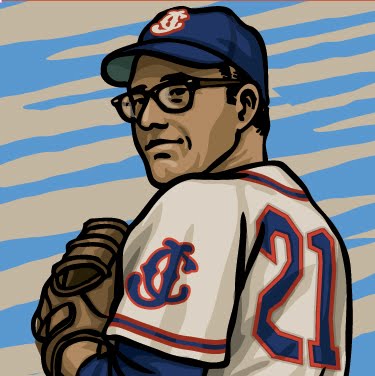


If you haven't guessed by now, I'm always interested in presenting characters and situations in history you normally wouldn't associate with the game of baseball. Without any further meandering, I bring you a story of baseball and the man who saved what remained of Custer's 7th Cavalry in The Battle of Little Big Horn...
Frederick Benteen was born in Petersburg, Virginia in 1834. His family was originally from Baltimore and he was brought up in a thoroughly Southern family which became important when his family moved to St. Louis, Missouri as a teenager. Missouri at this time was a territory in flames - half of the settlers wanted slavery and the other half did not. Many acts of unspeakable terrorism was perpetrated on both sides in the years leading up to the Civil War and identifying oneself with either the North or the South was a matter of both pride and preservation.
After relocating to St. Louis, the young Benteen developed a love for the new game of "base ball." As in New York City, the game appealed to the new generation of young, urban middle-class gentleman of which Frederick, as a professional sign painter, belonged. The strong, athletic young man apparently was pretty good for he played on the city's Cyclone Club, one of the best in the area. The new game was associated with the North, something Benteen's staunch Southern father was against, and to make matters even worse, Frederick went one step further and sided with the Union when war broke out in 1861. In a terrible showdown, the elder Benteen told his son that he hoped the first bullet fired in the war killed him, preferably fired by one of the plethora of Benteen's who were fighting for the South.
With that, Frederick Benteen embarked on a career in the U.S. Army, but base ball was never far away.
Starting out as a 1st lieutenant in the 10th Missouri Volunteer cavalry he quickly rose through the ranks as the list of battles he took part in piled up: Wilson's Creek, Bolivar, Milliken's Bend, Pea Ridge, and Vicksburg. By the time the war ended he was a full-bird colonel commanding the 138th United States Colored Infantry. He was judged by his superiors to be an exceptional combat leader and was offered the chance to stay in the regular army at the wars end. A newspaper article that quotes from a letter from Benteen himself describes him organizing and playing in 3 ball games in one day!
Benteen was reduced to the rank of captain (the officer corps of the peacetime army was very small so everyone was reduced in rank) and posted to command H Company of the newly-formed 7th Cavalry Regiment. The field commander of the unit was the famed "Boy General" George Armstrong Custer (reduced in rank to Lt. Colonel). Benteen, who was older than Custer, did not like him from the get-go. For one, Custer was younger and Benteen considered it a slight to be under Custer's command. There was also a great divide between officers who had been educated at the elite West Point Military Academy and those, like Benteen, who were appointed to officer rank from the civilian world. Their style of leadership was also at odds - Custer was somewhat of a romantic, daydreaming of glorious cavalry charges and dashing knights of old. He liked to think of himself as a gentleman who appreciated the finer things in life and meticulously fussed over his appearance and image. Benteen was more of a modern man, more practical when it came to envisioning warfare and looked not to the past, but to the present, for things to inspire his men: things such as baseball. He was something of a 1870's stud - he had muscular biceps, carried himself with a manly swagger and wasn't afraid to be hands-on.
The 7th Cavalry was as dysfunctional as a unit could be and still stay together. The regiment was divided into 2 camps: those who liked Custer and those who didn't. Those who did were treated to never-ending social engagements sponsored by Custer's wife Libby and it was alleged preference when advancement time came. Custer was also a teetotaler and didn't have much respect for heavy boozers. Being posted to a cavalry regiment on the great plains or the Black Hills back in those days was one long battle against boredom and many officers destroyed their careers because they turned to the sauce in order to cope with the hard and lonely life. Benteen tended to overdue it on occasion, sometimes making a spectacle of himself. Away from his family he also earned a reputation of turning into "Mr. Hands" when intoxicated. In his defense, by the early 1870's he had seen the death of 3 of his 4 children due to a hereditary condition passed down by him, and his beloved wife and surviving son were far away in Atlanta. He was also increasingly at odds with the Custer group that ruled the regiment.
Benteen quickly formed "Benteen's Base Ball Club" which helped not only to satisfy the captain's baseball fix but game helped create a sense of camaraderie and pride that made H Company the 7th best unit. The Benteen's played ball regardless of their surroundings and their captain would invite other local nines to engage his team at every chance he could get. Even in the remote regions the 7th campaigned there was always a small town or group of miners who enjoyed a good game of base ball. Benteen and his boys prided themselves on bringing the game to the most inhospitable places in the west. During the Black Hills expedition of 1874 the team found time to play a few games, making temporary ball fields complete with grandiose names such as "Custer Park" and "Genevieve Park." To underline the fact that danger, in the form of Indians on the warpath, was always near, armed pickets were posted nearby for protection. The games were very popular with the cavalrymen and Custer even grudgingly attended a game. When Company H was rushed east to New Orleans to help quell a race riot in the fall of 1874, The Benteen's made sure to pack their equipment and find time for games with other army teams stationed nearby.
I've been unable to find out exactly what position the captain regularly played. I'm guessing that he didn't participate in actual games at this point in his career. Officers were discouraged from mixing with the enlisted men so he probably held a managerial role with the club. By the time the 7th Cavalry embarked on the Sioux Expedition in the spring of 1876 the Benteen's were known through out the west as a first-class ballclub. A few players were deemed good enough to pursue professional careers when they left the service.
The Benteen's captain and starting pitcher was 1st Sergeant Joseph McCurry. He was regarded as the best player on the team and was due to be discharged in 1877 where he was encouraged to pursue playing the game professionally. Second baseman "Fatty" Williams was another Benteen who was considered good enough to turn pro. Company H's own baseball reporter, Trooper Theodore Ewert, recorded that Williams had signed a contract to play ball for Pittsburgh after his enlistment was up. (Although his name is given as "George Williams," I believe Fatty was actually named William Williams. A look at the company H muster rolls made me draw this conclusion).
However, a little place called Little Big Horn would end that hope for many.
Many better historians can tell you what happened on the Little Big Horn better than I can, so I am going to just give a quick summation as it relates to Benteen. Since Custer and Benteen were at odds much of the time, the Captain was given command of a battalion and told to protect Custer's left flank. Custer and his favorite officers would lead the rest of the 7th Cavalry in a triumphant charge and defeat the Sioux on their own. After wandering around for a few hours a rider from Custer's command delivered a note telling the Captain to: "Come on. Big village. Be quick. Bring packs."
Benteen collected the pack animals that carried the supplies and ammunition Custer asked for and rode off towards where he was supposed to be. Along the way Benteen's command met up with a battalion led by Major Reno. They had been routed by a huge number of Sioux and were taking a beating while loosely defending a hilltop where the retreating troopers had paused. Major Reno had all but cracked under the pressure and it was here that Benteen became a hero.
With the addition of his command, including the formidable H Company, Benteen usurped command and mounted a spirited defense of the hilltop. Coming to the aid of Custer was out of the question - it was all they could do to save their own hides. The attacking Sioux were joined by the Lakota and Cheyenne who had just wiped out Custer and his men. Benteen commanded his men in a 24 hour defensive fight where displayed immense leadership and bravery by leading from the front and making calm, rational command decisions under heavy fire. While Reno hid with the pack horses, Benteen was wounded in the thumb and had the heel of his boot shot off. At two separate time when it looked as if his precarious position was about to be overtaken, he and his troopers turned the tables on the attacking Indians and charged.
Benteen's leadership saved the remaining men of the 7th Cavalry.
Later Benteen would be criticised for not trying to get to Custer quicker and his decision to make a defensive position with Reno rather than charge towards Custer's command was said by some to have caused Custer's demise. From what I have read, I think Benteen acted correctly and it was only his cool actions under fire that saved the entire 7th Cavalry from decimation that June afternoon. I can also field the idea that Benteen's elite H Company, which displayed such a high degree of esprit de corp and discipline during the hilltop battle, was able to hold out against vastly superior numbers due in part to the pride and teamwork drilled into them through the baseball team.
But what became of The Benteen's? The team's captain and pitcher Joseph McCurry was wounded in the shoulder that day and never made it to the big leagues. Likewise future Pittsburgh player "Fatty" Williams was wounded in the hilltop battle and though he lived until 1919, he never appeared in a ballgame with Pittsburgh. Pitcher Alex Bishop's baseball career ended after sustaining wounds on the hilltop defenses and Charlie Bishop was wounded in the arm.
I've been unable to find any other reference to baseball in the 7th Cavalry after Little Big Horn. It's possible to surmise that the game was no longer played after the decimation of more than half the regiment. The once proud unit was now demoralized and I'm sure revenge, not baseball was on the minds of the remaining officers and troopers. Besides, it looks like almost half of the Benteen ballclub was wounded in the battle. Benteen himself remained in the Cavalry although he remained a controversial figure. Custer's wife Libby and her highly placed political benefactors launched a tireless campaign that used every excuse imaginable to shift blame for the massacre from her husband to anyone else and Benteen bore part of this unwarranted slander. He continued to be a talented and brave combat officer and was decorated for his part in the campaign against the Nez Perce Indians. A bitter man, he sank deeper and deeper into alcohol abuse and was suspended for a year after he was convicted of being drunk and disorderly. He retired from the army in 1888 due to rheumatism which he claimed was caused not by 25 years of combat, but by playing his beloved game of baseball.
Among the many references I used for this little piece was Tim Wolter's article in The National Pastime Number 17 called "Bats and Saddles", a great website on 19th Century baseball in St. Louis called "This Game of Games", and James Donovan's superb book "A Terrible Glory."


